Written by Madeleine Chan, Staff Writer, and Paige Riding, News Writer
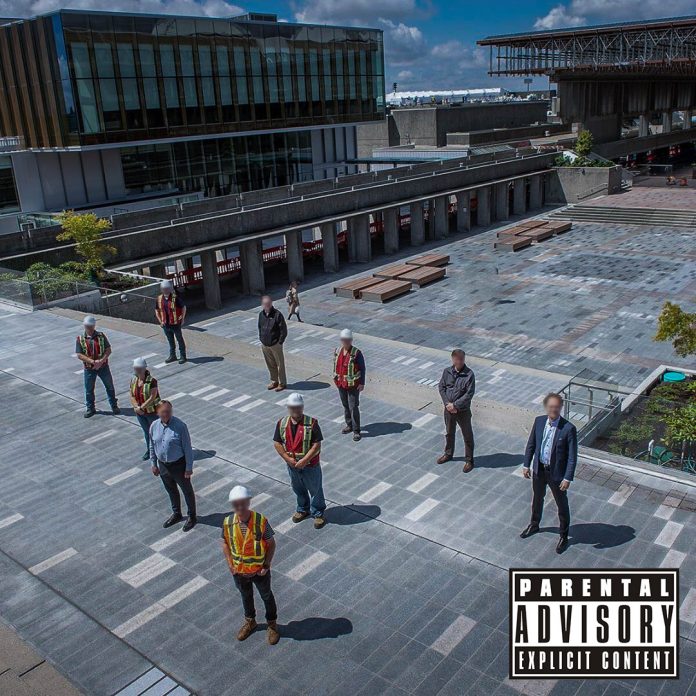
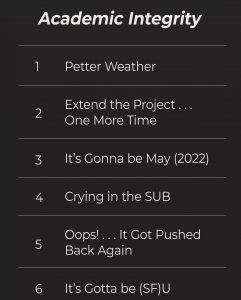
After four years of hard work on the SUB, SFU is releasing their first album Academic Integrity, out Fall 2020 via British Columbia Records.The group announced the project and played their lead single, “Petter Weather,” with an intimate concert for their fans in the unfinished building.
Joss Illfuel, one of five attendees and CEO of Trans Canada Energy Corporation, told The Peak that that the song made him “tear up at the mere mention of it.”
“I was so overwhelmed with the quality and care that went into every detail of the song. It really drilled into my head just how great this mountain is at supporting students, and how lucky they are to attend SFU.”
Academic Integrity is being billed as the “most anticipated project at SFU” and a “masterpiece over seven years in the making” by the SFSS. Lead singer of the band Ken Struckshin told The Peak that the project grew out of their desire to “build something great” for the SFU community.
“We really wanted to give back to the students for all of the hard-earned money that they give us. It’s our way of saying thanks to past, current, and future SFU students for their monetary contributions to the school.”
When asked about the process of making the album, Struckshin said that it was “grueling.”
“Freezing winters, staffing issues, and pandemic precautions all made it so hard to finish the album. One time we couldn’t even get into the studio because it was blocked by a bunch of students trying to get to their classes. It was a nightmare.”
Struckshin clarified that their studio is also located in the SUB.
“It has the best acoustics. We wanted to keep the inside bare and unfinished so that the tracks have that authentic SFU vibe. Empty promises, hollow words.”
Struckshin said that the group is currently planning for their upcoming Engaging the World Tour for when the pandemic “completely” ends and stated that the SUB will be completed “sometime after they get back.”
Academic Integrity is available for pre-order from the SFU Bookstore. “Petter Weather” can be streamed exclusively from the computers in the W.A.C. Bennett Library.
Recently, a Vancouver-based university graduate took to Facebook to describe his regrets about the life choices he pursued during his bachelor’s.
“I just graduated from SFU with honours, and after some heavy self-reflection, I know now that I have no passion for Head & Shoulders Anti Dandruff Shampoo and Conditioner,” says Linden Sightsieve, a recent alum. “I’ve thrown away nine years of my life washing my hair with liquid whitebread.”
According to Sightsieve, he kept using Head & Shoulders not because he truly enjoyed the product, but simply because it was easy for him.
“I’ve never had a hard time with hair, not like other people,” he shrugged, his blond curls dramatically falling and framing his forehead. “So I went for it. Part of me wanted to prove that I had what it takes to get through four years of Head & Shoulders, too.”
Now, however, Sightsieve feels “trapped” by his current shampoo brand.
“I’ve used so much of this bottle already, these past nine long years,” he sighed. “I might as well finish it, right?”
If he were given the chance to do things over, Sightsieve is unsure what he would have wanted to wash his hair with instead. However, he believes he would settle for anything that challenges his creativity while still cleansing his scalp of the stench of actually planning ahead for things.
Ultimately, Sightsieve offered some advice for anyone out there in his position, university students or otherwise.
“Don’t end up where I have, you guys,” he stressed. “Don’t waste your time building someone else’s vision of what a hair-care routine should look like. Don’t commit to a shampoo unless you’re truly invested in it. Just be your own inspiration, and love what you do. Also have enough generational wealth on your side to keep going to school indefinitely and, like, finding your shampoo self.”
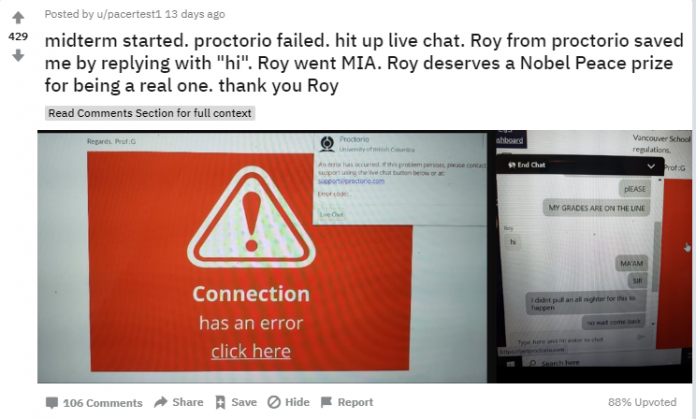
A screen capture of the Reddit post. Screenshot courtesy of Michelle Gomez via Reddit.
Written by: Paige Riding, News Writer
Online invigilation software company Proctorio sparked public privacy concerns when their CEO released chat logs between a student and a customer service representative.
On June 26, a UBC student posted a portion of a chat log with a Proctorio support team member on Reddit, claiming that the representative “went MIA” when the Chrome extension crashed during an exam held on June 10. The photo of the chat log shows the agent responding “hi” to the student’s concerns, and nothing else. Proctorio CEO Mike Olsen later commented on the student’s post under the username u/artfulhacker with a transcript of the full conversation between the student and the agent, showing that the issue had been resolved.
Olsen wrote, “If you’re gonna lie bro… don’t do it when the company clearly has an entire transcript of your conversation.”
With remote learning in place at SFU, many professors are using software like Proctorio for examinations. Some SFU students have already raised privacy concerns over proctoring software.
A Proctorio spokesperson provided the following statement to The Peak via email about the occurrence.
“Normally, a transcript would be impossible to locate since our chat transcripts never include any personal information,” the statement began.
“However, since the student had already posted a portion of the chat transcript on Reddit, our team was able to locate the full transcript utilizing keywords found in the public screenshot the student provided. In the transcript, it was clear that the Support Agent did, in fact, respond to the student and assisted them with the technical issues they were facing.”
The spokesperson said that Proctorio’s Social Media Team responded to the thread with a censored transcript of the conversation, only showing the agent’s responses and timestamps. It was around the time when Proctorio first responded when Olsen was tagged in the thread.
According to the spokesperson, Olsen privately reached out to the student facing technical issues and was notified by the student that the issue was resolved directly with the professor. The response was then removed from Reddit.
“The privacy of students is a top priority at Proctorio. Proctorio would never share any personally identifiable information, of any student, ever. Moreover, Proctorio cannot access any personally identifiable information from our servers, without student consent,” the spokesperson for Proctorio said.
The UBC student wrote in afollow-up Reddit commentthat “the post was initially meant to [be] purely comedic and a display of how much I disliked using Proctorio. I am realizing now, my actions were immature and antagonistic, by proving Proctorio’s malfunction, I was also wrongfully framing Roy as incompetent, as my post was extremely misleading. Which I sincerely apologize on my behalf.”
“However, this also reveals a much deeper issue [ . . . ] Proctorio is notoriously known for being invasive, unnecessary, and as well appears to illegally violate our provincial laws on privacy,” the comment continued.
UBC released aletteron July 3 noting that they will continue to allow professors to use Proctorio in their classes. SFU appears to continue to allow the use of the software.
Award-winning short Hair Love was shown to kick off the discussion on Black hair. Courtesy of Sony Pictures Animation
By: Nicole Magas, Opinions Editor
On June 30, SFU Students of Caribbean & African Ancestry (SOCA) hosted Black Hair in Focus: The History and Politics of Black Hair, a live online discussion on how Black hair has been coded, stigmatized, and valued throughout history. As a silent observer in the discussion and someone who has never faced discrimination over, nor pressure to change the appearance of my hair, this discussion was incredibly informative and eye-opening. The histories and personal stories shared were both tragic and triumphant, and the inner socio-political complexities of something as benign as natural hair were laid bare in frank, honest discussion.
The conversation opened with the stated goal of using the space to embrace Black hair. In setting this tone, the workshop audience viewed the animated short film, Hair Love. The film is about a little girl’s foray into the care and styling of her Black hair on her own ahead of a visit to her mother in the hospital. The story gradually reveals just how important the success of this endeavor is to her, as she and her mother have a strong bond created through her mother’s hair-styling vlog. Though it takes effort, patience, and “a whole lot of love,” she and her father eventually pull off a successful style and go to the hospital. There, the viewer learns that the mother has lost her own hair, presumably due to cancer treatments.
Even on the third viewing this short still makes me cry like a baby. But more than its emotional impact and gorgeous animations, the film subtly expresses some of the key issues Black hair — in particular, natural Black hair — has faced throughout history. The scenes where the hair comes to life and literally wrestles with the characters can be interpreted as a “wrestling” in double consciousness of physical characteristics and individual identity, against the external gaze and prejudices of society. Similarly, the shame, disappointment, and defeat expressed in the temporary decision to hide the messy hair under a cap represents having Black individuality and Black beauty subordinated, shamed, and devalued by white, Eurocentric standards of aesthetics and respectability. The decision to open the Black Hair in Focus event with this short was therefore brilliant in not only starting on a bright, colourful, and emotional note, but in setting the stage for the topics and conversation to follow.
Guiding the discussion was a slide presentation covering three overarching topics: history, resistance, and the Modern Natural Hair Movement. Interspersed between historical facts in each category were media clips and calls for reflective sharing of personal thoughts or stories, which made for an engaging delivery.
Understandably, the event discussion dealt with the history of colonization and slavery, particularly how Black hair has always been positioned as a political focal point in the oppression, resistance, resurgence, and celebration of Black lives. Examples were given of how shaving Black hair was used as a means of cultural genocide, as well as how the thickness of hair was used to test racial purity. Discussions frequently centred around what sort of signals natural Black hair gives in societies where white values are coded into the desirability of some aesthetics over others.
One participant shared, “I’m from Zimbabwe [where] the school system [ . . . ] follows the British school system and that includes rules, code of conducts, and how to wear your hair [ . . . ] I grew up thinking that my hair was sub-par and my true texture needs [sic] to be hidden.” Conversely, stories of solidarity, self-love, and empowerment in taking pride in one’s natural hair were also shared and celebrated.
Most striking to me was the discussion around what constituted “good” Black hair, and whether this entailed straightening it or letting it appear natural; whether it meant always having full, thick hair, loving the hair one has, or even augmenting hair. The general consensus of this discussion was that there is not “one” way to have or express “good hair.” The similarities of this idea with that of there being no one way of being a “good woman” in a feminist perspective really resonated with me, and made me feel more connected with the perspectives being expressed.
One thing not covered in this event was a more thorough discussion on how Black hair is cared for and maintained in its many presentations. Fortunately, SOCA is planning another event on this very topic, and I look forward to being an observer in that workshop as well.
Monday Music: your weekly themed playlist. Image courtesy of The Peak.
By: Marco Ovies, Editor-in-Chief
Fans of The Peak (or as I like to call them, Peaklings) will remember that I wrote a Monday Music about my coming-of-age soundtrack. It wasn’t until I saw it in print that I realized every single artist I had included was a white male. White men have been telling me for long enough what to do and quite honestly I’m not sure I want them controlling my coming-of-age soundtrack. So consider this my coming-of-age soundtrack 2.0.
“Nobody Cares” by Superorganism
Courtesy of Domino Recording Co Ltd
This is the song that I wish would have come out when I was in high school. It is the perfect song to play as you (the main character) rush out of bed in the morning late to school. The credits roll over as you alternate between slamming your alarm clock, brushing your teeth, grabbing your clothes, and grabbing that one slice of toast on your way out of the door. What makes Superorganism such a great band is their combination of really mundane sounds (like a bottle of soda, a bucket of water, an apple, and a toy car, to name a few) incorporated with heavy synths. If you get a chance to watch their NPR Tiny Desk Session I would highly recommend it.
“Burnt Houses” by Sam Truth
Courtesy of 1146804 Records DK
This song is for the montage driving moment where you stick your hand out the car window and do that “Just girly things,” feeling-the-air-between-your-fingers thing from Tumblr (do people still use Tumblr?). You might be out driving with your friend, or maybe your crush. I always envision it as you driving home from a really good date with a person that the audience just knows is not good for you. They might scream and throw popcorn at the screen, but you don’t need to worry about that. No good coming-of-age movie breaks the fourth wall like that (and yes that includes Ferris Bueller’s Day Off, fight me).
“Floors (feat. Foster Cazz)” by Abhi the Nomad
Courtesy of Abhi The Nomad
This is the song that I should have put for the party scene that I mentioned in my previous Monday Music. Even though your coming-of-age movie got enough money for a sequel, the studio still can’t afford the rights to a Drake song. Don’t worry though, ‘cause all the cool kids in your high school definitely listened to alternative music and not the same three generic rap songs over and over again.
“Pluto” by Phum Viphurit
Courtesy of Rats Records
This song is for the slow dance with your crush where you finally kiss. You spent all of senior year stressing about how to ask them and here you are, dancing in the middle of the room. The camera zooms in close as you say something super cliché or reference something from the beginning of the movie that you know the audience will eat up. Meanwhile, at my high school prom I went stag and the closest thing to a slow song they played was Macklemore’s “Thrift Shop.” If anyone is looking to recreate that moment to this song my emails are always open.
Existing symptoms of anxiety and depression are worsening under COVID-19. Photo: Maxwell Gawlick/The Peak
By: Nicole Magas, Opinions Editor
A global pandemic is not a good time for anyone. Even those of us of the introvert persuasion are now looking at our four walls and wondering when it will be safe to have unrestricted interactions with friends and family again. And yet, as we start to settle into a “new normal” of face coverings, social distancing, and terrified Google searches at the onset of any cough or sore throat, it’s worth taking the time to shore up our emotional and structural defenses against the coming tsunami of mental health problems that is the inevitable result of this epoch of global upheaval.
Even as BC has seen a flattening of the COVID-19 curve, the pandemic continues to rage on elsewhere in Canada and around the world. The World Health Organization reported its single largest daily increase in cases on June 22 — a whopping 183,020 new reportedinfections. These new cases add to the strain already caused by the virus: the stress on healthcare systems, the loss of employment, economic stagnation, loss of social support systems and, of course, loss of life. Even the ever-growing number of questions around how the virus operates within the body is a source of continuing stress, with some patients experiencing debilitating symptoms months after the virus is undetectable in their systems.
All of these compounding stressors are a problem, not only in the immediate moment, but also in the long-term ramifications on collective and individual mental health. We are currently in the “active trauma” stage of this pandemic. We are focused on the immediate problems in front of us: how to keep ourselves and our loved ones safe, while also guarding against complete economic collapse and the inability to support ourselves. But dealing with trauma can only be pushed back so long. Eventually that bill is going to come due, and many, many people aren’t going to have the support they need to get through the coming crisis.
Just before COVID-19 came to Canada, mental health care was still somewhat of a grey area in this nation. Data on wait times to receive care for mental health issues wasn’t available for many regions, making necessary funding initiatives difficult to assess and allocate nationally. Of the data that does exist, patients seeking care could expect to wait for over a year to have their specific needs addressed, depending on where they live.
These disparities and holes in data are worrying for the same reason that an unrestrained viral pandemic is worrying. If a huge number of people suddenly need mental health services to get through the onset of months of stress, anxiety, and depression, there is a very good chance that these needs will overwhelm our current mental health care capacity — especially where we don’t actually know what that capacity is. What this means is that people with existing mental health problems may find it more difficult to access services with increased strain on the system, while those who are experiencing a mental health crisis for the first time may not have access to the resources needed to identify, nor the counselling needed to address, these new conditions.
There is no doubt that while we are still wrestling with COVID-19, resources must be funnelled into helping our communities stay safe and healthy. However, as the immediate scramble to get a hold on the virus seems to be over (at least in Canada) now is a good time to start directing resources toward the future aftermath of the virus. In particular, both provincial and federal governments need to take steps to assess their current mental health care capacities, and the projected increase in care needs post-COVID. Additional resources need to be subsequently allocated into areas specializing in anxiety and depression counceling, as well as suicide prevention.
The SFSS summary in “The COVID-19 Pandemic & the Student Experience” reports that nearly 50% of students have experienced worsening mental health as a result of the pandemic. It also states that only 10% of students have accessed the mental health supports available to them as SFU students, even though 75% know that they exist. While in the immediate moment these statistics show a worrying disparity between care needs and accessing care, at least we have an idea of where we can improve.
We won’t be completely done with COVID-19 once the virus itself leaves us. We need to start preparing now to deal with its aftermath so that we won’t be scrambling again to keep up with another emergency as it is unfolding.
Aries: This week, try stretching your body each morning. Sure, stretching has countless health benefits, but I’m mostly telling you to do this because you only ever stretch yourself thin figuratively. Help your hamstrings.
Taurus: Don’t forget to wear sunscreen this summer. I know it leaves your skin feeling oily, but nothing is more painful than damaged skin, except the hurt you feel from Pokémon not announcing a Sinnoh remake this year.
Gemini: This week, try revamping that old t-shirt chilling in the back of your closet. Tie-dye? Too messy. Purposeful tearing or chopping? Too dangerous. An accidental soup staining? Tasteful. Innovative. Brilliant.
Cancer: Try drinking more lemon water this week, Cancer. It’s cloudy and leaves a sour taste in everyone’s mouth. Just like your sense of judgment.
Leo: If you’re touch-starved this week, just spend your time waiting for your leftovers right in front of the microwave. You’ll get a warm, fuzzy feeling inside as the radiation reaches your heart faster than any significant other ever could.
Virgo: This week, buy a Roomba. Your home will feel tidy, just how you like it. And even if the worst case scenario happens and the vacuum becomes self-aware, at least you’ll have a friend who actually knows how to pick up after itself.
Libra: When’s the last time you read for fun? Are all the young-adult books tastefully broken up by a few classics on your bookshelf getting dusty? It’s alright. You can read two pages of a class’s reading and call it a day. Maybe just dust off the Suzanne Collins for your own health.
Scorpio: When you zone out during your online lectures this week, try shifting your focus from your phone to the amount of dust on your keyboard. It wastes just as much time and makes you just as uncomfortable. But you’re your computer’s only subscriber, and it’s lonely.
Sagittarius: This week, try reading under a tree. You’re used to being a victim of things throwing shade. Grow up and turn it around to benefit you, just like grown-ups commodify every other life experience.
Capricorn: Why do people try calling you after you text them? You have places to go, people to see, the self-esteems of some water signs to destroy. It ain’t much, but it’s honest work.
Aquarius: What summer fashion trends are you rocking this year? I bet a practical yet stylish pair of pale Vans would look great with your constant scowl.
Pisces: If you still have it, go listen to your old music player from when you were younger. Replaying the classics from middle school will give you the best of both worlds: a recollection of every single embarrassing thing you said or did at that time and the exhausting cynicism you have today.
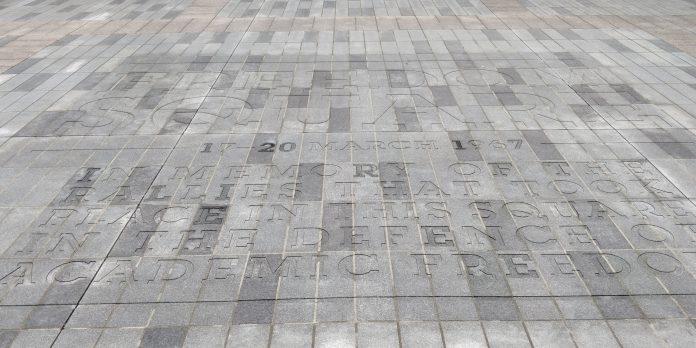
Engraving in tiles in Freedom Square, installed June 2020. Photo: WeiChun Kua.
Written by: Michelle Gomez, News Editor
The plaque that once stood in SFU’s Freedom Square, in commemoration of protests that took place in 1967, has now been engraved into the new tiles in Freedom Square with different wording.
According to SFU’s Chief Facilities Officer Larry Waddell, the original plaque, which is attached to a podium, was removed in October 2019 due to construction, and has since been stored in the basement of Maggie Benston Centre.
The initial plaque read: “FREEDOM SQUARE. SO NAMED IN COMMEMORATION OF THE RALLIES HELD HERE MARCH 17–20, 1967 AND OF THE STUDENTS, TEACHING ASSISTANTS, AND FACULTY WHO GAVE OF THEMSELVES IN THE CAUSE OF ACADEMIC FREEDOM.”
The current engraving reads: “FREEDOM SQUARE | 17-20 MARCH 1967 | IN MEMORY OF THE RALLIES THAT TOOK PLACE IN THIS SQUARE IN THE DEFENCE OF ACADEMIC FREEDOM.”
Simon Fraser Student Society (SFSS) Science Representative WeiChun Kua noticed the engraving on the ground in mid-June. Kua stated in a Facebook post that the new wording is “a total erasure of history and unity in the SFU community to stand up to SFU Admins.”
In a follow-up statement to The Peak, Kua said specifically that the wording that includes “Students, Teaching Assistants and Faculty” is important to “maintain the context of the solidarity against the Board of Governors/SFU Admins.”
Assistant Director of SFU Communications & Marketing Marianne Meadahl told The Peak via email that the engraving of the writing was intended to “enhance” Freedom Square. “Removal of the weathered podium cleared the square for ease of movement of activities,” wrote Meadahl.
She also noted that the wording on the podium “could be interpreted as implying loss of life in its initial description.” Particularly, this is referring to the wording: “who gave of themselves in the cause of academic freedom.” Meadahl stated that the new wording was approved by SFU administration and a representative of the SFSS.
SFSS President Osob Mohamed told The Peak that although the wording was approved by an SFSS staff member at the time, the SFSS “would like to re-open the conversation to reinstate the wording that reflects on the solidarity between students, teaching assistants, and faculty members.”
With regard to the original plaque itself, Waddell told The Peak that there had been discussion with the SFSS about displaying it in the new Student Union Building.
Former SFSS President Giovanni HoSang said that this issue was not brought to his or the VP University Relation’s attention, noting that the issue “seems to have fell through in communication within the management structure that [the SFSS] had.”
Mohamed said that she does not believe that this was intentional, but was rather the product of miscommunication. She added that the SFSS would “like to see the plaque returned to its rightful home in Freedom Square.”
Background and context
In 1967, five SFU Teaching Assistants (TAs) signed an open letter to the students of Templeton Secondary School asking them to support their fellow grade 12 student, Peter Haines, who had been expelled for writing and distributing a book of poetry that criticized a student and teacher. The TAs (John Edmond, Chris Huxley, Martin Loney, Jeff Mercer, and Phil Stanworth) were subsequently fired from their TA positions.
Chris Huxley, one of the five original TAs that was fired, recalled the experience in a recent interview with The Peak. “It was quite an innocuous thing he did [ . . . ] He criticized the way English literature was taught at that school.”
Huxley explained that the group of TAs had heard about the expulsion through an article in the Vancouver Sun. In response, they wrote a letter back to the Vancouver Sun, all five of them signing it. On Monday March 13 1967, Huxley and some of the TAs protested in front of Templeton Secondary School and distributed leaflets to Templeton students.
By the end of the week, the five TAs were fired from SFU, via telegram.
“The reaction was far beyond our expectations,” said Huxley. He added that he had moved to Canada from England with the promise of the TA position as a source of income.
“It wasn’t like it was a sidelined source of experience or some money, it was our only means of livelihood,” he stated. “To be fired without any due process or warning was quite a hit.”
“Students of both Simon Fraser and UBC got very concerned,” Huxley said. Additionally, Tom Bottomore, who was Head of the PSA Department and Dean of Arts at the time, resigned as the Dean of Arts in protest of the firings.
Between March 17 and March 20, thousands of SFU students and faculty members held a sit-in protest in Freedom Square in support of the TAs.
Huxley noted that these protests took place in “the era of the so-called teach-in.” He explained that those involved would encourage both sides of any argument to speak. During this particular protest, there were not many people in favour of the SFU administration, “but if there was somebody, we would almost encourage them to come forward.”
Reflecting on the experience, Huxley recalled that “people had enormous interest and patience to listen to many speeches. These rallies would go on for hours, it was quite amazing.”
Eventually, the Board of Governors met to consider appeals by the TAs. According to Huxley, hundreds of students went into the administration building and waited in the halls outside the meeting, threatening to strike if the firings were not overturned.
The firings were overturned and the TAs were reinstated.
Huxley noted that the two key issues being addressed in the protests were free speech and academic freedom. He believes it was part of the bigger Free Speech Movement, that was spreading across the world and burgeoning on the West Coast at the time. In the context of the Vietnam war, apartheid in South Africa, and the Civil Rights Movement, students engaging in and protesting for free speech was becoming the norm.
History of the plaque
The commemorative plaque was purchased by the SFSS in the Summer of 1967, and was initially installed on September 11, 1968 after over a year’s delay (due to various bureaucratic processes of SFU administration). It was stolen the next day by UBC engineering students, and was substituted by a replica plaque with the wording ‘Fool’s Square’ replacing ‘Freedom Square.’ According to a 1968 edition of TheUbyssey, four students were seen running from the scene in the early morning of Thursday, September 12. An anonymous letter was allegedly sent to The Peak referring to the incident. The Peak did not disclose the contents of the letter.
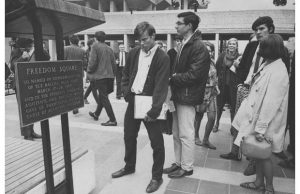
The original Freedom Square podium installed in 1968. Photo courtesy of SFU archives.
The plaque went on to spend several years in the trunk of someone’s car, and eventually made its way to a UBC fraternity house. It was later used as a TV stand for a UBC alumnus, who eventually returned it to SFU in 1990 when he became aware that SFU was looking for it.
The plaque then disappeared again, and was discovered years later by student Amanda Camley in 1999 in an SFU administration office. The plaque was reinstated in Fall 2000, only to disappear again shortly after.
It was then found in 2014 by the SFSS, in a storage space under a staircase in Convocation Mall. Facilities services told the SFSS that it had been there for at least 10 years. The plaque was returned to Freedom Square in October 2014, where it remained until Fall 2019.
On the wording of the new engraving, Huxley said, “I can see that [people] might be concerned that it is diluting the original inscription.” He added that he did not recall the plaque being put in place, nor the initial theft of the plaque.
“My memory of the late 60s was that we didn’t pay that much attention to the plaque at the time [ . . . ] I can see that if it’s etched into the stonework, it’s less likely to be stolen. There’s pluses and minuses I guess.”
SFU’s sports teams have made several attempts to subtly distance themselves from their team name. Image via Wikimedia Commons
By: Devana Petrovic, Staff Writer
It’s no secret to the SFU community that our athletics teams are represented by an embarrassing and dangerously misleading name: “The Clan.” Meant as an homage to SFU’s Scottish roots, the name is more ubiquitously associated these days with the Klu Klux Klan (KKK), especially when teams travel to the US.
Although athletes and professors have been speaking out against the name’s racist undertones for years, only now, in the midst of a conversational eruption on racialized violence, has the gravity of the name been given serious consideration by the university administration.
The Clan may appear to be “just a name” with an unfortunate connotation to some. However, for SFU’s Black students, athletes, and the teams they play, it is a harmful and direct call-back to the violent racist regimes that have enabled and allowed for the continued dehumanization of Black and brown people over multiple generations. When it comes to basic safety and respect of students’ lived experiences, SFU should be prioritizing students above all else.
Black students at SFU have once again, in recent weeks, expressed the frustration of playing under a name that carries the connotation of being subordinate to white people. Mason Glover, a football player and student at SFU, expressed the difficulty of representing “The Clan” when, as he put it, the name is“the same name as someone that is out to kill you.” What Mason is referencing, of course, is the KKK.
The KKK — an organization purely aimed at erasing Black people and establishing white supremacy — has a well-documented legacy of brutality and racist mass-murdering. But it’s important to remember that even though the group is most often associated with the US, Canada is not exempt from a history of racialized violence; the KKK made an appearance here as well. While many Canadians have the privilege to simply ignore this history, any reference to the KKK — including having “clan” in a team name — is a painful reminder of this legacy to our Black communities.
Which is why it is so important to seriously reevaluate the necessity of the words and titles we institutionalize. When taken outside of history, “clan” is as benign as any other word. Unfortunately, words don’t exist in cultural vacuums. They adopt associations and meanings that must be accounted for, even in situations where those allusions aren’t intended. Frankly, I and many other students find it impossible to hear “The Clan” any differently than its racist connotations to the KKK. Isn’t it considerably shameful for an institution to maintain a name that demeans the very existence and excellence of its Black student body? The bare minimum for any university, especially one that claims diversity and acceptance, is to ensure all of its students feel equally safe.
And let’s be clear, this is absolutely a safety issue as much as it is an issue of basic human respect. Instances of harassment are widely known to have occurred, even to the point where Black student-athletes have experienced racist remarks — Glover described recounting instances of mockery from other teams’ athletes when travelling in the southern United States.
Doreen Anane-Bediakoh, a student-athlete playing for SFU’s soccer team, expressed how she feels like the name “has allowed for people to be offensive because it has given other people the ammunition, the power they need to attack Black folks.” She explained how being affiliated with a name that historically undermines the existence of Black people has destroyed any attempts at claiming Black self-empowerment.
Up until very recently, attempts to change the name have all failed. Glover spoke on how just last year, there was a survey that went out in which a majority of athletes expressed a desire for a name change; SFU, however, “ran out of time to address the issue further.” He further noted how shortly after, word went out that “alumni and donors were threatening to withdraw funding from our athletics program” because a name change would be, as quoted from an anonymous alumni, misappropriating “the Scottish heritage of Simon Fraser.” If this is true, the human dignity that has been sacrificed in exchange for money is grotesque and embarrassing.
Ultimately, there is no room for “school pride” when that school insists on a name that brings its athletes feelings of discomfort and shame, evokes ideas of terror, and mobilizes racist commentary against the very athletes who carry our sports teams. Even though SFU has formally announced its commitment to dropping the name, it is important that actions follow these promises and that the collective action of students, athletes, coaches, and professors doesn’t become another “thing of the past.”
To further engage in activism on this topic, check out Othniel Spence’s article on the name’s impact on Black athletes. There is also a GoFundMe you can consider donating to, and an email template you can fill out and send to administrators.
Every day, I got chills taking the 145 bus up the mountain and reaching the peak. See the uninviting concrete façade. See the sports field, the one that has too much money invested into it. It was like starting your day with a cold shower, giving that nice kick to your adrenals, but also paralyzing you with fear of another day at school. What a rush.
To remedy this longing for our school atop a glorified hill, I’ve started changing things around my home to bring more of that good ol’ au de engage into my life. For starters, I bought cans of SFU’s patented “Student Blood Red” paint (Pantone 19-1557 TCX, for your reference) and slathered it all over my walls, floors, Scottish Terrier — you name it, it’s been covered. I really wanted to be able to see red everywhere I go, just like I often do on campus.
I have also not cleaned my room in three months (totally on purpose) so I can navigate the accumulating debris with increasing difficulty. Getting up in the morning to turn my alarm off on the other side of my room feels just like trying to get from Blusson Hall to WMC in 10 minutes. I also order takeout for every meal so that my bank account gets drained as fast as it does when faced with two sushi rolls at Mackenzie Café.
Unfortunately, my home wasn’t built in 1965 and doesn’t have asbestos lurking under its bland walls, so I have to huff the fumes from the otherwise unused Sharpies I bought in first year. You know, to have the same detrimental effect on my health. The SFU experience also wouldn’t be complete without inviting the RCMP into my home to set up a career fair booth. This is where I truly experience that colonial dissonance that SFU radiates.
Though, all of these attempts come nowhere near close to the real deal. Nothing I’ve tried can replicate the sickly sweet smell of the improperly sorted four-stream waste bins or the almost post-pubescent fear radiating off of a gaggle of high school students on a tour with their unusually excited parents. I don’t know how to deal with the fact that one of those groups may never stare at me like scientists studying a wild animal again.
I’m laying in bed now to try to process this loss. I’m starting to see shapes. They’re round, no, oval. They swirl around my vision, clouding my artistic judgement, making me believe that Arthur Erickson is a bad architect. Then, they merge into one, unusually upright statue: the avocado. I stare into the endless hole where the pit should be and think about if you can get avocado toast somewhere on campus, and feel sad that I can’t check. All I can do now is surround myself with these pitiful fleshy avocado replicas and daydream of a time where I can almost fall into the reflection pool on my way to see the real one.