Home Blog Page 419

LETTER TO THE EDITOR: There are other solutions to policing problems other than abolishing the police

0
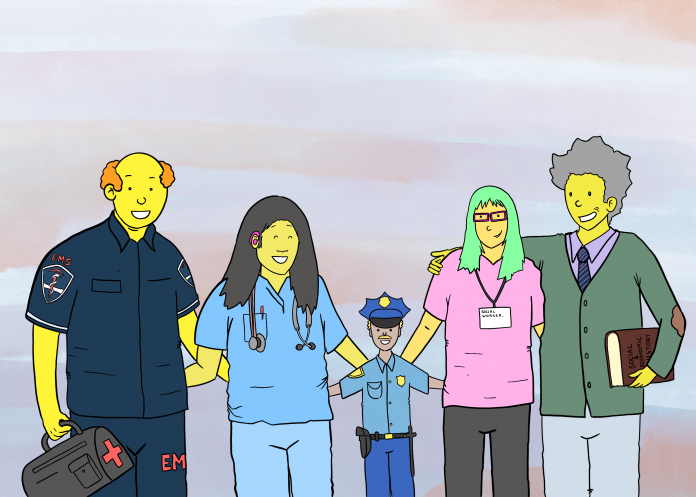
The police should be just one small part of a larger community protection service. Illustrated by Reslus/The Peak.

Dear Editor-in-Chief,

Recently, The Peak published an editorial covering the debate surrounding policing in Canada, and whether the institution needs to be abolished or reformed. There’s no question that we have a problem with policing — namely the lack of accountability and the no-holds-barred approach the police have to even minor issues. While I agree that reform alone is not the answer, it is imperative that a deeper dive be taken into this issue — one that outlines alternative solutions to dissolving the police entirely.

Demands to completely abolish the police have at their crux the argument that policing is an institution of violence, and thus beyond reform or repair. It is a demand raised out of genuine, long-standing frustration with police brutality and abuse of power. However, it does come with a key problem: if the police are completely eradicated as an institution, what are they replaced with?

As of 2013, the Vancouver Police Department (VPD) has over 1,500 employees. Federally, the RCMP has over 30,000 employees. When taken as one institution, law enforcement is one of the largest employers in the country. Calls for complete abolishment essentially mean that all these workers — in uniform and otherwise — would be out of work, a prospect that police unions will (and should) fight bitterly.  

There is also the public safety side of things, with legitimate concerns around response to violent crimes. It is true that a large part of the time, police officers respond to issues such as noise complaints, traffic citations, and other non-criminal matters. Having said that, simply because responding to violent crimes is not what an officer does on a daily basis does not mean that violent crimes don’t exist. The public should have a police force to protect them in these rare cases.

Complete abolishment, thus, is not the solution. The example of Camden, New Jersey is frequently used to highlight “successful” abolishment. Prior to its sweeping changes, Camden’s violent crime was high and police brutality worse. There were 37 complaints of brutality at the hands of police in 2011. Since the police reforms, violent crimes have dropped 42% according to data provided by the department, and the crime rate itself has dropped considerably. The general public’s perception of the police has improved radically too. 

However, one needs to remember that Camden has a population of under 100,000, and in turn has a different law enforcement dynamic compared to much larger cities in the US and Canada. Also, and more importantly perhaps, the police force in Camden was not eliminated completely. They only changed the way policing took place, via retraining staff and putting new policies in place. So even if cities in Canada were to implement the same changes as in Camden, there is no guarantee that the results would be the same.

What is the answer to the police problem then? Defunding, for one.

Regardless of where we are in the debate, we can all agree that police departments across Canada are grossly overfunded. As reported by Statistics Canada, over $15 billion was spent in this country on policing in 2017–18, an increase of 2% from the prior year. At home in Vancouver, the city allocates $314 million to the VPD. This is an increase of $100 million over the last one decade.

Defunding these departments even by 50% would maintain the ability to respond to violent crimes and would also result in the availability of substantial funds for other essential services. However even a small decrease of 10–20% would be substantial. A shift in funding to public servants such as mental health responders, addiction professionals, and outreach support workers would be a critical cog in the solution to the policing problem. 

Not only are these professionals better equipped to address mental health and addiction, but they really should be the first people to encounter calls for help from people going through these crises — not the police. Examples such as the recent murder of Ejaz Chaudhry in Ontario, and the abuse suffered by Mona Wang and Shanna Blanchard in BC — all during police wellness checks — come to mind. 

None of what I have proposed is intended to deny that systemic racism exists in our policing institutions, however it would be incorrect to say that every police officer on the force has racist views. Furthermore, we need to acknowledge that at the end of the day, everyone in a police force is a worker doing a job. The political left has historically fought for both civil rights and workers rights. This case should be no different. Officers who are guilty of homicides, assault, and abuse of power should absolutely be prosecuted, but complete abolishment of the force creates more problems than solutions. 

The focus of solving the policing problem should not be on eliminating the force altogether, but to bring it back in a new form that preserves the jobs of those who deserve them, as well as ends the violent practices too often made against the general populace.

Sincerely,
Salman Zafar
SFU Alumnus

What I learned about navigating relationships during COVID-19

0
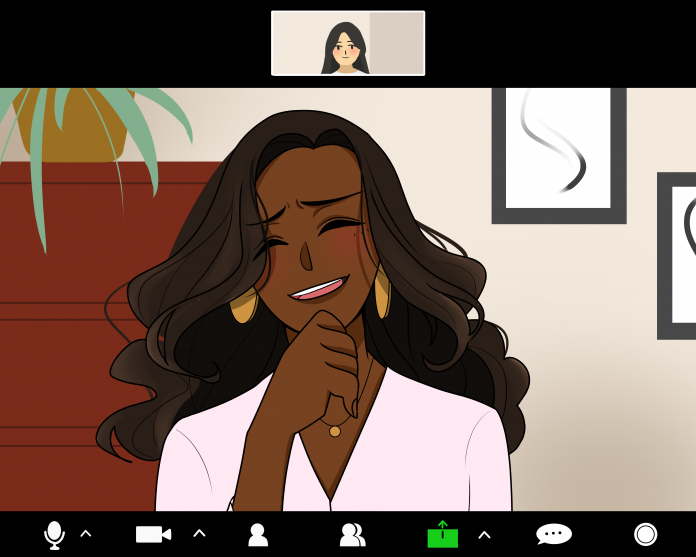
Illustration: Out On Campus

By: Winona Young, Peak Associate

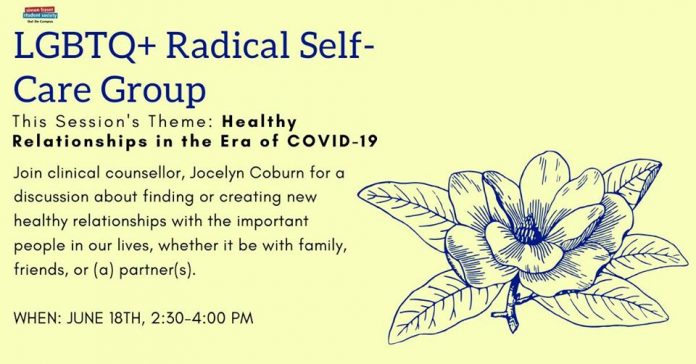
I’m not sure if therapy can count as a special interest, but if I see any article or event that involves self-improvement or healing as the focus, my reaction is usually of dorkish excitement. So when I learned that SFU Health & Counselling was collaborating with Out On Campus on a series of workshops focused on LGBTQ2+ radical self-care, I was all in. The workshop I signed up for was called, “Healthy Relationships in the Era of COVID-19” wherein individuals would talk about how to forge a healthy relationship with friends, family, and partners during the pandemic. 

For the sake of confidentiality of other people in the workshop, I will focus on my own personal experience as well as the experience of other participants who have consented to sharing their answers. Amongst them was SFU clinical counsellor Jocelyn Coburn, the organizer of the workshop, who I interviewed via email afterwards on why she began these workshops with OOC.


IMMEDIATELY INTIMATE

After completing a consent form confirming my registration for the workshop itself, I received a Zoom link and I immediately felt some  anxiety on what the workshop would look like. My worries melted away when I logged into the Zoom conference room and heard laughter along with welcome wishes.

We began the workshop by stating our names, pronouns, and which relationships of ours were most affected during COVID-19. I was struck instantly by how much honesty we had to indulge right away. But our cozy group stepped up; Ashley Brooks  (Out On Campus’ Director) spoke about how the relationships he felt were most affected were with his partner and friend group. Jocelyn spoke about her relationship with her live-in partner and her parents. I spoke on how throughout COVID-19, I felt my relationship with myself and my friends felt strained. 

When I asked Jocelyn later why we should focus on relationships for this workshop, she remarked on how important it is to focus on relationships other than romantic ones. She hoped that through this workshop, individuals could feel a sense of community by connecting to others in a virtual space.

“Hearing your experiences reflected back from others is so empowering,” she said. “Feeling connected and heard is so foundational to healing!”


GVING MYSELF COMPASSION

Ashley mentioned earlier how in pre-COVID-19 times, he felt the need to be ‘go-go-go.’ I replied with the emotionally articulate, ‘mood,’ and expressed how one problem I felt was scheduling with friends and myself. I shared with the group that even during COVID-19, I made plans like crazy to 1. keep busy, and 2. fill the frightening silence of my empty apartment. 

I expressed how I felt guilty with my long stretches of unproductivity and irritation with friends after an hour or two of calling, even though in pre-COVID-19 times, friends and I would hang out from lunch ‘til sundown. I asked if anyone else was feeling this kind of guilt. While I am spending hours upon hours of time with myself these days, and have a glutton of free time theoretically between online classes and errand running, I feel relieved to hear my friends cancel call plans. While scheduled calls were initially a comfort to me, they now felt like a burden. Time by myself now didn’t feel like my own.

While others told me they couldn’t relate (oof), they recommended that I practice being compassionate to myself. It honestly felt comforting being told by relative strangers that I needed to be easier on myself while they reminded me that pre-COVID-19 rules don’t apply these days. In my journal, I scrawled one participant’s response which was: “It’s very taxing to be alive.” 

“COVID-19 is putting stress on not only us but our relationships! It is OK to acknowledge that your emotional needs may be very different […]”

SETTING DIFFERENT BOUNDARIES

When I asked Jocelyn what one thing she wanted individuals to walk out of the workshop with, she replied with a very helpful reminder: 

“It is OK to acknowledge that your emotional needs may be very different during COVID-19 and you can adjust your boundaries accordingly,” she wrote. 

“Practically speaking, this means you may have less capacity to meet others needs right now because just existing is taking a lot of energy.”

A common problem that Ashley and Jocelyn expressed were their difficulties maintaining boundaries. Given that both of them live with other people, they both felt home situations felt strained at times by constantly being with each other. While I’m currently living with a relatively quiet roommate, I told the group how I felt pressured to constantly hangout with friends online. I asked others if they felt that difficulty of feeling tired with spending virtual time with others, i.e. what I’ve termed, “Zoom fatigue.” Others agreed that scheduling in social time even with their roommates felt different because ‘alone time’ was virtually non-existent, even if doors were closed. 

Jocelyn remarked that for individuals living with others, managing physical space was important. She emphasized that there was a difference between coexistence and cohabitating. While coexisting meant simply being in each other’s presence constantly, cohabitating meant intentionally spending time with others in different contexts and spending time with yourself at home were different. Intention, she reasoned, was important in setting important emotional and physical boundaries, whether it was with friends online or people you’re living with. 


PRACTICING MINDFULNESS 

By far one of my favourite parts of the workshop was when Jocelyn walked us through a mindfulness exercise that she researched online

It was surprisingly easy to do a guided meditation via Zoom. Jocelyn told us to begin by physically rooting ourselves to the ground, like having both feet placed on the floor. We were told to think of something we were having difficulty with for relationships, and while COVID-19 hadn’t impacted my relationship with my partner, I thought of how jealous I felt when they would mention their ex. Jocelyn then asked to observe our feelings — for me, I thought, “I feel jealous, I feel stupid, I feel irrational, and I feel so small.” 

She then asked to acknowledge the difficulty of our feelings, and think to ourselves, “This is a moment of suffering,” which felt cathartic to admit to myself, and helped me be more accepting towards myself. The next step then was to establish a comforting touch to oneself, like placing one’s hand over heart, which Jocelyn mentioned felt too intense for her so she would hold her other hand. And once we would be holding ourselves, she would tell us to think of our problem, and then ask ourselves, “Can I be compassionate to myself? Can I be kind to myself at this moment?”

I remember the exercise feeling very intimate and calming; and at the time of writing this, after being upset by violently triggering content, repeating this exercise helped ground me. Asking myself to feel compassion for myself made me feel peaceful, more in control of my problem, and less overwhelmed. 

FINAL WORDS (LITERALLY)

We ended the workshop by going around the group and summarizing the workshop in one word and why. Ashley chose his word to be ‘compassion,’ while Jocelyn chose ‘learning’ as hers. I chose ‘intention’ as mine. I wanted to remind myself that whether or not it’s interacting with others, or even noticing how you talk with yourself in times of stress, it’s important to be mindful and interact with others with intention. While it was definitely an emotional and very introspection-heavy way to spend an afternoon, this workshop was definitely worthwhile.

For more information on workshops provided by Out On Campus, visit SFU’s Health & Counselling’s tab of Support Options for LGBTQ2+ students. The next workshop, “Finding Community and Boundary-Setting Online” will be held on July 2.

My experiences with dating during COVID-19

0
Illustration: MIchelle Chiang / The Peak

By: A hopeless romantic

So, this is the first time I’m single in almost three years and of course it’s during a world pandemic, which makes things kind of difficult. You can’t exactly go to your local coffee shop and flirt with the cute barista, fall in love, get married, and have three kids anymore. Nope, you have to resort to the amazingly awful world of online dating. Spending your days swiping left and right just praying that you match with someone whose only personality trait isn’t “watching The Office” (it ended seven years ago, it’s time to move on). But as the hopeless romantic that I am, I wanted to meet someone. 

So that’s where I stumbled across this super cute girl who I seemed to have a lot in common with. We started talking, I got her number, and we even did a paint night over FaceTime. The next step? Well, naturally, since I work at The Peak, my journalistic instincts told me that I needed to interview her. 

I was curious what had drawn someone to download a dating app during a time where you can’t exactly go out with strangers, but honestly, I was also looking for an excuse to flirt with her. 


Warning: This is about as corny as it sounds. 


Me: Umm, yeah, I started the recording. Hi. I’m also very embarrassed ’cause I have to send this to my coworkers to check that I wrote my quotes correctly.

Her: Oh, the recording?

Me: Yeah, the recording. So I’m fully going to embarrass myself, but y’know what? That’s fine, I’m used to it, I’m literally writing this piece so, umm . . . the first question I have is: 

How did we meet? How would you rate our first interaction, and is it what you were expecting from a typical Tinder match?

Her: We met on Tinder. You sent me the worst out of context pick-up line. It was like “Are you from Paris? ‘Cause I think Eiffel for you.” 

She said this in a deep voice that I can only assume was her attempt at mocking me and was in no way anywhere close to what I sound like . . .

I read it, rolled my eyes, I had to take half a day to respond, I think. “Do I respond?” was running through my head because y’know, he seemed sweet, a bit dorky, maybe I’ll even give him cute.

I laughed nervously.

Her: Was it what I expected from a typical Tinder match? Yes. You’d be surprised at how many cheesy pick-up lines I get on that thing, so you’re not so special after all.

Me: Damn, and I thought I was original, hurts me a little bit.

It hurt more than a little bit. 

But let’s be honest, I did give you the best line. ‘Cause here we are . . . in an interview. 

Me: The next question is . . .  I forgot I wrote this. 

I laughed nervously again as I read the question.

Can you tell the readers how handsome I am and how good I am at painting?

For, uhh . . . journalistic integrity. Just so I get the full scoop, y’know, I don’t want to leave any details out of the story. 

Her: OK, I know you called yourself a 13/10 before you got the haircut.

Me: Oh, you’re literally going to roast me right now? Is this what’s going to happen?

Her: I thought you were pretty cute before the haircut, too. But then you got a haircut, and so that puts you at a nice even 8.

I took a long pause.

Me: Oh my god . . . an 8 . . . out of 8 right? The scale only goes up to 8?

She laughs.

Me: I’m concerned.

Her: It’s an A.

Me: It’s an A? Hmm.

Her: It’s an A for an Egg.

She is convinced my head looks like an egg after I cut all of my hair off. It is also worth mentioning “egg” does not start with “A.”

Me: Honestly, I have to agree with you. I miss my hair. But it’s OK, we’re here now, you just insulted me, and everyone’s going to know and I’m going to call you out in this interview. 

Me: Now onto the serious questions . . .

Her: We didn’t start?

What made you download Tinder in the middle of a pandemic?

Her: Because I had just come back to Canada [from Italy] right? And I was stuck alone in quarantine and I had never lived alone alone before. So, [quarantine is] two weeks, and halfway through I [just needed] mind-numbing conversations and a big ego boost. But actually meeting and dating anyone was not on the forefront of my mind. 

As we spoke, I realized that I was too distracted with flirting and ended up ruining the recording. But what she said made a lot of sense, and I think reflects a lot on this basic human desire to connect with people. 

Ever since entering this pandemic I always reminisce on the crowd that used to gather in front of C9001 in between classes. That sort of human connection you get from seeing someone you know in that crowd, stopping for a bit and having that mind numbing conversation. Or like the small talk you might have when you order a coffee and ask the barista how their day went. 

But more importantly, her answer really made me reflect why I was on a dating app? And I think it was for the same reasons. I missed having some sort of connection with someone. I wasn’t exactly looking for a serious relationship, but just the fact that there are strangers online who think you are cute and you have a platform to engage with small talk with likeminded people offered some sort of comfort while we are all confined because of social distancing. 

On a scale of 1–10, how well would you rate our social distancing dates and why? Would they compare to a real one?

Her: So we’ve had two so far.

Me: I’m glad you keep track.

What the fuck am I doing? It’s like I’m not even listening to myself speak.

Her: They have both revolved around painting and small talk. They were good times. Do they compare to a real life date? I don’t think so. Sorry?

Me: No, no, no, no, I agree, but if you would like to elaborate on that.

Her: There’s definitely something missing when you’re talking to someone from a screen. There’s a bit of that human interaction that you miss, y’know, seeing how the air sort of moves around them as they walk into a room, how they smile, and how things around them light up . . . or not light up. 

She laughs.

So I think there’s definitely a vibe that you cannot catch from a computer, but [our dates] have been tight. I get to see how awfully you paint plants and sunsets and how awful you are at Skribbl.io. Those aren’t things I would get to experience in real life, so in a way this quarantine date situation has allowed me to see a different side of you that not many people — so fortunately — have been able to see.

Yep, dating virtually has definitely been interesting, but quite honestly I feel like it’s a very unique opportunity. I agree with what she said about being able to see a different side of someone, and I think that is especially interesting when you haven’t met them in person yet. 

Plus, you erase all the pressures that have to do with being in person. Personally when I’m on a date with someone I really like, I’m always very self conscious of my body cues. Do I kiss them at the end of the night? Offer to drive them home? Do that thing where you “accidentally” touched their hand but you totally meant to do it on purpose? 

With a computer screen between you two, all of that is gone and it opens up an opportunity to have a connection based entirely off of conversation. You really get to know a person, and I mean that’s the objective of dating . . . right? But anyways, back to the interview. 

This girl is about to roast the hell out of me. Is this flirting? Someone please tell me I have no clue.

Me: Nowhere in the question does it ask you to roast my painting skills so I’m a bit confused why you brought that up.

Her: Well, it’s definitely because you had to cut out most of my roasting [at the beginning] so I have to make up for it because of your recording failure.

Me: Well that’s just because I’m not good at my job. Oh shit, I can’t say.

Damn it, I work here.

. . . ‘Cause I’m writing this under a pseudonym which I haven’t decided yet. So I’m going to include that as a question, what should my pseudonym be?

Her: Definitely not like “Spider Planter,” or whatever the fuck you called your plant.

Me: OK, my spider plant is named Peter Planter, like Peter Parker because it’s like Spider-Man but it’s a spider plant and don’t roll your eyes, how dare you I think it’s so clever and you’re just jealous.

Her: So, no name recommendations right now, just definitely not that.

Me: Cool, so that’s going to be the name now, actually, it’s going to be the name I use for you.

Her: So does that make you my Mary John or something? 

She pretends to smoke a joint

Me: No, I’m Mary Jane ‘cause that’s already a plant and I think that’s really funny. 

See, the great thing about recording an audio interview is when you do hand motions and you don’t say anything, that just makes quality content.

Her: But you still think I’m funny, so me pretending to smoke a joint still translates pretty well. 

Me: That’s a bold assumption for someone who said they only wanted to talk to me for “mind numbing conversations.” Don’t think I’m going to forget that.

My voice 100% cracked here. Apparently, I’m a prepubescent child. 

Me: So, you kind of answered this in your previous question but:

What are some of the pros and cons of virtual dating?

Her: Pros — you don’t have to leave your bed, you don’t have to wear pants, no travel time, you don’t have to get into his car, and worry about whether or not he is going to murder you. 

Me: Well, I am a murderer as a side hustle, so it’s good you brought that up. 

Her: I don’t know, it’s just the ease and accessibility. 

She literally ignored my comment about being a murderer. Either she is entirely done with my shenanigans or the bar is so low for men that being a murderer is OK.

There’s very little commitment with having to log on for a couple of hours to chat. It’s nice, you really do get to know someone before you decide whether you want to take time out of your day to go and spend time with them. So it’s helpful, it’s easy, it’s still quite nice. 

Cons are still the whole not getting to feel out their vibe: you don’t get to see the way they smile at other people, not just how they smile at you. You get a better sense of a person when you’re outside doing everyday things. Otherwise, I guess our dates haven’t been that bad. And make sure to italicize the “that.”

Me: Oh, OK, all of a sudden she does one interview and she’s deciding how we write the piece.

Her: OK, next.

Me: Have you decided it’s time for the next question? I’ve lost control of this interview so quickly. 

Does virtual dating compare to the real thing? I don’t think so (and I’m not just agreeing with her cause I’m absolutely head over heels). I feel like it’s very easy to put on this sort of fictitious persona when you’re in front of a computer screen. It’s a very controlled environment and while the area that your webcam is pointing to is clean, it is impossible to see what is outside of that square. 

But I guess you could compare that to dating in real life, too. We want to present the best version of ourselves, that perfect shot of us with all of our mess pushed out of frame. I also haven’t gone on a first date in years so maybe I’m not the best one to judge. 

Me: So the last question I have for you is . . .

 Would you want to go out with me again?

She takes a long pause before responding. I may have been laughing in the recording but I was sweating from how nervous I was.

Me: Take your time!

Her: Yes.

Me: I mean, don’t just say yes for the piece, ‘cause if you say no I’ll just cut it. 

Her: Nah, we’re going out, it’s cool. 

Me: Cool.

Her: Cool.

Me: Cool cool cool.


I feel like it’s worth mentioning that she didn’t just say yes for the piece and we have plans for a picnic date. Please wish me luck. I need it. 

 

Board Briefs: June 25, 2020

0

Written by: Devana Petrovic, Staff Writer

Plans for Fall 2020 term 

Vice-President, Academic, and Provost pro tem Jonathan Driver gave updates on the Fall 2020 semester. Driver explained the creation of a special committee to make these important decisions. 

The first decision of this committee was (with some exceptions) that all teachings would be conducted remotely. The committee also “determine[d] which courses would be allowed to have some components of in-person activity.

“The process involved the faculties and departments making submissions to the committee, using a set of criteria to identify which courses could be considered for in-person instruction [ . . . ] As a result, less than 1% of courses will have an in-person component,” said Driver, also adding that a thorough safety plan had been created for the in-person courses. 

On conducting orientation for new students in the fall, Driver explained what this will look like amidst remote instruction. He confirmed that orientation would also be virtual through the program SFU 101, which will be upgraded this year. “We will be including coaching and training of students on using the various online learning resources [ . . . ] like Canvas [and] Zoom.”

President Updates

President Andrew Petter provided further details on SFU’s COVID-19 measures. Petter stated that as BC moves into Phase 3 of their four phase Restart Plan, SFU is likely to open up more services, including space for on-campus research. 

“Decisions have been made to allow a very limited number of in-person classes in the fall [ . . . ] the decision was to provide online teaching except where it could be shown that the learning outcomes associated with a course could not be achieved through virtual means and [ . . . ] could be delivered safely in-person,” stated Petter, further assuring that the majority of classes will resume as planned, virtually. 

Petter also announced that he has issued statements “condemning discrimination and violence against Black, Asian, and Indigenous communities.” He elaborated that calls for action and additional efforts of the SFU community will be taken to “continue to support our efforts to counter discrimination and to commit to the process that Joy Johnson has been overseeing [ . . . ] to address issues of equity, diversity and inclusion.” 

Additionally, Petter noted that SFU has “appropriately acknowledged” its role in “systemic discriminatory practices”, and that this means “we really have to work hard on the culture of the institution [ . . . ] through the processes that we have under way to do that.” 

The Human Rights 2019 Annual Report

Assistant Vice-President Angie Hall presented on the Human Rights 2019 Annual Report, prepared by the SFU’s Human Rights Office.

“The committee was informed that the human rights office continues to respond to primarily consultation requests received from individuals and managers, seeking advice on whether a situation is harassment or discrimination, and if so how to prevent, manage and resolve such situations,” explained Hall. 

Hall elaborated on how consultation numbers in 2019 represent a 32.8% increase over 2018. The report outlines the continued work in promoting and raising awareness “of the location services available from the HR office and [in] establishing a rotating schedule to serve all three campuses.” 

Additionally, there are efforts in collaboration with the vice provost and vice associate academic, in finding ways to increase the visibility of the Human Rights office, possibly to a more prominent area. 

Board Shorts: June 26, 2020

0
Image: Irene Lo

Editors note: This article initially stated that the Emergency Response and Student Engagement Group (ERSE) was created by the University’s administration. This was a error, as the group was created by the SFSS’s University and Academic Affairs Committee. The article has been updated to reflect this. 

Written by: Paige Riding, News Writer

The Board supports name change for SFU Athletics teams “The Simon Fraser Clan”

Driven by a petition with thousands of signatures demanding a change of the university sports team, the Board voted unanimously to endorse the current efforts put in place to change SFU’s sports team name. This includes signing a letter to the university drafted by Councillors and to “actively work with BIPOC athletes and students in organizing a campaign to support their calls for the athletic team name change.”

The motion, presented by At-Large Representative Balqees Jama, noted that the current “Clan” name is linked with the Ku Klux Klan. Advocators for a name change have been pushing since 2017. Recently, student organizers reached out to Jama about the issue, asking for support from the SFSS around this matter. 

“I think it’s just totally in line and appropriate with the kind of advocacy we want to do,” said Jama.

“This is a very simple step the Board can take if we’re actually committed to supporting anti-racism on campus. The Board will continue to ask the university and continue to work with the university in order to make sure that they’re actually moving toward actually changing the name,” said VP University Relations Gabe Liosis.

Student unions will be allowed to donate core funds to BLM and/or Indigenous-focused charities

The Board unanimously voted to suspend policy MGP-4 4.14.a that disallows SFU student unions to allocate their core funds outside of internal operations. The suspension will hold until August 1, 2020, and allows these groups to donate their funds where they choose.

VP Finance Corbett Gildersleve noted that some student unions have been requesting permission to donate their core funds, typically used for internal operations, including events and activities, to Black-led organizations and causes. Under the policies prior to this vote, student unions could distribute their trust funds however they wished, but core funds were to be used “to support the activities of the student union.”

FoodHub Project to receive one-time funding from The SFSS

The Board approved a one-time allocation of $5,000 and the use of the SFSS Forum Chambers for the FoodHub Project, a needs-based food bank project provided to students at SFU during the pandemic.

VP External Relations Samad Raza explained this service is one of the ideas that resulted from the formation of the Emergency Response and Student Engagement Group (ERSE). The group was created by the SFSS’s University and Academic Affairs Committee to help the student body during the pandemic.

Raza and his team reached out to SFU Civic and Community Engagement Coordinator Tara Flynn, who was trying to create a FoodHub service at SFU. They decided on the Forum Chambers as the home base for the service, a space on which the Board unanimously agreed in the vote. Further, a $5,000 grant to supplement the partial grant already provided by SFU was approved to allow the project to run until October.

The food will be pre-packaged into bags available for pick-up. Raza emphasized that six-feet social distancing will be enforced during these times.

“I think that this might act as a really cool pilot project, and then if things do go well, we can always extend it to other campuses, as well,” President Osob Mohamed said. 

Student loses house keys somewhere inside dense course reading

0
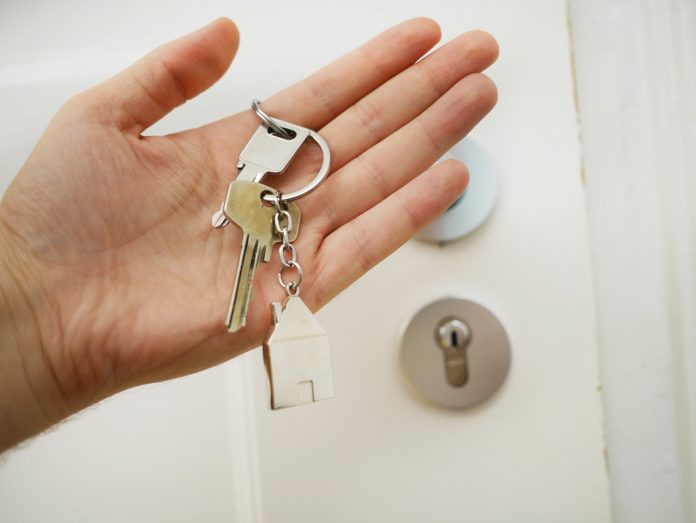
Photo courtesy of Maria Ziegler via Unsplash

Written by Zach Siddiqui, Humour Editor

VANCOUVER, BC — On Monday, Texas Boxerbatte, a third-year English student at SFU, found himself locked out of his home after dropping his house keys somewhere in the depths of his 150 pages of readings for the week.  

“I was vibing on my porch, immersing myself in my literary theory readings,” said Boxerbatte. “Which was very, very hard. I got up to get away from the mosquitos and my keys just fell out of my pocket and plopped straight in.”

Boxerbatte has been unable to locate the missing keys anywhere within the text, which he was supposed to read in the 24 hours between the professor remembering to unmute the module and the lecture session. Even his keys’ distinctive jangling has been drowned out by the white noise filling Boxerbatte’s brain every time he’s forced to look at the words “authorial intention” or “estranging the self.”

“They’re real deep in there, probably lodged in some backwater intersection of ideology and economy,” he shrugged about the keys. “I don’t know. I guess I will make a life for myself from the stones and the grass.”

Boxerbatte’s attempts at retrieving his keys via CTRL + F have also failed, as this reading is yet another badly scanned image-only PDF. His housemates have refused to let him inside, allegedly for fear that it is only a matter of time before they, too, vanish into Boxerbatte’s course readings.

Eli Tesma, a philosophy instructor at SFU, claimed that Boxerbatte is not the first student known to have lost things in their course readings. He has heard of students losing their remote controls, their laptops, and most recently their medical masks. 

One student reportedly lost his sense of proprioception somewhere in the sentence “Individual historical ages are here described as ‘allegories’ of nature insofar as history is envisaged as the epochal ‘petrifaction’ of historical into quasi-natural forms,” from Terence Holden’s “Adorno and Arendt: Evil, Modernity and the Underside of Theodicy.”

At press time, Boxerbatte was still living in his broccoli garden, reading Style: Ten Lessons In Clarity and Grace by Joseph Williams and hissing at trespassers. 

Post-COVID-19 SFU will be a truly alien world

0
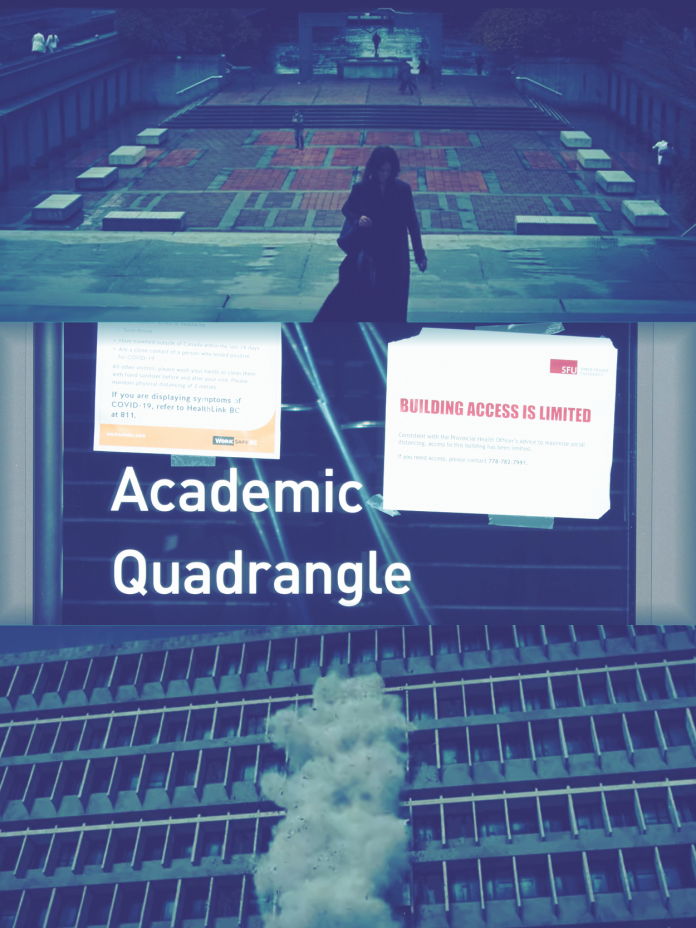
The new landscape of SFU might look stranger than the Sci-Fi worlds it has depicted. The Peak, with screenshots courtesy of Screen Gems and photo courtesy of Maxwell Gawlick / The Peak

Update (5/6/2020): A previous version of this story included rumours of Club Ilia’s permanent closure that have since been confirmed as false.

By: Nicole Magas, Opinions Editor

SFU is famous in the Sci-Fi world for being the setting of several science fiction films. However, students returning to in-person classes in the (hopefully) not-so-distant future will surely have a first-hand experience of SFU’s alien nature: nothing is going to look quite the same as how they left it.

To start with, the absence of students on campus for two entire semesters means that a lot of the construction projects that have had to tip-toe around class schedules up until now have instead had full reign over the campus. This means that by the time students return to classes in 2021, ongoing projects like the renovations in Convocation Mall, the Stadium Project, and possibly even the Student Union Building (gasp!) will be complete, giving the university a brand-new look and feel.

At the same time, new construction projects are going to drastically alter the usual flow of traffic. The renovations on the Applied Sciences Building (ASB) are projected to continue through to Fall 2021, so it’s almost a guarantee that this section of hallway won’t be available again for student use until Spring 2022 at the earliest. This is a shame as many students had gotten used to ducking through the ASB to avoid the construction on Convocation Mall’s renovation project on their way to the east parking lot or the Cornerstone bus loop. 

But what will perhaps alter the feel of SFU the most is the loss of so many businesses that have become an integral part of students’ lives. 

And it’s not as though the loss of businesses on campus is such a hard thing to believe. COVID-19 has already forced the closure of over 43% of small businesses across the Lower Mainland. Small, independently owned cafés and restaurants have been hit the hardest as social distancing has demanded fewer people in small spaces. The idea that businesses at SFU would somehow be spared this fate with the majority of their client base vanished off of the campus is laughable.

What alien world SFU will ultimately look like to current first and second years who stand a good chance of actually returning to in-person classes at some point still in their undergrad is anyone’s guess. For those who have ever wondered what it might be like to attend a different campus altogether, this might be the best chance at having that experience, without interrupting their degrees.


Your weekly SFU horoscopes: July 6–12

0
An illustration of a girl with long flowing hair. Astrological signs and stars shine around her.
ILLUSTRATION: Marissa Ouyang / The Peak

Written by Paige Riding, News Writer

Aries: How are you coping without waiting ridiculous amounts of time in the West Mall Tim Hortons line for a mediocre coffee and pastry? There was just something special about staring at your phone awkwardly while you shuffled forward like a caffeine-deprived penguin. Simpler times.

Taurus: Listen to your gut this week, Taurus. No, I’m not going to jump on the “eat something when your stomach growls” joke exploiting a stereotype about your sign. I’m telling you to dump your friends who are silent about the Black Lives Matter movement because they “don’t want to get political.”

Gemini: Did your friend just text you back in a slightly different tone than usual? What will you do? Leap to the conclusion that they’re sick of you and you’re annoying them by talking to them? Ask if they hate you? Post on your private story about it? Think of the possibilities!

Cancer: It’s your season, Cancer. Take this time to make overly emotional decisions that will haunt you for weeks and weeks to come with confidence. Who needs logic during hot girl summer, anyway?

Leo: Who do you have on your Close Friends list on Instagram? Your best friends? Cousins? That one person you met in line at a club washroom who became your other half while both of you were drunk as hell? They mean a lot to you, too.

Virgo: I know the red zigzag line under words really piss you off as you write. You’re trying to get your thoughts down before you forget them. Definately gets the point across, OK? Defiantely? Definitily? Anyway, you’re too busy being profound to care.

Libra: This week when you go grocery shopping, give the bruised bananas a chance. Your pride is still bruised from the time you couldn’t get your friends to all agree on your movie pick for the Netflix Party, but they didn’t leave you behind, did they?

Scorpio: How many times will you replay that song you’re currently obsessed with? Will it be like last time where you played it so many times that hearing the first notes of it now make you physically ill? Or will you learn from a completely avoidable error from the past for once?

Sagittarius: Netflix is finally adding Studio Ghibli films for its Canadian subscribers! What does this mean for you? You can ask that special someone to have a Netflix Party date. Either they’ll say yes and you’ll have a great time, or you’ll know it won’t work out if they don’t know what Studio Ghibli means. Win-win.

Capricorn: Your Notes app is full of lists you make in desperate moments of trying to appear put together. This week, take a look over them all, still do nothing on said lists, and then compile a master list of “bruh” moments you’ve had since your last spark of motivation four years ago.

Aquarius: Were you the one who loved One Direction back in 2013, or did you make it your personal vendetta to vocalize how much you despised their music? If you were the former, you’re now a sad Harry Styles stan. The latter just makes you sad with bad taste.

Pisces: This week, buy a shiny new pair of overpriced sunglasses. It’ll be a nice change from the rose-coloured shades you put on any time someone you desperately want to like shows red flags.

Monday Music: The Top Pop Albums of 2020 (so far)

2
"Monday Music" in giant yellow block letters with a red background
Monday Music: your weekly themed playlist. Image courtesy of The Peak.

By: Ahad Ghani, SFU Student

It’s been a strong year for music, and we’re only halfway there. We’ve received comeback albums from Lady Gaga and The Weeknd, a posthumous album from Mac Miller, a debut solo album from Paramore’s lead vocalist Hayley Williams, Charli XCX’s album recorded entirely in social isolation, and much more. However, some stood out more than others and deserve your immediate attention. Here are the best albums released this year, so far. 


Future Nostalgia by Dua Lipa

Courtesy of Dua Lipa

On her second studio album, the 2019 Grammy recipient for Best New Artist manages to avoid the sophomore slump with one of the best pop records in recent memory. Future Nostalgia allows Lipa to explore a far more mature and cohesive sound compared to that of her debut album. Despite being heavily influenced by 70s disco and 80s dance-pop, it manages to sound current. Clocking in at just 37 minutes, Future Nostalgia delivers pop banger after another, and leaves the listener longing for more.  

Released amidst the COVID-19 pandemic, the album managed to float above the noise, and will most likely continue to be a topic of conversation for the remainder of the year.

Highlights: “Physical”, “Love Again”, “Levitating”


Manic by Halsey

Courtesy of Capitol Records, LLC

Manic is Halsey’s most personal and introspective album to date. It addresses toxic relationships, heartbreak, loneliness, and her struggle with bipolar disorder. The album explores a variety of genres including electro-pop, hip-hop, country, and alt-rock. On “Suga’s Interlude,” featuring BTS member Suga, she embraces South Korean rap, while “3am” is reminiscent of early Avril Lavigne.  

Halsey delivers her strongest record yet with her third studio album. Despite none of the songs sounding alike, the album is cohesive — largely due to the singer’s vulnerability and creativity that shine throughout the album. It’s not the most commercial record of the year, but it’s undeniably a must-listen.

Highlights: “Finally // beautiful stranger”, “3am”, “Alanis’ Interlude”


SAWAYAMA by Rina Sawayama

Courtesy of Dirty Hit

SAWAYAMA serves as Japanese-British singer Rina Sawayama’s debut album. The record is both unique and fun. It shows why the singer is destined for mainstream success. While tracks such as “Love Me 4 Me” and “Bad Friend” are pop-leaning, she shocks listeners with “STFU,” a track heavily influenced by metal and rock.

“Akasaka Sad” addresses Sawayama’s disconnect from her Japanese heritage, “STFU” serves as a response to the racism the singer has endured, while on “XS,” the singer appears to be mocking capitalism. SAWAYAMA is exactly the record we currently need to be listening to.

Highlights: “XS”, “Bad Friend”, “Akasaka Sad”


Cape God by Allie X

Courtesy of Twin Music Inc.

On her second studio album, Canadian alt-pop singer Allie X embraces a far darker sound on while still retaining elements from her previous work. The lyrics address issues such as depression and past relationships which listeners can easily relate to. Despite the subject matter, the record manages to sound fun and radio-friendly.   

“Super Duper Party People” is an electro-pop party anthem, and on “Devil I Know,” the singer sings about her inner demons. Troye Sivan features on the ballad “Love Me Wrong” while Mitski appears on “Susie Save Your Love.”

Highlights: “Learning in Public”, “Susie Save Your Love”, “June Gloom”

Club Ilia owner hopes to reopen in Spring 2021 semester

1
Photo via Facebook courtesy of Club Ilia

Written by: Paige Riding, News Writer

Club Ilia has closed its doors amid the COVID-19 pandemic, not offering takeout or delivery. Despite rumours spreading on social media about the UniverCity bar-and-grill permanently closing, owner and chef Fred Soofi said in a phone interview with The Peak that this is not the case.

As of now, Soofi predicts the restaurant to reopen in January 2021.

“I don’t really know. But the [earliest] is January. There are no staff, no classes until January. So that’s for sure.”

Before opening Club Ilia, Soofi opened an organic pasta restaurant called Pasta Polo in Coquitlam. Around 11 years ago, Soofi was approached by individuals representing SFU after they ate at Pasta Polo.

“The people who were in charge, they were visiting my restaurant,” Soofi began. “They knew how good I was doing, and they said this is really good for SFU, for UniverCity.” Soofi noted that they wanted an independent business versus a chain to open on the campus.

Soofi said he spent up to $1 million to open Club Ilia in UniverCity, a neighbourhood described by the SFU trustees as a growing, busy area.

“But it wasn’t what they told me. The community wasn’t growing, they were very slow growing it,” Soofi said. Due to this, Soofi was subsidizing the restaurant out of his own pocket. This did not stop him from looking forward to a brighter future for the spot, though. When UniverCity finally started building the condominiums and other developments, what Soofi was met with was not increased traffic. It was the idea of something much more expensive.

“They said to me, your rent is going to be four times higher. I said ‘what?’ I mean, it can’t be possible. For 10 years I waited here!

“I have so much support at SFU, at the community [ . . . ] I’m here for the community.”

After discussing with SFU, Soofi noted that they were able to reach an agreement on a lease price. 

General Manager of Macdonald Property Management Nick Marini provided an email statement to The Peak regarding Club Ilia’s leasing. 

“We work diligently with all of our merchants including Club Ilia to ensure that their lease terms are a strong foundation for their long term success,” the email began. “I can’t comment on the rental rates for any specific tenant, however the current retail rents at the property that we manage and lease for SFU Community Trust are in line with the market conditions of the local trading area.

“Over the past decade the growing demand for services due to the constant growth of the overall population at SFU and Burnaby Mountain has resulted in higher rental rates but not at the level of other urban locations in Metro Vancouver [ . . . ] the net rental rates at Cornerstone Building have increased in the modest range of 2 to 3% per annum over the same period,” said Marini.

Once this decision was reached in mid 2019, Soofi again closed Club Ilia for two months to renovate. After they reopened for a while, they were again forced to close due to the pandemic.

“It had a big effect on my business side, very big one.” 

Soofi noted that while his other restaurant, Pasta Polo, is open in Coquitlam for takeout at the moment, this is not so easy to do with a restaurant so dependent on the student body to make ends meet.

“It’s a big restaurant. You have to pay for power, for insurance, you have to have the staff. You know, it just doesn’t make sense.”