Home Blog Page 38

Six non-fiction books that ask you to feel deeply

0
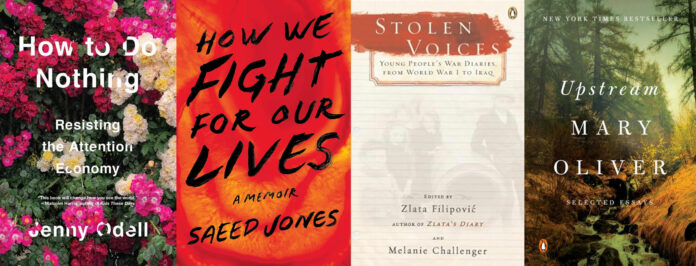
A collage of book covers for - (1) How to Do Nothing: Resisting the Attention Economy by Jenny Odell (2) How We Fight For Our Lives by Saeed Jones (3) Stolen Voices by Zlata Filipović and Melanie Challenger (4) Upstream: Selected Essays by Mary Oliver
IMAGES: Courtesy of Melville House, Simon and Schuster, Penguin Publishing Group, Penguin Press (Left to Right)

By: Ashima Shukla, Staff Writer and Michelle Young, Co-Editor-in-Chief

I love books that breathe — that smile gently at me and invite me into their orbit; that ask, “Will you join me? Will you look at what you’ve been avoiding?” If you think non-fiction is about dry facts and dull history, this list is an invitation to reconsider. 

How We Fight For Our Lives by Saeed Jones 
Jones’ memoir is a heart-wrenchingly honest account of growing up Black and gay in the American South. Born in Memphis to a Buddhist mother and an evangelical grandmother, Jones’s vignettes move through geographic and emotional landscapes in search of identity, understanding, and belonging. Written in a searing poetic prose that is equal parts fearful and courageous, Jones allows his full self to emerge in these pages — with all his multitudes and contradictions. In doing so, he invites the reader to confront the costs of surviving in a place that demands silence in exchange for safety. 

Upstream: Selected Essays by Mary Oliver 
Known for her poetry, Oliver’s essays inspire quiet wonder. In Upstream, she writes about nature, solitude, and creativity with a luminous attentiveness that invites you to slow down and look around. Soft but stubborn in her clarity, she writes of the divinity of nature like a lover full of reverence and gratitude. In these lucid but grounded reflections, she explores what it means to belong to the world, to pay attention again to the gentle rhythm of the river and joyous birdsong.  

How to Do Nothing: Resisting the Attention Economy by Jenny Odell 
What seems like a productivity detox is, in reality, a deep philosophical excavation of attention. Odell gently guides you to reconsider: what if your worth wasn’t measured in output? Part meditation and part love letter to idleness (and birdwatching), she helps you reclaim your time. It is not so much about disconnecting as it is about reconnecting — with the present moment, with your community, with yourself. 

Stolen Voices: Young People’s War Diaries, from World War I to Iraq edited by Zlata Filipović and Melanie Challenger
This haunting collection of war diaries is a lesser-known but highly relevant anthology in this time of global catastrophe. Helping us to personalize and make real the war statistics we consume (or are consumed by), this book is a testament to adolescent wonder and resilience in the face of violence. It asks you to listen to voices we often overlook, to face the raw and unfiltered accounts of survival that remind us that peace must never be taken for granted. 

In a world that asks us to scroll away, these books ask us to stay, to witness, to feel, to remember. 

— Ashima Shukla, Staff Writer

Small Bodies of Water by Nina Mingya Powles
Another author known for her poetry, Powles’ essays are just as descriptive and gravitational. Like water itself, her prose pulls you under the sea to explore identity and climate anxiety. She writes on recurring whale dreams, the exploitation of sea animals, and ponders how we can “write about nature without writing an elegy.” Weaving these themes with her experience of studying abroad in Shanghai and her mixed Chinese-Malaysian heritage, Powles interrogates how history has shaped the present day. 

A Cup of Water Under My Bed by Daisy Hernández
This memoir explores the intersections of class, race, and sexuality in a vivid coming-of-age commentary on what it means to grow up Colombian-Cuban in the US. Hernández not only details her experience growing up, but also confronting racial biases in journalism — notably while working at The New York Times. This piece is sure to tug at the heartstrings for any part of the queer diaspora, but it especially touched me with its tinges of Spanish unapologetically sprinkled throughout the book. 

— Michelle Young, Co-Editor-in-Chief

Lead with Joy: how Johnson’s memoir is touching millions

0
ILLUSTRATION: A cover of Joy Johnson's fictional memoir, Lead With Joy, Leader is Johnson. The Cover should say "SFU bookstore bestseller."
ILLUSTRATION: Abigail Streifel / The Peak

By: A humble grad student, forever changed

Have you ever wondered, “what if Brené Brown ran a university like a Fortune 500 company — but make it The Chair?” Then SFU president Joy Johnson’s long-awaited, totally real, best-selling memoir is the answer you didn’t know you needed (but are now required to cite in every funding application). Where Ji-Yoon collapses under the weight of moral contradictions, Johnson ascends — brand-safe, donor-friendly, and backed by a communication team reportedly headed by Margaret Thatcher’s ghost. 

From the (co-)author of more than 180 peer-reviewed articles, Lead With Joy: Leader is Johnson isn’t just a memoir. It is a paradigm-shifting manual for Canadian academic leadership and a manifesto for academic girl-bossing. Plus, it comes with a legally binding invoice for the emotional labour of narrating her own excellence. 

When Lead With Joy first hit SFU’s bookstore shelves, no one on the West Coast was ready. The Board of Governors cheered. The students wept. Our precious mountain tilted ever so slightly out of respect. Even a hummingbird spotted reading a copy paused mid-flight in what could only be called a rare review from nature’s fastest critic. 

Tracing her journey from being a nurse to Canada’s most spreadsheet-savvy university president, Johnson’s magnum opus reads like a hybrid between Sun Tzu’s The Art of War and Brianna Wiest’s The Mountain is You. Where most self-help books offer vague affirmations, Lead with Joy arms readers with a data-driven roadmap for cultivating the perfect leader: one who quietly and expertly outsources the messy business of morality. 

Her leadership philosophy? A delicate balance between denial in the face of inconvenient ethical questions and Key Performance Indicator (KPI)-driven ambition. As she passionately and eloquently argues, “to truly heal an institution, one must ignore the symptoms, quantify the wounds, and propose a data-driven five-year plan to reimagine wellness.” In one stirring chapter, “Care as KPI,” she boldly declares, “Joy, too, can be a deliverable.” 

Proudly documenting her previous success in raising SFU’s research income from $103 million in 2014 to $161 million in 2020 as vice-president research, she distances herself from the Barbie brand of commodified feminism. No, this isn’t pink outfits and empowerment merch. It’s feminist leadership optimized for the metrics. Where equity is performance-based and glass ceilings are broken only to install skylights in the president’s office. 

For instance, writing on the complexities of freedom of expression on campus, she clearly states, “Freedom of expression matters. So do limits.” After all, to lead with joy is to “host the hard conversations, schedule them quarterly, and issue branded reports afterwards” complete with community-facing search engineoptimized insights. 

Now mandatory reading for first years and emotionally destabilizing for tenured radicals, Lead With Joy is already outselling the iconic SFU dog hoodie. So much so that the bookstore has made Lead With Joy a bestseller (totally on their own accord).

Grab yours before the limited-edition hardcover — printed on recycled equity statements — sells out faster than funding for anti-fascism scholars during budget reviews. Buy two to receive a branded lanyard, endless joy, and a vague sense of institutional belonging, while supplies last.

The Peak’s Classifieds section

0

By: Corbett Gildersleve, News Writer

“chitter, growl, growl, snarl, chitter chitter howl, growl, shake, dig dig, sniff, chitter”

Contact: trail of trash leading into the forest


Found a “Sense of Joy” trapped in the water grates running along the convo mall. By the shape and size of it, I suspect it once belonged to a PhD candidate who honestly believed they would be researching what they wanted instead of whatever would give them grant money. If you’re looking to get this back, I’ve left it with the Beedie School of Business office. 

Contact: [email protected]


Looking for my missing research supervisor. I haven’t seen them since last week when I demonstrated how their life’s work, underpinning millions of dollars in research grants, just can’t work in reality. Suspect they might have run away to join a federal political party where reality doesn’t matter. If found, call their department chair and distract them by discussing their favourite pedagogical framework while you wait for a collections agent to arrive with coffee and new NSERC grant applications. 

Contact: [email protected]


Frisky yet repeatedly abandoned space in the south AQ looking for a committed and successful food business to fill me. Past failed relationships include a greasy yet popular burger place, a spicy taco joint, and a forgettable soup and sandwich bistro. Looking for something exotic that will drive me wild with variety and anticipation. 

Contact: [email protected]


Need responsive, enhanced, and foolproof techniques for writing exams? Look no further. I am selling a training program. It consists of remote support on the day of the exam via slightly used earbuds with mic. Earbuds are bright pink, but rarely noticed by exam invigilators. 

Contact: [email protected]


Looking to sublet my affordable two cupboard sleeping area. Great for a couple, friendly roommates occupying the laundry hamper. No pets, no cooking, and no laundry allowed. $2,000/month, pay in bitcoin. 

Contact: [email protected]


Extrovert seeking to kidnap an introvert to help them “get out of their shell” by dragging them to every social event on and off campus over the next three weeks. Looking for people with a growth mindset and who wish to be mentored. 

Contact: [email protected]


Introvert seeking a herd of other introverts to hide amongst. Extroverts keep dragging me to parties. Please help me! They keep inviting me to go outside and talk with strangers about pointless things. They’re outside my house now, knocking on the door, looking through my windows to see if I’m home. Oh god, they want to take me to a spin class. Send help!

Contact: [email protected]


Looking to join an alternative jazz-metal late-baroque slide whistle band. I can bring my tuba and we can book out the SFSS forum chambers to practice in. 

Contact: [email protected]


Looking to sell the latest edition to Math 150/151/152 . . . buy once, use it for 50% of your classes! Going quick . . . oh, they released a new edition just now? Shit. Looking to sell a $150 PC monitor stand.

Contact: [email protected]


Found a cute $20 million deficit in the university budget. Some people were complaining that it keeps digging holes everywhere, but those people will be out of a job soon, so oh well. I left with University Advancement for a nice rich donor to pick up and give it a forever home. 

Contact: [email protected]

Brighter Side: Custom work playlists

0
A barista in a bright yellow shirt pouring coffee behind a counter.
PHOTO: Azhar khairi / Unsplash

By: Peter Runn, SFU Student

Something I appreciate about working for a small local coffee shop is we’re allowed to play whatever music we want. Unlike the corporate-stocked playlists mandated by most retail chains, at least my employer understands not having Benson Boone serenade from the ceiling 20 times a shift boosts employee morale. As long as explicit music is filtered out, my coworkers and I get to decide exactly what we want to treat our ears to. We have custom playlists we share with each other to enlighten our music tastes. If we feel like listening to Lorde’s entire discography, an eighthour shift is the perfect opportunity to do so.

Baristas tend to have superior music taste, so our selection also increases customer satisfaction. There was that one time we got a negative review because, “It’s difficult to enjoy my latte when Sean Paul is blasting in my ears,” so my boss banned Sean Paul. Easy! I get to find out who the cool customers are when they comment on the unexpected music — or catch them shazaming it (the most mortifying thing you could be caught doing in the modern era). Music is a much better conversation starter than, “I heard it’s going to rain next week.”

I can handle being yelled at by a customer for their “no ice iced latte” not being cold enough when I can dissociate to Nemahsis or Sampha. My playlist is an ever-expanding mixture of everything from hidden gems to familiar hits that unlock forgotten memories, from all corners of the (listenable) genre spectrum. It makes hustling through a rush or lull much more bearable when I can tune into a variety of music I actually like. And because I’m not constantly listening to radio hits on a loop, I can appreciate some of them and sprinkle them into my playlists. Hot take — Mystical Magical” is not that bad in moderation.

Decolonizing education begins with reimagining

0
An Indigenous-designed wooden open-air structure with a triangle roof made with wooden planks and totem pole pillars. Sunlight is entering through the spaces between the spread-out wooden planks in the roof.
PHOTO: Ruth Hartnup / Flickr

By: Zainab Salam, Staff Writer

A decade ago, at a seminar for newcomer youth in downtown Vancouver, an Indigenous speaker shared a powerful observation that stuck with me. He asked us to think about the shape of rooms in buildings, whether it be a hall, a bedroom, or a classroom. He noted how most rooms in buildings are angular, with sharp corners and straight lines. At the time, I hadn’t ever wondered about such a matter. Rooms were just rooms, some rectangular, others square. They were simply places to exist in and to move through.

The speaker went on to explain that Indigenous spaces are often designed to be circular, open, and relational. This helps foster dialogue and community. In contrast, the rigid, closed-off architecture of colonial buildings that dominate our landscapes reflects a worldview rooted in hierarchy and separation. This shows how colonialism is often hidden within the things we take as neutral, and it’s no different with education.

Our current education system is colonial in its design and operation, so much so that we don’t often question what alternatives exist. Eurocentric values prioritize individual achievement, hierarchical authority, and standardized measures of intelligence. Knowledge is treated as a product to be acquired. In curricula, western philosophies are positioned as universal, while Indigenous and non-western ways of knowing are marginalized. Even when diverse perspectives are included, they are often framed as “alternative,” perpetuating the myth that western knowledge is the default

“Decolonial education is not simply the inclusion of Indigenous knowledge within the existing colonial framework of education. It is a transformative shift in how we understand, share, and experience knowledge.”

One of the core colonial landmarks is the imbalanced power dynamic between educators and students. Going back to the idea of rooms, the physical structure of lecture halls reflects a learning model where educators are positioned as authoritative sources of knowledge, while students are passive recipients. But Indigenous worldviews and ways of knowing call for a reciprocal process; one where students, educators, and communities learn from one another. This means a shift from the hierarchy to reciprocity can transform education from a site of passive consumption to one of active co-creation. Indigenous resources like Dr. Shauneen Pete’s “100 Ways: Indigenizing & Decolonizing Academic Programs” in the aboriginal policy studies journal serve as essential resources for education developers. She suggests “circle formats” and “small table groupings” as approaches that encourage dialogue, and emphasizes instructors not expecting Indigenous students to bring up Indigenous topics. This is an unfair burden, and instructors should prepare to catalyze these discussions.

Active engagement in decolonizing education means developing a decolonial consciousness; an awareness of the ways colonialism continues to shape our world and a commitment to dismantling it. Too often, efforts at decolonizing education are reduced to token gestures — passive land acknowledgments — while the underlying colonial structures of education remain unchanged. True decolonial education should go further and dismantle these structures, like, as Pete writes, “reducing the barriers to working with traditional knowledge keepers and Elders.” As well, rather than only having a set Indigenous curricula, professors should “be flexible enough to take up emerging local Indigenous issues as they arise.”

The Sylix Nation of the Okanagan Valley view place-based education as an act of resistance and resurgence, where learning emerges from land, culture, and community. These approaches disrupt the hierarchical and compartmentalized norms of settler education; instead, replacing them with modes of knowing that honour interdependence and ancestral knowledge. According to a publication by FemNorthNet, a feminist research project, decolonial pedagogies also require recognizing how colonialism intersects with race, gender, and power within educational spaces. This means true transformation must address structural inequities and systemic barriers faced by Indigenous teachers and learners. Decolonial education, therefore, is more than just an academic project; it is a pathway to healing. 

The colonial structure of education and its spaces is not an occurrence through happenstance. It is a deliberate legacy of the historical role of universities in promoting settler colonialism. Decolonial education is a call to reimagine learning as a reciprocal process. It is a call to change the way we structure learning. To improve how we learn, what we learn, and where we learn.

2025 SFSS vice-president candidate details concerns around name misspelling

0
This is a photo of the SFSS building on a bright, sunny day, where the glass of the building reflects the blue sky and clouds.
PHOTO: Kriti Monga / The Peak

By: Lucaiah Smith-Miodownik, News Writer

Vaibhav Babbar, who also goes by Vee, spoke with The Peak after his lingering concerns about the election were brought to the paper’s attention by an anonymous source. 

Babbar, who served as one of the associate vice-presidents of events and student affairs during the 2024/25 term, ran in this year’s election cycle but was not elected by a margin of 88 votes. He said issues around his platform commenced before the election took place. At the candidate debate, his nickname was incorrectly spelled “Veer.” At this point in the election, the mistake “was fine because I reached out to [the SFSS] and they apologized,” he said. “But then they did the same thing again in the polling ballot itself. It was supposed to be ‘Vaibhav,’ and they did ‘Viabhav,’” with the “I” and “A” switched.

“I sent them an email regarding this, and the email was ignored, and after the election, I raised concerns about this, and they just apologized,” Babbar said. “But obviously, you need to fix that right away while the election is going on, not after elections.” He also noted some of his friends did not recognize his name on the ballot. When he explained his friends’ confusion to the SFSS, they said Babbar’s friends should have recognized him as there was only one candidate beginning with a V. 

“It didn’t feel like an acknowledgement of their mistake. It just felt like they’re trying to defend their position,” he said.

“It’s a big election, it’s a major university election in BC and it’s the whole student society — not a club, not a union — the whole student society.” — Vaibhav (Vee) Babbar, 2025/26 candidate

Babbar also raised concerns about the voting system used for the election, a topic The Peak reported on earlier this year. While individuals were able to cast more than one vote by switching browsers or using incognito mode, The Peak previously reported that “the election system has safeguards in place to ensure that each student gets only one counted vote,” according to the SFSS and the Independent Electoral Commission.

When Babbar asked for proof that illegitimate votes had been removed, the SFSS told him they could not release the raw, unfiltered polling data.

The Peak reached out to the Independent Electoral Commission for additional comment, but did not hear back by the publication deadline. SFSS also informed The Peak that they were unable to comment at the time of the article.

At the time this piece was published, the SFSS has no plans to run a re-election.

Easy udon for when the executive isn’t functioning

0
ILLUSTRATION: A warm bowl of Udon noodles, with cut tofu slices and vegetables (carrots, green onion) near the bowl
ILLUSTRATION: Cassandra Nguyen / The Peak

By: Noah Jozic, SFU Student

A dear friend shared this recipe with me, knowing I was struggling to cook regularly because of mental health challenges. This super easy udon is her go-to when she is low on energy. I could see it was effective right away — when she first made it for me, she had been eating udon all week! Now, whenever I’m brought down by executive dysfunction, depression, or other barriers that keep me from getting in the kitchen, I keep her recipe to heart as a reliable, convenient, and healthy meal option.

A few features make this udon stand out as a low-barrier meal:

  1. Easy prep, on impulse

This udon can be prepared at a moment’s notice, using long-lasting ingredients. The easiest version, featured below, uses tofu and frozen veggies. It’s a great option if you worry that your produce will only go rotten after a bad week, or if you prefer a consistent meal plan. If you need novelty to feel good about eating, you can always vary each batch with fresh and preserved ingredients: sesame seeds, wakame seaweed, bonito flakes, mushrooms, green onions, leafy greens would all work with this recipe. Greens could be the usual spinach or kale, but my friend has even used nettles foraged from Burnaby Lake!

Many of these ingredients require no chopping, and most only need to be heated through before serving.

  1. The right soup base

A delicious store-bought soup base makes the difference between this recipe and other quick soups I’ve tried. My friend introduced me to Kikkoman’s Hon Tsuyu soup base, available at T&T, which has a lovely smoky flavour straight out of the bottle. If you can’t find that soup base, feel free to swap it over to either miso paste or a vegan alternative. Do keep in mind that Hon Tsuyu and miso may contain fish.

  1. Single-servings, and the right pot

Personally, I prefer a single-serving option because it makes the meal fresh every time. A surprising game-changer for me was buying a small saucepan to make this recipe. Before, the thought of using and washing a big pot was daunting enough to keep me from cooking. My gadget of choice is a Zwilling one-litre pot from HomeSense. It has a nice, heavy base, and the brand is a personal favourite, so I’m always happy to bring it out. However, as I say this, feel free to choose any cookware that will feel good to you!

RECIPE

4 tablespoons Hon Tsuyu soup base (or an alternative, like miso)
500 ml water
1 packet udon noodles
Tofu, to taste
Frozen vegetables, to taste (eg. cauliflower, broccoli, carrot blend)

1. Add the soup base and water to a small pot. Bring to a boil.
2. Add noodles to the pot.
3. Slice or cube tofu. Next, stir the soup gently to untangle the noodles, then add tofu and vegetables.
4. Simmer for around five minutes until all ingredients are hot. Make sure the noodles have cooked for at least as long as the package indicates.
5. Enjoy!

Personal reflections on the launch of Elegy for Opportunity

0
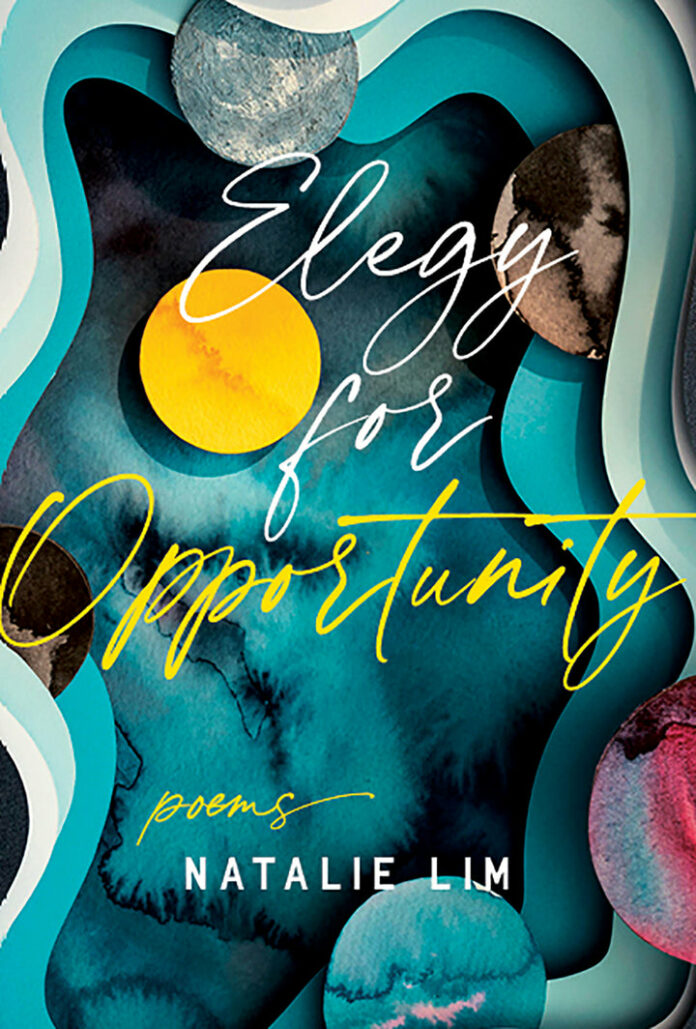
This is a cover of Natalie Lim’s book, Elegy for Opportunity
PHOTO: Courtesy of Buckrider Books and Wolsak & Wynn

By: Alex Traynor, SFU Student

On May 10, I ventured down to SFU Harbour Center in Vancouver for the first time to attend the official book launch for Elegy for Opportunity, written by the award-winning poet and SFU English alum Natalie Lim. I knew I couldn’t miss the event as soon as I read the question Lim explores in her work: “How do we go on living and loving in a time of overlapping crises?” As someone grappling with the philosophical dread of how I can continue functioning as if nothing is wrong in the world, I hoped Lim’s poetry would provide some insight and validation. I wasn’t disappointed.

Upon arrival, I quickly realized that this event was more than a celebration of Lim’s debut book. It was a testament to her profound impact on a vibrant and connected community. The room was packed, the energy warm and uplifting. Friends, family, colleagues, fellow writers, and academics filled every seat, eager to celebrate the esteemed poet and her work. The event opened with Mallory Tater, a four-time author and lecturer at UBC’s School of Creative Writing, who described Lim’s poetry as an expression of community kindness. This simple description resonated with me, and became evident as I read her works. Despite feeling a distinct lack of community during my time at SFU, this event gave me a glimpse of what a supportive creative circle looks like. I’ve generally felt helpless in finding any semblance of community since becoming an adult, watching neoliberalism invade social reactions — encouraging individualism, isolation, and meritocracy. In a political and economic climate where it’s everyone for themselves, building strong communities is a direct act of resistance to the systems that benefit off of us feeling detached. 

Stephen Collis, the chair of SFU’s English department, took the stage next. He recounted reading Lim’s first ever published poem arrhythmia, a piece that explores her identity as a Chinese Canadian, and how it impressed him so much that he encouraged its publication. She would go on to win the CBC Poetry Prize for the piece in 2018. Following Collis, Isabella Wang, author of Pebble Swing, read a poem dedicated to Lim, referencing a line from arrhythmia to connect their shared experiences. The tribute was emotional, making it clear that the afternoon was as much about celebrating Lim’s work as it was about honouring her connection to those around her. Lim’s long-time friend and Vancouver-based poet Tina Do also shared a piece written for her that left Lim in tears. By then, I’d already decided to buy a copy of Elegy for Opportunity. I had promised myself to engage with more art this year, and the authenticity and vulnerability of Lim’s prose felt like the kind of art I needed to support. 

Elegy for Opportunity intertwines love poems with tributes for the deceased NASA space rover Opportunity. After being overtaken by a sandstorm on Mars in 2018, the robot’s 15 year service to human scientific research came to an end. Lim was struck by the collective mourning for this machine that had been programmed for the very purpose of permanent exile — this paradox spoke to her about humanity’s capacity for love and grief. Initially titled Everyone I Love is Now, Lim’s love poems in the collection explore love in its multifaceted nature, including familial love, companionate love, love for environment, and even love for non-living objects, like that we reserve for machines. During the discussion and Q&A facilitated by Mallory Taylor, Lim spoke about the duality of love and grief, describing how grief can deepen our understanding of love, especially in those moments when love seems most fragile. Before reading the first poem in her book Love Poems Don’t Win Contests, she shared how self-doubt almost kept her from publishing work that felt too vulnerable. But in the end, Lim chose to lean into that discomfort, allowing her rawest, most honest reflections to emerge. 

For Lim, Elegy for Opportunity is a book for this particular moment in time, a time marked by fear, loss, and uncertainty — all the while eliciting endless moments of connection and tenderness. Created during the start of COVID-19, Lim grappled with how joy and connection can blossom in times of lockdown, and how young people increasingly fear the future due to climate crises, active genocides, and threat of facism. Despite such bleakness, the resilience of the human spirit is undeniable, and I love how this book illustrates the tumultuous burden and joy of the human experience in this age. 

I feel honoured to have been in that room and to have experienced those couple hours. The event reminded me that paying attention to space and time by allowing yourself to be fully present in the moment comes with the most rewarding results.

SFU student versus campus construction: Installment 2

0
ILLUSTRATIONS: Small illustrations of traffic cones (two variations) and construction workers to place around the borders of the photos.
ILLUSTRATION: Noah Jozic / The Peak
Small illustrations of caution tape and construction ladders to place around the borders of the photos.
PHOTO: Mason Mattu / The Peak
Small illustrations of caution tape and construction ladders to place around the borders of the photos.
PHOTO: Mason Mattu / The Peak

Political Cartoon: Carney gives into Trump

0
politcal cartoon
CARTOON: Cliff Ebora / The Peak

By: Cliff Ebora / The Peak