Home Blog Page 28

Facebook Dating solves the issues with modern romance

0
A girl with her face painted blue crouching down in her washroom. Next to her is a speaker.
PHOTO: Katie Walkley / The Peak

By: Katie Walkley, SFU Student

In our modern era, staying single has become an appealing option. I count my blessings every day I don’t have to be married by age 14 like my foremothers. My romantic interactions are limited to checking out the SFU hotties on the 143 bus (hmu baddies). Just kidding, please don’t, I’m not ready. 

Anyways, I have noticed that many of my friends also experience the epic highs and lows of singledom. On one hand, I would not give up my solo nights watching old Survivor seasons for ANYONE. However, I need to take a peek at what we’re missing out on. Thus, I have taken it upon myself to investigate how to find love as a dating-curious-loner-queen.

The saying is true that love finds you when you stop trying. And I really had given up on that one fateful night where after asking, “Why on earth does Facebook have a dating app?” I made myself a Facebook Dating profile. 

No bio. Just a picture of me in my alien makeup sitting on my friend’s toilet. 

It was originally just to see what kind of hooligans were finding love on my Aunt Linda’s favourite app. Then, my curiosity grew into respect like a caterpillar’s transformation into a slightly larger caterpillar. So, here are my three reasons why Facebook dating will change your status from unwitting loner to reciprocal boner just in time for some summer romance. 

  1.       Low standards: boost your ego!

My extraterrestrial form has received many confessions of love and coffee invites after the briefest of exchanges. Since it is impossible to fumble a Facebook diva, even the most inexperienced, non-committal users will feel like fine shyt in no time. 

  1.       Absence of rizz: assure a genuine connection

Most Facebook daters have limited real-life dating experience. Some are even bold enough to sing their woes in their bios. One man wrote a full paragraph about how he’s a good-looking guy — so it’s not his fault he hasn’t had sex in over a year. I could tell his hand was relieved to take a break from its full time job and write that paragraph. You can rest assured that these people aren’t putting up an act because they tell you things that most wouldn’t give up under torture.

  1.       Loneliness across the board: you’re not the only hermit

In a land where people have resorted to finding their other half on Zuckerberg’s social hellscape, the inhabitants surprisingly do not have the most frivolous social lives. This means they will text you back faster than even your closest friends. With their abundant free time, they put lots of thought into their responses and they don’t mind giving you a double, triple, no, wait, septuple text.

So, is Facebook the place for you to embark on your first relationship? God no! I hope you said no or else you’ve misunderstood everything I’ve said worse than an ignorant bachelor misunderstands 500 Days of Summer. But is it the place for you to go from time to time to safely flirt while remaining peacefully single? Absolutely.

Political cartoon: BCNDP passes Bill 15

0
Political cartoon: BCNDP passes Bill 15
CARTOON: Cliff Ebora / The Peak

SFU study indicates men surviving intimate partner violence don’t have enough support

0
This is a black and white photo, composed so that only a man’s black silhouette is visible in front of a white, grey, and black gradient in the background.
PHOTO: Bita Eskandari / Unsplash

By: Corbett Gildersleve, News Writer

Content warning: mentions of physical and sexual abuse, intimate partner violence, substance abuse, and suicide. 

A new study co-authored by Dr. Alexandra Lysova and Dr. Eugene Emeka Dim was published on February 28 in the Journal of Family Violence, examining how men surviving intimate partner violence (IPV) deal with their abuse. Lysova, an SFU criminology professor, and Dim, a University of Victoria assistant professor in sociology, highlighted that men in Canada were significantly less likely to receive support due to stigma, a lack of dedicated services, and poor coping strategies. The Peak reached out to Dr. Lysova and CJ Rowe, director at SFU’s Sexual Violence Support & Prevention Office, for an interview, but could not conduct an interview by press time.

This study reviewed previous studies conducted on the topic, drew data from the 2014 General Social Survey (GSS) victimization survey, and analyzed 2016 interviews with 16 men who experienced IPV. Although the interviews occurred almost 10 years ago, the researchers found that “there have been no significant changes in societal attitudes or support systems” toward men who experienced IPV in Canada. The men who were interviewed were over the age of 18 and had experienced IPV in their married, common-law, or dating relationships. 

The study states, “Previous studies utilizing the GSS 2014 data found that men were significantly more likely than women to report experiences of physical and/or sexual IPV (2.9% of men and 1.8% of women in current relationships).” However, the 2025 study highlights that men were significantly less likely to seek support than women, revealing several disparities, as found through several statistics. For one, the study found women “are more likely to confide in their families (56.3%)” compared to men (27.8%).

“When men survivors wanted to seek support through counselling or other services, some were not immediately available to them, or they were expensive.”

The interviews showed that the men’s coping strategies fell into four areas: “denial of abuse and/or withdrawal, diversion to work or other activities, maintaining the relationship, and seeking help after the abusive relationship ended.” 

One respondent said, “I wasn’t (coping). I was just existing. I guess I was dissociating; that would be my best guess. I still don’t remember those memories; it’s a bad time of my life. Obviously, I tried to repress it.” Another respondent who focused on other activities said, “I hide . . . work more, play video games, do home projects, and other activities.” Others tried to focus on saving their relationship through seeking couples counselling, Alcoholics Anonymous support groups, or focusing on helping the abuser instead of themselves. One man said, “I thought I could be a hero . . . I focused solely on trying to help her, instead of trying to help me. Alcoholics Anonymous group helps you look at the alcoholic person from a different perspective. I loved my wife and I believed that she would change.” Only after the relationships ended, some found support through counsellors or groups: “I’m going to the male support center every week for meetings,” one noted.

When men wanted to seek support through counselling or other services, some were not immediately available to them, or they were expensive. From the 2014 GSS victimization survey, a substantial percentage of respondents had incomes below $40,000, with (at the time) counselling sessions costing $50–220 per session. One of the 16 interviewees said that after their breakup, they sought out suicide prevention support and shelters, but “every helpline was for women and children.” One man noted, “So, the message for me was, don’t call this number . . . Even shelters in Toronto are all named for women and children.” Fortunately, he was able to find support through his job benefits — something that not all men survivors have. The study concluded that a “nuanced understanding” of the factors affecting men “is crucial for developing policies, practices, and interventions that comprehensively meet” their needs.

For more information, the study is available here. If you or someone you know has experienced physical and/or sexual abuse, you can contact the SFU Sexual Violence Support and Prevention Office, call 778-782-7233, or email [email protected]. They support anyone in the SFU community and are open to all gender identities and sexual orientations. Additionally, the BC Society for Male Survivors of Sexual Abuse provides individual and group therapy sessions as well as victim services at 604-682-6482 or [email protected] (Vancouver), and 672-963-9931 or [email protected] (Surrey).

The Vancouver Arts Book Fair returns to the city once more

0
The picture shows a book fair, focused on a few books on and around a table
PHOTO: Kate Bezzubets / Unsplash

By: Ashima Shukla, Staff Writer

From July 4–6, 2025, the Vancouver Arts Book Fair (VABF) returns to the Roundhouse Community Arts and Recreation Centre, bringing you not just knowledge transfer, but also many visions of what a publication can be. It is not just “Canada’s longest-running international art book fair,” but one of the most persistent, having been an annual Vancouver staple since 2012.

Kay Higgins, board chair at VABF and professional development coordinator at SFU School for the Contemporary Arts, attributes this longevity to “stubbornness.” Higgins has been attending art book fairs with her partner since the early 2000s. For her, this work is more than just making and selling books; it is about the intimacy inherent in this physical exchange. “It’s something that has gone from my hands to a stranger’s hands,” she says. 

For Higgins, it is also about self-expression and resistance. Art publishing “can be very, very political,” she notes. “It’s got the potential for you to express ideas that wouldn’t be very viable to express even through a small press.” And yet here they are in our hands: zines, risograph editions, photocopies, hand-stitched booklets, even envelopes. 

“There is so much variety in what we do,” Higgins continues, her passion for publishing evident in her voice. “A book is not just a vessel to put things in. It is a thing in itself,” she quotes from Ulises Carrión’s The New Art of Making Books. As beautiful objects, these publications have a life of their own, and book fairs are vital spaces for this culture of appreciating books to be made and passed along. 

However, Higgins is keenly aware of the limits of space, time, and funding. “We need to be able to do things we haven’t done yet,” she says. Imagining a future where arts book fairs can create broader networks of solidarity with Indigenous artists, those from the Global South, or those making art under oppressive regimes, she admits, “We are still in the infancy of working with Indigenous artists, including artists from the host nations.” This decolonization is not uncomplicated, as some might find even the book a colonial form

However, her work is ongoing. “My vision is that we manage to get everybody a living to produce work that creates meaning,” she shares. Mindful of the tension between these independent cultural spaces and her more institutional roles, she recognizes the limited power we hold as artists and scholars. Yet, she believes learning to work with institutions is a way to triangulate power, to make space for work that would otherwise be impossible. It is personal and political. And it has a cost. 

Yet, artist-publishers from all over the world show up: Brooklyn, Seattle, Tokyo, Eindhoven, Shanghai, Hong Kong. From established names like Art Metropole and Emily Carr/Libby Leshgold, to some of Kay’s personal favourites like Brick Press, Cathy Busby Projects, HOMOCATS, Wendy’s Subway, and more, the fair is packed with diversity. The best part? It is also free to attend and open to all. The books are often affordable, and most exhibitors accept debit and credit payments. 

Higgins first learned about art publishing in her twenties, with creative projects like File magazine by General Idea, which parodied fashion and culture, and Aspen magazine, which came in a box. It was a revelation to her then, that “anything made public is a publication.” That same wonder and sense of possibility is what VABF is about. 

Wander in. Stay awhile. Witness what happens when strangers gather around ideas made tactile. And take something home — a sense of community but also a book or two — a reminder of the long, invisible chain that connects us. No special equipment or knowledge required. Just curiosity and some time. So, head out to Yaletown to see the fair for yourself!

A funeral for my tongue

0
the wings and the menu of the hot sauce coating
PHOTO: Corbett Gildersleve / The Peak

By: Corbett Gildersleve, News Writer

We are all gathered here today to mourn the loss of Corbett’s tongue, lost to us at a ripe young age of 44. Corbett thought himself adventurous, having lived in China for two years where he ate many different types of dishes, many of which were of the spicy variety. The numbing spice of Sichuan peppercorn was no match for him, nor the shredded pork dishes heaped with chilis. So, when one of The Peak’s Editor-in-Chiefs asked for someone to attend a Hot One’s Challenge as a media taster, Corbett foolishly volunteered as tribute. 

On June 7, Corbett arrived at the Good Company Granville, host of the event. It was sponsored by Gladstone Hot Sauce, who provided six of their eight featured flavours. While watching a competition of eager community members, he was provided an eight-piece sampler with a list of hot sauce flavours, ranging from mildest to hottest. What he didn’t know was that the wings were not in the same order. It was a chicken wing roulette!

This poor, innocent man, not knowing the danger in front of him, grabbed the first wing and, after devouring it in seconds, knew he had chosen poorly. Heat filled his mouth like never before. What heat! What betrayal! The ice water . . . it does nothing! Fortunately, the fire faded quickly, and he decided to be more thoughtful in his next choice. Luck was on his side, as the next five were of the mild to medium variety. Some had a sweet honey flavour, while others had a chipotle or sweet Thai chili. Maybe he just got unlucky with the first wing. Maybe that was the hottest. 

Editor’s note: It was not the hottest

“Heat filled his mouth like never before. What heat! What betrayal! The ice water . . . It does nothing!” — Corbett Gildersleve, A poor fool

After biting into the second-to-last wing . . . Pain! Unmitigated pain! 

Corbett went through at least two litres of ice water, which he knew would have no real effect, but it was better than doing nothing. Tears flowed, face muscles perked, and breathing was as heavy as in all those “romance” novels people read now. 

The final wing provided no relief as it, too, was one of the hotter ones — or maybe Corbett’s tongue was so burned that the nerve endings had given up. Either way, he quickly flagged down a server to order a bowl of ice cream, which just so happened to be advertised on a board next to the competition. 

That singular bowl of ice cream was the only source of comfort that day. Corbett left Good Company Granville a broken, changed man. Never again will his tongue be able to taste things the same again. 

Ashes to ashes, dust to dust

Monday Music: A reminder that time is lived in every direction, at every speed

0
A photo of two sand hourglasses of different shapes against a white background
PHOTO: Karolina Grabowska / Pexels

By: Lucaiah Smith-Miodownik, News Writer

A car comes and goes, the present nestled somewhere between those four wheels. The past lingers in the air like dust on the dirt road. The future is still miles away, or perhaps it has already passed by. Music reminds us that time is lived in every direction, at every speed. A moment stretches on, while days go by in the blink of an eye. A good tune allows us to slip past the illusion of linear existence, and into a world blanketed by the soft understanding that we are more than dots on a timeline. Here are a few songs that humanize what it feels like to live through the passing of time, captivating attention with beautiful melodies and thoughtful lyrics in the process.

“Airplane” by Hana Vu

Do you remember getting older? Can you tell me what it’s about?” Vu delivers a ballad for what once was, or perhaps what could be. With a voice that echoes equal parts longing and apprehension, she blends past with present in a song that leaves listeners simultaneously nodding their heads and tapping their feet while searching for memories yet to happen. “I don’t feel the same as I did when it’s over,” sings Vu, and neither will the listener after hearing this song.

“Pretty Lady” by Tash Sultana

Tash Sultana brings an infectious sound to the often complex dynamics of relationships. Anyone who has struggled to find a balance in communication with their partner, romantic or otherwise, can see themselves in the lyrics. “I’m passing through a lesson learnt in time, but I know we’ve been over this. Why can’t I break through the other side?” Sultana forces us to ask ourselves how many chances we get before our past simply transcends our present, or perhaps the other way around. Still, beautiful experiences are forged when we are with the right person, and it’s times like these that we “try to make a moment last,” as Sultana sings.

“Burn” by Benja and Glitter Party

Time continues to change, regardless of whether we follow suit or remain “frozen thinking everything through.” With gentle voices, Benja and Glitter Party explore what it means to look at what used to be in order to become something new. Calming riffs and tender intonations coax the listener towards a sense of hope and possibility, a reminder that sometimes a better tomorrow is hidden in yesterday, so “today I’ll face my life and make it burn.”

“Forgot Your Roots” by Buffalo Traffic Jam

You lost who you are, forgot your roots and it shows.” Buffalo Traffic Jam confides in listeners what it means to lose yourself through someone else’s eyes. With Caampesque vocals, the duo reminisces on what could have been. But whose fault is it when things don’t work out? Such a question is seldom easily answered. As the song reminds us, the truth is usually a messy combination spanning across people and timelines. Wishing extends its well-worn arms in all directions, pushing and pulling us with it. This is a tune for anyone who finds themselves longing to be anywhere but the here and now.

2025 song of the summer shortlist

0
A composite photo of Sabrina Carpenter holding a dog, a SkyTrain, a photo of Alanis Morissette singing, and someone’s feet.
PHOTOS: Courtesy of @sabrinacarpenter / Instagram, Diego Mazz / Unsplash, @alanis / Instagram, Mehrdad Jiryaee / Unsplash (left to right) EDIT: Gudrun Wai-Gunnarsson / The Peak

By: Ashima Shukla, Staff Writer and Mason Mattu, Humour Editor

It’s June, and the vibes are off. We’re in a climate apocalypse, the billionaires are feeling victimized, the aux cord is haunted, and we still don’t have a song of the summer. Can Benson Boone save us? No. Can the “married in a year in the suburbs” or whatever guy save us? Certainly not. What shall a world-in-collapse do without a unifying bop?? 

We asked our very professional music reviewers, Mason and Ashima, to come up with The Peak’s shortlist for song of the summer! You’re welcome.  

Sounds of Vancouver: The SkyTrain” by CelGen Studios (selected by Mason)
We’re literally being trained like one of Pavlov’s dogs. Even when we’re not in a rush, as soon as we hear the aggressive “NEXT STOP” from our SkyTrain, we’re pushing and shoving like we’re some sort of celebrity. Let’s stay anxious 24/7 with this underrated banger. 

Hand in My Pocket” by Alanis Morrisette (selected by Ashima)
 Nothing screams 2025 like Y2K nostalgia and ungrounded optimism. Let the youth believe “I’m high but I’m grounded” meant microdosing shrooms and ASMR-induced nirvana. 

Who Let the Dogs Out” by Baha Men (selected by Mason)
This song is a public service announcement. Because this summer, we’re hoping NO ONE lets their dogs out. Let me make it crystal clear that NO ONE wants to see unclipped toenails in your Instagram posts. Thanks!!

Manchild” by Sabrina Carpenter (selected by Ashima)
In a world of pastel-Glinda-Grande-conservatism, Nara-Smith-apron-core-delusion, and Sydney Sweeney bath-water-soaps, this song is perfect for the girlies rethinking feminism. Because nothing screams empowerment like performative rebellion and satire that only props up the status-quo.

Welcome to Hell” by Black Midi (selected by our office nihilist
And if you’ve stopped asking questions altogether, this one is for you. Perfect for lying face-down on a hot sidewalk and realising that, this is the summer, babe. No skips. Just censorship, surveillance, and a bonus LSD trip (minus the LSD).

Hot-take: Shrek is anti-ogre

0
Shrek running away from Fiona. Both are in ogre form.
ILLUSTRATION: Cliff Ebora / The Peak

By: Zainab Salam, Opinions Editor

Let’s get this out of the swamp: Shrek is not the ogre ally you think he is. Sure, he’s an ogre. Sure, he lives in a swamp, eats eyeballs like olives, and has a roar that can clear out an entire Disney knock-off kingdom. But let’s not confuse identity with ideology. I am here to make a bold, probably an obvious claim: Shrek hates ogres, including himself, especially himself. 

You may be thinking, “But wait! Shrek taught us it’s OK to be different, that beauty is in the eye of the beholder, and that ogres are like onions!” Well, sure. But onions also make people cry. Shrek’s layers? Stinky

Here’s the love story: a classic grumpy/sunshine trope. A tale of a surly ogre who falls in love with a beautiful princess, who then turns out to also be an ogre. At first glance, it’s empowering, it’s feminist. By the 98th viewing, the fragments begin to make themselves present. The main fragment is that Shrek fell for the human Fiona

By this point, I can feel a bunch of you disagreeing with me — yes, I can. But I have the proof to dispel you from your erroneous ways of thinking. Exhibit A, your honours, the scene where Fiona confesses her ogre-ness to Donkey. Shrek overhears her say, “Who could ever love a beast so hideous and ugly?” Instead of hearing her out or allowing her to explain herself, he throws a FIT! Like, daddy chill

Even after discovering that Fiona is an ogre by night, Shrek doesn’t immediately say, “Cool, we can be gross together.” No. He mopes. He pouts. He hands her to Lord Farquaad, a man with the charisma of a soggy breadstick. 

To be honest, I almost wish that Fiona had married Lord Farquaad. At least he would’ve provided for her. He’s got the bob look going for him, and he has an army. Who cares about his milk-boarding habits in the cellar — It’s not like I am a gingerbread woman. 

And don’t even get me started on the sequels. In Shrek 2, Shrek literally drinks a magical potion to turn himself into a human just so Fiona will love him more. And guess what? He loves himself more, too! He struts, and smoulders. The ogre was thriving. The only time he’s ever confident and happy is when he looks like a medieval Liam Hemsworth, who happens to be the least loved Hemsworth. Yeah, Liam, I will never forgive you for what you’ve done to Miley

We need to call it what it is: internalized ogrephobia. Shrek, despite his gruff charm and thick accent, never really embraces his ogre identity. He tolerates the way some people tolerate beige. He accepts being an ogre the way I accept a parking ticket — grudgingly. He never wanted a fairytale ending with an ogre bride. He wanted a normal, non-sludge-covered life with a princess who had fewer warts. 

So the next time you watch Shrek, pay close attention. Behind the earwax candles and mud baths lies a bitter truth: Shrek doesn’t love ogres. And if Fiona had stayed human, Shrek wouldn’t have complained. He’d have probably installed a bidet and learned how to use a napkin.

Why local newspapers still matter

0
old newspapers
PHOTO: Coen Devlin / The Peak EDIT: Gudrun Wai-Gunnarsson / The Peak

By: Ashima Shukla, Staff Writer

I picked up my first copy of The Georgia Straight on a crisp fall afternoon, wandering through the East Vancouver neighbourhood I had just moved into. The air smelled of damp leaves, a woman was singing from the second-floor balcony, and I still didn’t know where to buy the good dumplings. Tucked into a rusty blue box near Victoria Drive, the paper felt like a time capsule and a relic. Thick with classifieds, live music listings, and bold headlines about local parks and politics — I couldn’t believe they were distributed for free. 

Holding that newspaper did something no algorithm ever had: it told me where I was, not just geographically, but culturally. It told me about experimental live music at the Biltmore and the story of resistance emerging from CRAB Park. It helped me better understand the place I was in, and with it, a sense of belonging to a rich history of local stories. Hidden in the newsprint, I hadn’t just found information, I had found a friend — an unlikely intimacy. 

In a world where clicks shape headlines, these little encounters brought me back into my reality. They made me reconsider: what happens when news serves community rather than capital? 

Local and student newspapers might not seem revolutionary. After all, they are slow to be published, some smell like dust, and are decorated with coffee stains and margin doodles. We find them discarded around the hallways and assume they are practice runs for aspiring writers building their portfolio. But in that slowness, in their physicality and long-term commitment to a place, they gently resist the way most of us consume news today. They don’t just report events, they participate in collective memory. While the world accelerates, they stubbornly stand still and ask us to pause — to hold, to remember. 

“The folded newspaper on your kitchen table doesn’t just say this happened; it says this matters.”

Consider Haida Gwaii, a temperate archipelago draped in fog and stories of resilience. Here, the sea presses up against the forest, and the islanders’ lives are shaped by wind, salt, and time — a place of mostly locally owned businesses. Here, The Haida Gwaii Observer ran locally from 1969 until it was sold to Black Press in 2014. This wasn’t just a matter of economics; the islanders lost a mirror that reflected to them their values and voiced their concerns. 

When the ferry ride to the mainland takes seven hours and things like milk become difficult to find, “go local” becomes a strategy for survival. Black Press’ ownership, tied to Big Oil, led to headlines that missed the nuance of kinship and ongoing local disputes. Simon Davies, former communications director for the Council of the Haida Nation, told J-Source that when journalists lack the awareness of decades of cultural annihilation and resource extraction, they “stomp around on top of material.” Davies added that they “don’t know the situation, don’t know the complexity, don’t know the families, don’t know the strife within the families.” That’s the difference between larger publications and local news: when residents can read a story and recognize it as their own. It’s what makes the work of community members like Stacey Brzostowski, who co-founded and runs the Haida Gwaii News from her kitchen, stand out. While algorithmic newsfeeds collapse geography and context and create an illusion of omniscience, her paper is rooted in the now, bringing the community together. 

The Observer is not alone in its disappearance. Since 2008, over 340 Canadian communities have lost local news providers and today, over 2.5 million Canadians live in postal codes with none or only one local news source. In the silence left behind, we are at risk of losing the ability of a place to remember itself. 

Cultural critic Walter Benjamin once wrote that modern time is “homogenous and empty” — a string of identical days to be filled with productivity. TikTok trends vanish in hours, news disappears behind paywalls. By contrast, the work of local newspapers lives on, allowing the past to surge into the present with urgency. The folded newspaper on your kitchen table doesn’t just say this happened; it says this matters. 

They record what the dominant media forgets: the lives of seniors, the questions of tenants, the songs of underground musicians, the legacy of local traditions.”

The Georgia Straight for instance, was born during the Vietnam war, the environmental movement, and a counterculture looking for a home. It reported police harassment, platformed scandalous art, and educated readers about climate change long before it was fashionable. Its power lay in its refusal to be just a “product” because really, it was making culture. Just as a dam alters the flow of a river and protest signs shift one’s perceptions, a local newspaper can reshape its community. That’s why sociologist Bruno Latour called some objects “actants,” things that don’t just exist passively but have the potential to initiate change. Local newspapers are actants too, they can change a community’s sense of self. 

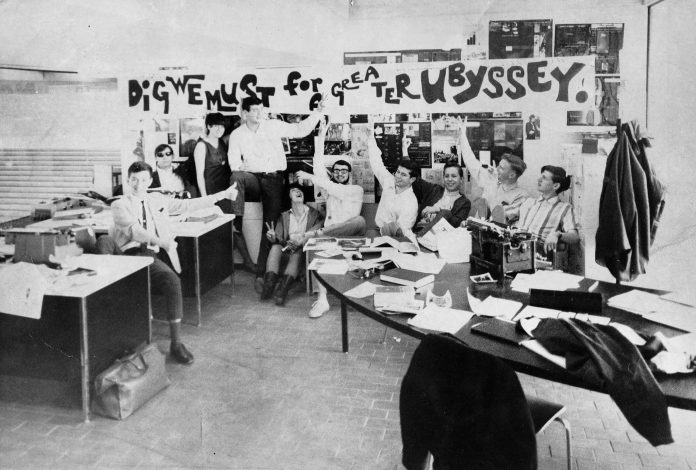
The Ubyssey, UBC’s student paper since 1918, sued the university in 1995 after exposing a secret deal with Coca-Cola. Their win set new benchmarks for transparency across Canadian universities. This same spirit fuels The Eastern Door, a community paper in Kanien’kehá:ka which started with a print circulation of only about 1,500 copies. Under financial strain from the pandemic, they launched a bilingual site to preserve Elder stories in Kanien’kéha. Perhaps not traditional news, it became the site for cultural and linguistic revival for the community. 

Beyond present-tense media, these newspapers thus also do the work of cultural and political memory keepers. They witness, record, and remember with care that few institutions can summon. They create living archives of sidewalks and townhalls, of public parks and public grief. Take The Sprawl from Calgary — launched just before the 2017 municipal election — its purpose is not to dominate headlines but to deepen them. Funded by over 1,600 readers giving $5 a month, it tries to tell stories that other media don’t. And to tell them slower, to dwell, to notice. This commitment is present throughout the country. In Montreal, a banker named David Price launched The Westmouth Independent and here in Vancouver’s West End, a writer and publicist Kevin McKeown launched The West End Journal to chronicle the small stuff: sewers, rezoning applications, local artists. The news of ordinary life, with the trust that someone will care enough to follow it. 

In a time of sponsored content, disappearing stories, and infinite scrolls, unfolding a local newspaper and smearing your thumb across the newsprint is about joining a quiet ritual of remembering together. 

From the archived cover pages on The Peak’s office walls and the archived photographs of WWII veterans being welcomed back home on Crowsnest Pass Herald’s office door, local newspapers show up every day to document the mundane. As Pass Herald’s publisher Lisa Sygutek writes, “Local papers are the diary of their community.” They record what the dominant media forgets: the lives of seniors, the questions of tenants, the songs of underground musicians, the legacy of local traditions. They gather the evolving symbols, dialects, and concerns of a place before they are forgotten. 

So, we press ink into paper like our ancestors pressed pigment onto rock. We declare: we were here. In the pages of our community paper, we ensure we still are. And in doing so, we believe we can continue to be.

Independent Jewish Voices responds to SFU’s resource list for Jewish Heritage Month

0
This is an illustration of kippahs, tallits, a hebrew bible, lillies, and traditional foods like matzo ball soup, knishes, and latkes spread out on a table in an aesthetically pleasing way. There’s also a Palestine flag laying on the table, though not in the middle or overly prominent.
ILLUSTRATION: Jill Baccay / The Peak

By: Lucaiah Smith-Miodownik, News Writer

In May, SFU shared a collection of resources for Jewish Heritage Month. In response, Independent Jewish Voices (IJV) SFU issued a statement condemning the inclusion of links from the Anti-Defamation League (ADL) and the Centre for Israel and Jewish Affairs (CIJA), which are Zionist organizations.

IJV SFU, “a small collective of anti-Zionist Jewish students” on campus, was explicit in expressing that the ADL and CIJA alike “endorse the International Holocaust Remembrance Alliance definition of anti-semitism, which conflates criticism of Israel with bigotry against Jewish people.” According to IJV SFU, the “definition has been used to smear anti-genocide protestors and perpetuates Islamaphobia and anti-Palestinian racism.” Both organizations have published pieces denying that the state of Israel is committing genocide.

IJV’s statement included a call to action, asking “that SFU revise this resource list with an effort to preserve our university’s commitment to social justice and peace-building.” They added, “We expect that an institution of higher learning, such as our own, would have done more research to understand the nature of the resources they are distributing on behalf of the Jewish community.” 

The Peak spoke with Dina, a member of IJV. Dina compared the resources shared by SFU to the school’s stated commitment to the University Act, explaining that “the idea that this is just a non-political document on Jewish history is obviously not true and does go against [SFU’s] stated goal and position of being non-political and sectarian.” She added, “On top of that, I would argue that CIJA literally has Israel in its name — it’s an explicitly political organization. 

“We ask that SFU revise this resource list with an effort to preserve our university’s commitment to social justice and peace-building.” — Dina, Independent Jewish Voices SFU

“It’s really hard to claim that anything is non-political these days, especially when there’s a genocide going on. You can’t really be neutral in a situation like that.” While IJV reached out to SFU after the document was sent out, the university has yet to reply. SFU told The Peak, “The university often shares resources from the Canadian Centre for Diversity and Inclusion (CCDI), or other partner organizations, for those in our community who may be interested. The three-page document on Jewish History Month contained around 80 links to articles, groups, movies, books, podcasts, and social media accounts. The list is compiled by the Canadian Centre for Diversity and Inclusion and any questions or concerns about those educational resources should be directed there.”

Dina explained, “We as Jews have no problem in educating people when it comes to anti-semitism, when it comes to Jewish heritage. I just think that it is very, very important that when we’re doing so, we’re doing so in a way that doesn’t pit us against other marginalized groups.” She added, “I also think that there are a lot of aspects of Jewish history and heritage that are not talked about. It’s always very tied to Zionism and imperialist projects.

“Until I got involved with IJV, I didn’t know anything about the Bund, which was a socialist Jewish movement” founded in 1897. It was explicitly anti-Zionist and called for “the abolition of discrimination against Jews.” The Bund “fought for a democratic republic, women’s equality, social reforms, and an eighthour workday.” The movement also defended “Jewish identity, the Yiddish language, and the culture of Eastern European Jewry.”

“Things like that never get highlighted when it comes to Jewish history,” Dina said. Regarding what IJV is focused on at the moment, Dina shared that the organization is hoping to reach out to more Jews at SFU. She also spoke to her involvement in an ongoing project titled the 2025 University Scholasticide Response University Rankings, which involves ranking Canadian universities on “their complicity in genocide and their commitments to various goals and demands that students have laid out.”

SFU is second on the list for “most responsive to scholasticide,” with the ranking giving SFU an “A” for “divestment from or lack of investments in complicit corporations.” SFU has not divested from companies that supply arms to Israel, investing $7.2 million in 2024. University of Alberta, at the bottom of the list with a D+ in divestment, comparatively “has invested more than $130 million per year in at least 46 companies that are well-known violators of Palestinians’ human rights,” according to Just Peace Advocates. All universities that have been graded, the rankings note, would received an “F” had they not been graded on a curve.