
By: Angela Shen



By: Clarence Ndabahwerize, Staff Writer
WHISTLER — A Kiwi tourist was in for a nasty surprise when she woke up at one of Whistler’s renowned lodges and found an emu staring right at her. After screaming for 15 minutes, the tourist activated an alarm which resonated throughout the resort municipality. It was then discovered that this was not merely a one emu situation: in fact, it would prove to be an emu-tionally charged night at Whistler.
Ah, the humble emu. Birds native to Australia, these tourists seemed to be enjoying a holiday vacation as they flooded eateries and ski hills with fluffy scarves (for the blustery Canadian cold, of course!) The scenes were incredible as the RCMP’s Emergency Response Team and Canadian Armed Forces were called into action. Some residents had taken to marooning themselves in the middle of Alta, Nita, and Lost lakes, and aptly had to be airlifted to safety.
“Bro! It’s the only way to escape those silly flightless birds,” said a Subaru driving character who was wearing plaid.
A meeting at the town hall revealed that a homesick tourist had in fact managed to sneak in a couple of emu eggs. The eggy culprit was nowhere to be found. Additionally, it seemed that many people, while terrified of the birds, found them rather sweet. Some thought they were a part of a tourism event, and embraced the birds’ presence with glee to the authorities’ chagrin. Other tourists, from Medellín, Colombia watched in terror. They knew how dangerous an invasive species could be given the situation with Pablo’s infamous hippos. They elected not to say anything.
A visit by the Premier and Prime Minister to ascertain the situation ended up a disaster as the birds seemingly got more rattled and began to herd the residents out of Whistler. The victorious emus championed their victory, chasing the downtrodden townspeople up Highway 99 on foot defiantly saying, “Allez! We shall return.”
Unfortunately, the emus unexpectedly did well for themselves and have been granted autonomous territory within BC with provincial and federal representation within both the Commons and Senate. It seems that yet again, the emus have come out on top of a fight with the humans. Legislators have said it will take some getting used to “having these giant birds around,” and translators have reportedly made good progress with emus for the Senators and members of the houses.
By: Nercya Kalino, Staff Writer
Harambe Ethiopian Restaurant
2149 Commercial Dr., Vancouver / $8–$30 per plate (small and large portions)
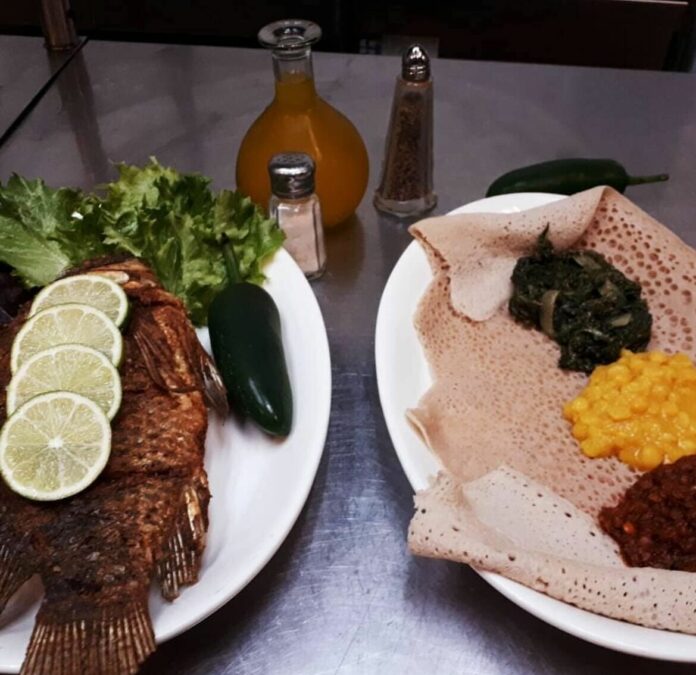
Harambe is a great place to experience Ethiopian culture and food at once. The restaurant has a beautiful, inviting interior with cultural art on display. Once you have some food on your table, you’re in for an unforgettable experience. They have vegetarian, beef, chicken, lamb, and fish options; an advanced selection of tasty experiences to choose from. For appetizers, I recommend miser wot, which is red split lentils cooked with onions, and berbere and harambe organic spices. I find that lamb plates are not common in many cuisines; this would be a great place to try it out. Yebeg wot, which is a lamb stew served with injera (Ethiopian flatbread), comes with three vegetable dishes. This dish is the epitome of Ethiopian cuisine, from the flavour and the plating to the way you eat it. Unlike western cultures, where most foods are eaten with cutlery, Ethiopian food, among other African-originated cuisines, tastes better with your hands. Take out is available.
Di Reggae Cafe
13593 King George Blvd, Surrey / $13–$22 per plate (small and large portions)
From the outside, this spot might seem like an average restaurant, but that couldn’t be further from the truth. This place has plenty of top-tier, comforting meals to choose from. You should start with a tummy-filling appetizer, such as their Jamaican patty, which is a savory pastry with three choices: spicy beef, chicken, or veggie. Or you could go for a sweet appetizer, like slices of ripe fried plantain. For their main meals, they have meat, chicken, vegetarian, seafood, and roti options. There’s something for everyone. My personal favorite is the oxtail stew, which is more tender than you could imagine, simmered with potatoes, carrots, and sweet peppers. It’s mildly spicy and served with rice and kidney beans. For their chicken plates, you might want to jump right into the jerk chicken, which is by-far the most satisfactory plate. You’ll definitely want a take-away portion for later.
Kilimanjaro Snack House
789 Kingsway, Vancouver / snacks $3–$15, meals $15–$27
This restaurant is named after the highest mountain in Africa, which is located in Tanzania. They offer a large variety of snacks that are enjoyed as part of Swahili culture, such as mogo, vegetable pakora, kachori, as well as sweets snacks such as gulab jamun. They also serve meals, including vegetable curry with rice or roti, kheema curry, coconut daal and rice, muthiya, biryani, and mishkaki. One of the best ways to experience this East African cuisine is by bringing friends or ordering takeout with them. With their exciting menu, it would be hard to choose where to start, but with friends, it would be easier to try more dishes by sharing. It’s a great way to share a memory with your friends, without emptying your pockets.

By: Kelly Chia, Humour Editor and Nercya Kalino, Staff Writer
The Peak has had the incredible opportunity to gather two of SFU Burnaby’s most coveted raccoon starlets: resident food critic Reginald the III himself and Stinks the Raccoon, TV personality extraordinaire! These grubby little paws possess knowledge of every corner on campus, and we are blessed to have them with us today.
In this new segment that totally doesn’t parody our own Opinions section, we have “Opinions in Garbage!” Watch these two starlets tackle SFU’s biggest questions, like why logging into your email or Canvas actually boots you to the log out screen, or whether SFU Burnaby’s bathrooms could ever compare to Surrey or Vancouver!
This time, we’re making them tackle something close to home. What do you two think of the garbage cans around campus?
Reginald the III: First of all, I’m honoured to have a space on your human periodical, fellow SFU dwellers. But I have to say, I think this is a rather droll question to direct to me and my fellow raccoon. There is obviously one correct answer, right, Stinks?
Stinks the Raccoon : Certainly, but your grace, don’t forget our work is much more enticing compared to SFU students’ work. They might find our dialogue redundant, but they’ll tune in. Regardless, the garbage cans as a topic is subjective, Reginald the III would know. Sounds like someone needs to do some research.
Reginald the III: That’s right, a better question more well suited for serious news in the raccoon community is how we feel about garbage infighting! Now, that’s a hotly debated topic. Just imagine our youngest raccoons, munching on old Tim Horton’s wrappers instead of the juiciest pears rolling behind the Nester’s Market! I just can’t imagine it, Stinks. It is so important to have sustainable scavenging practices for our young’ins. You know my humble opinion of the Burnaby campus’ greatest, obviously, I have a soft spot for the Surrey campus. What do you think of the garbage options at SFU, if I could have a penny (or a half-eaten orange) for your thoughts?
Stinks the Raccoon : Now that’s a question! Well, let me tell you something. Garbage riots make for good content. Do I condemn it? Certainly, but whenever it happens, you know where I will be with my camera. And of course as the younger generation, we have a level of entitlement especially with the dining expansion! Some raccoon s will be losing their paws I tell you. So far, I think I am still learning which garbage bins benefit me best. I am not a picky eater but if we need to be honest, the Burnaby Residence garbage sucks! There are just low quality items there. So I have to agree with you on this one Reginald. I guess my question would have to be what is the weirdest human encounter you’ve had when dumpster diving?
Reginald the III: What a wonderful question! I must agree with you, Stinks, even for a budget or comfortable option for your regular raccoon, the Burnaby Residence garbage is simply sub-par. There is so much soggy spinach from the humans’ intent to eat healthy produce, and it is boring! I wish they would try . . . some apples, or some dragonfruit. Some diversity would really brighten up that dump. As you know, yours truly prefers to dine alone. So I would say the most interesting encounter was when I made eye contact with what the humans call Mc . . . Dog? Anyways, there I was, and this furry imposter was staring straight at me as I tried to settle for my dinner! It was so upsetting. Have you encountered anything like that, Stinks?
Stinks the Raccoon : McDog, what a name . . . I’m sorry for your encounter and I do hear you on the lone dining. As for me, what I am about to tell you dies here in this article. As usual, I brought my camera with me for a small vlogging trip down at the Burnaby residence, behind the graduate resident building. I approached the bins, mind you, this was just after sunset. I heard some grunting and rustles inside the bins. So I thought maybe it was just some raccoon s playing around. No! There was a human inside. Rummaging through the trash. What a sight! I was recording the whole thing live. I must say, that was my highest rated video.
Reginald the III: Well! I surmise we have inspired the humans, and that is cause for celebration. I remember watching that video myself, and it gave me a good old chortle. Now, I think we’re overdue for a meal together, old friend. What do you say we ditch this intrepid underground office together?
Stinks the Raccoon : Well, of course! A dinner with you is the highlight of my day. I know your followers will surely be jealous of me, your grace.
Reginald the III: And mine yours, dear friend! Let’s ditch this interview.
By: Saije Rusimovici, SFU Student
For Vancouver’s cultural communities, community spaces help preserve culture and offer a sense of belonging. As a hub for both educational resources and interpersonal connection, newly-opened Vancouver Black Library (VBL) is the comfortable space that does just that.
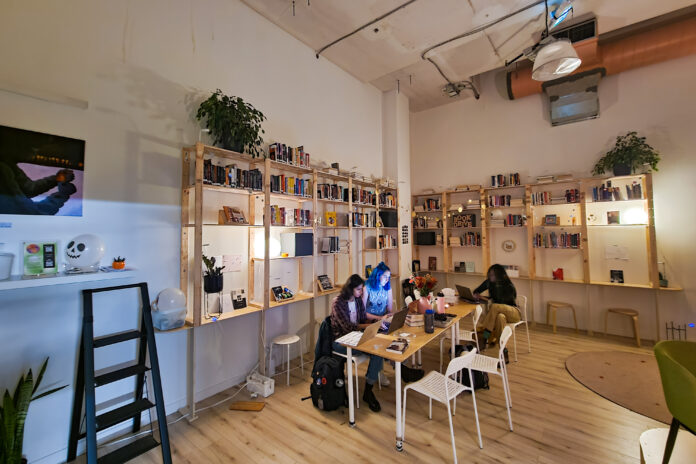
Close by to where the historic Black cultural hub, Hogan’s Alley once stood, VBL is a lofty, cozy space, complete with hand-crafted bookshelves, a movie projector, and several spots to read or study. Located in the basement level of the Sun Wah Centre on Keefer Street, it’s the ideal workspace for any college student. The minimalist decor offers a welcoming space for not only members of the BIPOC community, but anyone looking for a place to study and learn from Black perspectives.
Founder Maya Preshyon, a 21-year-old student at the University of British Columbia, wants people to feel at home in the space she describes as “a boujee community centre.” As a driven advocate for the Black community, Preshyon’s idea for the space stemmed from a desire not only to connect people to a source of information, but also to each other. As urban development has displaced much of Vancouver’s Black population, the purpose of VBL is to bring a sense of community back to the area.
“I wrote for my school’s magazine and was involved with the radio station [ . . . ] and I thought through that I could find a space that I felt like I was welcome or represented, but that wasn’t always the case,” Preshyon said. She noted there were structural barriers that made it difficult for her to find support within that environment. Inspired by the International Gallery for Contemporary Asian Art (also located in the Sun Wah Centre), she made it her goal to recreate a space with a similar concept for the Black community.
The library construction began as an almost entirely crowd-funded project, built to make people feel like “they were in a space made with intention and care, elevating the idea of a community space,” Preshyon said.
The library contains a collection of books by Black authors, as well as familiar favourites, with an additional 1,500 books in storage waiting to be catalogued in VBL’s unique system. Their goal is to create an inclusive, decolonial, anti-racist process of cataloguing, assisted by volunteer Nola Boasberg. The books are catalogued to highlight narratives and perspectives told by the BIPOC community, as well as allowing space for new and diverse voices.
“There are a lot of ways that categories can isolate people,” Preshyon said. “Community input and the advice of librarians has been super integral in making it good, and we’re constantly trying to make it better.”
VBL is accepting monetary donations through their GoFundMe page and are currently accepting books as well. “If you have a favourite and want to pass it on, we’d love to have it.”
Visit the Vancouver Black Library to learn more about the history of Vancouver’s Black culture, meet new people, and keep the culture alive.

By: C Icart, Staff Writer
I am one of over a million Francophones in Canada who live outside Québec. A common response I get when Anglophones hear this is to tell me they did French immersion as a kid. I’m not quite sure why this happens, since they almost never try to have a conversation with me in French afterwards — probably because almost none of them are fluent in the language.
When people tell me they did French immersion, what I’m hearing is, “My parents wanted me to get the benefits of French immersion.” A good amount of students who don’t finish grade 12 enroll in French immersion. Of those who don’t transfer out, CBC reports, “only 10 per cent finished Grade 12 with an ‘advanced’ or better level of French.” But if the benefits aren’t fluency in French, what are they?
In practice, these programs are often elitist, perpetuate inequalities, and cause what some call a “two-tier school system,” which is a system where one group has more advantages than the other. Another way parents have described it is a “private school within the public system.” According to Caroline Alphonso from The Globe and Mail, this happens because French immersion programs have more students with “parents with a very high socio-economic status, a university-level education, and who were both born in Canada.” This contributes to a vicious cycle since outside Québec, English-French bilingualism can lead to more work opportunities and better pay.
Students from low-income families, immigrant families, and students with lower grades, disabilities, or behavioural problems are often overrepresented in English-program schools. It’s time to acknowledge the truth: this enrollment in French immersion is a form of “streaming.”
Streaming is “the process of dividing students into differentiated groups based on their perceived academic ability and/or prior achievement.” It’s common in schools across Ontario and in French immersion schools. Studies have shown this results in worse academic outcomes for students placed in “lower-level” courses. This is a self-fulfilling prophecy because of the stigma and perceptions teachers and students develop about supposed academic potential.
It’s natural for parents to want to enroll their children in what they perceive as the best school programs. In fact, some parents have gone as far as camping overnight to secure a French immersion spot for their child. However, children with learning disabilities are often encouraged to leave French immersion schools and allophone (one whose first language is neither French or English) students are generally discouraged from enrolling in the first place. These are some of the ways that systemic inequalities manifest themselves in French immersion programs.
As enrollment in French immersion increases across the country, the number of Canadians who are fluently bilingual in English and French is going down outside of Québec. It’s time to recognize that French immersion is separating students in ways that perpetuate inequalities. The idea that these programs actually produce bilingual adults is a myth. Single-track French immersion is not the only way to teach French. In fact, that may hinder some students as they are discouraged from asking questions in English. We need an approach to education that takes all students into account instead of being tailored to a certain type of student while the others are pushed out.

By: Hannah Kazemi, Staff Writer
Richard Frank, SFU researcher and associate professor for the School of Criminology, recently conducted a study to identify strategies to combat online child exploitation. The Peak sat down with Frank to learn more about his research and its implications.
Research into automating a process to combat online child exploitation started over a decade ago, in collaboration with a graduate student at the time. Frank described the method and process, indicating it involves using digital fingerprints of images given to them by the RCMP. “Once we download some of these images and fingerprint it and compare it to a database that the RCMP gave us, that is how we would identify a known child exploitation website,” Frank explained.
This process is automated so that it uses software to identify child exploitation websites, thus initiating a continuous loop of identifying websites. “The idea behind the paper is that these websites have links to each other. If a person is looking for child exploitation images, they would go to a website, look around, find a link [ . . . ] follow it into another website [and so on]. So they can discover multiple websites this way.”
The automation of the destruction of exploitative websites is simple: “We wanted to map this network out and identify websites which, if you were to remove it from the network, would cause the biggest disruption to the network. So an offender or person interested in this content wouldn’t be able to discover other websites.”
Frank told The Peak that through their research, they found online child exploitation is a much more severe problem than originally thought. He said they were “surprised by just how easily discoverable [child exploitation] was. But looking at statistics, a lot of statistics show that the problem is much more severe than the networks that we had built up.”
These networks continue to evolve; Frank said that over time, some websites are removed from the network “possibly by law enforcement, possibly by good samaritans. People who have the ability to hack into these websites will take them out, because no one likes that kind of content on the internet. So it is a fine target for a lot of ethical hackers.”
Frank said before starting this project, he approached the RCMP to work out the legal aspects of conducting this specific research and mapping online activity, and learned that the RCMP has also attempted to tackle this issue. However, due to how quickly the internet changes and the way websites pop up and disappear, Frank said the RCMP was “completely overwhelmed. Given the resources they have, they can only look after the worst of the worst of the worst offenders. So we wanted to see how we could help in that process.”
This study into combating online child exploitation is the predecessor to other research and work done by Frank; he has created a tool called The Dark Crawler. It is a data collection tool Frank developed in order to search for and identify both online child exploitation, and online extremist activity.
When asked about what’s next on the path to research methods of combating online child exploitation, Frank said he can’t do it on his own. “Much of my research is student-driven [ . . . ] If a student approached me saying, ‘I’m really interested in mapping out child exploitation networks, or try to identify other ways of combating this problem,’ I would happily take them on and continue this work. I can’t do it myself, unfortunately. So if help is available, I’m very happy to continue.”
For more information on The Dark Crawler project, visit their website.
By: Michelle Young, Editor-in-Chief
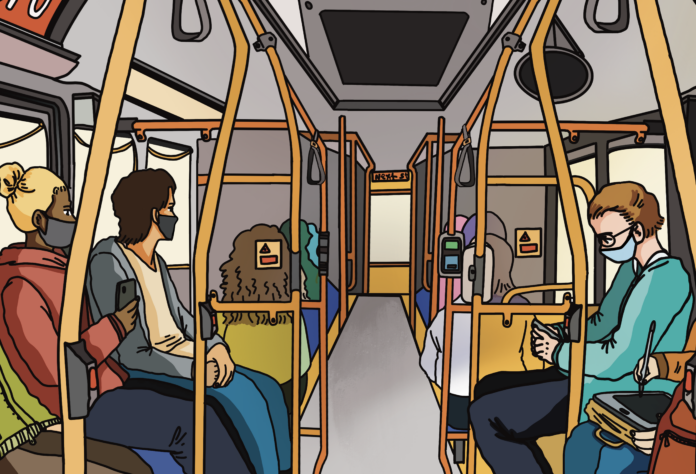
Since March 2022, masks are no longer mandatory in public spaces. Not only is this a huge public health and human rights failure, but it’s evidence that this province and country cares more about the façade of moving forward than protecting the lives of its citizens.
Before I get hit with the “COVID-19 is mild and we have the tools” rhetoric, I’d like to preface this piece with a reminder that COVID-19 is still killing large amounts of people, disabling many others, and public health failures are leaking into our healthcare system. Directly or indirectly, this affects all of us.
After two years of pandemic precautions, and pleading with people to do the bare minimum, I’m exhausted. I can talk about all the studies, news pieces, and evidence that backs universal masking, but as long as it isn’t “required,” lots of people don’t care. But wearing a mask is more than a simple requirement — it’s an equity issue.
Back in 2020, many spoke on how COVID-19 disproportionality affects disabled people, low-income individuals, and people of colour. These groups are still being affected by COVID-19. It should go without saying that these lives are worth protecting. However, virtual events are no longer as widespread, public spaces are still widely inaccessible, and many leftists protesting human rights are forgetting about disability solidarity.
The same people who gladly wore a mask when required have peeled back their “commitment to equity.” Organizations who champion themselves as equitable and accessible are cleaning their hands of any responsibility. On an individual level, wearing a mask will help curb infections, protecting yourself and those around you. On a larger scale, event organizers and institutions should be keeping in mind how they can create COVID-19 safe spaces for everyone. Anything less than that is exclusionary.
You cannot claim you care about equity, accessibility, or disabled people if you aren’t helping to create safe spaces for everyone — this includes the basic practice of masking. When mandated, this wasn’t an issue for the majority of people, and polls show that most are willing to mask.
If you’re someone who cares about human rights, or even just the well-being of others, you should wear a mask. It shows you’re not just following BCCDC “guidelines” without question, since their recommendations and information have been all over the place — often lacking data and precautionary principles to back themselves. The Canadian government is not known to have progressive policies on climate change, racial equality, or disability rights to begin with, despite what many believe. We must critically think about how these guidelines disproportionately affect the same groups we claim to care about.
If you can help make public spaces safer for everyone, why wouldn’t you? Wearing a mask should not be a personal choice — but by government guidelines, it now is. Make the right one.

By: Suraj Raj, SFU Student
Today’s exploration in Cryptid Spotlight takes a turn toward the sewers. Isn’t it difficult being a student with an 8:00 a.m. class? You have no time to eat breakfast. Now you have to leave for class and a thought plagues your mind. What if I need to take a dump in the university toilets?
SFU has a wealth of toilets at your disposal. Every corner you turn on your way to class is a constant reminder you need to release the beast. Your stomach churns and grunts as you try to go to your happy place but the intensifying pain prevents you from doing so. You’re already late to class, what can you possibly do to keep it in? Now, what if I told you that an exquisite bathroom on campus could really exist? This SFU bathroom will make all your poop-relieving dreams come true.
The legend goes, every day, this mysterious marvel of a bathroom appears in a different area around campus. It’s spotless, with the scent of lemon lysol and lavender. A toilet with a seat so comfortable it’s like you’re sitting on a cushion with toilet paper as smooth as silk. The crystal clear water running from the taps is an indescribably perfect temperature. However, only few have ever seen it, and even fewer have had the privilege of using it.
We found one alleged user of the legendary bathroom, Harry Potty, and immediately chased them for answers. They claim the bathroom must CHOOSE to appear in front of you. In other words, you must be worthy of it.
“I was just walking down the halls when the poop shaped scar on my stomach started burning intensely. That’s when I saw it. It was incredible. I felt like I was transported into a magical world. I came out of it a completely different person!” they exclaimed.
Potty also added that to prove yourself worthy, you must first do a trial. Something unthinkable. One must sit on the toilet seat of a regular public SFU washroom, without placing rolls of toilet paper on the seat.
“One day, long before I was blessed with the magical washroom, I was dying. I mean, I literally felt like it was going to explode down there,” Potty reminisced.
“There was no time to think. I rushed into one of the 3rd floor AQ bathrooms. It was super crowded too. Man, that brings back some horrible memories,” a disheartened Potty said.
“However, I made sure I cleaned up after myself. With my all-purpose gloves and homemade cleaning solution I carry with me every time I come on to campus, I left the area spotless. So while I made the ultimate sacrifice, I did not intend on passing that on to the next toilet user,” they said proudly.
Potty also believes that to be worthy of the magical bathroom, one must prove they never leave a stinking mess behind. After all, even the phantom bathroom won’t clean itself.
So there you go! SFU may in fact have the most perfect bathroom known to human existence. But even if you struggle to find yourself to be worthy, there is no reason the regular SFU bathrooms won’t do the trick. If it is scrubbed, swept, mopped, and immaculately cleansed, there is no reason one can’t drop a deuce without a worry in the world about which bathroom on campus is the cleanest one.
Signed,
Suraj Raj, Toilet Expert

By: Gem Yelin Lee, Copy Editor
There are things customers who have never worked in a café will probably not know. Among these include the ability to act like a decent human being with bare minimum manners, and the daily mantra, “cops get decaf.” Especially the ones who wear the white supremacist blue lives matter patch. Here’s a small, miniscule, condensed list of things that make me seeth behind my mask:
You should be nice to your barista. Your barista is always right. Because you never know if the one time you started screaming obscenities over a thawed pastry (no, we don’t bake these in the back) is the time your barista rips off their apron and jumps the counter.

Simon Fraser University’s independent student newspaper since 1965.
For advertising inquiries: [email protected]
For promotional inquiries: [email protected]

Simon Fraser University’s independent student newspaper since 1965.
For advertising inquiries: [email protected]
For promotional inquiries: [email protected]