Home Blog Page 229

The game through a goalkeeper’s eyes

0
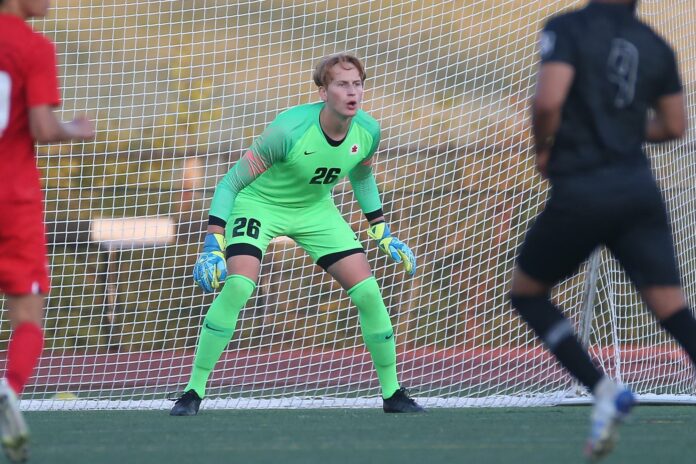
Photo of goalkeeper Jordan Thorsen in net
The luxury of being the only player in your position comes at the price of being put under a microscope. PHOTO: SFU Athletics

By: Clarence Ndabahwerize, Staff Writer

In soccer, the goalkeeper is the sole figure at the back of their team’s side of the pitch. In a fixed position and constantly close to the stands, they either receive support or harangue from fans of the opposition. Some might say this makes them the “odd one out” on the team. We interviewed Jordan Thorsen, #26 on the SFU men’s soccer team, to find out whether there’s any validity to these claims. 

“There’s a much finer line between good and bad performances as a goalkeeper,” said Thorsen. For an outfield player, making a few mistakes isn’t magnified as much, he explained. On the other hand, a mistake from a goalkeeper could “sacrifice their [team’s] result.” It’s a lot of responsibility for one player to handle at any given time in a 90-minute game. “Goalkeeping is polarized that way,” Thorsen admits, “You really are the hero or the villain. You are essentially an individual in a team sport, which can feel lonely, especially when you haven’t been playing well.”

Despite the position’s spotlighting nature, Thorsen knew he wanted to be a goalkeeper from the time he started playing soccer. Growing up, his biggest inspiration was Danish Manchester United goalkeeper, Peter Schmeichel. His love for the goalkeeper came from his father, who grew up in Denmark and showed him highlight videos of Schmeichel in his formative years. It’s no wonder Thorsen’s current favourite club in the English Premier League is Leicester City — the same team Kasper Schmeichel, son of Peter Schmeichel, plays for.

When it comes to training, Thorsen acknowledged the athleticism required for a goalkeeper is remarkably different from outfielders. “Whereas outfield players are more endurance-based athletes, goalkeepers are all about explosivity, and training reflects that.” He likened training days to doing burpees for an hour. “Training as a goalkeeper reflects the perfection which is demanded by the position,” said Thorsen, “Repetition. Repetition. Repetition, until you can do it almost perfectly every time, because perfection is what is demanded from us.” 

So, how does Thorsen push down these thoughts of perfection during a game? Although he confessed to feeling nervous before matches, instead of letting it get the better of him, Thorsen has learned to turn the nerves into focus. “As soon as the starting whistle sounds, a lot of those nerves melt away. You’re still [nervous], but again, if your mental game is sharp, it’s far more of a blessing than a curse.” Being in goal has also allowed Thorsen to see everything on the pitch, like “team morale dropping in the face of a great challenge.” 

So, sure, goalkeepers may be hanging by themselves in no-man’s land for the majority of games, but it’s anything but quiet on their side of the pitch. Having the best seat in the house forces goalkeepers to have a “very vocal presence,” and be “great leaders in times of adversity.” Sometimes, it can be a much-needed save, and other times, it’s keeping your head up for the team because “no challenge is insurmountable in [soccer]. You have to believe that.”
What Grinds Our Gears: Why are we still using iClickers!?

0
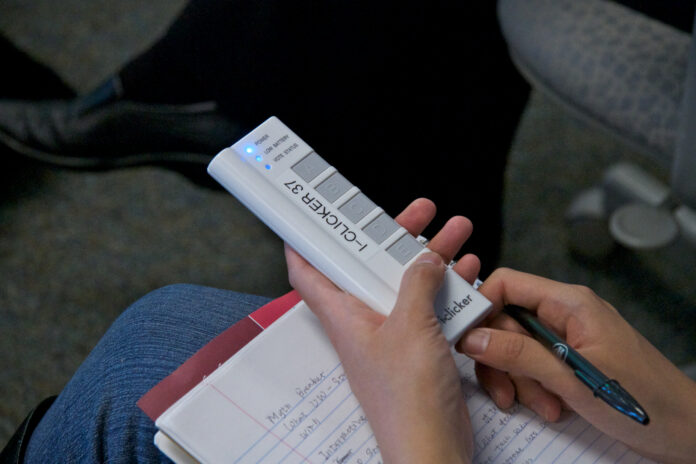
hand holding an iClicker device
Can't we just use our phones for this!? PHOTO: Alan Wolf / Flickr

By: Nercya Kalino, Staff Writer

Throughout our university degrees, we’ve all been in a course where the professor clearly states that not having an iClicker will affect your attendance grade. That isn’t fair. Quite frankly, I think iClickers are a waste of time. We go through all that clicking in class only to have another canvas discussion, quiz, or module that achieves the same goal of boosting your grade.

Now more than ever, the iClicker is a useless device. Most activities nowadays, like using a calculator, can be done on your phone. If your professor requires you to buy an iClicker for their course — nine out of ten times, you’re unlikely to use it much in the future. Live quizzes hosted on Canvas or even the new iClicker app, would be a more reasonable advancement.

I’ve had my pricey iClicker, which I purchased myself, since the Summer of 2019. I have only used it once  that’s it! Now, many of us have sold ours after realizing just how much the iClicker is a waste of money.

Disabled and Disbelieved: People with invisible illnesses still aren’t taken seriously

0
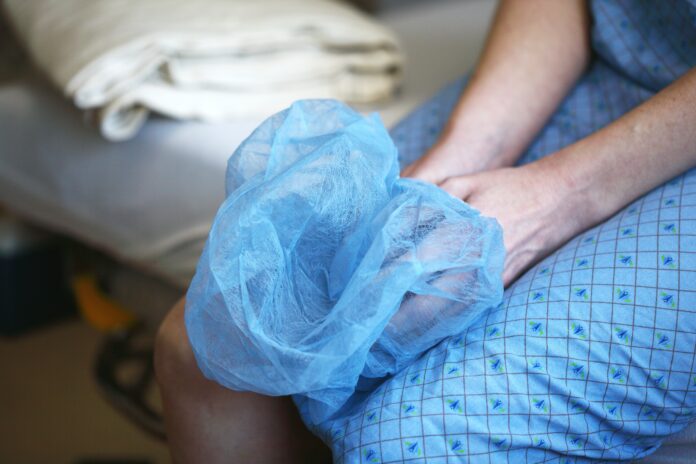
hands of someone in a hospital gown holding a medical hair net
Inclusion doesn’t start with telling people they’re lying. PHOTO: Alexander Grey / Unsplash

By: Olivia Visser, Opinions Editor

Content warning: ableism, online bullying

Disabled people still experience considerable social stigma in modern society. Although online awareness is on the rise, communities still face backlash by able-bodied people who are uncomfortable with the way some people express themselves. Online communities dedicated to calling out “illness fakers,” and defamatory news articles discourage invisibly disabled people from seeking like-minded support.

Recently, the Daily Mail published an article titled “Addicted to being sad: Teenage girls with invisible illnesses — known as ‘Spoonies’ — post TikToks of themselves crying or in hospital to generate thousands of likes.” If the article’s headline didn’t raise enough red flags for you, its content is just as disturbing. Ignoring the fact that the piece takes much of its content from an equally harmful Common Sense article, it upholds a fallacious rhetoric about disability. To older generations who might not understand Gen Z and millennial social media culture, this piece of writing anchors ignorant readers in their already troubling beliefs. The idea that young people are faking their identity for attention is a narrative that harms marginalized communities in many ways, from queer and trans people, to disabled people. For disabled readers, the message is clear: shut up and suffer in silence because your pain “isn’t real.”

The term “spoonies” refers to spoon theory — a concept created by invisibly disabled activist Christine Miserandino. For no particular reason besides being in a café at the time, she picked spoons to illustrate to a friend what it’s like to live with a chronic illness. To her, everyone starts their day with a set number of spoons, which represents their ability to expend energy. Disabled people often start with fewer spoons, so they have to limit or adjust their activities in order to prevent exhaustion and burnout. The simple yet effective analogy spoke to many people online, who dub themselves “spoonies” as a way to identify with other disabled people.

Emma James, Daily Mail senior news reporter, asserts the spoonie community “encourages [people] to lie to doctors in order to get the diagnosis that they want.” However, she never gives any examples of someone encouraging others to lie to doctors about their symptoms.

In any community, there will be some who lie or are misguided, but such a small fraction of spoonies actually fit that bill. Why should an entire community suffer from stigmatization because of a few outliers? I’d be inclined to say almost everyone who complains to doctors about disabling physical symptoms has some sort of undiagnosed medical illness. Perhaps James never considered that people are not seeking diagnoses they want to have, but answers to very real and life-altering symptoms they experience.

It’s easier to judge disabled people when you’ve never had to deal with regular stigmatization from doctors, friends, and now strangers online. A subreddit dedicated to calling out “illness fakers” has over 125,000 followers. Behaviour like this, which targets the infinitely small percentage of “fakers,” vilifies everyone sharing their disabled experience online. It inevitably ends up targeting people who are actually disabled in the process. One autistic TikToker, Raven DeRose, shared her experience with being called a faker by redditors for . . . wait for it . . . dancing for the camera. It’s ridiculous.

The Daily Mail article follows shortly after J.K. Rowling released her new novel, The Ink Black Heart, which has received backlash for targeting trans and disabled communities. Critics suggest her writing is driven by disdain for the massive criticism she regularly receives after sharing her transphobic beliefs on Twitter. Now, she’s targeting the disabled community, which is increasingly receiving its share of online cruelty and discrimination.

Articles that call disabled people “addicted to being sad” grossly underestimate the isolation that comes with physical or mental illness, and the genuine comfort social media can bring. Online communities can offer meaningful support for those who find themselves unable to socialize in-person, especially during COVID-19. Able-bodied people don’t need to fully understand this, but they do need to respect it.

Nobody has the right to decide whether someone is faking their illness, and it’s none of their business anyways. The fact that this even needs to be said should spark concern. Considering 22% of Canadians over 15 have a disability, we must let go of our mindset that tells us disabled people are a rarity — we’re not. Disability sits at the intersections of all identities and communities. The spoonie community doesn’t represent anything toxic, besides reflecting back a society that’s guilty of excluding and misunderstanding those with chronic illnesses.

September 17 is set to be a big day for the SFU football and volleyball team

0
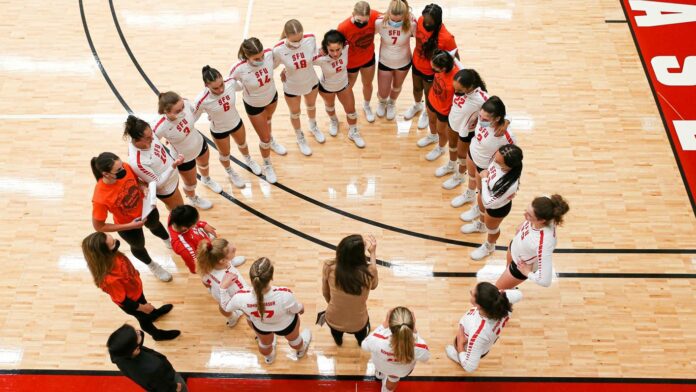
Photo of the SFU volleyball team in a huddle.
The volleyball team looks to exercise some demons on the road, while the football team hopes to beat a nine-year streak. PHOTO: Paul Yates / SFU Athletics

By: Simran Sarai, Sports Writer

For SFU’s football and volleyball teams, September 17 is a date that’s been circled on their calendar. It’s all about opportunities for the football team. After four of their five home games were relocated to Blaine, Washington, September 17 will be men’s first and only home conference game at Terry Fox Field. For the SFU volleyball team, it’s a shot at redemption. The team will come face to face with Western Washington University (WWU) in Bellingham. The last time these two teams met, Western Washington eliminated SFU from the playoffs. We reached out to members from both teams to understand if these storylines were a focal point in preparation for their matchups.

SFU Football

This may be SFU’s first game in the Lone Star Conference, but it’s against an all too familiar opponent in Central Washington University. SFU hasn’t won a game against Central Washington dating all the way back to the 2013 season. The best chance to do so last season was at home, when SFU found themselves trailing their opponent by one point at halftime. This time around, the team is hoping to get a win in front of friends and family. 

When asked about the team’s unique border situation, senior kicker Kristie Elliott says the team will have to do the most with what they’re given. “Obviously, it’s not the most ideal situation for us. We were so excited to have five home games, and now we’re only down to the one home conference game. It sucks, but what can you do about it? We’re still gonna go across the border and do the best that we can.”

The only home game of the season bears extra importance to Elliott, who is one of many seniors taking to the field to play one last game at SFU. Normally, you wouldn’t expect the first game of the season to carry such bittersweet sentiments. Because this will be the team’s final home game, graduating seniors will be honoured at the start of the season, as opposed to near the end. “It’s a big night for me,” Elliot said, “I’ll probably start crying.” 

While it might not be the team’s first choice to sub out their home games to go across the border, Elliott is excited to get the chance to experience the football culture in southern American schools, which mainly make up the Lone Star Conference. “Football is completely different down there [ . . . ] There’s so many people there. Each football [team] has their own little football town.” She also spoke to the excitement and anticipation of the whole team, who are preparing to play against a slate of new teams this season. “I think it’s going to be a challenge, but I think we can take it on.” 

SFU Volleyball

The volleyball team had a strong 2021 season, going 17–9 and making it to the West Regionals for the second time in program history. However, the team was eliminated in the quarter-finals matchup in four sets by WWU. The Peak spoke with junior libero and defensive specialist Kalissa Beltran on the team’s hopes for redemption against WWU, and the team’s goals for the 2022 season.

Speaking to their elimination last season, Beltran highlighted the team’s gratitude in advancing to the playoffs in a highly competitive Great Northwest Athletic Conference (GNAC). This preseason alone, the GNAC teams had a .700 winning percentage. What makes these two matchups even more challenging is the compatibility in their playing style. “Western Washington does a lot of things well [ . . . ] Both WWU and our team are gritty and passionate, making for a great match.”

When asked whether taking on WWU in Bellingham upped the stakes for the team, Beltran spoke clearly about the team’s focus on their own play, regardless of the opponent. But, she did acknowledge away matches can “create more of a fire” to hand the home team a loss in their own building. Beltran assured us the team is “less focused on expectations and more on simply getting 1% better every day.” The team is also heading into the 2022 season with the desire to represent SFU and its adopted name to the best of their abilities. “We are excited for this season under the new name and we will be focusing a lot on our side of the court and playing for each other.”

The Rundown

0
Photo of SFU golfer Shirin Anjarwalla mid-swing.
Shirin Anjarwalla’s golf team gets off to a good start at home. PHOTO: Wilson Wong / SFU Athletics

By: Isabella Urbani, Sports Editor

Men’s soccer — September 8, 10 

The men’s soccer team split their two games at the Colorado Mesa Kickoff after opening their first match with a tight 1–0 victory over Fort Lewis. Goalkeeper Justyn Sandhu earned his third clean sheet in as many games, getting some support from Alan Soto’s first goal as a Red Leaf to earn the win. SFU dropped the following game to host, no. 18 ranked Colorado Mesa by a score of 3–1. The team will return home to play conference games for the remainder of the season. 

Women’s soccer — September 10 

The women’s soccer team earned their second straight tie after being unable to notch a third goal against California State, Los Angeles on the road. Both SFU goals came in the opening half, starting with freshman Kaylese Callender’s first goal of the season less than two minutes into the game. However, California State quickly took the lead after scoring two goals in 1:32 seconds. SFU was able to battle back to tie the game thanks to junior Kiara Buono

Women’s volleyball — September 10

The women’s team picked up their second consecutive win at home, needing all five sets to steal a victory from Seattle Pacific. Entering the third set with a 2–0 lead, it looked like SFU was going to pull off the sweep until their opponents followed up with two tight 25–23 winning sets. SFU was able to hold off the comeback, bringing their record to 5–6 on the season.

Women’s golf — September 12–13

The women’s golf team matched last year’s second-place finish at their first classic of the year. However, this year, the classic was held on home turf at the Richmond Country Club. The women finished second on both days of the event, a total of 43 strokes over par. Hats off to freshman Chloe Tran, who led SFU with her fourth-place solo finish at her first collegiate competition. 

SFU Football Alumni Spotlight: Jon Choboter

0
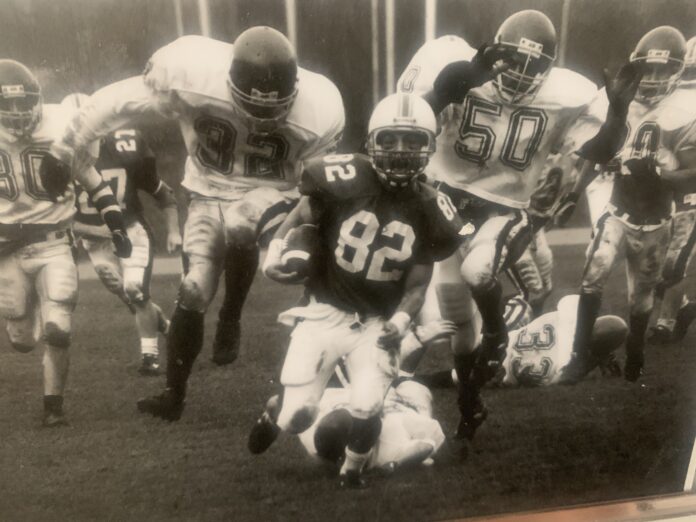
A black and white photo of Jon Choboter running with the ball.
Choboter playing for SFU versus Central Washington University, 1992. PHOTO: Jon Choboter

By: Hannah Kazemi, Staff Writer

We often hear about SFU athletes who have stepped up or had a particularly impressive season, but what happens to those athletes when they graduate and leave SFU? In this Alumni Spotlight series, The Peak will be sitting down with four SFU football alumni to find out how and why they continue to support SFU’s young student athletes 30–35 years after their time with the program.

The SFU Football Alumni Society is made up of four main executives as well as members-at-large. It relies on supplementary alumni and sponsors to provide services like financial aid, mentorship, and ongoing support to current SFU football players. This week The Peak spoke with Jon Choboter, ongoing treasurer and current member-at-large of the society. Choboter played on the SFU football team from 1989–1992 as a wide-receiver and kick-returner. In 1992, he set the SFU National Association of Intercollegiate Athletics record for most yards per catch and third-most return yards.

When asked about his favourite memory from SFU, Choboter didn’t bring up any accolades. Instead, he settled for the multi-sport annual rivalry game between SFU and UBC for the coveted Shrum Bowl. While bragging rights were on the line, Choboter said it was the massive fan turnout that really got players excited. More than the memories he made on the way, Choboter also reflected on how his time as a student athlete has been transferable in his everyday life: “As a young person, it’s good to kind of go through that [ . . . ] you can always take those skills afterwards and use them for the rest of your life.” Some of Choboter’s teammates have done just that. “A lot of them are managing large companies and so on,” he revealed, “and a lot of those skills come from their early days at SFU football.”

The SFU Football Alumni Society has been going strong for decades with past players like Choboter returning to support current players both in coaching positions and as part of the executive team. “I learned a lot from the program, and I wanted to give back and be a difference for other young people going through it, because it [made] a big difference in my life in terms of helping me go through some different maturing aspects,” said Choboter. Some of those positive aspects include “discipline, being on time, balancing a schedule, and developing friendships and relationships with other people. ”

One of the ways the SFU Football Alumni Society supports current players is by hosting alumni events, such as the annual Rick Klassen Memorial Golf Classic to fund scholarships for players. This event is what kick-started Choboter’s volunteer involvement with the Society back in 2006. Another big event is the Legacy Dinner, held by the Society every November for graduating athletes. Choboter refers to the night as a “welcome to the club” event. During the dinner, the graduating athletes meet the alumni for a handshake line. Besides showing a sign of respect, there’s a greater meaning behind the gesture. It’s meant to let players know their time at SFU doesn’t have to stop with their playing career. The Society makes sure to post jobs and other contacts on their website. While it was born out of the desire to take care of current players, the SFU Football Alumni Society doesn’t forget about its graduates.

Bright-er Side: Getting to experience the Burnaby Campus for the first time since remote learning

0
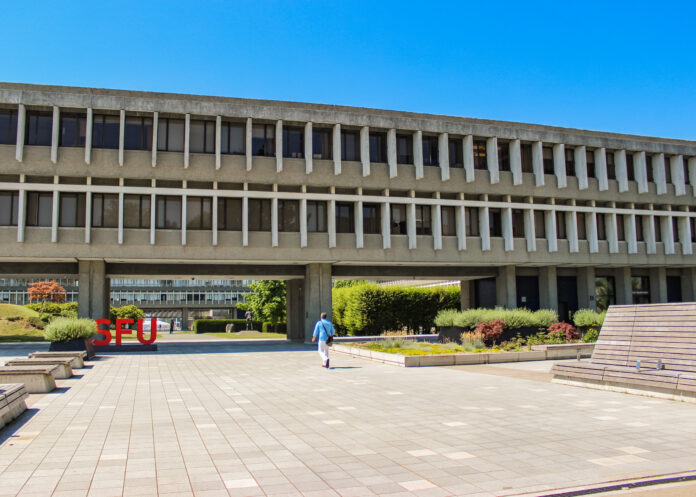
someone walking in front of SFU's academic quadrangle
A fresh perspective on the design of the Burnaby campus. PHOTO: Gudrun Wai-Gunnarsson / The Peak

By: eveluchka, SFU Student

Thanks to COVID-19, I’m a third year student and this semester is the first time I’ve had a class at the Burnaby campus. It’s not been what I expected. For two years, I was told I wasn’t missing much by having Zoom classes. They told me I was better off because it was cold on the mountain, the campus was like a prison, and it’s hard to get to. But the first thing that struck me about the campus wasn’t any of those negative things; it was the sense of tranquillity. The Burnaby campus is an oasis of peace for stressed-out students.

Going to class in Gastown means I get to see the chaotic urban workings of the city every day, which offers a fascinating, but mostly over-stimulating experience. After years of social distancing, it’s strange to be forced into the thick of it all. The Burnaby campus is all at once a part and apart from city living. It’s a way to remove yourself from the hectic nature of a big city like Vancouver, while still being able to meet pretty much any need you have.

The tranquility is only enhanced by the campus’ position in the middle of the conservation zone. You can walk out of Spanish class after a demoralizing quiz and relax while looking at the ocean stretching out to the horizon, or you can just take a few steps out the front door of any of the campus’ buildings and feel like you’re in the middle of any BC forest. It’s incredibly calming.

I’m still new to the Burnaby campus, and I really appreciate it when I’m there. I don’t think I will ever fully lose that sense of wonder. After years of isolation throughout COVID-19, the Burnaby campus has become the most positive type of retreat a way to maintain a sense of calm while still being surrounded by people.

Political Corner: Student debt cancellation is smart, not selfish

0
hand holding an empty wallet
We should want the best for graduates. PHOTO: Towfiqu Barbhuiya / Unsplash

By: Olivia Visser, Opinions Editor

Last month, US President Joe Biden announced plans to cancel up to $20,000 USD in federal student loan debt per person. This is a monumental decision for roughly 48 million US students holding onto student debt. Despite the fact that student loan cancellation will improve the lives of millions, some question its fairness. Taxpayers who never received student loans worry this might place an extra financial burden on their families by increasing taxes and inflation, while those who already paid theirs off feel cheated. While these are understandable concerns, student debt relief can help everyone.

Student loans are a good incentive to encourage the pursuit of higher education. BC’s latest labour market outlook predicts the next decade will see 1 million new job openings, but 80% of them will require some level of post-secondary education. Although a university degree is so influential in obtaining a well-paying job nowadays, government loans are the only option for many prospective students with limited financial resources.

Canada’s NDP Party has promised student debt forgiveness for a while now, but the country hasn’t seen many significant strides in this direction. In 2021, the Trudeau government announced its decision to suspend interest accumulation on federal student loans until March 2023. This is great, but it’s a temporary solution that overlooks the barriers faced by people seeking higher education who have no option but student loans. Next year, low income graduates will once again have to face the reality of paying off their ever-increasing federal student loan debt.

University degrees contribute positively to employment rates and earnings, but we’re living through a crisis of increasing costs of living alongside stagnant wages. 49% of Canadian students have student debt at the time of graduating. Student debt relief lets people focus on important expenses and saving for their undoubtedly costly futures instead of paying off loans that create further barriers to living comfortably.

Joseph E. Stiglitz, professor at Columbia University and chief economist at the Roosevelt Institute, argues student debt relief would have a minimal impact on inflation at its worst. Debt relief critics believe student loan repayment rates would be significantly lower after forgiveness, but in reality the difference is “negligible.” Most people won’t be paying their loans back at high rates anyways, so forgiving them will have an insignificant economic impact. Stiglitz’s article for The Atlantic also argues “student-loan debt is linked to people delaying significant life events such as getting married and having children.” It complicates “starting a family or a small business, moving, or otherwise building up lives.” This isn’t good for our economy.

Why is our society so preoccupied with what other people have? We should all advocate for student loan forgiveness because it helps the greater good. Student debt relief will allow graduates to focus on moving their lives forward, instead of feeling dragged down by finances. This can help everyone. Besides, people shouldn’t have to face barriers to education in the first place. Student loans relieve some of that, but they also trap vulnerable and low-income graduates into lifetimes of unrecoverable debt. It’s about time Canada takes tangible steps towards student debt relief.

Soul Style Quiz: Fall-ing in love

0
Illustration vector of a mint green iPod Shuffle.
ILLUSTRATION: Alyssa Umbal / The Peak

By: Kelly Chia, Humour Editor

Hello my darling sprouts,

You may remember my mother before me, Sylvia XVII, whose express purpose was to divine your perfect style by the mere art of quiz-taking. Now, for my modern perspective as you enter your fall semester. Are you ready to fall in love?

1. What’s your accessory of choice for lecture halls this term, darling?

    1. Your lovely custom-bedazzled iClicker! You dress to impress, and make incredibly permanent decisions based on material you will only use for the first y— I mean, what?
    2. You don three stopwatches with style. The first to check time, the second to remind someone that you have a cool stopwatch, and the third for glorious purposes even I can’t divine. So mysterious!
    3. Oh, a pal for my vintage heart. Metaphorically, of course. Yours truly is very young. You still wear your iPod Shuffle, which has a longer battery life than any phone anyways, and you can play your ten live versions of “Hands Down” by Dashboard Confessional in peace. Emo is so very.
    4. Your accessory is three Red Bulls, let’s GOOOO!!!
An illustration vector of a pair of Ray-Bans.
ILLUSTRATION: Alyssa Umbal / The Peak

2. What do you think you value most in life?

    1. “Everytime we Touch” by Cascada. In your mind, there is nothing more transcendent than 2000’s Eurodance music.
    2. The intangible yet constant pressure of your future to do better, you say? WOW! We’ve got a bummer over here!!
    3. As you do this quiz, you are already starting the cheer, “When I say, ‘Chic,’ you say, ‘Punk!’” I have no power to stop you. A crowd has already gathered around you.
    4. “Value? In this economy?” Fair point, my little energizer bunny. But you must be vulnerable for us to proceed!

3. It’s time for the ephemeral and always relevant question: which line resonates with you, dear?

    1. “Hey now, hey now! This is what dreeeeeams are made of!”
    2. “No line could ever describe my wild, beating heart!” You suddenly shout. A raven mysteriously caws behind you.
    3. “When I was . . . a young boy . . . my father—” That’s enough, you’ve already started singing, haven’t you? Yep, there you go!
    4. “I describe myself more as a circle than a line.” Contrarian, I will compartmentalise you!

4. Of these four completely hypothetical scenarios from my galaxy brain, where do you feel most at home?

    1. The filmset of “Fabulous” from High School Musical 2. Ah, yet another pal after my chagrined theatre student heart.
    2. The actual gears of a grandfather clock, golden and hallowed. You aim to both be unfathomable and consistent, eh?
    3. I can’t even see you. You’ve disappeared into the crowds of Emo Nite!
    4. In . . . in my brain, you say? Why, how intrusive! Why not yours? Or perhaps there is . . . nothing in there of note? Ooooh, burn by the all-knowing Sylvia XVIII!

5. Finally, let’s turn this over: what aesthetic do you think best describes you. Please clap, you’re almost at the results after all!

    1. “Um, like, obviously Y2K.”
    2. “Steampunk all the way.”
    3. “Emo!”
    4. “No aesthetic, just vibes.”


If you answered mostly A’s, you are BEDAZZLED BABY!

Why, yes, you do love your Clueless and Mean Girl and Bratz dolls. I know this, but I also know there is more in you, even if you don’t know this yourself. Your key accessory item this fall is your bedazzler. Bedazzle your notes, bedazzle your professors, and your TA’s! And definitely consider bedazzling your coping mechanisms. If there’s one thing you should learn, it’s to never hold back, my darling child.

If you answered mostly B’s, you’ll be pleased to know that you are . . . MEAN GRANDPA!

Dress up in your finest tweed jacket because you’ll need to remind everyone that you are the undergrad doctor on campus! You pride yourself on being undefinable, and unfortunately for you, this is not that kind of quiz. Your best fashion items can be found inside a magical forest, as we all know you are too poor to actually afford quality steampunk items. But do not worry, you will ascend to your fabulous self! With my help.

If you answered mostly C’s, I hereby dub thee STUCK-IN-A03 KILLER QUEEN!

Um, rawr. XD Not to be mistaken for mean grandpa, I would never make redundant generalisations — that’s why there are four results, after all. You need to stay firmly hidden in a Hot Topic to succeed this semester. Your task is to decorate a super long Furby and wear it, sort of like a cute little boa. I’ve already named him: Sir Snurklepops!

If you answered mostly D’s, my CUTE little villain, you are the DEVIL’S ADVOCATE!

Awww, you. I recognize you just wanted to keep picking the answer that seemed the most fun. BUT THERE IS NO FUN TO BE HAD IN FASHION! There is only divination. And I’ve divined you to be THE DEVIL’S OWN APPRENTICE! Luckily, this too has been laid out in my devious machinations. You see, you will continue, contrarian.

Your lucky accessory is your voice: “Well, actually,” everyone in class! I think you should don little devil horns to really get into character, because you are, for sure, a Halloween bitch. Love you lots!


New study connects sitting time with increased risk of heart disease

0
This photo is of an individual sitting at their computer. Their head is in their hands and they look stressed and tired.
Study says inactive people are up to 50% more likely to develop heart health concerns. PHOTO: Jonadan Cheun / The Peak

By: Chloë Arneson, News Writer

A new study published in the journal of JAMA Cardiology supports the notion that prolonged sitting is associated with increased risk of early death and heart conditions. The research found individuals who sit for more than eight hours a day have a 20% higher risk of cardiovascular disease. 

The Peak interviewed the co-lead of the study, Scott Lear, for more information about their findings. Lear is a health science professor at SFU and has been working on the study since 2003.

The study included over 100,000 people across 21 countries, tracking their heart health over an average of 11 years. It focused on following individuals from countries of varying economic levels.

Lear noted the study may play an important role in preventing early deaths and increasing life expectancy. “People who were active could minimize the effects of sitting,” he said. In the paper, they stated by meeting World Health Organization (WHO) recommendations for physical activity, individuals who sit for prolonged periods can reduce their risk of heart-related issues. 

“Most people probably aren’t thinking about their activity levels,” Lear said. “A simple thing like setting your phone alarm every 30 minutes and getting up to walk around,” can make a big difference, according to Lear. Simple household chores scheduled throughout the day can reduce the impact of those working from home. 

Lear discussed how socioeconomic status affects daily routines and impacts overall health. He noted the majority of studies that have focused on the impacts of sitting take place in higher-income countries. “Most people are working jobs where they sit during the day and then they get their exercise activity during their leisure time,” Lear explained.

The connection between sitting and health concerns was especially significant in lower to middle-income countries, according to Lear. “What we’ve found in our previous research is that this recreational leisure time is almost non-existent,” he said. An analysis of a report released by the WHO suggests that lower-income countries have more opportunities for work and transit-related activity, but significantly less time for leisure. Due to longer average working hours, people in lower-income countries have less time, money, and energy to participate in physical activities outside of work or transit-related movement.

Lear wrote an article for the Heart and Stroke Foundation about “exercise snacking” that outlines the importance of incorporating small bites of movement into our daily routines. He describes simple exercises anyone can do from their living rooms with no equipment or experience, such as jumping jacks or walking up and down a set of stairs. 

In SFU’s news release, Lear also mentioned that clinicians should ensure their patients are incorporating these healthy habits in their lives. “It’s a low-cost intervention that can have enormous benefits,” Lear said.