Home Blog Page 186

Fake crisis pregnancy centres infringe on reproductive freedom

0
multiple people holding up abortion rights signs at a protest, including signs that read “abortion is healthcare” and “trust women”
PHOTO: Manny Becerra / Unsplash

By: Hannah Kazemi, Staff Writer

Content warning: mentions of pro-life rhetoric. 

Masquerading as support services for pregnant people, clinics known as crisis pregnancy centres (CPC) are dangerous and deceive those that require support services to deal with unwanted pregnancies. These centres operate under the guise of neutrality. In reality, they often have religious affiliations and anti-abortion motives. This should be illegal. However, if they continue to operate, they should at least be monitored for bias and medical malpractice. Using vague and misleading rhetoric to advance an anti-abortion agenda imposes on people’s ability to make informed decisions about their reproductive health. While knowing about abortion alternatives is valuable, they must be discussed alongside abortion as a viable option. Anything less is deceptive.

A new report from the Abortion Rights Coalition of Canada (ARCC) showcases how they impose anti-choice ideals onto individuals that unknowingly seek out help from them. These centres provide resources such as baby clothing and counselling services. On the surface, these seem like normal things for CPCs to offer, but the majority of these centres are “Christian ministries” that don’t offer abortion referrals or contraception, and spread misinformation. They often reference “post-abortion distress,” as a fear tactic, which is “not a medically recognized condition.” The issue is that these clinics are not neutral like they claim to be. Pregnant people seeking out care should be receiving unbiased and accurate information. They should not be misled and manipulated into a certain outcome in the process.

Tactics used to persuade individuals away from getting an abortion include discussing abortion risks and alternatives, giving ultrasounds, encouraging adoption, and offering parenting support. Support should exist for those who want to carry a child — but we shouldn’t be trying to persuade vulnerable people by misinforming them of potential risks and outcomes between carrying a child and having an abortion. We should be empowering people with the tools to make a decision for what is best for them. 

The Canadian government needs to ban these centres from providing medical services like ultrasounds, which should only be performed by professionals in licensed medical facilities. According to a separate report by the ARCC on ultrasonography in CPCs, ultrasound misinterpretation can “delay pregnant people from seeking real medical care,” as volunteers can miss dangerous fetal abnormalities. Ultrasounds should be provided for medical purposes, not emotional manipulation. 

The recent report makes it clear crisis pregnancy centres are not regulated in Canada nor are they licensed to provide medical care due to being charitable organizations. In 2021, the Liberal Party promised to remove the charity status of openly anti-abortion groups. However, there’s no way to guarantee that religious and anti-choice messaging doesn’t occur behind the scenes, which further puts pregnant people at risk of not getting the care they need. 

Most crisis pregnancy centres now use vague and misleading language to “conceal their anti-abortion ideology so that potential clients are not deterred if they are considering terminating their pregnancies.” Some centres have been “actively adjusting their language and practices to appear less opposed to abortion” due to risk of losing their charitable tax status if they’re found to be anti-choice. Changing the language they use makes it more difficult to determine a clinic’s viewpoint, which is a sinister way of deceiving at-risk people with unwanted pregnancies. 

Crisis pregnancy centres only do harm to those who go to them for help — the lack of regulation and transparency within these institutions allows individuals to be misled and manipulated by their anti-choice or “pro-life” perspectives. Often, those who seek support from CPCs are already vulnerable, which makes their tactics even more hostile. We should have a right to make informed decisions about our options when it comes to reproductive health. Crisis pregnancy centres violate this right, which is why they need to be stopped. 
Adopting new research methodologies in the context of reconciliation

0
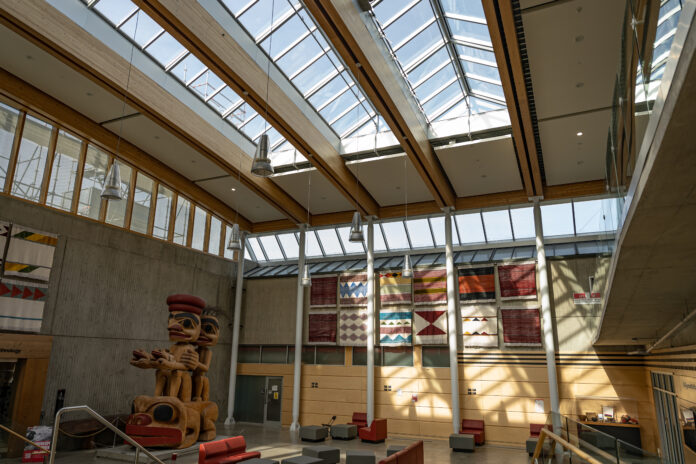
This is a photo of the SFU archaeology space at the Burnaby campus. There are chairs and tables lined up and a large totem pole near the wall
PHOTO: Victor Tran / The Peak

By: Natalie Cooke, News Writer

Dr. Adam Murry is an assistant professor of psychology at the University of Calgary. His research focuses on Indigenous employment, substance use, and mental health, among other topics. SFU psychology recently hosted the “Psychological Research in the Context of Reconciliation” event where Murry discussed why psychology research needs to progress in the “context of reconciliation.” 

Murry said at the beginning of the seminar: “I didn’t ever mean to get into research. It wasn’t even my plan to get educated.” However, after immersing himself in schooling, he was on a “quest for information.” 

Throughout his schooling and research, Murry has seen different forms of research that have not made room for ethical considerations; in his seminar he differentiated a variety of methodologies and expressed the effect of each research method on Indigenous communities. 

Murry explained how research has transformed from previous methodologies which did not value the relationship between the researcher and the group being researched. He explained helicopter research and deficit-based research as examples of poor research methods. They both include researchers from outside the community being researched. They typically observe and then evaluate a local community, with little involvement from them. This kind of research continues a historical imbalance in academia, based on exploiting the subject. Both methods neglect to put the community first, and do not work to uplift and support them. 

Murry explained the importance of having an “ethical space,” for psychological research where people with different ways of life can come together, and suspend judgement for the sake of listening and understanding. “When you have two different groups with two different cultures that come together, they’re going to have different values and see things through a different lens.” 

Murry discussed the emotional toll that some studies can also have on the researcher. “If you were just studying atoms, you would not have to think about poverty, sixties scoop, residential schools, deforestation. That stuff is heavy.” When Murry used to do substance use work, “It hit too close to home.” 

Community based participatory research (CBPR) was discussed as a methodology that seeks to prioritize the community, their values, and the land they’re on during research processes. The Arctic Institute of Community-Based Research describes CBPR as “an empowering process through which participants can increase control over their lives by nurturing community strengths and problem-solving abilities.” This is a co-learning process where researchers and participants participate, share excitement, and engage in co-operation.  

Murry noted that at every stage in the research “there’s a way to share power or a way to keep power [ . . . ] you can include or exclude the people you are working with.” 

To learn about Dr. Murry’s research lab, visit the Indigenous Organizations’ and Communities’ Research Lab website

SFU alumni starts petition to increase graduate funding

0
This is a photo of the BC parliament building in Victoria BC
PHOTO: Mario Mendez / Unsplash

By: Anastasia Fast, SFU Student

Nicholas Fast is currently a PhD Candidate at the University of Toronto and an SFU alumni hoping to change graduate studies funding. He is starting a petition with the goal of providing graduate students with more financial support. Specifically, he’s calling on the Tri-Agency organizations to increase their scholarships. The Tri-Agency organizations are the Social Sciences and Humanities Research Council, Natural Sciences and Engineering Research Council, and Canadian Institutes of Health Research. They give out the highest amount of financial awards, offering scholarships totalling $20,000 for PhD students and $17,000 for Master’s students.

In an interview with The Peak, Fast said, “Graduate student funding has not increased” in nearly twenty years. He noted, “Since then, the cost of living has skyrocketed, meaning that many [ . . . ] researchers are unable to support themselves as they complete their projects.” Fast’s petition demands a rise in the monetary value and the number of scholarships awarded. 

Fast’s main goals are to upgrade the current living conditions for graduate students, which are barely manageable, and improve the Tri-Council funding. He told The Peak he was inspired to start this petition by talking to other graduate students in Canada that live based on these “below poverty level funding packages” and agree on the urgent need to take action. As the cost of living continues to rise, Canadian researchers are facing increased financial difficulties while working on their projects.

Students can spread awareness by contacting their local Members of Parliament, since the Tri-Council organizations and federal government work tightly together. 

Fast noted some provinces, like Ontario, offer their own provincial funding aids if students fail to secure one of the bigger awards. He noted these awards differ in monetary value and are “barely sufficient at best.” He suggested appealing to the government of BC, and all provincial governments, to develop a strategy for providing support to their local graduate students.

The hope is that this petition will open a door of discussion into the House of Commons, so that a conversation about the improvement of graduate funding awards can take place. 

Another suggestion from Fast is to take Ontario’s provincially funded scholarship program, called Ontario Graduate Scholarships (OGS), as a role model for other provinces to integrate. However, only Canadian citizens are eligible for these awards, which is hindering the ability for international students to access already limited resources.

Amid the financial crisis, graduate students have to rely on multiple forms of income like taking a second job to further pursue their goals. Fast noted, “Most funding packages are actually below the poverty line in their host cities, putting significant financial strain on those who wish to pursue post-secondary — let alone postgraduate education. 

“This disproportionately affects prospective and current students who are first generation scholars [ . . . ] women, visible minorities, working-class people, and people with dependents. With government intervention, conditions can at least start to see an improvement.”

To sign Fast’s petition, visit the e-4287 petition on the House of Commons website

Sports quiz: Bizarre occurrences

0
Aerial shot of multiple people pointing at a computer screen.
PHOTO: John Schnobrich / Unsplash

By: Simran Sarai, Sports Writer

Q1.) True or false: At one point in his career, legendary track and field athlete Jesse Owens broke three world records in under an hour.

Answer: True. Owens set world records in long jump, the 200-meter dash, and 220-yard hurdles in 45 minutes back in 1935.

Q2.) Which baseball legend paid a fan to get his home run ball back?

  1. Jackie Robinson
  2. Joe DiMaggio
  3. Babe Ruth
  4. Lou Gehrig

Answer: C. Ruth paid the fan twenty dollars to get his 700th home run ball back.

Q3.) How many hours did the world’s longest soccer match last? 

  1. 169 hours
  2. 250 hours
  3. 72 hours
  4. 24 hours

Answer: A. That’s right. The world’s longest soccer match went on for just over one week in Cardiff, United Kingdom in 2019. Players were raising money for cancer research, and only took five minute breaks for every hour they played. 

Q4.) True or false: The New York Islanders were purchased in 1996 by a fraudulent business man who couldn’t afford the team. 

Answer: True. John Spano, who was rumored to be worth over $200 million, got his hands on the Islanders after a deal to acquire the Dallas Stars the year before fell through. The National Hockey League suspected something was astray when Spano’s $17 million down payment was signed as a cheque for $1,700. 

Q5.) What’s the only sport that’s been played on the moon? 

  1. Volleyball 
  2. Golf 
  3. Badminton 
  4. Baseball 

Answer: B. Alan Shepard, an avid golfer and an Apollo 14 astronaut, had a specialized golf club created for his 10 day excursion on the moon, unbeknownst to NASA. Shepard hid the club and a few golf balls in his suit, taking them out to hit a few shots on February 6, 1971 — three days before his descent back to Earth. 

Q6.) During which superstar’s last game were the Canadian and American national anthems altered to pay tribute to their departure?

  1. Michael Jordan 
  2. Derek Jeter 
  3. Wayne Gretzky 
  4. Tom Brady 

Answer: C. On April 18, 1999, in Madison Square Garden, “The Great One” was taken by surprise with personalized versions of “O’Canada” and “The Star-Spangled Banner.” Both adlibs happened near the end of the renditions: “We’re going to miss you Wayne Gretzky” in the Canadian anthem, and the “Land of Wayne Gretzky” in the American anthem. 

Q7.) Chelsea Football Club banned which vegetable in 2007 from games after fans wouldn’t stop throwing it on the pitch?

  1. Celery 
  2. Cabbage 
  3. Tomatoes 
  4. Cucumbers 

Answer: A. Chelsea has had celery fever since 2002 after several fans were temporarily arrested for lobbing the vegetable at opposing players. While celery might be banned at games, it always makes an appearance at team parades

SFU dance team brings school spirit to basketball games

0
photo of the SFU dance team.
Photo: SFU Athletics Dance Team / Instagram

By: Natalie Cooke, News Writer 

There’s plenty of fun to be found at SFU men’s and women’s basketball games. Puppy therapy, heritage nights, concessions, and giveaways were regularly a part of home games. But the most constant form of entertainment was SFU’s very own dance team, run and established by students since 2014

In addition to cheering and handing out merchandise during the game, the dance team performs a routine during half-time. In an interview with co-captains Dessie Barton and Kara Silverberg, The Peak learned about the work that goes into performing at games, and how new and seasonal dancers can find a home on the team.

Barton and Silverberg explained how the team’s presence gives SFU strength through numbers. “Hyping them up and creating more exposure for games allows them to play to their fullest potential.” 

The co-captains were especially excited about their current dance routines. “Our team has put a lot of hard work into our dances. We are so incredibly proud of them for how far they’ve come and for putting it all out there on the court.”

The most enjoyable aspect of being a part of the dance team is “the comradery with teammates.”

“We both started at SFU without knowing many people,” said Barton and Silverberg. “Joining the team made us feel like we had found our place.”

Barton and Silverberg had similar upbringings into the dance community. Barton started dancing when she was three years old, and continued to find more passion in dance as she grew older. “Dance has always been an outlet for me to destress and focus on something that I am passionate about; it feels like an escape. This is why after I graduated from high school, I knew I needed to continue my dance training.”

Silverberg also danced from a young age, and explained that despite moving to BC, dance became her home away from home. “This team was my way of continuing the art and giving me peace of mind and comfort in this new place.” 

Barton and Silverberg want to share these same sentiments with their fellow dancers. “We pride ourselves on providing SFU students with an outlet to continue their dance experience post-high school. Every team member is a part of our family.”

To join the performance dance team that takes part in the half-time show, you’ll need to attend auditions in September. There is no specific dance experience required; however, there are a limited number of spots on the team. Performers “train for five hours per week, and the whole [fall] semester is spent working on techniques and learning dances.”

If you’re looking for something more casual, there’s also a training team that allows you to take classes between March and April. Classes are taught in the “following styles: jazz, street jazz, hip-hop, lyrical, and contemporary.” To register, please refer to the SFU Athletics and Recreation website. The schedule can be found on their Instagram page (@sfuathleticsdanceteam).

Exploring Michel Dumont’s wearable art

0
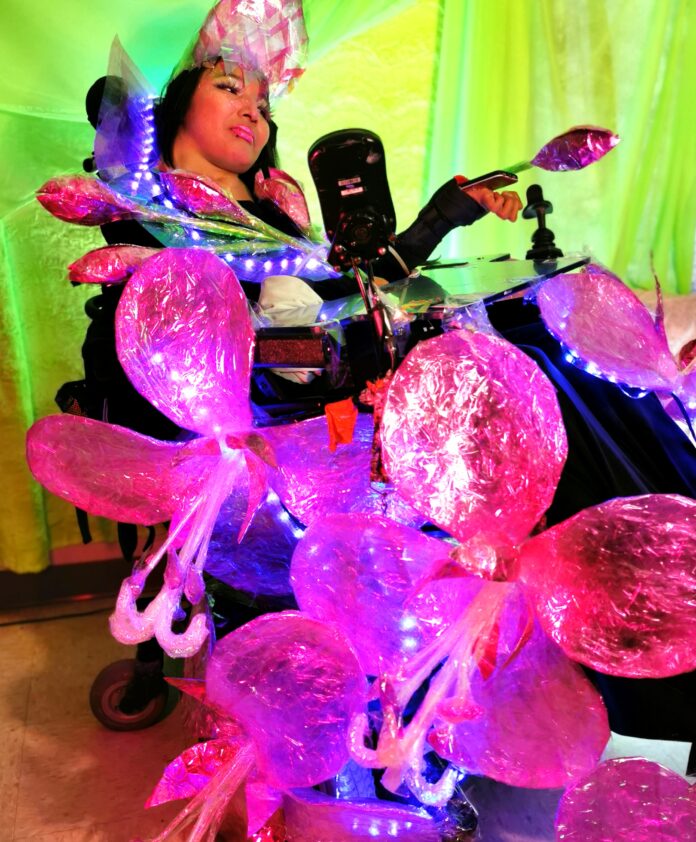
An Indigenous model in a wheelchair wearing a shimmery dress made of fireweed flower. The dress consists of large fireweed flowers and flower petals adorning the wheelchair, with LED lights and purple fringe.
PHOTO: Michel Dumont

By: Petra Chase, Arts & Culture Editor

At the core of his drag queen-“christened” trademark, House of Dumont, Michel Dumont is an “old, queer punk” whose commitment to love is infused into his creative work. Dumont is a “Métis, Two-Spirit, disabled artist” based in Thunder Bay, Ontario. His “wearable art, installation, and mosaic” incorporate elements of goth, camp, the ‛80s, and glam. In an interview with The Peak, Dumont shared some memorable moments thus far in his career, and his experiences navigating his disability in the arts world.

Dumont’s interest in costume crafting began during childhood, inspired by the Halloween costumes his mother, aunts, and grandmother would make by hand. “I had to be incredibly thrifty, working minimum wage, so I was constantly collecting clothes and up-cycling and embellishing with leather patches or painting,” he said.

After developing a sensitivity to multiple chemicals later in his life, Dumont could no longer work with many materials he was used to, such as leather and dye. It was from experimenting with non-toxic materials like “cellophane and packing tape,” combined with his expertise in dressmaking, that he produced his first wearable sculptures to don the runway.

In 2019, Dumont’s runway design at his local Definitely Superior Art Gallery’s 11th annual Derelicte costume contest brought him success. Named the “ice princess dress,” he described his design as an “angry drag queen dress with spikes.” The costume’s aquamarine, soft, iridescent glow juxtaposed with icicle-like spears give off a delicate yet fierce persona. To top it off, the model wore a diamond-shaped crown lit up with a bright blue frame.

A few years later, his wheelchair costume made with fireweed made it into Vogue. What made the design special was that Maggie Sofea, the Indigenous model who wore it, was also the inspiration for the dress. Dumont met her in the drag community, and was inspired by one particular drag show where he and a group of drag queens lifted her to the second floor to see the show. “I wanted to show resiliency of that moment where the community came together to uplift this person who would’ve had an extreme barrier to culture if we all hadn’t pitched in to make it accessible,” he said. “Fireweed is this flower that pops up after a fire, and it’s one of the most beautiful flowers that is resilient.”

It’s this same sense of mutual assistance present in the close-knit arts community of Thunder Bay, where artists from a diverse range of disciplines work together and collaborate. “We all depend on each other and we share our skills,” he said.

Dumont also opened up about experiencing access barriers due to his invisible disability including chronic back pain, mobility issues, and chemical sensitivity. For instance, he said “art galleries paint the walls fresh in between each show, so I have to wait two or three days [ . . . ] before I can even walk in the room.” 

“It can be difficult to tell people ‘I’m sore.’ I have this leftover baggage to minimize my disabilities or try to cover for [other people],” he said. “I’ve had to learn how to ask for accommodation.” For instance, asking for a supportive chair for his back is now a requirement when working with an organization.

“I initially used to be kind of shy, like ‘they don’t really mean it when they ask if I have accommodation needs.’ I was skeptical,” he said. “And then I realized, people are asking about my accessibility needs because they really want to facilitate something successful. So, I had to learn to trust other people.”

Dumont also attributed many of the opportunities he’s received in recent years to the internet, and its ability to connect artists and audiences around the world, especially during the pandemic. “I got into a couple of international shows because everyone was [online] in lockdown,” he said. While he’s never been to BC for concern over the risks of being exposed to mould, he was able to showcase his wearable art in Vancouver Pride virtually. 

Dumont’s first solo exhibit, Mukwa Dodem, which showcases his mosaic work, will take place during May in Toronto. The title of the exhibit means “I am bear clan.” He wrote, “As a survivor of intergenerational trauma stemming from Indian Day School, my work often explores emerging themes in anti-colonial urban indigenous and queer identities.”

He’s also gearing up to participate in Indigenous Disability Awareness Month (IDAM) in November. Started in 2015, IDAM brings awareness to the significantly higher rate by which Indigenous people experience disability in comparison to the general population. The unique barriers experienced by Indigenous people with disabilities are linked to colonialism.

 “My work seems to resonate with people and it’s humbling and it makes me want to cry,” he said. “I started making art full time about eight years ago. I was 48. And, so, life can begin at 50.”

Follow Dumont on Instagram at @madbear67, twitter at @micheldumontart, and TikTok at micheldumont3.

The SFSS Council emphasized security changes for the upcoming year

0
This photo is of the SFU stadium at the Burnaby Campus. The stadium is empty but it is a sunny day.
PHOTO: Krystal Chan / The Peak

By: Natalie Cooke, News Writer 

On March 8, The Peak attended the Simon Fraser Student Society’s (SFSS) bi-weekly Council meeting. The highlights from the meeting include discussing the new student health care committee and the approved funding for the 2023 Faculty of Applied Science Winter Formal.

Data Privacy and Security

Rastko Koprivica, who was the vice-president of finances and services, at the time of the meeting, addressed the issue of data privacy and security in the most recent SFSS Council meeting. It was noted, “The society relies heavily on non-domestic data storage mediums [ . . . ] The storage of data outside of the country, especially pertaining to personal information of members and society staff, pose questions of liability and protection of social data.” 

In the upcoming fiscal year, the SFSS will conduct research to determine where the society should store data. The current Council emphasized their recommendation for the upcoming executive committee to centre “privacy of member and employee information: a key priority to consider when making decisions in regards to information technology services of the society.” 

New Student Health Care Committee   

The SFSS is prepared to include students in important matters regarding SFU services; there is intention to form a new student health care committee. Abhishek Parmar, the acting president of the SFSS, said: “Students do not have enough input into their health care services [ . . . ] A committee should be established to ensure input, increased engagement, and researched health care matters throughout the fiscal year.” 

Despite their intention to create a new healthcare committee, no action or further discussion was taken at the time. 

FAS Formal 

The SFSS is preparing for the upcoming faculty of applied science (FAS) formal. At the February 8, 2023 Council meeting, the SFSS had approved spending $10,000. Their budget is going towards an evening that “has seen more interest than originally expected, where the current waitlist for the event is already halfway full with many people looking to purchase tickets.” 

FAS was requesting an additional $5,000 for the formal. The additional funding was passed unanimously.

It’s OK to live with your parents as an adult

0
PHOTO: Amirul Anirban/ The Peak

By: Jerrica Zabala, Peak Associate

There’s this assumption, especially among older generations, that living with your parents means you haven’t matured yet or you’re behind on the milestones you “need” to be an adult. Living with your parents or guardians should be more normalized because the cost of living is beyond unmanageable in the Lower Mainland.

Boomers and Gen X can talk shit all they want, but I’m staying with my parents until I can save up for a down payment on a house. Even my parents understand this absurd housing market, and give me the privilege of living under their care until I have financial stability. For many of us, our parents have been our financial, emotional, and social safety nets since we were young, so there’s nothing wrong with extending your stay to get ahead.

In reality, if you’re completing any type of higher education, you’re going to take at least 26 years depending on if you’re studying full-time or part-time. If you’re paying for your education, it helps to have a roof over your head, not worry about rent, or tip-toe around roommates. Even if you have to take out student loans, living with your parents gives you the ability to save more money than you would living alone. This is a huge advantage that can set you up for long-term financial security.

That’s not to say that there aren’t any disadvantages to living with your parents. For me and most likely other students, we pay with our mental health regardless. You run the risk of still being viewed as a child, having to personally communicate about physical and emotional boundaries, or enduring the invisible contract of being a “fake” renter. However, no amount of societal pressure, unsolicited life advice, or invasion of privacy will ever amount to how much I get to save so I don’t enter the “real world” in debt.

It’s time to let go of the belief that young adults need to move out as quickly as physically possible. With that being said, if you’re lucky enough to live in comfort with parents who are letting you stay just a tad bit longer, don’t be ashamed. 

Donatello’s advice to new and current SFU students

0
An 80’s style illustration of a wise raccoon looking off into space.
ILLUSTRATION: Raissa Sourabh / The Peak

By: Hana Hoffman, SFU Student

Hey there, I’m Donatello. I’ve been living at SFU and observing life here for longer than you can imagine, and it has come to my attention that some of you need my wise advice today. I’m happy to share my knowledge, but I really hope you read these tips and take them seriously because I had to skip my dumpster diving sesh with the raccoon community just to write this down.

  1. Get the free stuff.

You’re paying so much to be at SFU, so make the most out of it! The most important day of the semester is Clubs Day because almost every table has something to giveaway, including snacks and prizes. It’s basically trick-or-treating, except you have to talk a little bit and possibly sign up in order to get the prize. And, during the semester, you’ll see some tables here and there doing the same. I do want to mention one life hack to save time: if you join some clubs, just skip all the regular meetings and only attend the special events where they’ll have free food. Otherwise you’ll leave too much food for me and my friends! In addition, I expect you all to enter every single SFU giveaway. If you’re not already, then get started right now! Eyes on the prize, friend.

2. Enjoy nature, don’t hate it.

Although you must hate waiting in the freezing weather for the bus, slipping down the stairs, coming home in soggy shoes, and carrying an umbrella everywhere, there are still numerous reasons to be grateful to live on a mountain. With the earth’s temperature increasing, you might not get much cold weather anymore when you’re older. Don’t take the present for granted; go sledding on Burnaby Mountain, or get a cup and scoop up some free unlimited snow cones. Plus, on the occasion that it’s not foggy, you’ll see amazing views from campus! You can brag to your friends from other schools about how much higher you are than them, both geographically and academically, I hope!

3. Use my “eat, sleep, slay, repeat” method.

First of all, if it’s dark around your eyes like me then you’re not getting enough sleep. Don’t worry, my fellow raccoons, this only applies to humans. It’s also important to eat healthy, because you’d create a bad image of SFU if you’re seen eating packaged snacks and creating more garbage at a school known for its sustainable research and planning. Most importantly, I advise you to slay everyday fur real! I’ll even chant about it for you to get it in your head. Get good grades, get those A’s, get in shape, get that pay. Dash your way, through the rain, slay the day and get that praise. Okay. . . this is kind of cheesy, but you get the point, right? Make the most out of your years at SFU because you can’t paws time. I am spittin’ raccoon rhymes! AHEM.

To all new and current students, follow my advice and you’ll be thanking me later. From the bottom of my little raccoon heart I wish you the best. And if you ever see me or my raccoon friends hanging out on campus, please take a picture and post us on your socials. We wanna be famous!

— Donatello

Dear CAL: we want Subway Surfers side-playing in our lectures

0
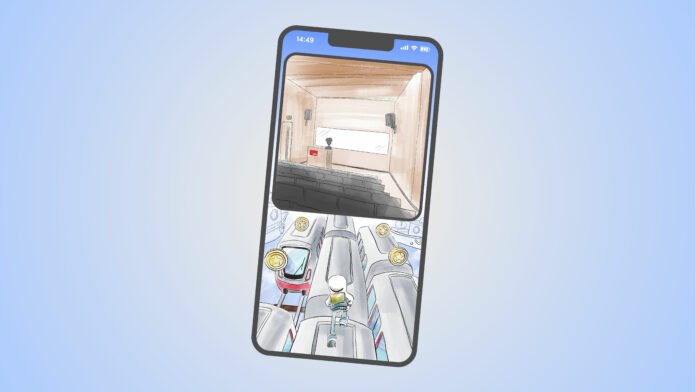
Illustration of Subway Surfers on a phone.
ILLUSTRATION: Christina Cao / The Peak

By: Dev Petrovic, Peak Associate

Dear Centre for Accessible Learning,

Word around campus tells us you’re able to pull some strings and make things happen, and we wanted to get in on that. We are the SFU Centralized Union for Mid-focused Students, or, as we are commonly referred to: the chrnically oline. We do not claim that term. But anyone can form a union, so here we are. At this time, lectures at SFU do not include side-play videos of mobile games like Subway Surfers. We demand this changes across all SFU campuses — if that means ignoring CAL students’ needs even more to get it done, so be it. It’s the only way to make SFU an accessible place for everyone. 

We are students who have adapted to the simultaneous streaming trends of TikTok, and now only have the attention spans to consume information if there’s side-by-side video footage of a stranger playing a mobile game. You may wrongfully believe this would be a distraction for other students. This is partially true: they would be distracted from fully experiencing the Subway Surfers stream while partially paying attention to their lecture. The psychology checks out and the method is foolproof. 

Since lectures are already boring, SFU has nothing to lose by integrating mobile game side-streaming, and will only gain brighter individuals with a “renewed sudden interest” in their major and excellent “endless runner” game skills. These are valuable and highly applicable assets to students entering the post-graduation world in this economy. Sometimes we can learn just as much about quantum physics from Subway Surfers as some old guy with glasses and a ten-yer, whatever that means. Alternatively, SFU is also welcome to expand their range of educational videos to include ASMR soap-carving (teaches you how to waste soap), slime-making (chemistry), and hydraulic press compilations (sexy). 

What would this cost SFU? Money from their budget. But, finances and logistics are hardly relevant since money is more of an imaginary concept and side-streaming is a heavily integrated, highly valued, and relied-on aspect of society. Most importantly, with these integrations SFU would become the first university in the world to recognize and utilize Subway Surfers side-streaming as a mode of educational support. You can’t get any more engaged with the world than that! 

It’s critical for students’ health and well-being to be given the same opportunities to thrive despite systemic and institutional barriers, which is why this should be the priority and not anything else. Based on research (a cute way of saying we don’t have to prove it), students who get what they ask for from their universities — like Subway Surfers side-play — are far less likely to write hate mail to a certain student resource created to advocate for and accommodate students. Its also historically true that universities who don’t do exactly as they’re told will be very sorry and shouldn’t be surprised when an anonymous hacker hijacks every SFU monitor to stream Sandwich Runner, the mobile game. Our point being, if you care about us at all, you’ll just do it — even though we’ll probably make it happen anyways. 

Sincerely,
SFU CUMS (Centralized Union for Mid-focused Students)