Home Blog Page 16

SFYou: Dr. María Ignacia Barraza

0
A collage of four photos: Maria Marraza’s professional headshot, a cut-out photo of Barazza in her grad uniform holding flowers after graduating SFU, a photo of Barraza holding her degree in front of the university of Salamanca, and a photo of author Gabriel García Márquez
IMAGES: Courtesy of Kia Porter, Courtesy of Maria Ignacia Barraza, Courtesy of Maria Ignacia Barraza, and Gorup de Besanez / Wikimedia Commons

By: Noeka Nimmervoll, Staff Writer

María Ignacia Barraza is an assistant professor in the department of world languages and literatures in the faculty of arts and social sciences at SFU. This semester, she’s teaching “Modern World Literatures 104W” and “World Literature 410,” with the special topic of Latin American Literature. Her research involves “the Spanish literary generations of 1898 and 1927, 19th and 20th century Latin American poetry and prose, as well as film and the visual arts.” 

In an interview with The Peak, she tells us where it all began. Born and raised in Argentina, Barraza always held close to her upbringing surrounded by Latin American culture and literature. “I’m very proud of my Argentinian roots,” she says. When she moved to BC at 11, she was the kid with her “nose in a book.” She adds, “I always knew my vocation would have something to do with Spanish language and Hispanic cultures and literature.”

After getting her bachelor’s degree in English literature at SFU, Barraza decided to apply to the University of Salamanca in Spain, longing for adventure.

“That little girl in me said, ‘You’ve got to do something to continue this search for knowledge in Latin American history and culture and literature.’”

Barraza recalls how surprised she was when she was accepted into “one of the most prestigious universities” specializing in the subject.

Moving away from home at the age of 25 to pursue her education was not easy, but the immersion in Salamanca was an unforgettable experience. “I was very family-oriented, very Latin American in that sense, but I moved away on my own.” She never regretted taking that leap of faith for her education, either: “I encourage anybody who has that little voice in their head or heart that is telling them, ‘This is what I think I want to study’ — follow it.” 

While Latin American literature wasn’t offered as a course when she studied here, Barraza now highlights Latin American literature for SFU students. “The Latin American ‘boom,’ perhaps, is the most exciting for me,” she says. “That’s when the world started to pay attention” to Latin American authors. This period began in the 1960s, in the aftermath of the Cuban Revolution of 1959, and lasted until the 1970s. Barraza explains this was a period characterized by political themes, which included many “writers who were very much on the side of the Cuban Revolution” and efforts to uplift marginalized voices. Authors of the “boom,” which was notably dominated by men, began experimenting with writing techniques and produced many great works. 

The literature as a whole was highly imaginative, often exploring time as non-linear, incorporating multiple narrative perspectives, and using magical realism, the defining genre of this time and another of Barraza’s favourites. First used by Cuban author Alejo Carpentier in the 1940s, magical realism employs elements of surrealism and otherworldliness within realistic settings. When authors such as Mario Vargas Llosa (Peru), Gabriel García Márquez (Colombia), Carlos Fuentes (Mexico), and Julio Cortázar (Argentina) became global celebrities (“wearing cool sunglasses,” Barraza quips), it marked a period of expansion of the literature and culture of the time. 

However, Barraza cautions against the tendency for the “boom” to be presented as the “peak” of Latin literature. The periods that came before are just as fascinating, and not representing them is “misleading.”

The seeds of the “boom” and magical realism started long before. As a pushback against colonial narratives, modernismo was born. Modernismo was a 19th century movement that emerged from the desire of Indigenous Latin Americans to have a distinct artistic voice, free from Spanish colonizers and “colonial literary legacy.” Inspired by European literary movements of romanticism, parnassianism, and symbolism, modernismo highlighted the Latin American perspective. 

Teaching Hispanic literature in the world literature and languages department requires translating the texts to English. In the classroom, Barraza highlights “the way that texts travel and change and are accepted.” Sometimes, she will place the Spanish and English texts side by side and discuss the implications of the translation.

In personal reading, Barraza always goes back to the original text.

“There’s something about the musicality of Spanish, especially in poetry” 

The 19th century Nicaraguan poet Rubén Darío, considered the father of modernismo, is an author whose work she reads aloud to her students in the original Spanish. She tells them to close their eyes and listen to the ornate language. “Most of them don’t speak Spanish, actually. But it’s about the emotional impact of poetry and literature that students feel,” she says. 

Barraza also reflects, “I think it would be wonderful if, moving forward, SFU could continue expanding options for students — for instance, creating opportunities for interdisciplinary work across different units. That way, students can gain a broader understanding of the region in all its richness.”

Barraza takes care to note that Latin Americans are “a mixed culture, mixed people, both racially, but culturally, linguistically, even religiously.” She adds that she tries “to give students an idea of the complexity of it all.”

One of Barraza’s joys of teaching is “highlighting obscure, unknown authors.” She mentions Oliverio Girondo, a 20th century Argentinian poet who published seven books in his lifetime, using surrealism and “weird” imagery tied to the ultraism movement. He was a vanguardist, one of the avant-garde innovators who broke away from artistic traditions of the time. “Highlighting him and bringing him to my students, I see them get excited about authors that they’ve never heard about. And that makes me super happy,” she gushes. 

The Peak made sure to ask Barraza for her recommendations:

Magical realism

One Hundred Years of Solitude by Gabriel García Márquez is canonical for a reason, as it’s “hands down” Barraza’s favourite in this genre. The story follows a town’s turbulent history, told through the lives of seven generations of the Buendia family who have been there through it all.

Latin classic work

The poetry of Rubén Darío, who Barraza vows “every student should read.” Specifically, she recommends his poem “To Roosevelt,” written in 1904. The poem marks the time when the Panama Canal was being built in the US. “It’s so relevant today with the whole Trump and the US and expansionism. It’s as if he wrote it two weeks ago,” she says.

Underrepresented authors

Barraza adores the Cuban Juana Borrero and the Uruguayan Delmira Agustini, who brought themes of sensuality into the modernismo movement. 

Oliverio Girondo’s early 20th century poetry collection Scarecrow and Other Anomalies “is guaranteed to make you feel less alone,” according to Barraza. “He is one of my favourite poets, yet remains little known beyond the Hispanophone world. You won’t regret reading him!”

Contemporary authors

Laia Jufresa, and her book Umami: a story of private griefs in a Mexico City neighbourhood. The Argentine Samanta Schweblin’s short stories are also a favourite.

Classic films

Diarios de Motocicleta / The Motorcycle Diaries (2004): A road trip takes a young man, Che, and his friend across South America and changes him forever.

Nueve Reinas / Nine Queens (2000): Two con artists attempt to swindle a stamp collector through the trade of falsified rare stamps.

Son of the Bride (2001): In this comedy, a 40-year-old single man is pushed to reconsider his own life when his mother and father finally decide to marry.

The Exterminating Angel (1962): a classic of Mexican Golden Age cinema, directed by the Spanish surrealist master Luis Buñuel.

While she won’t be teaching the selected topic on Latin American literature next semester, Barraza always includes Latin American texts in her courses. In Spring, she’ll continue teaching Modern World Literature 104W, as well as World Literature 400: Early Literary Cultures.
Honor Thy Mother documentary screens at SFU

0
IMAGE: Courtesy of Stourwater Pictures

By: Jonah Lazar, SFU Student

Content warning: Mention of residential schools

“When they asked what my race was, I had no idea.” These are the words of Colleen Almojuela, an Indipino Elder and panellist at the Honor Thy Mother documentary screening at SFU Burnaby’s Leslie & Gordon Diamond Family Auditorium. Almojuela is one of the children of the 36 Indigenous women who sought out work on Japanese-owned berry farms on Bainbridge Island in Washington state in the early 1940s. 

These women, many of whom were survivors of residential schools in Canada, all ended up marrying and having children with Filipino immigrants who were also working on these farms. Marriage had dire consequences for them, as marrying a non-Indigenous man meant they lost their Indigenous status due to Canada’s Indian Act of 1876. This law isolated them from their communities by only allowing them to return to Canada for brief family visits and restricting them from participating in ceremonies and cultural events. The children of these marriages, referred to as Indipinos, have now gathered together to share their story in Honor Thy Mother. 

This documentary, with a runtime of just over half an hour, managed to deliver a valuable introductory insight into the residential school system of Canada, before delving into personal accounts of the Indipinos of Bainbridge Island.

Many of the stories told in the documentary were deeply personal, with several of the children of this community — now Elders — recounting their struggle with identity, racism, and belonging due to their mixed-race heritage.

While I believe there could have been room for further contextualization of the Indipino community in the broader Filipino and Indigenous diasporas, as well as a deeper exploration of the place this identity holds in future generations, Honor Thy Mother still offers a unique, untold story of a marginalized group. 

After the screening, Indipino Elders Colleen Almojuela and Gina Corpuz, along with Indipino Community of Bainbridge Island’s board chair Lanessa Cerrillo, and 2024–25 Jack and Doris Shadbolt Fellow (and son of Almojuela) Justin Neal, participated in a panel discussion about the film and what it means to identify as Indipino.

A noteworthy project that was highlighted at the screening was the 100% Project, a digital archive of the experiences and recipes of “multiethnic Filipinos,” supported by the Smithsonian Asian Pacific American Center. The project, led by the Corpuz family, deals with Indipino self-identification as both entirely Indigenous and entirely Filipino.  

The panel also proudly announced that Bainbridge Island’s school system has since made Honor Thy Mother a key part of their eighth-grade curriculum, highlighting the importance of this story to the history of the island and cementing Indipino experiences as ones which future generations will retell. 

As Truth and Reconciliation Day passed us by, many of us will have taken a moment to remember the impacts of residential schools and the cultural genocide implemented on Indigenous Peoples on Turtle Island. While these tragedies often take centre stage, and rightfully so, it is also crucial for us to consider lesser-known, intersectional stories such as that of Bainbridge Island’s Indipino community.

The Handmaiden offers resistance and love

0
Sook-hee and Lady Hideko getting ready together.
Courtesy of Moho Film and Yong Film

By: Michelle Young, Co-Editor-in-Chief

Content warning: Japanese imperialism, grooming 

Park Chan-Wook’s filmography is filled with critical acclaim: he recently released No Other Choice (2025) and is also known for works such as Decision to Leave (2022) and Oldboy (2003). However, my favourite will always be the psychological thriller The Handmaiden (2016). Under heavy rain, the Imperial Japanese Army marches into a small alleyway in colonial Korea. Korean children sing behind them, and the Japanese army draws their weapons — the children scream and scatter. This is the film’s opening and sets the tone for the rest of the movie. 

We are soon introduced to Sook-hee (Kim Tae-ri), who has been hired to trick the Japanese heiress, Lady Hideko (Kim Min-hee), into giving away her fortune. The Handmaiden rapidly unravels itself like an onion. Everyone has their own plans, and the film beautifully layers itself with various plots and secrets. As Sook-hee and Lady Hideko fall in love, the complexities of these plans and their relationship are slowly revealed to the audience over the span of the film. 

Both Sook-hee and Lady Hideko are trapped: literally and figuratively. Literally, inside a colonial-style manor, which they can’t leave, and figuratively by a society shaped by patriarchy and colonialism — two oppressive ideologies. The men, the manor, and the influence of colonialism are far more sinister than the beginning of the film lets on.

The Handmaiden is filled with both the subtle and the grotesque, juxtaposing tenderness against violence.

There are subtle lies and outright violence of men who seek to take — they feel entitled to money and pleasure, only using women as a means to their desires. This is important, as the sexual relationships between men and women are always either violent, one-sided, or for an underhanded purpose. In contrast, the sex between women builds their trust and relationship. 

A common critique of the film is that it pertains to the male gaze by including multiple scenes of lesbian sex. While the male gaze brings attention to how women are sexualized and objectified in film, this is the most misguided critique of The Handmaiden. Lesbian sex shouldn’t be stripped away from queer film for it to be acknowledged as legitimate representation — lesbians have sex. The way in which these sex scenes are portrayed and shot is important to the film’s plot and themes. Further, they defy typical conventions used when pandering to the male gaze. As the audience learns of Lady Hideko’s forced erotic readings, it is clear she holds these readings without ever enjoying them — and understandably so, as she was groomed to do them. She is forced to read about sex in such a repulsive and distorted view that her discovery of love and pleasure with Sook-hee is of genuine importance to her character. In using the same sex objects she was forced to read about, she reclaims herself — when for so long, she was made to perform for others. While some have complained of the lengthiness of the explicit scenes in the film, they are unapologetic and beautiful, with little focus on the body and emphasis on the women building intimacy. 

The Handmaiden is cinematically stunning, carefully shot, and skillful in its timing: each scene is a portrait. The score is a masterful collection of strings, perfectly suited to the film’s suspense. While the film can be difficult and visceral, it is a testament to the power of intimacy and ambition, and empowers the audience to fight against the same structures it critiques. 


Gwangju Uprising explores the quest for democracy

0
Schlarpi / Wikimedia Commons

By: Phone Min Thant, Arts & Culture Editor

Content warning: Brief mention of military brutality 

Beyond Death, Beyond the Darkness of the Age — a poetic name for a book that has so much suffering, death, and destruction. While the book’s first revised, English-language publication did not carry its original name, it carried the painful experiences of ordinary South Koreans in their struggle for freedom and democracy. 

Gwangju Uprising: The Rebellion for Democracy in South Korea is a hefty book that details the movement for democracy espoused by citizens of Gwangju against the authoritarian military dictatorship of Chun Doo-hwan. Written by activists with input from the acclaimed novelist Hwang Sok-yong, the original publication in the 1980s — although discreetly distributed and read throughout South Korea — faced numerous efforts at censorship, landing the authors in jail

In a style dissimilar to many other history books that I have read, Gwangju Uprising can best be seen as a testimony from a courtroom extrapolated into over 500 pages of reading. The book takes the reader through every detail of the protests (later uprising), from the formations used by the riot police and soldiers to the types of injuries sustained by victims of military brutality. Accompanying each chapter (each of which roughly represents a day during the ten days of the uprising) are maps which chart all the routes taken by security forces as well as the protestors at critical moments of the movement. 

Also complementing these observations are the first-hand testimonies of those involved in the uprising. Many of these quotes reflected the real emotions of those seeing horrific events unfold right in front of their eyes, but also give insight into the inhumane mentality of the soldiers assigned to suppress the protests — many parallels could be drawn from these quotes to contemporary protests happening around the world, and how the oppressed can remain hopeful in the face of unbelievable oppression. The juxtaposition between quotes from soldiers describing their experiences beating up protestors with their batons and those from activists asking, “Don’t you remember which country you are sworn to defend?” painfully highlights the usual power imbalance between authoritarianism and its victims. 

Another noticeable feature I also enjoyed about the book is that the authors did not forgo important geopolitical analyses in their quest for first-hand record-keeping. There are many references to issues such as the US’ implicit consent to South Korea’s military government, or the negligence of its military and diplomatic officials regarding the situation in Gwangju. This was something I found particularly useful to me as someone who is both interested in history but also wanted to learn more about how the Cold War’s diplomatic and security environment negatively affected democracy in countries like South Korea. 

Given the intensity and detail of the book, you might be wondering if it is suitable for someone who doesn’t know anything about the protests or even about South Korean politics. While most of the content focuses on the protests, the first few chapters significantly (and concisely) lay down the domestic political situation leading to the uprising, beginning with the assassination of president Park Chung-hee and the rise of Chung Doo-hwan in the military — and later political — echelons. There is enough information — without unnecessary jargon — to get the layreader going!

Coming from a country whose citizens have stood up to military authoritarianism, many of the scenes in the book spoke to me dearly, sometimes painfully, sometimes with hope. Gwangju Uprising is not only a history book, but also a homage to ordinary people fighting for democracy, in South Korea back then, and around the world today. 

Latin American Heritage Month events

0
RDNE Stock Project / Pexels

By:  Lucaiah Smith-Miodownik, News Writer

October marks Latin American Heritage Month in Canada — a time to honour the ongoing impact and future influence of Latin Americans on the country. Both Canada and Latin America are steeped in rich Indigenous cultures that are foundational to their existences, and Latin American Heritage Month also provides an opportunity to reflect on the colonial history that both share.

For intriguing opportunities to celebrate and learn about Latinx culture just outside your door, read on!

What: Fire Never Dies: The Tina Modotti Project  

Where: The Cultch Historic Theatre, 1895 Venables St., Vancouver

When: October 15–26, 2:00 or 7:30 p.m.

Chilean Canadian playwright Carmen Aguirre brings her latest work to the Vancouver stage for its world premiere. Fire Never Dies: The Tina Modotti Project is a play that tells the story of Tina Modotti, a photographer turned activist during the Spanish Civil War. The play will preview on October 15, before debuting the following evening. Those interested can also purchase special talkback tickets on October 19 and 21, which provide the opportunity for audience members to ask any questions they may have.

What: Brazilian Live Experience

Where: Latin Plaza Hub, 68 Water St., Unit 301, Vancouver

When: October 24, 7:00 p.m.

Come experience Brazilian song and dance on a night out in Gastown. This event will feature live performances honouring both Brazilian and Afro-Brazilian culture. Experience samba, a dance style that originated in Salvador de Bahia, where it was developed primarily by enslaved people trafficked from Portuguese Angola. Forró, another popular style of Brazilian music and dance to enjoy, was born from “a fusion of African, Indigenous, and European musical influences.”

What: La Feria del Libro en Español (“the book fair” in Spanish)

Where: Ocean Artworks Pavilion, 1531 Johnston Street, Vancouver

When: October 25, 11:00 a.m. – October 26, 5:00 p.m.

Immerse yourself in literature at the book fair! This event “highlights the diversity of Latin America through books, storytelling, art, and family-friendly activities.” There will be book exchanges including Spanish and Portuguese collections, talks by authors, and art displays exhibiting Latin-inspired works.

What: Cut & Create: Paper Flowers Workshop

Where: Ocean Artworks Pavilion, 1531 Johnston Street, Vancouver

When: November 1, 5:00–6:00 p.m.

If you are interested in crafting your own paper cempasúchil (marigold), this event is the perfect opportunity. The cempasúchil is rooted in Mexican culture as the flower of the dead, and is often used in ofrendas as a part of Día de los Muertos (Day of the Dead). In addition to crafting flowers from crepe and tissue paper, participants will learn about the cultural significance of the holiday. Día de los Muertos is a celebratory opportunity to reunite families with their deceased loved ones, and in doing so, reframes the concept of death itself as something not to be feared.

What: Catrina Party

Where: Old Bridge St., Vancouver 

When: November 1, 7:00–11:00 p.m.

La Catrina, also known as the elegant lady, is another image distinctly tied to Día de los Muertos. Created by artist José Guadalupe Posada, the illustrations are rooted in a sense of satire and serve to remind us that we all die in the end, regardless of our social status. This event will feature a La Catrina costume parade, best-dressed La Catrina contest, live music, and Día de los Muertos-inspired cocktails.

There will also be a closing ceremony on November 2 from 6:00 to 8:00 p.m. at Granville Island’s Day of the Dead Market. For more  Latin American Heritage Month events, visit latincouver.ca/lahm and vlacc.ca/latin-expressions.

Two songs that played as a soundtrack to my embarrassing life

0
A chaotic-looking lady with hair curlers all tied up in her hair.
PHOTO: wayhomestudio / Freepik

By: Noeka Nimmervoll, Staff Diva 

Dear Diary, 

I can’t lie, life has been wild recently. I don’t know what’s going on with the universe — I think Mercury is definitely in retrograde. Either that, or the universe has developed a remarkable sense of comedic timing. These songs played in the most ridiculous situations all this week. I’m hiding inside my home from now on, for real. 

Every Day’s a Lesson in Humilityby Suki Waterhouse & Belle and Sebastian 

Every day’s a lesson in futility

Got to take the dogs out

Every day’s a lesson in humility

Got to eat my own words

It’s so embarrassing to be alive, girl. On Sunday, I was at the mall in the food court. I had just done some shopping, and I decided to get a bowl of pho. I sat down with my pho, took a bite, yadayada. Right then, I saw a friend walking through the mall in my direction. I got so excited to see her — we hadn’t seen each other in months! I stood up in the middle of the food court and yelled, “SARAH!” spraying a mouthful of food, EWW. I shocked (and probably disgusted) a bunch of people around me. Oopsie. But then . . . I guess my jacket got caught under the bowl because it spilled. ALL. OVER. ME. Girl. I was MORTIFIED. AND THEN. My “friend” locked eyes with me and pretended to gag. I GASPED. She strutted away, laughing, and I was there, DRENCHED in beef soup and noodles with the ENTIRE FOOD COURT watching as I made a fool of myself. Then, this bitch-ass song played — it was insane timing, evil even. That was the worst way to spend $18 ever.

Landslideby Fleetwood Mac

Oh, mirror in the sky, what is love?

Can the child within my heart rise above?

Can I sail through the changin’ ocean tides?

Can I handle the seasons of my life?

OK. Diary, let me set the scene for this one. I’m at H-Mart after a serious and horrible realization. It’s a Tuesday at 10:00 a.m., and I have makeup POURING down my face — I had just realized that being a popstar without having any singing or dancing talent is not a viable career path. Girl, I do NOT need this emotional turmoil before my dentist appointment, and I was literally BANKING on that career path. I am feeling this song so hard, walking through the aisles with my heartbreak in the air, MELTING on the floor while sob-singing this song in the frozen section. Then, girl, security kicks me out. I KNOW. H-mart hates to see a diva like me coming, I guess. So I get my cute butt moving, I go to my dentist appointment with makeup smudged all over my face, and then I get trapped in a sterile room with my dental hygienist scraping metal against my teeth. I am still so distraught that I forget to lie when she asks if I’ve been flossing. And then, I hear:

I took my love, I took it down

GIRLLLL. THEY’RE PLAYING THE SONG AT THE DENTIST’S TOO. What the hell am I supposed to do?? Cry, with my mouth wide open? Why is this acceptable radio music?? Ugh, musicians are so useless anyway.

I literally couldn’t believe it. I’ve gone THROUGH it this week, and these songs are officially ruined for me now. Girllll, whatever. At least my teeth are clean.

With love,

Noeka 


My journey infiltrating the country of Islam

0
A white woman wearing all sorts of different cultural attire, holding a map in her pocket.
ILLUSTRATION: Cliff Ebora / The Peak

By: Zainab Salam, Sand Excavator

Mission report: Desert Day 1

Subject: Bringing Civilization™ to the so-called Orient.

Girl, we going to Islam?” That is what I asked my adjutant upon dismounting the camel. He nodded gravely. Neither of us knew exactly where the country of Islam was located, but it seemed vast enough to cause me to ponder for about 6 or 7 minutes. I landed on the idea that we would stumble upon it . . . eventually. 

Once I entered the tent, I was greeted with suspicious glances from the Bedouins. To calm them down, I then declared my heritage: “Do not fear me, people. I am from Civilization™!” I made sure to place a heavy emphasis on the capital C. It had the desired effect — they incredulously laughed at me. I should note that they laughed at me, due to their cultural teachings that encourage being welcoming towards your superiors by laughing at them. It is their Muslimanity’s teachings. 

For efficiency, I requested to speak with their leader. A Bedouin man with warm brown eyes emerged from the back room of the linoleum-floor tent. When I explained to him that his tribe had insulted a person from Civilization™, he replied, “Ma’am, this is a Wendy’s.” Turns out I had been queuing at a Wendy’s the entire time. Ah, my diet was about to be ruined! 

But that was yesterday. Today is a new day! 

Upon embarking on my new mission today, I met three merchants. One of them does not appear to be of the Muslimanity faith. He was pale and had blue eyes. I believe he might have been a covert Civilization™ personnel. I winked at him, but he was deep undercover and acted confused. That behaviour had me nodding sagely. His faithfulness to our Civilization™ will be reported to my superiors upon my return to base. 

Later that evening, I attempted to ride a camel into the sunset for dramatic effect. The camel threw me into the sand. I concluded this was a symbolic gesture of respect. This is an odd land: just yesterday, a local decided to honour me by lifting the entrance cloth off the tent. I had to explain to him that I am but a regular Civilization™ person. He looked at me weirdly and said, “I am literally camping. No — this isn’t my home — can you please leave me alone?” Silly commoner. Camping doesn’t exist outside of Civilization™! This is literally cultural appropriation. 

As the sun set, I posed dramatically against the dunes. I am sure history will remember me fondly — I will be remembered as the bridge between our Civilization™ and their tribes. I am the main character! 

Mission report ends. Glory begins. I know my work here will grant me a book deal. My life story will be turned into a Hollywood movie, where I will be played by a blonde actress with piercing blue eyes. Naturally, the locals will be played by ethnically ambiguous and amateur actors, but who cares? Huzzah!

The Steve Chronigulls

0
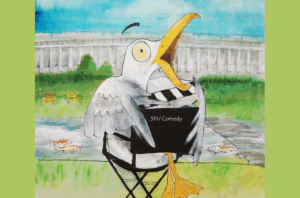
A seagull sitting in front of the koi pond. He’s holding a director’s clapper.
ILLUSTRATION: Angela Shen / The Peak

By: Lucaiah Smith-Miodownik

The Peak recently interviewed Steve C. Gull, a local screenwriter and seagull who lives in the reflecting pond. We decided to check back in with the avian creative and see how he’s been since we last spoke.

Last time we talked, you were working on your screenplay, Romeo and Gulliet. How’s that going?

“Turns out there were some licensing issues with the whole thing. Apparently, the idea is already taken? To be honest, I’m kind of starting to regret telling you guys about the project. I think someone else might have stolen my idea. I looked it up, and it turns out there’s a gnome version, too? C’mon, let’s be realistic here. Anyways, all that to say, Romeo and Gulliet won’t be hitting the big screen anytime soon. Such is the life of an artiste, I suppose.”

Do you have any other projects in the works?

“Yes. But I’m not taking any chances this time. I don’t want you people leaking my work again. Well . . . what the hell, I guess a little sneak-peak couldn’t hurt. So, picture this: A young Canadian seagull has a burning passion for ice hockey. Turns out, though, that he’s much better at golf. He enters a tournament hoping to beat the pros and win enough money to save his grandma’s house. It’s a real David and Gulliath situation (yes, that one’s in the works as well). So far, the working title is Flappy Gullmore. Keep in mind here that we’re still in the rough draft phase. Creativity takes time.

“I’ve also been looking to branch out and diversify my portfolio. I’m working with my agent on securing a role in an upcoming National Geographic documentary. Oh, and I just booked a cameo in a PETA commercial starring my buddy, Daffy.”

Let’s go back to the beginning. How did you first find your passion for the arts?

“I like to think the passion found me, really. I remember it was after a particularly spicy SoulCycle session. I went to pop in to my favourite vegan acai bar like usual, but they were closed. I was devastated. I went home, and the words kind of just flowed out onto the page. It was a healing experience, really. From then on, I just knew I had a gift, and I was obligated to let people hear my voice. What I want anyone seeing my art to take away is that you can get through hard things in life. If I can help one person with their trauma, then I’ve done my job.

“My career hasn’t been without struggle. You know, I actually applied to be the arts editor for The Peak back in my university days. I had the job for a little while until they fired me. Apparently the new cigarette-timbits compote in the dumpster behind the Student Union Building isn’t worth writing about multiple times? Oh well, their loss. Between you and me, I still sometimes shit on the newspaper stands around campus just to spite them.”

Is there anything else you’d like to add?

“To anyone reading, you better not get any ideas about stealing my project. I hired the best lawyers to sue people, including your seagull-phobic newspaper. I further demand that The Peak rename itself to The Beak. Oh, and follow me on Instagram: @whatsteveseesgull.”

Nepal’s Gen Z protests have led to an uncertain political transformation

0
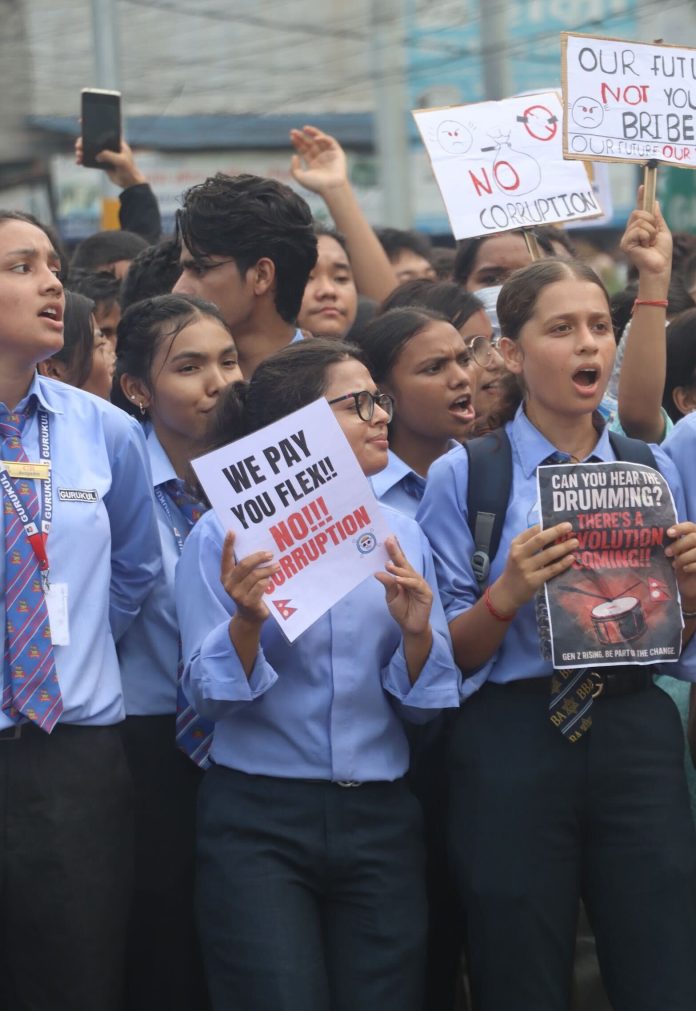
A crowd of students protests against Nepali corruption, holding signs saying, “We pay you flex!! No!! corruption” and “Can you hear the drumming? There’s revolution coming!!” in all caps. The photo is a close-up of five girls in particular, who all wear blue collared shirts and dark dress pants.
PHOTO: हिमाल सुवेदी / Wikimedia Commons

By: Niveja Assalaarachchi, News Writer

On September 4, the government of Nepal, headed by then-prime minister K. P. Sharma Oli, banned 26 social media platforms from being accessed within the country. The government introduced the ban for platforms that did not register themselves with the country’s Ministry of Communication and Information Technology, such as WhatsApp, Instagram, and Facebook. However, the ban was seen as more than a registration issue as it sparked widespread outrage over deeper socioeconomic issues in the country, such as corruption. 

The Peak interviewed Dr. Rupak Shrestha, an assistant professor at SFU’s school of international studies, on the situation in Nepal. Shrestha, born in Nepal, is a political geographer whose research explores topics such as sovereignty, security, and surveillance.

On one level, “Nepal has one of the highest rates of social media users per capita in South Asia.” Shrestha discussed how daily communication, business relations, remittances from abroad, and other activities are all carried out through social media, meaning the ban would disrupt these aspects of everyday life for Nepalis.

Shrestha also pointed out how the ban was the breaking point in large-scale dissatisfaction: “Citizens were angered by a state that appeared to criminalize everyday life. For many, the ban was not [seen] as a regulatory measure but a direct attack on their ability to speak, connect, and survive in the midst of increased unemployment and deepening distrust of the state and its elite ruling class.” He noted these socioeconomic pressures, which either force many to move abroad or find work in the informal sectors, were acutely felt among the youth due to their more active role in the economy. 

In the weeks leading up to the social media ban, activists launched campaigns to highlight the wealth accumulated through corruption by political elites. Corruption is deeply rooted in Nepal’s political structure, affecting most aspects of daily life. Transparency International, an anti-corruption organization, ranked Nepal 107th out of 180 countries on a scale of “very clean” to “highly corrupt.” A nepotistic political culture of appointments, combined with poor accountability for government spending, has led to scandals relating to the misuse of funds, bribery, offshore financial accounts, and money laundering

The protestors had “non-negotiable” demands, including “the dissolution of the parliament, mass resignation of parliamentarians, immediate suspension of officials who issued the order to fire on protesters, and new elections.” 

Protesters targeted key government institutions, such as the parliamentary complex, Supreme Court premises, and homes of famous politicians, setting them on fire. The violence permeated throughout the protest movement, which saw 74 protesters dead and more than 2,100 injured.

Facing mass discontent, prime minister K. P. Sharma Oli resigned from his post, citing the need for a new “political solution.” With the blessing of protesters, Shushila Karki was eventually appointed by President Ramchandra Paudel as the interim prime minister. Nepal has both a president and a prime minister. Karki is a former chief justice and has been popular among the population for her “stance against government corruption” and financial mismanagement. In her first few days, she dissolved parliament, setting the stage for federal elections by March 2026.

Shrestha highlighted how stability will come from “rethinking power itself. In Nepal, military and police power often operate as if they are distinct from the state, yet they shape its legitimacy and citizens’ everyday lives,” he continued. 

“Without reforming, and in some cases dismantling/abolishing, the cohesive arm of the state, democratic futures will remain fragile.” — Dr. Rupak Shrestha, assistant professor at SFU’s school of international studies