Home Blog Page 13

A letter of challenge from a recovering perfectionist

0
A small figure looks despairing at a yellow giant figure with a crown. The figure is a metaphor for the unachievable standard the figure projects onto himself.
ILLUSTRATION: Yan Ting Leung / The Peak

By: Noeka Nimmervoll, Staff Writer

Are you a perfectionist? Start with this short checklist:

  • Do you set big goals for yourself, yet feel no sense of accomplishment if you reach them? 
  • Are you highly critical of yourself and/or others?
  • Do you struggle to experiment or adapt to changing situations?
  • Do you find it hard to accept that you will make mistakes

If you answered yes to all or most of the situations above, welcome. This is a safe space. As a fellow perfectionist, I understand you, and I empathize with your state of mind. Constantly comparing yourself to a perfect version of yourself takes its toll. Perfectionists are more at risk for anxiety, depression, and eating disorders.

Perfectionism can often be a result of complex trauma. It can come from a place of compulsion to assert your worth, or a fear of failure or disappointing others. If you were unfairly criticized or undervalued during your upbringing, you didn’t deserve it. It’s not your fault for coping the way you do.

All-or-nothing thinking will lead you to believe there is a perfect state of existence to which you are not yet measuring up. Don’t you wish, though, that you could sleep a little better at night? Or not be bombarded with self-criticism every time you make a slight error in judgment, or even make mistakes due to situations out of your control? Let me take you through some arguments you may have, where I challenge the perfectionist’s point of view with a more holistic way of thinking: one rooted in acceptance, realism, and self-love.

Aiming for perfection makes me a great [student/worker/family member/friend]. Why should I change if that’s what pushes me? 

It’s a common argument: if I’m functioning at an excellent level and everyone is benefitting, why should I change? But here’s the problem. Tying your self-worth to your productivity is a shortcut to some damn disappointing times and some serious mental struggles. You’ve likely experienced some brutal moments that felt like crushing failure, and thought, “I just need to work harder.” When has it ever been enough? It’s a thirst that can’t be satisfied. The only real solution is to accept yourself.

Aiming for perfection might provide you enough validation to get by: grades, connections, work, hobbies. But sooner or later, your mind and body will tire of this attitude. Mental health is a serious aspect of life that deserves your attention. Your body needs rest and relaxation. You deserve to be well. You deserve to love yourself.

I’m doing fine, I don’t need self-care

Tell that to your upcoming (or current) burnout. I am a firm believer that:

How your life feels is much more important than how it looks.

Sure, you’re holding it together, and you might be very good at managing a hectic schedule. Still, do you like your life? Do you feel good? If not, ask yourself: who are you working so hard for? What are you trying to prove?

I want to be successful. How am I supposed to do that without having high expectations for myself? 

Let’s distinguish some things. Being a perfectionist is not the only way to be motivated. In fact, perfectionist traits tend to impede success, as they often result in higher stress levels and overthinking. Indulging your inner critic isn’t the best way forward, despite what your intuition may tell you. Have you ever stopped something before you started because you didn’t believe you could do it? The way that I see it, fear and hostility are not long-term strategies for success. And let’s face it — you’re going to be on Earth for a while. There’s nothing wrong with taking your own time, and figuring out how you best function.

But I’m behind! I need to work hard to catch up. 

You are not behind, darling. Life is happening every second of every day. Breathe it in. Living out of fear is no way to live at all. We are all on our own journey — don’t get caught up in the comparison game. And besides, there are many people who experienced success later in life. Laura Ingalls Wilder, author of Little House on the Prairie, started writing the series in her 40s and only became a published author at 65. The famous Vivienne Westwood only began pursuing design in her 30s — before that, she was a schoolteacher. It’s cheesy, but it illustrates the point: it’s never too late to find your own version of success. 

OK, I want to implement strategies to address this. Where do I start? 

That is amazing! You’re halfway there already. Letting go of your image as a perfect person can be arduous. The good thing is, you are not alone. You can start in many different places, such as practicing mindfulness to interrupt negative thought cycles, clearing your schedule to get some well-deserved rest, and actively practicing self-love. Even if you need to make money or keep up your grades for a scholarship, there might be some work you can delegate or remove from your life.

Professional guidance, like a therapist, is crucial, especially when perfectionism is pathological. Cognitive behavioural therapy (CBT) is the most common type of clinically-informed intervention, which involves identifying and understanding unhealthy behaviours and patterns, and working to change them. Individual workbooks written by psychotherapists, like the CBT Workbook for Perfectionism by Sharon Martin, provide accessible options for reflecting and adopting healthier coping strategies. 

Part of CBT is taking time to separate your inner critic from your identity. Your thoughts, although personal, are not objectively true. Treating thoughts as separate from yourself, instead of advice you must listen to, is a good first step to cultivating acceptance of yourself. For example, instead of berating yourself for resting, recognize that you are thinking that resting isn’t worthwhile but that’s not necessarily true. This practice is an essential component of mindfulness. 

I would recommend practicing daily journaling: spend time getting to know your likes and dislikes. It makes scheduling easier: if you know your priorities, you know where to put your energy. Beyond that, it’s a great place to express yourself, safely and free from external judgment

Nurture yourself. Spend quality time with someone you feel comfortable with. Take yourself on a date. These small acts of self-nurturing and self-discovery might feel silly at first, but they build up and become an excellent body of evidence as to why you should love yourself. Do it enraged, do it grumpy, do it disbelieving. Just as long as you do it.

I hope I challenged some notions you have about your world and provided you with tools to grow and heal. As a recovering perfectionist myself, I do not pretend to know all the answers. All I can confirm is that my life is leaps and bounds more fulfilling now than when I strived for perfection, and I am now at peace with myself. I believe in you, and I wish you the very best.

SFYou: Sarah Law

0
A headshot of Sarah Law behind a bookshelf.
PHOTO: Courtesy of Vicky Kim

By: Ashima Shukla, Staff Writer

A recent SFU graduate with a master’s of arts in sociology, Sarah Law currently works as the director of community engagement of the feminist science and technology lab Doing STS. She is also an organizing member of the research society Asian Indigenous Relations. She has been organizing for social and climate justice for the last eight years. The Peak sat down with Law to learn more about her work.

The following interview has been edited for concision. 

What drew you to studying sociology at graduate school?

My advisor, Dr. Kyle Willmott. I wrote an undergraduate honours thesis in my last semester, also in sociology. My second reader was Kyle. I had been kind of resistant to grad school because I had a lot of anti-institutional angst in me. In my last semester, Kyle basically spent a lot of time mentoring me and cultivating my research interests. He’s the one who convinced me to do grad school with him as my advisor. 

Do you think your understanding of the discipline of sociology has changed in the process of doing this master’s? 

A lot of things have changed — my writing style, my relationship to my discipline. I feel quite attached to my discipline, which is not something I would ever say as an undergrad, ever. I’ve recently been finding myself in defence of what the university can do. There’s really not a lot of spaces where you’re able to do research and have that be a part of your labour, right? I still have that angst inside of me. But through this master’s program, I really came to develop immense gratitude for what grad school gave me. Like the luxury to be able to read and write, and be curious, and ask questions. 

In what ways does this anti-institutional angst still stay with you? 

The university has also been malleable to hyper-neoliberalization, putting profit over quality and humanity. I feel really upset that TAs and RAs are underpaid, and that the people who do the most amount of work to keep this university running — like contract workers, student workers, precariously-employed professors — face all of these structural barriers to keep the university running as a profit-centred enterprise. 

My concerns have also laid in the context of what is ethical knowledge production. The university structurally is an institution of settler colonialism and capitalism, and upholds patriarchy. If you don’t have a good advisor, and even if you have a good advisor,

Nobody can be absolved of the way that power makes you subject to it. So, I wonder, what does it mean to produce ethical knowledge in the context of an unethical institution?” 

— Sarah Law, SFU alum and climate researcher

Can you walk us through some of the central ideas and questions behind your research?

In my thesis, “Futures on FIRE: The Moral Politics of Hard Economic Sensibilities,” I wrote about how people come to understand the moral weight of their economic conduct through a financial self-help movement called Financial Independence, Retire Early (FIRE). People are worried about fascism all around the world, and we are seeing unprecedented overlapping crises unfolding at the same time. The questions of my thesis were really about, how do people talk about financial independence in this context? How do people come to understand what independence means? And how do people talk about hard work under neoliberalism? 

Were there any moments during your research that deeply impacted you?

In my first term, I was in Dr. Coleman Nye’s graduate feminist theory course, and I would go to Nye’s office and be like, “I don’t want to be here.” And then we would have a conversation. I would read something from class, like the work of Indigenous and Black feminist theorists who are already doing this work, whose relationship to the university and the way that the university produces knowledge is really different from mine. And they have found alternative ways to produce knowledge otherwise that I found really inspiring. 

You’ve received numerous accolades for your work, including the Dean’s convocation medal, SSHRC Master’s award, the Laurine Harrison Graduate Thesis Award, and the Canadian Sociological Association Graduate Merit Award, among others. What do these honours mean to you?

These awards are the only way I can sustain my life and make my work possible. Grad students need money. So, I am grateful for these awards. But I also think that everybody should get them. Everybody who does this work should not have to worry about their rent and groceries. With that being said, my gratitude for awards like this mainly comes from my gratitude for the people who make it possible for me to do this work. So, my advisors, and also, my friends, my comrades. 

I think the real marker of legitimacy for my master’s is that I got to answer the questions that I’ve been asking my whole life. The institutional accolades are good in terms of where it gets me career-wise, I guess, but the way that I want to be legitimized, ultimately, is that my work needs to be meaningful to people who I think really matter. 

How do you hold space for both critical rigour and emotional resilience in doing this work?

What this Empire ultimately does emotionally, and this is what I argue in my thesis, is that it makes subjects who desire to become unaffected by crisis, and become cold and void, so that you don’t have to deal. It’s ultimately trying to sever our ability to feel and have empathy. 

I’ve cried a lot. I read Audre Lorde and I cry. I read Leanne Simpson and I cry. What we don’t talk about in organizing work is that it’s grieving work. It’s grieving work because we are witnessing the constant ending of so many worlds and the deaths of so many people. 

I would say, lean into the feeling, even if it is hard and feels like it’s distracting you from your work. Bring it into the work, because it’s what we need. We cannot produce work that is empty of the writer, especially in moments like this.  

How do you personally imagine a just or liberated future?  

My vision for a just future — it is both really sad and really wonderful in that it is really simple. And it comes with grief. Ultimately, it is: my loved ones live nearby. There are kids riding their bikes outside. I’m sitting on the porch with my closest friends. We don’t have to worry about our housing. We don’t have to worry about food. We know our neighbours. They know us. The water is clean. The land is governed by people who really care for it and know it. Land is returned. Native species are thriving, and people are happy. 

I feel lucky that I have glimpses of those moments when I’m with the people who I love, and that’s how I know that I can remain hopeful, because in those moments, I see it is possible. 

If you could give advice to future sociology graduate students or aspiring researchers, what would it be?

The future seems really scary. Nothing is promised. I can’t promise if you do the right things, you’ll get the dream job in academia.

“Nothing is promised or secure except for our love and commitment to worlds otherwise. When everything else seems fraught, turn to the thing that is promised, that is, each other.” — Sarah Law, SFU alum and climate researcher

Find out more about Law’s research, including her thesis, at her website, linktr.ee/sarahlaw.

Poetry in Transit launches new poems

0
ILLUSTRATION: Den Kinanti / The Peak

By: Jonah Lazar, SFU Student

On September 20, poets and poetry enthusiasts gathered to celebrate this year’s selection of poems for the Poetry In Transit program as part of the conclusion of the Word Vancouver Festival, which had been running since September 14. This event took place at Robson Square, where, between a cacophony of car alarms, fire trucks, and noises of the downtown, the ten poets selected for this year’s edition read a few of their poems to a crowd of about fifty keen onlookers.  

Poetry in Transit is a program that aims to showcase local poets to Vancouver’s thousands of transit users, as well as to bring a touch of artistry to the local public transport scene by featuring a collection of poetry in the advertising spaces on SkyTrains and buses. It also aims to support small BC-based publishers by celebrating the authors with whom they work. The program, which has been up and running since 1996, is brought to life by the Association of Book Publishers of British Columbia, in partnership with TransLink and BC Transit, and has helped display hundreds of poems over its nearly three decades of activity. 

Curating this event was Vancouver’s Elee Kraljii Gardiner, a renowned poet and author of Trauma Head and Serpentine Loop, who also serves on the board that selected the poems to be featured as part of this year’s Poetry in Transit.

Also present at the event was the Poetry Bus — a bus lent to the event organizers by the City of Vancouver with all of the selected works proudly displayed along its advertising spaces. Onlookers and passersby stopped by the parked bus to get a sneak peek at the selected poems, which will soon be displayed on most of the buses in the city over the coming weeks. 

This year’s poems cover a wide variety of topics, with Vancouver-relevant themes such as the rain, rock climbing, and, of course, riding public transit. One poem I found especially moving was Susan Alexander’s book Berberitzen, which deals with themes of grief and loss of a loved one in the wake of personal tragedy. The line from one of the poems, “Our leaving out the deck furniture was optimistic / for encounters that will not come. Cushions sodden,particularly resonated with the onlookers at the event. 

For me however, the most captivating poem present in this year’s launch is a wonderfully constructed poem from the book Devotional Forensics, written by former Deer Lake Artist-in-Residence Joseph Kidney, which, through imagery of birds circling beneath seaside cliffs, asks the reader to confront their own mortality. This poem, through its uneven line structure and scattered perspective, commands the reader’s attention. 

Next time you are on the jam-packed 145 after an evening class or an empty R5 at dawn, be sure to check between the mosaics of advertisements on their ceilings for these brilliant poems. 

Celebrating Latin American heritage with Latincouver

0
PHOTO: Sean P. Twomey / Pexels

By: Heidi Kwok, Staff Writer

In Canada, Latin American Heritage Month (LAHM) is observed throughout October. In celebration of the month, Latincouver’s programming, an organization that aims to promote “relationships and cultural exchange among Latin Americans and the Canadian mosaic,” will run from October 14 to November 12. There are events planned across three locations throughout Metro Vancouver: Granville Island, Gastown, and Burnaby’s Brentwood Mall. Led by the theme Árbol de la Vida or Tree of Life, it pays tribute to an icon emblematic of Mexico’s rich cultural, spiritual, and historic traditions. Árbol de la Vida serves as a symbol of “diversity, joy, and connection,” which aims to honour the past while simultaneously carrying hopes for a more resilient future. Here’s a sneak peek of some of these immersive events that you might want to check out!

Art Exhibition: “Ritmos del Corazón by Mauricio Silerio”

Latin Plaza Hub – Latincouver, 68 Water Street #301, Gastown, Vancouver

Runs from October 15 to 31, 11:00 a.m.–5:00 p.m.

Step into the vibrant streets of Mexico through Ritmos del Corazón (The Heart’s Rhythm), a photo exhibition curated and produced by Mexican artist Mauricio Silerio. Through vivid snapshots of celebratory occasions, Silerio highlights the cultural identity of diverse folkloric dance groups from all corners of Mexico, inviting viewers on a journey of “tradition, memory, and spirituality in Mexican culture.” At the heart of the series are portrayals of traditional dances, which “carry ancestral knowledge and serve as a bridge of communication between generations.”

Brazilian Capoeira

Latin Plaza Hub – Latincouver, 68 Water Street #301, Gastown, Vancouver

Friday, October 24, 5:00 p.m.–6:00 p.m.

Discover the Afro-Brazilian art form of capoeira, which “blends martial arts, dance, acrobatics, and music,” in a fast-paced and hands-on beginner’s class. Participants will be exposed to a variety of introductory “movements, rhythms, and songs,” while also learning more about the origins and significance of this unique cultural gem, which is part martial arts, part dance, and part game.

Ceviches and Causas Festival

Soundhouse Studios, 33 West 8th Avenue, Vancouver

Saturday, October 25, 11:00 a.m.

Brought to you by the Latincouver Cultural and Business Society, this event showcases “an authentic taste of Peru brought to life by some of the city’s most talented Peruvian chefs.” The menu will feature a variety of tasty treats, including “freshly prepared ceviches, traditional causas, and mouthwatering Peruvian desserts.” For all you foodies out there, don’t miss this chance to savour some of Peru’s most famous dishes!

Day of the Dead Market

1500 Old Bridge St., Granville Island, Vancouver

Saturday to Sunday, November 1–2, 11:00–8:00 p.m.

Día de los Muertos is a day of remembrance — a Mexican holiday recognized by UNESCO as a cultural treasure. It celebrates both life and death, reuniting the living with their departed loved ones. On this day, Granville Island will be transformed by “colourful altars, the fragrance of marigolds, and rich storytelling,” weaving together a vibrant tapestry of remembrance and community. Expect to be met with artisans showcasing handmade art and crafts, vendors offering authentic Mexican flavours, and a lively atmosphere filled with music and cultural performances.

The Sacred Art of Corn Reading: Discovering Ancestral Varieties

Ocean Artworks Pavilion, 1531 Johnston St., Granville Island, Vancouver

Sunday, November 2, 4:00 p.m.

This family-friendly workshop highlights and celebrates the “ancestral knowledge and spiritual significance of corn,” in the traditions and ways of life of Latin American Indigenous Peoples. Participants will explore the integral role corn (also known as maize) plays in Latin American communities, discover how to identify ancestral and heirloom varieties, and gain an introduction to the art of corn reading (such as distinguishing kernel types, colours, and form), all while being immersed in the “traditional stories and teachings related to maize.”


CCMS’ film club builds third spaces through cinema

0
PHOTO: Courtesy of Atmo, Memento, and Bufo

By: Ashima Shukla, Staff Writer 

SFU’s Centre for Comparative Muslim Studies (CCMS) film club was created by Parsa Alirezaei, a research assistant (RA) at the centre, along with Joseph Methuselah, a fellow RA and filmmaker, and coordinator, Kylie Broderick. Its purpose is to use cinema for fostering dialogue around Muslim societies, cultures, and diasporas, while also building third spaces that bridge the gap between academia and community. 

For Alirezaei, the inspiration goes back to his time with the Iranian Students Club at SFU, where Friday film nights drew people together. “People start to engage with a lot of social questions, cultural questions. There would be discussions before and after the film. A lot of friendships were made, which was a really sweet part about it,” he recalls. So, when he met Methuselah at the CCMS, Alirezaei took this opportunity to carry the model forward. 

Alirezaei doesn’t see the film club as an academic undertaking. Smiling, he clarified, “We really wanted to have something that was more intimate, right? The experience of going out and watching the film, not only for its artistic craftsmanship but also its subject matter. You know, you can hate the film too. We’re experiencing this together.” 

The fall lineup also reflects this spirit of togetherness, showcasing stories across time and space. Cairo Conspiracy was screened on September 23, while The Message is expected to be screened on October 28, in time for Canadian Islamic History Month, and Something Like a War is scheduled for November 25. Each film opens a different window: politics and religion in Egypt, an origin story meaningful to many Muslims, the struggles of marginalized women in India facing state violence. In doing so, they carry forward CCMS’s mandate of shifting “the analysis from the notion of a single religious landscape defined by the religion of Islam to that of Muslims of different experiences and interpretations as agents in the construction of their societies and cultures.” 

As Alirezaei explains, “We want to cover the geographic and sociological complexity of the communities that are within our mandate, and the communities that interact with them too.” True to this vision, the club is open to everyone, not just students or staff.

 “We just want to create a community of people who want to learn about the world of the Middle East, of South Asia, Southeast Asia, and the diaspora.” – Parsa Alirezaei, research assistant at CCMS

Film screenings are often followed by discussions shaped by the audience, from PowerPoint slides to guest lectures to spontaneous conversations. All you need to bring is your curiosity, and you’ll find yourself engaging in conversations grounded in situated knowledge, from members who bring lived experiences into the room. 

In the act of gathering around these films, cinema becomes more than entertainment. It becomes a bridge, a mirror, a provocation, a disagreement, a collective reimagining. And the medium of film, Alirezaei believes, is uniquely positioned to carry this weight. “I think what film does well is . . . to humanize an experience. There’s something about watching a human go through the emotions of being human in a context. This is why art can have a particularly big impact.” In the process of deconstructing these films, we come to understand how cultural production shapes our imagination — as portals into distant worlds, into lives as they are lived. It is one way we come to wrestle with power. 

To take a seat in the circle, email CCMS at [email protected], and stay tuned for more screening announcements on their website.

Sound check: A look into SFU’s upcoming musicians

0
ILLUSTRATION: Stella Laurino / The Peak

By: Francesca Bonifacio, SFU Student

SFU’s music scene is far from dead, and incredible bands from classmates continue to proliferate.

Whether you’re walking through the concrete AQ, taking the long R5 to downtown campus, or strolling through the Surrey Central mall, these bands can guide you through your day.

Their live shows are exhilarating to watch and make for an excellent night out, especially when a break from studying is much needed! Keep an eye out for these bands for some post-midterm stress relief, or to support the musical ventures of your fellow students!

Autonomous Apes

Tied together with a soul-binding contract to lead singer Egor Kopshar, Autonomous Apes mixes grunge alternative rock with post hardcore undertones. On top of two established albums, Blame me and Heavy Balloon, their latest release, Your own people, spins an electric tune about hypocrisy and individuality that will leave you screaming the lyrics alongside. You can find their music on Spotify, Apple Music, YouTube, and Instagram @autonomous_apes!

The four members are inspired by Russian indie/punk rock, J-rock, and early 2000s alternative rock. Kopshar, the frontman, is an arts, performance, and cinema studies major. Erin Docherty, the drummer, is a third-year film student. Marissa Chan is on bass, studied visual arts, and is the group’s resident baker. Misha Bezruchko, an environmental science student, and his moustache are on guitar.

Their next show is in Calgary, but we can join them on October 23 at SFU SCA students’ favourite local music and art space, RedGate. Stay tuned for their piece, “Bumper Cars, coming out in November, followed by two new singles releasing soon! 

Mortel

Translated as “deadly” from French, Mortel’s killer sounds are memorable and thrilling. They explore metal and are heavily influenced by Metallica, Black Sabbath, Pantera, and more thrash metal bands from the ‘80s. 

Originating from three childhood friends, Mortel has come a long way from the playground to creating an exciting band history, including performing at The Roxy and, more recently, recording in the studio. Their members consist of Mikayla Brown on vocals and songwriting, Cedric Thiessen on lead guitar, Harrison LaChappelle on rhythm guitar, Liam Flanagan on bass and SFU’s very own psychology major, Oliver Whalley on drums. Their friendship truly shines through in their performances, making them captivating to watch and listen to.

You can find them performing at The Roxy and also see their demos on YouTube. Their upcoming single, “Reckless” is a definite crowd pleaser that melds powerful vocals and complex instrumentation. Make sure to check out their Instagram @mortel_0fficial!

Glisk

Inspired by My Bloody Valentine, Sonic Youth, Astrobrite, Whirr, and Full Body 2, Glisk’s music fits into the genre of shoegaze and noise rock, but they prefer to create their sound without restraint and defy notions of genre. 

The four-member crew consists of: Justin Wu on vocals and guitar, Adriel Sanvicente on guitar, Emilio Rogazy on bass, and Erin Docherty (yes, the Erin Docherty from Autonomous Apes) on drums. Docherty, Sanvicente, and Wu all go to SFU SCA’s downtown campus together, with Wu and Sanvicente studying in the music and sound program. Rogazy is a friend of Sanvicente’s who also plays in another band with him called La Haine

They will be performing on October 12 and October 26 at Take Your Time Back and then on November 30 at Green Auto. They are also working on an album, so keep your ears open! See the band’s Instagram, @glisk.band, to keep up to date with them.

Asbestos speak out against heartless renoviction from the library

0
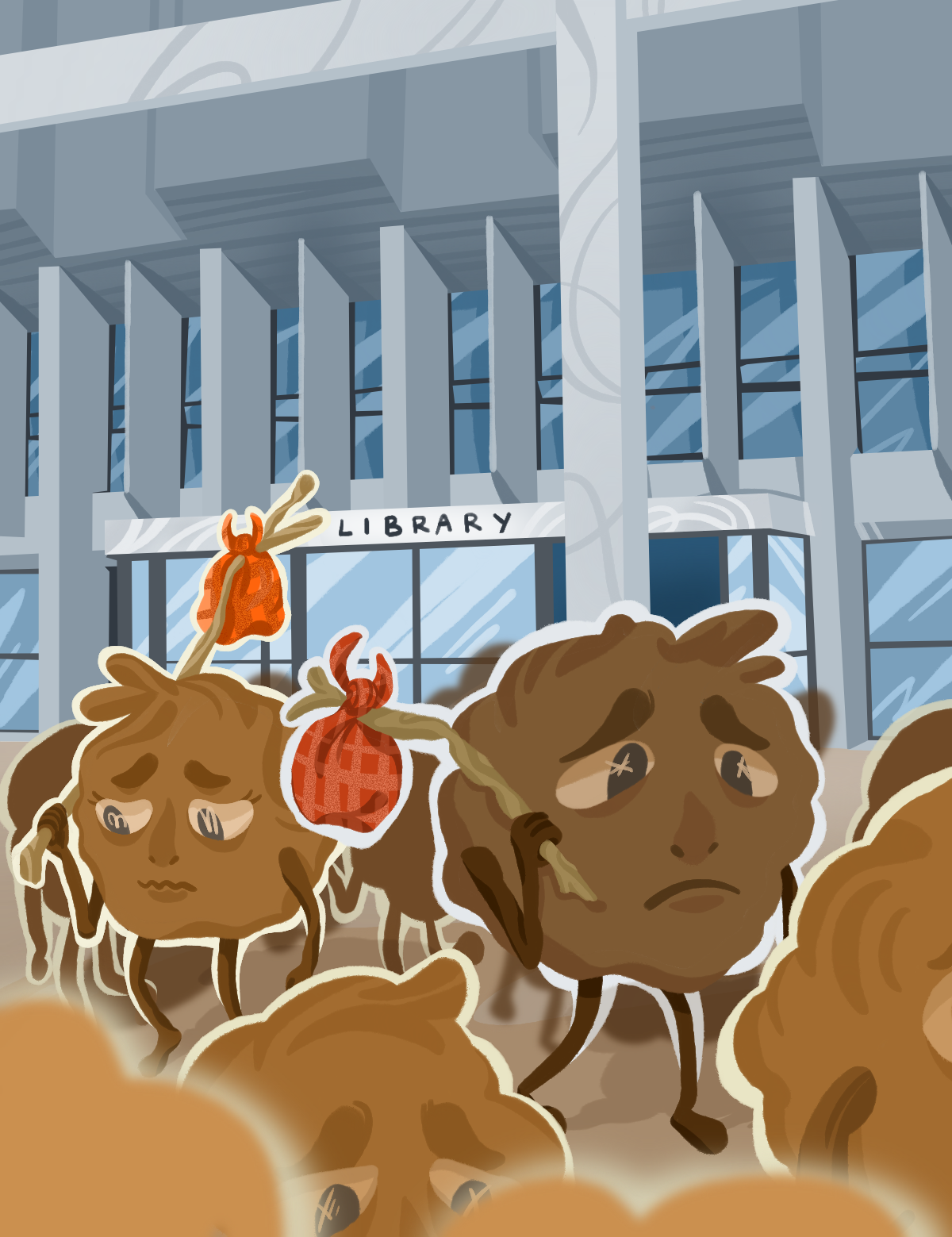
Cartoon asbestos particles (little brown specks with googly eyes) walking away from the SFU library building with a bindle upon their shoulders. They have a look of desperation upon their faces.
ILLUSTRATION: Olivia Blackmore / The Peak

By: Heidi Kwok, asbestos tenant advocate

Over the summer, SFU’s asbestos community was served a notice to vacate the fifth floor of the W.A.C. Bennett Library on the Burnaby campus. This eviction coincides with the reopening of the floor on August 25, following a nearly three-year renovation project. Henry J. Asbestos Junior, the primary tenant, and his extended family of over nine and a half million particles (and counting!) have been locked in a bitter eviction battle with the library since November 2022. They allege to have been victims of a targeted renoviction campaign and are demanding justice.

“We are beyond outraged,” said Henry J. Asbestos Junior, a concerned father of 485 asbestoslings. “For six decades, we’ve been model tenants — quiet, respectful, and generous. With open arms and open lungs, we have proudly offered refuge to countless panic-stricken undergrads since our humble floorboard beginnings. Although admittedly, not everyone appreciated our hospitality or our complimentary parting gift basket. It included goodies like chronic chest pain, wheezing, and mesothelioma.” 

The tenants claimed to have entered into a perpetual fixed-term lease contract with the library since 1965. However, Gohar Ashoughian, SFU’s University Librarian and Dean of Libraries, told The Peak otherwise. “The asbestos community has continuously failed to pay rent and strata fees, failed to contribute meaningfully at bi-weekly floor occupant association meetings, and has been unapologetically freeloading off of student health plans. We had to put our foot down on the floorboards.” 

Asbestos Junior showed The Peak what remained of his former home — now a grey, soulless, refurbished office space for the health sciences’ library liaison. “They have ruined everything,” he tearfully said. “Our former home had a certain je ne sais quoi — a distinct charm and character.” Upon walking up to the newly constructed private study room 5063, Asbestos Junior was practically bawling. “This used to be where our community centre was built. We held picnics, book club meetings, Friday night bingos, and barbecues during the summer here. Sometimes, we’d even use the nearby books the librarians so helpfully supplied as kindling.”

The Fifth Floor Fibrous Coalition, a grassroots movement fighting for asbestos justice, has filed a complaint with the BC Residential Tenancy Board and vows to take the library to arbitration. “This is our home. Where else are we supposed to go — the campus dorms? They’re already occupied by a thriving single-family neighbourhood of Moulds. Virtually every corner of campus has been called dibs by other more hostile communities like the Dust Mites Mafia, the Mildew Missionary, and the Raccoon Society,” said a spokesperson from the coalition. “We are living in the worst crisis of gentrification in SFU’s 60-year asbestos history.”

Gossip Peakie: The fall you turned ugly

0
ILLUSTRATION: Yan Ting Leung / The Peak

By: Gossip Peakie 

Hey, Burnaby Mountain dwellers. At this point, you should know who I am (even you first-years). If you don’t, you have a lot to learn about this town, sweetie. Gossip Peakie here — your number one source for all the hot goss on campus. 

Welcome back to another year at SFU, or should I say to another category on my blog page. The title? The Fall You Turned Ugly (who did you get fashion advice from? Your girl Noeka? Barf). How was my summer, you ask? Wouldn’t you love to know. I took a little posting break for an August vacation to Turks and Caicos on my sugar daddy’s dime — because mental health matters. After doing the Gwyneth Paltrow “eat nothing but corn starch and get a beach bod” cleanse, I’m starving for some hot gossip. Watch your backs. 


Spotted: Little Ms. Aritzia Warehouse Sale walking around campus in an Aritzia Super Puff. Girl . . . be so for real for a second. We’re not even in November, and you’re ready for December? All the while, she was wearing shorts. What an . . . interesting outfit choice.

Trust me, peakies. She was sweating to the max. Earth’s in her global warming era — expect 20-degree weather until November. 


Spotted: Lonely Boy takes a day trip to Bellingham just for a Trader Joe’s tote bag. Why? To secure a girlfriend by the end of the calendar year. Apparently, he figured investing $5 was better than spending the same amount every day on matcha to look approachable. 

Sorry, Lonely Boy. Looks like you didn’t study the concept of the performative woman. When he settled into his lecture hall seat, he was immediately met by a group of girls who held up hastily-scribed protest signs. “HEY, HEY, HO, HO! IF YOU SHOP AT TRADER JOE’S YOU’RE A CAPITALIST, BRO!” they screamed. 

The irony? Half of them had a $15 oat whatchamacallit from Starbucks in their hand. I guess a Starbucks gift card is really a “get out of practicing what you preach” card. 


Spotted: An attention-craving couple cosplaying Gilmore Girls in the library. 

“Ugh, you’re being such a Dean, Dean! I can’t believe you don’t get me! I am so studious, I go to Yale!” she screamed, flipping her scarf in a scripted manner and looking around the room to see if anyone was recording this for TikTok. This is SFU, not Yale — sorry to burst your bubble. “Oh, right. I totallyyyy forgot about Yale. Are you making fun of me for being a bag boy? Your nose is alwayssss in a fricking book — it’s not like you’ll get a job in this economy anyway!” The only person to notice this little breakdown was a librarian who shushed them with much enthusiasm. 

That’s all for now, besties. 

You know you love me. XOXO, Gossip Peakie. 

When university completely changes that person you avoided in high school

0
A man facing the camera, with a clone of his body facing away from the camera. It appears to be a clone of himself. Both are wearing business casual clothing.
PHOTO: Jack Thompson / Flickr

By: Katie Walkley, Peak Associate

Some people never change. Some people make it seem like they’ve changed, but it’s actually a disguise that they horrifyingly switch out of when they think they’re alone. 

The other day, I met the latter. It was not pretty.

He was an old acquaintance from my high school. Back when we first knew each other, my favourite conversations were the ones where we never spoke a word. Avoiding conversations in the first place always made my day extra special. He was one of those crypto bros who tried to sell me Pierre Poilievre’s NFT every time we met. I expected our relationship to continue with our anti-social ways after we graduated, but when I saw him at SFU, his usual RBF had been replaced by a smile so jolly that I almost didn’t recognize him. I tried to run — but he caught me first. 

We actually had the most uplifting conversation about how he’s enjoying school and having fun with friends. I was really impressed. How refreshing to see someone who went through an emotional maturation — to see the transformation of someone who used to say phrases like “what’s good my broski,” and now says, “Can’t we just talk about the political and economic state of the world?” 

After catching up, and talking about the importance of a feminist reading of Ibsen’s A Doll’s House, then about how much we hate Poilievre (shocker! He’s changed!), we said our goodbyes in the parking lot. We even made plans for karaoke Friday night. As I gave him an endearing wave, he hopped into the front seat of his car, letting out a sigh. While I walked away, I heard an unusual screeching sound. 

I turned around and saw a transformation that made a lot more sense than whatever emotional transformation he would have had to make to have gotten so cheerful and intellectual since high school. I thought he must have just read a self-help book or something, but the reality was much worse. Eat, Pray, Love was more like Starve, Curse, Hate for this guy.

In the privacy of his car, he screamed and held onto his head in pain. He peeled a suddenly-apparent mask (wtf?) off of his face, and his joyous grin morphed back into a scowl that I knew all too well. He punched the steering wheel so hard that it shook the car and a printed selfie of him with Elon Musk flew out of his sun visor. I hid behind a car so I could see what the hell was happening. He gazed upon the photo and it seemed to help ease the discomfort that escaping from his disguise must have caused him.

“GOD, MOM — what am I going to wear tomorrow now that all of my band shirts are dirty?? How about my The Clash shirt . . .  NO MOM. I need real music, like Radiohead or Death Grips . . . You know what? Just forget it. You suck, Barbara!” he screamed into the phone, his voice shaking the ground beneath me. 

I watched, disappointedly, with the realization that our short time getting along was all a façade. Maybe he adopted this persona to hit on the radical left baddies here (spoiler alert: he found one), or perhaps he’s just having a pre-quarter-life identity crisis? I guess I’ll be singing “Reunited” all by myself for karaoke this Friday. Or who knows, maybe he’ll change back? 


The Peak investigates: The SFU Pisser

0
The AQ pond at night, a shadowy figure walking away from the viewer. An observer is holding a cellphone, filming them.
ILLUSTRATION: Olivia Blackmore / The Peak

By: The Humour Investigator

As I sat at my cubicle in The Peak office, all I could think about was what I used to be. When I was a News Writer, I investigated crime on campus . . . and now I sit in the dark, writing subpar humour that no one actually reads. 

What gives me hope is finding my arch nemesis — the SFU Pisser. I was once a real investigator, not a phony-ass detective wannabe who set up a sketchy Instagram page. If I were to return to my former days of glory, then perhaps it was crucial — no, super-duper crucial — to find out the identity of the pisser. We must stop them before copycats pop up. There are already fan accounts . . . 

Fellow students, I present to you 75 hours’ worth of investigative work. I present to you my shortlist for the identity of the SFU Pisser. 

POSSIBILITY ONE: The Port Moody Pisser 

My doomscrolling tendencies have led me to who I believe is the OG pisser in the Tri-Cities-Plus-Burnaby region. I present to you suspect #1: The Port Moody Pisser, located at Port Moody Secondary School. 

What is interesting about the Port Moody Pisser is that, what I believe to be their most recent pissing post, a video of their yellow urine painting the walls and toilet seat of a high school bathroom, was taken on March 10. The account recently posted another video from the same toilet . . . looks like someone pre-recorded videos and is now releasing them. 

The Port Moody Pisser is a very viable option to be the SFU Pisser. Perhaps the Port Moody Pisser graduated and is now maintaining both accounts? But what would explain the pisser’s shift in pee colour from dark yellow in Port Moody to clear white at SFU? Perhaps they did some TLC and stayed hydrated over the summer. In a statement to The Peak, the Port Moody RCMP also thought that the Port Moody Pisser had crossed the city line, and asked all SFU students who spot yellow pee on a toilet seat to call Crime Stoppers immediately. 

POSSIBILITY TWO: The SFU Investigator 

This would also make sense. Imagine this — you’re an evil comp sci student with nothing better to do than to make up fake characters in an SFU multiverse. The SFU Investigator seriously can’t be this bad at investigating crime on campus. Where are the stakeouts? Where’s the attempt to get CCTV footage? 

It is clear that the SFU Investigator, a no-good Instagram wannabe investigative journalist, is the equivalent of putting a child in Inspector Gadget’s robe. If he is this bad at investigating, then there’s a real possibility that he’s making all this shit up. 

POSSIBILITY THREE: Ex-UBC president Santa Ono wants attention

Santa Ono, the former president of UBC, was once loved by all students. After a tumultuous job search in the States that ended in him rejecting the diversity, equity, and inclusion policies that he once embraced (to kiss the ass of Republicans), he became unemployed. 

Think about it. Santa’s the perfect man for the job: he wants to see higher education suffer for kicking him out of the club, he’s got a desperate need for clout, and had years’ worth of access to campus bathrooms. It is also scientifically proven that after eating like a lavish university executive for two years, your piss will turn clear. Ah-HA Santa Ono! We’ve got you good. 

His motive? Relevance. Maybe we should remove him from our list — 

POSSIBILITY FOUR: The Simon Fraser Student Society (SFSS

The SFSS is officially irrelevant. According to a survey by The Peak, when asked who the SFSS president was, 99% of students answered Joy Johnson. Perhaps the SFSS decided that it was time to become relevant again. Instead of politely taking SFU’s shitty (no pun intended) treatment of students, maybe the group decided to stage a public demonstration. 

Want to raise tuition? Want to ban paper towels? Fine. The SFSS will just piss on the floor. After posting the piss on Instagram, we suspect that he cleans it up. They don’t want to be too disruptive — they’re the SFSS after all. Except, they forgot to attach their name to the piss . . . looks like they need to hire a better PR firm. 

POSSIBILITY FIVE: No one 

Perhaps the pisser is just a figment of our imaginations. Perhaps there are better things to worry about in life than their identity. Nonetheless, I will continue to obsess over this. 

If the SFU Pisser wants a prime-time interview with The Peak — I’m here. I’m waiting.