

Man cancels opening of new ski resort after becoming aware of tiny flaw on molehill location

A local entrepreneur has hit the brakes on his plan to build a multi-million dollar, state-of-the-art ski resort after he discovered that the molehill he intended to build on had a small dent in it that could potentially make the resort at risk of earthquakes.
Although the man has been accused of overreacting to such a minor problem, as the odds of an earthquake coming in the next hundred years is 1 in 25,000, he says he isn’t taking any chances on this enormous project and is also hopeful that he can manage to make a federal case out of his situation.
With files from The Idiom Inquirer
Student unions look to leave Canadian Federation of Students

A CFS Day of Action in Toronto in 2008
Last week, a group of organizers from various universities across the country announced plans to begin petitioning to leave the Canadian Federation of Students (CFS) — a nation-wide lobby group whose mission statement, according to their website, is to “provide students with an effective and united voice, provincially and nationally.”
Currently, CFS — founded in 1981 — represents over 80 student unions and half a million individual students from various universities and colleges across Canada, with the largest concentration of post-secondary institutions being located in Ontario.
This latest push to leave the CFS includes student unions from Kwantlen Polytechnic University, Capilano University, the University of Toronto, Ryerson University, York University, Laurentian University, and Dawson College. This defection could leave the CFS without representation in British Columbia, Manitoba, and Quebec.
In the release made by the student organizers, Ashleigh Ingle, a graduate student at University of Toronto, stated, “Many of us are longtime student organizers and have seen students attempt to reform the CFS from within for decades, but to no avail.”
She continued, “Students are realizing that their interests are not served by the Canadian Federation of Students. We are not walking away from organizing at the national and provincial level; we are creating the space for that to happen effectively.”
SFU’s undergraduate student union, the Simon Fraser Student Society (SFSS), formally left the CFS in 2012 after a 2008 referendum showed that 67 per cent of voters wished to leave the federation. A lengthy legal battle ensued between the two parties, which was eventually settled out of court. The case cost the SFSS over $450,000 in legal fees.
They’ve been very resistant to change.”
– Alex McGowan, Kwantlen Polytechnic, University student
In 2011, the Concordia Student Union also began the process of attempting to sue their way out of CFS membership, becoming the 8th university at the time to do so. Complaints about membership with the CFS revolve around the organization acting non-democratically, and not representing its student members.
“Mainly, it’s their inactivity, the fact that they haven’t been doing anything with our money,” said Alex McGowan, a Kwantlen Polytechnic University student and West Coast representative of the movement. “They haven’t been effective, all the services and discounts that they provide us are already provided by our student association, and the lobbying has been ineffective.”
McGowan went on to describe the CFS’ “anti-democratic nature.” He said, “They’ve been very resistant to change, and students trying to work within the organization have to be able to get elected.”
Currently at Kwantlen, a full-time student pays $8.52 per semester to the CFS, while a part-time student pays 95 cents per credit. In order to leave the CFS, a student union needs to have 20 per cent of the student body sign a petition in favour. After that, a date is set for a referendum, which passes by majority.
Petitions like this have sprung up at the other 15 institutions involved in the statement, which also encourages other university student unions to take the same steps.
CFS internal coordinator Brent Farrington said that the reasons and unions behind the movement is unclear. “The real question for us is who they are and where they are, because it’s quite vague . . . We’re mostly just trying to find out what the actual grievances are. We’re kind of in the dark.”
Heteronormativity is everywhere

Heteronormativity is pervasive, even in the ivory towers of academia. Heteronormativity is when heterosexuality is treated as more natural than other sexual orientations, and is inherently damaging to queer people. It was the fear of being treated as deviant — which happens almost every day of my life as a direct result of being openly gay — that prevented my coming out for a very long time.
In this column throughout the semester, I will be challenging heteronormativity and making it clear that heteronormativity — like homophobia — is always unacceptable. This first installment will focus on heteronormativity in the heterosexual world. Part two will focus on my own experience as a queer person who internalized heteronormativity and my inability to acknowledge and resist it.
I will not be addressing arguments for and against homosexuality; there is a good deal of material available for those interested in the topic, and 500 to 600 words simply cannot do it justice.
Regardless of the cause of homosexuality, I believe that, as queer people are doing no harm to others and are well-established as a legitimate sexual orientation, we should be treated with all the respect granted to heterosexuals.
Heteronormativity is to acceptance as homophobia is to tolerance. While the homophobic person is unable or unwilling to tolerate queer people, heteronormative people are unable or unwilling to accept queer people as true equals. Because it is subtler than homophobia, heteronormativity often operates under the heterosexual radar, and is dismissed by heterosexuals when concerns are raised.
This in itself is harmful: queer people are told via the acceptance of heteronormativity that our marginalization is legitimate, regardless of personal impact. The queer person’s self-esteem is secondary to the institution of heterosexuality.
As suggested, even the enlightened university student is often prone to heteronormative remarks. Comments I have encountered include the suggestion that to speak of characters in an historical novel as queer is to “project” a “modern” identity upon them. Radcliffe Hall and other historical queer figures would object to this notion. However, when I objected by citing such examples, I received blank stares in response.
I dreaded this class from then on, particularly that student and others who agreed with them. This was compounded when the professor completely ignored my email about how marginalizing the student’s statements were and how it affected me personally.
I am grateful that, at this time, I was out of the closet and had mostly come to terms with my own internalized heteronormativity. However, coming out should not be a stressful event to plan and practice; it should not even be necessary. I had to wait months before coming out to my heterosexual parents because they had heard distressing news two months after I realized I am queer.
This meant I had to lie to them by making up male names for the women I was dating. I wanted to be honest with them — I wanted them to know me — but this was not possible at the time because they, too, had been indoctrinated by heteronormativity. When I finally came out, I was confessing rather than sharing. I wanted to soften the blow, but knew there was no way to do so.
Living a lie means constantly testing the waters of social interaction. If someone makes a heteronormative comment around a closeted queer person, it is likely that person will internalize the comment — as we have been taught to do — and stay closeted for longer. Being closeted is painful, and is something we as a society should seek to reduce.
SFU grad film premieres at TIFF

It all began in a monastery. Devan Scott, an SFU film studies graduate, was helping out a friend with a documentary being shot at a monastery. After living with the monks for three days, an idea was formed, and Paradiso was born.
Scott’s grad film, a black-as-night comedy, follows two brothers after the sorting of the second coming. Cain is sent to heaven — mistakenly — and his brother to hell, a slip-up that Cain spends the span of the film’s 13 minutes trying to remedy. Joined by St. Peter, a scruffy, white robe-clad, foul-mouthed angel of sorts, Cain confronts God and tries to set the record straight: he was not meant for heaven, but his brother was.
The short film has been selected for the Toronto International Film Festival’s Short Cuts Canada Programme, a feat that only a handful of SFU film grads have achieved. “It totally blindsided me. I didn’t think it was programmable; it’s profane yet deals with religious iconography. It was a film I made just for fun for myself,” Scott says.
The film is a manifestation of Scott’s ideas about existentialism and religion at the time, his visit to the monastery acting as a sort of incubation period.
“It really changed my view on religion. I used to think not only that the whole thing was based on fiction, but that the entire lifestyle based on it was kind of stupid. Seeing these people . . . they’re very content and are really hurting the planet less than I am and are really having a higher standard of life doing it. It made me think ‘maybe it isn’t so bad,’ but at the same time it got me thinking: if god existed I’d be really, really screwed.”
The end result is a film tinged with the existential terror of living in an indifferent universe where there are no real choices. “The thing about Cain is he never has much agency. He kind of gets tossed into heaven and he only has one option, and that’s to try and talk to God. St. Peter is the one who either has to help him escape or not. He represents the kind of natural, logical conclusion to there being an all powerful God, where he’d have to have people who have no choice but to help him, regardless of what they think,” Scott says.
– Devan Scott, director and screenwriter
The chilling ending of the film — which I won’t give away here — demonstrates this thinking, a visual narrative indicating that there’s no way out: “I think the ending is a case where it’s me following the idea of heaven to its conclusion. In the more pop cultural forms it’s this green field, in others it’s literally whatever makes you happiest. What if what makes you happiest is rebellion? And not being in heaven? Then the only definition for heaven would be a lie. You would have to literally live a lie.”
Paradiso’s place in TIFF’s scheduling may have something to do with the very personal quality of the film. It’s possible it’s this very reason that “a lot of people who make shorts [with the express purpose of] festivals . . . don’t tend to get in. Often the films kind of lack soul.”
As for Scott’s own success, as well as his filmmaking philosophy, it’s all very close to home. “The ones [I’m most proud of are] where I just hit on something really personal for me. They’re almost mischievous, where I feel like I’m gonna get away with something. If I feel like I’m being told not to make something, I’ll make it; I have a rebellious streak that only manifests in movies, apparently.”
Next he’ll be working on a project based on a recent news article about a white supremacist who is trying to take over a small town: “I thought, that’s incredible, it’s basically a political zombie movie.” Before he turns his “five pages of word vomit” into a script though, he’ll be seeing as many films at TIFF as he can.
“We bought tickets to [Alfonso Cuaron’s] Gravity and [Errol Morris’] The Unknown Known. There’s also the new Kelly Reichardt film, the new Claire Denis film, so I’ll be busy.”
University Briefs

Students choose arts and social sciences over high-paying majors
According to a new CIBC World Markets report, university students are still pursuing low-paying majors over lucrative ones — and they know it. Benjamin Tal, CIBC Deputy Chief Economist, notes that fields like physics, math, medicine, and engineering will “. . . have this nice rate of return on education . . . social science [and] those kinds of fields do not give you the same rate of return.”
Though students are aware when they enter lower-income fields, the number of students applying for higher-salary majors has not increased over the last decade, says the report. It suggests that the trend is driven by the joy of learning about fine arts and social sciences.
With files from CBC News
Saint Mary’s Frosh leaders slammed for controversial chant
Community members both on and off Saint Mary’s campus are up in arms after an Instagram video captured Frosh leaders teaching a chant to new students that glorifies non-consensual sex with underage girls.
The chant — which according to Student Association President Jared Perry has been taught to Frosh for years — goes, “Y is for your sister, O is for ‘oh so tight,’ U is for underage, N is for no consent, G is for grab that ass — Saint Mary’s boys we like them young.”
In reaction to the chant, the University has ordered the 80 frosh week leaders and the entire Saint Mary’s University student union executive to take sensitivity training. Additionally, the executive is being sent to a conference on issues of sexual violence and consent at St. Francis Xavier University next week.
With files from The Journal
Saving face by wearing makeup
Pissed your pants during a nerve-wracking tutorial presentation? A new University of Toronto study suggests putting on makeup may relieve your embarrassment. The research suggests that metaphorical thinking — like saving your face by restoring it with makeup — affects daily behaviour and helps cope with negative emotions like humiliation.
“Although embarrassment leads people both to hide their face [with an item like sunglasses] and to restore their face, only by restoring their face can their embarrassment be decreased,” doctoral student Ping Dong explains. “It is interesting to speculate that people who wear cosmetics on a daily basis may be more tolerant of potentially embarrassing behaviour.”
With files from The University of Toronto News
Golden Key society raises skepticism in students
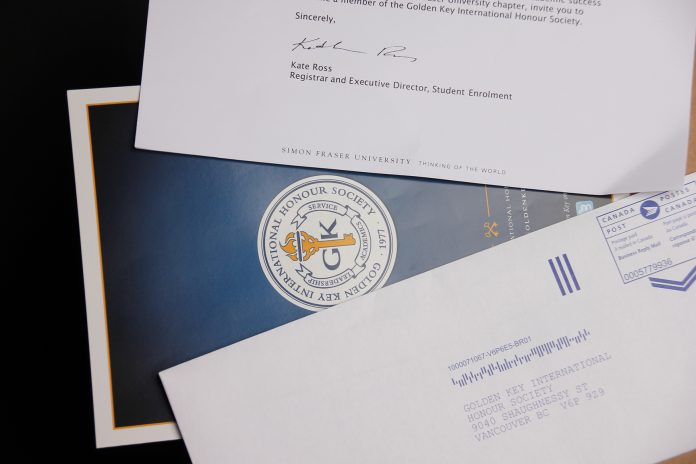
Every September, the top 15 per cent of SFU students in their program receive a letter from the Golden Key International Honours Society, a non-profit organization, happily inviting them to join the society for the chance to participate in workshops, attend conferences, and apply for scholarships, for a one time fee of $90. Once a student has joined the society, they are a member for life. They count former US president Bill Clinton among their honorees.
For many students, the letters appear out of nowhere, and are received with a bout of skepticism. Top comments on in the SFU subreddit of popular social media site Reddit about the society read, “Scam. Don’t do it,” “Hey, you’re smart enough to do well in school, are you dumb enough to join this society?” and “Not quite a scam, but not worth your time and money.”
One of the more forgiving comments reads, “Be honoured that you are in fact in the top 15 [per cent] of your major, but I would not join unless you really want extracurricular activities. Most of the people online said that they gained nothing from joining and it was not really worth it.”
The letters are sent out from the office of SFU Registrar Kate Ross, who acts as the advisor to the SFU Golden Key chapter, along with Kim Thee, Student Life Educator and Leadership Programming.
“They’ve been around a long time . . . and they really are like a club in many many ways,” said Ross. “They actually do a lot in order to actually be involved as a Golden Key chapter, there are a variety of things that they have to do to achieve a certain status, and it’s really around service and leadership.”
Top comments on Reddit read “Scam. Don’t do it.” and “Not quite a scam, but not worth your time and money.”
The SFU chapter of Golden Key has been around since 2000, and over 5000 SFU students have joined Golden Key since then, most of which are now alumni members. According to Ian Sankey, the director of Golden Key in Canada, approximately 400 SFU students join the society each year. At $90 per student, Golden Key receives approximately $36,000 from new SFU members per year.
The international organization started in 1977 and came to Canada in 1997. It now boasts chapters at universities in eight countries: Canada, the US, South Africa, Australia, New Zealand, India, the Bahamas, and Malaysia.
The current co-residents of the SFU chapter are Andreas Hovland and Victoria Harraway, who will lead the chapter for this year. When asked why he chose to join Golden Key, Hovland said, “I believe in the three pillars of Golden Key. They are academic excellence, community service and leadership. I think that the work being done by the Golden Key chapters around the world is truly inspiring and wanted to be a part of this within our own community.”
Ross acknowledged the mistrust that students may feel towards Golden Key, and pointed to the fact that the idea of an honours society is very much an American concept. “You don’t know how many times I’ve actually said to [Golden Key], you know the honours society doesn’t work in Canada,” Ross said. “Elitism doesn’t work well in Canada.”
She mentioned that Golden Key’s Canadian partners have even suggested changing the name to the Golden Key Leadership Organization, or something along those lines, in order to appear less elitist to students.
Activities of the SFU chapter include book drives, clothing drives, networking events, and volunteer projects for Nanook Daycare and Charles Best Secondary School. The chapter receives approximately $5,000 each year from Golden Key to “support chapter activities and community service projects,” according to Sankey. In recent years, SFU students have also been the recipients of some of the larger scholarships offered by Golden Key, in amounts up to $10,000.
For Moe Kopahi, Member Services Officer of the Simon Fraser Student Society (SFSS), Golden Key’s practices are “nonsense.” Kopahi compared the services provided to students by Golden Key as very similar to those provided by the SFSS. He also mentioned that the SFU chapter of Golden Key has previously applied to become a club of the SFSS, but was denied due to the elitist nature of the organization.
“I have no question about the legitimacy of Golden Key, but compared to the services that the SFSS provides, as the official representative of SFU students, it’s not legitimate,” said Kopahi. “We do the same seminars, we do all these different things, and if the students want to see something, they come to us and we find the funding to make it happen.”
Peak Week September 9 – 14

Eats
Looking to make summer last a little longer? Earnest Ice Cream’s brick and mortar location on Fraser and King Edward has finally opened its doors, just in time for the last rays of sunshine. The local business, formed by Ben Ernst and Erica Bernardi, started out with a little cycle-freezer, transporting to-die-for pints and gourmet ice cream sandwiches to farmer’s markets around the city. Their company eventually outgrew the cart, which is understandable considering their goods are some of the best ice cream to come around in a long while. Check out some of their staple flavours, like whiskey hazelnut or vanilla, or take the adventurous route and sample their earl grey or summer-preserving basil strawberry.
Beats
The Cobalt’s new Karaoke event, offered the third Thursday of every month, is not to be missed. Ear Muffs: Karaoke is “a potentially horrific karaoke night hosted by Seany Guys.” There’s a host to guide you through the good and bad performers, plus drinks are cheap — which is good, because the more drinks you have, the better the brave soul on stage is going to sound. Bring your friends and liven up a regular Thursday night.
Theats
Cinematheque’s new fall schedule is out, and it’s looking hot. This week, check out their Blue, White and Red series, featuring the Three Colours Trilogy (inspired by the three colours of the French Flag) by the late Polish master Krzysztof Kieslowski. His Blue, White and Red trilogy stands out as one of his crowning achievements. Blue is the first film in the series, following Juliette Binoche as a young woman who loses her family in a car accident; White is a black comedy follows a hairdresser who is left penniless on the streets of Paris after a divorce; Red is the story of a young model who meets a retired judge.
Elites
Check out the opening of SFU Gallery’s newest exhibit, Samuel Roy-Bois: Not a new world, just an old trick on Sept. 14. Between 11:00 a.m. and 1:00 p.m. the gallery will offer breakfast, mimosas and live Dvorak for guests of the exhibit. Samuel Roy-Bois’ work questions the conceptual and physical definition of space and how we define the spaces around us. The exhibit will question the boundaries between art and exhibition. Check out sfu.ca/gallery for more details.
Treats
Board of Trade is a concept clothing shop with two locations in Vancouver, in Chinatown at Union Street and in Gastown at Carrall Street. The main concept is to offer local creatives a place to showcase and sell their work, and the shop hosts a medley of brands ranging from clothing to jewelry to ceramics. If you’re looking for some back to school duds, or some unique pieces to spiff up your dorm, consider buying local. Check out Wylden’s stacked thin and wide silver rings or the classic-with-a-twist denim western shirts by Soulland.
Championship or bust
The Simon Fraser University Men’s hockey team ended last year’s BCIHL season on a sour note, losing to Selkirk College in the championship series. The deciding game in that series was played, for the most part, without the team’s leading goal scorer Ben Van Lare.
His injury served as a precursor to the upcoming 2013-14 season as his graduation, along with captain Chris Hoe’s and several other key players who graduated, sent head coach Mark Coletta hard along the recruiting trail to replace the offensive production that was departing. He did just that.
This offseason saw the Clan introduce a recruiting class of 12 new players, all with significant shoes to fill. The most notable players of the 2013 recruiting class are Trevor Esau, Josh McKissock and Yan Kalashnikov.
It will be hard to miss Trevor Esau when he hits the ice, as he stands 6’4 and weighs 220 pounds. Esau will bring much needed leadership and physicality to a very young squad; the physical defenseman served as captain for his former team the Prince George Spruce Kings of the BCHL, and he also racked up 290 penalty minutes in only 159 games played. Esau will likely team up with returning defenseman Mike Ball to create a formidable defense in front of goaltender Graeme Gordon.
Incoming forwards Josh McKissock and Yan Kalashnikov will be relied upon heavily to put pucks in the net, and judging by their track record, scoring will not be an issue. Mckissock netted 51 points in 43 games for the Junior B side Fernie Ghostriders and Kalashnikov chipped in 35 points in 36 games for his former Junior A club, the Alberni Bulldogs.
The key aspect to each player’s offensive game is consistent scoring, as both players tallied, essentially, a point per game. The added production, along with the return of talented forward Nick Sandor, gives SFU a vaunted offense that could give every BCIHL goaltender nightmares this upcoming season.
As for the rest of the BCIHL, the upcoming season seems to be leading to another two-horse race between SFU and Selkirk College. Selkirk lost BCIHL leading goal scorer Jordan Wood but returned two dynamic forwards in Logan Proulx and Connor McLaughlin. Selkirk also added a former junior hockey goaltender of the year in Guelph Ontario’s James Prigione, making the Saints a formidable opponent once again.
The Clan hockey team’s regular season begins October 12 against Thompson River at Bill Copeland Sports Centre. Until then, the team will play exhibition games against cross town rivals the UBC Thunderbirds, as well as make a trip out to the East Coast of the United States to take on four NCAA Division I hockey teams. The preseason schedule will give coach Coletta a great idea of how his team stacks up against elite talent and will serve as a measuring stick for an upcoming season that should end in a championship title and nothing less.
Superheroes and Sexism

Though many strong arguments exist against the sexist representation of women in comic books, the most immediate of them all may well be the Hawkeye Initiative. Begun in late 2012 by female webcomic artist Noelle Stevenson, the Hawkeye Initiative is a satirical blog comprised of images of Hawkeye aping female comic book characters in “Strong Female Character” poses, which have been criticized as degrading and unrealistic by feminists, comic book fans and members of the artistic community.
The results are, predictably, hilarious. Those of you who are familiar with the comic series, or with Jeremy Renner’s performance of Hawkeye in Joss Whedon’s The Avengers, will doubtlessly find humour in seeing the character semi-nude and twisted like a pretzel, often with a set of pursed lips and a seductive come-hither expression.
But the Hawkeye Initiative also successfully sheds light on the oft-degrading depiction of women in comic books: if we find a male character in these poses so ridiculous, why don’t we react the same way when characters like Elektra, Batgirl and She-Hulk are presented the same way? For that matter, where is that Wonder Woman movie that’s been in development hell for decades? And what’s the deal with all the revealing costumes — wouldn’t armour be more practical?
Most comic books remain as exaggeratedly misogynistic as ever.
The natural conclusion that many cite for the myriad issues under the Women in Comics umbrella is that comic books are naturally a male domain, and artists depict women with the male gaze in mind; that is, as objects rather than subjects. Although this may have been the case in the Golden Age of comics, that was more than half a century ago.
Nowadays women form a sizable percentage of the comic book market, and a comparably large chunk of the industry, especially in the realm of “alternative” comics. Writers and artists like Hiromu Arakawa (Fullmetal Alchemist), Alison Bechdel (Fun Home), Pia Guerra (Y: The Last Man) and Kate Beaton (Hark! A Vagrant) have done incredible work for the comics medium in the last decade alone, and those are just a few of my personal favourites.
Still, many of the biggest names in the medium seem hell-bent on reminding their fans just how old-fashioned their views are. Tony Harris, the artist behind such comics as Brian K. Vaughan’s Ex Machina, took to Facebook last year with a rant about female cosplayers — fans who dress up as fictional characters — which culminated in an all-caps accusation: “YOU DON’T KNOW SHIT ABOUT COMICS, BEYOND WHATEVER GOOGLE IMAGE SEARCH YOU DID TO GET REF ON THE MOST MAINSTREAM CHARACTER WITH THE MOST REVEALING COSTUME EVER.”
More recently, Todd McFarlane and Mark Millar — the creators of Spawn and Kick-Ass, respectively — came under fire for their comments about the supposed inherent masculinity of superhero comics, and their use of rape as a plot device. Let’s get this straight right off the bat: superheroes are fictional. It is entirely up to a given author or artist to depict superheroes in any way they choose.
Calling the superhero genre “testosterone driven,” as McFarlane recently did in a panel promoting a PBS documentary, is missing the point. Just because comics have mostly been macho power fantasies in the past doesn’t disqualify their potential to grow and evolve with time. To deny the possibility for change is laziness, plain and simple. If we all thought this way, we’d still be riding horses to work and bloodletting at the barbershop.
Maybe the reason that so many still see the medium as a boy’s club is that many comic series just aren’t very inviting to women as fans. After all, who wants to see their gender constantly objectified, contorted into anatomically impossible poses and depicted as either virginal and innocent or seductive and sexualized? (Google the Madonna/Whore Complex sometime.) Those of you who’ve seen the Fake Geek Girl meme or who’ve spoken with gamers online know that geek culture can be viciously and unapologetically misogynistic — comic creators and fans alike seem obsessed with preserving this reputation.
Nowadays women form a sizeable percentage of the comic book market, and a comparably large chunk of the industry.
Take Millar’s comments on rape as a storytelling tool. In an article for The New Republic earlier this year, Millar defended his use of rape as a plot device, saying, “The ultimate [act] that would be the taboo, to show how bad some villain is, was to have somebody being raped, you know? [. . .] It’s the same as, like, decapitation. It’s just a horrible act to show that somebody’s a bad guy.”
But Millar’s defense hints at the truth of rape as a storytelling tool: its purpose is, more often than not, to have an effect on the male protagonist rather than the female victim. Though several male comic book characters — Batman and Green Arrow among them — have been raped themselves, it’s always been advance their own character arcs, and to develop them as protagonists.
When female characters experience the same fate, it is almost always in the service of the arc of a male character; the victims are often secondary or tertiary figures, and more often than not, little attention is paid to the physical and psychological repercussions of their experience.
The website Women in Refrigerators borrows its name from a particularly gruesome Green Lantern comic in which his girlfriend is killed and stuffed into a refrigerator by his nemesis. Created by comic writer Gail Simone, the site lists female characters who have been “killed, raped, depowered, crippled, turned evil, maimed, tortured, contracted a disease or had other life-derailing tragedies befall her.” Compiled in 1999, the original list includes over 100 characters.
Of course, these tropes are common in film, television, literature, video games and music videos, too. But where these mediums have seen a steady improvement in their depiction of women, most comic books remain as exaggeratedly misogynistic as ever. And those are the ones that have the audacity to even include female characters; many modern comic books have scarcely any speaking roles for women at all.
Women read comic books, write comic books, and are affected by their portrayals in comic books, directly and indirectly. Heck, a comic book made Time magazine’s list of 100 best novels of the last century (Alan Moore’s Watchmen) — the medium is gaining respectability every year, and rightfully so. For a genre with so much potential, there’s no excuse for the antiquated, sexist portrayals of women that still plague panel after panel. If there’s any hope for a new Golden Age in comics, this would be a good place to start.


