Home Blog Page 1227

Canvas takes over

0

WEB - canvas-Mark Burnham

At the end of December, WebCT will officially be retired from use at SFU. Canvas, an open source learning management system (LMS) by provider Instructure, was chosen as its replacement.

Implementation started at the beginning of the spring 2013 semester and was tested by eight SFU courses as part of a pilot project. The implementation expanded in the summer semester to the point where approximately 5,000 students were using Canvas.

“The implementation has actually been going really well, and we’re quite a bit ahead of schedule, actually,” said Mark Bachmann, communications officer at the Teaching and Learning Centre.

This semester, it was originally forecasted that half of of LMS courses would be delivered in Canvas. In reality, over three quarters of classes used the new platform, something that Bachmann is excited about.

Bachmann points to the fact that more instructors using Canvas than expected as proof that faculty are responding well to the pilot, something that has been echoed in student feedback.

“In terms of Canvas support, the help desks are reporting that there’s less activity than there has been in the past, even though they’re dealing with a new learning management system,” said Bachmann. “Either that means that Canvas is very easy to use, or it means that students are quick to learn. Probably both.”

According to Bachmann, in surveys of the pilot project done at the end of the summer semester, 64 per cent of students were either satisfied or very satisfied with Canvas, and 58 per cent rated it as easy to use.

While the progress of Canvas overtaking WebCT has been quicker than expected, Bachmann said there is still room for improvement.

quotes1That means that Canvas is very easy to use, or . . . that students are quick to learn. Probably both.”

– Mark Bachmann, Teaching and Learning Centre communications officer


One huge, and previously unexpected, improvement to the system, is the agreement with Instructure to create a mobile app, something that was not thought possible considering BC’s strict privacy legislation that doesn’t allow institutions like SFU to host information on the Cloud.

However, SFU and Instructure have negotiated an agreement to create a mobile app that doesn’t use Kaltura, a platform for hosting and delivering content that is built right into cloud versions of systems. Instructure and SFU will be building the Canvas app separated from Kaltura, so that it complies with BC legislation.

According to Bachmann, the Canvas mobile app should be available sometime in the spring 2014 semester.

One of the main strengths of Canvas over WebCT is the fact that it is an open source platform, which allows it to be constantly adding new features to the system. With the open source aspect, instructors are able to build their own modules, such as grammar tools or plagiarism checks, that can then be used by other faculty members.

Further adding to its flexibility, Canvas also uses Learning Tools Interoperability (LTI), which allows the system to integrate third-party plugins and modules. Bachmann believes as faculty become more accustomed to the system, use of LTI and modules will deepen the capabilities of the system.

Poet’s Corner: Coffee house

0

coffeecup

Pound down the pavement

Rain is falling, on me, on my hair, on my face, on my back, all of me

I’m soaked

It’s miserable out

It’s beautiful out

Open the glass door to coffee house

Door to another world

Hit by a wave of damp, warm air bearing a strong aroma

Coffee; with a hint of mildew and a dash of despair

It’s beautiful in here too

Coffee made by a misty-eyed university drop out in a heavy metal tee shirt

I order a cappuccino and he makes me a latte

Perfection

Sit by the window, let the light seep in, watch the rain fall down

Somewhere someone else is miserable out there

Makes me feel warm and protected sitting inside with my coffee

They say you watch the world go by but it comes too, it comes and it goes

It does not forget

The Coffee house


Architects propose uses for SUB space

0

CMYK-cards- Leah Bjornson

On Friday, Nov. 8, SUB architects held a public presentation to update the SFU community on their current vision for the project. The architects have narrowed down the sites to Main Street and Crossroads, as the Treehouse site was not preferred by students.

The presentation centered around their preliminary plans for the Student Union Building (SUB) space as well as their space programming interpretations of the information collected from students.

After reviewing the feedback from students collected during Build SFU’s Focus Group sessions, the architects have come up with four areas of focus as outlined in the benchmark statement: student focus, sense of community, outstanding design, and nature.


The team outlined a desire to create the SUB as the “heart of the student experience.”


For student focus, the team outlined a desire to create the SUB as the “heart of the student experience” that instills unity among students, pride in their school, and includes a clear “wow factor.” They also hope to create a sense of community in a comfortable, fun, welcoming space which provides a “home-away-from-home” for students.

With regards to design and nature, the team plans for the SUB to be a focal point or “postcard image” of the campus living room that allows students to connect with the natural mountain environment of the Burnaby Campus.

Marc Fontaine, Build SFU general manager, shared with The Peak the proposed space program for the building, which outlines the net square footage (NSF) allotments for different uses of the space in both Main Street and Crossroads. There is approximately 105,000 NSF total available on each site, and that space is split up similarly in both options.

For administration, which encompasses the SFSS board offices and general office, both sites have allotted 3,553 NSF.

Both sites have also designated 16,750 NSF for student activities, organizations, services, and clubs. This space includes eight proposed ‘organization suites’ which are meant for departments of SFSS or other student organizations that are “student centred,” like the FNSA or the Women’s Centre.

These suites come in two sizes: 1,320 NSF, which is roughly the current size of the Women’s Centre, and 820 NSF, which roughly equates to Out on Campus’ current size. However, Build SFU is planning to create more suites than there are current groups.

“If a group was created in two years and it’s a really active group and the Student Society at that time wanted to provide a space to assist with its function and growth, that group wouldn’t be disadvantaged by not having existed today,” explained Fontaine.

Both sites also feature 12,730 NSF of designated meeting and multi-purpose space. The plans include four meeting rooms which would hold 20 to 25 people, 15 meeting rooms for four to six people, one formal meeting room, one dance rehearsal space, two music rehearsal spaces, and a ‘cabaret’ space which would act as an informal stage or performance space.

There would also be a 4,000 NSF mutli-purpose room, which could be used for lectures or other public events.

The sites differed in their division of space concerning Food Services and Lounge areas. In the proposed Main Street building, architects allotted 10,650 NSF for food and beverage services; in comparison, Crossroads only has 2,950 NSF, which is planned for a coffee shop and dining seats. Fontaine explained this decision, saying, “The Crossroads site can tie directly into the food court in [MBC].”

What this means for Crossroads is that with the extra space, architects were able to designate 17,060 NSF for lounge area. Compare this with 9,500 NSF in the proposed Main Street building. Lounge space includes features like common areas, quiet study space, games areas (one in Main Street and two in Crossroads), group lounge space (for between 90 and 200 people), and a multi-purpose foyer.

When asked whether this difference could be a key determinant in which building is chosen, Fontaine replied, ““It could be one of the factors. It’s definitely a big piece.”

PED use should result in lifetime ban

0

Performance-enhancing drugs (PED) use is one of the utmost concerns in the professional sporting world, as the deterioration of once-revered New York Yankee Alexander Rodriguez’s legacy has proven. With most competent athletes being able to avoid detection for years, some argue that performance enhancers should be allowed in order for them to be administered in a safe manner and to, somehow, ‘level the playing field’ amongst athletes.

I, however, would argue that this completely disregards what it means to be a sportsman and puts the athletes in harm’s way. The only way to truly mitigate the use of PED in sports is to effectively ban those found guilty of using them.

Perhaps the most convincing argument against loosening the restrictions on PED and in favour of stricter legislation comes from the world of contact sports. No careers are shortened by how fast Lance Armstrong can pedal a bike or how fast a sprinter can run; however, serious injuries can occur when an NFL player can deliver harder hits or when a boxer can orchestrate a more concussive attack. Drugs that allow athletes participating in such sports to encourage an above-normal amount of muscle growth only further opens sportsmen to dangerous injuries.

In addition to the danger that stronger and faster athletes present in high-contact sports, PED also devalue what it means to be a professional athlete. Adding an unnatural substance into the training regimen goes against the pursuit of pushing the human body to its natural limits.

While they do not negate the necessity of skill, PED allow the possibility of otherwise unworthy athletes being able to force their way into the professional ranks on the basis of ill-gotten gains rather than pure, unadulterated hard work. Professional sport should be a celebration of the skill of a select few who are able to hone their craft better than anyone else rather than a bizarre science experiment.

It may, at first, seem that the system of temporary suspensions currently being used almost across the board is sufficient to deter users and punish those who have used them in the past. After all, don’t those who have been punished for past use of PED deserve a second chance? Not at all, says a recent study reported on by the BBC.

Research done at the University of Oslo suggests that those who use steroids, even for a short period of time, can reap the physical benefits on a long-term basis, perhaps even a decade after stopping use. If correct, the implication would be that once an athlete has been found to be using PED once, not only would their past achievements be called into question, but all their future outings would also be tainted.

As one of the authors of the study, professor Kristian Gundersen, tells the BBC, “In science if you cheat you are out for life, and my personal view is that it should be similar for athletes . . . it is a harsh treatment but if you really are cheating, I think that’s reasonable.”

For centuries, sports, both professional and amateur, have given us all a reason to come together and cheer. However, with the growing commodification of the industry, it is only natural to assume that there will be those who want to gain an unfair advantage.

Given all we now know about brain injuries in professional athletics, it is nothing short of irresponsible to let anything increase that risk. Furthermore, PED dilute the standard to which professional athletes should be held, by introducing an unnatural variable into the equation. As a result, those who have been found guilty of using such substances should face a permanent ban from their chosen sport, rather than a temporary suspension or other likewise insufficient punishment.

Music to your ears

0

WEB-mark nazemi-Pamr copy

A new study by an SFU PhD student has found that women suffering from chronic pain have increased sensitivity to specific frequencies and therefore might respond differently to sounds and music — a discovery which opens up new options for treatment through acoustic therapy.

During a study on the therapeutic use of music for chronic pain (CP) patients, lead researcher Mark Nazemi discovered that chronic pain patients were more sensitive to sounds than the control group. Even more notable was the fact that women experienced this pain more significantly than the male participants.

“Not only did we find this through the data set that we collected using a software that we designed, but also reinforced by the results of the qualitative questionnaires in which female CP patients reported greater sensitivity to everyday environmental sounds,” explained Nazemi.

“For example, [women] tend to listen to music at speech level versus listening to [it] loud, they prefer listening to speakers rather than use headphones, so they have this kind of phobia in terms of wanting to be farther away from sound source.”

A student in SFU’s School of Interactive Arts and Technology (SIAT), Nazemi first became interested in the topic while working on other health related projects. “I noticed that in the field of music therapy they weren’t really looking at the frequency content in music, and they would just generalize the type of music that would have therapeutic qualities example, ‘play some classical music’ or ‘let’s play some jazz,’” related Nazemi.

quotes1They have this kind of phobia in terms of wanting to be farther away from sound source.”

– Mark Nazemi, lead researcher

The problem he noticed, based on existing research, was that chronic pain patients tend to be in a hypersensitive state, so environmental factors can be more damaging than previously thought. Therefore, there is a real need for greater awareness of the effects of sound on chronic pain patients. “Let’s say if there is a construction site, being able to shut the windows can actually help them feel less pain at home,” said Nazemi.

Building on this research, Nazemi is now looking to develop an interactive sound system for therapy, which could help those suffering from chronic pain. He is doing so by creating a database of “comfortable sounds,” which mainly includes nature sounds, such as birds, the ocean, and even the sound of wind.

Nazemi and his team hope that by compiling these sounds, they can potentially provide patients in medical waiting rooms and similar stressful or uncomfortable environments with “soundwalks” to help lower anxiety and stress while they are waiting.

Said Nazemi, “If patients are really affected by listening to these recordings, if their anxiety levels are reduced, then I would actually want to make this into an actual system that we could implement in clinics and hospitals around the world.”

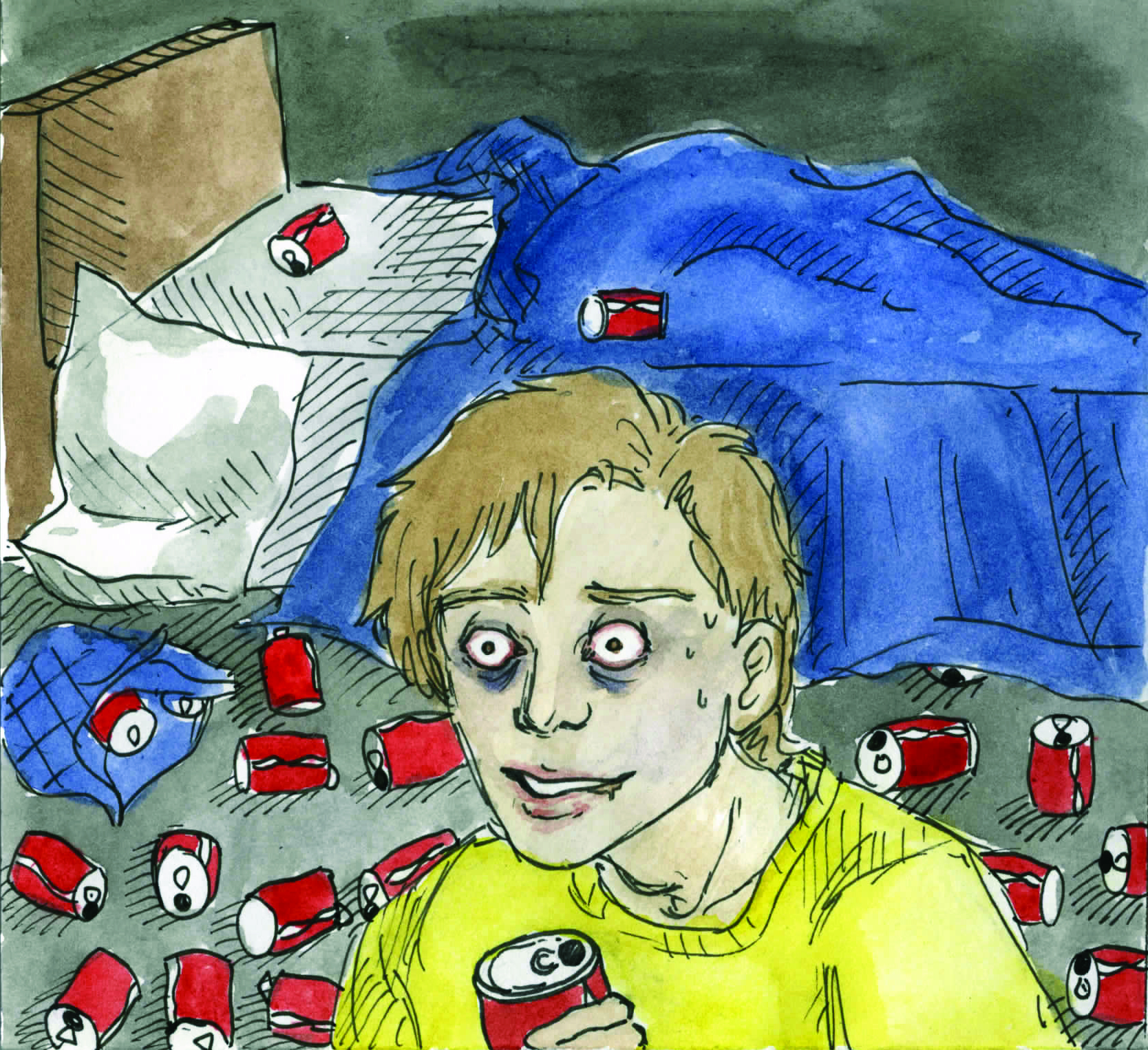
Family hit hard with 12 year-old’s Coke addiction

0

BURNABY —The Gonzales family has had a lot of tough breaks since arriving in Canada including a lack of jobs, repossessions and a house fire earlier in the year. However, nothing compares to their 12 year-old son’s two can-a-day Coke habit.

Bobby Gonzales, who started drinking Coke at the young age of five, was found to have two cavities. He has already previously had one filling. He often has a hard time paying attention in class. His room is untidy with a few cans of coke scattered across the room. These are symptoms common in heavy Coke use.

“His teeth are falling out, his teacher says he talks too much, I just don’t know what to do,” said Flores, the mother of the household, while holding back tears, “He’s out of control!”

The Gonzales’ dentist, Dr David Wong, though calmer, was equally grim in his words saying, “If he doesn’t get help, I don’t see a scenario that he won’t get another cavity,” and that Bobby “will have to probably have at least four fillings for the rest of his life,” to the audible gasps of the dental hygienists in the room.

When he is not allowed to have a Coke, he will pull drastic stunts such as pout or say moderately hurtful things. Sometimes he will even state statistics that sugar “is not that bad for you.”

“Come on man, what is so bad about Coke? If I want to drink it, I should be able to drink it,” justified Bobby, while sipping some Coke. “Besides everyone is doing it.”

Indeed, he is correct: Coke drinking has become an epidemic, not only reaching school children, but people of all ages. Drinking of sugary substances has not been this high since the Pepsidemic of the mid-90s. However, Dr. Cooper, a soft drink treatment specialist, says it is much worse now.

“In the 90s you had the edgy youth, what we would now call hipsters, drinking Pepsi during the height of the Pepsidemic, maybe a few schoolchildren would have the odd can,”  Cooper explained.

“But now, everyone from lil’ Sue in kindergarten to your grandmother are drinking Coke. I have not seen anything like it in all my years.”

Many addicts are in denial, not realizing the seriousness of their addictions, claiming that “it’s just a drink” or that they “only have one once in a blue moon.” Former addict Sean Howard knows this all too well.

“At first, it was a Coke after work, then it became two, then it became three. My wife and children no longer recognized me. I was a wreck,” said Howard, a rough looking man, with not quite white teeth. “Before long, I lost my wife, my job, my home . . .  everything to Coca-Cola.”

It was not an easy road to recovery for Seam Howard, a former lumberjack. “I tried cold turkey but it wasn’t working, when I’d go to a restaurant, I’d slip up and order a Coke. It wasn’t until my doctor suggested I try heroin that I fully kicked the habit. I haven’t touched a can of Coke since.”

Lacking funds for “food,” new restaurant opens as specialty “Breatharian” establishment

0

VANCOUVER — Capitalizing on the ever increasing number of specialty restaurants in the city, a new restaurant opened last week which is expected to take the city by storm by really setting its menu apart.

While Vancouver prides itself on its abundance of trendy vegan and vegetarian eateries, places that cater to specific diets, almost all of them have something that could appeal to anyone. The hippest new place in town, The Windbag, however, is expected to appeal to almost no one which could just make the next big sensation in local cuisine.

According to the owner, Alexander Conacher, The Windbag is a “breatharian” restaurant that caters to the lifestyle of those who shun all conventional foods and even water, believing humans can live and thrive on air and sunlight alone.

“Biting, chewing, swallowing; all the shallow mechanisms of eating only distract us from savouring the sweet taste of  the universe,” Conacher told The Peak. “But even breatharians should still have a place where they can go out, socialize, and have a good time.”

While food and drinks are not served at The Windbag, all the essential amenities of the breatharian  lifestyle are present.

The lighting is designed to be as close as possible to natural sunlight, in order to stimulate photosynthesis and tables are spread out so when patrons take their seats they aren’t accidentally breathing in their neighbours’ “meals.”

“We can serve hundreds of people a night because we don’t need to waste time cooking,” Conacher raved, happy to put in as little work as possible. “And all the money that we save on unnecessary plates and cutlery, we put into our state of the art air conditioning system. We even offer a full buffet; just pay at the front and we’ll setup a fan beside your table.”

“So, if you’re ever downtown and you’re looking for a nibble of fresh air, or you’re feeling “green” and just want a “light” snack, drop by at the place with the best “atmosphere” around!” Conacher said in promotion of The Windbag. “And if you don’t finish your meal, we’ll wrap it up in a balloon and you can enjoy your meal at home!”

Trans*phobia exists in the trans* community

1

“Trans*phobia,” derived from “homophobia,” refers to the aversion to trans* people. This is rather common among cis (non-trans*) people, but it also exists within the trans* community. It occurs when trans*normative people, those who appear cis and believe that other trans* people ought to as well, discriminate against people who do not wish to appear cis.

This is a manifestation of internalized cisnormativity, or the belief that cis people are more normal than trans* people, which ultimately harms all trans* people by suggesting that one’s gender is debatable.

I do not think that trans*nor-mative people are, in most cases, actively trying to oppress non-normative people. Often, appearing cis (or “passing”) is a matter of personal safety, as being visibly trans* makes one vulnerable to abuse. If several trans* people go out together and some are visibly trans*, it may jeopardize the safety of everyone in the group.

A violent trans*phobic person might not care if someone is visibly trans* because it reflects their gender, only that they are not cis. However, this does not excuse trans*normative people from discriminatory behavior.

I have most often seen this discrimination in the form of refusing to use gender-neutral pronouns, like the singular “they.” Choosing “he” or “she” to refer to someone who does not identify as such assumes that everyone must fit into the gender binary, even against their will. This is especially harmful because refusing to use someone’s preferred pronouns may trigger dysphoria, the disorder that living as one’s actual, rather than designated, gender (or “transitioning”) treats. It is akin to what trans*normative people suffer at the hands of cis people when they refuse to use their preferred pronouns.

History has taught us liberation of some at the expense of others is still oppression.

I have heard people protest that the singular “they” is grammatically-incorrect. I imagine these same people would be incensed if they saw other neutral pronouns, like “ze/hir,” that non-normative trans* people have had to create simply to communicate comfortably.

As mentioned in my previous article, English itself works against trans* people generally, and therefore it is unfair to claim that grammar is a good reason to cause dysphoria. Those who use neutral pronouns are attempting to work around a language that is designed to exclude them.

People often justify refusing to respect a non-normative person’s pronouns on the grounds that the person has not had a medical transition, like hormone replacement therapy or surgery. This is simply not defensible. There are many personal reasons why one may not transition in this way, like, for instance, not being able to come out as trans*, which is inevitable when undergoing drastic physical changes.

Oppression within the trans* community creates obstacles on the path to liberation. I hesitated to write this article because I have been told it will open up the community to attacks from cis opponents. This has been a tactic used by the ruling class against the organized oppressed throughout history and across a range of struggles, and has sometimes been effective, as seen in the homophobic lesbian/feminist divide in the 1970s.

However, history has also taught us that liberation of some at the expense of others is still oppression. This oppression is a reflection of cisnormativity, an insistence that presenting as trans* is bad even if it reflects one’s gender, even if passing as male or female would cause dysphoria. This attitude is harmful even for those who want to appear cis, as it perpetuates trans*phobic attitudes within and without the community.

When we speak of liberation, we must speak of liberation for all. We must imagine a world in which no gender is privileged over another.

Contact Sport

0

CMYK-bench-Leah Bjornson

Even if you don’t follow or care about professional football, you’ve probably heard of the full-blown scandal enveloping the Miami Dolphins that has pushed the crystal-ball soothsayer ship and fawning that generally composes the 24/7 sports news cycle onto the backburner for past two weeks.

You may have heard the racially and sexually explicit transcripts of voicemails Richie Incognito allegedly left fellow offensive lineman Jonathan Martin in nauseating detail. A polarizing firestorm has since erupted over what is considered normative locker room banter and culture, where some players denounced and belittled Martin, who is of mixed heritage, for “ratting out” a fellow teammate, whilst embracing Incognito, a Caucasian man, as an honorary “brother.”

After Martin walked out of the Dolphins facility and checked himself into an unspecified South Floridian hospital seeking treatment for emotional distress, his replacement Tyson Clabo perfectly summarized the sneering, juvenile mentality that doubtlessly extends beyond Miami’s locker room when he excoriated Martin for failing to “stand up and be a man.” If you don’t get the gist of that statement, he was nonplussed that Martin failed to address the situation by delivering a fist to Incognito’s face.

The liberal white-collar media has used broad brush strokes to paint complex interpersonal dynamics, which themselves are influenced by prevailing social trends, beliefs and expectations. Jason Whitlock of ESPN, who doubtlessly meant well in an article on November 8 entitled “Martin walked into twisted world,” repeatedly compares the Dolphin’s locker room to a prison facility and identifies Incognito as some sort of sadistic cell-block leader cut out of The Shawshank Redemption.

“The Dolphins don’t have the kind of environment to support someone with Martin’s background,” writes Whitlock. “It takes intelligence and common sense to connect with and manage Martin. Those attributes appear to be in short supply in Miami.” He bases his thesis, that Martin is an incredibly intelligent, well-bred and soft-spoken John Coffey-esque gentle giant solely on Martin having graduated from Stanford, which appears to be the rallying point of most of the second-year lineman’s supporters. Of course, if he graduated from an Ivy League school, he has to be far more well-adjusted than the other thugs in the Miami locker room — right?

The liberal scribes may not be too far off-the-mark, but as always with cases like these, both sides are far too quick to utilise broad labels to depict the behaviour and characteristics of the opposing group. It is unlikely that Martin, given the response of his teammates, will return to Miami’s locker room. He’s been described, variably, in a myriad of emasculating terms — “pussy, selfish, a little girl,” etcetera.

Meanwhile, Martin’s detractors are almost to a man denounced as “thugs,” “gang-bangers,” “socially backward” and “uneducated primitives.” If there’s a middle ground to be had in all of this, it’s difficult to find underneath the hail of arrows being volleyed by both sides.

It is difficult for us to empathize with victims because to be a victim is considered a self-admission of weakness.

So what do we learn from all of this? In a venerable display of showmanship, a number of former players in the media have nodded their heads sagely in insistence that the locker room culture around the NFL has to change. Michael Irvin, a Hall of Fame wide receiver who won three Super Bowls with Dallas in the 90s, threw his hat into the ring, insisting that he never would have allowed something like this to happen in his locker room.

In an interview last week with the Cleveland Browns Daily, Irvin recounted an event on a chartered team flight where former defensive lineman Charles Haley — who was later diagnosed with bipolar disorder — bullied and physically threatened a team staffer. Such behaviour was not out of the norm for Haley at the time. Irvin described in pulse-pounding detail how he stood up to the larger Haley and insisted he step down.

Irvin failed to mention however, how, some years later, he again attempted to exercise seniority while waiting in line for a haircut at the Cowboys facility and, in the ensuing argument, stabbed former teammate Everett McIver in the neck with a pair of scissors.

This is not to say that Irvin’s original point is invalid, far from it. The desire to change a locker room culture seeded on macho displays of exaggerated masculinity that serve little to no purpose is a noble goal; but it is not a modern day invention. It is founded on so much more than sociological trends driven by rap music and glorification of the gang-banger lifestyle, as supposed by the many two-cent behavioural psychologists who populate the mediasphere — whom I count myself among, of course.

But consider that up until Martin stormed out of the team’s cafeteria, the word “bully” or any of its derivatives was hardly a pressing concern in the world of sports — indeed, it barely existed. Homonyms or softer terms were more commonly heard, embraced and even canonized within the cultures of teams: rookie initiations, or rites of passage. According to Miami defensive lineman Cameron Wake, “I don’t want to call it hazing. I mean, that’s rite of passage in this league. It’s a group of elite men. It’s a fraternity, it’s a brotherhood. It’s a lot of things. And there’s a membership. You have to pay your dues to get certain privileges.”

Bullying is, of course, not simply limited to the NFL. It pervades the locker rooms of all sports at every level, and flowers out into the world of workspaces, schools and offices. It is symptomatic of a broader cultural disease, one that idealises and deifies power and its attainment with a certain sense of modern nobility. In this context, the bully is an individual of greater power and social standing. The bullied individual, the victim, is therefore weaker and subservient.

It is, however, an individual inability to empathize with that all-too-common weakness that enables bullies and further empowers them, even as lives may be irrevocably ruined as a result of their actions.

In a society that values strength as leadership, it is often the most boisterous and vocal individuals who are capable of commanding and holding the attention of others around them. Richie Incognito is one such individual for the Dolphins. Despite a slew of on and off-the-field issues that saw him bounce from franchise to franchise, Incognito’s overwhelming popularity within the Miami locker room may be rooted in part to his domineering and forceful personality, which was captured a multitude of times on HBO’s Hard Knocks. His capability to express himself and dominate other individuals on the team, potentially espousing the bully-victim relationship, allowed him to allegedly torment Martin.

In an excellent piece for Slate, Emily Bazelon and Josh Levin dive into how Incognito’s strong level of play absolved him of his sins in the eyes of the Miami Dolphins’ management, and how his forceful personality attracted the admiration of teammates. So much so that they were either unwilling to disagree with his alleged actions towards Martin, or unwilling to rock the boat themselves, “the implication was that if Martin couldn’t hack it in the Dolphins locker room, he was the one who needed help.” The Dolphins closed ranks around Incognito because in their eyes he was a leader. Jonathan Martin, however, was just a guy, and therefore utterly expendable.

I have never played for a professional or collegiate team, nor have I been privy to the locker room shenanigans that go on within, so it’s impossible for me to relate to what is and isn’t acceptable in terms of behaviour and convention. Boundaries vary from team to team based on personnel and personalities, and it is a self-righteous task for any of us with little experience in anything other than a white-collar work environment to harumph at the locker room actions of professional athletes.

But, as it goes with the general issue of bullying (physical or psychological), it remains difficult for us to empathize with victims because to be a victim is considered a self-admission of weakness, a condition only magnified in professional athletes whose job descriptions involve active, aggressive physical violence.

It is all too simple for Tyson Clabo to quizzically ponder why a Martin wouldn’t deck an Incognito, because he himself was not placed in the situation. Instead, Clabo is explaining how he would have acted in the situation Martin was in, without all of the other sources of pressure bearing down on him. He is pontificating on an immediate and emotionally volatile situation while bestowed the benefit of distance and absence of an imminent physical threat.

Football players aren’t seen as ‘bullied’ in this hyper-macho environment. They are ‘inducted.’

It’s easy for us to denigrate the victim of bullying or abuse because we feel that if placed in their situation, we would do better. Call it the gut reaction you have when someone enters a dimly lit basement in a horror movie.

The individual ideal of a person — well-adjusted, confident, physically fit, attractive, intelligent — is a dictum we each strive towards and fantasize ourselves to have, at least in part, achieved. Of course, it is nigh impossible to check all those boxes, and self-criticisms may always exist, but these are weaknesses that are actual and tangible. Individuals who do check all these boxes (or at least appear to) are empowered by the remainder of society. Politics runs on this: the development of cults of personality. Attractive and positive qualities are magnified while those minor blemishes are excused or forgiven without question because we cannot allow ourselves to believe that they exist.

The weak who are victimized by the strong are, therefore, incapable of fulfilling all of our fantasized tenets. It is difficult to empathise with their plight because with that empathy comes the understanding that anybody can be a victim. This realisation is hard to indulge because we like to think that we are not personally weak enough to be dominated.

This is why we find it hard to empathize with victims of bullying and abuse, and why we as a society tend to look for reasons to blame them for their own victimization. Believing that these victims are at fault for being harassed because they are ‘not tough enough’ is preferable to the idea that they were dominated by someone — and that the same thing could happen to us.

Athletes, whether male or female, are driven by the innate desire to be the dominant individual, engendering a (gender nonspecific) machismo that makes it even harder to relate to those ‘weak’ individuals capable of being bullied. Hazing is rampant within the culture of sports because of the self-propagating nature of it — a belief that team unity and individual acceptance into the group is dependent on kowtowing to the absurd requests of elder statesman.

This is what Cameron Wake was getting at. Those individuals aren’t seen as ‘bullied’ in this hyper-macho environment. They are ‘inducted.’ And that means sometimes they have to pick up the tab for team dinners (which may run into the tens of thousands), carry pads, stand on tables and sing on command and/or accept torrents of physical, verbal and emotional abuse. All in the name of T-E-A-M.

It is this skepticism and reduction of the victim’s experience that makes our culture one in which it is all too easy to be a bully. It’s the societal painting of the victim as weak, the thorough and systematic emasculation by a society that empowers abusers to ply their trade. Until we fix this, the likelihood of change of any sort is slim to none.

Health magazines aren’t healthy

1

Nov 18 2013 copy_BenBuckley_002“Superfoods for Weight Loss,” reads one Self magazine headline. “Moves to Resize Your Butt and Thighs,” reads another. “Great news — you don’t have to skip the pie this Thanksgiving,” exclaims Women’s Health as they excitedly share the recipe of “the best-ever low-cal pumpkin pie recipe.” Thanks, Women’s Health, but I wasn’t going to skip it. And I’m not going for the low-cal pumpkin pie, as I will bet my student loans that it’s not the “best-ever.”

Everyone’s body is different, yet they have in common the constant call to change them, they are constantly being bombarded with magazine articles and advertisements that tell us to how to change. The part of this that irks me the most of it is done in the name of “health.”

Health is good, we can all agree on this. But these headlines all have the unhealthy fundamental assumptions that skinny equals healthy, that everyone is on a diet, and that if one is not doing either of these, they don’t have the self-control or innovativeness to cut the calories and “work out like a supermodel” (Self’s words, not mine).

These magazines are constantly perpetrating a link between enjoying food and feeling guilt about it. “Go ahead,” they croon, “have that chocolate.” Yet these throw-caution-in-the-wind sentiments are only ever an introduction to an article about how to burn the most calories.

Anybody who has ever been on a diet or has, for whatever reason, had dietary restrictions has realized what a large part food plays in our social and cultural interactions. Yet women are told they should constantly count their calories, obsess about what they eat, and isolate themselves through diets.

Women’s health comes in all shapes, all sizes, all lifestyles, and all women.

The assumption is that all women want to lose weight, that all women are of a certain socio-economic status guaranteeing them choice of what they eat, that all women have the time and the money for pilates or a gym membership, that all women are able-bodied, and both capable and willing to follow these tips.

How does a single mother working two jobs make the Kraft Dinner from the food bank “low cal”? What about self-identified women who feel uncomfortable working out in discriminatory studios and gyms? It seems that “health” only addresses a very slim — so to speak — demographic of women.

It comes as no surprise either that our society’s obsession with a specific brand of health manifests itself in individuals in a fairly recent increase in orthorexia nervosa — literally translating into “fixation on righteous eating.”

“Orthorexia starts out as an innocent attempt to eat more healthfully, but orthorexics become fixated on . . . what and how much to eat, and how to deal with ‘slip-ups,’” according to the National Eating Disorders Association. “Eventually food choices become so restrictive, in both variety and calories, that health suffers — an ironic twist for a person so completely dedicated to healthy eating.”

Not all bodies are healthy when they are thin and women do not need any more guilt-mongering and judgment about what we do with our bodies. We do not need magazines to define what health is, because I guarantee we know ourselves better than Self does. Women’s health comes in all shapes, all sizes, all lifestyles, and all women.  When the meaning of “health” is stretched to the point that these magazines take it, we’ve gone too far.

As for the article about “pretty post-workout hair,” pick your battles, Self.