Home Blog Page 1222

Due to popularity of Movember, entire Gregorian Calendar changed to reflect hair-growth

0

TORONTO — Thanks to the overwhelming popularity of the recently instated month of Movember, massive reforms are on the way to ensure that the rest of the calendar keeps up with the current renaissance of growing silly hair styles.

According to a press release from the International Calendar Committee, in order to maintain consistency with the newly replaced ‘November,’ the remaining 11 months of the Gregorian Calendar will have their names changed to reflect other forms of hair growth.

“Everyone seems to get so excited by Movember and we just wanted to bring some of that enthusiasm to our other months,” explained ICC president Bill Franklin in a press conference this week. “Now instead of people having to feel sad about the end of Movember, they can forget about it and immediately start growing their Decemburns.”

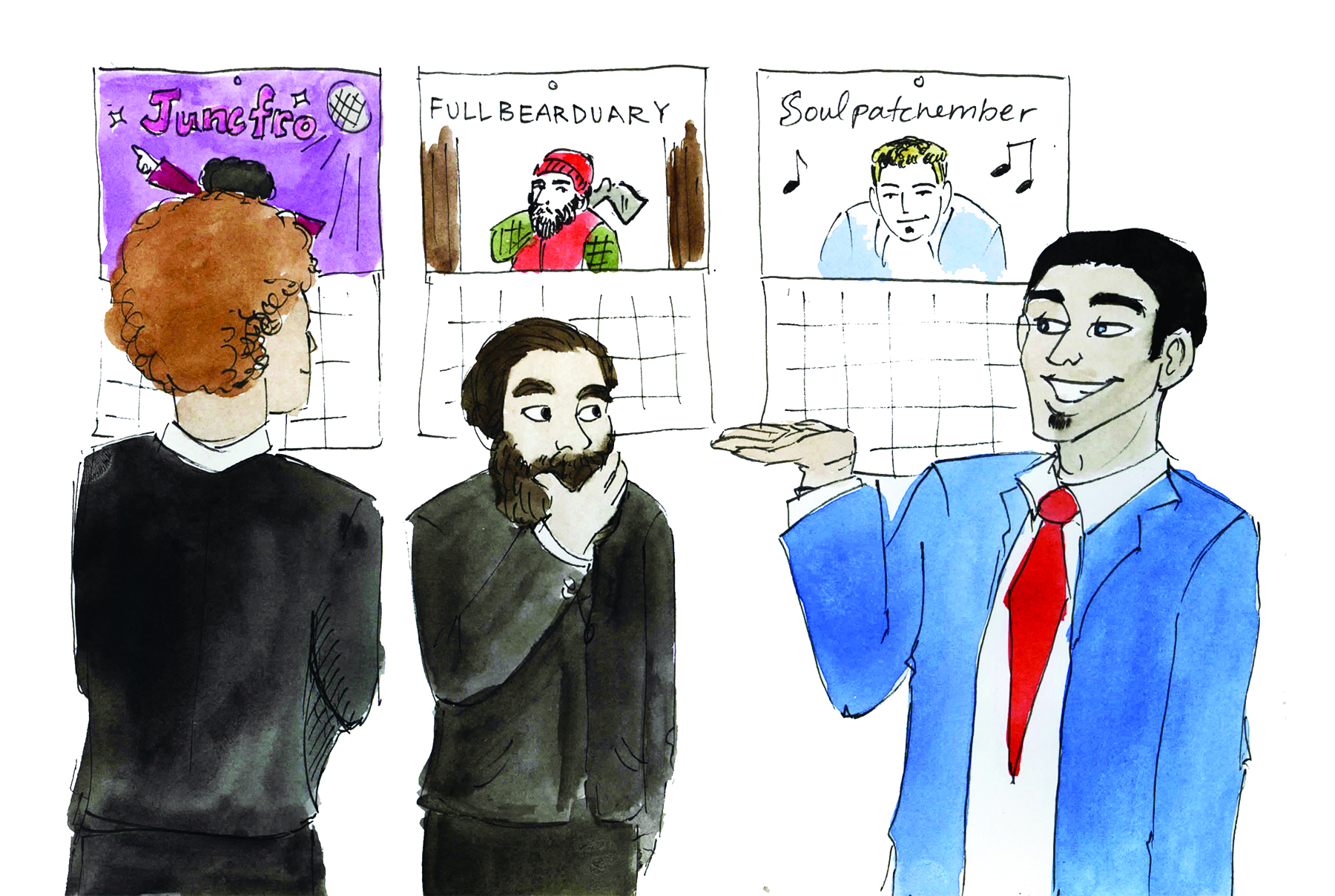
Although they are still in the planning stages, the new Gregorian calendar has been rumoured to also include the thrilling new months of Fullbearduary, Junefrow and Soulpatchember.

“I think this will be a great opportunity to get people to identify with some of our less popular months,” Franklin told reporters. “I mean the ‘Movember’ label instantly skyrocketed those 30 days to the top . . . who’s to say the same thing can’t happen to ‘Marchonchops’?”

Although the news of the new calendar has been very well received by the public, eager to have more legitimate reasons for not shaving, the process is moving very slowly due to a number of debates raging at the ICC.

According to sources close to the ICC there have been a number of quarrels between committee members over the naming of the months including a very heated argument over the new name of the twelfth month.

“I’d probably hold off a little on those Decembeards, this calendar is still a long way from completion,” explained committee member, John Samos, before being interrupted by another member insisting that it was “Decembrow . . . hold off on your Decembrow!”

Samos was then overheard screaming at the man about how “no one’s going to want to grow out their brow that close to Christmas” and then arguing with another man about how “Decemburns was too derivative of Marchonchops, not to mention Chinstrapril!”

Members of the ICC have also said that several other months are still being finalized as they have found it very difficult to come up with eleven different hairstyles that kind-of sound like months.

“It seemed easy at first, we came up with Soulpatchtember in a couple minutes, but a lot of them are really tricky,” explained ICC vice-president, Hal Krakow. “I mean, why does every goddamn month start with ‘j’?”

Krakow explained that the original intention was to have every month in the new calendar’s name reflect a different form of facial hair but the idea was deemed “too difficult” after the month of “Goateectober” was a legitimate candidate to replace October.

“I think going away from just facial hair might have been a huge mistake,” Krakow said regretting ever taking a job at the ICC, which he’s not even sure is a real thing anymore, “Now it seems like everything is up for grabs to be changed, recently I’ve been hearing people say we should just eliminate the month of July because no form of hair growth fits nicely with it, isn’t that crazy?”

This lack of respect for the current calendar was not met with resistance by everyone though, although some suspect that the fervent supporters of a lengthen ‘Junefrow’ are receiving kickbacks from hair salons who make a great deal of money from their “perm” sales.

“I’m just saying, what if ‘Junefrow’ was 62 days?” argued ICC president Franklin. “I mean, who knows the difference between June and July anyway? It’s like Nebraska and Iowa, what’s the point of separating them?”

While the ICC is struggling to deal with all their problems, they maintain that the new calendar will be instated eventually and that they haven’t lost sight of the big picture.

“Really, just like Movember this whole thing is just about doing something good for charity,” Franklin said, in a brief moment of calm. “We really believe that this calendar could help put an end to Malaria . . . I mean, world hunger? What is this for again? Prostate cancer? What the hell is that? And what does it have to do with moustaches?”

SFU hockey loses first of the season

0

The SFU men’s hockey team took to the road over the Nov. 15 weekend for back-to-back games against the Eastern Washington University Eagles and Selkirk Saints. The latter was a marquee matchup between two of the BCIHL’s best teams, but SFU could not afford to look past the Eagles. And they didn’t: SFU dismantled EWU 7–1, but showed fatigue against Selkirk, falling 9–5.

The first period of the Eagles’ game was quite even. SFU got on the board first with an Aaron Enns tally, but EWU responded just over a minute later when Uriah Machuga evened things up.

Then SFU opened the floodgates in the second period. After Nick Sandor gave his team the lead 2:38 into the frame, SFU potted four more goals in just over four minutes, ending opposing goaltender Jason Greenwell’s night prematurely. This game was essentially over after 40 minutes, but Taylor Piller added a late powerplay goal in the third for good measure.

The story was quite different when the Clan hit the ice against the Saints. Selkirk came out flying, controlling the boards and winning battles for the puck all night.

Saints Cody Fidgett and Beau Taylor gave Selkirk and early two-goal lead off of two quick shots that found their way past Clan netminder Andrew Parent. Taylor Piller’s goal would keep SFU within striking distance before Fidgett restored the Saints two-goal lead as he cashed in off of a SFU turnover at their own blue line.

Graham Smerek then muscled home SFU’s second goal, and Jono Ceci displayed all sorts of patience in finding the trailing Nick Sandor on an odd-man rush to tie the game at three.  Sandor’s goal would result in SFU chasing their second goalie in as many nights, as backup Chris Hurry replaced James Prigione.

Unfortunately for SFU, Saints’ head coach Jeff Dubois’ move of pulling his netminder seemed to spark the home side. The second period highlighted Selkirk’s speed and determination, as they out-muscled and out-skated the Clan for three goals in the period to gain a commanding 6–3 lead. SFU could not muster much offense as they had difficulty navigating through the neutral zone, and were forced to dump the puck in and chase it around.

In the third, Cody Fidgett registered his fifth point of the night in style, skating end to end and right around the Clan’s defense, eventually finding a wide open Thomas Hardy in front for the easy tap in. Each team would add two more goals in the frame, but SFU had their great early season start halted by a 9–5 loss, their first of the season.

Graeme Gordon is the unquestioned number one goalie for the Clan, and forward Trevor Milner had been a fixture on the top line much of the season, so it was curious to see both out of the lineup for the Saints game. SFU boasts a deep squad so, regardless of personnel, surrendering nine goals will not sit well with the Burnaby side.

The Clan is back in action next weekend with a home-and-home against the surprising Trinity Western Spartans. TWU sits above SFU in the standings with two more points, but the Spartans having played four more games, so next week’s contests could go a long way in determining SFU’s spot in the standings.

The advertisers are [not] always right

0

corporations_in_our_heads-artwork_by_dafne_blanco-ar-785x0

Despite having adblock software on our computers, recording television to then fast forward through commercials, and muting the radio when the adverts come on, we are still bombarded daily with marketing propaganda.

Every day we see transit advertising, billboards, flyers, posters, adverts in the paper, and sidewalk signs — and that’s just walking down the street. In the 1970s, the average person was exposed to an estimated 500 marketing messages daily; by 2000, that number had risen to approximately 5,000 per day.

Artistic and managing director of Theater for Living, David Diamond, believes that these corporate messages are invading our psyche, which “affects the way we make really profound decisions about how to be, who to aspire to be, our definitions of success and failure, our relationship with ourselves and others, our relationship to the planet, all kinds of things.” Diamond has developed a process project using theatre to explore these messages: Corporations in our Heads.

With no actors, no script, and no play, there is only a Joker, a maestro of sorts for the event, “Everything comes from audience involvement,” explains Diamond. He starts out the evening by explaining the event, the general purpose of the project, and then asks for stories from the audience where the messages of corporations affected or influenced their decisions.

“They are not big stories, but the ones that seem inconsequential,” says Diamond, stressing that the event isn’t trying to psychoanalyse the storyteller, but use these stories as an entry point to theatrically open up these ideas.

quotes1[Corporate messages] affect the way we make really profound decisions about how to be.”

David Diamond, artistic director of Theatre for Living

In a previous project about global warming, Thetre for Living had a similar event and a woman told a story about standing in the grocery store picking out tomatoes. Should she buy the lovely hot house ones, all perfectly round and plump, or the local organic ones with minor bruises and flaws?

The technique used is based on Augusto Boal’s The Cop in the Head theatre game. Boal developed a method called Theatre of the Oppressed where the audience become active participants in the outcome of the theatrical event. In Cops, individuals explore internal voices, fears, and oppressions rather than focus on external oppressors.

Diamond has used The Cop in the Head as a jumping off point for Corporations in our Heads, but also incorporates Forum Theatre techniques where audience members can stop the action, replace an existing person on stage, and change the message. Diamond explains that it is a way of opening up serious topics, learning and figuring out how we internalize these messages.

During the tour, Diamond is visiting 22 communities throughout BC and Alberta. “I’m imaging the messages will be different, and the event will change dramatically from community to community.”

One of the final nights of the tour in Vancouver is in partnership with the Simon Fraser Public Interest Research Group (SFPIRG), which seems like an ideal on-campus partnership.

“One of the things that we like about [Theatre for Living’s] work is that it gives participants a chance to engage in an experiential process,” says Shahaa Kakar, the Media and Outreach Coordinator for SFPIRG. “It’s exciting to see this kind of live process unfold because it connects with where people are actually at right now and that includes and builds from our lived experiences.”

There is no illusion that these conflicts will be solved in two and a half hours, but Diamond believes identifying and understanding the source is the first step to changing the behaviour: “As an activist, there is an error of tricking ourselves into thinking structural change needs to happen. But it is patterns of behaviour that create structure, and if we only engage in structural change, we will just recreate the same structure.”

Capturing North Korea

0

WEB-flag

David Guttenfelder, a photographer for the Associated Press, has sparked what might be one of the most illuminating glimpses into everyday North Korean society.

Guttenfelder, cell phone in-hand, has been uploading photos of real-time Pyongyang straight from his phone to his Instagram account, while on an assignment in the Democratic People’s Republic of Korea (DPRK). Prior to January 2013, all visitors and tourists were prohibited from any type of cell phone use — upon arrival into the country, all cellular devices were initially confiscated at customs, making it nearly impossible for foreigners to have any contact with the outside world while in North Korea.

This, however, has changed. The bigwigs of the Democratic Republic recently changed their policy on cell phone use in the country, enacting a relatively lax policy for visitors to the country with cell phones. They even flipped on a visitor-only 3G network that is allegedly not state-run or filtered in any way. This service is, predictably, inacessible for the North Korean population.

This has made it easier than ever for visitors to utilize social media platforms while in North Korea. Through his simple, untreated photos of North Korean streets, statues and homes, Guttenfelder has begun to expose the nature of everyday life in Pyongyang, the North Korean capital, through the use of his iPhone.

The freedom to use cell phone photography in North Korea offers us an absolutely unprecedented view of the nation.

Through the global platform of social media, Guttenfelder has been able to reveal images such as dismal, dark mornings in Pyongyang after widespread power shortages; candid photos of the North Korean police force going skating at a local ice rink; and, most shockingly, daycare centres playing military propaganda cartoons.

What the photographer is ultimately doing, with the help of Instagram, is painting a more detailed image of North Korea, one that challenges our usual conceptions of the nation as a repressed, industrial wasteland. Amid the snapshots of indistinct concrete and empty shopfronts, there are also images of vibrancy and humanity: colourful folk dances, rollerblading children and a marriage.

The fact that Guttenfelder is also able to “check in,” or tag his location on Instagram, is helping create a more defined and attuned image of what was once the blank slate of our North Korean map. Though many areas of North Korea have been identified by such services as Google Maps, many corners of the nation remain shrouded in mystery. By uploading photos of everyday Pyongyang and surrounding areas, Guttenfelder is opening not only his Instagram followers, but also the rest of the world, to a new perspective of North Korea.

What really gets me, though, is how Guttenfelder has used such a simple and ubiquitous tool to this great an effect. It seems so effortless — many people in the Western world, myself included, use Instagram on a daily basis. The fact that Guttenfelder is able to expose the daily minutiae of arguably the most repressed authoritarian regime in the modern world through a free iPhone application is nothing short of mind-boggling.

One question remains, though. Why? Why is the North Korean government — no stranger to repression, both political and social — allowing visitors to the nation to do this? Why is the notorious Party of the DPRK, enforcers of state-run internet as well as highly state-controlled tours of the country for foreigners, allowing Guttenfelder and others to come into the country and document everyday life for the world to see?

The Party is obviously aware of what Guttenfelder is doing. They have eyes and ears all over the country. Why, then, is no one coming forward and stopping him? Though the vantage point of visitors to the DPRK remains limited, the freedom to use cell phone photography in the country offers us an absolutely unprecedented view of the nation. So, what gives?

Amid the snapshots of indistinct concrete and empty shopfronts, there are also images of vibrancy and humanity.

In my eyes, there is only one explanation as to why the North Korean Party, with its intense media regulations on both domestic and foreign media content, would allow for everyday life in the capital to be released into the world via social media: they must be getting something out of it. What “it” is, we have no way of knowing — still, it seems naïve to suggest that the DPRK government is offering this personal agency to tourists for selfless reasons.

This real-time Instagram exposure of North Korea is beginning to paint a more detailed and defined picture of the nation and its inhabitants.

Though I am more than a bit skeptical as to the motive behind it all, one thing is for sure: things are slowly, but surely, changing in North Korea. Though these snapshots may not be enough to spark a full-scale uprising, I am excited to see the inevitable changes they bring about on a national and global level. Just look at the Arab spring — these days, an iPhone is more than enough to start a revolution.

University Briefs

0

WEB - Briefs - Enrique Lin
UBC student attacked in attempted robbery

An 18 year-old UBC student is recovering after a failed early morning robbery attempt that left him with several injuries.

The attempted robbery occurred just after 4:00 a.m. on Nov. 19. The student was returning to his residence building when he was suddenly confronted from behind by an unknown male brandishing a small knife. As the student attempted to run away, he was slashed in the back by the attacker. Injuries sustained included several superficial cuts to the student’s back and shoulders.

The attacker has been described as around 40 years of age, of average build, and having a grey beard. The attack does not seem to be connected to the recent sexual assaults at UBC.

With files from The Ubyssey

Concordia opens new Sexual Assault Resource Centre

Concordia now has a permanent location dedicated to providing a safe space and support for survivors of sexual assault.

Last week, the Sexual Assault Resource Centre opened after two years and a petition signed by over a thousand students. The centre will also focus on assault prevention, though as a campus organization, it sets itself apart from other sexual assault resources in Montreal by “offer[ing] immediate support, immediate crisis intervention, and immediate information,” according to Jennifer Drummond, the centre’s coordinator.

The university has committed only one year to the project as of yet.

With files from The Link

Movember funds men’s mental health studies

Five studies by Canadian universities will take home a significant part of the $12 million funding that the Movember Foundation has set aside for projects that target men’s mental health. Selected universities include Queen’s, UBC, Ryerson, Western, and McGill University, all of which are furthering a wide range of men’s mental health initiatives.

Queen’s University, for example, will be researching binge-drinking among first-year male university students. McGill will use the funds to develop HealthyDads.ca, a site for expectant first-time fathers who are at risk of developing mental health problems.

With files from University Affairs

Don’t look at me

0

The library has a problem, at least that is what Adam Van der Zwan tells us in his article “We need to be watched.” A very grave and serious problem — so serious, in fact, that it’s worthy of trotting out the sort of “we must act now” rhetoric you expect to hear from a politician.

Twenty thefts a week are reported at the Bennett library, yet there’s apparently only one surveillance camera. SFU has to simply kick in all the extra money it has lying around to up the surveillance. After all, video surveillance would instantaneously and overnight reduce the number of thefts to justify the cost of implementation.

What Adam misses is that SFU is providing a remarkable service by declining to direct its ‘unlimited’ budget to subsidize personal carelessness and irresponsibility. It is thereby making students develop the very valuable and marketable skill of actually giving a shit about their belongings.

Does that seem awfully paternalistic? Is being constantly surveyed by the depths of a blinking camera any less so? I mean, really, who ought to care more about your own personal possessions than yourself? Certainly the cameras won’t. Twenty thefts a week, that’s a fraction of the student population begging to externalize the costs of their irresponsibility onto the rest. “Save me from myself,” they seem to cry.

The naïve are slapped on the wrist by being stolen from. Although it’s morally wrong for a thieves to steal students’ iPads, it’s morally better than the costs of their own naïvety becoming externalized to general society. The responsibility they learn from having valuables stolen is becoming of post-secondary graduates.

Is this the same wrongful victim shaming that you (no doubt) read on Salon.com? Perhaps. The difference here is that I’m blaming the criminal, too.

It’s best expressed in the counterfactual: had you been a more astute and careful steward of your resources, you would not have suffered a loss. You violate a sense of moral responsibility by not watching your valuables, so it is good that you directly experience the consequences of such behavior.

Had you been a more careful steward of your resources, you would not have suffered a loss.

The rate of thefts will likely generally stay constant, not because the same folks are being robbed again and again, but because there’s always a new batch of young ‘un’s who cannot take the slightest care of their own possessions, yet fancy themselves the solver of all the world’s problems. Absent-mindedness is often seen as a trait accompanying geniuses; perhaps these kids see this correlation, that allows them to blame their problems on everyone but themselves. Is this the logical result of a degree? Do we become too smart to be responsilbe for our own possessions?

By the time you’ve finished at SFU — with one less laptop — you’ll be that much more able to combine your newly minted critical thinking skills with a modicum of personal responsibility, and an ability to engage in the most menial cost/benefit analyses.

It’s for your own good that the library isn’t stocked full of God-tech. Think of it as SFU’s gift to you.

Anchorman 2: That escalated quickly

0

ANCHORMAN 2: THE LEGEND CONTINUES

The highly anticipated Anchorman 2: The Legend Continues is scheduled for release later this year. In a conference call with The Peak and several schools across North America, Steve Carell and Paul Rudd were pretty tight-lipped about the details.

“There aren’t any specifics that I want to get into,” Carell said, concerning scenes in the movie. “Trying to explain something always is a little difficult.” Explaining funny takes to his wife, he says, “definitely loses something in the translation.”

They’re apparently trying to increase anticipation, not that they have to. The original movie became immensely popular immediately following its release, and retained a strong following long after. Its irreverent lines and silly humour made it a household name, and helped launch both Rudd and Carell’s mainstream comedy careers in 2004; Rudd has since starred in I Love You, Man, Carell in The Office, and both in The 40-Year-Old-Virgin, among other hits.

Unsurprisingly, the line recited to Carell most, he says, still comes from his Anchorman character Brick Tamland: “I love lamp.”

On whether Sex Panther, Rudd’s character’s infamously terrible cologne, would return in the new movie, Rudd only offered, “I can’t really give it away.” He wants people to be curious to the point of frustration going into the movie, a feeling reminiscent of 2003’s Lost In Translation: “Remember when Scarlett Johansson whispered into his ear and no one knows what she said? . . . I want that level of frustration.”

The premise is so admittedly silly that the second movie was originally pitched as a broadway musical.

Part of the draw of the first Anchorman, according to Rudd, was how “it felt like an indie movie. It just felt like a very small, kind of quirky comedy . . . that did not seem particularly commercial.” And the indie spirit “still [exists] this time around,” he says.

This is reflected in the extreme irreverency in the first movie; the premise is, after all, 1970s newsmen competing for the number-one spot on network television, dim-wittedly drinking, assaulting, and sexually discriminating in the process.

I don’t think I need to exhaust its slew of ridiculous lines to prove this point. Just look at Brick’s explanation of killing a man in a comically violent brawl between the rivaling anchormen: “There were horses, and a man on fire, and I killed a guy with a trident.” Or Ron, threatened by Veronica’s determination, suggesting that she go “back to her home on whore island.”

In both movies, many lines were improvised. Carell said the new release didn’t necessarily call for improvisation, but the actors couldn’t resist. “On any given day,” Carell said, “we or Adam [McKay, director] or Will [Farrell] would come up with . . . as much material as was on the page. I mean, there were scenes that were supposed to be about a minute and a half that ended up being 10 minute scenes.”

“Everything that [Adam McKay] says,” he added, “is kind of golden . . . There were just so many fertile lines working, we ended up with way more material than we needed.”

The premise is so admittedly silly that the second movie was originally pitched as a broadway musical, according to the actors. Rudd said that he “liked the idea that . . . at that point in time, enough people had been clamoring for an Anchorman sequel and the idea of doing it as a musical on Broadway . . . was funny and annoyed people.” The two comedians both laughed in agreement.

Rudd and Carell agreed that the fun they had doing the first movie was reason enough to make another. Rudd said, “Mainly it was like working with these guys again, who I love;” the fun of the first one made him “jump at the chance to come back and beat a dead horse.”Carell added, “Even if there was no film in any camera, we would have come back and done it.”

Home is where the wins are

0

WEB-M basketball-Mark Burnham

It’s early yet, but so far in 2013, West Gym has proven to be home sweet home for the SFU men’s basketball team.

After hitting the road for two exhibition games against elite NCAA Div. I squads, the Clan traveled to California for the first two games of their own NCAA season, winning one and dropping the other. But since returning home for their first game on the hill this season on Nov. 12, SFU has caught fire, winning three straight at West Gym.

The most recent victory came against the Douglas College Royals, a dominant 104–76 win.

Senior guard Elijah Matthews led the Clan’s scoring efforts with 21 points in just 19 minutes of play — including hitting on all five of his three-point attempts — but five SFU players all hit double-digit point totals.

“Matthews played through some of our goofiness to lead the team,” said head coach James Blake after the game. “Other guys then jumped on that and earned the win.”

As a team, the Clan hit on 58 per cent of their field goals, and hit threes early and often, shooting an incredible 52 per cent from beyond the arc.

Fittingly, it was Matthews who opened the scoring with a three-pointer, but SFU couldn’t hang on to the lead early. The Royals, aided by an 8–0 run midway through the first half, climbed ahead and took a 22–15 lead early. But shortly after, the Clan went on an 8–0 run of their own, to pull ahead 28–23, a lead they would not relinquish.

SFU led by 10 at the half, 49–39, but pulled away in the second, stifling the Royals attack while having their way offensively. Forward Keegan Dunlop put the Clan above the century mark with almost four minutes left to play.

“Everyone gets to play a lot and we mould as a team in these types of games,” said senior guard Taylor Dunn, who lead the team with seven rebounds and chipped in with 16 points of his own. “We have a lot of new guys so its good for us to just get out on the court, that’s the best way for the team to get comfortable together.

“The teams we’re playing are very competitive, so it’s good for us to come up against that,” he added.

There’s an old saying in sports, that you can only beat the team put in front of you. Even if the competition the Clan have faced hasn’t been of the highest caliber, they’re still winning the games they’re supposed to, and the win over Douglas improves SFU’s record to 4–1 on the year.

“We need to get up for everybody, whether it’s conference winners or a community college. I like to evolve and learn from these games,” said Blake.

With two more games against non-conference opponents, and five more at home before hitting the road, Blake’s squad will have plenty of learning opportunities, and are in good shape to keep up this early season success.

Lucky SFU student approved by BMO for credit card

0

BURNABY — An extremely fortunate first-year student, who is sure to quickly become the envy of all his classmates, reportedly was hand-picked by the illustrious Bank of Montreal to receive his very own credit card.

According to his story, Jason Seidelman, an 18 year-old SFU student was selected to receive a free credit card from BMO, an honour he is sure is extremely rare.

“I was just walking through the Blusson Hall on my way to a biology lecture when out of nowhere they approached me,” Seidelman explained while proudly showing off his new “gold” credit card. “They said that I was eligible for a special student credit card . . . I don’t know how they knew I was eligible, but I figured that they must’ve been on their radar for quite some time now.”

Seidelman told The Peak that he believed it was his strong work ethic and diligence that had attracted BMO to offer him this amazing opportunity and although he wasn’t sure, he said he wouldn’t be surprised if they had heard about his impressive “A-” grade on his latest Chemistry lab report.

“Anyway the woman from BMO took me to their secret booth and asked me if I’d be interested in getting their card,” Seidelman said bulging his eyes, “Of course I said yes, who would turn down an opportunity like that?”

Although statistics reveal that about 99 per cent of students offered BMO credit cards actually do turn the offer down while pretending they really have to get to their class, Seidelman’s feeling of uniqueness has not been diminished.

At press time however, Seidelman did experience a minor dip in his positive feelings when it came to his attention that his idiot friend Craig had also been head-hunted by BMO an hour after him in the same location.

Point/Counterpoint

0

SFU students respond to whether educated North Americans should be able to suggest change in third world countries. This comes into light after SFU professor Morten Jerven’s book on research in African statistics, Poor Numbers, caused him to be blacklisted from two international conferences, and accused of being a “hired gun” of the West with a hidden agenda to discredit African officials.


Lauren Kyle, SFU student

Jerven’s main argument is that African economic statistics are not reliable, and can misinform the delegation of funding for countries in need. In his quest to re-examine the methods used in statistics, he suggests more universal data collection techniques. He has opened up a new conversation across multiple disciplines in academia: do we have the right to stick our noses into other countries and claim their practices to be insufficient? I don’t think we do.

As a high school student, I participated in many activist endeavours and even a major protest in downtown Vancouver collecting petitions to stop the practice of FGM (female genital mutilation) in third world countries. At the time, it seemed a heroic, thrilling, and controversial topic. Now, as a social science student, I cringe at the attitude and approach behind that rally. Do I have the right as a naive student to label as immoral a cultural practice that has been continuing for years?

Although it is important to stand up for human rights and to keep an open dialogue about what should be considered universal standards of living and freedoms, it is equally important to realize that our education is Eurocentric in its curriculum and purpose, and when looking through this magnifying glass at other cultures, we do not have the lived experiences of other peoples, nor the ultimate superior lifestyle of the world. Even with seemingly superior statistics or health practices, we will never be able to replace the voices of those who live in the cultures.


Leah Bjornson, Associate News Editor

Many voices critique the “whiteness” of academia — and rightly so. There is an overwhelming number of male, caucasian scholars who write the histories of and prescribe policies for less-developed countries. The repercussions of western academics taking up the “white man’s burden” to educate people in African nations — and in doing so, treating them as children — can include ignorant policies that do not acknowledge the complications and realities on the ground.

However, by viewing this complicated relationship as a fight between ‘the West and the rest,’ we are potentially solidifying a way of thinking that created this problem in the first place. This dialogue of ‘us’ and ‘them’ might result in closing off channels of information that could be potentially beneficial. For example, if Jerven is correct in his observations that certain policies pursued by governments like Malawi are less than effective, this has vital consequences for those governments. If we discriminate and reject his thesis on the basis of his “whiteness,” then the danger is that alternative and helpful initiatives may never be implemented.

What this opening of dialogue requires is easier said than done. Western policymakers have for a long time imposed their policies in Africa, many of which have been ineffective or even harmful. It follows that African officials may distrust an academic like Jerven, whose critiques could have major implications for the amount of foreign direct investment flowing into the continent.

Nevertheless, it does not make sense to disallow talented scholars from investigating a particular issue on account of their race. In doing so, we only serve to reinforce this dialogue of “us” and “them” — which was the root of the problem.