Home Blog Page 1216

Women’s basketball earn upset victory on split weekend

0

As the Great Northwest Athletic Conference basketball season heats up, the Simon Fraser University women’s team is in the race for conference supremacy. The very competitive conference that started the 2013-14 season with three nationally ranked teams is as tight as ever heading into week four of play. SFU saw a split weekend at home to wrap up week three, proving without a doubt that the GNAC is still anyone’s for the taking.

The Clan earned an upset victory over No. 18 Northwest Nazarene on Thursday before falling to the 10th place team in the conference, Central Washington, moving to a 3–2 conference record. The split is a perfect example of the battle for a conference title; any team to win on any given day.

The story of the weekend, however, was the play of junior captain Erin Chambers who led her team and all athletes on the floor in both contests. Against the Crusaders the fiery guard/forward combo tallied 25 points, leading her team to a 75–66 victory over the visitors.

Assisting her in the victory was Rebecca Langmead, as the senior had her first double-double of the season. The 6’5” forward used her height to her advantage tallying 15 points and 12 rebounds in the contest to lead all players on the boards.

Katie Lowen and Kia Van Laare each added 11 points as well. It was Van Laare’s sharp-shooting from off the bench that gave the Clan a mid-game rush, as the senior netted back-to-back three-pointers to give the Clan the much needed lead heading into the second half.

After a one day break, the team took to the court Saturday evening against the Wildcats but a lackluster Clan side was only able to hang in during a 63–54 loss, thanks to Chambers’ 32 points — over half of the team’s total. The captain was able to keep her team in the running throughout the game, bringing them within as few as two points.

The Clan women were plagued by the flu, as starters Marie-Line Petit and Langmead saw limited minutes due to illness. Despite playing only 16 minutes, Petit was the Clan’s second highest scorer, but only put up eight points, as the home team fell to the previously 0-5 visitors.

Now moving further along into conference play the team will face the final four competitors in the conference rotation before a rematch with all nine GNAC teams to wrap up the season. Their next match will be against conference leaders, the Saint Martin’s Saints, who are currently 4–1 after an upset over former GNAC leaders, Alaska Anchorage. SFU will face the Seawolves the following weekend as they round out the first set of games.


Clan place second at National Duals

0

It was almost a repeat of 2013 for the SFU Clan women’s wrestling team when they travelled to Des Moines, IA for the Women’s Collegiate Wrestling Association (WCWA) National Duals last weekend. They finished in second place after two days of competition; though they were just one win away from repeating as WCWA Dual Champions, the second place success is still an excellent showing for the dual team.

The Clan women started the tournament against University of the Cumberlands winning nine of the 10 matches, beating the Patriots 38–6 overall. The following day the Clan took on second-ranked Oklahoma City University in the semi-finals where they would bounce the 2013 runner-ups out of the finals. SFU saw more intense competition from the highly ranked OCU Stars, taking the dual 27–17 on the second day of competition.

In the final, SFU fell to King College by two points, losing 21–19 in the last dual of the meet.  The Tornado would finish first, matching their ranking entering the competition, taking the title for the first time in school history.

SFU’s dual team included Darby Huckle, Victoria Anthony, Laura Anderson, Helen Maroulis, Maegan Kuruvita, Monika Podgorski, Justina DiStasio, Jenna McLatchy, Nikkie Brar, Mallory Velte, and Michiko Araki. Seniors Anthony, Maroulis, DiStasio and McLatchy were all undefeated throughout the tournament, closing out their dual careers with the Clan in winning style and leading their team to their second top-two finish at the championships in as many years.

Velte, Kuruvita and Anderson all won matches in their first championships as the three freshmen were able to earn points for the Clan in the first two duals of the meet. Huckle won the Clan’s first match in the final against King before Maroulis, DiStasio and McLatchy finished it off for SFU.

The Clan will get another shot at a first-place finish when they head to St. Louis, MO, beginning January 24, where they will attempt to defend their 2013 WCWA National Championship in the non-dual portion of their championship season.

The Clan lost seniors Danielle Lappage and Sidney Morrison who were champions in their weight-classes in 2013, but retain many members of the winning squad heading into this year’s tournament. McLatchey, DiStasio and Maroulis are all returning champions, and Brar and Huckle are returning bronze medalists.

Lost (and found) in translation

0

DRA_photo73_DannyTaillon

A play about one man’s personal journey, Théâtre PÀP’s The Dragonfly of Chicoutimi is also a play about language, culture, and finding your identity. First performed in 1995 on the eve of the Quebec referendum, there are strong political undertones, but it is also an emotional portrait of Gaston Talbot, one troubled man played by five actors.

The play is performed in English, but in a way it is also performed in French. Although the actors are speaking English, they are using French syntax, and this has a strange effect on the audience. “People will ask us a year later, ‘do you want to translate it into English,’ and we say ‘it was in English,’” laughs Patrice Dubois, one of the actors and the company’s artistic co-director.

Written by Larry Tremblay, Dragonfly wasn’t always performed by five actors. “It was a solo at first,” explained Dubois. “I saw it as a young actor in a small venue. We recreated it with a new touch: five voices. The challenge was to keep the intimacy of the main character and put it into something more formal. It’s a way for the audience to take part in five parts of a character. They see his fragility, he is strong, he’s a child, he’s sad, he’s crazy . . . there are different portraits on stage to see at the same time, these mysterious parts inside us as an individual.”

Bringing together five people as one cohesive character can be difficult, and Dubois said that the rehearsal process is very precise because the show has a choral element to it and timing is very important.

Playing Gaston Talbot is an emotional experience for all of the actors: “Gaston Talbot is not interesting at first sight; he’s someone you’d see in the street and not stop to look at, but you get interested in his own little story,” said Dubois. “Gaston Talbot is really upset with his childhood. He says his childhood was a success, but he lies and then he tries to tell the truth.”

Bringing together five people as one cohesive character can be difficult.

Aside from Gaston’s emotional world, there is another layer of meaning in Dragonfly. “On one side it’s really emotional, and on the other side there are things to do with language. People hear their own language in a different way, and this funny side of the show is really important, too,” Dubois explained.

“When we first speak a language we have a certain way to think. There is a tension between what’s going on in our head and what’s going on in our mouths.” This cultural side of the show allows for a great deal of humour for those who speak both languages, while others are able to hear their own language in a new way.

Dubois and Théâtre PÀP artistic co-director Claude Poissant recently made a decision to tour their company’s work within Canada instead of just to Europe and are thrilled to be at the PuSh Festival where they can encounter new audiences.

The Dragonfly of Chicoutimi runs from Jan 22–25 at SFU’s Goldcorp Centre for the Arts as part of the PuSh International Performing Arts Festival. For more information visit pushfestival.ca.

New $4.4 million SFU observatory set to monitor construction of new $4.4 trillion Rigel 6 satellite campus

0

BURNABY — SFU’s long discussed and fully supported $4.4 trillion Rigel 6 satellite campus, which was officially announced last week, is set to be accompanied by an observatory whose $4.4 million price tag has set off a large number of angry SFU students.

While few are against the planned billions-of-light-years away satellite campus located in the far-off Rigel universe and set to be complete in August 3045, concerned students say they feel ‘blindsided’ by the new Trottier Observatory and Plaza.

“Are we really going to spend a few million dollars on a building that just magnifies space a little?” questioned Jill Stevens, a third year communications major. “I can totally understand the practicality of keeping some connection with the new Rigel 6 campus, but can’t we just trust that its getting built and not have to spy on them?”

Stevens’ sentiments have been echoed by many students at SFU who say that $4.4 million seems excessive just for an earth-building.

“In this economy we really need to think about what is absolutely necessary, and this observatory just seems a little excessive,” SFU biology alum, Tyler Deroche, told The Peak. “Hopefully the people in charge of our Rigel 6 campus will be a little more level headed.”

Deroche went on to say that he felt it wasn’t really the observatory that had students so riled up but that they were simply unhappy about the way it was implemented.

“Well, the Starry Nights stargazing program has been around since 2007 so I think we all knew that a satellite campus located in another universe was coming for sure,” he explained, thinking back. “But an observatory? Where the fuck did that come from? Don’t even get me started on the plaza they’ve been saying is going to be built with it . . . this school is getting down-right reckless with its spending!”

While Deroche has said they will fight hard to prevent the observatory, he also stated that he still hasn’t soured on the Rigel 6 campus.

“I’ve supported that from the beginning and I think it has a lot of potential” he said, trying to remain optimistic. “There could be so much great stuff there, it could have it’s own academic quadrangle, it’s own SUB building . . . oooh they could even build an observatory — that would be pretty cool!”

Observatory plans will have students seeing stars

0

WEB-howard observatory-mark burnham

Watch out, koi pond. There’s a bigger fish planning to make its home on the AQ lawn, and it’s a $4.4 million observatory.

With financial support from the Trottier Foundation, headed by Lorne and Louise Trottier, SFU Burnaby will become home to the Trottier Observatory and Courtyard, set to be completed August, 2014.

The observatory will offer a range of programs including beginners’ astronomy courses for both SFU science and social science students in addition to permanent community outreach programs. Courses such as these may be offered within the next two years.

“[The observatory] is in part for science geeks, but it’s much broader than that. Everyone is curious about the universe,” said Howard Trottier.

Students taking the beginners’ astronomy course can expect to learn about the operation of the telescope: how to process its data as well as the physics behind it. Assignments may include looking for exoplanets around other stars and using information from previous discoveries to conduct analyses.

An amateur astronomer and SFU professor of physics, Trottier has been working on the observatory project for over seven years. The project lay dormant, until Trottier was able to involve his brother and sister-in-law who are now providing funding for the institution.

The observatory will be located near Strand Hall on the AQ lawn and will feature a 0.7-metre diameter reflector telescope within a six-metre-diameter dome.

The mandate of the observatory is threefold: public outreach, undergraduate education, and allowing outside schools to use the observatory remotely. Not only will visitors to the Burnaby campus be able to use its telescope to view and capture photos of distant galaxies billions of years old, but its remote capabilities will allow interested parties across the country to access it.

“SFU, as a community-oriented university, really plugs into that very well, and so we’re going to reach the entire province, and even beyond eventually,” said Trottier.

The building itself may spread beyond the AQ lawn, penetrating the concrete walls of the AQ itself. “The proposal is to actually extend [a cosmic timeline] into the AQ and have it line up with one of the stairways,” explained Trottier. “We would have a connection into the heartland of the campus, and that would be really exciting.”

The observatory and accompanying science plaza will be open in September. “It sounds ridiculous, but the architects say it’s a small building so it’s easy,” Trottier explained. “It’s going to be a destination place to hangout.”

Raw Power

0

1531887_636048596453347_1811622818_o

“But… it’s raw!”

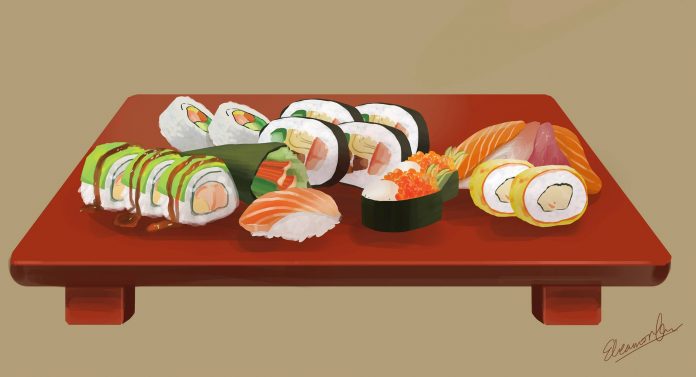
This is the main argument I get from those who have never before experienced what we North Americans call “real sushi”. But really, what makes for real sushi over here? If we can’t even get the terminology straight, how can we truly enjoy another culture’s cuisine to its fullest? It’s time to set the record straight on the edible work of art that North America loves to blindly indulge in: sushi.

But what exactly is sushi, anyway? Well, in plain terms, sushi is cooked rice with rice vinegar. It’s the sweet, sticky rice that holds the food you’re eating — and the whole restaurant — together. Like sushi, sashimi is often used incorrectly; it refers to a thin slice of unadorned raw meat which is, more often than not, fish. Slap some sashimi on top of a ball of sushi rice with a pinch of wasabi and, presto: nigiri sushi.

This is what usually gives sushi newbies the “ick” factor. However, most of the sushi eaten in North America is in roll form — the Japanese call this makizushi. Rolls are made up of rice and nori (seaweed), with pretty much anything inside. Raw fish, crab and roe (fish eggs) are popular in Japan, but up north our rolls can include avocado, cucumber, cream cheese, or even mushrooms.

There are also plenty of variations on the standard roll model. Maki with rice on the outside is called yukiwa-maki, while hand-made cones are deemed temaki. Futomaki are large rolls with two layers of nori, while gunkanmaki is a sort of roll/nigiri hybrid that features slices of raw meat wrapped in nori and sushi rice. It’s enough to make your head spin!

This next bit is for all you health nuts. In 2011, Japan earned the distinction of having the highest life expectancy in the entire world at 83 years of age. Apart from their cozy island lifestyle and high tech gadgets, what do they have that we don’t?

Well, for one, their cuisine! Though Japanese folks tend to eat sushi a lot less frequently than we do, it certainly doesn’t seem to be making them unhealthy. Some students may be hesitant to eat that extra slice of ebi between classes, but it turns out that sushi has a ton of health benefits for us, too.

For starters, all you celiacs will have no trouble with most things served at a sushi bar — sushi rice is gluten free, and sushi is easy on the digestive tract because of this. The other main upside is that fish is very low in calories: most white fish has less than 100 calories per 100 grams, while chicken breast clocks in at 172.

Because almost all sushi is raw, there is no oil or deep fried gunk to worry about clogging your arteries and lower bowels. On the other hand, if you’re craving a little more grease in your life, you’re in luck: on this side of the Pacific, deep fried maki is a popular option.

When looking for the best sushi in town, the key is freshness. Japan is great at this: their fish markets are teeming with live fish being carted around in barrels waiting to be purchased and served that day, raw or cooked. The fish used for sushi should be so fresh and well-cut that it melts in your mouth.

steps

Believe it or not, by putting those well-trained googling fingers to work, making maki sushi at home could be a reality tonight — and, since most recipes don’t require cooking, it’s also dorm-friendly.

You’re going to want to chop some long, thin strips of your veggie of choice. I suggest cucumber or carrot because they’re cheap and easy. Add some faux crab meat or fish to complete the package.

Your shopping list should also include sushi rice, rice vinegar, nori, and a bamboo mat to roll your delicacy. The latter should be the fanciest of the bunch — after all, you want it to last you for years of homemade sushi dinners.

Rinse the rice until the water runs clear, then cook it according to the brand’s instructions. Transfer it to a bowl and add some rice vinegar, along with salt and a little sugar to taste. Put down a piece of nori on your bamboo mat, and layer it with some rice. Leave a strip of nori bare of rice on one side and dampen it with rice vinegar so the roll will seal up. Add your fillings, roll it up and, ta-da! A tasty and healthy maki roll that’s all your own. Mom would be so proud.

RCMP responds to threat on Burnaby campus

0

twitterpic

Photo by Helen Crofts (@croftsyyy)


Students were all atwitter on Burnaby Mountain as the RCMP flooded the campus on Wed. Jan 8, responding to a threat made against the university.

On their website and Facebook page, the university stated at 1:31p.m., “There is a police incident at SFU’s Burnaby campus. The university remains opens.”

The intersection at Gaglardi and South Campus Road was shut down for approximately one hour as police interviewed persons on the scene.

Several students tweeted SFU for information as the incident unfolded, which had begun prior to SFU’s Facebook announcement. Helen Crofts, a member of the SFU track and field team, tweeted at 1:12p.m., “Police everywhere @SFU and asking to see peoples id. Hope everything is ok!”

Students waiting at the transportation centre bus loop were left stranded for approximately 45 minutes until the university announced that the police incident was over and began letting buses proceed through the intersection.

The SFU website and Facebook page later confirmed that the police incident had been resolved “without issue,” but students questioned why the university had not employed their recently implemented emergency system, SFU Alerts. The university replied that “this incident did not warrant its use.”

SFU and campus security have refused to comment on the nature of the threat, as the matter is currently under police investigation. However, in a update on their website and Facebook page, Simon Fraser released the following statement on Thurs, Jan 9:

“On Wednesday January 8, 2014, the Burnaby RCMP and SFU Campus Security responded to a threat made by unknown persons against the University.

Access to the Burnaby campus was briefly restricted by the RCMP as an initial precautionary measure; the police quickly determined there was no threat to the campus community. University operations were not affected by this incident and the University is operating as normal.”

“What I can say is, the incident was not a threat to SFU students,” Steven Maclean, director of campus security, commented. “As an initial precautionary measure police closed Gaglardi Way at South Campus Road, however the investigation quickly determined that there was no threat to the community and the road was reopened. There was no impact to University operations.”

Peak Behind the Scenes: PQ Photoshoot

0

Today we go behind the scenes of a photoshoot; the latest issue of PQ had Luke Henry, professional table tennis player, grace its cover. With words from Markus Burnham, an established figure in the fashion-photo industry, we uncover some of the challenges faced in this job.

Created by Brandon Hillier

Dating in the Internet Age

0

Do use Yelp and other review aggregates to help plan a dinner date.

Dinner and a movie might sound like a positively twentieth century approach to dating, but you’d be surprised how much intimacy can build between two people when they’re sharing a meal. It helps, of course, when the food is good — when you use Yelp (my personal favourite), Urbanspoon, or any of the other myriad restaurant or café review services on your mobile phone, you can pick a spot that will impress every time without hitting you where it hurts: your wallet. Plus, you’ll look like a savvy city dweller who knows the best place for every sort of food.

Don’t text during the date.

No exceptions. Why even think about it? That’s what trips to the washroom are for, guys. No matter how many times your phone buzzes (and I hope you’ve remembered to turn your phone to vibrate — no one wants to hear the same tritone chime every ten minutes), do not pick it up and text that person back. If it can’t be helped, make sure to politely excuse yourself and travel a safe distance away before texting back your mom, roommate, or step cousin.

Do use a Calendar service to remember important dates and times.

It’s 2013, people — there’s absolutely no excuse to be late to anything anymore now that we’ve all got miniature computers in our pockets. You don’t have to use Apple’s Calendar app; if you find a better one, download it and use it instead. If you intend on dating this person for a while, think about writing down casual details — a birthday, a religious celebration, whatever — for serious brownie points later.

Don’t use Wikipedia or other search engines to cheat in conversation.

One of the most important things when you start dating someone is establishing common ground — what your common interests are, what movies you both like, what foods neither of you can stand. Now that it’s easier to research pretty much anything immediately, it’s tempting to cheat when finding out about another person. Say their favourite book is Moby Dick, and you’ve never read it. Your mini encyclopedia phone is not an excuse to look up the SparkNotes or a quick review; just tell your beau you’re planning on reading it soon. The earlier you get in the habit of telling the truth, the smoother your ‘ship will sail.

Do agree on a way to present your relationship on the web.

Is it really a relationship if it’s not Facebook official? To some of you, this will come off as an asinine question, but to a few of you, it’s probably a serious consideration. Maybe both of you are pleased as punch to be “In a Relationship” on social media sites; maybe neither of you are very interested in using labels just yet; maybe you’ve never had a Facebook account or a Twitter username, making this a moot point. Still, any relationship with a set of legs should include at least one conversation that ends with a consensus on how to handle the delicacies of Internet fine print.

Don’t drop bombshells electronically.

This one I can’t stress enough. Don’t tell her you love her over text; don’t ask if he wants to meet your parents over email; don’t pop the question through Facebook chat. The Internet does make it easier to communicate, but it blurs the lines of the appropriateness of communication in equal measure. This is especially pertinent in the age of the cowardly breakup — too many yellow bellied boyfriends have broken it off via text. Even if it’s only been a couple weeks since you’ve started dating, they deserve at least a phone convo, and preferably a face to face sit-down. If you’ve been dating three months or more, that last part is non-negotiable.

Seven Essentials

0

president peter

1

Coffee: “For sure.”

2

Exercise: “I try to run if not every day then at least every second day.”

3

CBC Radio:  “I’m addicted to CBC Radio.”

4

Email: “I wouldn’t be wholly honest if I didn’t say I was also addicted to email, whether I wanted to or not.”

5

Reading the news: “There’s SFU in the news, that I check every day and of course The Peak every week (pandering there).”

6

Smartphone: “Yes, I am addicted to my smartphone.”

7

The Daily Show: “I guess I have to confess that when it’s not in repeats, The Daily Show.”


– LEAH BJORNSON