Home Blog Page 1180

Orwellian nightmare

0

WEB-google glass-flickr-Wilbert Baan copyFrom the first mention of Google Glass, it seemed inevitable that this state-of-the-art technology would eventually be used as a surveillance tool for law enforcement officials to further infringe on our privacy. That’s why it comes as no surprise that the NYPD recently purchased a few pairs of the cutting-edge specs to test their efficiency in the field.

Government law enforcement officials who walk around with computerized glasses capable of recording, facial recognition, and access to a myriad of federal databases — does this not sound like a dystopian fantasy straight out of an Orwellian nightmare?

In The Peak’s fifth issue this semester, Adam Van der Zwan wrote an insightful piece on the legal implications of Google Glass. Although the legal implications are unnerving, the potential for infringement on privacy and equality is a scary threat to the current state of civil freedoms.

What frightens me most about Glass in the hands of law enforcement officials is the ability to identify a face, and match it with records stored in a database. With the extensive GPS and cyber-data collections officials have access to, they would essentially have a person’s whole life story laid out on a pane of glass.

There seem to be no limitations on how far officials will go to protect us from ourselves.

This means profiling based on where we have been, what we’ve searched on the Internet, and what kinds of photos we’re tagged in. This will only serve to encourage police profiling.

Tactics like “Stop-and-Frisk,” popular in recent New York history, in which officers stop individuals on the street and pat them down simply because they look suspicious, are bound to become more popular.

Apart from racial profiling, Google Glass and similar technologies invite a new kind of profiling: one relient on digitized history. Google Glass’s recording capabilities are another obvious potential privacy infringement. Consider how much can be recorded when everyone is wearing recording devices on their faces.

Of course, this could potentially work in favour of the general public: law enforcement officials will be under just as much surveillance as the rest of us. In any police encounters we could request Glass footage of the event from an officer’s point of view, and have video evidence of exactly what happened. But this one positive hardly outweighs the negatives.

Consider facial recognition capabilities. At this point in time, Google Glass lacks the ability to recognize faces, but it is not a stretch to imagine that this feature will be possible in the future.

The government have proved that they’re willing to spy through any means, as we’ve seen recently with our own Communications Security Establishment Canada (CSEC) using airport wifi to do so, or America’s National Security Agency (NSA) collecting user data from smartphone apps like Angry Birds. There seem to be no limitations on how far officials will go to protect us from ourselves.

Beyond Google Glass’s potential legal problems, we need to worry more about its use as a surveillance tool. It is bound to infringe on our privacy, alienate us into compliance and remove a few more of our civil liberties.

Satellite Signals

0

WEB - Satellite Signals
Woodward’s

The Olympic Games are a time of global celebration and, inevitably, with celebration comes spending. Jules Boykoff of Pacific University, a former member of the US Olympic soccer team, spoke on Feb. 14 at the Djavad Mowafaghian World Art Centre about “celebration capitalism.”

Celebration capitalism, a theory coined by Boykoff, refers to the economic state that emerges during a time of exhilaration and extravagance. Boykoff analyzed manifestations of celebration capitalism in the political contexts of the most recent Olympic Games — Vancouver 2010, London 2012 and Sochi 2014.


Surrey

On Feb. 11, PhD student Sieun Lee facilitated a Philosophers’ Café on depression, or what he referred to as “the ‘common cold’ of mental disorders.” This interactive session was held at the City Centre Library (just across the street from the SFU Surrey Campus).

The informal discussion addressed the causes and appropriate methods and techniques with which conscientious members of society should be addressing the “Epidemic of Depression.”


Vancouver

Coinciding with Valentine’s week, SFU’s Centre for the Comparative Studies of Muslim Societies and Cultures hosted a lecture, as part of the Spring Colloquium Series, titled “Rumi’s Religion of Humanity: Why Love Matters for Justice.”

On Feb. 13, Hossein Houshmand addressed the role of love “as the physician of our many illnesses,” through the perspective of renowned 13th-century poet, theologian and mystic, Jalaluddin Rumi. Houshmand argued that “if the society is to be stable ‘for the right reasons,’ its basic principles must be embraced with love and compassion.”

You’ve got chutzpah

0

BODYTRAFFIC GreenBride1 group red flecks

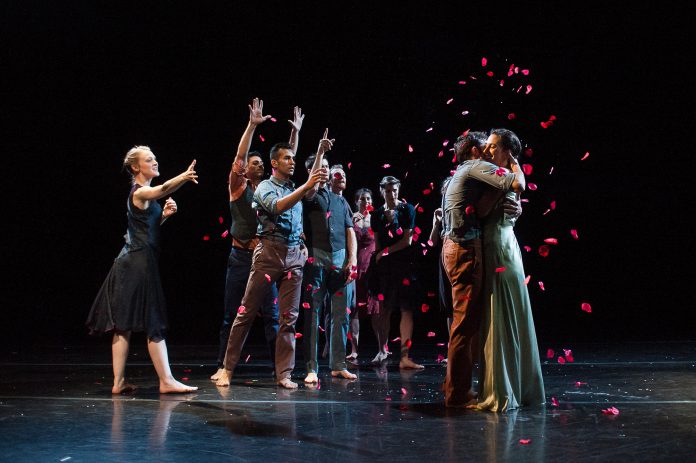
Body/Traffic is a LA-based dance company with a unique philosophy and supportive work environment. As co-director Tina Finkelman Berkett explains, “We’re 10 individuals who love what we’re doing and we want to share our work in a passionate, generous way.”

They will be sharing this work with Vancouver as part of the Chutzpah Festival, presenting three pieces, including a world premiere and two Canadian premieres.

Berkett said that Body/Traffic is “absolutely thrilled” to be back at the Chutzpah Festival after their performance two years ago. Appropriately, all of the works they are bringing this year are by Jewish choreographers. “All of the works have a very different style and feel; each has a distinctive choreographic voice,” said Berkett. “The audience gets to see three very different faces of our company.”

Barak Marshall’s piece is gestural and influenced by dance theatre, described Berkett, and it has a comical mood. Hofesh Shechter’s work is more grounded, athletic and physical, with an internal focus and emotional maturity. The final work, by Richard Siegal, is an homage to American jazz music. It’s light, upbeat, and fun with challenging musicality for the dancers.

This variety in one evening can be difficult for the dancers but Berkett said, “We love it. It’s challenging, we love a good challenge.” There is an added layer of responsibility for Berkett as her relationship with the work is unique: “Being the director, I’m responsible for the show in a different way, so there’s a different attachment to the work — I see things from behind the scenes and there’s a whole backstory with the choreographers — it’s very rich.”

BODYTRAFFIC GreenBride4 bride lifted

The philosophy of the company is to create an environment where dancers are supported and can thrive. “At Body/Traffic,” said Berkett, “we’re really trying to make a breeding ground to make work. We have the most open and loving environment as possible; we’re a tight knit family. It makes a difference when you trust the people in the room, and respect them. We have a common focus and goal, and you can see it on stage — it’s reflected in the work.” Their teamwork and mutual trust makes their work stronger, which is felt by the audience.

Before founding Body/Traffic, Berkett danced with Aszure Barton & Artists and she spoke very fondly of her time there: “Aszure had a tremendous impact on me both personally and professionally. She taught me about integrity, artistry, professionalism, and etiquette in the dance world.” Those are principles that have become the foundation of what Body/Traffic is all about.

“I learned that it was very important to be attentive in rehearsal, to be a tool to the choreographer and allow yourself to facilitate the process,” said Berkett. “It’s important to be respectful and patient with a choreographer, you have to have faith in their decision and that they are doing what is best for the art. It takes a mature dancer to do that.” She passes this knowledge on to the dancers of Body/Traffic, and this attitude of respect and trust is fundamental to their work ethic.

“I hope what we’re doing is curating a sense of what’s going on in contemporary dance today,” said Berkett. It seems that they are succeeding with this performance, as they are presenting the works of three world-renowned contemporary choreographers.

Body/Traffic will perform at the Norman & Annette Rothstein Theatre as part of the Chutzpah Festival Feb. 22 to 24. For more information visit chutzpahfestival.com.

Manhattan and Monopoly: the American press, as told by Muntadas and Bananas

0

bananas

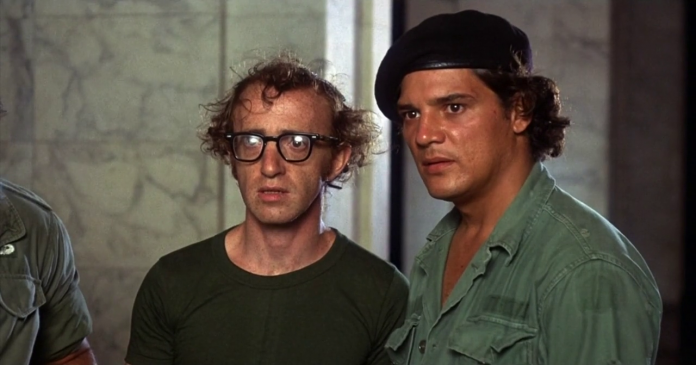
Why are people leaving the Vancouver Art Gallery pondering the same things as those who recently watched Woody Allen’s 1971 film, Bananas? Probably because the stinging satire of the American press in Bananas takes the same critical approach to the mass-media as Antoni Muntadas in his exhibit Entre/Between, recently featured at the Vancouver Art Gallery.

Despite the fact that the press and media industries are not typically considered traditional art forms, the commodification of these industries has, arguably, more extensive effects than the commercialization of any other industry.

Muntadas and Allen take drastically different approaches to addressing the issue at hand, but both shed light on the gruesome effects of commodification of media industries.


What’s personal is public, and what’s public is personal

Muntadas’ “Personal/Public” installation featured a wall with two television screens and a chair in front of them. The first screen, labelled ‘Personal Public’, screens real-time surveillance footage of the viewer viewing the exhibit; the second screen, labelled ‘Public Personal’, shows a live local news station, complete with infomercials.

This installation reflects the paradoxical development of entertainment television: frivolous details of personal lives become public, and public ideas — fed to us through television — are internalized as an aspect of our personal lives, perpetuating a shallow, entertainment-based lifestyle.

This trend is evident in the closing scene of Bananas, as Howard Cosell, on ABC’s Wide World of Sports, commentates the consummation of Fielding Mellish and Nancy’s wedding. The details of their personal lives are public, aired on ABC and viewed by the public — evidently, more intriguing than the civil war that is still taking place in San Marcos.

Reina_personal_public

The media naturalizes indifference to atrocities committed around the world

“On Translation,” one of Muntadas’ film displays, featured three screens: one screen showed magnified footage of applauding hands, the sound of cheering and clapping filling the room. Another showed an audience in theatre seats, applauding and cheering, with brief interruptions of clips of the Colombian civil war and other clips of violence, corruption and inequality.

Viewers are meant to reflect on the gruesomeness with which the media desensitizes atrocities across the globe, conditioning us to passively accept violence and inequality.

Nothing depicts this phenomenon better than the opening scene in Bananas. Again, commentator Howard Cosell helps us out: “Would you people let me through — this is American television, let me through,” he demands, making his way through a rioting crowd to the dying dictator who has just been shot; he mumbles his last few words into the microphone held by a smiling Howard Cosell.


Everything is Framed 

Framing is best demonstrated in a courtroom scene from Bananas, during which a witness testifies for Fielding Mellish against the state.

Witness: I’m sorry to disappoint you, but I’ve known Fielding Mellish for years and he’s a warm, wonderful human being.

Fielding Mellish: Uh, would the clerk read that statement back please?

Court Clerk: I’ve known Fielding Mellish for years and he’s a rotten, conniving, dishonest little rat. 

Fielding Mellish: Ok, I just wanted to make sure you were getting it. 

Judge: You’re out of order!


The message in this scene is clear: the media frames facts to resonate with its agenda, and those who fight it are simply out of order.

In Muntadas’ “Drastic Carpet,” a visual carpet of news items, headlines, and advertisements is projected on the floor, demonstrating the use of framing as a public manipulation tool.

The headlines in the slideshow are a sequence of advertisements, primarily from the 70s and 80s, promoting a range of products, all using a similar marketing technique: average and ordinary is bad, and the only way to avoid being average and ordinary is to purchase this product.

The advertisements and headlines frame the public as consumers, so the public begins to portray themselves as consumers.

This is the reality of media industries as we know them: issues of cultural and political significance are replaced with violent atrocities and frivolous details. Commodification of cultural industries at its finest.

The Last Laugh

0

thoughtful-pen-writing-24581037-2560-1702

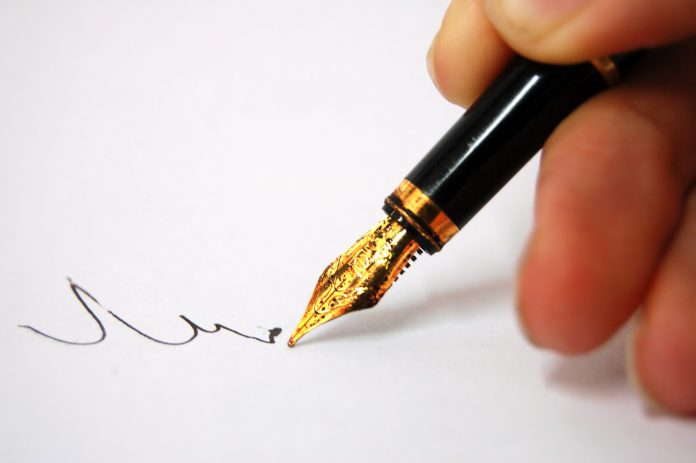
People are usually remembered either for great things they’ve done or great things they’ve said. Clever lines and thoughtful words are great to quote at a dinner party, but they are especially memorable and poignant when they are final words. Some just refuse to take death seriously, and keep on spouting witty phrases to their last breath.

So start considering your own epitaphs, because here are some of the most witty, clever and downright strange last words ever uttered.

Voltaire

“Now now, my good man, this is no time for making enemies.”

One of the absolute best and most ridiculously bold last phrases of all time. Voltaire (November 21, 1694 – May 30, 1778) was a prominent French Enlightenment thinker who was an outspoken advocate for free speech, freedom of religion, and the secularization of the state. His real name was Francois-Marie Arouet, but he used the pseudonym “Voltaire” when publishing all his works. He is famous for much of what he said throughout his life — “While I do not agree with what you say, I’ll defend to the death your right to say it” is just one of his many memorable phrases.

His last words are only fully appreciated in context. A critic of the Catholic Church all his life, on his deathbed he was asked by a priest to renounce Satan so that he might save his soul. His response is probably funnier now than it was then.

Aldous Huxley

“LSD, 100 micrograms, intramuscular.”

Aldous Huxley (July 26, 1894 – November 22, 1963) is probably best known for his dystopian novel Brave New World, but should also be appreciated for his many essays, short stories and other written works. He came from a family of intellectuals, including Thomas Henry Huxley, who was one of the first vocal advocates for Darwin’s theory of natural selection.

Aldous’s last words are understood better when considering his experiences with psychedelic drugs throughout his life. At the brink of losing a lengthy battle with cancer, his last request was to his wife, asking to be administered a dose of LSD. She agreed and injected him twice before he expired. Though I suppose his wit is not the defining element of this utterance, his priorities and sense of practicality in the face of oblivion shine through.

Groucho Marx

“Die, my dear doctor? Why, that’s the last thing I’ll do!”

Julius Henry Marx (October 2, 1890 – August 19, 1977) is better known by his nickname “Groucho” and even better known for his ridiculously exaggerated features, including a large nose, horn-rimmed glasses, bushy eyebrows and moustache. He found his calling as a vaudevillian and later as a Hollywood actor, starring in 26 movies and leaving us with more clever quotes than could ever be included in this article.

In a letter detailing his resignation from a prestigious club, he wrote, “I don’t care to be part of any club that accepts people like me as members.” That kind of levity and irony show up one last time in his final moments.

Oscar Wilde

“These curtains are killing me; one of us has got to go.”

Oscar Fingal O’Flahertie Wills Wilde (October 16, 1854 – November 30, 1900) was a Dublin born poet, playwright and author, not to mention a god of wit, comedy and satire. For plays like The Importance of Being Earnest and stories such as The Picture of Dorian Gray, he became famous.

He was incarcerated for two years for the crime of “gross indecency” with other men, and his career never recovered. But 100 years later, he’s chiefly remembered for what he said, be it the profound — “Experience is merely the name we give to our mistakes,” — or the downright confusing — “I can believe anything, provided it is quite incredible.” There is some dispute as to whether the lines above really were his last words. In my opinion it’s irrelevant; if he didn’t say that, then he probably said something equally memorable.

Dominique Bouhours

“I am about to — or I am going to — die: either expression is correct.”

This quote seems kind of obvious, but bear with me. Unlike many of the other names on this list, Dominique Bouhours (May 15, 1628 – May 17, 1702) isn’t exactly a household name. He has no great works that are still read today and to my knowledge he didn’t do anything extraordinary enough to put him in a history book. All in all, he was a relatively average French monk who spent his whole life in Paris.

Why, then, does he make the list? Well, our Bouhours is one of those otherwise inconspicuous people whose last words alone brought them fame. This final sentence seems somewhat lacking, until one learns that Dominique Bouhours was an eminent French grammarian, whose appreciation and respect for language was literally as important to him as life itself.

Haida tattooing makes its mark

0

haida tatoo-new

The ancient art of Haida tattooing has recently garnered new interest after being featured in the Vancouver Sun on Jan. 17.

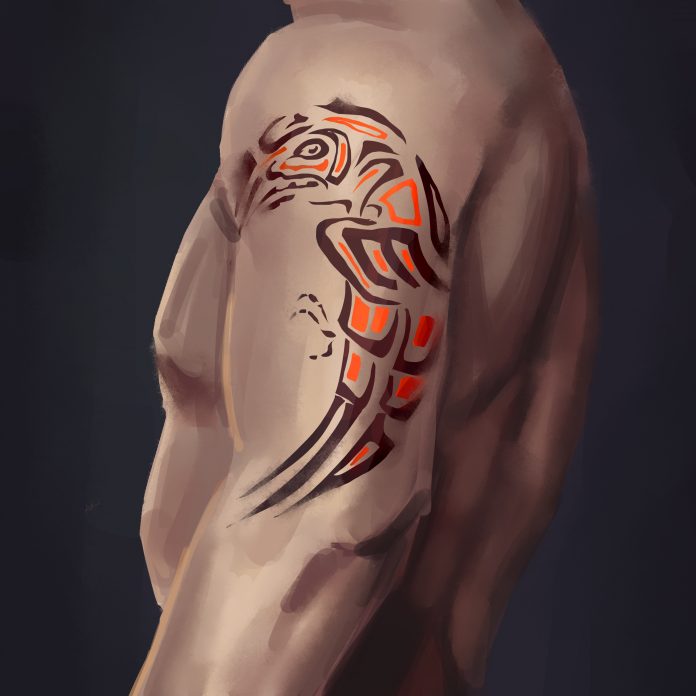
According to new research from the Bill Reid Centre for Northwest Coast Art Studies, located within the First Nations Studies at SFU, the Haida practiced the art of tattooing for centuries before European contact. Always a part of Haida culture, these tattoos represent crests, similar to what coat of arms represented for Europeans.

These crests were symbols of status, social adornment or self-adornment. Each person, depending on their rank and their family, had a right to wear certain crests on their skin — just as they had a right to sing certain songs while others did not.

Haida tattoos were linked with the ceremony of potlatch: individuals were honoured with tattoos that were unveiled during a dance. Since Haida traditions were often passed down by word of mouth, a great deal of cultural knowledge was transferred orally at these potlatches from one generation to the next — including knowledge of the status and spirituality of other members.

The staff at the Bill Reid Gallery, explained, “The potlatch was the legally binding system for the Haida people, just like a signed contract would have been for the Europeans.” They said that tattoos “were celebrated at the potlatch [. . .] so that the other members of the community could recognize the right that [. . .] individual [held, as represented by] that particular crest.”

British Columbia is home to more than 40 different First Nations peoples, each with their own territory, culture and government. Among First Nations, the Haida are known for their art, and home territory of Haida Gwaii, which is also known as the Queen Charlotte Islands.

Gregory Williams, who is the first formally trained Haida tattoo artist in more than 100 years and is himself Haida, explained the artform to The Peak: “There is a strict rule that makes Haida art [authentic]. It is in the way the drawings are done and the space is filled between the negative and the positive space.”

The exposition on Haida Art at the Bill Reid Gallery stated, “There is a formline system of expression using mostly the U form and the ovoid form.” This means that most Haida drawings use a combination of those two forms to represent crests. The colors used — black and red — also distinguish Haida tattoos.

Williams, who lives on Haida Gwaii, believes in continuing and sharing this art form. “Even if the Haida tattoos are part of our culture, it is important for me that we share it with visitors who come to Haida Gwaii,” he said. “This way they can go back home with a memory on their skin of their trip.”

Williams hopes to soon open a store in Haida Gwaii, called Haida Ink, where he would train at least five other Haida tattoo artists who could continue his work.

Questionable Information: Great Wall of China

0

Prior to the 14th century, all that separated China from Mongolia was a “Great Privacy Hedge”.

Drumming to her own beat

0

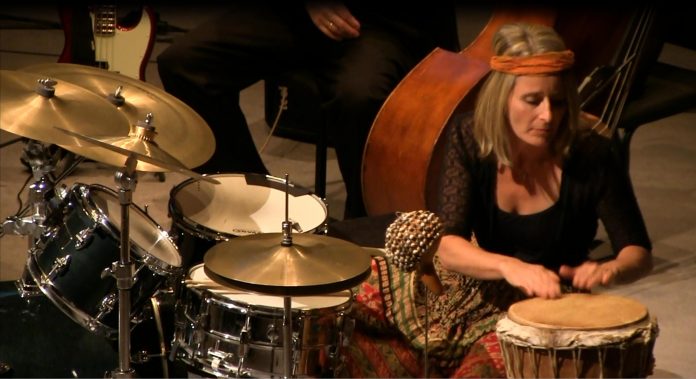
Lauri Lyster - The Drummer Girl still - aren't we clever video by Rod Matheson

Kat Wahamaa wears a lot of hats. Along with being a musician and a mom, she is also a publicist and the co-artistic director of an artist’s collective. Her band Kat and Tony recently released a new album, Everything Blue, and she is currently playing mandolin and singing in the Firehall Arts Centre’s The Drummer Girl with her longtime friend and colleague Lauri Lyster.

Wahamaa has known Lyster since 1996 when she played on Wahamaa’s solo album Wise Woman. The Drummer Girl is a show about Lyster’s experiences as a professional musician in Vancouver from playing with the Vancouver Symphony Orchestra to being part of a jazz ensemble.

“It’s kind of universal. It’s Lauri’s personal experience; she’s a multi-disciplinary artist who works in many different genres,” said Wahamma. “The show is about what it’s like to be a mom and a musician.”

Lyster’s and Wahamaa’s careers are similar in more ways than one: “I can relate to all the different places you can find yourself in as a musician and you’re thinking something like, ‘At least he didn’t throw up on my shoe,’” laughed Wahamaa. “It’s a mom’s perspective which I can relate to as well,” she continued, “I believe in engaging children in the joy of making music.”

Although Lyster incorporates many songs into her show, there are also many sections of dialogue and humourous anecdotes she shares with the audience. “It’s interesting, extremely engaging, and there’s a wonderful selection of tunes,” said Wahamaa, “and the writing is also entertaining.”

Lauri Lyster in Winter Harp

After hearing about Lyster’s experiences, “the audience will leave uplifted by the music and the humour,” said Wahamaa. “It’s also an eye-opener in some respects,” she continued, “it’s not all glamour and limos. They’ll see that there’s such a broad spectrum of artists to discover, and maybe they’ll be inspired to make some of their own music.”

While possibly eye-opening about the realities of the music industry, Wahamaa said that the institution is part of the culture in North America and musicians support it regardless. “The music industry is this thing that’s over there and looms over everything musicians do,” she continued, “it’s a continuum, so I can’t say whether it’s good or bad.”

The Internet, for example, has both a good and bad side, said Wahamma: “It allows you to share your music with a huge audience, but it creates anonymity on a grand scale.”

On Wahamaa’s new Kat and Tony album, she seems to have done things her own way. The album was completed over a couple of years, and songs were recorded in Japan and Mission, BC.

Wahamaa and partner in music and life Tony Rees are glad to have this album finished and she said they ended up with almost two more albums worth of material. Kat and Tony also play with other artists: “It’s nice because we can just go out the two of us or we can bring a seven piece band,” said Wahamaa.

The Drummer Girl premiered in 2012, and Wahamaa and the entire cast is looking forward to remounting it. The show is about life as a musician, and as Wahamaa said, “Being a musician, there’s no lack of interesting times. There’s also the pure joy that the music gives you, putting you in the flow; the here and now.” Just like a great song, Wahamaa said of the show: “It’s gonna leave you feeling good, and the feeling will linger.”

The Drummer Girl will be presented at Firehall Arts Centre until February 22. For more information visit firehallartscentre.ca.

SFU Bookstore Clearance Items

0

Here’s a look at some products that our beloved bookstore is having a little trouble selling. Unlike everything else they sell this is some real almost-appropriately-priced merch!


WEB-tupac

Only God Can Judge Me and Other Flimsy Legal Excuses that Won’t Hold up in Court

by Tupac Shakur 

$40.95 $9.95

This textbook, written by failed criminology scholar Tupac Shakur, would later inspire a track off his 1996 rap music album All Eyez on Me, although with a shortened title.

WEB-tshirt

“SFU: Female Body Inspector” T-Shirt

$10.99 $2.50

Originally sold during the SFU Bookstore’s “joke tee” phase, this shirt was markedly unpopular especially in comparison with the bestselling “Who Farted at SFU?” and “Simon Fraseringa!” shirts.

WEB-Dummie

Advanced Name-Calling for Shit-Zippers

$42.00 $9.69

This item is leftover from a briefly offered English course on the “Study of Vulgarity and Insolence in Writing”. These were supposed to be sent back to the manufacturer but apparently some “monkey-weasel” lost the receipt.

WEB-flag

Misprint “Go Klan Go” Pennant

 $22.65 $0.25

With 10,000 currently in stock, these pennants are the result of a massive error by a South Carolina athletic company which refuses to acknowledge the mistake and claims that “none of the other chapters have complained.”

WEB-tuna

Half-eaten Tuna Sandwich

 $??.?? FREE

This was just something that got left in the bookstore’s workroom fridge and no one would cop to it. It’s unclear how old it is or if it’s really tuna (it smells like tuna) but if you want to come get it, it’s yours.

Tippy Top Ten: Reading Week

0

10. Spent entire week writing in ultimate act of rebelliousness

9. Without the usual crazy lines, finally visited SFU Art Gallery

8. Discovered your idea of “sleeping-in” has reached 4 p.m.

7. Coined a new term for masturbation then played “flappy bird” a lot

6. Adjusted to life without the Tonight Show with Jay Leno

5. Watched world’s finest athletes compete in the Olympics due to being too lazy to reach for the remote

4. Found out “Reading Break” isn’t that big of a party in Cabo San Lucas

3. Practiced silent, unconscious, lying down form of meditation

2. Learned what “neknominate” means and counted it as studying for PoliSci

1. Reading, obviously