Home Blog Page 1167

Student Opinions on the SFSS Elections

0

Love it or hate it, elections time is here. Sit back and relax as your favourite spots on campus are taken over by posters of your smiling SFSS candidates.

The Peak interviews SFU students to try and nail down the general opinion of the elections.

Hosted by Leah Bjornson
Created by Brandon Hillier

Music provided by Nouvellas (http://www.nouvellas.com)

TransLink efficiency measures potentially problematic

1


WEB-Translink reform-Mark Burnham

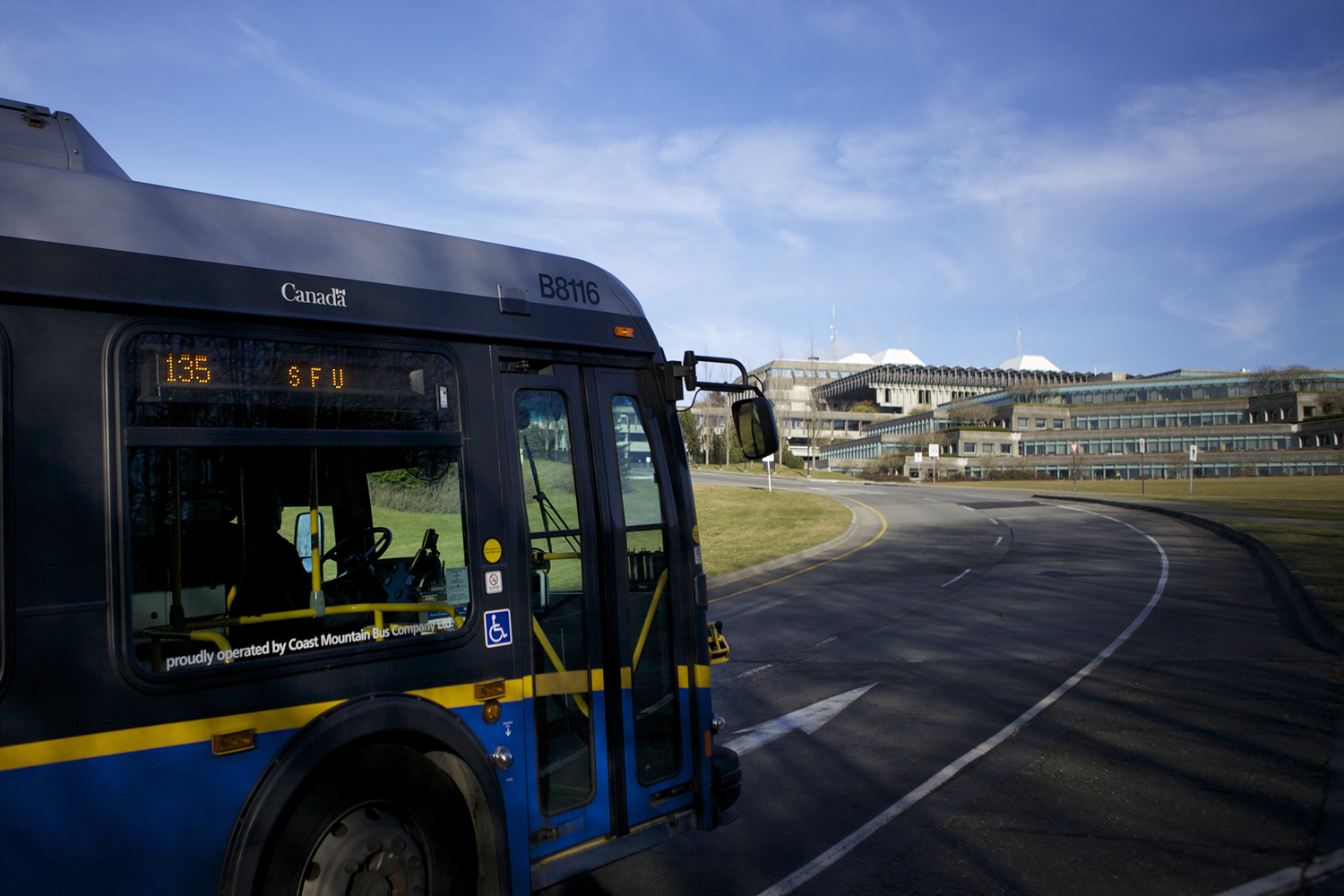
An interview with professional bus driver Dianne McKenzie has revealed funding problems within TransLink; McKenzie told The Peak she feels “good working for such a successful transportation company,” but is “worried about the future.”

McKenzie, driver for the Coast Mountain Bus Company — a subsidiary of TransLink — and Port Coquitlam Transit Centre job steward says TransLink recently implemented new efficiency measures. These include reduced driver “down time,” as TransLink described it, as well as route time changes with shortened connection times.

McKenzie cited these measures as well as issues with TransLink’s governance, as two central problems with the way TransLink is currently being run.

The route times optimization allows “less and less time between runs,” McKenzie said, which not only reduces breaks, but makes it harder for passengers to make their connections.

However, TransLink frames this differently. In its 2014 Base Plan, TransLink explained that these changes were focused on reallocating 56,000 hours from underutilized routes to areas of otherwise underserved high demand routes.

The Plan stated, “This enabled TransLink to increase bus boardings per service hour by by 3.4 per cent while at the same time reducing the cost per boarded passenger by 2.2 per cent.”

McKenzie said she feels “treated inhumanely” with this reduced down time, which does not give drivers time to even “stretch” or sit down to eat a meal. “We are not machines,” she said.

The 2014 Base Plan, which includes these efficiency measures, outlines long-term, sustainable transportation strategies to match the demand from the million new residents expected in the Metro Vancouver region between now and 2045.

TransLink’s ridership has significantly increased over the last few years. In 2011, TransLink set their 10th annual ridership record in a row; however, the numbers fell during the first six months of 2013, according to a study by the American Public Transit Association.

This decrease in commuters raises the question of funding. In a statement, TransLink explained, “Current funding sources are not keeping pace, and there is a reason to believe that simply keeping pace is not good enough.”


“We’ve been having a pretty good hate on.”


Gordon Price,
director of city program, SFU

In last May’s provincial election, Premier Christy Clark promised that a referendum on TransLink funding would be held on Nov. 15 of this year. The referendum has been pushed until a later date due to concerns from regional mayors who suggest that more time and input are needed on the subject beforehand.

For SFU director of city program Gordon Price, the only answer to the referendum question is a yes vote for more funding, but commuters shouldn’t be too quick to blame the organization for the lack thereof.

“It shouldn’t be about TransLink. We’ve been having a pretty good hate on, we’ve all contributed to that. Oddly enough, some can make a good case that it’s a good organization, as its authorizing legislation is admired around the world,” Price told Burnaby Now.

Despite her criticism, McKenzie insisted that she is not trying to bash the company, but merely point out the problems with its current system. “As bus drivers, we empathize with our users,” she said. “We hear their concerns daily and often it’s not very nice.”

She hopes to at least help others understand “why some drivers are not too happy, why they can’t wait for [. . .] any number of seemingly small actions on the part of the passengers.” Drivers, she said, “now really don’t have the time.”

Keep the Fraser Surrey Docks coal-free

0

WEB-Fraser coal docks-Flickr-Judy and Ed

Recently, Port Metro Vancouver purposed opening a coal terminal at the Fraser Surrey Docks. Since then, concerned citizens from all over the lower mainland have joined to raise awareness of the potential hazards linked to this project. Their cautions are justified: as it stands, the threat of immediate and long-term pollution from the project is very large.

While some have made great arguments for the $15 million investment, local residents, predominantly from Surrey, New Westminster, Burnaby, Delta, and Richmond are asking to see a comprehensive assessment of the possible long-term health and environmental implications that would follow the resumed activity at the docks.

They are rightly cautious about the abundance of coal dust and diesel emissions that come with coal transportation, considering there has not yet been a comprehensive study to identify potential health risks of the project.

As the demand for coal goes up, so will pollution along the Fraser River.

Robin Silvester, president and CEO of Port Metro Vancouver, claims he is satisfied with the current Environmental Impact Assessment (EIA), which states that dust will not pose a health risk.

But many officials, such as Dr. Paul Van Buynder of Fraser Health and Dr. Patricia Daly of Vancouver Health, believe otherwise. They say, in a letter to the docking company, that Silvester’s report “does not meet even the most basic requirements of a health impact assessment.”

This project is not the right way to grow the economy. Supporters of the project argue that the docks could allow for both an increase in local jobs and economic growth in the area. Jeopardizing both the long-term health and the comfort of the surrounding communities, however, will not balance what we gain from the Surrey coal docks.

Even if the initial reactivation has minimal impacts, as the demand for Canadian coal goes up, so will the amount of fugitive dust, diesel, and noise along the Fraser River. In 2013, in fact, coal shipments increased by 17 per cent, up to 38.2 million tonnes, according to several local news sites.

The communities situated along the Fraser River are home to many families who shouldn’t be forced to live in such industrial areas — it’s not hard to understand why some are considering leaving.

The call for a public, comprehensive report remains crucial to families across the Metro Vancouver area, and that call is perfectly justified.

As many organizations, such as the British Columbian Nurses Union, the Canadian Association of Physicians for the Environment, multiple MLAs, and school boards, lend support to those fighting Port Metro Vancouver, it is hard to anticipate how the project will end.

Certainly, no matter where we mine for coal or where we choose to transfer it, there will always be pollution. However, we can at least control how close that pollution is to such a huge population.

Moving the docks further from the city will address health concerns and improve the day-to-day life of thousands of people. Facilities such as coal transfer docks belong in sparsely or unpopulated areas of the country to minimize discomfort and inconvenience.

Canada should invest in its people first, and its resources second. This proposed project stands for the exact opposite.

Clan athletes earn GNAC honours

0

WEB-Erin Chambers-Anderson Wang

The Clan basketball teams have wrapped up their regular seasons, and with the season’s end come the Great Northwest Athletic Conference awards. This year, Erin Chambers headlines the Clan women’s nominees, following an all-star season which saw the junior take control of the team’s offence and lead the team and the conference in scoring.

The 6’1” guard/forward combo averaged 22.7 points per game this season, the eighth best scoring average in all of the NCAA Division II. The team’s co-captain was unanimously selected by all GNAC coaches to the first all-star team, one of only three women to earn this honour this season.

However, Chambers remains modest about the accomplishment.

“It is an awesome accomplishment and I feel very honoured to be named to the all-star team of such a competitive league,” said Chambers, who also took the time to acknowledge her teammates’ support this season.

One of those teammates, Katie Lowen, earned honourable mention for the all-star awards, as the junior was second for the Clan in points, first in three-point field goal percentage and second
in steals.

The women’s program also received GNAC all-academic honours as three athletes were named to the 2013-14 team. Lowen and Kia Van Laare are repeat honourees from last season, while senior Chelsea Reist is a first time honouree. To be eligible, student-athletes must have a minimum grade-point average of 3.20 (cumulative) and be in at least their second year of competition at their current university.

On the men’s side, Sango Niang was named to the GNAC second all-star team, his first conference honour after transferring to the Clan for the 2013-14 season. Niang started in 23 of 24 games, helping the men’s program earn their highest overall win total since moving to the NCAA.

He’s also only the second Clan man to be named to a GNAC all-star team, following Justin Brown’s nomination in 2011-12. Niang averaged 16.3 points and 5.6 assists per game in his first NCAA season, and was eighth in the conference in point average and third in assists.

“I tried to just play aggressive all season, get my teammates involved and ultimately, tried to win games,” explained the junior. Now, with his season over, his attention turns to preparation for the 2014-15 season, where the Clan will look to continue improving in the conference standings.

Clan roast Ducks

0

WEB-SFU Lacrosse

The smell of roasted duck wafted over the Burnaby campus after the Clan lacrosse squad finished off long-time rival and Pacific Northwest Collegiate Lacrosse League (PNCLL) powerhouse #12 University of Oregon Ducks, tripling them 15–5.

The Ducks, normally a top contender in the PNCLL and Men’s Collegiate Lacrosse Association (MCLA), couldn’t hold it together against the consistency and speed of the Clan, hungry for a big win at home. And after shoveling a foot of snow off the field for seven hours so they could practice and play on their home field, the win was even sweeter.

The Clan dominated everything right from the get-go, controlling offensive possessions, loose balls, shots and defensive stands; the Ducks only beat the Clan in face offs, winning 57 per cent.

SFU, meanwhile, came out firing early, going up 3–0 in the first seven minutes, though the Ducks managed to fight back, evening the score at three by the end of the first quarter. But that’s as close as they would get, as the Clan outshot the Ducks 33–24 over the game, and their offence just kept rolling.

SFU made it 6–4 at the half and then went on a dominant 9–1 run in the second half, keeping the Ducks scoreless for the entire third quarter. The 15–5 loss gave the Ducks, who haven’t had any success against ranked opponents, their worst loss of the season and gave SFU a boost of confidence heading into the season’s second half.

The usual suspects led the way for SFU offensively. Tyler Kirkby continued his strong season with four goals and one assist, while  Sam Clare and Lyndon Knuttila tallied four goals apiece. Five Clan players recorded assists to get themselves on the score sheet as well.

The MVP of the game however, was senior goaltender Darren Zwack who stood as solid as the walls of the AQ, backing an already rock solid defence by stopping 19 of 24 shots for a season high .792 save percentage, one of his career bests. His season save percentage, now an impressive .697, earned a boost as well.

But most importantly, this was the first time in four years the Clan have beaten the Ducks. With the win the Clan improve their record to 3–0 in their division and 4–1 on the season, claiming sole possession of first place in the PNCLL and moving up two spots in the MCLA rankings to #12, while Oregon drops to #15.

The Clan play in Washington this Friday, March 17, against the University of Utah Utes before hitting the road for almost the rest of the month, but the schedule only gets tougher from here.

Upcoming games against ranked opponents include #3 Arizona State, #23 Arizona, and #25 Oregon State. But with the season the Clan have had so far, there’s no reason the winning can’t continue through to the PNCLL Championships at season’s end.

How my anxiety made me a better person

2

WEB-head

A little over two years ago, I had my first panic attack.

In retrospect, it was a pretty normal night — I was in bed with my (now ex) girlfriend, watching Parks and Recreation and eating junk food. This was right before I began university, and a dead end barista job was pretty much my only responsibility. I spent most of my days watching movies, drinking with my friends, and playing video games. I had no concrete plans for my future, and little to no passion for anything.

My anxiety changed all that. That night, my heart went into overdrive, my body started shaking uncontrollably, and my vision blurred. I laid on the bathroom floor for what seemed like hours, trying to catch my breath. I can still remember the feeling of the cold tile on my cheek.

I was sure that I was having a stroke, a brain aneurysm, a seizure — something like that. I’ve always been a hypochondriac, and that night, it felt like all my fears had finally been confirmed. I stuck my finger down my throat until I threw up, just to make sure I hadn’t accidentally swallowed something poisonous.

Things didn’t get much better from there.

The person I am today is a result of the struggles and challenges that my anxiety has presented me.

The next six months were a blur of sleepless nights, sick days, and empty beer bottles. Never the most social person, I retreated even deeper into my shell. I didn’t call anyone, and I barely ever went outside. I self-medicated with alcohol and chamomile tea. On the off chance someone tried to contact me, I pretended I wasn’t there. My girlfriend and I grew more and more distant, and my growing isolation only made me more anxious, more afraid.

For months and months afterward, I struggled to keep my head above water. I would start to feel my hands shake, a chill would go down my spine, and instantly I’d be transported back to that night, lying on the bathroom floor.

But somewhere along the way — whether it was the pills, a gradual increase in confidence, or plain old time — I got stronger. I stopped feeling sorry for myself and I started stepping outside of my comfort zone. It was scary, and more than once I felt like I was making a huge mistake.

Two years later, I’m in university, I’ve met someone new, and I’m doing the best work of my life. If I met the kid I was two years ago, I wouldn’t recognize him.

People with mental illness are too often told to “suck it up” or “think positively,” as though depression or anxiety are conditions that can be cured by sheer willpower. This, of course, is not true — it takes time, a steady support system, and often the help of a doctor or a medical professional.

But I’d be lying if I said that my anxiety hasn’t made my life better than it was before. I know that in no small part, the person that I am today is a result of the struggles and challenges that my mental illness has presented me.

Once I had the strength to start broadening my horizons, I did so; the thought of being holed up in my room for the rest of my life was even more terrifying than coming out of my carefully constructed shell. I applied to SFU, and got an entrance scholarship. I started writing for the student newspaper, and rediscovered a passion for writing and journalism. I ended an unhealthy relationship and I made new connections.

This meant stepping out of my comfort zone almost daily — most of the time, it sucked. But it didn’t suck half as much as standing still and waiting for my situation to get better on its own.

I told my doctor about what I was going through, even though I was terrified and ashamed of admitting it, and he wrote me a prescription. It took a lot more than willpower to put my life in the right direction, but having the courage to admit that I had a problem is one of the most important decisions I’ve ever made.

Now, I think of myself as a better, more courageous person, because I know that if my anxiety threatens to take over my life again, I’ll have the tools necessary to beat it. After all, I’ve done it before.

I’m not arguing that all other people in similar predicaments should take the same approach as me; different strategies work for different people. The important thing is to find what works for you, and to follow through. If watching reruns of Buffy the Vampire Slayer calms your nerves, do that. If exercise and healthy food make the world seem a little less dim, more power to you.

People forget that mental illness, at the end of the day, is a lot like most physical illness. It’s not easy to fix, and it’s impossible to beat it all by yourself. But that doesn’t make you powerless — if you’re willing to ask for help and to find out which strategies suit you best, you have a much better chance at controlling your illness, rather than letting it control you.

If I met my former self two years ago, worrying he’d be this way forever, I would tell him the same thing I’m saying here: your life isn’t over. It’s just beginning.


Satellite Signals

0

penny

Woodward’s

As part of a panel last Thursday night, four experts analysed and explored society’s fascination with superheroes. Discussing traditional and unconventional characters, and superheroes versus sidekicks, the panel delved into the implications of heroism on culture.

Each panelist touched on different topics, bringing to light heroic PTSD in dystopian fiction, gender representation of super heroines, as well as the redemption of the Hulk’s anger issues.
Surrey

Surrey campus’ annual open house, an event which usually sees over 3,000 visitors, took place last Thursday, Mar. 6. The open house provided campus tours, as well as information on academic programs, student services, and admission.

There were also various displays and performances highlighting the cultural diversity fostered on campus. Activities featured at the event included live experiments, wearable technology, robot battles that visitors could participate in, and touchable sea creatures.

Vancouver

The Canadian government announced its decision to phase out the Canadian penny in 2012 and on Feb. 4, 2013, the Royal Canadian Mint officially stopped circulation of the penny. A talk held downtown on Mar. 1 discussed the cultural ramifications of this change to our currency and how coins have affected culture in general. The event description questioned whether the loss of the penny will be easily accepted, or, “like inches and ounces, its ghost will continue to haunt our collective psyche.”

No coalition, no government

0

Fellow Conservatives, rejoice! Justin Trudeau has handed the Conservative Party another key to victory. And no, I’m not talking about his ill-timed joke about the situation developing between Russia and Ukraine.

I’m talking about his unwillingness to join with Tom Mulcair and the NDP to run as a united party in the next election. If this were to happen, it would ensure the defeat of Stephen Harper and the Conservatives.

Let’s look at the facts. Following the fragmentation of the Progressive Conservative Party in the early 1990’s, Canada entered a period of domination by the Liberal Party, at the time led by Jean Chrétien.

During his tenure as Prime Minister, there was never a serious threat to the government from the right-wing parties struggling for power amongst themselves.

If the Liberals and NDP ran together in the last election, together they would have defeated Stephen Harper.

It was not until the Canadian Alliance and the Progressive Conservatives united as the Conservative Party that they became a threat to the Liberals’ hold on power, reducing the Liberals to a minority government in the 2004 election, the first in which they ran as a united party.

The subsequent election in 2006 led to the Conservatives gaining their first victory in close to 20 years, despite being in the form of a minority government. Five years later, the Conservatives achieved a majority government, which we enjoy today.

At the time of the 2011 election, there were already some among the Liberals and New Democrats who proposed running as a coalition of the left. The Liberal leadership rejected the proposal, believing they did not need the New Democrats to defeat Stephen Harper. They made Canadian history that year as, for the first time since Canadian Confederation, Liberals formed neither the government nor the opposition.

If they had run as a coalition, the current situation in Canada would be very different.

Out of the 167 seats won by Conservatives, 45 were won with a minority of the vote, the remainder of the vote split between the two left-wing parties. Of those 45 seats, six are cabinet ministers, including both the Minister of Foreign Affairs and the Minister of Citizenship and Immigration.

Assuming all Canadians who voted made the same decisions, the coalition would have won 182 seats, with Conservatives only winning 121. Stephen Harper would be the Leader of the Opposition, and given Liberal power before the election, Michael Ignatieff would be the Prime Minister.

Both the Liberals and the NDP plan on courting the Canadian middle class and the province of Quebec in the buildup to next year’s election. With Quebec having played such a key role in the NDP’s surge to Official Opposition status, they will likely have to fight to keep the province. It was largely ignored by the Conservatives in the last election, but could become a battleground and the focus of large scale efforts by the two left-wing parties.

As next year’s election moves ever closer, the parties that seem bent on defeating Stephen Harper move farther and farther apart. Both Mulcair and Trudeau want to see the Conservatives defeated. But each wants to take responsibility for that victory, and that could be their downfall.

5-year old totally blanking on “magic word”

0

BURNABY —  A local 5-year old boy is on the verge of not receiving the cookie that he’s been looking forward to all day after reportedly freezing up on what “the magic word” is.

According to witnesses, little Johnny Parker had been waiting politely in line at Nelson Elementary’s annual cookie sale for almost 10 minutes before blowing his transaction at the very last moment.

“He seemed like a really considerate, good little boy,” explained Mrs. Linda Turner, an organizer of the sale and also Brian’s mom. “He had proper posture and didn’t raise his voice, but then when he got to the front of the line it all fell apart.”

While seemingly having a grasp on basic manners, Parker’s request for a chocolate cookie was met with more resistance than he had anticipated.

“When they came back at him with ‘what’s the magic word’, I could tell he was rattled”

– Stevie Harris, classmate

“He said ‘may I have a cookie’, which I thought was a pretty good way of putting it,” Parker’s friend Stevie Harris told The Peak. “But then they came back at him with ‘what’s the magic word’ and I could tell right away that he was rattled.”

It was at this point that witnesses say Parker went completely silent and just stared intently at the wall crinkling his face and clutching his forehead.

“They totally blindsided him and it was ugly to watch,” Harris explained as he watched his friend continue to struggle. “It was a sucker-punch, no doubt about it.”

After a couple seconds, Parker was told that unless he came up with the “magic word” he would not get his cookie despite being willing to pay full price for it.

Organizers say they gave him more than his fair chance and even started to mouth the first syllable “pl…” but that he was still drawing a blank.

“I don’t know what’s happening to me, I know this one,” Parker complained, looking to the sky. “I just said it when I borrowed a skipping rope this morning . . . gah what is it?”

While the sale’s organizers have come out on record stating that the cookie will be available whenever Parker is willing to come by and ask for it properly, at press time the “magic word” was still eluding the boy and most are predicting that the situation could continue well into recess.

Conference discusses becoming a living wage university

1

WEB-j bannister- courtesy of Living Wage SFU

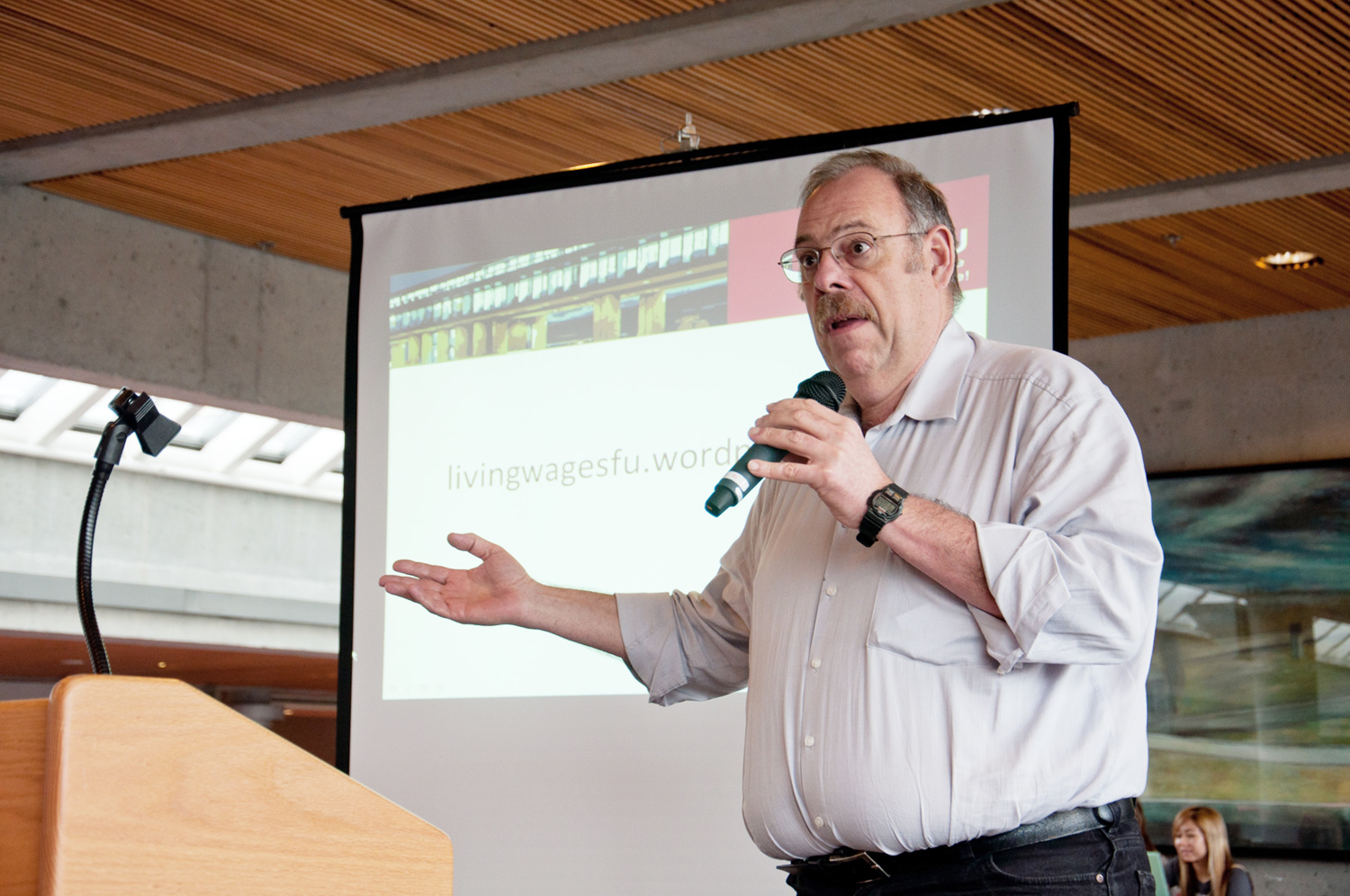
In a conference on Feb. 27, Living Wage SFU called for Simon Fraser to become the first living wage university in Canada, following the example of Queen Mary University of London (QMUL).

Living wage refers to the salary that one would have to make to earn a “decent living” according to Marjorie Griffin Cohen, a professor of political science at SFU, and the only faculty member currently a part of Living Wage SFU.

To become a living wage university by Metro Vancouver standards, SFU would have to pay all workers $19.62 per hour; this would also apply to jobs that are outsourced to other companies.

According to Adrienne Montani, provincial coordinator at First Call: BC Child and Youth Advocacy Coalition and leader of the living wage movement in BC, the province’s $10.25 minimum wage does not allow workers to get out of poverty, never mind make a decent living. “We’re not trying to get people at the poverty line; we’re trying to get them above it,” she said.

Also in attendance at the conference was Jane Willis, a professor from QMUL, the first living wage university in England. Willis stated that living wages for the workers at QMUL have resulted in increased productivity and less turnover as job satisfaction is higher.

Previously, despite similar arguments, the board of governors decided not to pursue becoming a living wage university, citing financial inability. As stated in an email from Judith Osborne, vice president legal affairs and university secretary, “the board felt it would not be appropriate for one publicly-funded university to pursue this policy in isolation from others.”

“The costs of adopting such a policy would [ . . . ] require off-setting cuts, thereby weakening the university’s position to meet its educational objectives and placing it at a competitive disadvantage relative to other institutions,” stated Osborne.

She suggested that the matter was more one of provincial policy, for which the government would need to provide the funding.


To become a living wage university, SFU would have to pay all workers $19.62 per hour.


SFSS board members also had mixed reactions to the idea, as discussed at their Feb. 19 board of directors meeting. Some, like ERO Chardaye Bueckert, were in favour, while others, including business representative Brandon Chapman, shared concerns about the financial implications. He stated, “We need to be careful, [ . . . ] we have a university that can’t make ends meet in many areas.”

Shahaa Kakar, of Simon Fraser Public Interest Research Group (SFPIRG) and a member of Living Wage SFU, does not believe cost is the problem. “They [university administration] had done some preliminary costings, and they basically told us that [. . .] they estimated it would cost them less than half a per cent of their annual operating budget to become a living wage employer.”

Member services officer Moe Kopahi reminded the SFSS board, however, that “it’s more complex than we think. It’s not a simple math of percentage increase.”

The board of governors stated that part of the problem is that they are unable to raise student tuition fees. Julia Lane, of the GSS, elaborated, “The university is still bound by the provincial mandate to cap tuition increases for domestic students by no more than two per cent per year. So I don’t think tuition fees would be a logical place to look for the necessary increases.”

However, both Cohen and Kakar agree that it should not be necessary to raise tuition fees to make SFU living wage. “The living wage campaign would not endorse raising tuition fees,” said Cohen via email. “That would be improving the situation of one vulnerable group at the expense of another and that is never the way people who advance this issue find acceptable.”

Kakar believes it is more of an “issue of political will.” She told the conference that it was necessary to raise public awareness, as the university allegedly told her that it was not a priority, and that it would not be dealt with until the community makes it known that it is a priority.

“But we’re a handful of people,” she stated. “We won’t be taken seriously by the university unless we can really show that there is a large amount of political will to make this happen.”