Home Blog Page 1157

The Peak starts aNUW

0

As of a vote by our board of directors last week, The Peak has decided to leave the Canadian University Press (CUP) opting, instead, to join  the National University Wire (NUW).

If you haven’t been paying attention to the Canadian student newspaper world lately, let me tell you, things have been going on.

The Canadian University Press (CUP) is a non-profit, member owned and operated organization of Canadian student newspapers, and the oldest student newswire service in the world. In this capacity, CUP has provided services and support such as conferences and a national newswire to its members, including The Peak. All sounds good, right?

Right now, not so good. Currently, CUP is facing a financial crisis so bad that on Feb. 28 they launched a $50,000 Indiegogo fundraising campaign in an effort to keep themselves afloat, after facing their third consecutive deficit year. As of press time, they’ve raised a little over $7,000.

Over the past two years, we have repeatedly voiced our concerns, and CUP has not made serious moves to respond.

How did things get to this point, you ask? CUP depends on membership fees — calculated by the available finances of the individual paper — to operate. It’s a fine balance of providing services valuable to larger papers with plentiful resources, and to those with much less.

Unfortunately, a year ago, member papers started leaving, deciding that in the changing financial landscape of press that CUP fees were no longer worth the services they were receiving. CUP suddenly had a lot less money to keep up their national staff and expensive wire service.

The tensions arising from this financial state culminated in a plenary meeting at this year’s national conference in Edmonton, when a coalition of current and former members, including The Peak, tried to pass a new fee structure and online article plan to replace the current newswire. The proposal was rejected, with softer fee cuts chosen instead.

Over the past two years, The Peak has repeatedly voiced concerns about relevant services, asking for a more productive newswire service or an RSS feed that would allow papers to push content quickly and effectively, providing more diversity and choice for republishing. CUP has not made any serious moves to respond to these requests.

At this point, the mismanagement of the organization, the lack of response to our needs, and the resistance to decisive change have moved us to do something we have been discussing since I started at The Peak over two years ago: leave CUP.

If you need us, you can find us over at the National University Wire (NUW), which launched last Monday. NUW was founded out of collaboration between two former CUPpies, Geoff Lister of UBC’s The Ubyssey and Joshua Oliver of U of T’s The Varsity, in an effort to address the need that CUP has actively ignored. It’s the collaborative, user-generated feed we’ve always wanted.

And the company’s not bad either. Along with The Peak, members of NUW are student newspaper heavyweights, including The Gateway, The Ubyssey, The Martlet, and six others, all of which can be found on the site.

We are proud to be a part of a wire that is working towards creating a strong, collaborative, unified student press, which is the most valuable thing we could ever receive from an organization.

We hope CUP will be able to provide that again  one day. But for now, we’re trying something NUW.

Manhattan and Monopoly: Creativity, copyright, and culture

0

“The artist’s job is not to succumb to despair, but to find an antidote for the emptiness of existence.”

For those who live by such words, today’s North American cultural industries have infinitely failed us. The corporate monopoly production of culture that comes out of Hollywood reflects capitalist values that individualize life’s miseries rather than provide a remedy.

But thanks to the sharing capacities of the Internet, not all North American art production has succumbed to this despair. In the last 10 years, the economy has become increasingly dependant on the generation of knowledge through creativity and innovation, otherwise known as the creative industries.

The rise of the creative industries has shifted cultural production away from corporations, and into the hands of the masses. This reduces the strength of cultural monopolies, and allows for meaningful artistic work that reflects the real values of middle class citizens living in North America.

Although the creative industries have changed the face of cultural production, there are barriers preventing the free flow of meaningful art. These barriers come in the form of intellectual property rights.

Sleeper 4

Take the example of the new-age digital music producer. This person takes sounds from other artists, remixes them, and puts them on top of various other tracks. The web presents an unlimited number of mediums to showcase and market this kind of work.

However, if a large record label owns the rights to a song, any reproduction of that song is strictly prohibited. If a new-age digital music artist uses only a few seconds of that song they could be heavily fined. The only way to legally produce a track that uses a protected song is to buy rights to it. Unfortunately, those don’t come cheap.

But even with strict intellectual property laws, the Internet and the creative industries have still revolutionized cultural production. There is now a population of creators who make a living in online video production, blogging, online graphic design, and a range of other practices made possible by the creative industries.

Copyright laws stifle the innovative practices the creative industries provide and restrict the free flow of meaningful cultural production. But, as Woody Allen tells us, “We should not succumb to despair.”

Although the commodification of art in the cultural industries has led to corporate monopolies on creativity, innovation, and the production of culture, the web has provided us with an arena for meaningful cultural production at our fingertips. The web may be limited by intensive copyright laws at this point in time, but it has increased artistic practices that better reflect the values of the majority of North American citizens.

Clan finish second at Cal Baptist Invitational

0

The Clan men’s golf team continues to climb leaderboards ahead of April’s championship season.

Last week the men travelled south for the California Baptist Invitational where, after a very strong opening round that saw them take the lead, they finished in second place at tournament’s end. The SFU squad posted a team score of 875, only three strokes behind the winners and Great Northwest Athletic Conference (GNAC) rivals, Western Washington University.

Senior captain Mike Belle led the team through the three-round event, finishing in a tie for 10th position with rounds of 71-70-75 for a tournament total of 216. Belle’s was not the only quality performance, as four of the five men finished in the top 30 of the 96-player field.

Following his captain was John Mlikotic who finished in a tie for 14th with a total of 218 strokes and rounds of 70-73-75. Bret Thompson followed in 24th place after faltering in the latter rounds of the tournament. The sophomore’s opening round of 67 was five strokes below par,  but he couldn’t hang on, adding 77 and 78 in rounds two and three. Freshman Kevin Vigna finished in a tie for 29th place with scores of 78-72-73, improving significantly over the second two rounds and only one stroke behind Thompson. Their tournament totals were 222 and 223 respectively.

Rounding out the Clan side was freshman Craig Titterington, appearing in his first collegiate tournament where he opened with a very respectable round of 74. He stumbled in the later part of the tournament with rounds of 77-83, posting a three-round score of 234. The Clan men have one final tournament before they head to the GNAC Championships
in mid-April.

Boasting three of the top-10 scoring averages in the conference in Belle, Thompson and Vigna, the Clan have an excellent chance to win the title. Sitting at 19th in the NCAA Division II rankings, the Clan also hold the second best team scoring average in the GNAC with 298.6, just behind Montana State Billings with 298.1.

The men will be looking to advance to the West Region Championships for the first time since joining the NCAA in 2010, a chance they narrowly missed in 2013, when the Clan finished third at the conference event.

Woohoo, boohoo

0

Woohoo: writing

As I come closer to completing my degree in English and become more interested in writing in general, writing is becoming the practice. The continuous mountain. The never-ending journey. I find little else as satisfying.

Handing in a completed essay feels fantastic. To have put together all the information from weeks of studying and research, to solve the puzzle of how to include as much info as possible from the semester into one complete package, I get a high.

The place of discovery that is writing also gets me stoned. Poetry specifically, but also prose and essay writing, allow the detachment of oneself from a written piece of work; the writing speaks for itself and can have unpredictable effects on a reader. Writing offers a means to create something new, and an opportunity to escape oneself in the process.

Cocaine? No, thanks. I get my high from the pencil and the pen. I get my dopamine from the keyboard.

Boohoo: getting started

Holy crap, am I ever terrified of starting to write.

I’m terrified of writing research papers, sifting through convoluted scholarly articles, potentially choosing the wrong ones, writing, editing, second-guessing, and nit-picking over every sentence.

I’m terrified of opening myself up to critiques. Especially when writing opinions, I really don’t want to take a hard stance for or against something, to invite a reaction, to potentially have to question my own beliefs.

I’m terrified of potentially having to defend an argument against anyone who might feel more educated (or, God forbid, more passionate) about a subject.

But I have to write like I have to speak. I have to express myself. I can’t live a life of fear, protected by the absence of rebuttals.

And I have to write essays. Because profs say so. But this semester, I’m gonna give myself at least a month to prepare each.

. . . Aaand the semester is over in a week. Well, I don’t really need sleep.

No UNSC nation should have veto power

0

Recently, members of the United Nations Security Council (UNSC) voted unanimously in favour of adopting a proposal to condemn the Crimean referendum as illegal, with two exceptions: China, who abstained, and Russia, who voted against the proposal.

In any other democratic forum, this would not matter, but Russia, as a permanent member of the UNSC, can veto any resolution that this organization attempts to pass. This veto power needs to be reformed.

When the United Nations was founded during World War II, it was decided that Great Britain, China, the Soviet Union, the US, and France would be the permanent members of this Security Council, and would have veto power in issues relating to threats to the peace and stability of the world. One reason for this power was to ensure the major powers act in concert, and to prohibit the UN from taking future actions against its principal founding members.

It’s a problem that there is nothing binding about the General Assembly overriding a Security Council veto.

In many ways, these five nations are the biggest threat to world peace. A report to the United States Congress on international arms sales found that these five nations together were responsible for 78 per cent of all arms deals to developing and industrialized countries from 2004 to 2011. Further, all five of these nations have been guilty of using the power of veto to block actions against their own countries.

These have included an attempt to condemn the American invasion of Panama, the Soviet invasion of Afghanistan, and the Suez Crisis. The veto has allowed these nations to act as they see fit without fear of condemnation by the UN.

Yet there does exist a process by which the United Nations can circumvent a veto or the threat of a veto; UN Resolution 377, known colloquially as “Uniting for Peace.” This resolution was adopted by the UN in 1950, allowing for the General Assembly to convene an emergency special session in the event that “the Security Council [ . . . ] fails to exercise [ . . . ] international peace and security in any case where there appears to be a threat to the peace, breach of the peace, or act of aggression.”

The problem with Resolution 377 is that it is more a tactic of putting pressure on belligerent nations than firm action. Unlike the veto system in the United States, where a presidential veto can be overridden with a two-thirds majority in each house, there is nothing binding about the General Assembly overriding a Security Council veto.

This is simply because the task of the Security Council is to enforce the peace, and any permanent member that does not agree with the resolution is likely to prevent the deployment of peacekeeping forces to a conflict zone.

So even if, for example, the UNGA was to initiate the process involved in invoking Resolution 377, it is entirely possible that Russia will simply ignore the action, much as they did in 1980 when the General Assembly protested the Soviet Union’s presence in Afghanistan.

What is needed here is reform, but it is difficult to see how this can be accomplished. The United Nations does not have any real power to enforce its will, and the will of the international community, on nations that choose to ignore it. For all of its accomplishments, this continual failure to protect the nations of the world from the will of the permanent members will be part of its legacy.

You want fries with that?

0

IMG_4435.JPG

You’ve been eyeing the job boards lately, looking for that perfect internship to kick-start your professional career. Then, suddenly, it’s the end of March. The warmer weather is an ominous reminder that you might have to beg your old boss at that dreaded customer service job to take you back.

Searching for summer work as a student can be stressful. When else in life do you have to cycle through unemployment and full-time employment so frequently? The added stress of exams and the foreknowledge that that tuition payment isn’t so far away don’t help, either.

So what’s the best thing to do? Blow off studying for finals and use the time to hand out resumes? Hope that summer work will land in your lap? Give up on seeking opportunities that further your career and fall back on an old job that will pay the bills? The answer: none of the above.

Finals are overwhelming, and job hunting can be stressful, but the good news is that doing both is not unmanageable. We live in a world where, even if you walk into an office in a suit, resume in hand, you will be informed you that the application process begins online. Take advantage of this.

Take advantage of online applications.

Instead of making job-hunting a huge task that you put off until the last day of exams, budget time for it now. Wake up half an hour earlier every day, get the coffee on, and discipline yourself to apply for just one job a day. This will help you focus on applying with quality, instead of the exhaustive “I’ll just hand my resume to every single business in the neighborhood and hope for the best” approach.

Read the job description and the qualifications, and apply for positions that you would hire yourself for. It is great to stretch yourself, but you’re probably not a CEO, so don’t waste your time and the employer’s time. Take a few minutes to cater your resume to the qualifications that the employer is looking for (provided, of course, that you possess them), and take the extra 10 minutes to write a cover letter.

With the stress of final papers and exams, too often we leave summer job hunting to the bottom of the to-do list, and end up with work that isn’t furthering us in the long run. Set aside some extra time to look for positions that will build your resume and apply for them with integrity. Doing so will set yourself up for success, and save yourself a lot of stress at the end of April.

Wildlife talks On the Heart

0

wildlifepic3

Described as an essay about all matters to do with the heart, Wildlife’s On the Heart is about more than love.

“It’s not just about being in love and being heartbroken, that’s definitely part of it, but it’s about everything related to the heart,” said lead singer and guitarist Dean Povinsky.

As they embark on a national tour, Povinsky said that he is looking forward to playing in some cities that they haven’t played in a while, and also returning to Vancouver for their fifth show in the city. For their first few dates in Ontario they shared the stage with Fast Romantics, and for their western dates they will be playing with Boy and Bear.

Povinksy says he misses his own bed the most when on the road, “and not sharing it with some dudes,” he adds, laughing.

Povinsky comes up with the lyrics and melodies for Wildlife’s songs first, then brings them to the rest of the band. It’s a collaborative process with everyone shaping each song together. For On the Heart the band worked with producers Peter Katis, Gus Van Go, and Werner F., and Povinsky said that the album developed organically and that it was a lot of fun to work with them.

“Peter put the unifying patina on the whole album, so it didn’t sound schizophrenic,” said Povinsky.

“You make an album and it’s bound to be a learning experience,” he continued. “There’s no way you can’t take something away.” He’s happy with the process and proud of the album: “It’s pretty reflective of what we were trying to do.”

The thing Povinksy misses most when on the road is his bed: “And not sharing it with some dudes.”

The theme of the record, said Povinsky, is reflected in “Don’t Fear” with its juxtaposition of happy and sad elements. “It encapsulates the record well,” said Povinsky, “sonically it’s a bit more melancholy and it’s instrumentally interesting — there’s a build up I like. Lyrically it reflects the tension we were trying to put in the songs.”

Another element of tension is in the idea of romanticizing something that might not be good for you and, on the other hand, being able to see the good in something negative.

While a concert may be a place of tension for some, Povinsky said, “We’re good at making people have fun in a live setting.” He likes to talk to the audience a lot and put them in a good mood. “I let them know we don’t think we’re better than them,” he said, “We’re honest and earnest about what we’re doing up there — they can relate to that.”

That being said, he doesn’t have anything specific prepared for each show. “I’m not a fan of delivering the same banter every night and having go-to jokes,” he said, explaining that the goal is just to make sure the audience has fun. “If I have to make fun of myself then so be it.”

Open letter RE: supporting unions on campus

0

It is no secret that times are getting tougher for post-secondary students who must support themselves through work. Minimum wage in BC is $10.25 while the living wage in the metro Vancouver region is $19.62 for a family of four with both parents fully employed.

It is true that most working students are not fully employed parents, [but this] nevertheless points toward structural impoverishment for low-skilled workers. Most students come to university to develop skills and abilities that will improve their position within the labour market because their current skill levels place them firmly in the minimum wage, or near minimum wage, pay grade.

Regardless of one’s political stance towards unionized labour, it is a fact that unionized workers on the whole have better wages and benefits and greater job security than do non-union workers. If this were not the case, businesses would not be so keen to oppose unionization or call upon the government to institute policies that erect barriers to workplace organization.

Unorganized low-skill workers, especially, are treated as readily substitutable for one another; economic precariousness is their hallmark condition of existence.

The growing rift between wages and the cost of living implies both that workplace unionization to protect jobs and labour militancy to fight for better working conditions and standards of living are increasingly becoming a matter of survival for low-wage workers. Indeed, the job protection against arbitrary dismissals that a union job provides enables a more solid position from which a militant struggle for respect and a better life can be fought.

There are a number of students who work on campus in unionized jobs. Teaching Assistants and Teacher Markers, the members of TSSU, are probably the most visible. The office, retail and library staff of both SFU and the SFSS as members of CUPE, are probably the second most apparent unionized workers on campus. Then there are the food and beverage services workers that you will find in the Highland Pub, who are also CUPE members employed by the SFSS.

Perhaps less apparent are the food and beverage service workers in the cafeterias, White Spot, Starbucks, Residence Dining Hall and the Diamond Alumni Club who are members of Unite Here! Local 40. These workers are employed by Compass Canada who holds the SFU food services contract. MBC private vendor food court workers are unorganized.

Many Unite Here! Local 40 members on campus are not students, but many are. SFU Food Services is a key provider of employment opportunities for working students on campus. Therefore, the strength of presence of Local 40 at SFU is a determinant of well-being for working students at SFU. Unite Here! Local 40 will be organizing to increase its presence on campus and improve standards of living for its members, many being students.


In solidarity,

Joel Warren

Chair, Labour Studies Student Union

Member, Unite Here! Local 40 (off campus)

Field trip challenges conventional urban environments

0

WEB-Urban studies

This year’s cohort of SFU urban studies graduate students recently returned from Portland, OR, where they explored the future of urban development. In a city known for “keeping it weird,” students drew inspiration from the concrete jungle as well as the work of admired innovators in their field.

The trip, which was first initiated in 2008, allowed those in attendance to opt into whichever workshops and seminars interested them on the two-day itinerary. The 40 students who travelled to Portland this year heard talks on immigrant and refugee community issues, city repair, and sustainable transportation, to name a few.

Students were significantly impacted by the hands-on experience of the trip. Said urban studies graduate student Peter Marriott, “It was sort of a highlight and defining moment of the program. Going to our laboratory of nearby cities, whether it’s Seattle, Portland, Victoria, maybe one day San Francisco, it really gives us an opportunity to study cities first-hand and to explore such a huge diversity of people who are working and researching in different cities.”

One speaker who left many of the students inspired was Mark Lakeman, a national leader in sustainable development who has created more than 300 community-generated public spaces in the Portland area.

Student Katelyn McDougall spoke about what resonated most with her — that the initiatives Lakeman discussed are run by, “people who aren’t afraid to stand up for their own use of what communities should be, contrary to what planning departments are telling them.”

One such initiative is Dignity Village, a self-governed, permanent housing encampment built by and for homeless people. Since being officially recognized by the city, the area houses approximately 60 people. It even elects its own officers, provides comforts such as showers, and offers a variety of community services.

Upon arriving at Dignity Village, student Robyn Craigie said, “It was quite awe-inspiring. I would recommend anyone go and see it, just the ability of people, who supposedly have no capacity to help themselves, are really creating something for themselves.”


“It’s much more powerful, I think, to go down and experience what people are living.”

– Robyn Craigie, urban studies graduate student


Many students appreciated similar opportunities to see theory in practice, exploring the neighbourhoods that they had heard about in their workshops. “It was really neat to hear that from the professors earlier and then to go out and experience the gradient of gentrification and neighbourhood change,” said Marriot.

With Portland only a stone’s throw away from Vancouver, participants were also exposed to initiatives that could potentially be made to work in our own urban world. “A lot of the issues we’re dealing with in Vancouver, you can find in a lot of major cities on the continent,” said Craigie. “You can read about that commonality of issues and experiences but it’s much more powerful, I think, to go down and experience what people are living and how they’re similar to you.”

Beyond an opportunity to consider new ways of thinking about urban development, the trip was an opportunity for urban studies students to engage with their peers and experts in their field. “Grad school can be a fairly isolating environment,” said Marriott, “It really strengthens us in the program, the program [itself], and what we were able to learn by going on this trip.”

Despite Portland’s attempts to keep itself “weird,” the understanding of urban issues brought back from the trip by students may not be so far-removed after all. McDougall commented, “Understanding the inequalities and the nature and fabric of the urban landscape is very important in terms of how we move forward creating a sustainable, economically [and] socially just place in the future.”

Students’ inner superheroes take on cancer

0

WEB-relay-Jennifer Hoffmeister

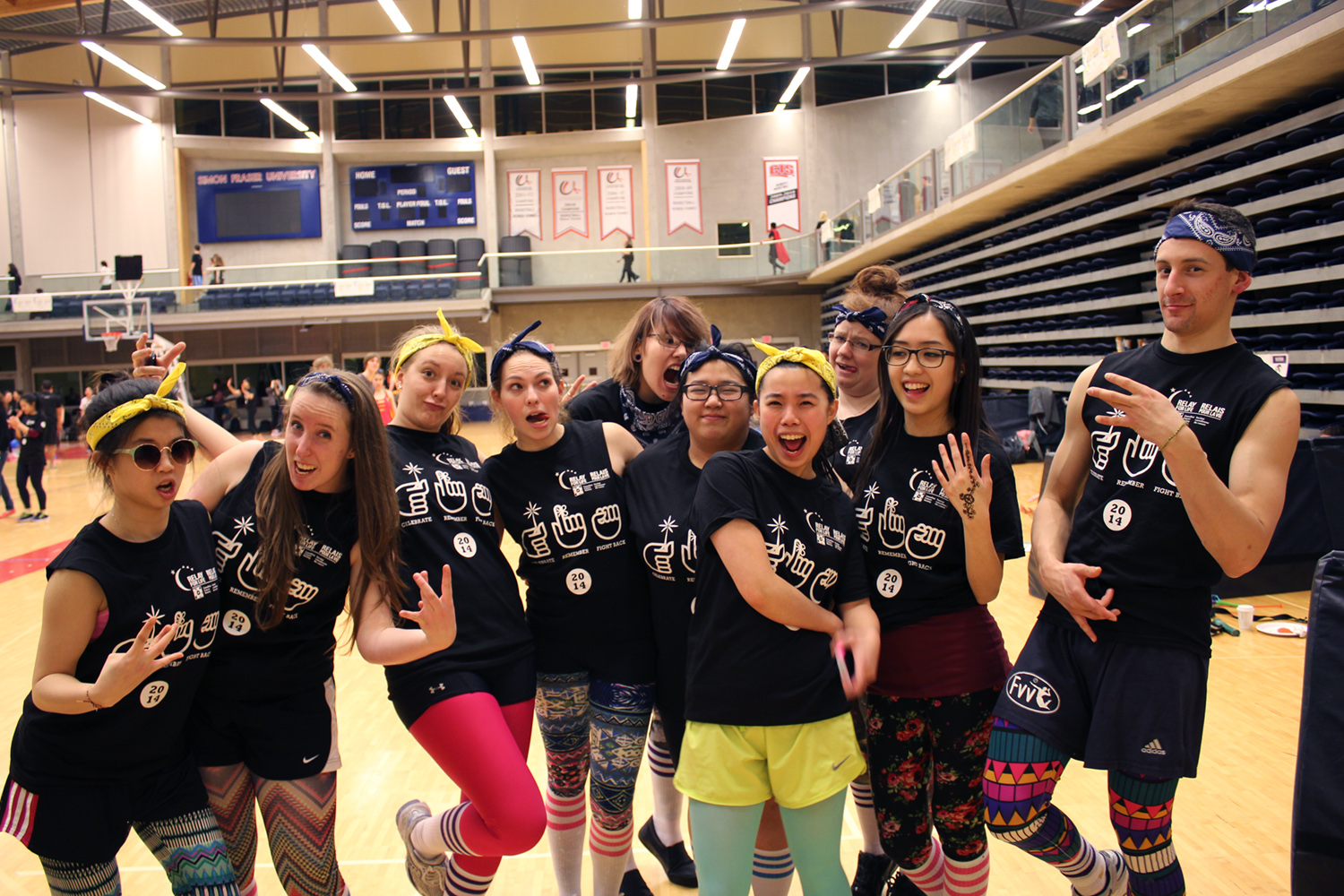
The West Gym hosted SFU’s sixth annual Relay for Life, lasting 12 consecutive hours, from 7:00p.m. to 7:00 a.m. on March 21 to 22. The charity event saw approximately 380 people, with 42 teams, as well as more than 30 volunteers.

Relay for Life (RFL) is an event organized entirely by students. According to Eve Mitchell, RFL youth coordinator, the fundraising target of $33,000 was exceeded before the night had even started, reaching $48,000 and counting. Proceeds will go to the Canadian Cancer Society (CCS) to fund research, prevention initiatives, and care services for people affected by cancer.

RFL aims to bring communities together in universities and high schools across Canada in a fun and festive way, while raising awareness around cancer prevention.

As team members took part in turn in the relay — walking or running laps for the duration of the event — a number of activities were scheduled throughout the night, partly to keep participants awake.

This year at SFU, as participant Norman Krismantara-Cheng told The Peak, “People were playing around, doing yoga, [listening to] two bands, trying to have fun.” Participants were also fed and able to decorate luminaries against cancer.


The fundraising target of $33,000 had been exceeded before it even started, reaching $48,000 and counting.


“The theme of the event changes every year, and actually I think this is the first year that SFU has done a theme, [superheroes against cancer],” said Mitchell. She continued, “I think it’s really nice because it’s that extra bit of fun; everyone loves dressing up so it gives them something to rally around.” She added that the costumes she saw were the best she had seen at a relay event, setting a high bar for next year.

At around midnight, participants joined for a solemn walk in the dark to remember cancer victims in what turned out to be a very emotional moment for some. However, there were also merrier moments, such as the survivors’ victory lap.

Ayla Kooner, co-chair of the organizing committee and a health sciences major, is one such survivor. Diagnosed at 12 with Ewing’s sarcoma, a bone cancer, she underwent a heavy year-long treatment involving both chemotherapy and radiation.

This year, she will celebrate her 10 years in remission. Kooner told The Peak, “The thing that people don’t understand about being a survivor is that you are forever living with the consequences of [your cancer]. [. . .] There are long-term side effects of chemotherapy we kind of all have to live through, and I will have to be going for check-ups for the rest of my life.”

The relay is SFU’s longest-running university event. “I think it started as a res event, so there was a really good awareness of getting people together, creating that community spirit, and also promoting health awareness,” Mitchell explained. The RFL involves teams of up to 15 people fundraising for the CCS, both individually and as a team.

One of the key programs funded is Camp Goodtimes at Loon Lake in Maple Ridge, where children and their families can go to forget about cancer treatments. It’s a place that, for Kooner, “puts your faith back into humanity.”

“One thing I would hope [participants] learned is that the fight against cancer is far from over,” Kooner concluded. “I hope that they take away how important life and time really are. [Anyone] could be diagnosed with a life-threatening disease like cancer tomorrow, so you better make the time you have count.”