Home Blog Page 112

Sitting in the dark because these motion sensor lights are pissing me off

0
Person wearing a red hoodie sitting in the dark in front of a tablet.
PHOTO: Christina Morillo / Pexels

By: C Icart, Humour Editor

This year marks the fourth time SFU ranks number one in so-called Canada for innovation, and if this is what innovation looks like, I don’t want it. God invented light switches for a reason. That reason is so I don’t have to start waving my arms like a Titanic survivor stranded at sea when I am suddenly plunged into complete darkness in the School of Communication Lab.

The lights aren’t broke; I am. So, stop taking my tuition to fund these motion-activated lights that don’t even detect my motion unless I do the Macarena three times, followed by the Cha Cha Slide. You’re not an Apple watch; you can’t get me to stand on command (yes, this joke only works if we suspend our disbelief for a second and pretend we actually stand up when our watches scream at us). 

Sorry, the grammar police entered the chat, so let me try that again. The lights aren’t broken; the doors to most bathroom stalls in the AQ are. Years of playing Twister still haven’t prepared me for the challenge of doing my business while holding the door. Also, I’m 5’2 and can barely reach. Stop investing in the lights and start investing in the locks.

You know what? I don’t even need light! Most of these Harbour Centre rooms don’t even have windows, and it’s OK. Humanity survived the “Dark Ages” before, and I will survive them again. I will sit in the dark like the monster hiding under your bed. 

ALSO (that’s right, I’m not done), real innovation would be SFU fixing the alarm in the Lab. You have to punch in a code to get inside, yet the alarm still goes off when you open the door. It doesn’t make any sense. I will not be treated like a trespasser in my own home. Once, it rang for so long, I became one with the shrill noise. I synced my heartbeat to it and everything. It was an experience. 

If this is all part of a social experiment to see how much students will tolerate before they transfer to another university, then challenge accepted. I keep getting those Loop earplug ads anyway, and I’ve been meaning to work on my night vision. Alternatively, SFU can get its rear in gear and fix this mess. Then, maybe next year, it will be included in the “list of universities people actually want to attend.” 

What Grinds Our Gears: Not wrapping gifts

0
A gift box wrapped in green paper with a twine bow tie.
PHOTO: Erica Marsland Huynh / Unsplash

By: Michelle Young, Copy Editor

Before you say anything — I’m not talking about wrapping gifts in cheap plastic that creates landfill waste, as I swore off buying this kind of wrapping paper years ago. However, I don’t think sustainability should be an excuse to never wrap anything ever. 

There are multiple ways to wrap gifts and decorate in an eco-friendly fashion: recyclable paper, dried flowers, reusable ribbons. You can even delve into the Japanese art of furoshiki and use fabric! Part of giving and receiving gifts is the joy of opening something and being surprised by what’s inside. I’m not a huge gift person, but in a way, the wrapping is part of the gift itself. It shows you put time and effort into wrapping your present (no matter how it turned out) just so the receiver can tear it open. 

When I receive a gift in a dusty shipping box which tells me exactly where this is coming from, it dampens the surprise of opening it. To solely give me a trinket without its wrapping removes the suspense factor. That’s not to say I’m ungrateful, but with no wrapping I don’t have the time to try and act curious and excited! It’s just straight disappointment.

Horoscopes July 1–7

0
An illustration of a girl, stars and astrological signs strewn in her hair.
ILLUSTRATION: Marissa Ouyang / The Peak

By: Michelle Young, Copy Editor

Aries
March 21–April 1
Isekai this, isekai that. Everything you own is isekai because you deeply relate to boring protagonists with no personality, and use manga for wish fulfilment. I promise if you were thrown into another world, you would die instantly and five beautiful women would not fall in love with you.

Taurus
April 20–May 20
Not to sound like every person who has ever seen your collection, but keeping all your manga  bagged does not entirely prevent yellowing. You are committed to making your shelves look like a store, and every time you pick up anything, it is loud and crinkly. Don’t worry; I support your decision to store your manga however you want! However, I do have a tip: try sleeves.

Gemini
May 21–June 20
You love that sweet, sweet shoujo (with a splash of josei). You are dedicated. You have the Tokyopop version and Collector’s edition of Fruits Basket, the full set of Nana, Kimi ni Todoke, and the bilingual and Japanese volumes of Chihayafuru. Friendship and romance are your favourite things to read about because they fulfill the unmet emotional needs in your reality. Also, you are sick of no one realizing Skip to Loafer is a seinen

Cancer
June 21–July 22
You are the devil, and Gemini’s worst enemy. You have a giant and basic collection of shounen that you accumulated in one month. You haven’t read any of it, and it is all the same as everyone else: Naruto, Attack on Titan, Spy x Family, and Chainsaw Man. You ask people to “give you recommendations” based on your collection, but you have no taste. You also have no idea what demographics are, and think they are genres instead (not all shoujo is romance, and you probably hate women!). 

Leo
July 23–August 22
Leo, bless your soul. You’re a newbie collector and everything confuses you. You don’t understand demographics either and you are overly paranoid about “fakes,” despite only purchasing from licensed distributors. No, your One Piece isn’t fake — it’s just poor quality control. 

Virgo
August 23–September 22
You are a dedicated yuri fan. You buy Japanese volumes before they are even licensed in English and will violently defend Bloom Into You and The Guy She Was Interested In Wasn’t a Guy at All to anyone who critiques them. This is probably because you cannot work up the courage to ask out a girl yourself! I admire how you proudly flaunt your love for Citrus (despite it being trash), but I highly recommend you read something by Milk Morinaga

Libra
September 23–October 22
You are a mess. You have been collecting for years, and still have no shelves. There are like 300 volumes in your office, and somehow you’ve managed to stack them all on top of each other. You are either oblivious to the fact that this could damage the spines, or you don’t care. Clearly, you haven’t read anything in years because who would when they are stored like that? 

Scorpio
October 23–November 21
Ah, Scorpio. Did you think I was going to compliment you for your “non-basic” taste? Wrong. You’re not much better than Cancer — seinen is your bread and butter. You are pretentious as hell and love almost anything by Inio Asano, but refuse to expand your taste outside of “philosophical” manga. Also, you most definitely have a figurine collection of Rei Ayanami.  

Sagittarius
November 22–December 21
Sagittarius, you are actually so cute. You have a very balanced and mixed manga collection, and your shelf is filled with miscellaneous plushies and figurines. I don’t know how you read anything with so many things blocking your manga, but I do know you could write an essay on queer representation in Sailor Moon — I see your HaruMichi shrine on the top shelf. 

Capricorn
December 22–January 19
You are god because you have the full English set of Mushishi. You also probably found it at a random, rural bookstore for a ridiculously low price. Now the whole manga community hates you because the rest of us will probably never run into a seller who doesn’t know the value of what they’re selling. 

Aquarius
January 20–February 18 
I thought Sagittarius was bad, but you are so much worse with your little anime girl figurines. They are blocking the view of your entire shelf, and I can’t see anything. I don’t even know how you dust them without knocking everything over. Most of your figure collection is just Homura Akemi. Call me when you need to sell everything because you are desperate for money. 

Pisces
February 19–March 20
You are still deeply and emotionally connected to the manga from your teen years. You have the full set of Haikyuu!! and reading it always makes you cry. You were also obsessed with Free! when it aired in 2013 (of course you were; it’s a swimming anime), and naturally collected the light novel it was based on. This also makes you cry. 

A tour of Rooted: Dining Commons’ inventive Indigenous food menu

0
A piece of toasty bannock topped with lettuce, black beans, corn, and spicy mayo. Closer to the camera is a mahogany-coloured chicken drumstick and a serving of pasta in a red sauce with ground bison.
PHOTO: Courtesy of Izzy Cheung / The Peak

By: Izzy Cheung, Arts & Culture Editor

For National Indigenous Peoples’ Day on June 21, SFU Dining Commons put the spotlight on Rooted. This menu, which is available in rotation all year long,  puts out delicious, Indigenous-inspired dishes created by Teetl’it Gwich’in chef Steph Baryluk. Following its debut last year, the program has continued to release mouthwatering renditions of pasta, tacos, and desserts, seven of which I had the pleasure of trying. 

Here’s a tour of these dishes rooted in Indigenous ingredients and inspiration.

Duck taco with charred corn salsa 

The dats’an (Teetl’it Gwich’in word for duck) tacos were the perfect mix of creamy, salty, and crisp. Small pieces of crusted duck with a salty umami flavour were placed on top of small beds of crunchy lettuce. A light layer of spicy mayo on top gave these little delicacies an added element of creaminess that completed the meal. 

Three sisters soup 

“The story of the three sisters (corn, squash, beans) is one of helping each other and protecting each other during growth,” chef Baryluk said in a statement. These three sisters refer to three plants that grow together when planted side by side. This dish, combining a medley of hearty vegetables, had a slight spice to the broth that would be perfect to indulge in during the snowy winter. 

Habanero candied salmon salad 

Salmon is important to Indigenous cultures as it is said to “give you positive energy and strength when consumed.” This candied salmon certainly fulfilled that promise, as it was by far the star of this dish. Sitting atop a bed of lively greens, the tuk (Teetl’it Gwich’in term for fish) was the perfect balance of salty and sweet. There was a tinge of spice to the sauce that hovered, not wanting to strike the taste buds right away. However, when it did hit, it wasn’t overpowering at all. 

“The fluffy bannock was the perfect base for the fresh, slightly spiced, and nutty taste profile delivered by this dish.”

Bison dhandaii nilii pasta and juniper berry rubbed chicken with blackberry BBQ sauce 

The Teetl’it Gwich’in phrase “dhandaii” is “tastes good” and “nilii” means “meat.” After having a bite of this dish, I definitely agree with its name. The bison meat gave the sauce a needed level of depth that reminded me of Italian bolognese with a slightly meatier flavour. On the same plate, I grabbed a piece of the tsiivii ch’ok (Teetl’it Gwich’in word for juniper berry) rubbed chicken, which had a surface-level sweetness to it that enhanced the flavour of the chicken itself.  

Bannock taco 

Tuhch’uh, which is the Teetl’it Gwich’in word for bannock, is a versatile staple that can take any taste profile that you’d like it to depending on what you top it with. A doughy, bread-like item, bannock is part of many Indigenous cuisines around Turtle Island. Rooted debuted their bannock taco on June 21 — it was stuffed with a light succotash and topped with hot sauce from Indigenous brand Sriracha Revolver. The fluffy bannock was the perfect base for the fresh, slightly spiced, and nutty taste profile delivered by this dish. 

Smoked juniper cherry jam cheesecake mousse 

This delicious dish was the perfect dessert to end off a spread of sumptuous goods. With a rich, panna cotta-like cream and tangy cherry jam from Tradish, this dessert was the perfect mix of sweet and slightly sour. Juniper berries have long been used “for ceremonial, medicinal, and culinary purposes” by Indigenous Peoples. While this tangy-yet-creamy dish tastes delicious, the ingredients used in this jam also help with “chest congestion, sore throat, cough, and mucus build up” — talk about a healthy dessert! 

Inside the UBC encampment for Palestine

0
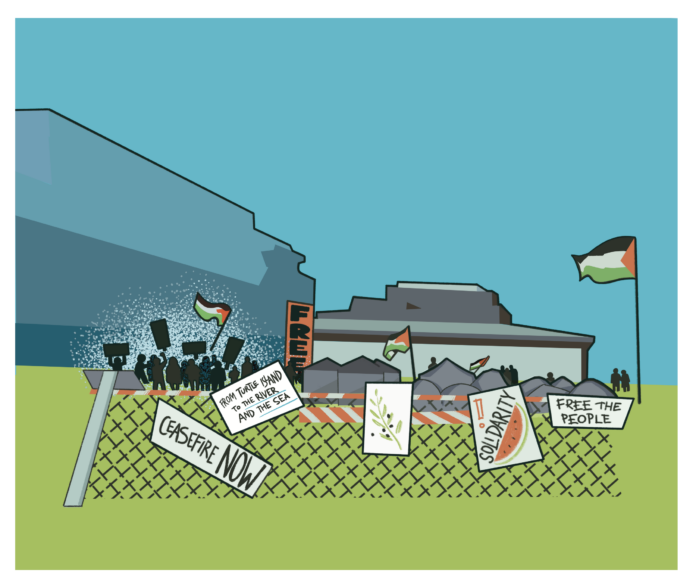
An Illustration of the encampment.
ILLUSTRATION: Aliya Nourlan / The Peak

By: Anonymous SFU Student

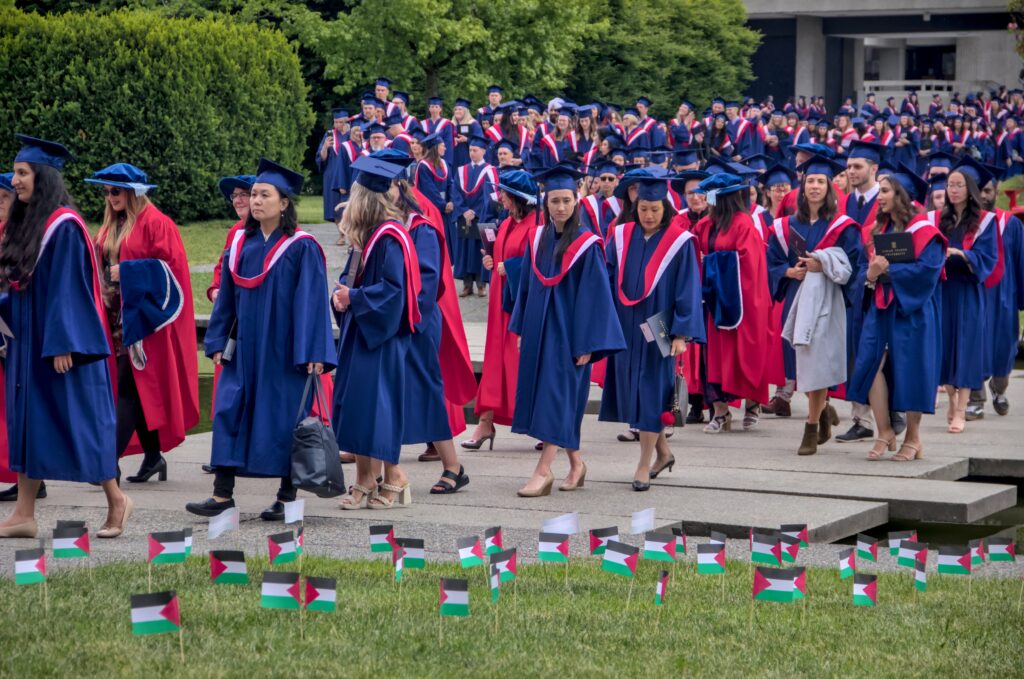
As of writing, 58 days have passed since the encampment at UBC began. Despite our united front, we still struggle to achieve our goals: demanding that UBC divests, academically sever ties with Israeli universities, and condemn the genocide in occupied Palestinian territories. Similar demands from SFU students have occurred recently. While SFU doesn’t have an encampment yet, students and faculty have intervened at convocations and occupied the downtown library to demand divestment. Both UBC and SFU need to understand the urgency of divesting from companies complicit in the Palestinian genocide, and listen to the voices of their students and community. I come into this space as a student, empathetic toward Palestinian people’s fight for their freedom, shaped by my South East Asian heritage and the legacy of colonization. Many of my comrades are united by similar experiences of oppression.

This isn’t the first time an effort for UBC to divest from problematic institutions has happened. Back in the early 2010s, the fossil fuel divestment protest was just starting. These protests lasted several years and were led by student groups like Climate Justice UBC (then called UBCC350) and faculty members, continuously pushing UBC to divest from fossil fuel companies. It wasn’t until 2019 when UBC finally committed to divest — it took them nearly a decade. Similarly, at SFU, it took years of work from student groups like SFU 350 for SFU to finally declare a climate emergency and later divest from fossil fuels. Unfortunately, the history of UBC’s slow action to enact student demands means the current encampment will likely take longer than the almost two months it has stood. However, continuous support for Palestine gives hope for the encampment to keep moving forward.

This made me think for quite some time, especially about why people continue to show up and hold down the camp after so many hardships. 

The UBC encampment for Palestine has been going strong since April 29. Working as a horizontal organizational structure, the encampment is a leaderless, non-hierarchical space where everyone is equal. We have groups in charge of different tents related to the daily operation of the camp, including food, safety, supply, medicine, art, and library. General meetings are held as frequently as possible and are the only platform to decide the goals of the encampment. It is a process of direct democracy where everyone’s voice is heard and considered, with final decisions being made based on majority votes. 

Everyone who shows up to this camp is intelligent, kind, and capable of doing great things, however, we are humans, and deep down, we all seek a sense of belonging. This whole encampment is like a community, and within it, each tent is part of the group. However, it did not always feel like a cohesive community. Before the camp reached this structure, it was run by multiple “invisible” hierarchies.

This encampment makes me hopeful about a future where people can afford to contribute in their own meaningful ways.

Initially, there were instances where outgoing white, cisgender, and conventionally-attractive men were automatically assumed to be smart, reliable, and worthy to make decisions, while non-conforming and marginalized individuals had to work harder to be acknowledged. I don’t think this was done purposely, but can be attributed to the mixture of pressure at the encampment and  the unconscious biases ingrained in colonial ideologies. The constant struggle to have all our voices heard caused tension in the supposedly democratic structure, as well as relationship mistrust in the camp. This was not what I and a lot of comrades expected from this space, where solidarity with Palestinians against colonization demands democratic practice and decentralized decision-making. 

As a young, gender-non-conforming person of color, my voice was often overshadowed in favour of white, cisgender campers. We took time to acknowledge and address these biases and hierarchical structures and we came up with alternative ways to ensure every voice was heard. I believe our camp is being managed in a more inclusive way, moving toward good causes, rather than replicating oppressive systems.

I acknowledge it’s hard to be trusting and welcoming when comrades don’t even know each other’s real names — we use camp names to protect our private identity. More so, we are under constant surveillance from UBC and the RCMP, but trust and hope are the elements that keep this encampment together. 

It doesn’t mean we stop practicing security culture. It’s vital to be self-aware and follow safety protocols, such as not engaging with cops and agitators, and having a dedicated media liaison. However, there is a saying at the camp: We keep us safe.” My way to build trust has been working at different tents, getting to know different comrades, and observing their behaviors. Over time, trust and relationships are formed. 

When I forgot to go to work one afternoon while I was at the encampment, I was so worried at first, but then relief came, because the encampment is a solidarity movement and addresses the basic needs our institutions are supposed to handle. This includes food, shelter, supplies, and medicines, all coming from community donations. 

We welcome visitors who are food insecure and/or unhoused. In exchange, campers offer their labor, time, commitment, and protection to the community. We have space for nurturing relationships, reading, doing art, hosting teach-in sessions on Palestinian resistance and cinema, playing music, and do not contribute to the capitalistic systems actively funding genocide and oppressing Palestinian people. 

I believe our camp is being managed in a more inclusive way, moving toward good causes, rather than replicating oppressive systems.

Ever since I joined the encampment, I’ve asked every new comrade I’ve met on shifts whether they’re a Zoë or a Zelda. The Zoë and Zelda theory, invented by the creator of my favourite show BoJack Horseman, is about two twin sisters with completely different personalities. Zoë is the serious, cautious, and sometimes cynical person who prefers quiet activities like reading and tends to avoid big crowds. On the other hand, Zelda embodies outgoing, optimistic, and energetic individuals who enjoy social activities and are full of life. 

Everyone gave interesting answers to this question. Some are optimistic, lifting the spirits of fellow protestors and smoothing out the high-stake environment we are all in, the Zeldas that reignite our hope. Others are more like Zoës: cautious, patient, and have keen critical thinking and conflict resolution skills. However, no matter how serious or cynical some people are, everyone in this encampment brings hope that we are fighting against oppressive systems, that we are fighting the good fight.

This encampment makes me hopeful about a future where people can afford to contribute in their own meaningful ways. There are those who are making sacrifices to stand for their beliefs, for what they consider righteous. Others come and contribute to the encampment just by showing up in solidarity with the protestors. I acknowledge that for me, being able to volunteer at the encampment is a privilege. Policing people for not being able to join the encampment is not fair, considering we come from different walks of life.

We are trying our best here, and I’m proud of all my beautiful comrades for what we’ve been fighting for. Our demands for UBC are clear: disclose, divest, and cut ties with Israeli universities that are complicit, as well as condemn this genocide. We demand UBC stop the RCMP’s intimidation and surveillance of their students. This should not end here, I hope in the future we can demand UBC fully fund tuition for Palestinian students.


The carbon tax is the least of our economic problems

0
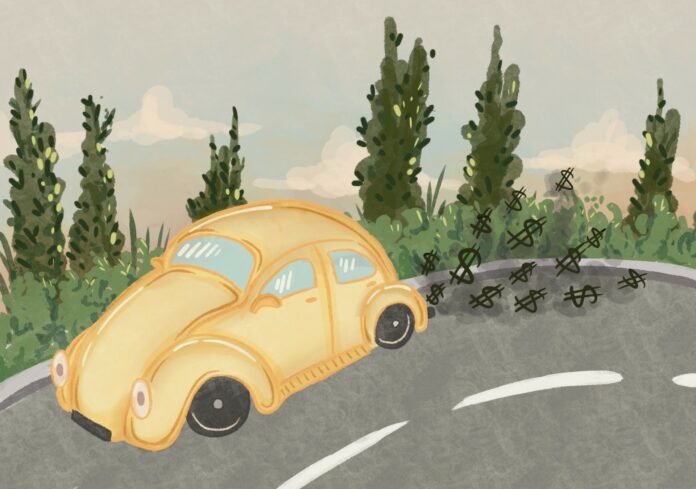
A yellow car driving down a winding road with dollar signs coming out the exhaust pipe.
ILLUSTRATION: Victoria Xi / The Peak

By: Kaja Antic, Staff Writer

As the effects of climate change grow increasingly dangerous each year, the Canadian government introduced a federal carbon tax in 2018 to decrease emissions, with BC being the first to introduce this policy in 2008. Discussions about the tax’s efficacy have increased as the next federal election draws near. However, the cost is minimal in comparison to the benefits of reducing our collective carbon footprint, especially considering that the largest emitters are transportation and fossil fuel corporations.

The carbon tax is a percentage added to purchases that emit greenhouse gases, like gas for your car or natural gas heating for your house. Canada’s current carbon tax is $80 per tonne of carbon emissions. It’s intended to increase by $15 yearly until 2030. The up-front cost of emitting excess carbon is meant to incentivize a gradual move toward clean energy for producers and consumers. 

The consequences of climate change can end up costing much more in the long run than a few cents per litre of gas. If there are little to no changes to emissions and climate policies, the effects could cost Canada up to $5.5 trillion by the end of the 21st century. The carbon tax produces significant results. In a study of countries that have adopted the carbon tax, they found it decreased emissions by 15%.

Current debates about the carbon tax have gone beyond disagreement with the cost itself. The Conservative Party of Canada claims carbon tax regulations are greatly impacting the national cost of living — including rising grocery prices. While gas prices are rising along with the general cost of living across the country, the carbon tax itself is not the cause of economic strife. It may be an inconvenience for the average person, but reducing emissions will ultimately benefit everyone. 

The consequences of climate change can end up costing much more in the long run than a few cents per litre of gas.

The same cannot be said for the extreme price-gouging seen in the housing market, grocery costs, and telecommunications monopolies. Eliminating the carbon tax won’t address the country’s widespread affordability crisis — campaigns revolving around this rhetoric are a distraction. The fixation on the carbon tax neglects policies that could benefit Canadians more, rather than just corporate interests. 

Currently, I drive a car with a 40 litre gas tank. If I fill that up from empty, I pay around $7 in carbon tax from that one stop. I know my experience isn’t the same as everyone else in Canada. Ford F-150 models in the 2020s vary from 23 gallon (87 litre) gas tanks to 36 gallon (136 litre) tanks, depending on the specifications chosen. On the lower end, that’s $15.32 per fill-up from empty in BC. On the higher end, it’s $23.95 per fill-up from empty. While that number isn’t negligible, gas prices are surging due to corporate price-gouging and supply chain issues, not the carbon tax alone. Canada’s affordability crisis is really what we should be paying attention to, and addressing it would make the carbon tax feel much more manageable. 

The carbon tax also impacts major emitters more than the average consumer, as individuals and small businesses benefit from tax credits. In BC, the provincial government has its own automatic climate action tax credit to help residents offset the carbon tax cost, with a similar rebate available to small business owners. According to the Government of Canada, around 90% of carbon tax proceeds “go right back to individuals.” The tax has more implications for corporate entities, and rightfully so — those leading in emissions rates should be expected to lead the transition to clean energy. 

While the carbon tax is a good step toward sustainability, that’s not to say there isn’t still work to be done to limit emissions across the country. The federal government has recently announced an emissions cap for the oil and gas industry, limiting how much pollutants corporations are allowed to produce. This is another step toward holding major emitters accountable.

It’s understandable to view another tax as a bad thing, though it truly is in our best interests. While it’s important to address the rising cost of living in this country, the carbon tax is not a major culprit. Protecting the climate and reducing emissions can also help prevent further hardships for those living in Canada. Compared to major contributors to the current cost of living, the carbon tax is not a heavy burden on our wallets. Concerns about it are nothing more than a distraction from taking genuine action against the affordability crisis.

SFU Woodward’s Cultural Programs ends amid budget cuts

0
This is a photo of the outside of the Woodward’s Cultural Programming building downtown Vancouver.
PHOTO: Aria Amirmoini / The Peak

By: Hannah Fraser, News Writer

SFU’s recent ongoing layoffs have impacted “nearly 100 employees, including instructors, administrative support staff, and custodial workers across all three campuses,” according to the Simon Fraser Student Society (SFSS). Following the layoffs, the Woodward’s Cultural Programs were cut after 15 years of running. The program’s website was taken down on June 19.

Since 2010, the programs have been “involved with over 200 events each year, focusing on contemporary arts, dance, theatre, cinema, and music.” They were once described as “a catalyst for the creation of new work,” where the Woodwards team would commission and facilitate the creation of local workshops, conversations, presentations, screenings, concerts, shows, and more. The program also worked to connect SFU students from the School of Contemporary Arts to local creatives and artists.  

“The opening of the venues and facilities at the SFU downtown campus, specifically the Fei and Milton Wong Experimental Theatre and The Djavad Mowafaghian Cinema and World Art Centre, offered such great engagement opportunities,” said Jim Smith, in an interview with The Peak. Smith is a co-founder and artistic and executive director for DanceHouse, who used the Woodward’s locations to co-present shows. 

“The university had positioned these venues to bring the School of Contemporary Arts down off Burnaby Mountain to allow for the integration of the program into the local professional arts scene, literally and figuratively,” continued Smith. He noted these venues added important venue capacity in Vancouver, especially as the city’s venue space has been steadily shrinking

Smith told Stir that he found the end of Woodward’s programming “infuriating” and that “it’s hard to see it washed away in a single stroke.” 

“It’s really unfortunate, when you think about the work and investment of Michael [Boucher]’s personal effort, and all the people and resources that SFU put into building the community presence in that campus,” he continued. Boucher was the director of Cultural Programs and Partnerships at SFU Woodward’s. 

Boucher told The Georgia Straight he was proud of the cultural engagement that came from the program. “We thank all of our longstanding collaborators who contributed enormously and also hats off to my great team.”

“SFU has a responsibility to its community not only as an educational institution but also as a cultural and economic center in BC.” — Simon Fraser Student Society

Closing Woodward’s Cultural Programs was not the only community space SFU closed this year. The English Language Culture Program, Interpretation & Translation Program, and the Climbing Wall were also closed. 

SFU cited financial hardships for its recent cutbacks, “estimating an annual deficit totalling $20.9 million for the 2023–24 fiscal year, with that number rising to an estimated $49.9 million during the 2024–25 fiscal year.” 

The SFSS stated employee “layoffs are not just numbers on a balance sheet; they represent a significant erosion of the support structures that enhance our learning environment.

SFU has a responsibility to its community not only as an educational institution but also as a cultural and economic center in BC.” However, the statement continued, “Cutting positions and programs [ . . . ] significantly diminishes SFU’s ability to fulfill this role.”

SFU noted in a statement to The Peak, “Many SFU departments, programs, and individuals have strong collaborations with the arts and culture sector.” While the program has ended, the “performance spaces remain available for use by arts organizations.” 

SFU also noted the discontinuation of funding for the program “enables us to refocus and strengthen support with arts organizations in the city through use of our venues and continued partnership with other parts of the organization, such as the Vancity Office of Community Engagement, School for Contemporary Arts, SFU Galleries, or individual faculty members and scholars.”

This is an ongoing story The Peak will continue to cover.

Protests against SFU’s continued investment in Israel arise at summer convocation

0
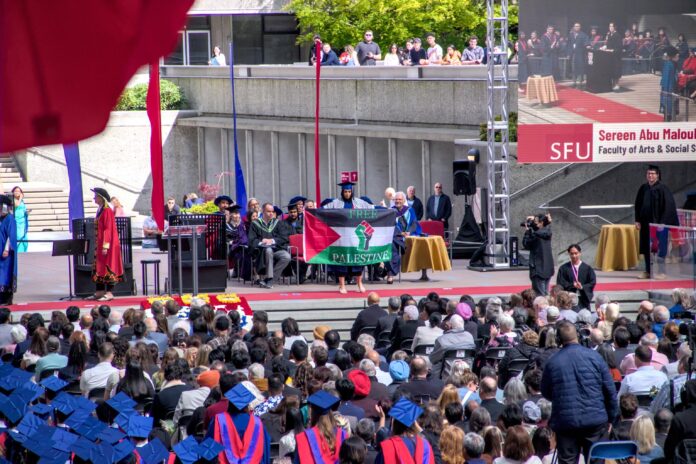
This is a photo of the convocation stage at SFU. As a student crosses the stage, they are holding a large Palestinian flag that reads, “Free Palestine.”
PHOTO: SFU Students For Justice in Palestine

By: Hannah Fraser, News Writer

Content warning: mentions of genocide.

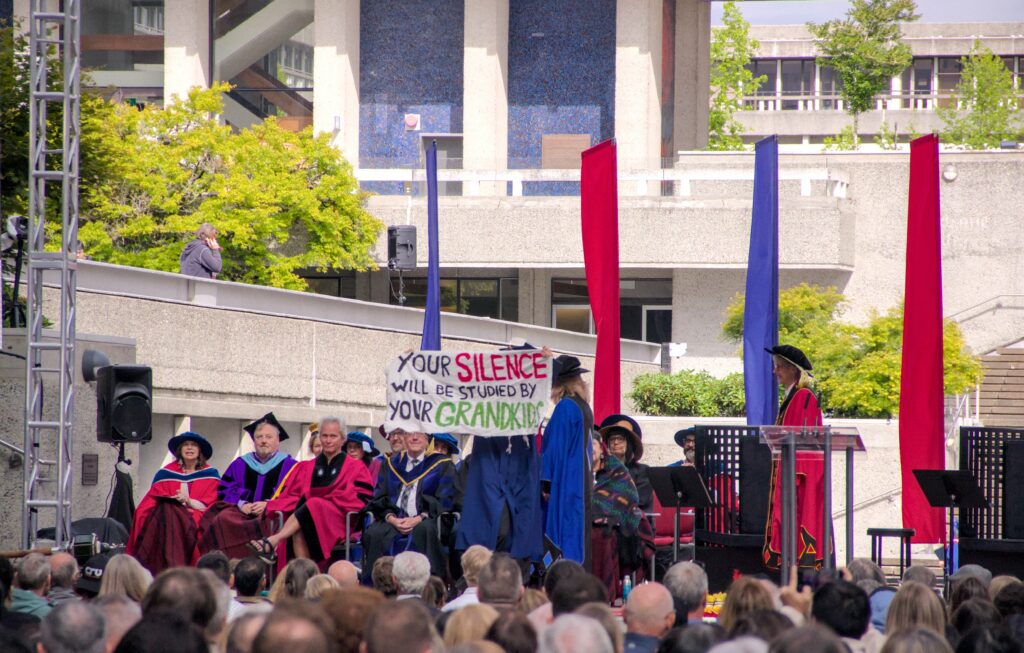
During the week of summer convocation at SFU, some graduates wore Palestinian keffiyehs, held up signs and Palestine flags while crossing the stage, and refused to shake hands with president Joy Johnson. The convocation took place June 11–14. At the morning celebration on June 11, SFU students dropped a banner from a window of the AQ during president Johnson’s speech and held banners on the steps of Convocation Mall in live camera view. On June 12, another banner was dropped from the balconies overlooking Convocation Mall. All of these acts protested SFU’s continued investment in companies that fund Israel’s genocide against Palestinians

These protests came two weeks after SFU’s Board of Governors agreed to start discussing divestment from these companies, and a week after the Faculty Association of SFU passed two BDS motions urging SFU to divest. The BDS movement — Boycott, Divestment, Sanctions — began in 2005 as “a Palestinian-led movement for freedom, justice and equality,” according to the BDS website.

This is the first time SFU has officially acknowledged students’ and faculty’s calls to divest.

The companies SFU invests in include BAE systems, Booz Allen Hamilton, and CAE Inc., which “have collectively facilitated the killing, maiming, or displacement of millions of individuals,” according to a statement from SFU Faculty for Palestine. These companies equate to $7.2 million “of the joint endowment and non-endowment invested funds of $1.13 billion as of March 31, 2024.”

The Peak interviewed SFU Students For Justice in Palestine (SJP). SFU SJP is a student group in support of Palestinian liberation and freedom, who say SFU’s “agreement to discuss divestment is not an action to divest.

PHOTO: SFU Students For Justice in Palestine

These actions were in solidarity with the students, faculty, staff, and university administration in Gaza who were not able to have a 2024 convocation ceremony as all universities in Gaza have been bombed and destroyed by Israel,” said SJP. A May 29 open letter by Palestinian academics called upon “friends and colleagues around the world to resist the ongoing campaign of scholasticide in occupied Palestine.” The United Nations classifies scholasticide as “systemic obliteration of education through the arrest, detention or killing of teachers, students and staff, and the destruction of educational infrastructure.”

“We, students, refuse to be used as talking points and to receive praise for our advocacy work when the university puts us in positions of marginalization and stifles movements on campus through various tactics including stalling, fear, and manipulation.” — SFU Students for justice in palestine

The Peak also interviewed Clint Burnham, a member of the SFU Faculty for Palestine and English literature professor. The SFU Faculty for Palestine is part of a broader, “Canada-wide solidarity network of academics committed to advancing the struggle for Palestinian liberation, justice, and equality through the academic sector.” Burnham said he was at convocation on June 11 and 13, and that he and three other faculty from the English department were wearing keffiyehs in support of Palestine. 

On June 12, the banner dropped by students during Joy Johnson’s speech read “SFU Students for Palestine / Divest / Free Gaza.” Johnson’s speech praised students’ “incredible advocacy work,” though SJP deemed her speech “hypocritical.”

PHOTO: SFU Students For Justice in Palestine

“SFU has still not met the demands of students and workers to divest from genocide, agree to a first contract for research assistants, and directly in-house our cleaning and food service staff,” said SJP. “We, students, refuse to be used as talking points and to receive praise for our advocacy work when the university puts us in positions of marginalization and stifles movements on campus through various tactics including stalling, fear, and manipulation.”

In a statement to The Peak, SFU stated, “SFU respects the right to peaceful protest, and in consideration of protest action at convocation ceremonies across Canada and the US, the university ensured that safety for all was considered in convocation preparations.” 

SJP claimed there was an “unprecedented amount of security during ceremonies” including “a room in the library for people who felt ‘uncomfortable’” and “bag checks.” SJP also said, “The university widely circulated a document outlining [a] de-escalation strategy in the event of protests at convocation that singled out pro-Palestinian actions.” 

PHOTO: SFU Students For Justice in Palestine

To this, SFU stated there was a “welcoming centre for guests to enjoy quiet time and light refreshments” at convocation and they “introduced a bag check and bag concierge service,” but that “there was no significant increase in security presence compared to previous years.” Professor Burnham said he did not notice a large increase in security at convocation.    

For more information on SFU SJP’s campaign, visit their Instagram @sfu.sjp. For more information on SFU Faculty for Palestine, visit their website at sfufacultyforpalestine.ca/

Indigenous voices must be prioritized when fighting climate change

0
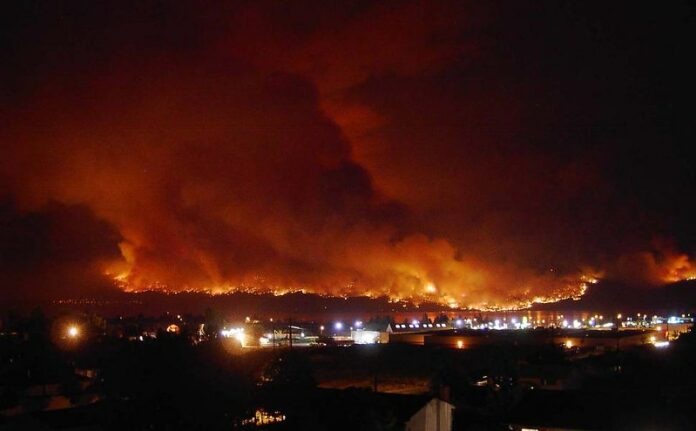
A large orange fire covering the sky above a town.
PHOTO: Province of British Columbia / Flickr

By: Hailey Miller, Staff Writer

The effects of climate change disproportionately harm Indigenous communities, yet their voices are often overlooked. Many Indigenous communities, especially those outside large cities, rely on natural resources for livelihood and sustenance, and are at a higher risk of health problems due to exposure to wildfire smoke. They’re also being displaced from their homes at significant rates due to wildfire evacuations. Climate action should prioritize the voices of those most affected by climate change, and Indigenous Peoples have been protecting the environment for thousands of years.

BC’s worsening wildfire conditions have resulted in an increase in drought and disruption to ecosystems. This includes harmful pollutants and toxic gases from wildfire smoke, alongside extreme weather conditions and a lack of fresh water supply. BC’s wildfire season has begun exceptionally early this year, following last year’s record-breaking season. Many communities have been affected by the wildfires, including Skeetchestn, near Kamloops. Here, the wildfires have threatened the salmon habitat, as well as food and medicine supplies

Many Indigenous communities rely on fishing, hunting, and plant harvesting as a means of food supply and ceremony. For instance, on Truth and Reconciliation Day last year, Líl̓wat Nation and N’Quatqua First Nation closed down Pipi7iyekw (Joffre Lakes Park) for a harvest celebration. Some Indigenous Peoples also use plants for traditional medicinal purposes, and land for ceremonial and burial purposes. Climate change threatens the availability of these natural resources, and by extension the ecological security of Indigenous Lands and Indigenous communities. While climate action has gained traction in recent years, Indigenous Peoples have been caretaking for the natural environment for millenia.

Community-led action involves staying connected to and taking care of both the environment and communities. Some ways Indigenous Peoples are doing this are by using renewable energy, curating climate conversations across generations and communities, and using Indigenous traditions and languages. Montana First Nation’s Green Arrow Corp, which was founded in 2012, is the first Indigenous-owned solar energy company in western Canada, which is operated by their community members. Similarly, Indigenous Climate Action curates programs across the country that raise awareness about the climate crisis and emphasize how Indigenous rights are essential to climate justice.  

The climate crisis is also disrupting communities. Extreme weather events result in community displacement and reduced access to food and supplies, which threatens cultures and traditions. Alongside physical and often irreversible damage to lands and species, human health risks are a significant threat to communities. Climate-related conditions such as chronic respiratory diseases, cardiovascular disease, and cancer are just a few results of the climate crisis. 

Indigenous Peoples are disproportionately impacted by the climate crisis, yet the Canadian government often leaves them out of climate talks and resolutions. To successfully combat the risks of climate change, we must work with Indigenous communities and leaders to respect their Lands, and allow Indigenous Peoples full liberty to initiate collective care of the environment. Prioritizing Indigenous rights will shift our efforts beyond climate awareness to equity and collaboration.

Wannabe influencer goes to the retirement home to tell her grandparents she’s replacing them with Marcus Pork and Grandma Droniak

0
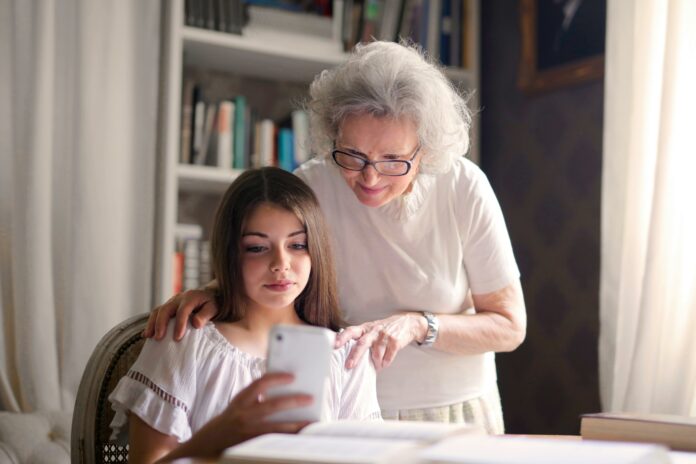
Young girl showing something on her phone to her grandmother who is standing behind her.
PHOTO: Andrea Piacquadio / Pexels

By: C Icart, Humour Editor

It’s a sunny Thursday afternoon, and Stacy is heading to the retirement home to visit her grandparents. She originally planned on going on Tuesday, but it was raining on Tuesday and filming a vlog in the rain is not a practice Stacy is interested in engaging in. That’s right, Stacy is an influencer. Or at least she wants to be. So the camera is always rolling, waiting to catch a viral moment. Stacy walks into the building. 

Stacy: Oh my gosh, there are so many old people here! Oop, one just looked at me. Did I say something offensive? This is actually so good for me. Such a great reminder to wear SPF. Remember everyone, aging is a choice and so is Botox. OK, we are finally here. Let’s knock.

Grandmother: Stacy? Is that you? Why are you filming me?

Grandfather: What are you talking about Murielle, Stacy never comes here — Oh Stacy! 

Stacy: Hi grandma and grandpa! Say hi to my followers! Oh wait, maybe move your chair over there grandma, the lighting is better. 

Grandmother: Oh my goodness, what a surprise! We’re so happy to see you. 

Stacy: Yes, I needed to come here to tell y’all some super exciting news! 

Grandfather: Murielle, we’re about to be great-grandparents! 

Stacy: No, grandpa. You know how I’m so obsessed with fashion? I thought my family should reflect that as well. So, I’ve decided to replace y’all with Marcus Pork and Grandma Droniak

Grandfather: Murielle, did you understand what she just said? Why is she talking about pork? I thought the dinner tonight was going to be shepherd’s pie.

Grandmother: Stacy, please put the camera down. You can’t replace us. We’re family. 

Stacy: No, no this is really good content! And it’s already set up! I reached out to them and I’m sure they’ll agree to collab! Marcus will make a unique fashion design for us and Grandma Droniak and I will feature it on our respective channels as OOTDs

Grandfather: Murielle, why did Stacy come here to speak to us in gibberish? 

Grandmother: Stacy, who are these people? 

Stacy: Famous grandparents that will help turn me into the next viral fashionable grandchild! Plus it’s not like I’ll stop visiting y’all, just that I won’t claim y’all as my grandparents online. 

Grandfather: Murielle, how can she stop visiting us when she never started? 

Stacy: Grandpa! You know it’s difficult for me. This place is so out of the way and so inconvenient for me to go to because there are no cute coffee shops on the way. But that didn’t deter me from making the 20-minute drive to the retirement home today. I only got lost twice, which isn’t bad when you consider the fact that I’ve never been here. 

Stacy starts pushing the chair her grandmother is sitting in. 

Grandmother: Ow! What is happening?! 

Stacy: I told you the light is better over there and we’re probably going to need to refilm because I need you to be more excited about my chosen family. I brought some shirts for you to wear as well. 

Stacy hands them the shirts and her grandparents read them out loud. 

Grandfather: Climate change is cringe?

Grandmother: Free bleed Friday? But I don’t. . .

Stacy: And mine says, “I slay while my haters lay.” It’s this iconic thing Grandma Droniak says because she keeps outliving her haters. 

Grandmother: Hun, we’re not wearing these shirts. 

Stacy: But Marcus Pork and Grandma Droniak would wear them!

Grandfather: I don’t even eat pork! 

Grandmother: Stacy we’re going to be late for Bingo night and I’m sure Bertha is already waiting for us. 

Stacy: Bertha? Bertha?! You can’t be friends with Bertha! She’s NOT invited to Grandma Droniak’s funeral! You have to realize how bad the optics are when it comes to us being seen with her! 

Grandfather: mumbles under his breath. Who said you were invited?

Grandmother: Joe! 

Stacy: Oh my god, y’all aren’t doing anything viralllll! I won’t be able to use any of this footage and . . . FUCK! Marcus is out, he said he can’t be my grandfather because apparently he’s 34? Dang . . . he needs a better skincare routine. I guess it’s back to the drawing board. I will be famous before I die, I’ll make sure of it.

Stacy leaves the retirement home without saying goodbye. Her grandparents are not complaining. Bertha skipped Bingo night to scheme about how to steal Grandma Droniak’s boyfriend. 

Fin