Home Blog Page 1098

“Fuck Safe Space” shirts encourage constructive debate

0

As a frat chapter out of Carleton University marched down Ottawa’s streets with saffron slogans on their shirts stating “Fuck Safe Space,” all it took was one snapshot ricocheting around the social media stratosphere for student frosh leaders to start pleading ignorance in its wake.

By the way the media circus paraded through the digital domain, you would’ve thought the local Hells Angels clubhouse had rounded up the soccer moms for a romp. The big fear was that the clothing would promote sexual harassment and homophobia. Taking in all the incensed media coverage of the perpetrators’ ‘on-campus brouhaha,’ it seems to have had the opposite effect.

Thankfully, today’s political climate can’t stand anything so blatantly bigoted, and incidents such as these only strengthen and entrench politically correct notions.

A reign of political correctness dominates the social landscape. People are quick to censor both themselves and others, out of fear of offending any ethnic, gender, theological, or ideological group with a voice in the wider public.

These notions can be applied to Jeremy Clarkson, leading presenter of the British car show Top Gear. A leaked video of him allegedly slipping the ‘N-word’ into a recital of Eeny, Meeny, Miny, Moe led to the TV persona’s public persecution. Speculation then circulated around his prophesied lay-off by the BBC.

“I was mortified by this [. . .] it is a word I loathe, and I did everything in my power to make sure that that version did not appear in the [transmitted] program,” said Clarkson, in an apologetic statement.

This is the sensitized climate of today. As the world circle expands, there is suddenly more open space to join new hands; minorities rush from the sidelines and the benches toward an accepting society.

On a national level, the LGBTQ community has been openly accepted by the upstanding members of society. The critical reception that Macklemore’s single “Same Love” received during Youtube’s Pride week demonstrates this encouragement. Young adult fiction has seen an increase in novels with a gay cast of characters; the bandwagon rocks with the next artist trying to reach out to the LGBTQ community. Gay is not just okay; it is hip too.

Rape culture is a harder pulse to put a finger on, with frat boy culture hanging like a fog of ether above university campuses. This issue is not funny, even when guffaws and chortles follow high-fives after a chauvinistic remark. Date rape drugs and boozy gangbangs are the nightmares haunting female students when dating or attending a party. None can deny the whiplash that occurs when a woman cries “rape!” Jock-shaming action is undertaken, and can be very bloody indeed.

This does not rule out the existence of these doomed bigoted clowns altogether. But they are a closeted minority, largely a moronic Beavis and Butthead goon squad, or an underground network of eunuchs from the old socially correct regime, still humping their misogynist, racist shrines.

This shirt incident, heightens awareness of politically correct notions — the Breakfast Club world where everyone can be accepted. Student campaigns and media sensationalism contribute to a firmer stand against future heretics in the ranks.

Already, the witch hunt has started against the frosh leaders, the torch-bearers. The institutional bloodhounds are out and they do not fuck around when it comes to family values. 
Task force explores flexible education at SFU

0
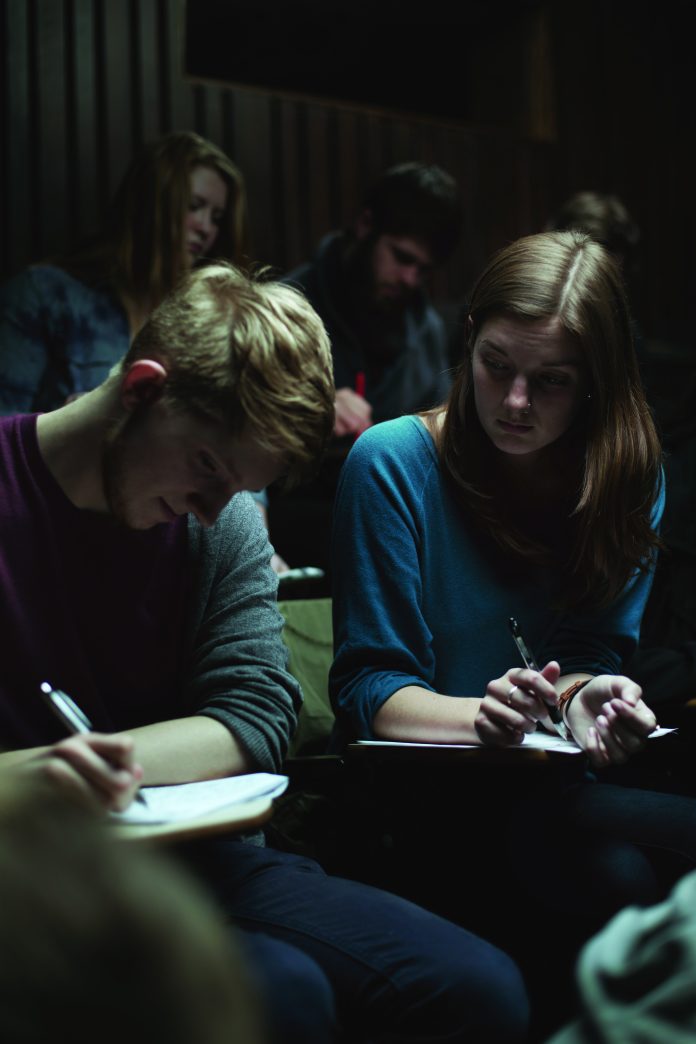
One idea of flexible education could mean moving away from a traditional lecture hall setting.

SFU’s Task Force on Flexible Education (TFFE) is looking for ways to create more education options for instructors and students.

Made up of various administrators, faculty, and both undergraduate and graduate student representatives, the task force was formed last April following a survey of SFU’s current online education resources.

During an initial consultation process, the TFFE attempted to define flexible education at SFU, opening up the conversation to the SFU community. The group completed an interim report in August summarizing the process.

According to the report, the task force discerned that the SFU community saw flexible education as offering more choices to accommodate increasingly diverse educational needs and objectives. The next step for the group was to divide into working groups — each of which is developing suggestions for a final report to be recommended to the university.

Some of the flexible education strategies being considered involve course restructuring, which could potentially mean course length adjustment, and more distance education options.

TFFE communication lead Mark Bachmann explained, “There are a lot of ways you can enable student and instructor choice, [. . .] offering an online version of a course [for] someone who can’t get to campus [for instance].”

He continued, “It can also mean perhaps offering courses that don’t last 13 weeks [. . .] so that people who are working and can’t fit into that schedule can take a course. It can be an accessibility for a student with a disability.”

Bachmann also mentioned alternative instruction styles that move away from the traditional lecture setting. One such style is the ‘flipped classroom,’ wherein students learn the material at home — perhaps through an instructional video — and class time is geared toward more interaction between students and instructors.

Bachmann suggested that, in a time when most information is available online, “that sort of interaction is going to become more and more valuable in the future.

“What a university can offer is that sort of unique space where instructors, and experts, and students can get together and talk about things, ask and answer questions, and work on common projects and goals,” he continued.

Another way to increase flexibility would be to reconsider the physical classroom space. “Maybe instead of having a traditional lecture hall where the instructor has no choice but to stand at the front and the students have no choice but to sit in the seats, we could offer spaces with flexible furniture, different levels, different configurations, so that different kinds of learning can take place,” said Bachmann.

In preparing recommendations for the final report, working groups will seek feedback through various means, including a student advisory group, a student survey sent out this fall, and presentations to the community.

The group will finish its work in June of 2015, when it will submit its final report to the VP academic and the SFU senate.

“How the ideas become reality, that depends [. . .] on what those recommendations are. Some of them will probably be the type of recommendation that can be enacted very quickly and others will be [longer]-term,” explained Bachmann.

He acknowledged that bringing some of the ideas to life will most likely require funding, but said that in some cases, “they might just need resources to be reallocated or they might just need a shift of emphasis.”

NHL teams should wear ads on their jerseys

1
Soccer led the way in jersey sponsorship.

Recently, the NHL rejected the proposed sale of advertising on jerseys, which the league estimated could net $120 million and approximately $4 million per team. The NHL declined the proposal because they didn’t want to be the first of the North American big four leagues (NFL, NBA, NHL, MLB) to feature sponsors on their jerseys. The league is also notorious for sticking with traditions — they do not want to trailblaze.

Public opinion doesn’t help the advertising cause either; no one wants to see ads plastered all over jerseys. Most people take comfort in the fact that sponsors on jerseys are limited to mainly European sports, such as soccer and cycling. Fans cringe at the idea of seeing a hideous Rogers logo on their beloved Canucks jerseys.

The truth is, the big four all already benefit from advertising revenue, so it’s not a question of purity. Take the NFL for instance, they have so many timeouts and breaks, advertisers are able to cram over a 100 commercials into three hours.

Baseball, with its breaks in between innings, has room for tons of commercials. In most instances, when there is a timeout in a basketball game they cut straight to commercial. Heck, even the NHL has TV timeouts to cater to the advertisers, and now even has digital advertisements added to the glass for the viewing audiences at home.

The thing is, ads on jerseys would provide the NHL with so much more money. The league already sells advertising, but due to some strange principle, they are denying themselves over $100 million, which is a hefty profit for the owners. These revenues could be used to help some of the struggling teams in the south such as the Arizona (formerly the Phoenix) Coyotes and the Florida Panthers.

Let’s take a look at one of the biggest current beneficiaries of advertising: Manchester United. They are about to enter a new 10-year, one billion dollar deal with Nike to make their jerseys. That is in combination with the over $70 million they will get per year from Chevrolet who sponsors their shirt — over $170 million in guaranteed revenue every year. That’s more than most teams anywhere in any sport make in a year. This is an extreme example, but it goes to show you how teams can take advantage of their brand to make a little — or a lot of — extra cash.

Passing up a new revenue stream because it will upset a few people makes no sense. If someone came up to me and said they would pay me $10,000 a week to wear an ad for their company to work, I’d take the deal in a heartbeat. Can you imagine how much revenue a team like the New York Yankees or Dallas Cowboys could potentially receive for a jersey sponsor? They would just be stupid to pass it up.

Advertising on jerseys in North American sports is inevitable; it’s just a question of when. With teams in the NHL like the Tampa Bay Lightning, who are losing $5.4 million per year according to Forbes, it’s a no-brainer, and the NHL might as well be first.

Fans might complain, but really, look at soccer teams — they still manage to sell tons of jerseys, even with those ugly ads plastered all over them. Right or wrong, at the end of the day, the money is all that matters.

FNSA hosts inaugural Indigenous Day at SFU

0
Convocation Mall was transformed for the day into a hub of cultural activities and performances.

The first ever SFU Indigenous Day was held on Thursday, September 25 in Convocation Mall at Burnaby campus.

The day of events was put on by the First Nations Student Association (FNSA), an organization dedicated to representing the interests of all self-identified Aboriginal, First Nations, Inuit, and Metis, along with both status and non-status SFU students.

Laura Forsythe, FNSA treasurer, explained, “This is [the FNSA’s] first attempt to create an event around educating versus showcasing. All of the elements have a large educational component to them. We hope to communicate Indigenous diversity here on Turtle Island [in North America] through a combination of sound, sight, and taste.”

Students walking by Convocation Mall were drawn into the vibrant event, which featured several performers on the convocation stage, informational booths about SFU’s Indigenous programs and initiatives, as well as a myriad of Indigenous artists who showcased and sold their handcrafted wares.

Those in attendance were entertained with lively music and dance as well as Indigenous artists’ work, which ranged from fine jewelry to moccasins and dream catchers.

Sharing circles, hosted by Indigenous elders, were one of the most unique opportunities at the event, meant to foster engaging and powerful community dialogue.

Several booths were set up to inform and educate SFU students about Indigenous culture as well as to shed some light on the ongoing projects in SFU’s Indigenous community. One such initiative is Intellectual Property Issues in Cultural Heritage (iPinCH), an international research initiative that, according to their mandate, “explores the rights, values, and responsibilities of material culture, cultural knowledge, and the practice of heritage research.”

Based out of the anthropology program at SFU, iPinCH tackles issues such as cultural appropriation, commodification, and how the flows of knowledge about history can affect communities today.

Those who work at the SFU Indigenous Centre, which opened in its brand new location on the second floor of the AQ earlier this month, were also present to inform people about their services as a study lounge and a source of support for self-identified Indigenous students. Their workshops and tutoring services will now be offered at their brand new location on the second floor of the AQ.

Mike Vegh, an FNSA board member and member of the Heiltsuk Nation, spoke to the day’s success: “The benefits for SFU students are tremendous, but overall they get to experience First Nations culture and combat colonialism in a way that is very exciting and interactive.”

He continued, “Promoting Indigenous culture is key in order to revitalize the Indigenous people in Canada, who in the past — and still today — have suffered tremendously from colonialism. With events like this, it shows that Indigenous culture and people have the strength and determination to be a voice that still wants to be heard.”

Don’t spank your children

1

Were you spanked as a child? In hindsight, do you feel resentment or even humiliation at being treated this way? The answer is likely yes. For these reasons, I am against spanking children. Spanking one’s children should not be used as a disciplinary method, as it is ineffective and can damage familial relationships.

Having grown up in Hong Kong, I was never spanked by my parents, though I’ve witnessed my uncle use force on my cousins when they would misbehave. The act of spanking has become a Western cultural norm, and this is why many caregivers see it as an appropriate parenting style, when in fact it is the opposite.

You may be surprised to hear of a Canadian ‘spanking law’ which allows parents and teachers to impose reasonable force to discipline children between the ages of two and 12. But how does one draw the line between what is reasonable and what is not? Inflicting pain on a child is simply unreasonable, no matter the severity.

Many research findings denounce spanking as an ineffective parenting style, as there are no observable long term benefits for children. According to Psychology Today, using this unnecessary force may “erode developmental growth in children and decrease a child’s IQ.” Spanking also teaches children to fear and disrespect their parents, and even to lie so that they may avoid punishment.

While raising a family, one should never have to resort to violence as a method of discipline.

While parents may intend to   teach their children a lesson, sometimes a parent may use force on a child out of frustration, and lack of control over their own temper. In losing control, parents do not solve their problems, but create them by sending children the message that its okay to inflict pain on someone when upset.

Furthermore, its not only a parent’s duty to raise a child, but to teach that child how to be a parent in the process. Disciplinary spanking gives children the impression that this is the correct way to act with their future children, which may in turn make children more aggressive.

Finally, when children are spanked by the very people who protect them, both the child’s self-esteem and the child-parent relationship are damaged. My cousin later told me that these childhood experiences made her feel not only ashamed of herself, but of her parents as well. These thoughts shake the foundation of a relationship, and disrupt the important emotional connection that families are supposed to have.

Believe it or not, there are more effective and appropriate ways to discipline a child. A few of these methods include giving your child a timeout session, rewarding your child when he or she displays good behaviour, and always modeling good behaviour as a parent. These methods are painless, enforce positivity, and will lead parents to positive relationships with their kids.

I understand that it’s not always easy to raise children, but while raising a family, one should never have to resort to violence as a method of discipline. In the end, your child will thank you and I’m sure you’ll thank yourself too.

Students should be allowed preferred names on SFU ID cards

1

Whenever someone pronounces my surname wrong, I smile, correct them, and jokinglyexplain how vowels hadn’t yet been invented when my ancestors came to the Western world. But despite the jokes I make in regards to my name, I fully understand how significant titles such as names are to our own identities.

Just recently, Lucas Crawford, lecturer in the Gender, Sexuality and Women’s Studies Department, and SFU student Nathan Lyndsay, suggested a change to SFU’s age-old policy of printing legal names on students IDs. This change could spell a further step towards equality and safety for all individuals at SFU, especially transgender students.

Many transgender students often change their names, yet the process to legally change one’s name in British Columbia is extensive and often expensive. The name change alone will often warrant a criminal record check, a new birth certificate, or the like. More often than not, it’s more efficient to keep a legal name on your documents, while being publicly referred to by a different chosen name.

However, requiring a legal name on an SFU ID poses problems for transgender students, namely that they may be subject to scrutiny or violence, and are made uneasy when having to explain themselves.

Universities must be prepared to correct archaic policies that discriminate against students.

While Simon Fraser University has always been a progressive hub for social equality, reality is a harsh mistress. Harassment and abuse can occur at any time, from subtle acts of discrimination to blatant attacks. As a student who believes in an environment of equality for all people, I strongly believe that SFU students should be able to choose what name is printed on their ID card. This way, such harassment may be avoided.

A new identification policy would also bring about practicalities for students with foreign names. As a child, many of my friends with names originating from their mother-language, had to go by their westernized first names. It was simply easier for Westerners to pronounce, and the troubles of watching people stumble over a foreign name often outweighed any doubts in their minds. In choosing their own names, foreign students would still retain their dignity and identity as individuals.

As our society grows to be more progressive, all universities must be prepared to correct their archaic policies that may discriminate against students. While allowing students a preferred name on their ID card may seem a small change, it’s a step in the direction of social tolerance and comfortable maintenance of one’s identity.

Apple’s new watch gets a little too personal

0

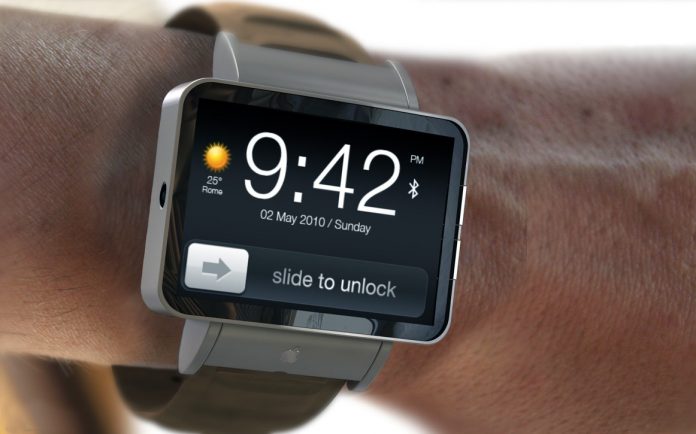
It’s easy to be disappointed by the announcement of Apple’s latest ‘game-changer.’ The Apple Watch, slated to be released in early 2015, has been described by Tim Cook as “the next chapter in Apple’s story,” but consumers are hesitant.

Apple’s previous successes — iPhone and iPad — both introduced entirely new product categories, and revolutionized communication in an (arguably) positive way. The Watch, however, which promises only marginal improvements on features already found in other mobile devices, further exacerbates the social challenges and unrestrained pervasiveness of mobile technology through its so-called convenience factor.

What should concern us is that the Apple Watch is not a piece of mobile technology, nor is it a mere gadget. It’s a clothing item; an accessory designed to be a permanent fixture in our daily lives from morning until night. Devices created to provide an augmented reality experience for the user aren’t anything new — Google’s overly ambitious and notoriously ugly Google Glass technology is the most notable example — however, the device is past beta testing and will soon be in consumer hands.

At a recent lunch with friends, I witnessed an all-too-familiar sight: five faces glued to their screens, casually dismissing one another. Such a scenario is a constant hazard in modern life, but imagine how much worse this would be if there was no option to unplug. There is no question that our lives are increasingly involved with mobile communication, but the Apple Watch is a step too far.

We need technology to live with us and to be at our disposal, not the other way around.

Each time you receive a text, Tweet, or Facebook notification, the watch lights up and sends your brain into overdrive as you re-focus your attention from whatever you’re doing in order to respond. It’s simple and rather liberating to let a vibrating phone sit in your pocket for 15 minutes before responding. However, it’s difficult to ignore a glass watch that constantly invades your personal space, and incentivizes multitasking through its cluttered design.

The Apple Watch is also marketed as an exercise aide. It includes a workout app and can flip through music simply by being in contact with your wrist. Apparently, a stopwatch and a trusty old iPod Shuffle can’t effectively do the exact same thing, because they’re not on your wrist and don’t cost $349.

Additionally, Apple has partnered with Honeywell and Lutron so that the Watch can dim your lights or turn on your air conditioning. It’s clear to me that the Watch has been designed to complement every part of your life, a somewhat invasive aspect that should not be taken lightly by users.

I do not intend to sound averse to technological advancement, but we need technology to live with us and to be at our disposal, not the other way around. CEO Tim Cook has proclaimed the Apple Watch to be “the most personal device Apple has ever created.” Though, it will soon be time for the average consumer to decide how personal is too personal.

League of Legends tournament accidentally breaks world record for most single men in one place

1
The tournament’s major sponsors included Microsoft Windows, Mountain Dew, and fedoras.

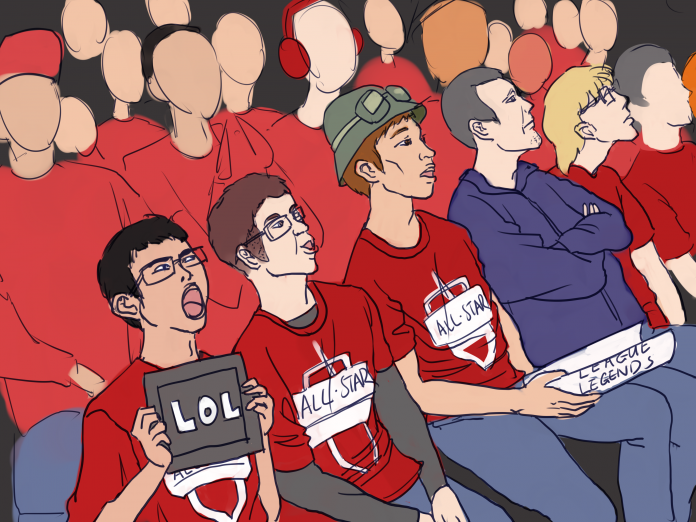
Late last week, Guinness World Records made a surprising announcement when it declared that the 2014 League of Legends World Championship had accidentally gathered the highest number of bachelors in a single place, shattering the previously held record.

The annual tournament, organized by American-based gaming company Riot Games, asks players from around the world to compete in a series of online PvP matches with prize money reaching close to $1 million. While breaking a world record had not been Riot Games’ intention, the tournament nonetheless drew absurdly high volumes of single men between the ages of 17 and 80.

“After four years of a being a world-class event, it’s great to see the tournament garnering the attention it deserves,” said Tom Flanny, a spokesperson for Riot Games. “Well, I mean, this isn’t the kind of attention we wanted, but no press is bad press, right?”

Operating on an anonymous tip, Guinness World Records employees arrived at the scene on September 19, the second day of the championships; they were immediately blown away at how previous record-holder BlizzCon 2013 paled in comparison. While exact numbers have yet to be finalized, early reports suggest that as many as three times the number of single men appeared at the League of Legends championship.

“Honestly, in the 20 years I’ve been with Guinness World Records I’d never seen anything quite like it,” Steven Sharkey, one of the first Guinness employees on the scene, told The Peak. “There were fedoras and 2L bottles of Mountain Dew as far as the eye could see.”

The world record for most single men in one location has existed since 1978, when it was first accidentally set via an organized rally of men’s rights activists. While the judging criteria has changed over the years — to include recently-widowed men or those with ‘totally hot’ internet girlfriends — the overall measurement has stayed the same. It is based off of how many single men are located within a singular, closed-off area. The League of Legends tournament reportedly had a ratio of one single male for every four square feet.

“While the tournament clearly destroyed any previous record holder, determining by how much has proved difficult,” Sharkey explained. “People kept trying to weasel their way out of telling us their relationship status.

“One guy told me he had a girlfriend named Savannah who was off at college in the States. He said something about a long distance relationship and communicating through letters, but I had to remind him that he was essentially describing the movie Dear John.”

The process was further convoluted by the high volume of men’s ponytails found at the tournament, making it difficult for Guinness employees to distinguish female attendees and subtract them from the final total.

While most tournament goers are still deciding if the broken record was something to brag about or not, Martin Handford, creator of the popular literary series Where’s Waldo?, expressed an interest via his Twitter in taking the real-life event and integrating it into a new book in which readers must try and spot a woman hiding in various illustrated pages of League of Legends tournaments. Handford’s publisher has yet to comment on the topic.

This week in comics

0

Fun in the Sun (Austin)
Fun in the Sun (Austin Cozicar)
Contribute (Jacey Gibb)
Not a shameless plug (Jacey Gibb)

peersclass
Peers (Leslie Lu)

Ski Ninja Week 4 (Kyle Lees)

Turning the page on tech innovation with bookbook™

0
Experts are already predicting how this new platform will impact the tech world.

Recently Ikea has been making world headlines with its innovative bookbook™, a new revolutionary device that’s small enough to fit in the palm of your hand. Straying from their traditional Ikea Edge, this new bookbook is a slim and sleeker version of your usual catalogue, with a 7.5 by 8 inch design. After the success of 2013’s iHorseMeatballs, Ikea’s new device has already garnered positive responses from some of the top technology critics. Here’s what some of them are saying.

“This is the future, I’ve never seen anything quite like it. The interface has totally changed from last year’s catalogue.” -Maria Yoshida, Wired

“Quite frankly, I’m satisfied with it. Especially with its new virus protection Roll-it-Up app, which fights off any bugs.” –Joel Lepp, Gizmag

“The fact that it has a bendable screen on every page is amazing. Sorry Samsung, I’ve Sam-singed your praises long enough.” -John Fowler, New Technology Magazine

“I love the multiple fonts this magazine offers. Now I can send cryptic kidnapping messages without having to find another magazine.” -Michael Klyne, Stuff

“It also doubles as toilet paper!” -Paige Lawless, Vancouver Sun

However, despite the massive hype circulating the internet, users of similar interfaces were unimpressed with what Ikea had to offer.

“Yeah, the extended battery life is great, but Ikea’s deliberately avoiding the fact that it’s not waterproof. I spilled my coffee on it and now the screen stopped working.” -Tania Turnbull, The Globe and Mail

“If you look inside the magazine, there’s nothing but proprietary hardware with no open source specifications. How am I supposed to know the NSA isn’t spying on me through my Tarva shelf? I’m going to store my personal photos on there you know.” -Alison Smith, Discover Magazine

“I don’t like how they’re only letting the bookbook™ be compatible with the bookbookhourglass™. Ikea has dominated the marketplace long enough; give us some room for competition!” -Tom Harold, Popular Science

“What a rip-off, it doesn’t even have any games.” – Rachelle Yeung, The Toronto Star

“Meh, they’re just going to shill out a bookbook™ 1S sooner or later.” – Max Hill, The Peak