Home Blog Page 1097

Canadians need an alliance between the Liberals and the NDP

0

Politics are a complicated topic for millennials. In Canada’s 2011 federal election, according to Elections Canada, only roughly 39 per cent of Canadians between the ages of 18 and 24 voted. We live in an age where equality, acceptance, and inclusivity are part of the ideological forefront for young, upcoming voters. These are all statistics and insights that, undoubtedly, we have seen many times before.

The root problem is that politics are a tribal exercise that, generally, are hostile to the aforementioned millennial values. Modern politics — with the advent of unfettered social media — require a Machiavellian ruthlessness and pettiness that is alienating to a generation of individuals who are, more often than not, declaring themselves as progressively independent. Subsequently, the question arises: how do we blend millennial progressivism and quell economic uncertainty in the 21st century? The answer: a more customizable government, which would involve an alliance between the federal Liberals and the NDP.

Technically, I am a millennial, although I am creakily bordering on the elderly edge. I am part of the older generation that still remembers (not fondly) the hyper-conservative Reagan/Thatcher era. I want to see a world where people are free to choose who they are and finite labels become a thing of the past. And so, over the course of the last two years, I sampled what different political groups had to offer.

I joined the BC Liberals, held quorum with the BCNDP, wrote policy for the Canadian Libertarian Party, attended an Ayn Rand conference, donated money to the federal Liberals, and purchased membership in the federal Conservative Party. After becoming involved with these groups, I came to the conclusion that they were all deficient in some manner.

If the two parties do not join forces they will inevitably split the vote in favour of the Conservatives.

This uncertainty of representative affiliation is the new reality of millennial politics: we are Consumer Citizens. In an effort for full disclosure, I would like to say that I still do not know exactly how to approach progressive politics. Ultimately my exploration of various ideologies was in an effort to find the best way to create actual freedom for every citizen, whether it was with a large active government or a small litigious one.

However, the more I explored libertarian ideas, the more I realized that it was mostly a load of baloney, where selfish pro-business advocates were heartily trumpeting deregulation and the removal of government interference. Shortly thereafter I discovered author Matt Taibbi’s excellent novel, Griftopia, which outlines how the Ayn Rand-ian influence on American business almost crashed the entire world economy in 2008. So on the political spectrum I am not far left, or far right, or much of a centrist either. I am, lo and behold, a progressive independent.

The (albeit temporary) solution for millennials, I think, is for a merger between the federal Liberals and NDP. Between the two parties (one aggressively progressive, the other cautiously pro-prosperity) and between their two leaders (Mulcair is an amazing prosecutorial presence in parliament, and Trudeau has the charisma and tactical prowess to gather popular support) a Liberal New Democrat Party would gather the votes necessary to form a viable, majority government. The two parties are so similar in practice and appearance that — if they do not join forces — they will inevitably split the vote in favour of the federal Conservatives.

If we are going to say that millennials are Consumer Citizens, then let’s follow the standard marketing trends and make things more customizable. I want the Canadian Government, version 2.0.

University Briefs

9
Female-only hours at the Ryerson University gym

UBC gets a boost for speech pathology masters program

The University of British Columbia has received increased funding from the provincial government toward its Masters of Science in Speech Pathology program.

The $2.475 million initial investment will allow for 13 spots to be added to the existing 23 by 2016, with another $932,000 for the program yearly. The reasoning behind the bump in funding is that it will address the need for speech therapists in northern and rural BC, where these experts have been scarce in the past.

With files from The Ubyssey

Saskatchewan universities see large tuition increases

Universities in the province of Saskatchewan have seen the highest tuition increases in Canada this academic year, according to a recent Statistics Canada report. The changes will affect students at both undergraduate and graduate levels, with four per cent and 5.2 per cent increases respectively.

The tuition fees for undergraduate students in Saskatchewan has increased from $6,402 to $6,659 this academic year, making it the second highest in Canada, with Ontario in the top spot with an average fee of $7,539.

Ernie Barber, interim provost and VP academic of U of S explained, “Despite the fact that Stats Canada reported that we had the highest increase, that doesn’t mean that we have the highest tuition. Our tuition fees, even with the increases, are about where we intended them to be set.”

With files from The Sheaf

Female-only gym hours introduced at Ryerson

Ryerson University is attempting to reduce feelings of discomfort in their campus recreation facilities by instituting female-only gym times for places such as the campus pool, weight rooms, and various studios.

The pilot project was launched after a survey of female students found a large portion of participants wanted women-only hours. As of September 18, the number of women using the facilities had increased by seven times. U of T and York University have implemented similar initiatives in past years.

With files from The Ryersonian

Former UN high commissioner interrogates global governance

0
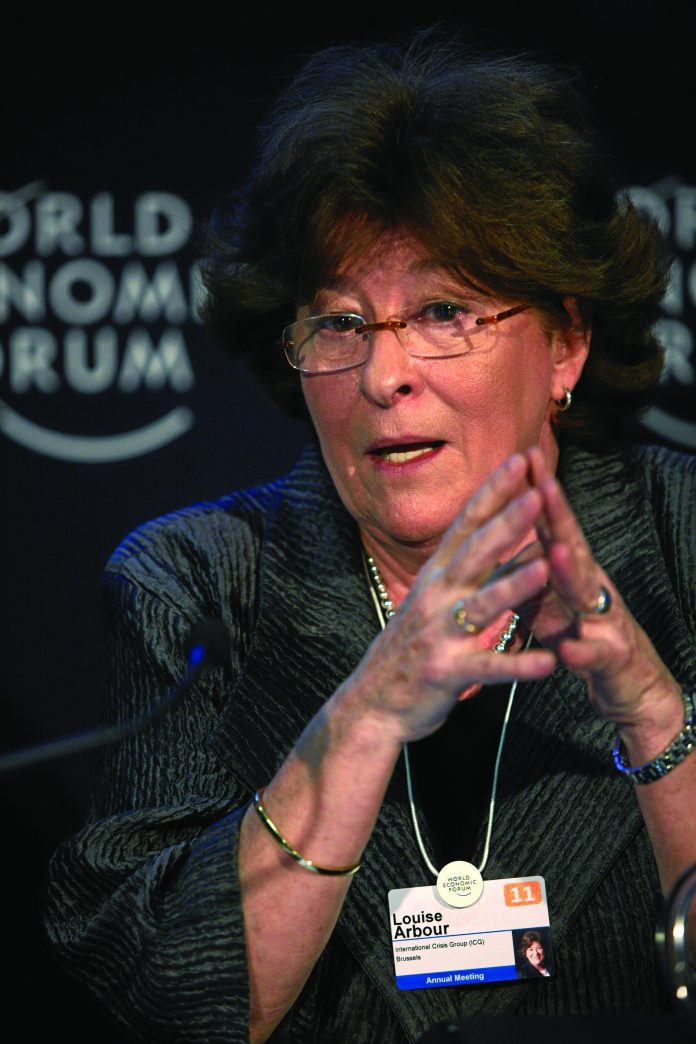
Louise Arbour made history by indicting Yugoslavian President Slobodan Milosevic, the first sitting head of state to be tried for war crimes.

Former UN High Commissioner for Human Rights and Supreme Court of Canada justice, the Honourable Louise Arbour, visited SFU Harbour Centre last Thursday, September 25 to give a talk titled, “From Syria to Crimea, is Global Governance at a Loss?”

Presented by SFU and the School for International Studies, the talk discussed whether doctrines and institutions of global conflict management are in need of self-examination and reform.

The Peak sat down with Arbour before her talk to discuss her perceptions of the current state of international criminal justice, peacekeeping operations, and the international human rights system.

The Peak: How would you characterize the current state of global governance?

Louise Arbour: The toolbox of conflict prevention, conflict management, conflict resolution, seems to be pretty outdated. I think it’s kind of stuck. It’s very stale.

For instance if you compare the kind of progress that’s been made in technology, particularly communication technology in the last several decades, and you look at how the post-Second World War international institutions of global governance has basically just drifted, there’s not been much new thinking, new ideas, and no kind of institutional reform.

P: How do these problems manifest in Syria and Crimea?

Arbour: In Syria, we have been paralysed by the difficulty of understanding the real nature of the conflict. [It’s been] a very, very slow response. A response that was at the time much more rhetorical than real. We support the opposition, but basically we do nothing to really support [them].

Now Syria has morphed; I mean, the opposition has kind of exploded into all these subgroups that I think public opinion outside the region cannot even begin to understand, and I don’t think we have much trust that our leaders understand either.

P: Does this reflect a lack of institutional or political trust?

Arbour: I think it’s both. I think that we are, I hope, at the very low point of personal leadership. Frankly, again, I think that’s why, in his first election campaign, Obama came across as such a giant, both intellectually, morally, [and] politically. He was operating in sort of a desert of remarkable leadership.

I think this fatigue in personal leadership probably also represents fatigue in the fact that political institutions are not very attractive to people with talent, maybe because there is a lot of competition for enormous material rewards in the private sector. But also the political environment is so deteriorated that it must be that it’s not very attractive to people who would have these kinds of qualities.

P: What do you think might attribute to global governance being, as you put it, “stuck?”

Arbour: I think those who, either institutionally or politically, were or [presented] themselves to be ‘the leaders’ [. . .] have been very unsuccessful in keeping up with the times.

They held to their position of power, and to me we are in a transitional mode now where, maybe as a result of some benefits of the international development agenda efforts, developing countries are actually developing. And, they’re asserting some political claims; we see it on climate change. They’re essentially saying, ‘You got rich by polluting the planet, and now you want to tell us that we cannot use the same means to get rich ourselves.’ Well, you know that won’t go.

So I think those who had a leadership, be it political, economic, or institutional, since the Second World War, essentially have held onto their privileges without much vision as to how they should position themselves in a world where they won’t have this monopoly anymore.

P: How does this relate back to the issue of trust?

Arbour: I think a lot of developing countries, rightly or wrongly, are very suspicious about the purity of intentions of Western, rich countries purporting to advance universal values and ideals that just coincidentally seem to serve them very well. And I think that’s a huge part of the problem in the international human rights agenda.

The recipients of all this good advice don’t feel like they’ve benefitted all that much from it. There’s a lot of suspicion.

P: How do we take the next step toward reviving that trust?

Arbour: The diagnosis is considerably simpler than the remedy in this case. [. . .] What you have to do is accompany people at their own pace and in their own struggles, for freedom, for a decent life, but you can’t have this paternalistic, patronizing [method] which will necessarily backfire.

Inasmuch as we believe that these values are represented by the human rights agenda, [. . .] even if you sincerely believe that this should be supported, I think that we have to do a much more modest [job], and in some cases just accept that people are entitled to make different choices.

Students struggle to find parking at Burnaby campus

0
The capacity of Lots B, C and Discovery P3 is 1,950, but 2,300 outdoor permits were sold this fall.

Trying to find a parking space at SFU Burnaby this fall has become a daily struggle for some students, as the most popular parking lots -— Lots B and C — are often filled to capacity by lunch time.

Although those with indoor permits have been largely unaffected, students with outdoor parking passes have complained about the lack of space they paid for.

The Peak spoke to director of Parking Services, David Agosti, to find out the reasons behind this issue and the steps Parking Services is taking to rectify it.

“We’ve sold more or less the same number of permits as we sold in Fall 2013,” said Agosti, explaining that the issue shouldn’t be one of capacity. 

In Fall 2013, Parking Services sold 2,200 outdoor permits; this year, they sold 2,300. The combined capacity of Lots B, C and Discovery P3 is 1,950.

When asked what other explanation might account for the over-crowded lots, Agosti responded, “We’re thinking that part of it might be because of the teachers’ strike [. . .] a lot of education students and faculty would normally be in the classroom, [but] couldn’t be in the classroom and are instead up here.”

At present, Parking Services is trying to mitigate the influx of extra cars in several ways. Through collaboration with Facilities Services, SFU service vehicles have been redirected to park elsewhere to create more spaces. Also, turnaround areas are being reduced in size, and the extra space will be used to paint in more parking spaces.

Agosti acknowledged that these are short-term solutions, and said that in the long-term the Sustainable Mobility Advisory Committee (SMAC) is working towards better bus service to and from campus. They are also working to better understand student behaviour, bus pass-ups, and reasons people elect not to take transit.

In Agosti’s opinion, transit problems may explain the greater demand for parking space: “It’s possible that some people are saying even though I have an U-Pass, I can’t get on the bus.”

For those still struggling to find a place to park, Agosti suggested a solution for the immediate future: “If you’re arriving between 10:30 and 1:00, for now, skip C lot, go straight to B lot or Discovery P3” in order to save yourself time and stress.

Satellite Signals

0

Woodward’s

Last Wednesday, Andrew Yan, a senior urban planner with Bing Thom Architects and researcher with BTAworks, hosted a panel discussion titled “Vancouver in the 21st Century” at SFU Woodward’s.

The topic covered various aspects of life in Vancouver, “through the lens of social statistics and community cartographies.” Proceeds from ticket sales were donated to the Downtown Eastside Neighbourhood House Food Program.

Surrey

On Wednesday evening at Surrey campus, Susmita Maskey, a young Nepali mountain climber and social activist, spoke about her experiences as a coordinator of the historic First Nepali Women Everest Expedition, and her preparations for climbing the last of the Seven Summits, Vinson Massif in Antarctica.

Maseky has climbed Mount Everest three times and advocates empowering young women and supporting victims of violence.

Harbour Centre

Dietrich Jung of University of Southern Denmark’s Centre for Contemporary Middle East Studies delivered a lecture titled “How To Be a Modern Muslim: Global Social Imaginaries and the Construction of Islamic Identities” on Wednesday, September 24 at Harbour Centre.

His lecture discussed ways in which Muslims have dealt with subjectivity and social constructs in the modern era.

BoG-gled

0

Surrey and downtown residences

Facilities Services is working in conjunction with Student Services to plan the development of student residences at SFU’s satellite campuses. The report reads, “A student survey has been completed and work is now being done on a market survey.”

SFU is in conversations with the City of Surrey to discuss property transfers for the planned changes to the bus loop and road configuration.

Meanwhile, a construction agreement was signed with the developer of the Vancouver Student Residence project in August and the project has received a “favourable response” from the City of Vancouver’s Urban Design Panel. The Vancouver building is due to be completed in May, 2016.

Textbook affordability

The board discussed the possible implementation of the SFU U-Read program at the SFU bookstore. This initiative would work to acquire content licence from publishers in order to provide more course materials digitally.

The program would save students up to 50 per cent on what they currently pay for printed textbooks, and would ensure that materials are available to students by the beginning of each semester; the concept is currently undergoing a consultation process.

The bookstore also plans to reduce costs for students by ordering books earlier so as to receive a 20 per cent shipping discount.

SFU honours Terry Fox in annual fundraiser

0
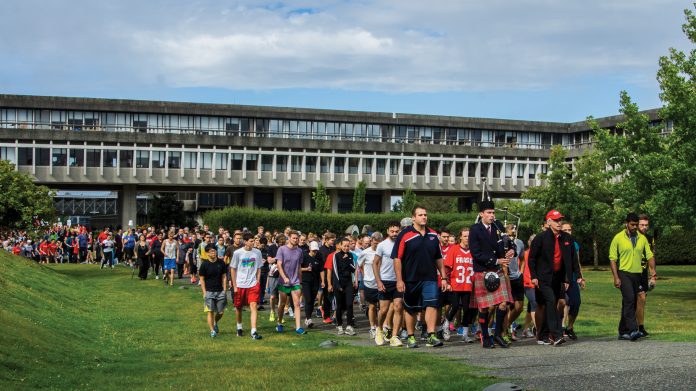
Participants gathered before the run to hear speeches from president Andrew Petter and Terry Fox Gold Medal winner Jeremy Pearce.

Students, faculty, volunteers, friends, and family congregated at SFU’s three campuses on the morning of September 24 for the annual Terry Fox Day celebrations in order to raise funds for cancer research.

Despite the uncertainty of the weather, participants demonstrated overwhelming enthusiasm as they cheered to support the cause. The day holds special significance for the university, as Fox was an SFU student at age 18.

This year there were over 40 fundraising teams and about 800 participants involved across all three SFU locations, raising a total of $29,960.

During the opening ceremony on Burnaby campus, SFU President Andrew Petter thanked all of the teams, participants, volunteers, and donors for their efforts. He also extended his gratitude to the nearly 30 universities that contributed to the Terry Fox Foundation this year.

Following the opening ceremony, runners and walkers prepared to make the five kilometre trek around Burnaby campus.

This year, Petter awarded the Terry Fox Gold Medal Award to Jeremy Pearce, SFSS at-large representative and a former student athlete. The award is given to an individual who demonstrates courage in the face of adversity. A supportive crowd cheered as Pearce accepted the honour, which includes free tuition at SFU for three semesters, $1,000 cash, a medal, and an honourary plaque.

Pearce spoke to The Peak about what this award means to him: “It’s a humbling experience, to be recognized like this. It’s amazing to have my name on an award that so many great people have had before me.”

Although Pearce now celebrates his accomplishments, he has overcome many difficulties to reach this point. At age 16, he moved out to avoid an unpleasant homelife and got a full-time job.

However, there were more challenges to come. One day, when Pearce was in his apartment, he unknowingly opened the door to thieves who ransacked the place and left him beaten. After being diagnosed with post-traumatic stress disorder as a result of the robbery, he attempted to commit suicide. He was later found by police and rushed to the hospital.

With hard work and the help of his high school football coach, things began to improve for Pearce, leading to an SFU scholarship offer. Currently pursuing a joint major in criminology and sociology with a minor in legal studies, he is a promising athlete who maintains excellent grades and is employed by the SFU Forensic Entomology Lab. After completing his degree, he hopes to start a career in law enforcement.

Pearce is also heavily involved in his community. He volunteers with Big Brothers, is a coach for the Special Olympics, and founded SFU Team Up — a program that connects athletes and students while also giving back to the community. In just a year, Pearce has put together various fundraisers and raised over $19,000 for local charities.

When asked what advice he would give to anyone facing hardships, Pearce answered, “It will get better. Just surround yourself with positive people and don’t give up.”

The spirit associated with this award — and inspired by Terry Fox — gains strength every year, with more universities than ever before contributing to improve the lives of cancer patients. To date, the Terry Fox Foundation has raised over $650 million for cancer research.

Students petition SFU to sever ties with mining institute

0
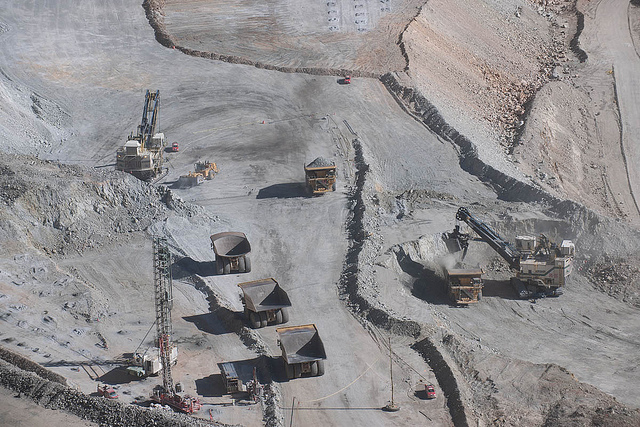
The institute’s initial activities will focus on countries in Latin America, Sub-Saharan Africa, and Asia.

Student opposition to SFU’s involvement with the Canadian International Institute for Extractive Industries and Development (CIIEID) reached a new high at the end of the summer with the release of a petition calling for the institute’s closure.

A collaboration between SFU, UBC, and École Polytechnique de Montréal, the CIIEID was created as a venture to lend Canadian mining expertise to developing countries where current mining practices may be more environmentally and socially damaging than necessary. 

Since the institute opened its doors at UBC’s campus in January of this year, concerns about the CIIEID’s corporate ties to the extraction sector have continually been raised by student groups on both UBC and SFU campuses. Now, students are taking their objections to centre stage.

“We’re trying to unite the voices of people at our universities and stakeholders from our community to let the highest authorities at UBC, SFU, and École Polytechnique de Montréal know that we’re not excited for our universities to be involved in something like this,” said Sam Stime, UBC graduate student and one of the driving forces behind the petition.

Students from UBC and SFU, along with environmentalists and concerned community members across the Lower Mainland, have banded together under the name Stop the Institute. Their goal is to coordinate efforts that aim to shut down the CIIEID unless changes to its internal structure are implemented. Their petition outlines issues of academic freedom, lack of impartiality, lack of credibility, and lack of accountability.

“Right now there is no representation of the historically marginalized; the voices of people of communities that have been negatively affected [by Canadian mining companies],’ Stime said.   

Jasheil Athalia, one of the principle organizers of Students for Transparency in Public Education, a faction of the Simon Fraser Public Interest Research Group (SFPIRG), told The Peak that she is worried about how SFU’s association with mining corporations will affect public perception of the university overall.

“As a student, I just don’t feel right graduating with a degree from SFU knowing that I contributed to that family somewhere in Columbia that doesn’t have a home now [due to foreign mining in their community],” said Athalia.

Transparency around funding sources has also caused controversy at SFU and UBC. When the initial grant of $24.6 million from the federal government’s Department of Foreign Affairs, Trade, and Development (DFATD) runs out after five years, the CIIEID’s Contributions Agreement states that further funding for the institute will be sourced from “fundraising, scholarships and chairs, research and charitable grants, tuition and other revenue streams and in-kind support.”

Stime told The Peak that, since the institute will be accepting money and in-kind aid from mining corporations who have vested interests in foreign extractive sectors, he feels that the academic freedom of the universities to conduct and publish unbiased research may be compromised.

However, influence from corporate mining executives on future projects for the institute is very minimal, according to Dan Shapiro, a member of CIIEID’s executive board and a professor in SFU’s Beedie School of Business. “We will do our research, and sometimes decide it’s not a good idea to go into an area,” he told The Peak. “We aren’t out there to make [the corporations] money. They knew that was the deal when they signed on.”

Stime said he feels that “many developing nations view Canadian mining companies as completely predatory,” based on the track records of some large corporations. He said he believes this calls into question the qualifications of the CIIEID to offer advice to developing countries.

Kristina Henriksson, director of learning and education on the CIIEID management committee and SFU adjunct professor maintains that the CIIEID is an autonomous, research-and-learning based endeavour that has no interest in forcing advice on communities in developing countries who don’t want it.

“We’d never go anywhere without an invitation,” Henrikkson explained. “Establishing best practices will require input from everyone involved.”

Board Shorts

0

Chief electoral officer appointed

Following the recent departure of Lorenz Young, the SFSS board of directors appointed Stephanie Munez as the new chief electoral officer (CEO) until November 2014. Yeung resigned after graduating this summer as the CEO must be a current society member. Munez will fill in for what would have been the rest of Yeung’s term, until a new appointment is made in January.

BASS constitution and bylaws

As recommended by the Constitution and Policy Review Committee, the board approved a proposed constitution and accompanying bylaws for the Business Administration Student Society (BASS) on Wednesday.

The constitution and bylaws were passed contingent upon approval by BASS membership at their AGM on October 8. If passed, BASS will have the ability to submit a question concerning its establishment as an FSU, to be voted on by BASS members in the SFSS’ November referendum.

Bylaw addition to be voted on at SFSS AGM

The society passed a proposed addition to the bylaws, on which students will vote in the upcoming SFSS AGM on October 22. The bylaw reads as follows:

The Society may not revoke, reduce or otherwise cancel a duly approved student society fee that has been implemented for the purpose of repaying a loan made to the Society or on the basis of which a loan has been made to the Society if the effect of such revocation, reduction or cancellation would be to cause the Society to be unable to repay the loan as it became due.

The addition concerns the Build SFU Student Union Building and Stadium projects. In order to enter into a mortgage in good faith, the society will need to ensure that it has the ability to repay the borrowed amount.

Guard.me insurance

The SFSS Advocacy Committee approved an open letter of position outlining the Society’s concerns regarding Guard.me, the basic health insurance program offered to SFU international students.

The letter, which was addressed to Andrew Petter, SFU President, Pat Hibbitts, SFU vice president finance, and Tim Rahilly, SFU associate vice president, students, singled out concerns regarding the price of the program, the absence of an automatic transition to MSP coverage upon achieving eligibility, and the automatic re-enrollment of international students in the Guard.me program after they have become eligible for MSP coverage.

The letter concluded with an invitation to the university administration to discuss options for international student insurance programming.

Canada must hold the line on Russian threats

0

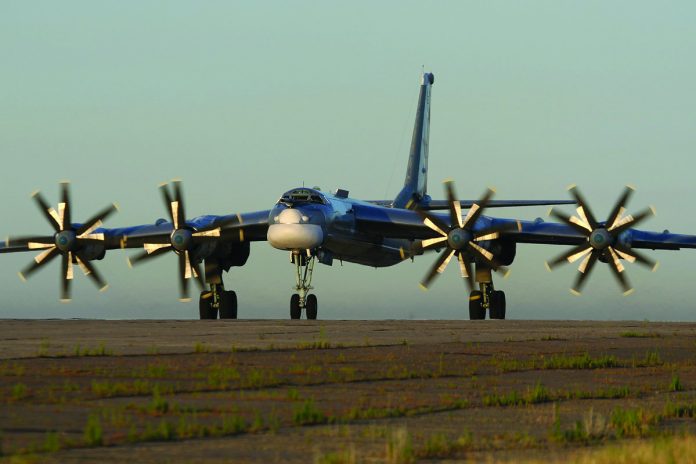
In the wee hours of what seemed to be an ordinary Friday, two Royal Canadian Air Force (RCAF) fighters scrambled to respond to an alert from the North American Aerospace Defense Command (NORAD), which had detected a pair of Russian Tu-95 bombers approaching Canadian airspace.

Intercepted only 50 km away from the coast, the Russians turned away at the sight of the RCAF. Later that same day, six Russian aircraft — a pair each of bombers, tankers, and fighters — were intercepted 60 km off of the Alaskan coast, and were warned off by United States Air Force jets.

While this may seem like a scene from the long-dead Cold War, it happened less than two weeks ago, as Russia attempted to push back against the West for its support of Ukraine during the recent turmoil there.

Canada, in particular, seems to be a target; earlier this month, Russian military aircraft buzzed the HMCS Toronto while the vessel was on manoeuvres in the Black Sea with other NATO warships. One Russian jet came within 300 metres of the Canadian vessel, causing the ship to lock weapons on the fighter. Russia’s actions make sense in light of Canada’s strong support for Ukraine and continual confrontation with the Eurasian giant over the Arctic.

There are some concerns if this becomes a pattern of behaviour in what is rapidly becoming a new Cold War, mainly the ability of the RCAF to continue to intercept Russian aircraft, as it will put increasing strain on both the pilots and the planes. Some would suggest that this is a sign that our country should back down from its position, but we must not allow the difficulty of a task to prevent us from doing what is right.

You make bullies back down by showing them that you refuse to be pushed around.

Russia is acting as little more than the schoolyard bully, threatening to take our lunch money if we don’t do what he wants. If there’s one thing I learned from being bullied in school, it’s that you don’t make bullies go away by backing down. You make them back down by standing up to them and showing them that you refuse to be pushed around.

I am not saying that there will not be great controversy over our government’s decision to stand firm in the face of Russian pressure. Likewise, I am sure there will be increasing criticism over the deployment of Canadian Forces personnel and equipment to Eastern Europe, as well as the deployment of military advisors from the Canadian Special Operations Regiment to provide tactical guidance to Iraqi and Kurdish forces currently battling ISIS. This announcement was made at the recent NATO summit in Wales, as the alliance also prepared to bolster its rapid reaction forces in order to make them capable of deploying to countries under Russian threat within 48 hours.

Canada has had a long history of standing up for a nation’s right to self-determination, and to democratic principles such as the ability to choose one’s government in free, honest, and open elections, something Russian President Vladimir Putin violated in his illegal seizure of Crimea.

It is in defence of these principles that Canada went to war 100 years ago, and did so again 25 years later. It is in defence of the rights of the people not to be subject to terror that the Canadian Armed Forces have deployed in battlefields and on peacekeeping missions around the world. We must not back down in the face of this new threat; we must, as Canadian forces so valiantly did at Ypres in the First World War, hold the line.