Home Blog Page 1097

BoG-gled

0

Surrey and downtown residences

Facilities Services is working in conjunction with Student Services to plan the development of student residences at SFU’s satellite campuses. The report reads, “A student survey has been completed and work is now being done on a market survey.”

SFU is in conversations with the City of Surrey to discuss property transfers for the planned changes to the bus loop and road configuration.

Meanwhile, a construction agreement was signed with the developer of the Vancouver Student Residence project in August and the project has received a “favourable response” from the City of Vancouver’s Urban Design Panel. The Vancouver building is due to be completed in May, 2016.

Textbook affordability

The board discussed the possible implementation of the SFU U-Read program at the SFU bookstore. This initiative would work to acquire content licence from publishers in order to provide more course materials digitally.

The program would save students up to 50 per cent on what they currently pay for printed textbooks, and would ensure that materials are available to students by the beginning of each semester; the concept is currently undergoing a consultation process.

The bookstore also plans to reduce costs for students by ordering books earlier so as to receive a 20 per cent shipping discount.

SFU honours Terry Fox in annual fundraiser

0
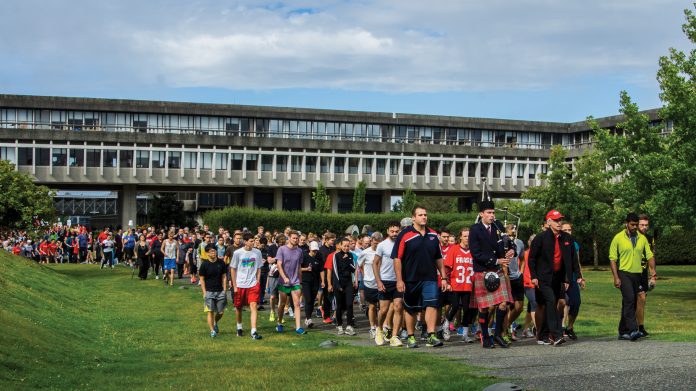
Participants gathered before the run to hear speeches from president Andrew Petter and Terry Fox Gold Medal winner Jeremy Pearce.

Students, faculty, volunteers, friends, and family congregated at SFU’s three campuses on the morning of September 24 for the annual Terry Fox Day celebrations in order to raise funds for cancer research.

Despite the uncertainty of the weather, participants demonstrated overwhelming enthusiasm as they cheered to support the cause. The day holds special significance for the university, as Fox was an SFU student at age 18.

This year there were over 40 fundraising teams and about 800 participants involved across all three SFU locations, raising a total of $29,960.

During the opening ceremony on Burnaby campus, SFU President Andrew Petter thanked all of the teams, participants, volunteers, and donors for their efforts. He also extended his gratitude to the nearly 30 universities that contributed to the Terry Fox Foundation this year.

Following the opening ceremony, runners and walkers prepared to make the five kilometre trek around Burnaby campus.

This year, Petter awarded the Terry Fox Gold Medal Award to Jeremy Pearce, SFSS at-large representative and a former student athlete. The award is given to an individual who demonstrates courage in the face of adversity. A supportive crowd cheered as Pearce accepted the honour, which includes free tuition at SFU for three semesters, $1,000 cash, a medal, and an honourary plaque.

Pearce spoke to The Peak about what this award means to him: “It’s a humbling experience, to be recognized like this. It’s amazing to have my name on an award that so many great people have had before me.”

Although Pearce now celebrates his accomplishments, he has overcome many difficulties to reach this point. At age 16, he moved out to avoid an unpleasant homelife and got a full-time job.

However, there were more challenges to come. One day, when Pearce was in his apartment, he unknowingly opened the door to thieves who ransacked the place and left him beaten. After being diagnosed with post-traumatic stress disorder as a result of the robbery, he attempted to commit suicide. He was later found by police and rushed to the hospital.

With hard work and the help of his high school football coach, things began to improve for Pearce, leading to an SFU scholarship offer. Currently pursuing a joint major in criminology and sociology with a minor in legal studies, he is a promising athlete who maintains excellent grades and is employed by the SFU Forensic Entomology Lab. After completing his degree, he hopes to start a career in law enforcement.

Pearce is also heavily involved in his community. He volunteers with Big Brothers, is a coach for the Special Olympics, and founded SFU Team Up — a program that connects athletes and students while also giving back to the community. In just a year, Pearce has put together various fundraisers and raised over $19,000 for local charities.

When asked what advice he would give to anyone facing hardships, Pearce answered, “It will get better. Just surround yourself with positive people and don’t give up.”

The spirit associated with this award — and inspired by Terry Fox — gains strength every year, with more universities than ever before contributing to improve the lives of cancer patients. To date, the Terry Fox Foundation has raised over $650 million for cancer research.

Students petition SFU to sever ties with mining institute

0
The institute’s initial activities will focus on countries in Latin America, Sub-Saharan Africa, and Asia.

Student opposition to SFU’s involvement with the Canadian International Institute for Extractive Industries and Development (CIIEID) reached a new high at the end of the summer with the release of a petition calling for the institute’s closure.

A collaboration between SFU, UBC, and École Polytechnique de Montréal, the CIIEID was created as a venture to lend Canadian mining expertise to developing countries where current mining practices may be more environmentally and socially damaging than necessary. 

Since the institute opened its doors at UBC’s campus in January of this year, concerns about the CIIEID’s corporate ties to the extraction sector have continually been raised by student groups on both UBC and SFU campuses. Now, students are taking their objections to centre stage.

“We’re trying to unite the voices of people at our universities and stakeholders from our community to let the highest authorities at UBC, SFU, and École Polytechnique de Montréal know that we’re not excited for our universities to be involved in something like this,” said Sam Stime, UBC graduate student and one of the driving forces behind the petition.

Students from UBC and SFU, along with environmentalists and concerned community members across the Lower Mainland, have banded together under the name Stop the Institute. Their goal is to coordinate efforts that aim to shut down the CIIEID unless changes to its internal structure are implemented. Their petition outlines issues of academic freedom, lack of impartiality, lack of credibility, and lack of accountability.

“Right now there is no representation of the historically marginalized; the voices of people of communities that have been negatively affected [by Canadian mining companies],’ Stime said.   

Jasheil Athalia, one of the principle organizers of Students for Transparency in Public Education, a faction of the Simon Fraser Public Interest Research Group (SFPIRG), told The Peak that she is worried about how SFU’s association with mining corporations will affect public perception of the university overall.

“As a student, I just don’t feel right graduating with a degree from SFU knowing that I contributed to that family somewhere in Columbia that doesn’t have a home now [due to foreign mining in their community],” said Athalia.

Transparency around funding sources has also caused controversy at SFU and UBC. When the initial grant of $24.6 million from the federal government’s Department of Foreign Affairs, Trade, and Development (DFATD) runs out after five years, the CIIEID’s Contributions Agreement states that further funding for the institute will be sourced from “fundraising, scholarships and chairs, research and charitable grants, tuition and other revenue streams and in-kind support.”

Stime told The Peak that, since the institute will be accepting money and in-kind aid from mining corporations who have vested interests in foreign extractive sectors, he feels that the academic freedom of the universities to conduct and publish unbiased research may be compromised.

However, influence from corporate mining executives on future projects for the institute is very minimal, according to Dan Shapiro, a member of CIIEID’s executive board and a professor in SFU’s Beedie School of Business. “We will do our research, and sometimes decide it’s not a good idea to go into an area,” he told The Peak. “We aren’t out there to make [the corporations] money. They knew that was the deal when they signed on.”

Stime said he feels that “many developing nations view Canadian mining companies as completely predatory,” based on the track records of some large corporations. He said he believes this calls into question the qualifications of the CIIEID to offer advice to developing countries.

Kristina Henriksson, director of learning and education on the CIIEID management committee and SFU adjunct professor maintains that the CIIEID is an autonomous, research-and-learning based endeavour that has no interest in forcing advice on communities in developing countries who don’t want it.

“We’d never go anywhere without an invitation,” Henrikkson explained. “Establishing best practices will require input from everyone involved.”

Board Shorts

0

Chief electoral officer appointed

Following the recent departure of Lorenz Young, the SFSS board of directors appointed Stephanie Munez as the new chief electoral officer (CEO) until November 2014. Yeung resigned after graduating this summer as the CEO must be a current society member. Munez will fill in for what would have been the rest of Yeung’s term, until a new appointment is made in January.

BASS constitution and bylaws

As recommended by the Constitution and Policy Review Committee, the board approved a proposed constitution and accompanying bylaws for the Business Administration Student Society (BASS) on Wednesday.

The constitution and bylaws were passed contingent upon approval by BASS membership at their AGM on October 8. If passed, BASS will have the ability to submit a question concerning its establishment as an FSU, to be voted on by BASS members in the SFSS’ November referendum.

Bylaw addition to be voted on at SFSS AGM

The society passed a proposed addition to the bylaws, on which students will vote in the upcoming SFSS AGM on October 22. The bylaw reads as follows:

The Society may not revoke, reduce or otherwise cancel a duly approved student society fee that has been implemented for the purpose of repaying a loan made to the Society or on the basis of which a loan has been made to the Society if the effect of such revocation, reduction or cancellation would be to cause the Society to be unable to repay the loan as it became due.

The addition concerns the Build SFU Student Union Building and Stadium projects. In order to enter into a mortgage in good faith, the society will need to ensure that it has the ability to repay the borrowed amount.

Guard.me insurance

The SFSS Advocacy Committee approved an open letter of position outlining the Society’s concerns regarding Guard.me, the basic health insurance program offered to SFU international students.

The letter, which was addressed to Andrew Petter, SFU President, Pat Hibbitts, SFU vice president finance, and Tim Rahilly, SFU associate vice president, students, singled out concerns regarding the price of the program, the absence of an automatic transition to MSP coverage upon achieving eligibility, and the automatic re-enrollment of international students in the Guard.me program after they have become eligible for MSP coverage.

The letter concluded with an invitation to the university administration to discuss options for international student insurance programming.

Canada must hold the line on Russian threats

0

In the wee hours of what seemed to be an ordinary Friday, two Royal Canadian Air Force (RCAF) fighters scrambled to respond to an alert from the North American Aerospace Defense Command (NORAD), which had detected a pair of Russian Tu-95 bombers approaching Canadian airspace.

Intercepted only 50 km away from the coast, the Russians turned away at the sight of the RCAF. Later that same day, six Russian aircraft — a pair each of bombers, tankers, and fighters — were intercepted 60 km off of the Alaskan coast, and were warned off by United States Air Force jets.

While this may seem like a scene from the long-dead Cold War, it happened less than two weeks ago, as Russia attempted to push back against the West for its support of Ukraine during the recent turmoil there.

Canada, in particular, seems to be a target; earlier this month, Russian military aircraft buzzed the HMCS Toronto while the vessel was on manoeuvres in the Black Sea with other NATO warships. One Russian jet came within 300 metres of the Canadian vessel, causing the ship to lock weapons on the fighter. Russia’s actions make sense in light of Canada’s strong support for Ukraine and continual confrontation with the Eurasian giant over the Arctic.

There are some concerns if this becomes a pattern of behaviour in what is rapidly becoming a new Cold War, mainly the ability of the RCAF to continue to intercept Russian aircraft, as it will put increasing strain on both the pilots and the planes. Some would suggest that this is a sign that our country should back down from its position, but we must not allow the difficulty of a task to prevent us from doing what is right.

You make bullies back down by showing them that you refuse to be pushed around.

Russia is acting as little more than the schoolyard bully, threatening to take our lunch money if we don’t do what he wants. If there’s one thing I learned from being bullied in school, it’s that you don’t make bullies go away by backing down. You make them back down by standing up to them and showing them that you refuse to be pushed around.

I am not saying that there will not be great controversy over our government’s decision to stand firm in the face of Russian pressure. Likewise, I am sure there will be increasing criticism over the deployment of Canadian Forces personnel and equipment to Eastern Europe, as well as the deployment of military advisors from the Canadian Special Operations Regiment to provide tactical guidance to Iraqi and Kurdish forces currently battling ISIS. This announcement was made at the recent NATO summit in Wales, as the alliance also prepared to bolster its rapid reaction forces in order to make them capable of deploying to countries under Russian threat within 48 hours.

Canada has had a long history of standing up for a nation’s right to self-determination, and to democratic principles such as the ability to choose one’s government in free, honest, and open elections, something Russian President Vladimir Putin violated in his illegal seizure of Crimea.

It is in defence of these principles that Canada went to war 100 years ago, and did so again 25 years later. It is in defence of the rights of the people not to be subject to terror that the Canadian Armed Forces have deployed in battlefields and on peacekeeping missions around the world. We must not back down in the face of this new threat; we must, as Canadian forces so valiantly did at Ypres in the First World War, hold the line.

“Fuck Safe Space” shirts encourage constructive debate

0

As a frat chapter out of Carleton University marched down Ottawa’s streets with saffron slogans on their shirts stating “Fuck Safe Space,” all it took was one snapshot ricocheting around the social media stratosphere for student frosh leaders to start pleading ignorance in its wake.

By the way the media circus paraded through the digital domain, you would’ve thought the local Hells Angels clubhouse had rounded up the soccer moms for a romp. The big fear was that the clothing would promote sexual harassment and homophobia. Taking in all the incensed media coverage of the perpetrators’ ‘on-campus brouhaha,’ it seems to have had the opposite effect.

Thankfully, today’s political climate can’t stand anything so blatantly bigoted, and incidents such as these only strengthen and entrench politically correct notions.

A reign of political correctness dominates the social landscape. People are quick to censor both themselves and others, out of fear of offending any ethnic, gender, theological, or ideological group with a voice in the wider public.

These notions can be applied to Jeremy Clarkson, leading presenter of the British car show Top Gear. A leaked video of him allegedly slipping the ‘N-word’ into a recital of Eeny, Meeny, Miny, Moe led to the TV persona’s public persecution. Speculation then circulated around his prophesied lay-off by the BBC.

“I was mortified by this [. . .] it is a word I loathe, and I did everything in my power to make sure that that version did not appear in the [transmitted] program,” said Clarkson, in an apologetic statement.

This is the sensitized climate of today. As the world circle expands, there is suddenly more open space to join new hands; minorities rush from the sidelines and the benches toward an accepting society.

On a national level, the LGBTQ community has been openly accepted by the upstanding members of society. The critical reception that Macklemore’s single “Same Love” received during Youtube’s Pride week demonstrates this encouragement. Young adult fiction has seen an increase in novels with a gay cast of characters; the bandwagon rocks with the next artist trying to reach out to the LGBTQ community. Gay is not just okay; it is hip too.

Rape culture is a harder pulse to put a finger on, with frat boy culture hanging like a fog of ether above university campuses. This issue is not funny, even when guffaws and chortles follow high-fives after a chauvinistic remark. Date rape drugs and boozy gangbangs are the nightmares haunting female students when dating or attending a party. None can deny the whiplash that occurs when a woman cries “rape!” Jock-shaming action is undertaken, and can be very bloody indeed.

This does not rule out the existence of these doomed bigoted clowns altogether. But they are a closeted minority, largely a moronic Beavis and Butthead goon squad, or an underground network of eunuchs from the old socially correct regime, still humping their misogynist, racist shrines.

This shirt incident, heightens awareness of politically correct notions — the Breakfast Club world where everyone can be accepted. Student campaigns and media sensationalism contribute to a firmer stand against future heretics in the ranks.

Already, the witch hunt has started against the frosh leaders, the torch-bearers. The institutional bloodhounds are out and they do not fuck around when it comes to family values. 

Task force explores flexible education at SFU

0
One idea of flexible education could mean moving away from a traditional lecture hall setting.

SFU’s Task Force on Flexible Education (TFFE) is looking for ways to create more education options for instructors and students.

Made up of various administrators, faculty, and both undergraduate and graduate student representatives, the task force was formed last April following a survey of SFU’s current online education resources.

During an initial consultation process, the TFFE attempted to define flexible education at SFU, opening up the conversation to the SFU community. The group completed an interim report in August summarizing the process.

According to the report, the task force discerned that the SFU community saw flexible education as offering more choices to accommodate increasingly diverse educational needs and objectives. The next step for the group was to divide into working groups — each of which is developing suggestions for a final report to be recommended to the university.

Some of the flexible education strategies being considered involve course restructuring, which could potentially mean course length adjustment, and more distance education options.

TFFE communication lead Mark Bachmann explained, “There are a lot of ways you can enable student and instructor choice, [. . .] offering an online version of a course [for] someone who can’t get to campus [for instance].”

He continued, “It can also mean perhaps offering courses that don’t last 13 weeks [. . .] so that people who are working and can’t fit into that schedule can take a course. It can be an accessibility for a student with a disability.”

Bachmann also mentioned alternative instruction styles that move away from the traditional lecture setting. One such style is the ‘flipped classroom,’ wherein students learn the material at home — perhaps through an instructional video — and class time is geared toward more interaction between students and instructors.

Bachmann suggested that, in a time when most information is available online, “that sort of interaction is going to become more and more valuable in the future.

“What a university can offer is that sort of unique space where instructors, and experts, and students can get together and talk about things, ask and answer questions, and work on common projects and goals,” he continued.

Another way to increase flexibility would be to reconsider the physical classroom space. “Maybe instead of having a traditional lecture hall where the instructor has no choice but to stand at the front and the students have no choice but to sit in the seats, we could offer spaces with flexible furniture, different levels, different configurations, so that different kinds of learning can take place,” said Bachmann.

In preparing recommendations for the final report, working groups will seek feedback through various means, including a student advisory group, a student survey sent out this fall, and presentations to the community.

The group will finish its work in June of 2015, when it will submit its final report to the VP academic and the SFU senate.

“How the ideas become reality, that depends [. . .] on what those recommendations are. Some of them will probably be the type of recommendation that can be enacted very quickly and others will be [longer]-term,” explained Bachmann.

He acknowledged that bringing some of the ideas to life will most likely require funding, but said that in some cases, “they might just need resources to be reallocated or they might just need a shift of emphasis.”

NHL teams should wear ads on their jerseys

1
Soccer led the way in jersey sponsorship.

Recently, the NHL rejected the proposed sale of advertising on jerseys, which the league estimated could net $120 million and approximately $4 million per team. The NHL declined the proposal because they didn’t want to be the first of the North American big four leagues (NFL, NBA, NHL, MLB) to feature sponsors on their jerseys. The league is also notorious for sticking with traditions — they do not want to trailblaze.

Public opinion doesn’t help the advertising cause either; no one wants to see ads plastered all over jerseys. Most people take comfort in the fact that sponsors on jerseys are limited to mainly European sports, such as soccer and cycling. Fans cringe at the idea of seeing a hideous Rogers logo on their beloved Canucks jerseys.

The truth is, the big four all already benefit from advertising revenue, so it’s not a question of purity. Take the NFL for instance, they have so many timeouts and breaks, advertisers are able to cram over a 100 commercials into three hours.

Baseball, with its breaks in between innings, has room for tons of commercials. In most instances, when there is a timeout in a basketball game they cut straight to commercial. Heck, even the NHL has TV timeouts to cater to the advertisers, and now even has digital advertisements added to the glass for the viewing audiences at home.

The thing is, ads on jerseys would provide the NHL with so much more money. The league already sells advertising, but due to some strange principle, they are denying themselves over $100 million, which is a hefty profit for the owners. These revenues could be used to help some of the struggling teams in the south such as the Arizona (formerly the Phoenix) Coyotes and the Florida Panthers.

Let’s take a look at one of the biggest current beneficiaries of advertising: Manchester United. They are about to enter a new 10-year, one billion dollar deal with Nike to make their jerseys. That is in combination with the over $70 million they will get per year from Chevrolet who sponsors their shirt — over $170 million in guaranteed revenue every year. That’s more than most teams anywhere in any sport make in a year. This is an extreme example, but it goes to show you how teams can take advantage of their brand to make a little — or a lot of — extra cash.

Passing up a new revenue stream because it will upset a few people makes no sense. If someone came up to me and said they would pay me $10,000 a week to wear an ad for their company to work, I’d take the deal in a heartbeat. Can you imagine how much revenue a team like the New York Yankees or Dallas Cowboys could potentially receive for a jersey sponsor? They would just be stupid to pass it up.

Advertising on jerseys in North American sports is inevitable; it’s just a question of when. With teams in the NHL like the Tampa Bay Lightning, who are losing $5.4 million per year according to Forbes, it’s a no-brainer, and the NHL might as well be first.

Fans might complain, but really, look at soccer teams — they still manage to sell tons of jerseys, even with those ugly ads plastered all over them. Right or wrong, at the end of the day, the money is all that matters.

FNSA hosts inaugural Indigenous Day at SFU

0
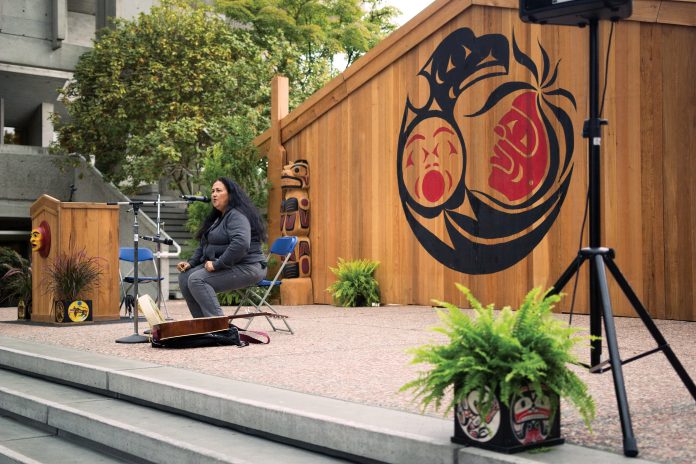
Convocation Mall was transformed for the day into a hub of cultural activities and performances.

The first ever SFU Indigenous Day was held on Thursday, September 25 in Convocation Mall at Burnaby campus.

The day of events was put on by the First Nations Student Association (FNSA), an organization dedicated to representing the interests of all self-identified Aboriginal, First Nations, Inuit, and Metis, along with both status and non-status SFU students.

Laura Forsythe, FNSA treasurer, explained, “This is [the FNSA’s] first attempt to create an event around educating versus showcasing. All of the elements have a large educational component to them. We hope to communicate Indigenous diversity here on Turtle Island [in North America] through a combination of sound, sight, and taste.”

Students walking by Convocation Mall were drawn into the vibrant event, which featured several performers on the convocation stage, informational booths about SFU’s Indigenous programs and initiatives, as well as a myriad of Indigenous artists who showcased and sold their handcrafted wares.

Those in attendance were entertained with lively music and dance as well as Indigenous artists’ work, which ranged from fine jewelry to moccasins and dream catchers.

Sharing circles, hosted by Indigenous elders, were one of the most unique opportunities at the event, meant to foster engaging and powerful community dialogue.

Several booths were set up to inform and educate SFU students about Indigenous culture as well as to shed some light on the ongoing projects in SFU’s Indigenous community. One such initiative is Intellectual Property Issues in Cultural Heritage (iPinCH), an international research initiative that, according to their mandate, “explores the rights, values, and responsibilities of material culture, cultural knowledge, and the practice of heritage research.”

Based out of the anthropology program at SFU, iPinCH tackles issues such as cultural appropriation, commodification, and how the flows of knowledge about history can affect communities today.

Those who work at the SFU Indigenous Centre, which opened in its brand new location on the second floor of the AQ earlier this month, were also present to inform people about their services as a study lounge and a source of support for self-identified Indigenous students. Their workshops and tutoring services will now be offered at their brand new location on the second floor of the AQ.

Mike Vegh, an FNSA board member and member of the Heiltsuk Nation, spoke to the day’s success: “The benefits for SFU students are tremendous, but overall they get to experience First Nations culture and combat colonialism in a way that is very exciting and interactive.”

He continued, “Promoting Indigenous culture is key in order to revitalize the Indigenous people in Canada, who in the past — and still today — have suffered tremendously from colonialism. With events like this, it shows that Indigenous culture and people have the strength and determination to be a voice that still wants to be heard.”

Don’t spank your children

1

Were you spanked as a child? In hindsight, do you feel resentment or even humiliation at being treated this way? The answer is likely yes. For these reasons, I am against spanking children. Spanking one’s children should not be used as a disciplinary method, as it is ineffective and can damage familial relationships.

Having grown up in Hong Kong, I was never spanked by my parents, though I’ve witnessed my uncle use force on my cousins when they would misbehave. The act of spanking has become a Western cultural norm, and this is why many caregivers see it as an appropriate parenting style, when in fact it is the opposite.

You may be surprised to hear of a Canadian ‘spanking law’ which allows parents and teachers to impose reasonable force to discipline children between the ages of two and 12. But how does one draw the line between what is reasonable and what is not? Inflicting pain on a child is simply unreasonable, no matter the severity.

Many research findings denounce spanking as an ineffective parenting style, as there are no observable long term benefits for children. According to Psychology Today, using this unnecessary force may “erode developmental growth in children and decrease a child’s IQ.” Spanking also teaches children to fear and disrespect their parents, and even to lie so that they may avoid punishment.

While raising a family, one should never have to resort to violence as a method of discipline.

While parents may intend to   teach their children a lesson, sometimes a parent may use force on a child out of frustration, and lack of control over their own temper. In losing control, parents do not solve their problems, but create them by sending children the message that its okay to inflict pain on someone when upset.

Furthermore, its not only a parent’s duty to raise a child, but to teach that child how to be a parent in the process. Disciplinary spanking gives children the impression that this is the correct way to act with their future children, which may in turn make children more aggressive.

Finally, when children are spanked by the very people who protect them, both the child’s self-esteem and the child-parent relationship are damaged. My cousin later told me that these childhood experiences made her feel not only ashamed of herself, but of her parents as well. These thoughts shake the foundation of a relationship, and disrupt the important emotional connection that families are supposed to have.

Believe it or not, there are more effective and appropriate ways to discipline a child. A few of these methods include giving your child a timeout session, rewarding your child when he or she displays good behaviour, and always modeling good behaviour as a parent. These methods are painless, enforce positivity, and will lead parents to positive relationships with their kids.

I understand that it’s not always easy to raise children, but while raising a family, one should never have to resort to violence as a method of discipline. In the end, your child will thank you and I’m sure you’ll thank yourself too.