Home Blog Page 1095

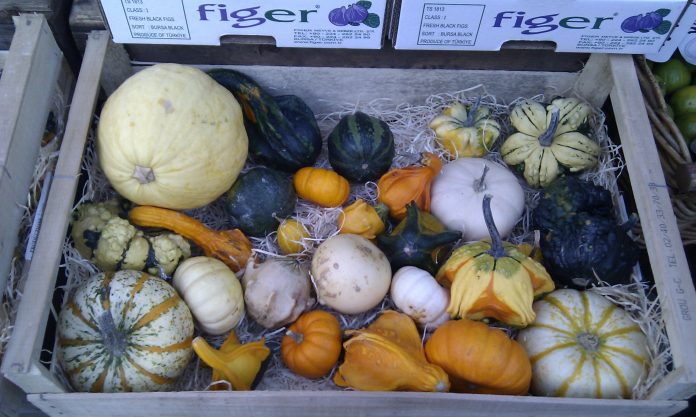
Fans of gross tumorous, discoloured plants celebrate the return of decorative gourd season

0
Ugh, really? These things again?!

While most sane people steer clear of these off-putting, rejected squashes — perhaps in fear that the haphazard bumps and off-colour patterns are transferable through mere touch — some of the populous is indeed thrilled to have those dumb yet festive-looking gourds readily available in the produce aisle again.

“September is definitely our busiest time of year for them,” says local produce manager Stephanie Miller about the bumpy, maybe-they-were-supposed-to-be-pumpkins-at-one-point gourds. “It’s like Christmas for folks in the decorative gourd industry.

“There’s just something about the changing seasons that drives people to fill woven baskets with gourds and leave them sporadically around the house. . . Now that I think about it, gourds don’t really make a lot of sense, do they?”

Aborted squash fetuses — or decorative gourds, as they’re most commonly called — have always been a fall favourite, often used as an aesthetic table setting at festive dinners, in seasonal ornamental arrangements, and as a recurring fixture in most of our night terrors.

“What people don’t seem to know about decorative gourds is most are either the lagenaria and cucurbita genres, which belong to the cucurbitacae genus,” Miller explains. “These names might sound like weird, silly names, but that’s just because they’re meant to describe weird, silly plants like gourds.”

Exactly where these botanical nightmares originated from has never been fully proven, though several theories do exist. Some religious organizations claim that every time someone renounces their faith, God punishes humanity by turning an adorable puppy into a decorative gourd, while a more far-fetched theory is that they’re relatively easy to grow in most climates, but do better in warm environments.

Historically, the first evidence of decorative gourds dates back to around 500 AD in Ancient Greece, courtesy of an urn discovered off the coast of Crete. The artifact, now on display at the Archaeological Museum of Chania, boasts a rather graphic depiction of Hades, supposed ruler of the Underworld, pelting what appear to be non-followers with these bumpy rejects.

While the origins and exact purpose of decorative gourds remain a mystery, citizens of the world are relieved to know that their Thanksgiving cornucopias will once again be filled with something as festive and pointless as the cornucopias themselves.
Fall fashion advice from someone who doesn’t know anything about fashion

0

Hey fashionistas/fashionettes,

I’m Jacey von Style, and I’m here to tell you everything I think you should probably know about this season’s hottest fashion trends.

First off, it’s fall, so that means average temperatures are going to be lower than they have been the last couple of months. Keep that in mind when you’re deciding whether or not you want to wear shorts or a dress instead of pants. But pants are always a good call, especially if you’re going to be out after the sun goes down. Sometimes it gets colder at night than it was during the day. So even if you’re thinking about wearing shorts, maybe wear pants instead. No one looks good in faux pas goosebumpy calves.

As September turns in October, make sure you’re wearing plenty of browns. Or is it plenty of oranges? I can’t really remember which one it is, but I’m definitely almost 100 per cent sure it’s one of the colours that leaves change into when they’re dying. Honestly, if you just pick a colour and wear a lot of it, people probably won’t even notice. Just don’t wear yellow. Everyone always looks like they have the flu when they wear yellow.

I’m pretty sure scarves are a thing people wear during the fall. Some folks look a lot better when their neck is covered, but other folks have really nice necks. Scarves are also great at hiding hickeys, or if you’re a character in a young adult fiction novel, scarves are perfect for hiding vampire bite marks. Just make sure it’s not an infinity scarf, unless you’re a total jackass — in that case, wear two infinity scarves so people can know to avoid you.

Another must-have for the fall season: shirts. Lots of shirts. Well, maybe not a lot of shirts. You’ll want seven of them, or at least five, so you can make it through the work week without wearing the same shirt twice. If you don’t have a full-time job, feel free to shed a few shirts and stick to a revolving door of maybe three. The worn-out look is mega-in right now, so be sure to rock it with your dirty, continuously worn garments.

Did I mention how hot hot hot socks are right now? Some fashion gurus are (probably) calling 2014 the ‘Year of the Sock,’ so hop on that clothing bandwagon before it fizzles and becomes tacky. They’re a miracle accessory to any outfit: they look great when they’re completely hidden by the shoes you’re wearing, they protect against blisters, and also keep your shoes from getting that weird odour when you go sockless too many times close together. You know the smell I’m talking about. 

Of course, a guide to fall fashion wouldn’t be complete if I didn’t talk about hats. People like wearing them, but while hats are predominantly a balding person’s look for most of the year, fall is the perfect season to start wearing them yourself. Why should bald people get to have all the fun?

Well, those are all of the hot tips I have for the 2014 fall fashion season. I mean, there’s probably more. I’m likely forgetting some major ones, but they might not even be fashionable by the time you read this article. Isn’t fashion hard? Just stick to everything I’ve told you and this season will be your most fashionable season yet. I hope.

Meet the Clan: John Mlikotic

0
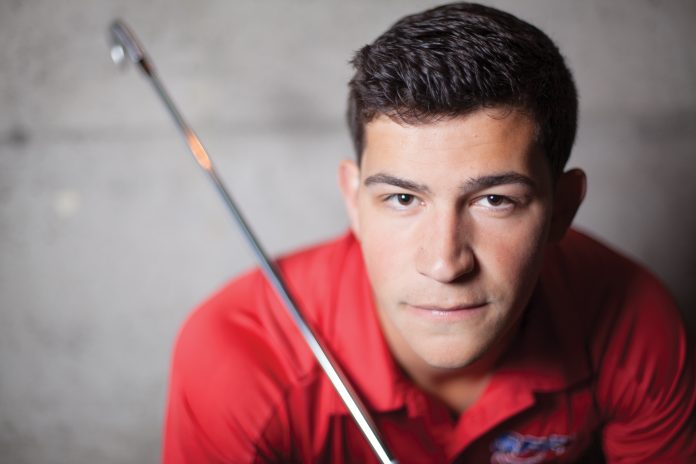
John Mlikotic enters his final year on the men’s golf team, hoping to lead them to national championship.

Screen Shot 2014-11-26 at 5.02.38 PMTo someone who has never stepped onto the golf course or hit a bucket of balls at the driving range, golf appears to be a rather easy game. All you have to do is walk up to a ball and hit it as hard as you can, repeating the motion until the ball is in the hole. How hard can that be?

Well, the truth is that golf is hard. In order to make that ball go anywhere, and preferably in the direction of the hole, you have to learn to swing the club, which is no small feat in itself — it takes many hours down at the driving range to come up with something workable. And that’s just scratching the surface before working on skills such as chipping, putting, or perhaps most importantly, your mental game.

So it’s rather surprising to hear senior golfer John Mlikotic say that he has only been playing seriously since grade nine, only taking up the game after having to hang up his skates.

“I was a hockey player when I was young, actually. I just lived and breathed hockey, but then things changed; I got injured multiple times and then I wasn’t able to play anymore. A bunch of my friends were golfers, and I thought ‘why not try it,’ so in grade nine I took up golfing, bought a membership and loved it. I haven’t dropped it since.”

Playing for his high school, Imaculata Regional, Mlikotic quickly became a proficient golfer, helping the school — which was single-A calibre — compete with the higher ranked triple-A schools. During his grade 10 year, his team went to provincials and came in second, and the following year the team won. To top it off, the school repeated in his grade 12 year.

However, his high school accomplishments were not just limited his team’s success; Mlikotic won the individual provincial championship in his senior year of high school as well — not bad for a player who only started golfing seriously in his grade nine year.

He attributes his quick proficiency to hard work: “I’d like to think I’m a pretty athletic guy, but I picked it up and just put a lot of time and effort into it. I dedicated a lot of time to improving and trying to catch up to my age group, because I was obviously pretty far behind,” said Mlikotic. “I think just hard work and the enjoyment and passion for the game definitely got me to where I am right now.”

He speculates that perhaps the late start made things easier in a way: “It probably took the pressure off me. I wasn’t really expected to do very well but, throughout time, I just kept getting better.”

His high school success carried over to his time at SFU — he was named a GNAC Second Team All-Star the last two seasons, and during the 2012-13 season placed third at the GNAC Championship, a team best.

“I played well that week and things were just clicking. We played in the final group, I learned a lot then [. . .] how to hold my composure while being close to the lead, not getting nervous and [to] not worry about results. I’d say that tournament was a contributor to adding confidence in my game.”

During his time here, he has focused on not only improving his golf game, but on his attitude as well: “When I was younger, I would just go out there and try to hit the ball far and see what happened from there. I think over the years I’ve matured and tried to stay patient throughout my rounds, and not get so frustrated when things don’t go well.”

Screen Shot 2014-11-26 at 5.03.30 PMNow, he is the captain of the men’s golf team, a position for which he is well-suited because of the importance he places on the mental side of golf.

“When I first came to SFU, I was young and maybe not mature enough at the time to realize that the mental side of golf is probably more important than the actual technical side, but now I realize that, and I’ve done research on that side of the game. I understand there’s certain techniques that I use to stay focused and stay calm on the golf course.”

This season, Mlikotic will lead the team in their quest for a national championship — a Clan golf first — as he begins his last season of NCAA eligibility.

SFU’s swim teams aim for next level

0
Both swim teams have risen to contender status.

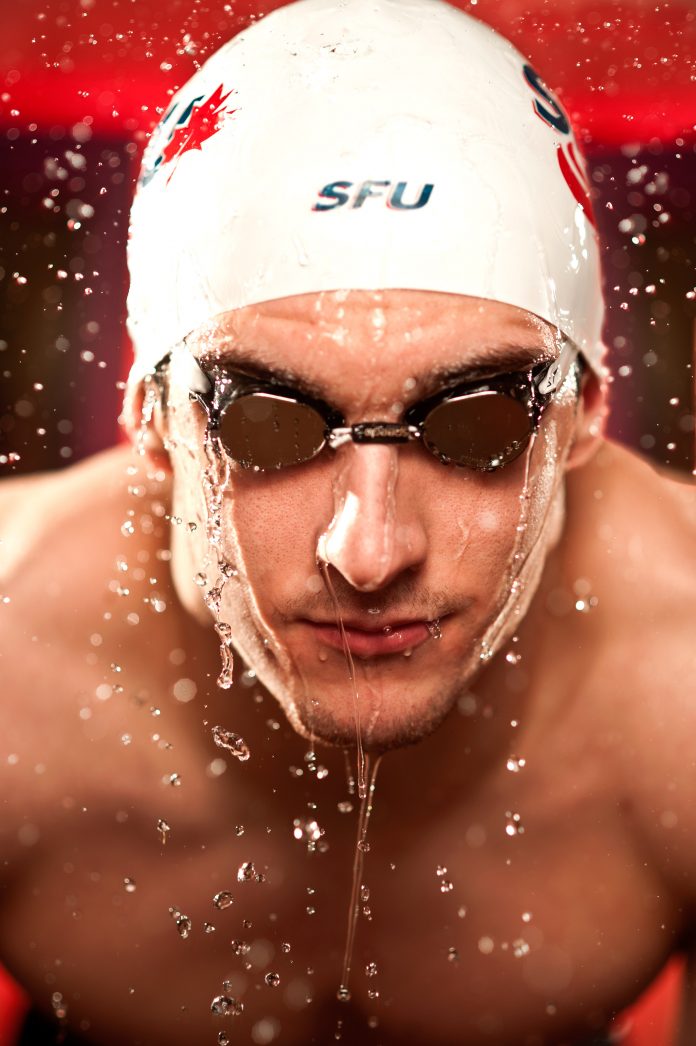
Entering their third year of NCAA competition, SFU’s swim teams have come a long way in a short time. The program, which started as one of SFU’s premiere teams, has been marred with ups and downs, but now looks to be a top contender in the NCAA once again.

In their first year of competition, the women’s team made it to the NCAA championship and placed in the top 10, while last season they placed in the top 20. Now, they look to push forward to a new level.

“Our team’s been improving every year and that’s been a goal for us,” explained head coach Liam Donnelly. “[With] the women’s team, our goal is to go down and get back in the top 10; ideally we would like to push into the top five. We’re going to need a full team effort to do that.”

He explains that, in order to do this, the team needs individual qualifiers. In order to place well, a team has to have enough swimmers qualified to represent it at the championship.

“The real challenge is getting the biggest team to qualify as possible. If you’re going to finish in the top five teams in the NCAA, you’re going to need 10 to 12 competitors to get enough points,” explained Donnelly.

In each of the last two seasons, SFU has sent six swimmers from the women’s team to the championship.

Donnelly hopes that SFU’s mix of veteran leadership and fresh blood will help propel them to higher glories: “We’ve got a good mix of returning leaders and freshmen on the women’s team.”

Senior Nicole Cossey, SFU’s 2013-14 female athlete of the year and All-American, returns to lead the team, having broken an NCAA record in the 100-yard freestyle at last season’s championship.

Also returning to wrap up their senior years are All-American Carmen Nam, Alexandria Schofield, and Grace Ni, supplemented by incoming freshmen including Maran Kokoszka and Megan Barrack.

The men’s team, however, has not had the same success — yet.

They enter this season never having qualified for the NCAA championship. This is not for a lack of trying, or even necessarily talent, as returning seniors Hans Heaves and Dmitar Ivanov just narrowly missed the cut, something Donnelly speculates will fire them up this season.

“We had a couple of guys knocking on the doorstep [. . .], it’s very bitter, it’s almost easier to finish at the back of the pack, where you don’t have much hope [of winning],” explained the coach.

The extra motivation for seniors such as Heaves and Ivanov should trickle down to the new talent, which includes freshmen Gabriel Lee and Adrian Vanderhelm, two swimmers the coach believes “have a pretty good shot at qualifying.”

For both teams, though, Donnelly is firm in his belief that they have improved from last season: “[They are] better in every way. The whole purpose of a university is to push your boundaries and your limits, whether it be in academia or athletics [. . .], about thought, thought processes, thinking and research; and we do the same athletically.

“The front-runners and the leaders on our team must continue to get better and the people who have just scraped their way onto it must do the same thing, so we are bound by this [principle],” concluded the coach.

Both teams open their season at home against the University of Puget Sound Loggers on Saturday, October 4.

Women’s soccer notches first win of the season

0

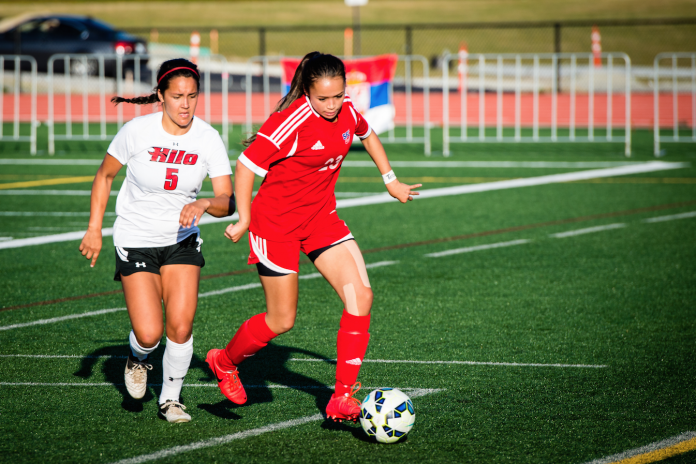
On Thursday, the SFU women’s soccer team earned their first GNAC win against the Western Oregon Wolves (WOU) by a score of one-nil. Usually a slim margin of victory indicates a close contest, but that was not the case in this game; SFU seemed to be in control almost from the outset.

The game started with SFU dominating the possession. In the 15th minute, midfielder Sierra Leung took a shot from just outside the 18-yard box and deposited it into the back of the net for a quick lead, which turned out to be the only goal of the evening for SFU, but not their last chance.

At the 20th minute, forward Olivia Aguiar got a header off from about six yards out, but it was right at the goalkeeper. She had a strong game, providing width for the team and delivering some excellent crosses into the box for her teammates. Aja Choy-Halo was also a notable presence whose physical defending frustrated the forwards of Western Oregon.

Nearing the end of the second half, freshman goalkeeper Priya Sandhu made what seemed to be her only difficult save of the evening, a nice diving save from a shot that was heading into the bottom corner.

The second half was more of the same. SFU played well defensively, forcing Western Oregon to attempt a counter attack. However, the visitors from Oregon could only manage long range shots, which were no trouble for SFU.

Screen Shot 2014-11-26 at 4.55.18 PMAssistant coach Lee Tregonning was pleased with the team’s victory: “Overall, the girls have come a long way. Based on their training attitude, and their playing attitude the last two to three weeks, they fully deserved a victory.”

He also addressed the squad rotation in the game, as there was a total of only five substitutions made by SFU. “We’ve got a small squad compared to other universities. Being able to trust and have everyone rotate when we need them to do a job, I think it’s a fantastic thing for the squad. Everyone that actually went in today fulfilled their duty and worked their socks off.”

The Clan look to turn this result into positive momentum as they travel to face the Western Washington Vikings in Bellingham, WA on Thursday, October 2.

Clan draw against Yellowjackets in overtime

0
SFU faced adversity in the second half.

Playing the Montana State Billings Yellowjackets (MSUB), the Clan faced enough twists and turns to make your head spin. Excitement was certainly not an issue in this game — though blown leads were.

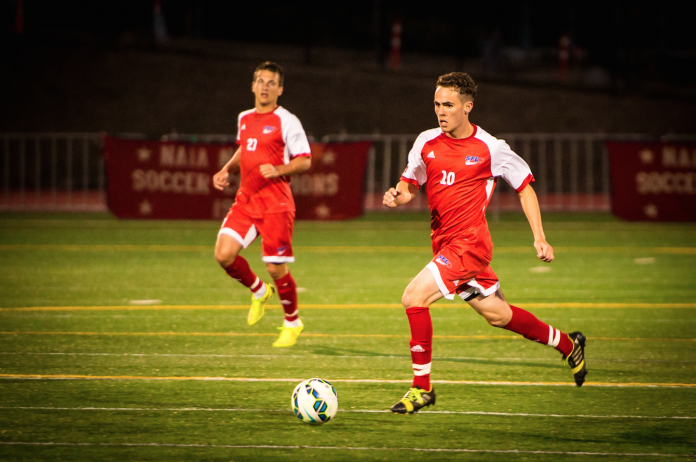
The game started off with a bang, as Clan midfielder Joseph Martin was taken down in the box within the first minute, leading to an SFU a penalty kick. Jovan Blagojevic did not miss the opportunity and delivered an early lead for SFU.

However, the lead was short lived, as the Billings returned the favour 12 minutes later, also off of a penalty kick.

SFU eventually seized a dominant lead, scoring two goals before the half was over, with Niko Schroettle and Ryan Dhillon adding to the total tally. Martin also notched an assist on the first goal. With a score of 3-1 in their favour, the game seemed to be in SFU’s hands.

The second half would prove to be less successful for the Clan.

Although it started off with a scoring opportunity for both teams, in the 60th minute, Martin was ejected for what appeared to be an obscene gesture towards the referee. This was a turning point in the match, and just like that, the Clan were down to 10 men.

To add injury to insult, starting goalie Brandon Watson was taken off the field with what looked like a pulled hamstring; Ivan Hutsulyak had to sub in to replace him.

In the 67th minute, MSUB’s Colin Ralston scored twice, tying SFU at three and eliminating the Clan’s hard earned lead.

Multiple scoring opportunities were exchanged before the half ended, the best chance for SFU being a saved header that tested the Montana goalie. The Yellowjackets scored just after time expired, and thought it should have counted. Luckily for the Clan, the referees did not agree, and the game headed into overtime.

Screen Shot 2014-11-26 at 4.50.58 PMThe overtime session was comprised of two 10-minute halves. Both teams waited until the last minute of the second half to make things interesting. Yellowjacket Strom Nuernberger was shown a red card and sent off. Off the ensuing free kick, defender Joel Malouf directed a header on goal that produced a rebound, but in the end was put wide. The game ended in SFU’s second straight draw.
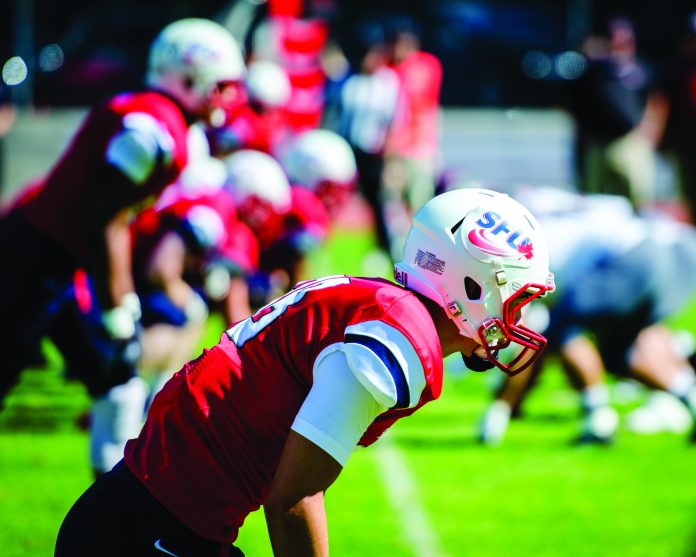

Head coach Alan Koch acknowledged the impact that Martin’s red card had on the game, saying, “It warrant[ed] a red card and that was part of the reason we didn’t get the three points tonight.”

Despite this, he was impressed with how the team handled the adversity. “I’m incredibly proud of the players that were on the pitch after we got the red card. Even though you’re a man down, you’re playing against a good team and our guys worked their backsides off throughout the game.”

Sports Briefs

0

Cross-Country

The Clan men’s and women’s cross-country teams both placed second at the 2014 Sundodger Invitational held in Seattle on September 20. Oliver Jorgenson and Rebecca Bassett led their respective teams finishing 24:39 and 21:36, each placing third. Both teams fell just short to the event champions, UBC.

Volleyball

The SFU volleyball team won against the Montana State Billings Yellowjackets (MSUB) on Thursday, September 25. Despite losing the first set, the Clan would end up winning in five sets in a back and forth affair. Kelsey Robinson and Mackenzie Dunham led the team in kills with 13 and 10 respectively. SFU now sits at .500 in the GNAC with a record of 2-2.

Hockey

The SFU men’s hockey team began their regular season Friday after splitting their exhibition games, winning against two Albertan teams, but losing to their local rivals, UBC and Trinity Western University. The team opens at home on Friday, October 10.

Men’s Basketball

The Clan men’s basketball team signed division I transfer Hidde Vos. Vos, who transferred from the University of Cal-State Fullerton, hails from the Netherlands. The 6’4 sophomore will play guard for the Clan. Head coach James Blake told SFU Athletics, “Hidde [Vos] is going to be one of the better shooters in the GNAC this season.”

Men’s Golf

SFU’s men’s golf team competed in back-to-back tournaments, placing second in both. The first, the Saint Martin’s Invitational, was held in Olympia, WA from September 19-20. Bret Thompson and Chris Crisologo led the team. The second was held last Monday and Tuesday at Western Washington University in Bellingham, WA. Chris Crisologo and Kevin Vigna led the team this time, placing the Clan ahead of the home team, the Vikings.

Basketball Alumnus

SFU basketball alumnus Chris Evans is heading to Scotland to play professional basketball. On Friday, the 6’0 guard from Port Moody was signed by the University of Edinburgh, where he also intends to continue his studies. This is the first professional contract for Evans, who last played for the Clan in 2013-14.

The Clan fall just short of an incredible comeback

0
The Clan showed marked improvement in the second half over the previous two games.

Although the scoreboard indicated a third straight loss for the Clan football team, the 32-24 result against the Azusa Pacific Cougars (APU) showed a team capable of fighting back, and perhaps one headed in the right direction.

SFU started the game with an abysmal first half, giving up 23 points and only managing to score a single field goal.

Right off the first drive, the Cougars converted for a touchdown after possessing the ball for nearly seven straight minutes.

Even though APU took a penalty on kickoff, the Clan were unable to convert for even just a first down during their first drive, which included a sack on quarterback Ryan Stanford. SFU was able to make a 16-yard rush, gaining back some of the yardage lost due to the sack and a false start penalty, before punting at their own 35-yard line.

The second drives for both teams were nearly identical. Azusa had another nearly seven-minute long drive, but SFU was able to hold them to a field goal. The Clan then followed with another fruitless four-play drive.

With 4:56 left in the half, the Clan finally got on the scoreboard with a 39-yard field goal, taking the score to 10-3. SFU also finally found some offensive rhythm, making 12 plays for 51 yards.

However, the Cougars would answer back immediately with two touchdowns before the half was over.

SFU allowed Cougar running back Terrell Watson 51 yards in a single drive and committed a 15-yard personal foul, both of which contributed to the first of the two touchdowns, taking the score to 16-3, as the Cougars missed the extra point kick.

After another ineffective SFU drive, APU would score the final touchdown of the half with 23 seconds left. The Clan could not even hold onto the ball until halftime, throwing an interception in the dying seconds of the half.

However, the second half was an entirely different story for the Clan. In the third quarter, they scored the only points: two touchdowns.

The first was built off a series of small gains and was saved by a bold move to go for a first down, rather than punting, at fourth and one on APU’s 20-yard line; Cole Tudor, who had 34 net rushing yards, ran for a five-yard gain.

The second scoring drive contained a few notable throws by Stanford, with wide receivers Kyle Kawamoto and Bobby Pospischil making 16- and 14-yard catches respectively.

The fourth quarter would bring a bit more trouble for the Clan — they suffered a safety followed immediately by an Azusa touchdown, putting up nine quick points, Azusa’s only points of the half.

SFU would come back with another touchdown after a poor Cougars punt left it at the APU five yard line with 1:08 left in the game.

Down by eight points, a Clan touchdown and a two-point conversion were needed to force overtime. The Clan made an onside kick and recovered the ball, making it to APU’s 21-yard line.

However, the comeback fell just short, as they missed on a fourth down conversion, and turned the ball over to the Cougars, who let the clock run with the final score 32-24.

Though the loss was a stinger, the resolve to come back in the second half showed a lot of heart, and an ability to stay in the game even when down by a seemingly insurmountable lead — something that was not there last game. SFU soundly won the second half 21-9, achieving all but three of their points in that half.

“Unfortunately [when] you combine both halves, you’re not the winner by a number of points but a lot of good things happened in the second half,” said head coach Jacques Chapdelaine. “We eliminated a lot of the costly mistakes that have been negative for us in terms of turnovers, ball security. We reduced the number of penalties.”

Chapdelaine also commented that, during the first half, the team could not stay on the field offensively, while on the defensive side, they were unable to keep the other team at bay. However, he noted that the most important thing is building a winning culture, so that the team perseveres through the mistakes they make and fights back — as they did against Azusa.

“We created and forged an identity for ourselves in the second half,” added the coach. “If there’s a silver lining in this defeat, it’s the fact that I thought our team got better tonight on a whole lot of different levels.”

Urban Outfitters needs to re-think its business strategies

0

Frankly, I’m not surprised by Urban Outfitters’ decision to sell a blood-stained, bullet hole-riddled sweater that blatantly refers to the 1970 shooting of four students at Kent State University. But, while the clothing company has released a number of offensive products, this sweater has simply gone too far.

The company sold the single sweater for $129 online; it was then put up for a $2,500 resale on Ebay, before it was eventually taken off the website. I’m sickened by the fact that a person would not only buy this sweater, but then try to re-sell it at such a high price. At this rate, Urban Outfitters and similarly-minded companies might as well begin pumping out Columbine, Sandy Hook Elementary, and Michael Brown attire to sell.

In response to this controversial incident, a slew of overwhelmingly negative comments emerged on social media. For example, Twitter user @toritaylor pointed out the horrific truth in stating, “How[ever] many @UrbanOutfitters staff OK’ed the design before it was printed = how[ever] many people should get fired.”

A company that hides behind poorly thought-out excuses clearly needs to find a new lawyer.

Twitter user @SamSPN13 responded to the incident with, “That’s just a punch in the face. I loved your store. Never shopping there again.”

The fact that the sweater was even up for sale means that it was designed, processed, and deemed appropriate by the company’s administration. Any company that considers graphic portrayals of a deceased person’s blood as an enticing mechanism for profit is one that should not be in business. How staggeringly immoral does a company have to be to entertain this notion?

Urban Outfitters has taken notice of the issue, and has since released an apology for the sweater, stating that “it was never [their] intention to allude to the tragic events that took place at Kent State in 1970.” However, I’m unconvinced that they would coincidentally depict blood splatter and bullet holes on a garment branded “Kent State University.”

In a Twitter statement, Urban Outfitters claimed that the red stains were “discoloration from the original shade of the sweater,” and the holes were due to “natural wear and fray.” If this is the case, then why would there be a $129 price tag? A company that hides behind these poorly thought-out excuses clearly needs to find a new lawyer.

I feel that Urban Outfitters, as a company, employs some of the most distasteful marketing strategies I’ve witnessed, and I will not be shopping there again. Anyone who belittles death and tries to profit from it needs to rethink these actions. Urban Outfitters, earn your profits by making comfortable, stylish, unobjectionable clothing rather than by inexcusable attempts to gain publicity.

How learning to cook has improved my well-being

0

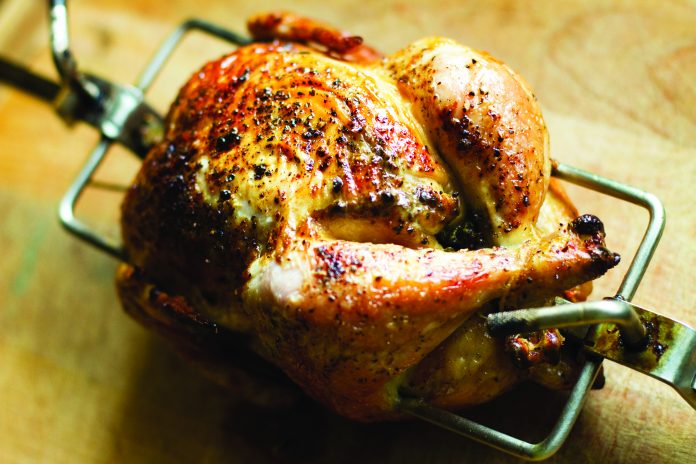
Most people can’t pinpoint the exact moment that they became an adult, but I can. I remember it like it was yesterday — the crackle of sizzling flesh, the smoke billowing calmly towards my open window, the smell of a well-cooked bird wafting throughout my studio apartment. What began as a soggy, shrink-wrapped sack of meat and bones had become a picturesque dinner for two through sheer force of will and the time-tested aid of a weathered cookbook.

I had roasted my first whole chicken, and I had become a man.

I’ll admit that, of all my New Year’s resolutions this year, I’ve only kept to one: I promised myself that I would finally learn how to cook, and though it’s hard to say if I’ve fully learned yet, I’m certainly learning. There’s something amazing about taking a mishmash of seemingly unrelated ingredients — a bay leaf here, some garlic powder there, a teaspoon of vinegar — and creating something new and wonderful that you can share with those you love.

It sounds cheesy, I know. But if you’ve ever spent hours in the kitchen making a meal from scratch, you’ll know that it’s worth it to see the faces of those you’re serving light up with genuine pleasure. Like playing the piano or speaking a foreign language, being able to cook (and cook well) is a skill that, once acquired, will serve you for the rest of your life.

Admittedly, part of the inspiration for my culinary goals is connected to having moved out this past spring — as those of you living on your own or with roommates will know, eating out isn’t cheap, and pre-packaged microwaveable meals leave something to be desired for those whose palates can differentiate a reheated pasta bowl from the real deal.

I had roasted my first whole chicken, and I had become a man.

Living with someone who’s often too busy to cook, the onus fell on me to learn how to turn regular grocery shop fare into meals both nutritious and delicious enough to sustain the lifestyles of two busy university students living under one cramped roof.

I was lucky enough growing up to have a father who, similarly, was the head chef of the household — most of what I’ve learned about cooking has been borrowed from him. Whenever I visit him, he shares with me a new recipe he’s been wanting to try, or shows me a new tool he’s bought for the grill. It’s this flair for experimentation that I’ve tried to carry over into my own cramped kitchen space: I’ll often liven up an old recipe with a new ingredient or flavour, just to keep things interesting.

But of all the benefits of learning how to cook for oneself, the one I value most is the ability to feed those I care about: my friends, my family, my partner. Maybe it goes back to our ancestors, who would hunt and gather food for those in their groups or tribes — all I know is, it’s hard to beat the feeling of fulfilment and accomplishment when you know you’ve provided someone you care about with a healthy, home cooked meal.

The best part? Once you get started, it ends up being easier, and much cheaper, than eating ramen and Kraft Dinner for every meal. My advice is to start slow — figure out how to fry an egg and cook a solid bowl of pasta, then move into intermediate fare like making soups and cooking meat. Before you know it, you’ll be wowing your friends and impressing your dates with your culinary flair. Bon appétit!