Home Blog Page 1092

Week 10 in Champions League

0
Bayern Munich took control of Group E.

It was a thrilling match day in the Champions League last Tuesday. There were a total of eight games, and a total of 20 goals were scored between them, an average of two and a half goals per game.

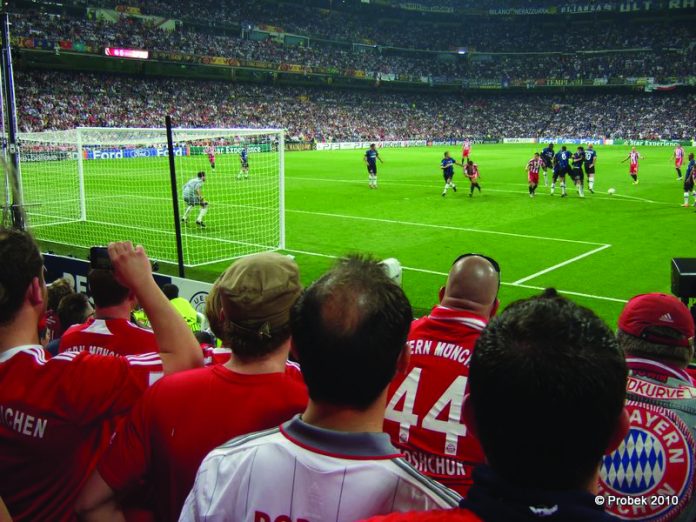
With an early start time — 9:00 a.m. here on the West Coast — Bayern Munich defeated CSKA Moscow one-nil. Thomas Muller scored the only goal of the game off of a penalty kick drawn by Mario Gotze, who was taken down from behind in the box after trying to dribble around a couple of defenders. Bayern dominated in possession, holding onto the ball for 73 per cent of the match. They are now in control of group E, with two wins in two matches so far in Europe.

The big match of the day was Paris St Germain (PSG) vs. Barcelona, the Group F matchup. The Parisians got the first goal, a left-footed shot by David Luiz from about 10 yards out. Barcelona responded just two minutes later with a beautiful goal, finished off by a strong left-footed strike from Lionel Messi, his 68th Champions League goal.

Marco Veratti gave PSG a 2-1 lead in the 26th minute — a header off a corner. Blaise Matuidi scored in the second half to put PSG up by two, but once again, Barcelona responded two minutes later with an excellent first time finish by Neymar, to cut the lead down to one. That’s as close as Barcelona would come, however, and the final score was 3-2 for PSG. This result leaves the group wide open, as both PSG, Barcelona, and to a lesser extent, Ajax, all now have a chance to take the top spot.

In another group E match, Manchester City took on Roma. The first goal of the game went to Man City as Sergio Aguero was pulled down in the box in the fourth minute, and calmly buried the ensuing penalty kick.

In the 23rd minute, Francesco Totti scored a wonderful chip shot to tie the game. With that goal, he became the oldest goalscorer in Champions League history, breaking the previous record set by Ryan Giggs. The game eventually ended in a 1-1 draw. Man City have made things hard on themselves with this draw — with only one point from their first two games, they’re going to need some wins in the near future if they want to progress.

Chelsea took on Sporting Lisbon in a group G clash. The only goal of the match was scored by Nemanja Matic, a header off of a free kick in the 34th minute. It was quite the even match, as both teams had 15 attempts on goal and the possession was almost split down the middle. Now with four points, Chelsea looks to be in control of the group.

In the other matches, Shaktar drew with Porto 2-2, Schalke 04 drew with Maribor 1-1, BATE beat Athletic Bilbao 2-1, and Ajax drew with Apoel Nicosia 1-1.

The Horvat Conundrum

0
Bo Horvat was the ninth overall pick in 2013’s NHL Draft.

The Canucks have an interesting problem, and for once, it does not have to do with a lack of prospects. In fact, it’s the opposite: too many prospects and too little room. Specifically, I’m talking about Bo Horvat and the difficulty he presents.

Frankly, the AHL is the proper place for Horvat. He wouldn’t be pressured to be NHL-ready too fast, and he would become accustomed to playing in a professional league against men not boys, if you’ll pardon the expression.

However, there is a rule that prevents players aged 20 and under from going to the minor leagues unless they have already played four years in the junior leagues (CHL).

Now, the Canucks have to decide whether they want to bring Horvat up to the big leagues — where he would most likely play fourth-line minutes as he may not yet be NHL ready — or to send him back to juniors to essentially waste a year.

Horvat is the only prospect who is really stuck in this situation. The Canucks may be full on paper, but the other prospects who might be ready to contend for a spot on the team — such as Hunter Shinkaruk or Brendan Gaunce — have played four years in junior, and can go down to the AHL, where they can be called up at any time.

It also looks as though Horvat will shape up to be a possible shutdown forward, not necessarily lacking an offensive edge, but certainly showing more potential in his defensive game, which doesn’t necessarily help his position.

Typically, players who are more defence-oriented require some time in the AHL. To be fair, all players could use AHL time, but it’s usually the high scoring — or potentially high scoring — first-rounders who make the NHL right out juniors, not the defence-first potential future Selke winners.

In what doesn’t seem to be a very controversial opinion, I think that the ruling preventing junior-eligible players from playing in the AHL should be thrown out.

Perhaps the rule helps the CHL retain players, as opposed to watching them bolt when drafted. Or maybe it is meant to protect the players from being sent to the big leagues before they are ready.

But at the end of the day, we’re talking about player development. Oftentimes, a draft bust, or a player not reaching their full potential, can be attributed to rushing that player out of the juniors, straight into the NHL.

The rule, as it stands, forces teams to make a hard decision: either rush the player into the NHL, or leave him in the juniors to waste a crucial developmental year. Playing in the AHL would be a much better option in this case.

Luckily, the situation isn’t that dramatic this time around. Horvat can still play nine games in the NHL before his entry-level contract kicks in — he could still be returned to the juniors after getting a taste of the big leagues with no consequence (which seems like the likely outcome).

But there should be another choice. If the rule is in place to protect players, then it defeats its own purpose, forcing players to either develop too quickly or stall completely. If the rule is to protect the CHL, it could be adjusted to allow only first round picks to play in the AHL (players most likely to have outgrown the junior level). A change such as this could lead to fewer draft busts and a few more players reaching their full potential.

Sports Briefs

0

Cross-Country

The Clan cross-country teams competed in the Stanford Invitational on Saturday, October 66 in Palo Alto, CA. The men’s team placed third in their respective class, while the women placed second behind Chico State. Rebecca Bassett finished fourth among non-Division I competitors to lead the women’s team, while freshman Marc-Antoine Rouleau led the men’s team.

Women’s Soccer

The SFU women’s soccer team lost a tight game in overtime to the Western Washington Vikings Thursday night. The Clan were able to hang in for a scoreless 95 minutes before the Vikings put one past freshman goalkeeper Priya Sandhu, who made seven saves in an otherwise perfect night. With the loss — their first GNAC loss — they are now 2-1 in conference play.

Men’s Golf

Over the weekend, the SFU’s men’s golf team competed in the Golfweek Division II Fall Invitational held at the Crosswater Golf Course in Sunrise, OR. Great Northwest Athletic Conference (GNAC) rivals Western Washington and Saint Martin’s also played.

GNAC Honours

Clan athletes Chris Crisologo, Rebecca Bassett, and Madeline Hait were named GNAC athletes of the week for the week of October 62-28. Crisologo is a member of the men’s golf team while Hait plays on the volleyball team. Bassett received her award for her performance at the Stanford Invitational.

Cancer Battle

A fundraiser was held at the Academic Public House on Sunday for former SFU football captain and 1996 Calgary Stampeders draft pick, David Lane, who was diagnosed with cancer earlier this year. The money will be used to help Lane seek treatment options outside of Canada.

With files from SFU Athletics and GNAC Sports

Clan lose first Battle for the Border

0
The Clan allowed an alarming nine Wildcat touchdowns.

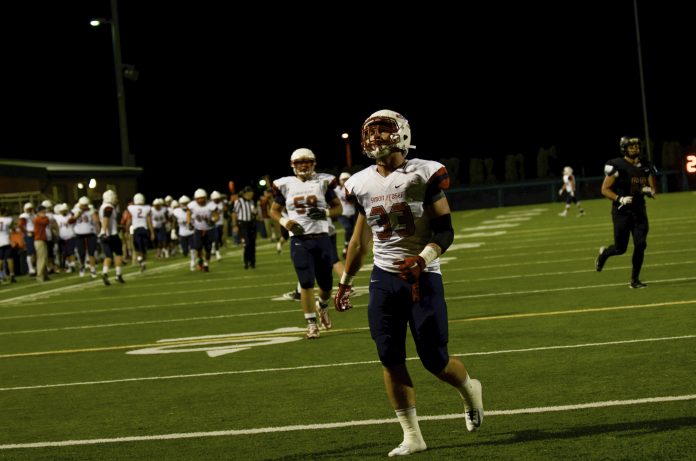
At the first ever Battle for the Border, the Clan continued their pattern of horrendous starts. Unfortunately, this time they did not play a redemptive second half.

The Battle for the Border was played against SFU’s closest conference rival, the Central Washington Wildcats (CWU), in a ‘neutral’ location in between the two universities, in Bothell, WA). Despite the fact that they are both in the Great Northwest Athletic Conference (GNAC), the game did not count toward conference standings.

Just after the third minute of gameplay at Pop Keeney Stadium, the Clan were already down a touchdown. A 56-yard pass caught by Wildcat wide receiver Greg Logan meant CWU only had to go three yards to put up the first points on the scoreboard.

This was only the beginning of SFU’s woes. After only five minutes had passed, CWU scored two more touchdowns. On both of the seven-pointers, the Wildcat defence prevented the Clan from achieving a first down, notably blocking their punt attempts to run them in for touchdowns both times.

After dropping 21 points, SFU was finally able to stop the bleeding — though only for the rest of the first quarter.

In this period of calm, the Clan were able to put up their first — and only — points of the game, off of a 26-yard pass from quarterback Ryan Stanford to wide receiver Bobby Pospischil, who led the team with 48 receiving yards.

However, only 1:38 into the second quarter, CWU scored again taking the score to 28-7, incited by another catch by CWU’s Logan, this time for 41 yards.

For the rest of the second quarter, SFU only allowed one more touchdown, and aside from being unable to produce any results offensively, they played a relatively tight defensive quarter. The bottom would not truly fall out until the second half.

When the bottom did fall, though, it fell hard. Up until CWU’s seventh touchdown, SFU could have still fought for a comeback. However, with 9:43 left in the quarter, that chance evaporated, as CWU took a  commanding 42-7 lead.

Before the game was over, CWU had scored three more touchdowns, winning 63-7. Stanford, who was sacked three times and threw two interceptions, was pulled from the massacre, giving second-string quarterback Tyler Nickel a chance to play. Nickel completed eight out of 17 passes —  not a bad showing.

Defensive linebacker Quinn Horton attributed the loss to a lack of urgency, saying, “We can’t rely on someone else to make a big play, we’ve got to go out and make a big play ourselves.”

He noted that, despite the lopsided score, the team had pockets of solid play, particularly for the last 12:44 of the fourth quarter during which CWU scored no points and SFU picked up 46 yards.

“At times our defence would shut down their run, and our offence could move the ball. When we wanted stuff, we could do it, but by the time we wanted to do it, it was too late,” added Horton.

With this game, the Clan drop to 0-4 for the season. However, as these games do not count toward GNAC standings, they have essentially been exhibition games.

SFSS Trip to the Border

DSC_7046

For the inaugural Battle for the Border, the SFSS took a bus of SFU students to Bothell, WA to watch the game.

At-large representative Jeremy Pearce previously told The Peak that he wanted to expose SFU to an American NCAA game, where university football is ingrained into the culture, saying, “I want students to experience that atmosphere and then eventually I’d love that atmosphere to carry over up here [at SFU].”

Although the number of students in attendance was smaller than the SFSS had anticipated, causing them to cancel an intended second bus that would have left from the Surrey campus, those who did go seemed to enjoy the experience.

Michiko Araki, a business student and former member of the women’s wrestling team, told The Peak, “I was kind of hoping [the Clan] would do better but it was cool that they had people bus down here for the event.”

Pearce hopes that this will be the first of many such events: “Based on everybody’s responses, hopefully this is something we can build on.”

Meet the Clan: Ryan Stanford

0
Ryan Stanford played for two different schools before coming to the Clan, but has found a home at SFU.

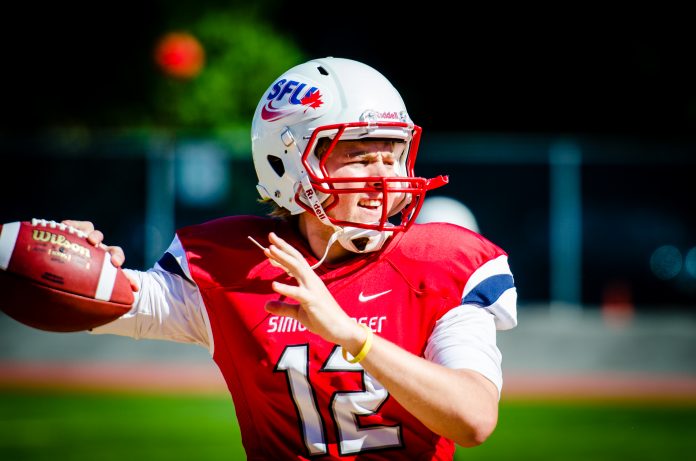
Screen Shot 2014-11-26 at 1.07.24 PMNow entering his second year with the Clan, Ryan Stanford has finally found a home.

A star quarterback on his high school team, the Horizon Huskies, Stanford initially chose to play for the North Dakota State Bison, an NCAA Division I FCS team. During his time there, the team won the first of its three national championships.

However, he was fourth on the quarterback depth chart, and did not see much playing time his freshman year; the team’s contender status made it unlikely that he would see any playing time in the near future.

So, in a bold move, he packed his bags and returned home where he played for Phoenix College, with the hope that another four-year football program would find him.

Luckily, the gamble paid off when then-SFU head coach Dave Johnson recruited him for the Clan’s 2013 season. And after a tough battle at training camp, he finally snagged his much coveted starting quarterback position.

He stresses, though, that his goals revolve around the team’s success, not individual glory: “I think, as a quarterback, the goal is always to put the team in the best possible chance to win. I’m not really concerned about personal statistics or anything like that. I want to be able to turn this program around, get some wins, some conference wins, and be competitive for years to come.

“Hopefully, [we can] change the culture of what people think about SFU football and take it to the next step,” he added.

Stanford hopes to help drive that culture shift within the team as well. “When I first got here [we had] this culture of accepting mediocrity and losing. We’re trying to change that. We want to be able to excel and succeed, be the best at what we do, so it starts one practice at a time. It’s not going to happen overnight, but I think we’re heading in the right direction.”

At the end of the day, what really matters is how the team plays on the field, and Stanford believes that this too is heading in the right direction towards contender status: “I think that the record doesn’t show it, but we’re really close and it’s frustrating and promising at the same time because we have the people to do it, but [we’re] just a little bit of confidence away from doing it.”

While the frustration of being close, but not putting up results can often lead to an even deeper hole, Stanford does his best to keep his head up. “It can [hurt],” he says. “I try not to show it. I think that each game we’ve gotten better at believing that we can achieve our goals, but it gets frustrating. It’s something that we have to overcome and will overcome.”

Despite going winless so far in their non-conference games, he still believes that the team can contend with anyone in the Great Northwest Athletic Conference (GNAC): “Going into every game, I felt we’ve been able to be in a position to win. Of course that’s probably biased from someone who’s on the team, but I don’t think we faced a team, and probably won’t, that is that much better than us.

“I think we’ve made mistakes and that’s what’s hurt us the most but [. . .] conference play starts this week, so all our goals that we set in the beginning of the year can still be accomplished,” said the 6’3 quarterback. “We haven’t given up on those goals yet, so we can still go out there, win the conference, and go from there.

“I do [believe winning the conference is possible]. If not this year, then this team will be a pivoting point for future teams and we’ll get it done sooner rather than later,” Stanford added.

At Swangard Stadium, home crowds provide the Clan with even more motivation to move in the right direction. But an away crowd motivates the QB as well.

“For me, I like playing away. I like being able to just go out there and disappoint those other [team’s fans]. I feed off both energies, positive and negative, and it motivates you to either quiet them down or make our own fans louder,” he concluded.Screen Shot 2014-11-26 at 1.08.54 PM

As conference games begin, Stanford will have to channel both the positive and negative energies, and the highs and lows, as he is expected to lead his team to success. He’s been preparing for a long time, and now it’s his time to shine.

Volleyball team lose back and forth affair

0
Clan fell just short after a hard fought fourth set.

The Clan went head-to-head with a giant and lost on Thursday night, as they fell in four sets to the Great Northwest Athletic Conference (GNAC) leader, the Northwest Nazarene Crusaders (NNU).

Despite strong performances at home by key players including Madeline Hait, Kelsey Robinson and Amanda Renkema, SFU was unable to contain the Crusaders, who continued their domination of the conference, pushing their winning streak to 12 games.

Down 24-21 at the end of a back-and-forth first set, SFU took a tactical timeout but unfortunately, not even the jazz band’s rendition of “Eye of the Tiger” could inspire them to claw their way back. NNU won the set after the next serve with a key block on a Clan attack by outside hitter Devon May.

SFU continued their strong play into the second set and managed to squeak out a 25-23 victory, finishing up with two straight kills from Kelsey Robinson.

“I think we showed a lot of composure at the beginning,” middle blocker Madeline Hait told The Peak. “It’s tough today because it’s a close game but I’m so proud of how my team played and everyone really came together.”

Hait, who was recently named the GNAC defensive player of the week, led the Clan offensively with 16 kills.

Unfortunately, the Clan could not maintain their solid play in the third set and decisively lost 25-13, notching only seven kills in the set. This killed the mood of a home crowd who had been treated to two sets of competitive volleyball, and a highly entertaining blindfolded volleyball contest during the intermission.

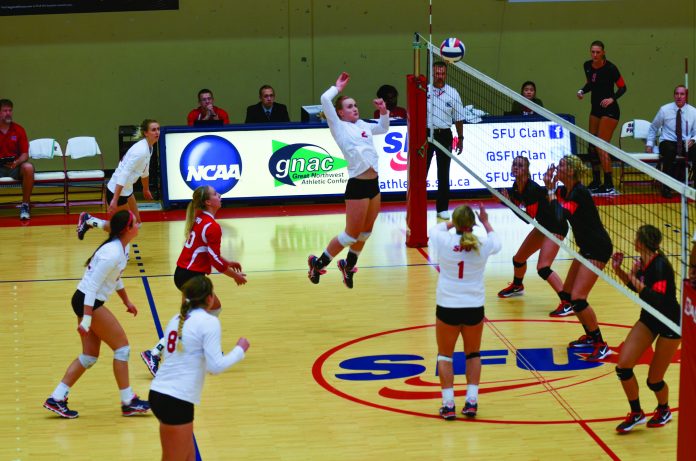
Screen Shot 2014-11-26 at 11.20.36 AMHowever, SFU returned to form, regaining the crowd’s support with a strong performance in the fourth set, featuring many rallies that could have gone to either side. In the end, though, they fell just short 25-21.

NNU’s Elayna Rice, who was named last week’s GNAC offensive player of the week, continued to shine by leading her team with 14 kills and, ultimately, got the best of the Clan.

“She was one of the key hitters and I definitely think that she’s a really good all-around player,” Hait said of Rice. “Something we can improve on is shutting down key hitters.”

The Clan will look to bounce back from this loss and already have their eyes set on Saturday’s tilt against Central Washington. Head coach Gina Schmidt likened the challenge to the one they just faced and said that she is “expecting another good game, just like this one.”

Clan seal first conference victory

0

The SFU men’s soccer team got back to its winning ways on the road Thursday, with a decisive 4-0 result against the Saint Martin’s University Saints (SMU). With that, the Clan snapped a four match winless run and achieved their first victory in the Great Northwest Athletic Conference (GNAC).

It was a fantastic response to a frustrating setback last weekend against the Northwest Nazarene Crusaders, who handed the Clan their first loss at home this season with a goal in the dying minutes of overtime play.

SFU quickly shook off their disappointment and brought their A-game to Lacey, WA, much to the satisfaction of head coach Alan Koch.

“I’m very happy with how they played; they came here very prepared and put in a great performance,” Koch told The Peak.

“The guys have had a reality check the last few games and been humbled a bit, but today you could see the hunger in them and the willingness to play for each other,” he added.

Sticking with their trademark style of play this season, the Clan started the match guns a-blazing with three goals in the opening 20 minutes. Magnus Kristensen linked up with Ryan Dhillon in attack, who then provided the assist for Jovan Blagojevic’s go-ahead goal.

Screen Shot 2014-11-26 at 11.18.19 AMDhillon would contribute further, less than 10 minutes later, with his third goal of the season thanks to a pass from Nico Espinoza. Blagojevic found the back of the net just three minutes later, taking his tally to eight goals as top scorer in the GNAC.

Espinoza, who started for SFU for the first time, made his presence felt tremendously  by grabbing the Clan’s fourth goal of the match, as Blagojevic found him open to tap in the ball from the middle of the box.

“Nico’s first start was fantastic,” said Koch. “We expected a lot from him and he exceeded those expectations, he’s a great distributor of the ball and spread play throughout the entire pitch.”

Defensively, the Clan were also top notch, allowing just two shots on target in the match and achieving their first clean sheet of the season.

The men will have to turn this momentum into more wins, in order to make the post-season, in what is turning out to be a highly competitive season in the GNAC.

Clan split season openers

0

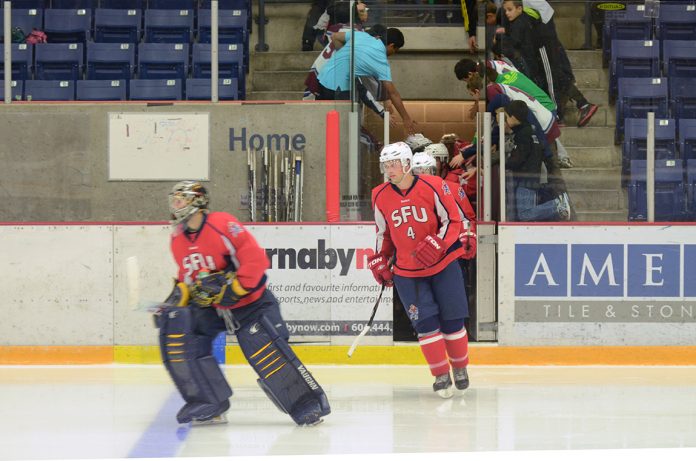
For the season opening series, the men’s hockey team hit the road, travelling to face the Eastern Washington University Eagles (EWU) in back to back games. The Clan were able to achieve a win on Friday night, but not on Saturday, losing out on a chance to shoot to the top of the league.

In Friday night’s game, the Clan got off to an early start, as Jesse Mysiorek and Jono Ceci made it 2-0 on a powerplay. However, the Eagles scored at the 7:07 mark of the first to cut the lead down to only one.

The second period was marked by a goal from Jesse Williamson, while the third period featured a goal from Nick Sandor, and a clean period of play with no penalties to either team. Jono Ceci was named the first star of the game, with a goal and two assists. The final score was 4-1 SFU.

Saturday night’s game was a different story entirely. This time, it was the Eastern Washington Eagles who got off to a quick 2-0 lead. The Clan managed to get to within one with a goal from Jared Eng, but the Eagles scored on a powerplay a few minutes later to restore the two goal lead.

Nick Sandor made it 3-2 in the second period, but due to a lack of Clan discipline, the Eagles were given a powerplay opportunity which they did not squander, bringing the score to 4-2.

The third period ended in a flurry of penalties. SFU’s Jesse Mysiorek and Tanner Hawes of Eastern Washington were both given 12 minutes in penalties: 10 minutes for game misconduct and two minutes for unsportsmanlike conduct. The Eagles added an empty net goal after the fact to make the final score 5-2 Eastern Washington.

Head Coach Mark Coletta, was pleased with how the team played over the weekend, however. “I thought we played really well,” he told The Peak in a phone interview. “We deserved to win both [games]. We just couldn’t score in the second game.”

Going forward, Coletta said, “We know we have a strong lineup. We can’t take games for granted like we did Saturday, we have to go into every game with the right mindset.”

The men’s hockey team will open at home on Friday, October 10 at Bill Copeland Sports Complex against Selkirk College.

Portrait of the Undergrad as a Young Man

10
Jacey smash!
"Frats are generally the go-to stereotype when we think of the college man; he goes on panty raids, engages in nasty hazing rituals, and drinks enough to tranquilize a horse."

Think of the average college man: what does he look like?

Is he the boozy, womanizing frat boy of films like Old School and Animal House? Is he the brazen college football star, whose ego is as artificially inflated as his GPA? Is he the nerdy shut-in, browsing 4chan and trolling feminist blogs instead of studying for his final exam? Or is he the snobby, pretentious Ivy League rich kid, silver spoon firmly implanted in his mouth?

If these seem like overgeneralizations and stereotypes, imagine how we feel. Young men in Canada and the United States, navigating the minefield between adolescence and adulthood, are in a steep and steady decline. Where their female counterparts are excelling in academics, starting clubs, and joining the workforce, men are getting lower grades, drinking more dangerously, and ignoring their studies.

They’re also reacting aggressively and often violently to the shifting demographics in colleges and universities across the continent. Business school students chant rape slogans at frosh events; sexual assaults are shared online and victims are blamed for attire and attitude; most recently, Carleton boys wearing “Fuck Safe Space” T-shirts have gained national attention and subsequent scorn.

There’s a strong link between participation in a fraternity and a decline in cognitive function and GPA.

Campaigns to quell the tide of sexual violence on campuses have begun shifting their focus towards men. Their argument is that, in a society that opposes rather than condones rape, we need to focus on the perpetrators, not just the victims.

These campaigns — as well as our cultural conversation around college men, and indeed all men — are on the right track. But they don’t go far enough. Telling men not to commit rape in college is a temporary bandage on a centuries-old wound that’s been festering since antiquity. Too many cultural critics have claimed that our sense of masculinity is in crisis, or that this is the end of men — and, in a way, it ought to be. But the problem here isn’t just men. It’s our cultural and social conception of what men should be.

Long before any boy in North America even thinks about applying to a post-secondary, he’s spent years of his life being told what to do and how to act by his parents, his peers, and countless authority figures.

He’s been called a pussy, a faggot, and a queer. He’s either been taunted in locker rooms and hallways, or done the taunting himself. He’s been threatened with social isolation and humiliation if he doesn’t live up to expectations of our society: namely, that he man up, not show any outward emotion, treat women as prizes to be won, show little interest in schoolwork, and express himself chiefly through violence and aggression.

As we age, the line we draw in the sand separating men from women becomes thicker and more pronounced. (As a result, those who don’t fit on either side of the binary tend to be unfairly cast out by our one-or-the-other society.) In that stressful and pivotal proving ground between boy and man is university: a series of culturally codified negotiations between scholastic achievement and party boy thrill-seeking.

This is a sales pitch. Our idea of college, borrowed from comedy flicks and breathless word-of-mouth, is culturally created, in part to woo young people into paying big money for an education they might not actually be interested in. We’ve created an image of college as one big four-year-long party, and this fantasy persists for many, despite the consequences.

We’ve created an image of college as one big four-year-long party, and this fantasy persists for many, despite the consequences.

It’s more complex than that: in college, we learn to negotiate social situations in a way we’ve never had to before, and issues such as consent and the politics of gender are introduced and explored, often for the first time. Our society does a woefully inadequate job of preparing men to deal with these issues in a respectful and tolerant way — boys are conditioned to react violently and carelessly to what they don’t understand, and what challenges their means of self-identification.

Masculinity is our societal default, our culture in neutral. We so rarely think of men as gendered the way we think of women, or those who exist outside the binary: so much of our society is built on our concept of masculinity, and the way it naturally intersects with values such as confidence, power, and accomplishment. It’s hard to think of a better way to describe the concept of man than as not woman, the same way women are defined as not men. Young boys are conditioned to be terrified of seeming girlish or feminine, and punished when they violate this social code: it threatens our sense of who we are.

But masculinity is a performance, like anything else. It’s made up of a complex language of codes and signifiers, all of which are taught to boys at an age too young to know any better. We don’t cry because men don’t cry. We drink because men drink. We are violent and aggressive and careless because that’s just the way boys are.

These are myths, plain and simple. There’s nothing intrinsic or natural about the way we think of manliness — it’s a performance that’s been carried on and on for centuries. The cast and the stage might be different, but the script has barely changed.

Untitled-1

Few contexts carry as many assumptions and challenges for our current definition of manhood as college. We think of it as the place where boys become men, as though it isn’t a process that spans one’s entire life. Countless friends and acquaintances, counting down the last days of high school, shared with me their lofty dreams for higher education: to go to parties, have sex, and generally raise hell.

Partly, this fantasy persists because college is historically a boys’ club. The first North American college to allow female students did so in 1833 — centuries after the first institutions opened their doors — and it took another hundred years or so until most colleges stopped categorizing women as ‘incidental students.’ Up to the 1970s, boys in Canadian colleges outnumbered women two to one.

Simon Fraser University, known for its political radicalism, introduced their first Women’s Studies course in 1971, but it took decades for other institutions to follow suit.

At the centre of the male university fantasy is the fraternity: historically all-white, all-male organizations which borrowed heavily from the guidelines of freemasonry and other secret societies. It’s impossible to tell the story of the university without telling the story of the fraternity — a quick look at the Fortune 500 or the list of big league politicians in the United States shows just how far the frat boy tag will take you.

Frats are generally the go-to stereotype when we think of the college man; he goes on panty raids, engages in nasty hazing rituals, and drinks enough to tranquilize a horse.

Sadly, there’s plenty of truth to the stereotype. The Atlantic reported earlier this year that over 60 people had died in the past decade as a result of fraternity-related pranks and activities. Many more have suffered serious injuries, engaged in or been victim to sexual assault or harassment, consumed dangerous amounts of alcohol or other stimulants, and ignored their studies.

The last issue is particularly prominent for first-years: multiple separate researchers have indicated a strong link between participation in a fraternity and a decline in both GPA and overall cognitive function.

Frank Harris of San Diego State University notes in an essay on college masculinities that membership in a fraternity is often seen as a measure of one’s popularity and dominance in the university setting — the only men more popular than frat boys are student athletes, whose statistical connections to physical assault mirror their fraternity brethren. Both subtypes tend to be associated with violence, power, and emotional immaturity — exactly the same archetypes boys are taught from childhood on.

The drinking doesn’t help, either. The world of alcohol has long been male-dominated: beer and spirit commercials uniformly target the frat boy and his grown-up counterpart, promising bikini-clad women and the excesses of unhampered virility. Every year, more than 1,800 college students die from alcohol-related accidents — most of those involved are men, who drink more than women on average. Students most at risk for drinking problems, according to recent research at the University of Washington, are “incoming freshmen, student athletes and those involved in the Greek system [fraternities].”

Where men who fit the narrow definition of manhood in college tend to be rewarded, those who don’t are often ostracized and humiliated. The pointed backlash against men who espouse feminist or egalitarian ideals betrays just how afraid men are of losing the power they’ve inherited. “Fuck Safe Space” T-shirts can be roughly translated as: I feel threatened.

The saddest part is that this reaction is hardly a surprise. These men have been told by authority figures their whole lives that masculinity is the ultimate ideal to live up to; that their dominance and influence in society is earned, rather than a product of historical power dynamic; that they should react to any challenge of that dominance with aggression and violence.

Yet we’re still shocked when men push back in violent and hateful ways against an increasingly tolerant and progressive society. We, all of us, are the ones who teach them to behave this way. It’s a poisonous and circuitous system, and one that’s best fixed by going straight to the source. To change men, we need to change our definition of what men can be; we need to throw out the rulebook and start fresh.

The truth is that universities, in the grand scheme of things, have only very recently become safe spaces for anyone who isn’t white, male, cisgender, heterosexual, and wealthy. And many would argue, convincingly, that they still aren’t truly safe spaces. The number of sexual assaults on campuses in North America is staggering: in Canada, roughly 29 per cent of female college students will experience some form of sexual assault while earning their degrees. These assaults are almost uniformly perpetrated by men.

And they’re getting worse: between 2001 and 2011, instances of sexual assault on American campuses shot up by 52 per cent.

The problem here isn’t just men. It’s our cultural and social conception of what men should be.

However, despite these challenges, women continue to excel in the university setting. Between 1971 and 2007, women went from making up 32 per cent to 59 per cent of college graduates in this country. Women in Canada are also much less likely to drop out of college or high school, and tend to be much more involved with extracurricular activities such as student government, clubs, or university media organizations.

Even sororities aren’t associated with the same low grades and violent statistics as their male counterparts — in fact, in second- and third-year students, sororities have been associated with positive trends in GPA and performance.

The increasing prominence of women on campus has inspired more institutions to adopt programs to benefit their needs: women’s centres have become commonplace, as well as LGBTQ organizations and expanded gender studies departments. The cultural conversation around campus sexual assault has been slow to build but steady, and an increasing outcry for better policies for victims has resulted in serious change at many institutions.

There’s no reason men can’t participate equally in this atmosphere of increased tolerance and understanding. Many do — our school is full of men who see themselves as allies, who support SFU as a positive learning space from those of all genders and backgrounds. Some of them are even involved in our fraternity or sports teams, changing the conversation from the inside out. Across the continent, others like them are working to make college campuses safer spaces for everyone.

But most importantly, we to change the way we treat men when they are young. We need to tell boys about consent, and teach them to think of women not as adversaries or sexual goals but as people, as equals, as collaborators. We need to promote respect and tolerance and emotional expression for everyone, and not make arbitrary distinctions based on a chromosome or a different set of genitals. We need to expose our ideas of masculinity for what they really are — a fiction.

In that fiction, there are ideas to reconcile. Strength and self-assurance and confidence are all virtues, and the leadership skills we teach boys have helped to make some of the most remarkable human beings who’ve ever lived.

But these traits needn’t be associated with any particular gender — or person, for that matter. Once we begin teaching boys that there are no limits to who they can be and what they can achieve, we’ll start to see the change our society sorely needs. To think men can’t change and evolve is shortsighted — we just need to give them the chance.

Want to change the world? Want to make better, more tolerant human beings? Start them young.

Survey tracks pass-ups at Burnaby campus

0
Transit on Burnaby campus has been a long-fought issue.

Next time the 145 passes you by, you can air your grievances online using the SFU Student Mobility Advisory Committee’s (SMAC) bus pass-up report form, meant to track transit troubles on the mountain.

SMAC, along with representatives from the SFSS, GSS, and SFU ancillary services, is asking students to contribute to the survey whenever they are passed by buses that are already at capacity — a frequent problem for students going to or departing from campus.

The groups plan to use this data to lobby Translink for improved bus service on Burnaby campus.

“There’s quite a level of frustration on campus about transit.”

“There’s quite a level of frustration on campus about transit, and so it’s really important that we capture this data, this information, so that when we meet with [Translink], we’re able to show what really is the situation,” explained Mark McLaughlin, director of SFU ancillary services. “The situation is really unacceptable, so we have been in touch with Translink to try to get them to remedy the situation.”

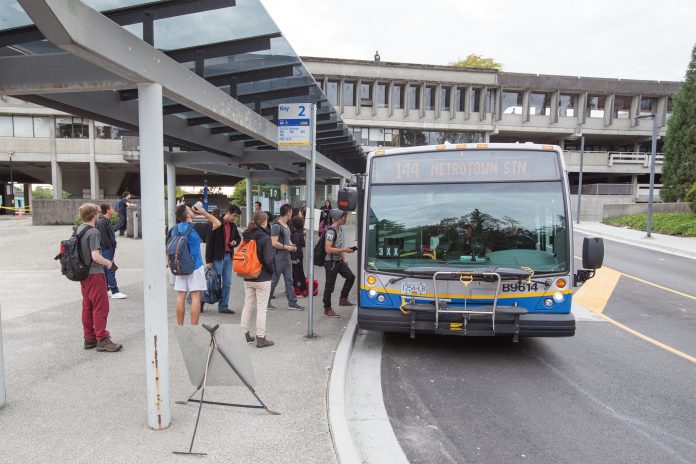
The problem of pass-ups is felt acutely at both the bus loop near Cornerstone and the Transportation Centre. McLaughlin explained, “There is a lot of congestion, a lot of overcrowding, and that results in pass-ups because the buses are full.”

The survey, which has been up since the end of September, asks for students’ emails, the bus stop at which they were passed, the number of the bus, and the time of day. “The information we’re gathering, it’s really coming in rather fast and furious,” McLaughlin commented.

The SFSS has a history of transit advocacy, so when McLaughlin approached the organization for support on the initiative, they quickly jumped on board. “Obviously there has been issues with [transit on campus],” Darwin Binesh, SFSS VP external said. “People sit at the last stop on the 143 and get passed seven or eight times before a bus actually brings them to school.”

He continued, “If we collect a lot of this data, if people fill out the form online, every time a bus passes them for whatever reason, we can keep track so that when we go to Translink and make arguments for better service, we have our own data to prove it.”

Cheryl Ziola, manager of media relations at Translink, told The Peak that they are well aware of the customer concerns about bus pass-ups at the SFU loop and have had transit supervisors and transit security on site to monitor the situation and ensure customer safety.

“We anticipate that congestion will ease next week when the detours around construction at the lower exchange are complete and all buses return to regular routes,” she explained. “Typically, September is one of our busiest months as students and teachers return to school. This peak ridership tends to level off as people adjust their schedules to non-peak class times or seek other alternative transport modes such as cycling or carpooling.”

For the fall, Translink has deployed all available buses to major student hubs as part of their service adjustments. These adjustments include weekday frequency increases to the 135 and 143 and a return to regular service hours for the 145.

The SMAC survey will continue to be offered online indefinitely, with SFU representatives approaching Translink once they have accumulated more data.

In the meantime, SFU will expand the space at the Cornerstone bus loop near the 145 stop in order to ease congestion and make transiting home more comfortable for students.