Home Blog Page 1090

University Briefs

0

UBC students rally in support of Hong Kong Umbrella Revolution

The UBC Hong Kong Student’s Association (HKSA) continues to vocalize its support for pro-democracy protesters in Hong Kong after hosting the Operation Yellow Ribbon student campaign earlier this month.

The group handed out over 500 yellow ribbons, as visual representations of support, and tied over 275 metres of yellow ribbon to students’ wrists and backpacks.

HKSA president Patricia Poon told Vancity Buzz, “We offer full support to Hong Kong students and their spirit. It is ultimately for the people of Hong Kong to decide what is best for them in the upcoming days.”

With files from Vancity Buzz


Google harvests innovators from U of Waterloo

University of Waterloo has been named one of the top recruiting sites for Google in North America.

The university has one of North America’s leading computer science programs, which acts as a natural recruitment site for high-technological companies such as Google.

Steven Woods, engineering director at Google Canada, explained, “[There] is an amazing amount of technical talent in Canada, and University of Waterloo is the center of that [excitement].”

With files from Canada Business Review


Lab explosion sends two to hospital

Two researchers were rushed to the hospital last Monday morning after being caught in a small chemical blast at the University of New Brunswick’s Fredericton campus.

The explosion occurred in the Enterprise Building, a research facility. Assistant fire chief Dave McKinley said a “small glass vessel” exploded and the chemicals involved were non-volatile. He said that there was  a small amount of blood visible at the scene of the explosion, but no flames were produced.

The researchers had minor injuries, and the building was temporarily evacuated after the blast.

With files from The Silhouette
SFU increases its financial support for students

0

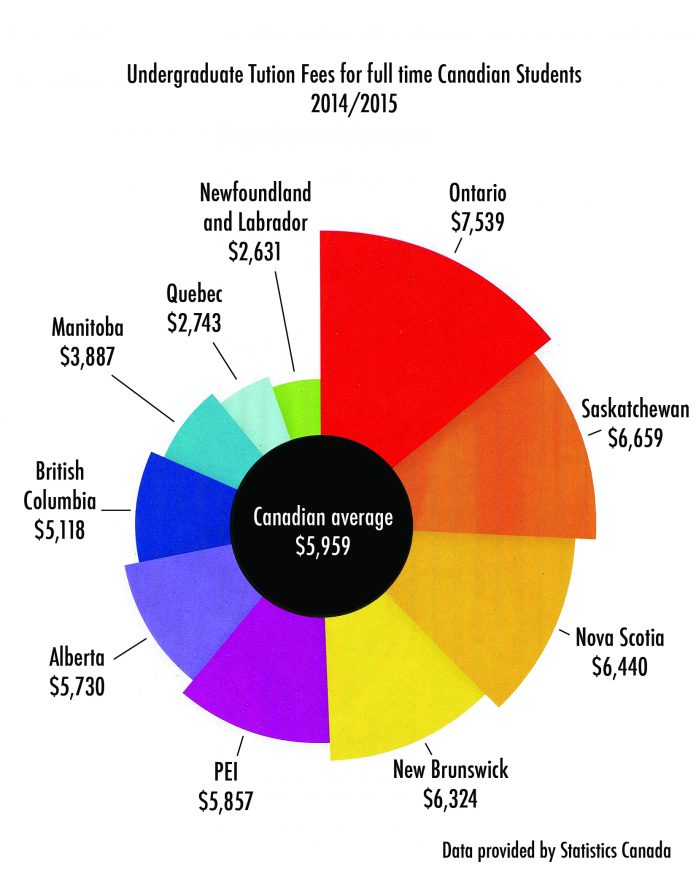
SFU is improving options for students seeking financial aid in response to rising tuition costs nationwide.

The Canadian Federation of Studies recently announced that post-secondary tuition costs in BC have increased twofold compared to 10 years ago.

According to the Canadian Centre for Policy Alternatives, the average university tuition in BC is expected to rise to $6,111 by the 2017/2018 school year.

SFU is not exempt from these tuition hikes. According to Tim Rahilly, associate vice-president, students, “We have had a two per cent increase, which is the cap for domestic students.”

When asked what SFU students can do to acquire more financial support, he mentioned several options, such as bursaries, open scholarships, and major entrance awards. “All the various provincial loan programs are certainly available to SFU students if they’re full time and if they qualify,” said Rahilly.

Manoj Bhakthan, director of Financial Aid and Awards at SFU, explained that there are increasing options for SFU students to obtain financial assistance. “SFU’s institutional budget for scholarships, awards, and bursaries has been moving up,” he said. He reported that the budget is currently a little over $11 million annually.

Along with this, he said that there has been an increase in the number of privately funded and endowed scholarships and bursaries.

For international students at SFU, the situation is more complex. As Rahilly explained, “During each of the last three years, we have had an increase for international students of an additional eight per cent per year.” He emphasized that the tuition increase for international students, “follows after several years of not having tuition increased, even though [SFU] had increased domestic tuition for several years.”

When asked about scholarships and financial aid for international students, Bhakthan replied, “International students are eligible for most scholarships, awards, work-study, and bursaries administered through SFU. [However], international students are not eligible for Canadian government student loans and grants.”

According to Bhakthan, the number of domestic and international students who received bursary funding at SFU in 2012/2013 academic year totalled about 3,800.

The Department of Financial Aid and Awards is advocating for further funding on an annual basis. “For example, over the past three years, [the department] received additional funding from the university to further support our Aboriginal students,” Bhakthan said.

He also spoke about a campaign called the Power of Engagement, though which SFU hopes to reach its fundraising goal of $250 million dollars by September 2015. Of these funds, $100 million would be delegated to financial aid for students.

Nevertheless, only a portion of students’ tuition is covered by existing financial aid. Rahilly held that there are many students who rely on their families for financial support, which can have a major impact on all areas of the population.

When families are resposible for a portion or the entirety of their child’s tuition, it can result in them having to divert their resources from other potential investments.

Jessica McCormick, national chairperson of the Canadian Federation of Students, explained, “The increase of tuition limits the ability for lower-middle class families to contribute to the economy and save for retirement.”

Bhakthan encouraged all students to apply for support from the school: “Don’t feel bad even if you don’t get something [. . .] Always apply each semester. It’s very important that students think about it and apply for it as soon as possible.”

SFU expert researches origins of stone tools

0
The technology found in Africa was also found in Armenia, dating back to a similar time period

The recent release of a paper about Stone Age tool development, co-authored by Francesco Berna, an SFU associate professor of archaeology, has claimed the attention of the archeological community.

The research provides evidence that overturns previous theories about the spread of technology throughout the world by our early human ancestors.

Along with an international research team, Berna found evidence of human occupation and tool use at a 325,000 year old site in Armenia called Nor Geghi 1. Accurate dating of the artifacts was made possible by the site’s location between two layers of volcanic ash.

“We used to think that lithic technology, or working with stone tools, had originated just in Africa and spread from there,” explained Berna. “But our findings show that some technological innovation occurred with different modalities, in different regions, at different times.”

Stone tool production among early humans occurred using two major technologies: the Acheulean technology came first, and entailed hammering rocks together to make a double-sided hand-axe; the later, more labour-intensive Lavellois technology was used to make smaller spear-head-like tools with a standardized pointed shape.

Berna pointed out that, until recently, the two tool varieties had been found either in different sites, or in the same site but stratigraphically separated, with the older Acheulean tools at the bottom. These findings were consistent with the notion that early humans left Africa in two major waves — the first were the Homo erectus, who ventured north into Eurasia with Acheulean tools in their hands. The second wave consisted of a more anatomically modern human, and was assumed to have brought the Lavellois technology with them.

However, the discovery of the more advanced Lavellois technology in Armenia shows that development of this ‘new’ technique had to have occurred there independently, and not simply as a result of human migration from Africa.

“What is striking in Armenia is the timing, because in Africa, their earliest Lavellois [artifact] is about 200,000 years old,” said Berna. Since the Armenian artifacts found are about 125,000 years older than this, it suggests that populations in Eurasia were experimenting with the Lavellois technique around the same time or earlier than African populations.

“There isn’t a centre of origin, or single population that innovated stone technology. It looks more multiregional,” Berna concluded, “When the data [from the site] came together, we knew we had found something important.”

Senate Report

0

Community trust endowment fund
Senate chair, president Andrew Petter, spoke to the continued community interest in the SFU community trust endowment fund. This fund channels revenue from the UniverCity development into the seven major initiatives outlined in the University’s Strategic Research Plan (SRP).

Petter commented that the senate has received many project proposals, mainly with regard to research. “It’s a very good sign of the strength of our research culture here at SFU,” he said.


Moving up in the rankings

SFU leapt 22 spots from last year in the QS World University rankings, which were released earlier this year. The university is now ranked 222 in the world, moving up from the 244 spot in 2013. It also moved up one spot in the Top 50 Universities under 50 category, reaching number 16.

“This is the second year of a major increase in standing for us in those rankings,” Petter remarked. “That’s indicative of many strengths.”


Climate change question
Senator Lynne Quarmby raised the question of whether or not president Petter should make an official statement on behalf of SFU regarding the existence of climate change.

Petter replied that he did not personally mind making statements about the issue, but did not feel it was appropriate to speak on behalf of SFU. “To call upon me to make a statement on behalf of the entire university on a matter of public policy, albeit one I personally care about an awful lot, I think is outside the jurisdiction of senate and frankly would be a mistake,” he said.

Quarmby replied, “It’s not a policy statement I’m looking for. I’m looking for a clear statement of factual reality.”

She continued, “[Speaking to this issue] does not seem to be within anyone’s jurisdiction, and those of us who do speak up get labelled as those extremists, those activists. It is frustrating to have our voices not heard.”

SFU community consultations address budget cuts

0
International students were present to voice their concerns

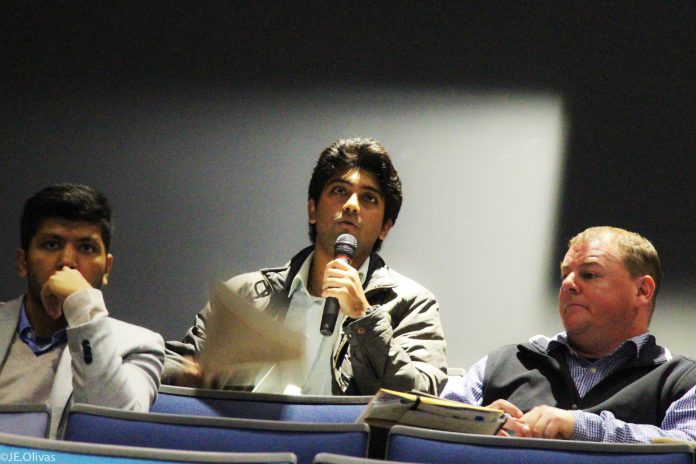
SFU administrators held a community consultation last Wednesday in the SFU Theatre concerning the university’s budget for the 2015/2016 year.

SFU president Andrew Petter explained the challenges the university is facing: “Government decided to cut budgets for post-secondary institutions a couple of years ago, and we are facing a third year of cuts in the coming year.”

Pat Hibbitts, VP finance and administration, and Jon Driver, VP academic and provost, led the presentation and discussion, addressing the current financial outlook of the university, and making recommendations for how the institution can move forward.

One topic that received considerable attention from attendees was increased international student tuition fees. As approved by the SFU board of governors in the 2013/2014 Operating Budget and Financial Plan, undergraduate international students’ tuition fees will be raised by ten per cent each year until 2016. This is eight per cent more than Canadian and resident undergraduate tuition fees, which will increase by the two per cent maximum allowed by BC government policy.

“It’s a very difficult public policy issue,” Driver explained. “There certainly is a question about whether an international student should come and simply pay the cost of their education, or should they pay a somewhat higher cost that reflects the investment that’s been made by the institution.”

Post-secondary institutions in BC receive grants based on the number of domestic students enrolled for the year, which make up a large proportion of the university’s budget. However, institutions do not receive any funding for international students. Hibbitts explained, “You’re not getting a grant for the international students. You’re getting $7,200 plus tuition for a domestic student, and so how do you make that equal?”

Many international students were present at the consultation, and raised concerns that the tuition increases were both unfair and unsustainable. They also questioned the amount of financial aid available to international students.

Driver replied that 25 per cent of the money raised from international student tuition fees would be directed to international student services, scholarships, bursaries, and staffing costs.

Other students expressed that they had not known about these fee increases when they started at SFU, and would likely not be able to afford them in the future.

When SFSS president Chardaye Bueckert asked Driver and Hibbitts whether they might grandfather these students — keeping their fees at a level consistent with what they paid when they first came to SFU — Driver responded that they were not going to consider such a proposal.

“It’s a complicated moral and ethical question when there are students here who are just able to afford this, and we put the tuition up and that makes it much more difficult,” Driver told The Peak. “The idea of the bursary and scholarship program is that that should help students who are in that difficult financial situation.”

Following the discussion, The Peak asked Bueckert whether she felt the university response was appropriate. She replied, “I certainly appreciate the things that SFU does for international students, but I think there needs to be more funding allocated to [needs-based funding].”

She continued, “I understand that only 30 per cent of assessed need for international students is currently being met through the bursary fund. I think, at a bare minimum, there needs to be more money injected into that fund.”

SFSS VP student life Kayode Fatoba was less than impressed. “I think that the dialogue wasn’t necessarily much of a dialogue in a sense that there were questions and suggestions coming from the international student community that were being met by a standstill,” Fatoba said.

“No input was warranted. And so, what was really the point of us coming out to see whether our voice was necessary?”

VIFF 2014 Reviews: White Bird in a Blizzard, 1987

0

White Bird in a Blizzard

By: Christopher Cross, SFU Student

Given the many young adult novels being adapted to film recently, it is no surprise that Shailene Woodley finds herself playing the lead actress in yet another adaptation. What is surprising in White Bird in a Blizzard, is Woodley’s character, Kat; she isn’t an innocent, wholesome girl, but a judgemental, sex-crazed teenager. So, when her mom (Eva Green) goes missing, Kat assumes that she got tired of her father’s (Christopher Meloni) wimpy attitude and decided to have an affair.

Don’t get too caught up in trying to figure out where her mom has actually gone, as it’s really not important in the grand scheme of things. What is important is how Kat deals with her mother’s absence, and the fact that, when writer/director Gregg Araki breaks from the mundane ‘80s nostalgia, there is something magnificent buried deep within the film.

However, it takes time to get there, and the film does not become wholly interesting until after Kat’s abhorrent narration ceases — that is, until the film decides to sacrifice all the work it put into a somber ending and wrecks it with more terrible narration and a five-minute wrap-up of the entire plot.

As a piece of character development, White Bird in a Blizzard shines bright, especially thanks to incredible performances by everyone involved. Eva Green steals every scene she is in, and Shailene Woodley has played a teenager so often in her career that she could do it in her sleep.

Araki’s latest effort is held back, however, by some sloppy storytelling and certain decisions that rob several scenes (such as the ending) of their dramatic impact.

1987

By: Josh Cabrita, Peak Associate

This coarse Quebecois film opens with neon lettering and a synthesizer score alluding to the 1983 masterwork, Risky Business. This is where the references start, and I began to ask myself, when does a movie cross the line from allusion to complete rip off? Most of the time, this quintessential 80s movie that has been recreated for our age hides behind being derivative and only rarely rises above plagiarising far better works.

We’ve seen this story about a horny teenager trying to lose his virginity while partying and partaking in petty crimes with his friends. We’ve seen characters break the fourth wall and talk directly to the audience in a self-aware manner. We’ve seen this kind of nostalgia piece which incorporates hit pop songs from a past era. We’ve seen the plotline which revolves around a teenager crashing or breaking an expensive car. We’ve seen so many movies like 1987 since 1987.

Haunting images in Kevin Smith’s Tusk

0

What the hell did I just see? A walrus rendition of the human centipede? A comedy? A fable? One of the scariest damn things ever!

In all my time watching movies, I cannot say that I have ever seen something quite like this nor have I had the ‘willies’ scared out of me this much. Tusk blends ethnographic comedy, horrifying visuals, economical characterization, and raw poignancy in a story that is simple yet tight and nearly perfect. This is far better than it has any right to be.

What makes Kevin Smith’s Tusk even odder is the story’s origin. During one instalment of his podcast, Smith and his co-host discussed a possible movie idea based on a peculiar news story they had read: a man was offering free rent so long as the tenant would dress up and act like a walrus for two hours a week. Smith asked his audience to tweet #Walrusyes if they wanted to see him make a movie with this premise or #Walrusno if they didn’t.

On the surface, the premise seems to be inspired by the infamous midnight horror flick, The Human Centipede. Where that flick artlessly unveiled its one twisted trick, however, this daring beast has more snarl than just some makeup and practical effects (although these are quite haunting). The build up allows for the natural suggestion of coming horrors in lengthy conversational scenes and brilliant transitional cuts that simultaneously draw the characters and our heebie-jeebies out.

Tusk is primarily exploitation filmmaking but, underneath all the gonzo evil, there is a message about how greed and power can erode a man’s soul and return it to its animalistic roots.

The protagonist, Wallace, is an American podcaster who travels around to interview internet sensations in order to embarrass them and profit from their misfortune. He gets what is coming to him when, in Manitoba, he accepts the offer of a weirdo letter which invites anyone to stay at an old man’s house free of charge, if they promise to listen to his grand stories of his past.

The ad is a ploy to draw in vulnerable travellers so that the creepy old man (Michael Parks) can surgically amputate their limbs and put them in a giant walrus suit. Meanwhile, Wallace’s girlfriend and co-host team up with a Quebecois police investigator to find him and the serial killer.

I’m sure you can imagine some of the haunting images that may never escape my mind’s eye, but even your wildest creations will fall short of the onscreen horrors. I literally shrieked at the sight. My friend had to quiet me down! The images are so haunting because they are carefully teased through close-ups and references to the old man’s profound anger.

Smith ignores squeaking doors and jump scares for a lingering dread that comes from his actors’ incredibly powerful performances and from his remarkable command over the film’s tone. Michael Parks is spectacular at holding our interest in lengthy dialogue scenes. He initially presents himself as a civil man, but because we can read Park’s performance, we see the exaggerated chivalry in his demeanour.

Horror comedies have nearly become synonymous with parodies, but Tusk takes its concept seriously, and the humour naturally arises from the absurdity of the situations or the quirks of the characters. The way this movie makes you laugh and shake in fear simultaneously is genius. #Walrusyes to one of the best movies of the year and one of the greatest midnight horror flicks I’ve ever seen.

Sex and the Suburbs: Hip hop is alive and well in Vancouver

0

In the 1970s, hip hop was an underground genre beginning to emerge. It started as a form of artistic expression through urban dance parties DJed by hip hop emcees and supported by grassroots local radio and, since that time, its popularity has only grown. Fast forward to present day, and hip hop is everywhere. Although many hip hop artists have strayed from its origins, there are still those out there who showcase hip hop’s original values of social consciousness and streetwise knowledge. And fortunately, some of these artists can be found right here in Vancouver.

Chance the Rapper (who Jordan lovingly refers to as Chaaaaance), for instance, is a modern day hip hop genius whom we both adore. After seeing him at the Pemberton Music Festival, we could not help but notice his positive attitude which is a contrast to some of the other acts at his level. With his most recent release of “Wonderful Everyday,” a rendition of the Arthur theme song, how can anyone not love this guy?

An East Coast classic, Nas, is coming to Vancouver on October 16 for two shows at the Vogue. He will screen the documentary, Nas: Time is Illmatic, to mark the 20th anniversary of his unprecedented Illmatic album. He will then perform this classic record, one of the best hip hop albums of all time, from start to finish, with some of his other hits sprinkled throughout.

Can’t afford a concert ticket? Vancouver has a host of great hip hop clubs at your disposal. At Five Sixty on Friday night you can enjoy three levels of turnt. We prefer the bottom level where DJs spin hip hop orgasms and you can booty quake with the best of them. If this sounds like your cup of tea make sure that you show up early! The line outside of Five Sixty on Fridays is one anaconda you do not want to mess with.

Shine nightclub on Saturdays is another worthy venue. It has great music and a cool vibe, especially when some of the more eclectic regulars dress to impress. The red room at the back of the club is a personal favourite of ours. This sanctuary offers the chance to people watch, chat, and refuel before returning to the battle ground to dance the rest of the night away.

For the gay hip hop connoisseur who relishes the chance to unbutton the Prada and don a greasy snap-back and oversized tank (speaking purely from experience here), check out Hustla at the Cobalt. This spot proudly advertises its “Homo Hip Hop night,” and what an event! From the dancers on stage, to drag queens strutting about, this event is a guaranteed good time for LGBTQ and LGBTQ-friendly individuals. One note: this event happens sporadically, so it is important to keep your ear to the ground (or facebook) if you want to attend.

Rich Aucoin: A legendary concert

0

Aucoin’s performance at Fortune Sound Club on September 16 transformed visuals into raw sound, and music into otherworldly sight. Never have I been so impressed with an artist’s ability to connect with his audience. I honestly did not really know what to expect walking into Fortune on a Tuesday, of all nights.

When Aucoin jumped into the crowd, embraced the chaos he was swallowed into, and came out as king, I didn’t have any doubts. Here was a legend. There wasn’t a single soul in the room that wasn’t entranced by the emotions he channeled through his lyrics, emotions that buzzed with barely contained passion on the edge of his skin, and echoed in the sweat drenching his entire being.

He told the crowd to form a circle around the middle of the room and the speed with which the audience followed his instruction was incredible. Fire-eaters and magicians on the street struggle to enthuse the crowd, forced to ask onlookers copious times to come closer or clap in rhythm to their stomping. Not Rich Aucoin — as soon as he directed, the audience acted.

A girl I didn’t know pulled me into the inner circle, right in front of Aucoin, slung an arm around my shoulders and grinned broadly at me. I grinned back. We both turned back to watch Aucoin fling himself from one edge of the circle to the opposite end, from one corner of the crowd to another. Girls screamed; guys whooped.

Aucoin’s amazing presence could turn the quietest of quiet mice into a screaming, flailing beast. His infectious grin made you extend your arm to the stranger next to you and embrace them as if they were your closest friend.

I was talking to a girl while standing in line at the entrance, and she told me she’d seen Rich Aucoin perform in Halifax before. “He brought out this huge parachute and tried to get everyone underneath it. Of course, not everyone could fit . . . Although some people actually chose to stand outside of it, the neanderthals. Why would you want to miss out on the magic?”

Apparently, the parachute is a trademark of Aucoin’s performances because it descended upon us that night. Streaks of yellow and green and purple and red floated on the energy of two hundred hands, and the disco lights pressed down through the canopy like the swirling headlights of flying cars and eerie reflections of owls’ eyes.

Yes, it was exactly as crazy as it sounds. Then the roof was pulled from right over our heads and, on Zeus’s command, the disco ball sent down bolts of illumination in time to the wild, crazy music; it was an epileptic’s nightmare, but a raver’s heaven.

You just need someone as inspiring as Aucoin conducting the madness, and everything truly feels possible. Why would you want to miss out on his magic?

Kinnie Starr discusses her music as social activism

0

Canadian singer, graphic artist, and activist, Kinnie Star, is set to release her newest album, From Far Away, on September 30. Over the past two decades, Kinnie has shaped a rewarding career that revolves around her many passions. Her new album reflects these; it’s a fusion of rap, poetry, folk music, and lyrics about the earth, our technological dependency, and the growing issues surrounding our global water supply.

Kinnie, a former graffiti and stencil artist, got her start in music after volunteering at a local event — she simply asked for a chance to perform, which led to some great connections and opportunities she could’ve never imagined.

Since then, her style has stayed true to who she is as an artist, unwavering in the face of pop music that tends to promote homogeneous ideals. Social change and environmental rights are top priorities to Kinnie, both in her life and in her music.

For her, the integral role of technology in so many aspects our lives leads to a sickness of disconnection — a sickness that she acknowledges she isn’t above.  A strong believer that people need to get outside more, and rely on technology less, Kinnie says that her favourite song on the upcoming album is “Summer Day.” She describes it as a song about “being young in a time before people were stuck on computers and cell phones,” saying, “It’s a song about the good times before we were robots.”

The environment has always been a priority in Kinnie’s life, and she hopes those who listen to her music take away some newfound respect for nature, as well. She urges people to become more informed in regards to the environmental issues that surround them, through “studying, reading, and learning.” She says, “[People should] learn about aquifers, learn about underground water, the names of the rivers and lakes. Watch the salmon spawn, and look at the mushrooms.” The study of all of these things can “open your mind,” according to Kinnie. We just need to pay attention to these often overlooked pieces of the world around us.

Kinnie hopes that listeners of the album will also take away from it the idea that they should feel free to think for themselves, and that they shouldn’t hesitate to question authority. She proudly states, “I do music to facilitate social change.”

This fall, Kinnie will take her new music out on a cross-Canada headlining tour. She will also join David Suzuki on his Blue Dot Tour for two select dates in Victoria and Ottawa. She expressed that she is excited and honoured to join so many other environmental activists, and people who wish to create lasting and positive changes.