Home Blog Page 109

Still Living With My Parents? Why, yes, I am!

0
A girl dressed in a white tanktop and blue jeans crouches with her head leaning against both of her arms.
ILLUSTRATION: Yan Ting Leung / The Peak

Youth seems to keep slipping through my fingers the older I get, which is how I assume it works. Becoming a person of your own is no easy feat, and artist NIA NADURATA is no stranger to the matter. Based in Toronto, Nadurata’s first EP, Still Living With My Parents, was released on January 3. As expected from its title, the album depicts the many “highs and lows of emerging adulthood,” paying homage to the most vulnerable years of life. With six songs, smooth vocals, upbeat drums, dynamic guitar, and extremely relatable lyrics, Nadurata speaks to the soul during its most turbulent times. 

Nadurata often works alongside artists like Russ, Nonso Amadi, Amaal, Boslen, and Isaiah Peck as a vocalist and songwriter. She released a couple singles of her own in 2023, like “drive faster,” “i think i like your girlfriend,” and “carSick,” but this EP has been brewing for quite some time now. As her bio says, “her music captures a time when the world and our thoughts tortured us or soothed us,” and I couldn’t agree more. Though she often sings about love, relationships, and the complicated nature of navigating bonds, whether you relate to the hard-hitting lyrics or not, the musical aspects are just as admirable.

Her songs have a similar sound to that of modern alt/indie artists beabadoobee and The Marías, with the gentle strums of a guitar present in every song. Even so, I did sense some influence from prolific RnB artists such as Aaliyah and Amy Winehouse. Nadurata’s smooth voice and the bossa nova-esque instrumentals on low-key songs like “boo hoo” make you want to belt the song’s lyrics in the car. “Souvenirs” is full of strident vocals, heartfelt lyrics, and up-beat drums that contrast the melancholy nature of lyrics — it practically begs to be shouted at full volume. Songs like “Trauma Bond” are particularly special, though. Unlike her other songs on the album, this one truly slows down, perfectly showing a more angsty side to growing up filled with wavy guitar reverbs and soft, angelic vocals.

“Nadurata puts a modern spin on it with more of an alt pop sound that makes you want to dance in your bedroom, or belt the song’s lyrics in the car.”

While I commonly hate listening to songs about past relationships and exes, I liked listening to “Practice” and then “i think i like your girlfriend;” it just makes sense and it’s a bit funny considering the context of both songs. Though your exes tend to steal their favourite aspects of your personality to use as their own, they still fail to do it like the OG (you, of course). They ultimately become watered-down versions of a person they no longer know, leaving you wondering why you divulged your soul to them only for it to become a poorly plagiarized adaptation. The song after, though, is essentially saying “move over, mini me, your new girlfriend is in love with the real thing and not the knock off,” which I can wholeheartedly stand behind. 

NIA NADURATA’s sounds are, simply put, catchy as ever. Though they all follow a similar theme, there’s bound to be something that sticks out to you. They are the perfect songs for earworms, because no matter how many times you hear her, you’ll likely never get tired of her smooth yet compelling vocals.

New year, no resolutions, just reflections on life

0
A tree on the beach with a swing at sunset
PHOTO: Jake Lille / Unsplash

I ended 2023 and started 2024 in what I can only describe now as a miserable situation. I was living in a place where I no longer felt comfortable, and was becoming unsafe. However, despite my misery, I remained for about six months — the last three of 2023 and the first three of 2024. Back then, I was looking at other places to move to, but I always found a reason not to: “It’s too far away from work,” “The room looks too small for my bed and desk,” “The building looks too old.” I kept finding reasons not to leave and remain in misery. 

While it might sound like I have poor decision making skills, I was actually very scared of change. I was scared of moving out, potentially with people I don’t know, to a place I’m not familiar with, and to a completely different day-to-day life. So, I kept sabotaging myself for the sake of remaining in the comfort of what I knew. Miserable, yes, but at least I knew that was the basal expectation. That all changed in February 2024, when the situation quickly escalated from miserable to potentially dangerous. In just one weekend I looked over 15 apartments, signed the lease for what is my current place, and organized moving out of the hell I had been living in by the next Tuesday. All of that in just five days . . . six months of misery ended in just five days. 

Looking back at it, I don’t know why I kept subjecting myself to that life. I was crying every other night, not out of sadness or anger, but of pure stress and anxiety. I used to love cooking and preparing my meals for the week, and I completely stopped doing so the last three months out of fear my food would be tampered with. Home cooked meals were replaced with local fast food chains, and my home had turned into a prison. I was barely sleeping and taking care of myself. I changed so much of what I liked and who I was for the sake of trying to fit in with familiarity, just to avoid confronting change. 

Fast forward to New Year’s eve 2024. I found myself in a New Year’s party I most definitely didn’t want to be in, but I had bought the tickets with a friend some months ago and felt I had to go. All I wanted that day was to have a quiet night and eat some food with my new flatmates, but I cleaned-up, served a really good outfit, and even styled my hair — all in the hopes that putting in the extra effort would somehow ensure I would enjoy the night. However, I didn’t. It didn’t matter that I got compliments on my outfit, it didn’t matter that the venue was pretty cool, or that you know . . . it was a New Year’s party. Those are fun, right? It didn’t matter because I don’t really enjoy clubbing, I rarely do. I kept putting myself in similar situations because to some degree I felt that’s what’s expected of me, to be young and enjoy the night rather than staying in. 

“Don’t stay six months living in misery when it can all be changed in five days.”

Thankfully, last night the power of foresight was by my side and I decided to leave relatively early. On my walk to the bus that would take me home, I kept thinking of where I was in New Year’s eve 2023, in the horrible situation I subconsciously decided to stay in for six months. These two stories, while different in many ways, share a common theme. I subjected myself to situations where I’m not really enjoying myself, whether it’s for fear of change or breaking-up with expectations, societal or self-imposed. 

So, for this 2025 I’m channeling my inner Kim Catrall and living by her words: “I don’t want to be in a situation for even an hour where I’m not enjoying myself.” I know it sounds idealistic and realistically impossible. Discomfort is inevitable for any living being and there will be many situations where I don’t have the power or choice to change them. However, there are many situations where discomfort and pain are chosen, even if subconsciously. 

This new year, my only resolution is to be more critical of my feelings, where they originate from, and whether it’s in my power to change them or not. I don’t intend to live a 2025 without discomfort. After all I love trying out new things and more likely than not, there’s some discomfort in starting something new and getting out of your comfort zone. Choosing to get out of your comfort zone and choosing discomfort, while similar statements, carry entirely different meanings for me. I don’t intend to remain in misery for the vague promise of comfort that comes from fulfilling expectations I don’t consciously align with. I don’t intend to remain in misery for the vague comfort of fending off the unknown, the fear of something worse coming if I embrace change. I don’t intend to remain in misery at all whenever I have the power to change it.

For this 2025, don’t be like me, don’t stay six months living in misery when it can all be changed in five days. I know a lot of situations seem like there’s no way out, and that any choice taken will be the wrong choice — it sure felt that way for me. But believe me, you most likely don’t have to wait for the straw to break the camel’s back for you to choose a better life.

New Year’s resolutions are counterproductive to self-growth

0
fireworks in the night sky
PHOTO: PHOTO: DESIGNECOLOGIST / Unsplash

Content warning: mental illness, brief mention of suicide.

The beginning of the year is a short-lived period of optimism that makes us believe change is within our reach. Many of us welcome the new year by promising we will become better versions of ourselves, whether that means socializing more, eating healthier, exercising regularly, or saving money. Despite considering myself ambitious, I rarely make New Year’s resolutions. For me, self-improvement is about more than goals, it’s about the person I wish to become, which is why Atomic Habits by James Clear especially resonated with me.

In Atomic Habits, Clear asks the reader to reflect: “Who is the type of person that could get the outcome I want?” For me, the answer is a resilient person. For example, instead of aiming to eliminate my mental illnesses, I can work on resilience. Like most, the journey to good mental health is not linear, and focusing only on the destination can be frustrating. Celebrating the process, including my struggles and not in spite of them, has helped me have a more positive perception of myself. Instead of berating myself for having a panic attack during a school presentation, I can appreciate the bravery of putting myself into a vulnerable position. 

Over 90% of New Year’s resolutions will be abandoned within a few months. The low success rate is attributed to people thinking too big, not asking themselves why they want to change, and not actually being ready to take action. We frequently forget that building a strong foundation is needed to make change possible. New Year’s resolution alternatives can be tools for you to create this foundation and allow you to explore your favourite version of yourself, like creating a vision board, writing a bucket list, or practicing mindfulness. 

“We frequently forget that building a strong foundation is needed to make change possible.”

A vision board is a fun and creative way to visualize different aspects of life that matter to you. You can put together pictures of friends, family, or dreams for a future love life if you want to prioritize healthy relationships. You can also include illustrations of hobbies, and career and education goals. A quick search on the internet will give you plenty of ideas. Although a vision board can be made traditionally with physical media like magazines or prints, it can also be done digitally. I use Pinterest boards as vision boards!

I love lists, which is why I love the concept of a bucket list. A bucket list is a list of experiences that you wish to achieve in a lifetime, but I find that such a big timeline can be overwhelming or feel more like a fantasy than a real possibility. My 2025 bucket list will probably involve getting a small dragonfly tattoo, changing my nose piercing, submitting creative writing to literary journals, visiting a friend in another province, and buying clothes from local brands or thrift stores. To make this a meaningful alternative, I recommend seeing your bucket list not as obligations, but as a list of opportunities. Remember that it’s OK if you don’t complete all of your bucket list ideas; ideas are there to inspire you. 

I am terrible at staying still, which is why I’ve always struggled with meditation (and painting my nails). Mindfulness, however, doesn’t always have to be associated with stillness. Running or other types of exercise can help calm your mind, think clearer, and focus on the present. Mindfulness can also be incorporated into activities like crafting, doodling, baking, building puzzles, or even practiced on the commute to SFU. Gratitude is deeply linked to mindfulness. As 2024 comes to an end, why not message your close ones a list of reasons why you are grateful to have them in your life? The new year is often bittersweet for me because it’s close to my suicide attempt anniversary. To highlight both occasions, I like to write a list of reasons I’m grateful to be alive. No doubt, new beginnings deserve to be honoured. 

If you or someone you know is experiencing suicidal thoughts, please reach out immediately to the 24/7 toll-free BC crisis and suicide prevention line at 1-800-SUICIDE. 

2024 News Rewind

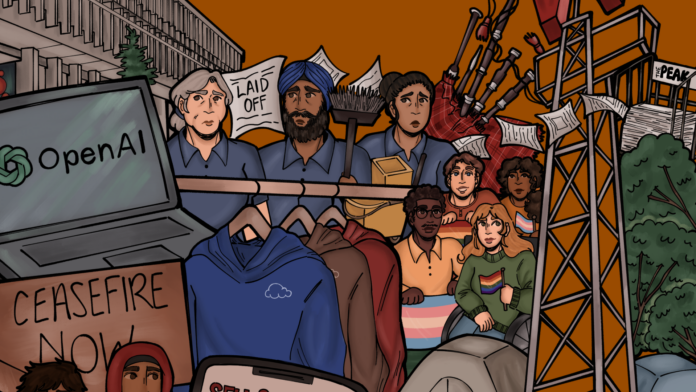
This is an illustration featuring the large W of the Woodward’s building downtown, three custodial workers in blue looking unhappy, a bagpipe, grey laptop open with the words “OpenAI” on its screen, and the grey exterior of SFU’s academic quadrangle.
ILLUSTRATION: Abigail Streifel / The Peak

Editor’s note: The ranking of these stories is roughly based on the number of articles written on each topic, whether these stories appeared on the cover of our weekly issues, and readership statistics from issuu.com. Multiple links under a single topic are presented in chronological order of publication.

  1. Support for Palestine in the community, ongoing

Learn more:

Throughout 2024, The Peak dedicated coverage to Israel’s ongoing genocide of Palestinians and SFU’s investment in weapons contractors. Interviews with various advocacy groups highlighted calls for a free Palestine on campus and beyond.

In late March, The Peak reported that 140 SFU faculty members representing SFU Faculty for Palestine (F4P) signed a collective statement that “endorses the Boycott, Divestment, and Sanctions (BDS) movement and denounces antisemitism.” F4P is a global movement with chapters across North America dedicated to supporting Palestinian liberation. 

In late May, SFU administration agreed to discuss divestment in companies that supply arms to Israel, including CAE Inc., Booz Allen Hamilton, and BAE Systems. Come summer convocation, some graduates donned keffiyehs and held up Palestinian flags as they crossed the graduation stage in continued protest. In September, the SFU Student Strike for Palestine held a general assembly on campus to also protest “SFU’s investment in the ongoing Palestinian genocide.” This meeting came after SFU president Joy Johnson’s school-wide message that SFU will not weigh in on “partisan political matters and current events.”

The Peak also covered the student-formed chapter of Independent Jewish Voices (IJV) Canada on campus. The larger organization’s mission is “to amplify the voices of Canadian Jews in support of justice in Israel-Palestine and at home.” This spring, IJV expressed concern over a proposed adaptation to the BC government’s definition of antisemitism, brought forth by the International Holocaust Remembrance Alliance. They were concerned that criticism directed at Israel would fall under antisemitism given this new definition. In November, IJV SFU voiced their “desire to have an identity that goes beyond Israel and gets back to core Jewish values.” The club told The Peak about their alignment with the broader campus movement for Palestine. IJV member Omri Haiven expressed, “The purpose of the university as an institution for social and environmental justice will be called into question.”

  1. 2SLGBTQIA+ rights and recognition in the community, ongoing

Learn more:

The Peak reported on SFU Queer Collective’s June 5 webinar, which focused on how universities should work to foster welcoming environments for queer individuals. The event also centred on ways to combat anti-2SLGBTQIA+ hate and rhetoric. Anti-Sexual Orientation and Gender Identity (SOGI) educational program protestors across Canada have claimed they are defending their “‘parental rights’ in deciding what their children learn” or religious beliefs. John Rustad, leader of the BC Conservatives, said “there’s no hate” in anti-SOGI protests. Dr. Travers, SFU professor of sociology, told The Peak that Rustad’s claim was “anti-LGBT” and that there’s been a “rise in politicians who are ‘using fear-mongering around queer and trans inclusion.’” At the webinar, speakers emphasized the need for meaningful, long-term change as opposed to simply “checking a box.”

“It’s putting it into practice and actually acting on these [ideas] in good faith that doesn’t always happen,” said Jude Mah, SFSS’ Out On Campus (OOC) coordinator. Presenters also spoke about “incorporating queer and trans experiences across curricula,” and deferring to those with lived experience for guidance: “Oftentimes when curriculums are developed, it’s developed about a community — forgetting that that community is often sitting in the seats that you’re teaching to,” said Mackenzie Kolton, Egale Canada director for learning.

The Peak also covered the OOC’s November 20 Transgender Day of Remembrance event in the Student Union Building ballroom. The ceremony was held to honour the now 359 trans people globally who lost their lives in 2024. Those leading the event read the names of these individuals, followed by a poetry reading, and opportunities for art and reflection. The day is designed “to share in the moment, to care for each other, to find light, and life, and connection out of the pain of the oppression that the trans community faces every day,” said SFSS accessibility coordinator Brianna Price.  

  1. SFU community speaks out after layoffs, ongoing

Learn more:

In the summer, “SFU laid off nearly 100 staff and eliminated positions citing budget concerns,” including inflation and a decline in international student enrollment. Lakshmi Gosyne, associate director of the Administrative and Professional Staff Association, confirmed an anonymous tip The Peak received that “many of those laid off were either on or returning from medical leave, and those impacted were disproportionately women close to retirement.” Gosyne described how those laid off were not forewarned, and were barred from asking questions about the layoffs. 

In December, The Peak reported on a development from the Teaching Support Staff Union (TSSU), which detailed the university’s decision “to increase the vehicle allowance perk for SFU executives by about $75,000” amid the summer layoffs. A vehicle allowance is a sum of money an employer pays to cover an employee’s vehicle expenses. In the school’s statement to The Peak, SFU described how the increase in vehicle allowances aligned with BC Public Service Policy, and that this rate “had not been increased since 2007.”

The decision and its timing were subject to criticism as Kayla Hilstob, TSSU chief steward, and Derek Sahota, TSSU member representative, indicated that it was “egregious” for SFU to be “‘designing’ the layoffs in the ‘exact same time frame’ as their decision to increase this perk.” Sahota labelled the move as a “gross misuse of public funds.” 

  1. AI and academic integrity at SFU, November

Learn more:

SFSS advocacy coordinator Trish Everett spoke with The Peak at the end of the year regarding SFU students using artificial intelligence (AI). 

Everett explained the process a student must navigate if accused of cheating with AI — one she is there to assist with. After a student meets with their accuser, cases move through the University Board on Student Discipline, and potentially to the Senate Committee on Disciplinary Appeals. 

There is currently no school-wide policy regarding the usage of AI in classes though one is in the works. Professors have varying expectations about what is acceptable and Everett noted that these discrepancies can leave students confused. In addition to these nuances, Everett spoke to the potential differences in consequences between a domestic and international student caught cheating, citing “expenses involved as well as the immigration implications.” She encouraged students to engage in honest communication with professors to prevent potentially difficult situations.

  1. Street sweeps and violence at the CRAB Park encampment, ongoing

Learn more:

Content warning: descriptions of police violence.

The Peak also covered the Vancouver CRAB Park encampment and those who sheltered there. From March through July, The Peak reported that residents were experiencing street sweeps carried out by the Vancouver Board of Parks and Recreation. Despite the Park Board informing residents in March that they could return after an intensive clean-up, the invitation was short-lived as the Board forced residents to vacate in April. The Board also confiscated residents’ belongings in the process. 

In May, The Peak reported on park bylaws established in April that stated residents could shelter in the park but had to “pack up [their] belongings by 7:00 a.m.” Only those in the designated area, which fit 14 residents, were permitted to stay past that time. Park rangers enforced these rules strictly and also barred “volunteers and media from entering” the camp. 

On September 24, Board officials slashed a tent and seized the belongings of a mother who had given birth 30 hours prior. The mother called the event “demonic.” Soon, on October 23, residents were informed via an eviction notice that the Park Board planned to close the encampment by November 7. At this time, seven individuals were still sheltering in CRAB Park. This decision was made despite pushback from various groups, including advocates and residents. 

  1. SFU community makes strides, ongoing

Learn more: 

In April, the Pacific Institute on Pathogens, Pandemics and Society (PIPPS) research institute based at SFU Burnaby released a study “emphasizing the need for broader awareness and understanding of Long COVID among healthcare professionals and the general public in Canada.” In May, The Peak reported that PIPPS had also “led 25 workshops helping people build more than 500 air filters to clean the air in their homes and reduce exposure to fine particulates from wildfire smoke.” 

In August, the SFU Pipe Band won third place at the World Pipe Band Championships in Glasgow. They placed top three for the first time since 2012. Robert MacNeil, president of the SFU Pipe Band Society told The Peak it was wonderful to win third and attributed the win to “steady improvement in competition.” 

In September, the SFSS hosted the Fall Kickoff Music Festival at the Burnaby campus after a “five-year hiatus.” Chitransh Motwani, SFSS vice president of events and student affairs, said, “We wanted to give students an opportunity to celebrate together, fostering a stronger sense of community and belonging, which has been a priority for us.” 

The Peak also spoke to SFU professor Esther Verheyen, whose lab worked with the Baylor College of Medicine to identify “a gene which may reverse symptoms of Parkinson’s disease.” The team’s paper discovered that the fruit fly gene Cdk8 and human equivalent CDK19 helped reduce movement impairments in fruit flies when added to their cells. The impairments in the flies were similar to some of the symptoms associated with Parkinsonism, particularly “stiffness, difficulty walking and balancing, and tremors.” Professor Verheyen said she hopes the scientific community would take this new information and “collectively move it forward” on Parkinson’s research. 

Other students were also in the spotlight. SFU Beedie student Vansh Sobti created an “anxiety hoodie.” His business, Cloud Nine Clothing, seeks to promote “ultimate comfort and relaxation” for students. The hoodie’s “discrete stress ball” under “the cuffs of its sleeves” is “made with a heavy fabric to help soothe the wearer.” Sobti told The Peak that his brand’s mission is “to promote better mental health and make people feel more comfortable in public.” He also expressed his goal to make the hoodies “available in therapy studios” and partner with universities “to make the anxiety hoodies official school merchandise.”

In October, The Peak spoke to SFU master’s student Vanessa Hum. Through her research, she found that “over 2,000 collisions” involving birds hitting windows at the Burnaby campus occurred in “over nearly half a year.” Hum said SFU needs to better its approach to bird collisions by installing Feather Friendly branded “dots” that make glass visible to birds at “high-risk locations on campus.” She also pointed out that not enough black bird silhouette decals are effectively put up on Burnaby campus windows. Hum secured funding for this project and gathered over 900 signatures from SFU students to “show SFU management that this is an important student-led issue.”

  1. Programs close due to budget cuts, June

Learn more:   

2024 saw the closure of the SFU Woodward’s Cultural Programs and two language programs. The university stated that its budget deficit led to the closure of these programs. 

The Woodward’s programs served as a “catalyst for the creation of new work” for nearly 15 years, involving “over 200 events each year focusing on contemporary arts, dance, theatre, cinema, and music.” The programs also exposed students to the local professional arts scene according to Jim Smith, co-founder and artistic and executive director for DanceHouse. In response to the closures, the SFSS stated that the university “has a responsibility to its community not only as an educational institution but also as a cultural and economic center in BC.” They said these cuts reduce “SFU’s ability to fulfill this role.”

Language learning programs, part of SFU’s continuing studies department, were also cut this year. The English Language and Culture program offered students the opportunity to improve their English language skills. The other language learning program cut was the Interpretation and Translation program, which offered “specialized training for medical, legal, and translation interpretation to prepare students to become professional interpreters and translators in these fields.” It also trained “fluent professionals to facilitate effective cross-cultural communication.” 36 instructors were let go without consultation with the Teaching Support Staff Union. 

The SFSS also stated that “layoffs are not just numbers on a balance sheet; they represent a significant erosion of the support structures that enhance our learning environment.”

  1. Students sleeping on campus as living costs skyrocket, October 

Learn more: 

In October, The Peak reported that there was an increase in “the number of SFU students found sleeping at the SFU Burnaby campus.”  

The situation reflects a national struggle. In the past few years, Vancouver’s cost of living and housing prices have risen. Vancouverites now have an expected cost of living of $4,000 a month — a near “3% increase from the previous year.” The Peak spoke to SFSS president Emmanuel Adegboyega, who said the “continual increases in tuition” and the rising cost of living in Vancouver produce a situation where students are no longer “able to afford to live on or off campus.” 

Abegboyega said “better housing options” for students have been at the “frontline of [the SFSS’] advocacy to the university.” He explained how possibly “rezoning areas surrounding the campus” in Burnaby could create more capacity for housing. SFU worked with the provincial government to add another 445 beds to the Burnaby campus by fall 2027, but added that “this doesn’t begin to put a dent in the waitlist for on-campus housing, nor the housing crisis overall.” He also mentioned that the SFSS planned to propose more cooperation between the province, university, and businesses to invest in housing projects. 

  1. Community responds to BC’s move to recriminalize substance use, June 

Learn more:


Content warning: mentions of death and overdose.


In early 2023, the BC government gained approval from Health Canada to implement a three-year pilot project for the decriminalization of possessing small amounts of illicit drugs. After multiple attempts by the provincial government to reverse this decision, they recriminalized drugs in April 2024. 

The Harm Reduction Nurses Association (HRNA) previously filed an injunction against the provincial government when they moved to alter the decriminalization project. The HRNA proclaimed that the government had “declared some lives unworthy of saving” due to the lack of social support for people who use drugs in public. The organization told The Peak that “when we see public drug use, it is because people do not have housing, services, or safe places to go — and because people want to stay alive, not die alone and out of sight.” 

  1. SFU safety and risk services launches SFU campus safety app, November / ongoing

Learn more: 

In an effort to promote safety and emergency preparedness on campus and in UniverCity, SFU’s safety and risk services (SRS) department launched the SFU Safe app in October 2024. The app includes emergency alerts, an option to report incidents and hazards, and “campus maps showing first aid and automated external defibrillators (AED) locations.” The app also offers contact information for different safety and support resources on campus, such as “the Indigenous Student Centre, Sexual Violence Support and Prevention Office, Crime Prevention, and more.”

The Peak spoke to Galib Bhayani, SRS’ chief safety and risk officer, who said the app allows students to “plan their campus experience” and for SFU to “effectively communicate emergency notifications around traffic, weather, wildlife, and more.” SFU SRS plans to review the app and its efficiency on a yearly basis. 

The Peak plans to investigate campus safety in the next issue.

Christmas in July

0
A man eating a waffle with a ghost besides him.
ILLUSTRATION: Yan Ting Leung / The Peak

In the winter of 2012, in a small elementary school in Burnaby, hallways are lined with handmade Christmas decorations, snowflakes, elves, Santa hats, Christmas trees, and multi-coloured lights on a string. It’s a cold December morning, with the dew outside frozen over the forest’s grass and snow piling up on the outskirts of sidewalks. The classrooms are empty, hallways too, for all the kids and staff are packed into the school gymnasium for the long awaited Santa Breakfast. When I looked at the calendar for the school year, this breakfast was something I made note of from the get go, something I could look forward to — as if second grade was getting me down. Sitting shoulder-to-shoulder with my friends and classmates, eating breakfast foods that, to me, were uncommon, and listening to Christmas music, I watched as the staff entertained us with the principal dressing as old Saint Nick. 

As much as I idealized this image of the Santa Breakfast in my head, I was almost always disappointed with my reality of it. For all my time spent at this school I was often let down with what fell on my plate. As I lined up to get my pick of goods from the tireless volunteering parents, I paid close attention to what my classmates got. Their plates had two little sausages, strips of crisped bacon, thick fluffy pancakes layered with syrup and a melting dollop of butter. If we got lucky, we’d get a muffin and hot chocolate with marshmallows. I gazed upon the spread with awe and excitement, wanting to propel myself through the line, even though I knew that would definitely land me on Santa’s naughty list! Still, I waited patiently for my turn as the line would wind up and down the gym, fidgeting with my plate as I eyed my friends in front of me. 

When it was my turn, after what felt like ages, I was left with a desolate array of choices. First of all, I couldn’t have any of the protein. My dad is Muslim, so, naturally I grew up not eating pork, and I stood by that promise of never eating it intentionally (even to this day). My breakfast at home usually consisted of ful, eggs, kasha, and salad of some sort, which meant that sugary American-style breakfasts were unheard of in my household. Dietary preferences weren’t a concern for most elementary schools in the 2010’s, or for any public North American institution for that matter. The majority of kids could have sausage and bacon, but unfortunately for people like me, options were limited. My smile quickly turned into a half-hearted grin, but I had hope for the pancakes and waffles at least. There were only a few sad, droopy-looking pancakes left, two orange wedges for fruit, and no milk for hot chocolate, so all I had was the sickly tasting apple juice no one wanted. While I was still happy to be sitting with my friends and sharing a meal put together by hard working parents, I felt a bit robbed of the indulgence that they got to feel. Food to me is a love language and one of the most important things ever as it carries more purpose than to fill your stomach. So, when met with the disappointing leftovers, it definitely made me like one. I started to think that perhaps a lump of coal would’ve been alright with me if it meant I got to have a proper Santa Breakfast.

Fast forward to 2024: It’s my last day of work after dedicating three years of my life to that . . . establishment. A quiet summer morning, Tuesday, there’s been one table for the past hour. I have told no one that it was my last day, hoping not to cause a stir, to slip quietly away from my beloved co-workers. I decided to treat myself to something since it was the last time I could use my employee discount, and I gave into my craving for a waffle. 

A freshly made waffle, thick, fluffy and golden-brown, as big as the plate it sat on, the melting dollop of butter waltzing across its doughy grid. I got myself a spout of warmed syrup and, before I went to the back to indulge, I piped a healthy helping of stiff, sweet, whipped cream, straight out of the metal canister. As I walked to the back, I felt sort of giddy inside; how scandalous of me to be enjoying such a silly looking Western delicacy. I poured the syrup across the waffle and cut myself a piece with everything on it. 


One moment I’m in the backroom of a restaurant in my uniform, and with one bite, I was taken away to the winter of 2012 with my furry patterned pajamas and fuzzy socks, sitting on the folding chairs of the school gym. This time there were no teachers dressed as elves, no tireless volunteer parents flipping half-burnt pancakes, no shabbily cut out paper ornaments strung with scotch-tape on lacquered white walls of the school gym, there was no one but me and that waffle. The child who once sat hungry, jealous of her peers, was now tasting the purely decadent breakfast she should’ve always had. I sat in that shabby leather seat and savoured each and every bite like it was the first and the last time I’d ever have something that good. With each bite I could feel a bit of my bitterness melt away. I teared up but they were happy tears. Maybe it was the fact that I’d miss my co-workers, the place that had much nostalgia, but I think we can all agree it was that waffle. Though I often thought of how annoyed I was at the lack of options for me back then, I’m almost glad that I didn’t, for the waffle now wouldn’t mean as much to me as it does. The thing about growing up is realizing you have your life in your hands; that you can be responsible for your own happiness, that you must be. A majority of people won’t stop and ask what kind of sausage you’d like, or whether you’d like a waffle or pancake, and that rhetoric goes further than breakfast foods. That means it’s up to you to make your daydreams a solid, cakey, syrupy reality! As a child who was told what to do and afraid to disappoint, being able to do things for myself and knowing that I put my happiness first made me feel a sense of closure I’d never felt. Most people think it’d be some life changing event, but being kind to yourself and giving love to your dreams can be as simple as a syrup-covered waffle. 

Brighter Side: Album releases

0
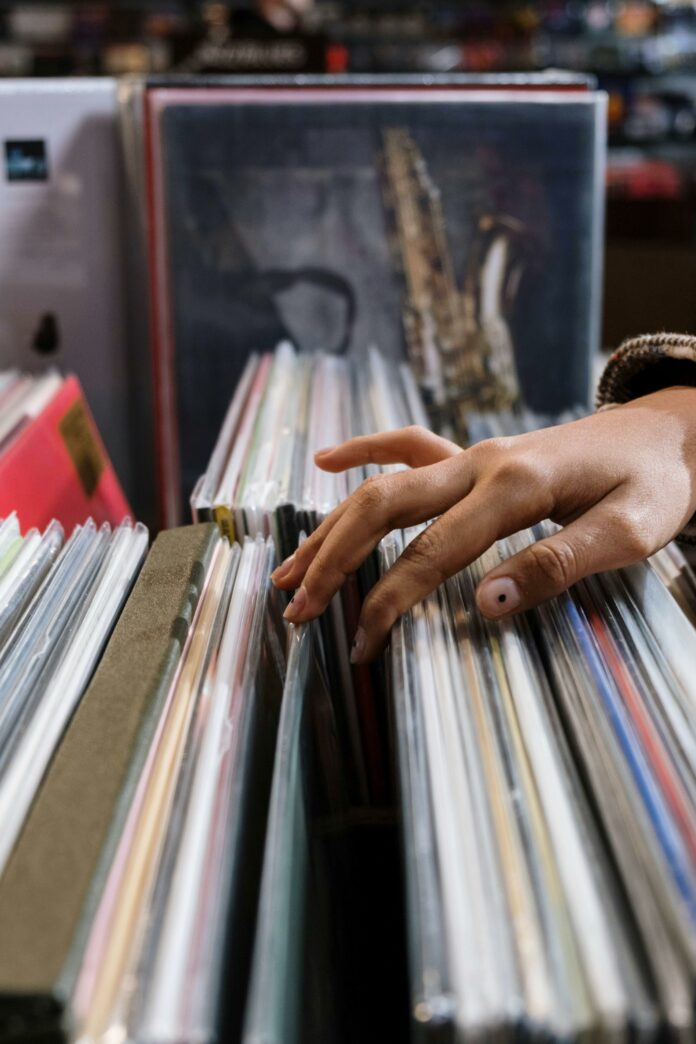
Close up view of a hand skimming through vinyl records
PHOTO: cottonbro studio / Pexels

As a huge music fan with an appreciation for every genre under the sun, there’s nothing more exciting than when one of my favourite artists announces the release of a new album. I’m just as hyped for it as they are, and I can’t wait to get my hands on whatever new record is to come. It’s literally music to my ears. 

I’ve been yearning to jam out to new material since an artist or band’s last album, and sometimes it feels like an eternity until a new song or record is released. The anticipation has lingered long enough! I particularly love when artists release music more frequently — although admittedly, when I’m forced to wait for a new tune or album, I enjoy it even more. Distance makes the heart grow fonder, I guess. It doesn’t stop me from thoroughly indulging in every single song, no matter how close between releases. I’ll play those songs and repeat, and I’ll never get sick of them.

There’s no such thing as a dry spell when there’s endless music to discover. Every time I hear a new release or discover another artist, I’m influenced by their works and every nuance that’s poured into the making of a record. There’s just something about an album release —  a new record by one of my favourite artists is the ultimate cherry on top for me. So, excuse me while I go listen to another album release!

We need to say goodbye to the Grammy Awards

0
Multiple grammy awards on a table
PHOTO: AFP pic / Free Malaysia Today

You may have seen those viral videos on Instagram Reels or YouTube Shorts that claim that Beyoncé is an evil figure in the music industry, or that singers or songwriters who don’t acknowledge her contributions to the music industry should receive a punishment akin to death. While I believe that this is a bit silly, it serves as an important example of the role that the Recording Academy plays in determining what we label as “good music.” Our society’s reliance on big music awards such as the Grammys greatly influences and even impedes on what we the people consider to be the “best” music. 

With roots going back to 1957, the Grammy Awards have acted as the greatest honour in the music industry, and is the only music award “in which nominees and winners are determined solely by the creators themselves.” The governing body that oversees the Grammys is called the Recording Academy, a body comprised of tens of thousands of “professional members” from across the US. 

At first glance, the Recording Academy may seem like an institution with democratic values enshrined in their core — empowering those with the microphone. Heck, even the Grammys have boasted the fact that there has been an increase in diversity within the Recording Academy over the past years, with 66% of its voting bloc being either BIPOC or women in 2024. This does not, however, mean that the body has achieved full representation of artists. Up until 2021, the decisions of the Recording Academy could be vetoed by smaller governing bodies of “experts” who would be swayed to vote for certain artists after the giving of bribes or flattery. Think about that, up until 2021, the musical elite overtly dominated the provision of these awards without us even knowing. 

However, this musical elite may still be running the Grammys behind the scenes. In order to be considered to join the Recording Academy, you need to have a career in the music industry and  recommendation from two existing Academy members. Instead of supporting the appointment of grassroots musicians and music industry members, the Academy relies on their own internal network to define what “professional” means. Even after that, nominees run elaborate and expensive campaigns to sway the votes of judges toward them. The musical elite continues to flex their power in terms of determining who we appreciate, who we hate, and whose music becomes immortalized within time.

The Academy has also been notorious for rejecting artists based on their preconceived notions about them. One example of someone who has been “snubbed” by the Academy is Diana Ross, an artist who has never won a Grammy despite being nominated 13 times. Music icons Tupac Shakur, Jimi Hendrix, and Bob Marley also never won Grammys. There is a historic bias against Black and women talents. From 2012 to 2020, Black performers represented 38% of the artists on the Billboard Top 100, but only made up 26.7% of total Grammy nominations in the same period. 

It is clear that the Grammys is not a participatory system that uplifts musicians of all backgrounds and experiences. So how can we move forward? First, we need to move away from reducing the beauty of music to an “expert’s” opinion. This democratization of the award process for music should not be a complicated one, requiring complete transparency in the amount of votes being received by artists, transnational participation in the online voting process, and a media blackout by the nominated artists during the voting period to prevent bribery from the general public. Instead of scandalous internal decision-making processes, the buy-out of votes by artists, and the overall presence of “elite” in other awards shows, this new form of recognition would be refreshing and long overdue. 

By putting the power in the hands of your average music listener, we can truly revolutionize the way that “good” music is rewarded. When the voting bloc is the general population, we have the most diversity, experience (because we are the ones who skip or save the song), and knowledge to give artists merit based on their work. So please join me in finally saying goodbye to the Grammys this coming February. 

A preview of SFU track & field

0
A group of girls wearing white uniforms with red lettering. The words “Simon Fraser” sit at the top of their shirts.
PHOTO: Courtesy of @fasttracksportsphotography / Instagram

The Red Leafs track and field team has had a year packed with milestones. From soaring at different tournaments, to individual personal achievements, the team has proven to be one of the most memorable in SFU history.

Earlier in May, the team competed in the Great Northwest Athletic Conference (GNAC) championship. The championship took place in Ellensburg, Washington, with the team seeing multiple top-three finishes in a diverse array of categories. The women’s team shone brightly, with Claire Bosma (first place) and Emma Canan (third place), outdoing opponents in the 400m race. Jarrett Chong also claimed first place in men’s Javelin, with an impressive throw of 64.25 m.

The team also competed in the Bill Roe Classic, which is filled with some of the best nationally ranked teams in Canada and the US. The competition took place on September 28 in Bellingham, Washington. The Red Leafs’ most remarkable performance came in the men’s 8 km, in which they finished in fourth place. It was a close battle between the other teams, but ultimately, the Red Leafs finished the run in a total time of 2:07:24. 

SFU’s track and field team is filled with many remarkable athletes,.Marie-Éloïse Leclair, who competed in the 2024 Paris Olympics with Team Canada, was named the 2023–24 GNAC female athlete of the year. 

Red Leafs track and field also enriched their sports heritage this year, as Debbi Brill, one of SFU’s most remarkable athletes, was inducted into Canada’s Sports Hall of Fame. Brill was a force of nature who set records like it was routine. She competed in four Olympic events from 1972–1984 and ended up placing fifth overall in the 1984 Los Angeles Olympics. Her well-decorated career includes more than 65 wins in national and international track and meet competitions, two gold medals (in the 1970 Commonwealth Games and 1971 Pan American Games). She also created the “Brill Bend,” a technique that nearly got banned because of how dangerous it can be. This technique became widely used by other athletes and changed the sport of women’s high jump. Brill’s legacy, achievements, and commitment to the sport has cemented her as one of the greatest athletes to ever compete in the Olympics for Canada.

The Red Leafs track and field team will begin their new season on January 10, 2025, travelling to Seattle, for an indoor meet.

Creative Corner: DIY holiday gifts

0
Ornaments of Santa, snowflakes, stars, stockings, bells, and gingerbread against a light blue background.
ILLUSTRATION: Kristen Lee / The Peak

Get ready, because it’s the winter season and the holidays are almost upon us. What better way to spend the holidays than by giving your friends and family gifts under a Christmas tree? Buying gifts can be expensive, so giving your loved ones heartfelt, hand-made knick knacks can make gifting fun and economically-efficient. Here are five DIY holiday gift ideas that you can try out this year. 

Clay ornaments

Creating clay ornaments you can hang up a Christmas tree not only sounds fun, but is also a great way to bring out your artistic side. The process is simple. All you have to do is get some air-dry clay, mold it into the shape you want, and wait for it to dry. Once it’s dry, get some acrylic paint and colour your decoration to life. Make sure you leave a hole in the clay so you can tie a ribbon through it. Whether the ornament is a gingerbread man, a candy cane, or a snowman, this handcrafted gift is sure to brighten up your loved ones’ Christmas trees. 

Personalized socks

Get cozy this winter by knitting some personalized fuzzy socks for your loved ones. Buy some needles and yarn, sit by a fireplace with your favorite rocking chair, and start knitting. Use fabric paint or differently coloured thread to add patterns like cross-stitched hearts, stars, or even their name on the cuff. It gets cold in December, so your friends and family would love having some socks this winter to keep their toes warm. You can also buy plain socks and embroider them with a few of their favourite things!

Homemade baked goods

Are you more of a baker than an artist? Try making a delicious treat for your loved ones to share. My favorite desserts are brownies, and I would be super grateful to anyone who gives me a fudgy brownie I could sink my teeth into. Find some easy recipes online for different baked goods you can make like caramel apples, chocolate chip cookies, or pumpkin pie, and let your baking skills shine! If you’re feeling daring, add your own secret ingredients — crushed up candy canes, dashes of chai spices, or eggnog could make your pastries pop. Whether you make brownies, cupcakes, chocolates, or gingerbread men, share them with those with a sweet tooth for the cozy winter season.

Decorative picture frames

Don’t have a lot of time on your hands? Here’s a quick and simple DIY gift idea you can make in under 15 minutes. Buy an unfinished wooden picture frame with plenty of room for decor. Liven up the frame with some ribbons, bows, glitter, and stickers to make it cute and colorful. Once it’s done, add a photo of yourself and that person for a personalized touch. This gift is not only meaningful, but could be the perfect way to practice your decorating abilities.

Handwritten christmas letters

Use your writing skills to craft the perfect letter as a Christmas gift. Get some paper, fold it in half, and practice your penmanship by crafting a wholesome and heartfelt hand-written letter dedicated to your loved ones. Show off your handwriting with beautiful cursive, create your own unique font, or learn how to do calligraphy. Draw a little doodle next to the note or even draw the whole cover by yourself. A Christmas tree or happy snowman would go great with letters for the holiday season. 

goSFU? More like noSFU

0
Man sitting in front of a laptop looking frustrated.
PHOTO: Oladimeji Ajegbile / Pexels

OK, it’s course selection season! Time to log into the easy-peasy, foolproof system called goSFU. It allows us to enroll in classes, request our wonderful advising transcripts, and pay our ever-increasing tuition. But what happens when the world goes dark? 

The only difference between the goSFU outage and the Y2K bug is that barely anyone was affected by the Y2K bug. The fall 2024 goSFU outage will be many students’ villain origin story. Here’s how the victims lived out the five stages of grief.

Denial 
Students constantly tried to sign into their accounts, justifying the waste of time by saying, “SFU would have fixed it” or “it should be up and working by now.” But no matter what they said to themselves, it was merely denial they hadn’t faced. 

Anger 
Students were in fits of fury, watching emails fly in saying that “goSFU will be fixed soon” — but there was no change. Instead of responding to the automated emails with choice words, students turned to the media to express their frustration. Like come on!! We get it . . . it’s broken. But, like, just fix it already! This has been going on far too long.

Bargaining  
Anger and denial aren’t the only ways some students were coping. Some were straight up bargaining . . . with tech support . . . It felt as though it would never be fixed. When this happens again (because we know it will), maybe reach out to SIAT students instead. May as well give them real-time issues to solve?

Depression 
This speaks for itself — the sorrow! The misery! “How will we pick our classes with both goSFU and mySchedule being out,” they wept. And they were right, how else were they supposed to plan? By pen and paper? Such an old way of doing things. Why even bother if not for the ways we have now?

Acceptance 
Very few, if anyone, made it here.

But Cruella’s full quote goes as follows: “They say there are five stages of grief. Denial, anger, bargaining, depression, and acceptance. Well, I’d like to add one more. Revenge.”

The outage may be in the past but the students have not forgotten. Watch out goSFU gods, watch out.