Home Blog Page 1070

Student poets spit verse at SFU’s inaugural Grand Poetry Slam

0
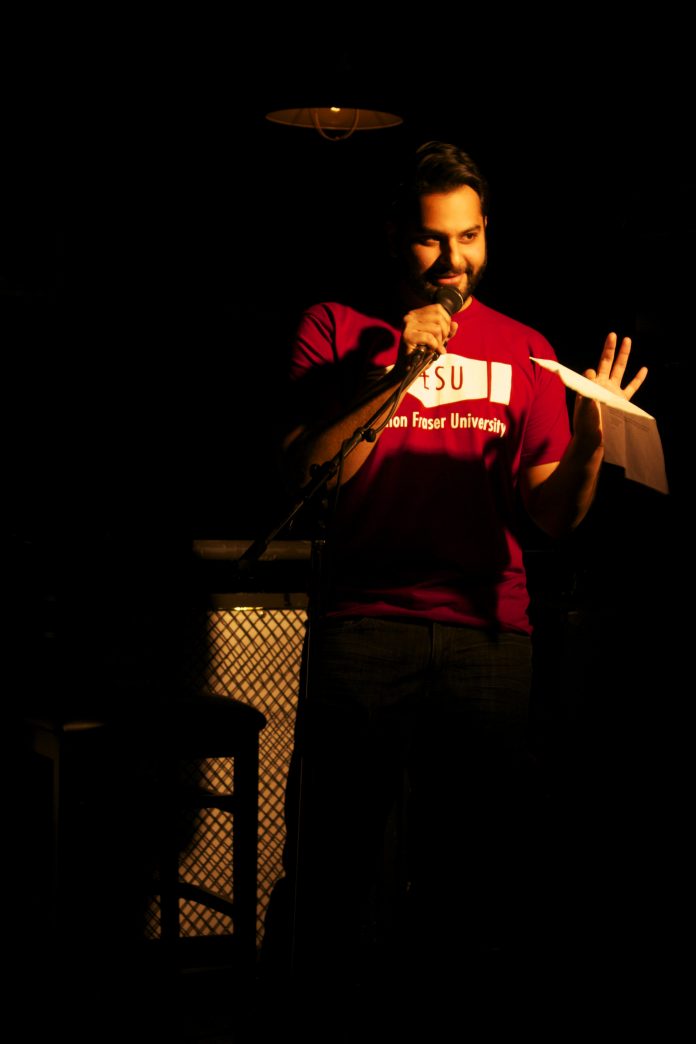
ESU president Hussan Riasat’s poem concerned the devaluation of words.

The English Student Union (ESU) held their first annual Grand Poetry Slam on Thursday, November 13 at Highland Pub on SFU’s Burnaby campus.

The upper level of the pub was filled at the event’s beginning, with a group of about 25 sticking around until its end, including the entire ESU executive committee.

The event featured more than 10 poets from English, sociology, French, communications, and business departments. Some were very expressive, some reserved, and many presented two or more poems.

Hussan Riasat, ESU president, said, “I wasn’t expecting this many people, and I wasn’t expecting this many people to actually be really enthusiastic about it.”

The event featured many different types of creative writing, including more traditional forms of rhyming poetry, prose-based, and abstract poems, and at least three that were admittedly composed either on the same day or at the event itself.

The atmosphere was receptive and respectful, with supportive ESU members sitting at the front of the audience, leading applause and supportive snaps. The group told the audience to snap their fingers rather than remain silent, if a speaker lost their place in their piece — luckily, this save was only needed once.

“We couldn’t have expected the amazing poets that came out today,” Sophia Katherina, ESU events coordinator, told the audience near the end of the event.

The group had originally planned to give out t-shirt prizes to poets chosen by audience members or the ESU, but were so “absolutely impressed with everyone,” according to Katherina, that every poet was entered into a random draw to win the prizes. Three poets took home luxurious ESU t-shirts, along with the pride of being selected randomly.

Vincent Mitra, who volunteered to read his writing after coming to the event, said he saw the evening as an opportunity to talk to like-minded people. “I think English can be a very solitary thing,” he said, explaining that writing “isn’t necessarily a group activity,” and that he was glad to see an event like this make it so. Readings like this, he said, “I imagine, are one of the only ways we can connect.”

Riasat said he hopes the poetry slam becomes something that the larger SFU community can bond over, not just those in the English department. “We’re trying to change things around” in the ESU, he said, “and we made the event open for that reason.”

He hopes that poetry can become part of a tradition at SFU, like the Fall Kickoff or Spring Sendoff.

“If writing poetry can be a bonding point, something that people from any department see as a means to go out, meet people, and have fun, [. . .], then [the event] can grow,” Riasat concluded.


Six things only people who can read at a seventh grade level will understand

0
There are just some things only a person who reads at higher than a sixth grade level will understand

We’ve all been there before. You’re talking to a friend’s younger sibling or at your job working with kids when that awkward moment hits: you realize they’re still in elementary school and haven’t even begun to think about taking grade seven vocabulary-building exercises. Here are six embarrassing situations that only people who read at at least a seventh grade level can relate to.

1. When you say you really “abated” a situation earlier that day, but the child you’re talking to doesn’t know if that was a good or bad thing.

2. Your jokes about how practicing an “orthodox” religion means you’re basically calling it in early life-wise don’t land because they don’t even know what orthodox means.

3. When you pay respects to the recent Evil Dead, saying how you appreciated that it was more of an “homage” than a complete reboot, but the 11-year-old still doesn’t know what you’re referring to.

4. You make a mental note to avoid using the word “nomadic” because none of the grade six kids ever know what you’re talking about.

5. Whenever you find a conversation with a child to be particularly “stodgy” — a reference they don’t quite understand, but should be able to after they complete their next year of schooling.

6. You have to forgo saying “robust” as often as you’d like, due to it being a word that not everyone has learned yet.

Recently graduated English major experiences overwhelming financial, personal success

0
Mo’ English degrees, mo’ money

Against all odds, a recent SFU graduate has shown the world how to make an arts degree work for him.

After graduating with a degree in English (minor in liberal studies), 23-year-old Monay Maker struggled with one major roadblock: he was lost as to how to actually utilize his degree in the corporate job market. Already in debt with $20,000 in student loans, Maker knew he had to make a move.

“As someone with a BA, I’m all about making big money,” said Maker. “But at first, the big money I was after elluded me.”

Formerly a full-time barista in Coquitlam, Maker began voicing his desire for quick cash and better employment to his customers.  A regular at the coffeeshop, known only by the name of Dr. Iceman, offered Maker a job helping him ship high quality pharmaceuticals to the less fortunate and mentally ill.

“I was ecstatic when Iceman offered me a job, as he seemed to only ever pay for his coffee in $100 bills. I felt like this was my out,” explained Maker. “Other employees always spelled his name ‘Icemen,’ and that’s the reason he loved me. I was the only one who spelled it right. I knew my English major would open up a world of opportunity for me.”

After quitting his barista job on the spot, Maker began working full-time for Iceman, helping to conceal pharmaceuticals for international shipments.

“Having the chance to read so many wonderful books during my degree led me to suggest the perfect way to smuggle drugs across the border,” said Maker. “We would cut out the middle part of the book, place the product inside, and then just close it back up again. The Bible makes a great door stopper, but it’s even better for shipping dope.”

After paying off his student loan and making enough money to support himself, Maker shifted careers and made a bid for the entertainment world. It was during this time that he wrote all of the songs that appeared on his debut album, Get Cash or Die Tryin’.

“Having taken multiple poetry classes, I was already familiar with some of the basic rhyming patterns,” said Maker. “Like I already mentioned, I knew my degree was gonna get me that cash.”

Released back in June of this year, Get Cash or Die Tryin’ debuted at the top of the US billboard charts and has enjoyed seven hit songs, including Maker’s first single, “C.U.N.T.” Standing for “Chosen Ultra-hip National Teacher,” Maker’s song has been particularly praised for its honest and inspiring chorus: “I don’t know what you heard about a fee / But a bitch can’t not respect my degree / No student loans, no debts, you can see / I’m just a motherfuckin’ C.U.N.T.”

But instead of basking in his absurd wealth, Maker recently began to give back to the academic world that helped make him the success he is today. Using the profits from his album sales, Maker is currently funding the construction of several colleges across the country in hopes that future generations can enjoy similar successes.

Only offering a single course, students attending Maker’s college will graduate with a degree in “Monay Making,” which will prepare them for a life of incomparable stardom, burgeoning popularity, and, of course, big big money.

This week in Comics

0


Literal Death (Serena Chan)
comicPun 2 3 (Sarah Walker)Pun 2 3 (Sarah Walker)

Ski Ninjas (Kyle Lees)

Planet of the Taylor Swifts (Eric Smith & Jacey Gibb)
apes

The Adventures of Agoraphobia Man: World Defender (Jacey Gibb)
agora

Spend your way to happiness

0
Spending only $5 on someone else can increase your happiness.

Students, instructors, faculty, and members of the community gathered at SFU’s Surrey campus on November 6 to learn about how they can spend their way to happiness.    

Lara Aknin, an SFU assistant professor of social psychology, gave a lecture titled, “Doing Good, Feeling Good,” as part of the President’s Faculty Lecture series. The lecture focused on her research, which looks at the emotional consequences of generous behaviour.

“Much of the research I have conducted examines people’s perceptions of the money and happiness relationship,” said Aknin. Her findings indicate that we feel happier when we spend money on others rather than on ourselves. During the talk, she described how there seems to be a “positive feedback loop” between generous behaviour and happiness.

Aknin and other researchers found that people from around the world gain emotional benefits from using their financial resources to help others.

She suggested, “Consider spending your extra disposable income on others instead of yourself. Our research suggests you’ll be happier for it!”

Aknin noted that this runs contrary to many preconceived notions about human nature: “While many perspectives of human nature argue that people are selfish, a growing body of research suggests that, when we help others, we experience a boost in happiness from doing so.”

Her research also indicates that benefits stem less from the actual gift than the act of giving. “Spending as little as $5 on others as opposed to yourself can have a measurable impact on your happiness,” said Aknin.

Aknin and colleagues found that even children experienced positive effects when they engaged in generous behaviour. Their research found that children as young as two years old were happier when they gave their treats away instead of keeping them.

Aknin’s research has been featured on CNN and quoted in Forbes Magazine and The New York Times. She has done over 300 interviews, and Yes Magazine quotes her research as “one of the top 10 things that science has taught us about happiness.”

SFU president Andrew Petter explained that the lecture series plays a crucial role in SFU’s commitment to being Canada’s most community-engaged university: “The President’s Lecture series is dedicated to highlighting our internationally recognized researchers and sharing their research with the community.”

Sports Briefs

0

Hockey

SFU hockey lost last weekend’s series against the Selkirk Saints. Having traveled to Castlegar to face the Saints, they put up two goals in both games, but fell 4-2 and 5-2. Jared Eng, Jesse Williamson, Saylor Preston, and Trent Murdoch all had tallies for the Clan. With the loss, SFU now sits at fourth place in the league.

Football

Clan football lost their second-last game of the season against the first placed Azusa Pacific Cougars 21-6. Despite an offensive no-show, the Clan defence played a great game, keeping the Great Northwest Athletic Conference (GNAC) undefeated Cougars scoreless in the first quarter. Running back Stephen Spagnuolo also continued his tear with 146 all-purpose yards. Read the full recap.

Volleyball

Clan volleyball came up with a loss to the University of Alaska-Anchorage Seawolves Thursday night in their second-last game of the season. The Seawolves jumped to 2-0 lead winning the first sets by scores of 25-13 and 25-20. SFU battled back and prolonged the game, winning the third set 25-23. However, Anchorage would close the game winning the fourth 25-17. Kelsey Robinson led the team in kills with 12.

Men’s Basketball

Men’s basketball wrapped up their exhibition season with a loss to the Division I University of California – Irvine, by a score of 128-92. Sango Niang, Justin Cole, and Roderick Evans-Taylor led the team’s offensive charge, notching 52 of the Clan’s points. “In the first half we didn’t put out a great performance but I was happy with the way the team adjusted and refocused in the second half,” head coach James Blake told SFU Athletics.

Lessons learned from broken bodies

0
Despite the massive profits made by many American NCAA sports programs, the actual athletes see none of it.

On the surface, things have worked out for Marcus Lattimore.

Hailing from Duncan, South Carolina, where the median household income is below $30,000, the running back received a $1.7 million insurance payout after the second of two devastating knee injuries he suffered playing at the University of South Carolina ended his NFL hopes.

The second was so catastrophic that Lattimore — a guaranteed first rounder — slipped to the fourth round in the 2012 draft. After trying to rehab the knee for over two years, Lattimore called it quits without seeing a single snap. Due to his injury status, he didn’t collect his salary from the 49ers, but was awarded a $300,000 signing bonus. A cool two million for five years of work; not too bad for a kid now returning to college to finish his degree.

You could fill a book nobody would ever read with manipulative, draconian NCAA tactics and its practice of modern indentured servitude. The biggest problem with the organization and its supporters is that they have embraced the ultimate capitalist impulse — the commodification of its workforce.

When Lattimore retired on November 5, the university and his former head coach Steve Spurrier were lauded in the press for offering him a job with the program if he so chooses, citing the cherished memory of Lattimore’s bruising running style that made him so popular on campus. But how noble is a program that drives its athletes to their collapse while hiding behind the nebulous curtain of amateurism?

Supporters of the NCAA have a rote response to charges of exploitation: a) nobody told these kids to play football and b) they get a free education out of the experience. But these arguments simply deflects from the severe inequalities innate to the system.

Consider the University of South Carolina before Lattimore’s arrival. In the five years that Spurrier was head coach before Lattimore, the program never won more than eight games. USC was considered a fallback option by college recruits who failed to make it into the bigger programs and divisional powerhouses — Alabama, Georgia, Florida.

After Lattimore, the team immediately vaulted into National Championship consideration. Quality recruits rolled in, sales of Lattimore’s jersey (with his number but no name) at $60-a-pop skyrocketed.

Williams-Brice Stadium was renovated and Spurrier’s income jumped from $1.75 million to $4 million annually in a five year time span (2009-2014). All this occurred while Lattimore was the team’s thoroughbred, carrying the ball up to 40 times a game. Everybody involved makes money except those creating the product.

Athletics have never been about the individual players — they’re eminently replaceable cogs in a machine. As fans, we’ve become conditioned to ignore the very real human costs of gladiatorial sports. We are far too desensitized to catastrophic injuries that bring games to screeching halts before the player is removed from the field and the important stuff continues. We don’t see the hours, weeks, and months of rehab, or the persistent pain that shadows athletes throughout the rest of their lives.

So why do we adamantly substantiate the NCAA’s absurd claim to amateurism, reverting to talking about tuition and living costs? Consider that in many sports leagues, there is a union mandated minimum salary — $420,000 per year for a rookie in the NFL, a compensation that reflects the dangers of the sport and the limited lifetime earning potential of athletes.

For a college system that is every bit as profitable, is a $40,000 annual ‘salary’ (in terms of cost covering) a sufficient repayment for the sweat, equity, and hazards these athletes invest and experience? Not in the least.

University Briefs

0
Club member Adam Pinkoski's hiding place of choice.

Hide and seek club thrives at U of A

Anywhere between 25 and 100 people come out each Friday to participate in a game of hide and seek on the University of Alberta campus.

The hide and seek club started in 2013 with just five members, but has since grown considerably and now requires a $5 fee for membership and the bandana that must be displayed during gameplay.

Club member Adam Pinkoski revealed one hiding spot of choice: tall blue recycling bins. He conceded that while he stays hidden, the bin is “a huge sweat box.”

With files from The Edmonton Journal

Saskatchewan GSA president faces impeachment

A group of graduate students from the University of Saskatchewan have put forward a motion of non-confidence against the president of the Graduate Students’ Association, Izabela Vlahu.

As reported in The Sheaf, “The group’s areas of greatest worry appear to be those concerning the spending of GSA finances, including the costs associated with U-Pass implementation and executive travel, and general allegations of poor governance.”

The time frame for U-pass pick-up was decreased from four weeks to nine days and Vlahu has allegedly been paying staff out of the U-pass line item. Other concerning allegations include a lack of government transparency and the bullying of dissenting GSA councillors.

With files from The Sheaf

U of T breaches students’ financial privacy

On October 29, over 170 files containing students’ sensitive financial information were sent out to the wrong recipients.

Various University of Toronto students received an email from enrollment services to inform them that they had been granted need-based funding through University of Toronto Advanced Planning for Students (UTAPS). Recipients noticed that they had also been sent the information of fellow students.

The files sent out “contained students’ names, street addresses, award amounts, student numbers, and faculties of study.”

With files from The Varsity

Satellite Signals

0

WEB-woodwardWoodward’s

In anticipation of United Nations Climate Change Conference in France in December 2015, the French embassies in both Canada and the United States are organizing a series of events called “FACTS” standing for French Ameri-Can Climate TalkS. Held at Woodward’s on November 12, the Vancouver event considered the challenge of climate change, and the effects that next year’s negotiations will have in a post-2020 world.


surreySurrey

A techie twosome came out on top in SFU Surrey’s Central City Community Engagement competition with their idea to develop an elite training program encouraging young innovators to solve health technology challenges. Sujoy Ghosh Hajra and Careesa Liu received $5,000 from Central City’s property management company, Blackwood Partners, to help implement their Surrey Collaborative Outreach and Research Experience (SCORE) project.


vancouverHarbour Centre

The importance of women’s voices in the public sphere was discussed on Friday, November 14 by Shari Graydon, founder of Informed Opinions, and the Right Honourable Kim Campbell. Although women make up 61 per cent of university grads and hold leadership posts in most arenas, the experts who are quoted or featured in dominant news media remain overwhelmingly male. The talk examined how we can change the status quo, and who is responsible.

Board Shorts

1
The SGM will address some items from the 2014 SFSS AGM, which quickly met capacity and was unable to accommodate all voting members.

Interfund transfer from Space Expansion Fund to Build SFU

The SFSS board of directors moved to make a non-cash interfund transfer from the Space Expansion Fund to Build SFU to settle the debt owed by Build SFU.

VP finance Adam Potvin explained, “This is merely a housekeeping item. We’re not looking to transfer cash.”

A sum of $645,859 has already been transferred from space expansion to Build SFU. Board members have decided that these two share the same mandate, so the non-cash transfer “effectively negates the requirement of repayment by Build SFU.”


Clean Energy Investment Plan

A proposal came to board to invest a portion of the SFSS general fund in clean energy.

The SFSS plans to buy 1,000 shares from iShares Global Clean Energy ETF, totalling approximately $12,000. This investment may be sold at any time.

“This investment is a tiny fraction of the society’s net worth,” said Potvin. “It’s just using the cash that’s sitting there as an asset now, so it doesn’t affect the budget whatsoever.”

Board carried a motion to accept the proposal, including in the motion that no further investments will be made “until such time as an investment policy has been approved by board.”

SFSS to host SGM on SUB motions

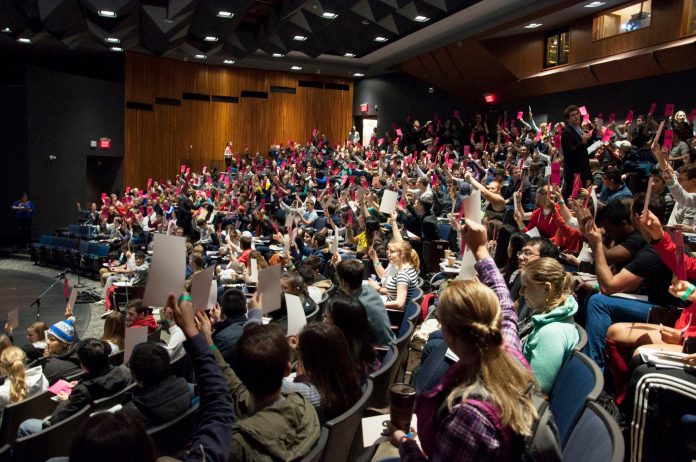
The SFSS’ Annual General Meeting held on October 22 was the first to make quorum since 2008, however the SFU Theatre where the meeting was being held quickly met capacity — approximately 60 students who were left outside were unable to vote on two motions related to the Build SFU Student Union Building and Stadium projects.

SFSS president Chardaye Bueckert sought legal advice as to whether or not the society could hold another AGM to allow everyone’s voices to be heard. However, an AGM must be held between September 15 and October 31 in any given year. Therefore, the SFSS voted to hold a Special General Meeting (SGM) on January 19 to allow all members who were unable to vote to do so.

“We want to make sure that everybody has a fair opportunity to vote,” Bueckert said. “I’m really confident that the motions will pass if revisited given the overwhelming support.”

The SFSS will also host a Town Hall to allow students to discuss any concerns in a less formal setting.

Board ratifies Science Undergraduate Society constitution and bylaws

As recommended by the Constitution and Policy Review Committee, board ratified the changes made to the Science Undergraduate Society constitution and bylaws.

Although science representative Deepak Sharma explained that they only made “minor edits,” Dion Chong, SASS president, voiced his concerns over the use of the alternative pronoun ‘zir’ in the document. “I think there are many many alternative pronouns that are available to that community and it’s a lot more inclusive to use ‘they’ which is already constantly used as opposed to using ‘zir’,” he said.

The approval of the document validates the referendum question which was posed this November concerning the establishment of the Science Undergraduate Society as the official Faculty Student Union.