You won’t be surprised to know that SFU is a cesspool of raw musical talent. These up-and-coming disc jockeys have been spinning this campus out of control with their mad beats. We sat down with three of the best and brightest to find out what it’s really like to walk in the shoes of an SFU DJ.
DJ Sajid || Photo by Brandon Hillier
DJ SAJID
An SFU student and renowned heartthrob, Sajjid has wowed the crowds of two of SFU’s recent SFSS concerts.
What is the first thing you do in the morning?:
“Honestly, check Twitter and Instagram. I wake up, see my phone on the right side, it’s ready to go.”
When you’re making your beats, what do you tend to start with?:
“Usually the melody, something that will hook people into the song right away. Try to focus on that and just build from there.”
Can you sing a part of one of your favourite tracks?:
“There’s a lot of them… One of my artists, he’s a first year at SFU, and he just came out with a new song called “Analog Dream,” but it’s not something you can really sing. It’s like that electronic sound.”
Can you try?:
“Ok well another song I like is Showtech, “Sun Goes Down,” so *begins singing* When the sun goes down, dun na na na na na, dun na na na na na na na.”
Who would be your celebrity crush and why?:
“Damn, that’s a hard one. Probably Kendall Jenner. She’s the same age, it’s like, ‘Hey, maybe I can date that one day.’”
Do you have a catch phrase?:
“No, don’t think so.”
Do you want a catch phrase?:
“No.”
DJ Potspin || Photo by Erik Sagmoen
DJ Potspin
When he’s not competing in business speaking competitions, DJ Potspin turns the tables at some of the hottest clubs around.
What is the first thing you do in the morning?:
“Protein shake, obviously. Fifty crunches — I’m building up to 100, but starting off with 50. Of course I have to moisturize my face. If you’ve watched the first scene of American Psycho, it’s pretty much that, but a little more intense I’d say.”
By recommendation of council, the SFSS board of directors has appointed a new chief electoral officer (CEO) to head up their independent electoral commission (IEC).
Oscar Sanchez was favoured by the council over opposing candidate Lindsay Shepherd in a vote of 23–4. He will serve in his position until November 30, 2015.
As the only candidate present, Sanchez fielded questions from council and board members for over 40 minutes.
During the question period, Sanchez shared his goals to double voter turnout from the previous election and to increase transparency in the electoral process.
“I’ve seen a lot of processes both in elections and in workplace environments that have been hampered by miscommunication and by misunderstood intentions,” said Sanchez.
President Chardaye Bueckert commended him for his performance in what she called “the most intimidating job interview ever.”
No to Build SFU presents to Council
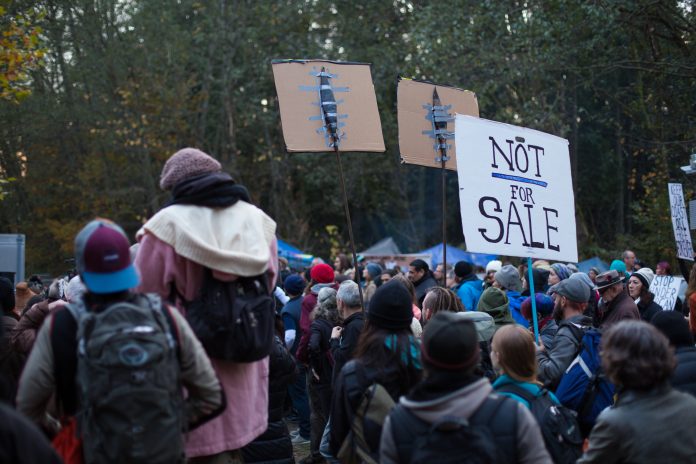
Students from the group, No to Build SFU, made a brief presentation to council on Wednesday night regarding the upcoming SGM and issues related to the Build SFU Student Union Building (SUB) and Stadium projects.
The group asked council members if they would disseminate the information on the site, NotoBuildSFU, to the student body. The site contains information related to the projects, and asks students to sign a petition contending that the SFSS Annual General Meeting held on October 22, 2014, “was not a democratic representation of student confidence in Build SFU.”
“Our concern is that, so far, as Build SFU has proceeded, there has not been a counterpoint offered that has official support or funding,” said Kaitlyn MacInnes, one of the group’s organisers and a fourth year history student. “We’re just trying to provide a balance so that students can see both sides of the argument and vote as they see fit.”
Though they scored on their first power play, the Clan were largely ineffective with an extra man, going one for seven (14.3 per cent).
The SFU’s men’s hockey team scored the first goal in their Thursday night game against the Trinity Western Spartans at the Langley Event Center, but the game quickly went downhill from there.
Clan defenceman Matthew Berry-Lamontagna opened up the scoring on the power play with a shot from the point at 5:25 minutes in.
SFU began playing a strong game, maintaining possession of the puck. However, once the Clan turned the puck over, Trinity Western were able to convert the turnovers into solid offensive opportunities — and goals.
The first period for the Spartans came on a breakaway. Trinity Western forward PJ Buys drove the puck in to tie the game.
However, this tie would quickly turn into a lead for Trinity Western. About two minutes later, forward James Russell put the Spartans up 2–1, and just over a minute later, BC Intercollegiate Hockey League (BCIHL) leading scorer Cody Fidgett solidified Trinity Western’s lead with his 19th goal of the season.
As a result, Clan starting goalie Jordan Liem was pulled with less than a period of play, in favour of backup Andrew Parent. Initially, the goaltender was successful, as SFU point leader Nick Sandor scored to put the Clan within one — a score that would hold until the second period.
However, just a little over three minutes in, Trinity Western scored their fourth of the game; this proved to be the final nail in SFU’s coffin. Although the Clan dominated much of the first half, the Spartans controlled much of the second period.
Trinity Western would add one more in the period to take a commanding 5–2 lead. Having made only two saves on four shots, Latimer was chased out of the net, and Liem made his return to the crease.
What followed was a relatively low-key third period. The Spartans were content to clamp down on the Clan’s offensive chances and protect their lead. Tempers flared over the course of the game, and the after-whistle activities became more heated. This culminated in 10 minute game misconducts for SFU forward Pavlo Zerebecky and Spartan defenceman Deryk Kirchner.
As a final kick in the teeth to the Clan, Trinity Western scored a sixth and final goal with only 1:34 left in the game.
Though they lost 6–2, the Clan outshot the Spartans 37–26. The high shot count emphasized SFU’s inability to finish — though their cycle game was in fine form, they had a hard time getting quality shots to the net and putting the puck in. Although they scored on their first power play, the Clan were largely ineffective with an extra man, going one for seven (14.3 per cent).
SFU will get the chance to avenge their loss next Thursday, when they return to the Langley Event Center to once again face the Spartans. They will be looking to give Trinity Western their first loss since November 29 (The Spartans last loss was in a 5–2 shootout to SFU). With this victory — and the Eastern Washington loss — the Spartans clinched a spot in the BCIHL playoffs.
Erin Chambers had 14 points and seven assists on the night.
This Thursday night, the SFU women’s basketball team played the Saint Martin’s Saints in the West Gym. The Clan came into the game with a 7–6 overall record, good enough for fourth in the league, while the Saints entered with a 4–9 record, which put them at ninth. Needless to say, it was a game the Clan were expected to win.
The game began with SFU winning the opening tip-off, and the Clan got off to an early 17–10 lead thanks to a 10–5 run. Saint Martin’s game plan early was evident, which was driving to the basket and drawing fouls. However, SFU’s three-point shooting was excellent, and the Clan established a 22–14 before settling for a 44–35 lead at the end of the first half. The highlight of the half was a basket by Alisha Roberts, who pulled off a nice move one on one before driving to the basket for the easy layup.
In the second half, SFU once again got off to a good start, scoring many times off fast breaks and starting off on a 10–4 run. The rest of the half was very even, with the teams trading baskets back and forth until the end of the half. The final score was 83–70 SFU. Freshman Rachel Fradgley had a fantastic game, with a game high 20 points and going nine for 10 from the field, as well as going two for two from the line. Senior guard Erin Chambers led the team with seven assists, as well as contributing 14 points of her own.
With the win, head coach Bruce Langford ties former women’s basketball coach Allison McNeill’s record of 363 wins in SFU’s women’s basketball program. After the game, he was humble about the record and instead put the focus back on the team. “Well I’m just happy we won today’s game. We need it for our league record after our bad game the other day,” he said.
The joint-record holder also commented on the difference between the first and second half. “I thought we were a bit better shooting in the first half for sure. We were unbelievable from the three point line in the first half, and I thought in the second half we were just holding on, looking over our shoulder.”
The next game will be Saturday night against Western Oregon. If they score another a victory, Langford will break the all-time wins record. Tip-off is at 7 p.m.
Some people are so insufferably righteous that you can’t stand them. You know the type: in a way you admire them, but those feelings are quickly overcome with the urge to slap them in their fair-trade-buying, bicycle-riding, self-satisfied faces. That’s how Mrs. Iverson feels about Julie.
Julie (Marisa Smith) and Peter (Sebastian Kroon) meet at university while Peter is a student at the Sauder School of Business and Julie is studying ecology. Peter’s mom, Annie Iverson (Susan Hogan), is very proud of the path her son’s life is on — she envisions him using his degree in business to get a stable job with a good retirement package, buy a house, and have a couple of grandchildren for her.
All of that changes, however, when Peter falls for Julie. He adores her for fighting for what she believes in, no matter what. As Julie travels around the world joining in protests and other forms of activism, Peter watches YouTube videos of her in action and awaits her return. Mrs. Iverson keeps waiting for the ‘Julie Phase’ to pass, but it never does.
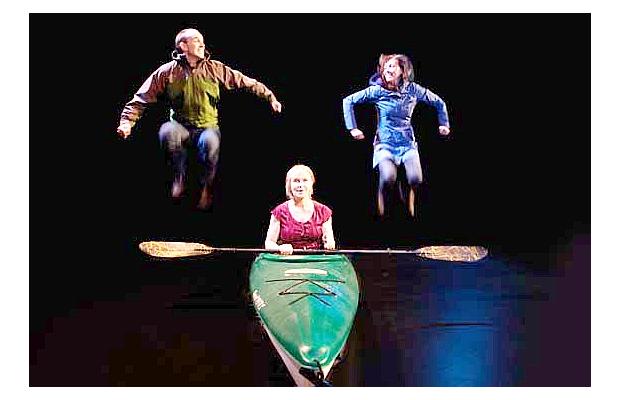
Mrs. Iverson — Julie never calls her by her first name — tells this story from her kayak as she conjures the ghost of Julie and recounts the series of events that led her to be stranded. Sitting in a kayak for over an hour on stage must be pretty uncomfortable, but Hogan delivers an impressive performance as a distraught mother who tried to protect her son from Julie, the environmental crusader.
With humorous, realistic characters, Kayak raises some important questions about the future consequences of our actions, and prompts us to think about our own impact on the environment. However, I felt that the message of the play could have been articulated even more clearly through these characters, and the plot became a bit muddy near the end with what I felt was a false ending and a confusing resolution.
Despite this, Kayak is a powerful story, and I’m glad that Jordan Hall was able to incorporate the subject of global warming in his work without it feeling contrived.
Alley Theatre presents Kayak at the Firehall Arts Centre from January 7–17. For more information, visit firehallartscentre.ca.
It’s a sort of sick kismet that on the week I’m slated to write my Editor’s Voice, my once-a-semester opportunity to address our newspaper’s readership directly and on any topic of my choosing, the name Charlie Hebdo is still making headlines. And while I don’t pretend that the work I do for The Peak as humour editor is comparable to what some satirists have made careers out of, I’d like to use the opportunity to talk about a time when print humour affected my life.
More than once during my time as humour editor I’ve faced criticism from some, telling me to take more risks with my writing and target certain people or organizations, but I digress. Humour isn’t something that always has to come at someone else’s expense and I stand by that. I don’t brilliantly lampoon controversial figureheads or use my words to suggest political change; nor do I have a fraction of these humourists’ reach or influence. I write articles about fake Jurassic Park movie scripts and draw weekly comics about agoraphobic superheroes.
When I was editor-in-chief of a different student newspaper last year, we came under scrutiny for publishing a staff writer’s humour article that mentioned a police department by name and linked them to accidental distribution of candy laced with LSD. The piece itself was relatively weak — relying on over-the-top description more than cleverness — but I had approved the piece regardless. (Since humour is wildly subjective, it’s hard to dismiss something simply because you yourself don’t find it funny.)
The week that followed the article’s publishing was one of the most stressful times of my life. It wasn’t until I received an email from the CBC, asking me to comment on the police department calling for a retraction of the article and apology for its publication, that I knew anything was amiss. As it turns out, the police had emailed me prior to this, though it went to my junk folder because sometimes life is awful and hates you like that.
It used to be my mantra to never apologize for something our student newspaper published regardless of its reception.
Up until that point, it had been my mantra to never apologize for something we published regardless of its reception. After all, newspapers are meant to create and curate content, not apologize for it. Unfortunately, this incident came at the same time that we were in the midst of renewing our study levy contract with the school. Someone told me they had contacted the college’s Board of Directors and my thoughts immediately jumped to what the fallout could be: student newspapers, for those who don’t know, survive largely on the income provided with student levies. Without one, I knew the publication wouldn’t be able to survive for long.
We ultimately took the article down and I issued a personal apology to the police department, using the most diplomatic language possible to say how wrong we were to publish it in the first place. My apology was accepted and within a few weeks any scrutiny from the public had fizzled.
While the stakes were probably never as high as they were in my mind, I made the conscious decision that stubbornly defending a subpar article wasn’t worth the bleak possibility of future generations not having the same newspaper I’d known and loved for years. I decided that I’d rather swallow my pride and wave the apology flag than have the newspaper not be there for future Jaceys. I wouldn’t say I regret the choice — our contract was renewed weeks afterwards without any hiccups — but I sometimes wonder what would have happened if I had stood by the article and refused to apologize.
Losing sleep for a few weeks pales in comparison to events such as what happened to the employees of Charlie Hebdo on January 7, but what I’m trying to say is that as harmless as writing humour may often seem — some of the editors at The Peak even refer to the section as “jokes” — there’s always the possibility that real-world repercussions can arise from it. Don’t let the fear of backlash hold you back from writing about certain topics, but keep in mind that some people might not necessarily find the humour in your jokes about LSD.
While climate change is likely our world’s greatest threat, pipelines are not at the crux of the problem, and protesting their construction is not a solution to alleviating climate change.
Oil is mined or pumped from underground. After being extracted and sometimes upgraded, oil is then transported via rail or pipeline to a refinery, where it is refined into various products ready for consumer use.
Pipelines are a conduit in this cycle. They’re also somewhat replaceable. Without them, crude-by-rail has grown exponentially over the last decade, as a lack of pipeline infrastructure has led to increased rail infrastructure. Companies like CN Rail and Canadian Pacific Railway have thrived as they continue to carry increasing amounts of oil.
In other words, whatever does not get transported by pipeline will eventually get transported by rail, and crude-by-rail carries many of the same risks as transportation by pipeline — spills often occur. In order for pipeline protesters to achieve their goal of ceasing oil spillage entirely, they ought to successfully block locomotive travel — and for that matter, oil tanker trucks and ships — in addition to pipeline construction, which is clearly not a sensible solution.
But even more important is the demand for oil that triggers its transportation in the first place. We should really be lying down on runways to protest air travel, or blockading major intersections to protest driving gas-fueled vehicles. If we weren’t so reliant on oil for our day-to-day activities, there would be no need for Suncor to pump oil out of the ground, and no need for Kinder Morgan to transport it.
To cease oil spillage altogether, protesters must successfully block all other forms of oil transportation.
So how can society advance into a greener future? Given the capitalist framework of our modern world, the private sector needs to be the engine of this electric car, and the government its driver.
Socially conscious consumers are a minority. We therefore need a renewable energy source which is less expensive than fossil fuels and which people will actually use. In order for this to happen, we need more capital to invest into research on the development and infrastructure of a clean energy system. Such a system can then expand, and will cost less to produce and consume. This can occur through government subsidies and creating investor-oriented tax incentives for clean energy, in addition to organizations taking it upon themselves to invest directly in clean energy companies.
For many developing nations, oil is cheaper than investing in clean energy; it may seem unfair for these nations to forego economic prosperity in the name of preventing climate change. However, as clean energy technology improves and becomes cheaper, and as the price of oil trends ever upwards, it may be economical even in the short-term for these nations to to invest in renewables over oilfields.
In North America, two excellent examples of clean energy advancement have come from the least likely of people. The Rockefeller Brothers Fund recently replaced about $50 billion of its oil and gas holdings with clean energy investments, and back in 2013 Stephen Harper gave big Canadian oil and gas companies $400 million to subsidize development in wind, biofuels, and carbon capture storage technology.
This is the type of activity that will lead to a renewable-energy world. Rather than blockading pipeline construction in an ineffective attempt to reduce the flow of fossil fuels that we ourselves demand, we should be looking for proactive strategies to help our population seamlessly transition from fossil fuels to clean energy without drastically hampering economic activity. The science behind renewable energy is nearly there; now it’s all about the financial capital.
When we discuss the pivotal shifts currently occurring in journalism, the rapid expansion of online media and the departure of printed press is often among the first things mentioned.
While this shift is without a doubt taking place, there is another transformation that deserves just as much, if not more, attention as the digitalization of our news: mainstream news channels are no longer the leaders in reporting hard-hitting stories. This position is now being filled by a recently popularized media form: fake news.
I am sure many of you have watched or have heard of programs such The Daily Show with Jon Stewart, Last Week Tonight with John Oliver, and The Colbert Report, the latter of which recently celebrated its finale. All of these programs mix biting satire with their presentation of real events.
This type of entertainment has proven itself popular with audiences, and has therefore led to a great expansion of the genre. But what no one accounted for when these programs emerged was that they would replace mainstream news channels in terms of the best source for relevant and important stories.
Increasingly often, national news broadcasters report on subjects that are of little substance. Mainstream news is now more like a source for gossip than anything else — reporting on trivialized events rather than controversial, important material. After skimming last week’s headlines, I was unable to find any in-depth coverage that hadn’t been watered down to keep audiences content.
Mainstream news now reports on trivialized events that contain little controversial material.
That being said, it’s not hard to imagine why fake news has seamlessly absorbed the title mainstream media once held. These programs pick up on the relevant and significant stories of the day, and create broad-minded editorials to provide the audience with effective and entertaining analyses of these events.
The main reason for the apparent reversal in content is that ‘fake news’ does not have to worry about offending parts of their audience for addressing these controversial issues, mainly because they are protected by their label as a satirical news outlet.
Mainstream outlets, on the other hand, do not have the same freedom to openly debate or criticize world events, as they have become preoccupied with the business side of media. If they lose their audience, they lose their revenue. The more large-scale media corporations focus on attracting audiences, the more journalistic substance they have to sacrifice to keep said audiences happy.
I find this particularly troubling. As much as I enjoy news-parody programs, networks should not have to compromise their reporting for any reason. After all, good investigative journalism involves finding fringe opinions and controversial stories to create a larger picture of the global and local communities of which we are a part.
Instead of avoiding the big stories in favour of inoffensive fluff, mainstream news should reinvest in investigative journalism to try to uncover the controversial stories that they would typically shy away from. While ‘fake news’ provides some great laughs, it should not have to replace the sources it mocks. Mainstream media must reclaim their authoritative and professional status by moving away from the safe topics that make them indistinguishable from BuzzFeed.