
SFU professor highlights the danger BC faces from natural disasters
By: Niveja Assalaarachchi, News Writer
2025 was one of the most destructive years on record for natural disasters. Though much of the damage to infrastructure and human lives was seen in the Global South, much of the economic cost was seen in Global North countries like Canada. The Peak interviewed Tim Takaro, a professor emeritus at SFU’s faculty of health sciences, to learn more about how the growing destruction of natural disasters specifically applies locally.
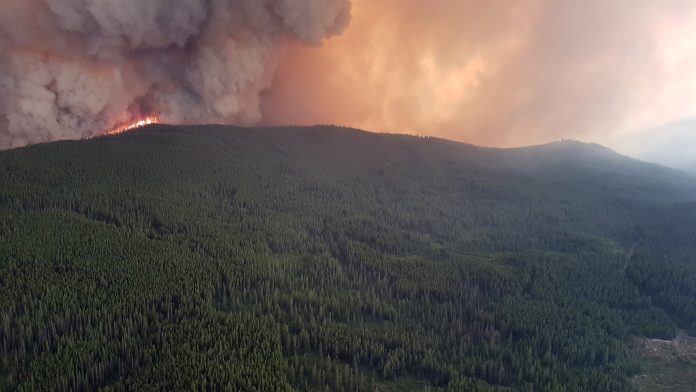
In 2025, BC faced disasters like the flooding of the Fraser Valley and forest fires. Takaro explained that these disasters as a whole had afflicted large segments of the population, especially marginalized communities. For one, he pointed to those with chronic illnesses, as chronic conditions can increase the chances of sickness and death during disasters. This can be due to potential disruptions in essential services, weakened immune systems, and increased mental health strain.
He also pointed out that natural disasters in BC have had a disproportionate effect on Indigenous Peoples, as they face the colonial legacy of being driven off their traditional lands towards more vulnerable areas for natural disasters. He argued that this set the stage for the present, where 80% of all Indigenous communities live in areas prone to disasters like wildfires, and about 42% of all disaster evacuees in Canada are Indigenous Peoples, despite only making up 5% of the population.
For these particular reasons, Takaro emphasized the need for the provincial government to adapt to the evolving threat of climate-induced disasters and tackle their root cause — fossil fuel emissions.
“I liken it to having your bathtub overflowing, and you go and look for a mop and some towels, and you don’t turn off the tap. That’s the way we’re approaching this problem — we’re not addressing the source.”
— Tim Takaro, professor emeritus at SFU’s faculty of health sciences
He argued that, due to the role of the gas industry, the government has a conflict of interest in tackling the role of carbon emissions in climate change for economic reasons. As well, The Vancouver Sun reported in September 2025 that, due to BC’s financial situation, it had no resources for a flood plan, highlighting concerns over the region’s readiness for future disasters.
Overall, Takaro emphasized the need for long-term and holistic planning to tackle the issues of climate-induced weather patterns in the province: “We tend to, in our thinking, follow the political cycle, which is thinking four years ahead; we can’t do that.”
CUPW holds rally to mark first anniversary of postal workers forced back to work

By: Heidi Kwok, Staff Writer
On December 20, a rally was held by the Canadian Union of Postal Workers (CUPW) and the East Van Workers Assembly at Victory Square to mark the first anniversary of 55,000 Canada Post workers being forced to resume work duties after a 32-day strike without properly negotiated collective agreements. The back-to-work order, issued on December 13, 2024, by the Canadian Industrial Relations Board under the recommendation of former labour minister Steven MacKinnon, relied on Section 107 of the Canadian Labour Code. CUPW argues that this provision was “deliberately misinterpreted” to prematurely end the strike. The Peak spoke with Alex Bernstein, an organizing director at CUPW Vancouver Local 846 and a North Shore letter carrier, to learn more.
“The atmosphere was quite electric,” he said. “There was a lot of support from CUPW, East Van Workers Assembly, Vancouver and District Labour Council, and a whole bunch of labour-adjacent people [ . . . ]. People were frustrated.”
In the past, the federal government had been repeatedly accused of misusing Section 107 to resolve industrial disputes without proper settlements between parties. Section 107 grants the labour minister authority to intervene in labour disputes to “maintain or secure industrial peace.” In a press statement, CUPW said that the provision “continues to be liberally wielded against organized workers,” having been utilized to end the BC and Montréal dock workers’ strike in 2024 and the 2025 Air Canada flight attendants strike.
Section 107 “stipulates that they can end the labour dispute in a way that would be conducive to getting a settlement.
“S. 107 did not end our [Canada Post’s] labour dispute. It ended our right to strike and forced us back to work.”
— Alex Bernstein, organizing director at CUPW Local 846
“It has been over a year now, and we don’t have a contract.”
Bernstein said that workers’ fundamental bargaining power is lost when they’re denied the ability to withhold their labour, thus removing any incentive for employers to bargain in good faith: “They need only wait a couple weeks or as ever long as it takes for the government to go, ‘All right, all right, back to work.’”
When asked what changes CUPW is demanding from the federal government, Bernstein said that Canada Post should be operated as an essential public service rather than a Crown corporation that relies on its own revenue to eliminate unfair competition with private companies like Purolator. While Canada Post owns most of Purolator, CTV News reported that “for several years, the subsidiary has been profitably handling packages that might otherwise be processed by Canada Post.” Secondly, he reiterated that workers’ right to strike and collectively bargain be respected. Thirdly, Bernstein argued that the ongoing mandate review of Canada’s Postal Charter, which may result in reduced service standards such as the end of daily and door-to-door delivery, should be heard publicly so Canadians can have a say in how they receive their mail. Finally, CUPW has also endorsed the reading of Bill C-247, which will involve amending the Canadian Labour Code to repeal Section 107.
“It’s a grave political error for them [the Liberal Party of Canada] to be a party that is supposed to be in opposition to the Conservatives, but they clearly resent people that work for a living,” he continued.
“All we’re asking for is healthy and safe jobs and job security. Our jobs [postal delivery] used to be one that was a career that people could retire on. We give our bodies for this public service, but over time, they erode these rights that we once had.
“So really, the government needs to respect the workers and the people in this country who are dependent on this service,” Bernstein concluded.
The Peak reached out to Patty Hadju, the minister of jobs and families, for a response to CUPW’s demands. Regarding demands one and three, her office stated, “the government firmly supports the collective bargaining process and respects workers’ fundamental right to strike.
“The expectation is always that parties can and should come to an agreement at the bargaining table, and this is why we have a skilled Federal Mediation and Conciliation Service to help support negotiations. The government will always maintain that the strongest deals are reached at the table by the parties.” The office recommended speaking to Public Services and Procurement Canada about demands two and four, but The Peak was unable to correspond with them before press time.
Political social media ads need to be better regulated
By: Mason Mattu, Section Editor
A document published by Elections Canada wrote that various social media advertisements aimed at getting Canadians to buy into cryptocurrency scams were not directly related to electoral misinformation. Yet, this description misses the mark regarding the political implications of these ads. It’s time to regulate social media giants to ensure that voters make their decisions based on accurate information.
Advertisement thumbnails are not uncommon. The ones I have come across often showcase a flashy headline and an artificial intelligence (AI) generated image of a political leader caught in a scandalous or illegal act. If viewers click on these advertisements, they are directed to a webpage that mimics a credible news source.
These ads are not just financial scams — they defame political figures. One example of such defamation can be seen with former federal New Democratic Party (NDP) leader Jagmeet Singh, who has been falsely labelled as a terrorist in 15 countries and as a mansion owner by social media advertisements since 2018. Another politician that has fallen prey to these advertisements is Prime Minister Mark Carney, whose face has been used in deepfake YouTube ads to promote cryptocurrency scams.
Even if we concede to Elections Canada’s conclusions regarding these advertisements, that they are not created to generate electoral misinformation, we must recognize the role they are playing in shaping public opinion about political figures. Many voters, if viewing a clickbait AI-generated graphic on a site like YouTube, might believe the information without even clicking the ad and buying into the financial scam. Not everyone has the same digital literacy, especially in the age of AI. I have seen firsthand how these advertisements impact voter sentiment. In the recent federal election, I came across online comments rallying against Singh, disapproving of his policies simply because people believed he is a terrorist/criminal. In the previous federal election, the Security and Intelligence Threats to Elections Task Force reached out to social media platforms when misinformation campaigns were spotted. Alongside this, Elections Canada made itself available for social media companies to flag concerns about misinformation (accidental) or disinformation (deliberate) campaigns.
We are relying on the good faith of these companies to voluntarily report — yet we know that their commitment isn’t enough.
Clearly, misinformation and disinformation are still spreading rampant on these sites. The government needs to ditch optional cooperation and actually get into the game of enforcement by regulating social media giants to ensure that misinformation and potential disinformation aren’t amplified through paid advertising programs.
The framework is already in place for proper regulation and enforcement. Elections Canada, for example, recommends that the Canada Elections Act (CEA) be amended to bar the misrepresentation of individuals in images and voice. This requires social media companies to become more stringent about the advertisements they are accepting and filters that help detect AI-generated content. Furthermore, the body recommends the CEA to require tags under advertisements that consist of AI-generated elements. This will ultimately help weed out misrepresentation in both paid and unpaid content. Finally, the government needs to create monetary punishments for big tech companies for failing to spot misinformation in paid content that is supposed to be reviewed before approved.
Ultimately, the distinction between different kinds of scam doesn’t matter when looking at how voters perceive them. Allowing social media platforms to profit from Canadian data while feeding misinformation to the masses is a gross error. The government must act to preserve our democratic institutions and the pure choice voters make, based on fact, at the ballot box.
EXAMPLE IMAGES:

New Year’s resolutions should leave some room for spontaneity

By: Maya Barillas Mohan, Staff Writer
There’s merit in questioning whether you’ll be keeping up with your New Year’s resolution of running every day. There’s a chance you probably won’t. While the new year is a tempting landmark to reconfigure the way you live, setting harsh or specific rules denies you access to spontaneity. Saying I oppose New Year’s resolutions is critical, but the common language for resolutions is all too iron-clad. There is no wrong way to fix your life, but not all approaches to achieving your goals are created equal. The all-or-nothing approach is not something to aspire to; when you say you will “always go to sleep by 11:00 p.m.,” you have removed a whole gulf of flexibility in your life. Maybe the ideal version of you has no desire to stay up late but the current you (I mean me, really) is not realistically surrendering that pleasure. Self-improvement is a detailed and complicated process, and leaning on the first of January sets an arbitrary deadline. Exemplified by the hard-and-fast fresh slate of the new year, resolutions are anti-spontaneity. Being able to adapt to new things is one of the most important venues for self-improvement. As such, New Year’s resolutions are not ideal rulebooks to instill positive change in your life.
Syntax and diction are invaluable when composing a sentence. A resolution is not a plain sentence, it is a goal. It should be about adding new experiences to your life, not just extinguishing bad habits. While the goal to cut-back on drinking might be a healthy one, I think phrasing the idea as trying new cafés (or some other non-alcohol drink) is a goal that seeks to colour your life with novel experiences that benefit you in many long-lasting ways. Some of which are improving your memory and increasing your happiness.
As such, your language choices could make or break your path to achieving your resolution. Wording your resolutions with statements that emphasizes your need, takes away from your freedom. Compared to the phrasing “it’s important to me that,” resolutions with agency make goals easier to keep because you are in control. In authoring statements with agency, you are empowered by your choices.
Keeping your resolutions means framing them with margins for spontaneity in the first place. The satisfaction that comes from integrating your aspirations into good habits is only possible if you are patient with yourself for the entire journey. Progress isn’t linear and will inevitably include lapses outside of the airtight, best-case-scenario. Expect the unexpected by making your goals specific but flexible and reap the rewards of self-efficacy, happiness, and motivation.
In leaving some room for spontaneity, a future you has a fighting chance.
Many fail by February because they place expectations that are too high or too drastic, and the idiosyncrasies that make life so fun aren’t accounted for. By cutting things out, you close yourself away from what your shiny new 2026 has to offer. If the point of a resolution is to compose a “better you,” I think we can agree that framing your goals by what you shouldn’t do is counterproductive to learning new things.
HIRING: Seeking law professional skilled in clownery

By: Noeka Nimmervoll, Hiring Agent
Bozo & Bubbles Law Group
We are hiring — Professional lawyer clown
Our client, Elon Musk, is engaged in a dynamic lawsuit with former business partner and current OpenAI CEO Sam Altman over the development of OpenAI. Our client claims that this anti-Musk establishment is becoming a for-profit monopoly — the exact opposite of the moral claims OpenAI was built on. We are seeking a top-notch Litigation Associate, specifically with a specialty in the art of clownery, to join our fast-paced dynamite team, who work tirelessly to maintain this very bold lawsuit. The role involves working closely with Musk in preparing the offence against Altman. The claim is that Altman is creating a monopoly over the AI industry — using the company that Musk wanted a monopoly over — so the claim must be airtight, as it opens Musk up to extreme ridicule. We require a clown professional to play into this ridiculous and blatant hypocrisy and, as they say, roll with the punches.
Position: Litigation and Clowning Associate
Areas of practice: General civil litigation, ridicule, public humiliation, hypocrisy
What you will do:
- Amuse and bamboozle both the plaintiff and defendant during lawsuit proceedings;
- Babysit Mr. Musk during all public appearances. It is important that he is kept entertained in court — we don’t want another tantrum on our hands;
- Draft pleadings to minimize public humiliation, while artfully knowing when to succumb to the intense shame that plagues us all who are involved in this ridiculous lawsuit;
- Support trial preparation and be the lead member in all trial appearances in full clown attire;
- Work directly with our client to find the best way to air out the other party’s dirty laundry in a way that does not come back to hit our client in the face (like a failed SpaceX launch).
For this advanced position, we require the candidate to have the following qualifications:
- Juris Doctor (JD) from an American Bar Association accredited law school;
- A track record in the courtroom of clever interpretations of the law, as well as playfulness and bamboozlement when trapped in a corner;
- Lack of self-awareness, displayed through a successful previous destruction of public image through repeated errors and shameful public appearances;
- Proven ability to make a strong impression on judge, jury, and law officials through intricate clown makeup and performance based in semi-truthful interpretations of past events;
- Outstanding interpersonal skills and excellent ability to improvise.
Compensation
We offer an unmatched, incredible, spectacularly competitive salary and benefits, as well as genuinely out-of-this-world bonuses rewarded every half quarter. The annual salary range for candidates is anticipated to be between $15,000,000 and $18,000,000. Successful candidates are required to take a semi-quarterly bonus of $300,000 (or a replacement clown nose) as a payment for their soul.
Our benefits package includes a lifetime supply of clown makeup, basic health insurance, and a complementary note of apology + flowers sent out to all family members whenever you appear on TV. Dental not included.
How to apply
Please submit your application to our Hiring Manager, Noeka Nimmervoll, at [email protected]. The application should include a cover letter, a CV, and a short five-minute audition with full character, costume, and clown makeup. Although we are moderately grateful for all the clowns who apply, only those who really tickle our funny bone will move forward in our highly selective audition process will be contacted.
What did UniForum cost SFU?
By: Hannah Fraser, News Editor
As SFU nears the end of its five-year contract with UniForum — a consulting program used during a period of financial strain — some community members are questioning how the program’s findings may have informed the university’s financial decisions.
UniForum is operated by Nous Group, an international management consultancy firm, and is marketed as a benchmarking program that allows universities to compare their administrative services with those of other institutions. Since 2019, Nous has expanded its work across Canadian universities in the face of rising costs, stagnant government funding, and growing uncertainty around international student revenues.
At SFU, the program involves an annual survey and data collection to assess how time and resources are allocated across areas like human resources, facilities, and finance. While the university emphasizes that UniForum’s primary purpose is benchmarking, the Administrative and Professional Staff Association (APSA) has continued to raise questions about the program in light of its impact on staff.
A trail of questions
In 2022, APSA published an update about UniForum, stating they were “carefully observing UniForum’s engagement by SFU and asking questions of the university’s senior administration.”
APSA noted to administrative staff that, “The UniForum model categorizes administrative jobs held by both professional and academic staff into activities. It then looks at ways to improve the “performance” of these activities by putting all of these activities into one position.” They also explained to staff that their “overtime or tasks outside [their] job scope are not added or used” when data about their position is categorized. The association deemed this a “critical issue” in terms of how data is input and represented, and said they would continue researching the program to update staff.
The Peak reached out to Andrew Boden, executive director at APSA, for further insight. Boden said that SFU’s lack of transparency regarding the UniForum process made it difficult to draw definitive conclusions. He said that, around fall 2023, APSA received “some thoughts from the senior administration” about the program, but “by no means was it anything like a fulsome report or what we would call a transparent process.”
In 2024, further discussion with administration suggested that UniForum was being used “as a tool to guide certain position layoffs.” Nearly 100 staff were laid off at SFU that summer, including positions in Student Services. Boden emphasized that the program was likely “only one factor” in those decisions and said he remains uncertain about “how much of a tool it was.” He also said that while staff had shared concerns about the program, he could not relay specific comments due to confidentiality.
Given the layoffs, questions remain about whether UniForum functioned solely as a benchmarking program. In a statement to The Peak, SFU said, “the ongoing staff hiring freeze and layoffs in 2024 were entirely in response SFU’s budget challenges, with changes in government policy on international students that negatively impacted enrolment.”
Inside questions about data and costs
SFU staff were also directly involved with the UniForum program, helping with data collection. One worker, Parker, was asked to confirm data collected by management and reached out to The Peak with concerns about the program. Parker’s name has been changed to protect their identity.
In line with APSA’s observations, Parker said there were issues with how employees were classified in the surveys. For instance, the system was unable to “fully break down a subject’s job” or capture “how an employee spends their time.” They added that UniForum’s surveys do not account for the nuance in which some administrative roles “would require more financial management than others — especially ones relying on grants and funds requiring reporting to external funders.” By oversimplifying roles in the surveys, Parker was concerned that the data would misrepresent how resources are actually used across the university.
Parker also noted that SFU’s Statements of Financial Information (SOFI) likely understated the full amount spent on the UniForum program. According to the reports, the amounts were $340,200 in 2021, $299,732 in 2023, $311,757 in 2024, and $330,378 in 2025 (under “Cubane”). Nous Group acquired Cubane Consulting and its UniForum program in 2021. SFU’s 2020 and 2022 SOFI reports do not explicitly include the Cubane costs.
Parker emphasized that these figures “will not account for the time spent on this project.” They estimated that, when combining staff salaries with the fees paid to Nous, “the true cost of the Nous contract would likely be over $2 million. Laying off the 50 CUPE members [would] almost be equivalent to that cost.
“I strongly feel that the university is misspending money. And that’s what opens my eyes is how much they’re spending on middle managers, consultants, travel, [and] mortgage subsidies for executives. Instead of cutting perks and cushy salaries, they [would] rather sacrifice essential clerical staff.”
— Parker, SFU staff member involved with UniForum’s data collection
“There’s lots of areas of weakness in our financial processes if they don’t dedicate labour for internal controls,” they added, referring to the recent lawsuit in which SFU sued their former School of Contemporary Arts administrative manager for allegedly misappropriating almost $200,000 for five years. “These things happen all the time. I’ve seen how things can easily slip through the cracks and be ignored,” said Parker.
Boden echoed some of these concerns, noting that he believes the SOFI figures only reflect staff salaries. APSA requested that SFU provide the full cost of the UniForum program, but never received a response.
Defence and doubt
The broader UniForum program has faced criticism from faculty across Canada who argue that Nous promotes a corporate approach to addressing university budget challenges. By encouraging universities to focus on efficiency metrics and centralization, these critics say the consulting results justify staff and program cuts. They also argue that attention is diverted from the deeper structural issues, such as government underfunding.
Some faculty have even coined the term “Nousferatu” — after the classic vampire Nosferatu — to describe the perceived dynamic in which corporate consultants are “extracting the lifeblood” from universities.
Tim Kennedy, head of Nous Group Canada, has rejected these characterizations. He told National Post that the firm’s approach is “not a race to the bottom. It’s what can you do with increasingly less budget.” He emphasized that UniForum does not direct specific cuts, but provides leaders with the tools to make informed decisions in an “institutionally led” renewal.
With hopes that UniForum could support SFU, the university told The Peak that, “Around five years ago, the Board and the senior leaders expressed interest in examining the university’s administrative services and how that compares with other institutions.” At that time, “research indicated that the UniForum was the most effective tool available, which was tailored to view university administrative work at a functional level to support making comparisons.”
SFU stated they were “aware of some criticism of the UniForum program, and how direct comparison can be nuanced, however, the program has provided data into administrative roles and functions across the university.”
When asked about what the SOFI figures reflected and the cost of the program as a whole, SFU stated, “As UniForum has a five-year contract with SFU, the figures for 2020 and 2022 would be in-line with the figures you provided as they are the Cubane/UniForum contract costs.”
Despite these statements, some questions remain. “We remain very much concerned [with] how UniForum was used by the university,” Boden said. “The outstanding question for me is what was the return on investment — how much did it cost versus how much did you get out of it? And is that return on investment justifiable?”
As well, “if the UniForum process was flawed and the university relied on it, what does that mean for resourcing at the university and for staff?”
SFU stated that “the current contract with UniForum ends Mar. 31, 2026. As the university continues to take a critical approach to spending, a decision has yet to be made on whether the program will continue.”
Lack of details in pedestrian deaths sparks conversation on police transparency

By: Lucaiah Smith-Miodownik, News Writer
In December 2025, Surrey police in officer vehicles fatally struck two pedestrians within two weeks of each other. The crashes raised concerns among community members regarding officer readiness and training, but they also rekindled larger questions around police transparency. The Peak corresponded with the Independent Investigations Office of BC (IIO), the Surrey Police Service, and former Delta officer and retired SFU criminology professor Dr. Rick Parent for more information.
The IIO is a “civilian-led police oversight” office, one of roughly 10 similar agencies in Canada. Designed to improve “public confidence in police oversight, accountability, and transparency in policing in British Columbia,” the office is tasked with investigating when police officers have potentially inflicted death or serious harm on others, or failed to act in a situation that has resulted in the same outcome. In instances where officers are found culpable, the IIO may recommend charges to the Crown counsel. When officers are not found responsible, no further steps are taken. “This occurs in approximately 75–85% of investigations,” the IIO told The Peak.
In addition to the IIO, the Office of the Police Complaint Commissioner reviews disciplinary incidents involving municipal police in BC, while the Civilian Review and Complaints Commission for the RCMP looks into disciplinary incidents involving the RCMP in BC.
When investigations are discontinued due to lack of evidence or failure to meet the threshold for serious harm, the IIO will typically mark the case as closed without public report. More details are not released because “the privacy interests of the affected person or their family are generally found to outweigh the public interest in releasing more information, or there is otherwise insufficient rationale to publish a release,” the IIO said.
Outcomes like discontinued investigations are common, as “recommending charges against the police is also rare for the IIO,” Alberta criminology professor Temitope Oriola told Vancouver Sun. Information that is released “can take years,” Dr. Parent also told the publication.
When asked if there is precedent for instances where information is released to the public, Surrey Police referred The Peak to the Memorandum of Understanding Respecting Investigations, which details “clear guidelines on what police may release publicly.” The memorandum states that “a police agency may advise the media: that an incident has occurred; the general nature and context of that call; that the IIO has been notified of the incident and the reason for the IIO referral; [and] with respect to the welfare of involved officers.” Further, “the IIO will be responsible for issuing media statements regarding the IIO investigation.”
Ultimately, the IIO’s Chief Civilian Director Jessica Berglund “determines if and when the IIO will provide information to the public,” as explained in the office’s external communications policy. This document outlines other considerations that play into what details are reported, the summation of which boils down to whether information is “in the public interest.” Surrey Police added they “will await the conclusion of the IIO’s investigation and may, if appropriate, be in a position to comment following the IIO’s investigation and any issuance of reports from their office.”
Still, when it comes to cases like the pedestrian fatalities, keeping tight lips does “more harm than good,” Dr. Parent told The Peak. “There’s a desperate need to review and to change the mandate of the IIO so that it benefits the public,” he added.
“We need somebody from either the federal government or the 10 oversight agencies to get together and say, ‘how can we talk the same, how can we report information to the public’ so that researchers can also be involved in this process,” he said.
“We need to be critical of the police so they do a good job, and we can’t do that right now because of the ‘dysfunctionalism’ of oversight agencies across Canada.”
— Dr. Rick Parent, former Delta officer and retired SFU criminology professor
“They have all this information and they are independent of the police,” Dr. Parent said. “The IIO could really play an important role in making BC’s society safer, and they’re not doing that,” he added. “They have the budget, they have great investigators, they’ve got all these good people involved, but because they’ve got this very, very narrow mandate, they’re doing their job, but their job should be so much wider than what it is.”
The US’ attack on Venezuela violates international law
By: Zainab Salam, Opinions Editor
On January 3, I sat glued to my phone watching the videos of the US’ attack on Venezuela’s capital Caracas. That same day, Nicolás Maduro was captured by US forces. While Maduro is a dictator with a long-list of heinous acts (as documented by Amnesty International and Human Rights Watch), the nature of his leadership does not legitimize the violation of international law.
The situation in Venezuela kick-started a film in my head that replayed the horrors that the US-led coalition had unleashed on my people. The images very closely resembled those shared upon the Battle of Baghdad, in 2003. In true colonizing fashion, the footage highlighted the bleak nature of militaristic attacks in the 21st century. The clips of Baghdad reflected a city that is being bombed beyond recognition. This made me think of all the suffering that is going to ensue against Venezuelan civilians — and the suffering that has already been inflicted by the “large-scale military strikes.” A people who have already experienced sociopolitical instability for such a long time will be subjected to further political turmoil.
To be clear, this military operation is an illegal act that transgresses over Venezuela’s sovereignty and undermines the international legal order. This legal order provides specific contexts that permit intervening in a sovereign state. Nevertheless, the violence carried out by the US government compels global citizens to revisit the commitments made at the end of the Second World War (WWII). Commitments that were codified to prevent this kind of aggression from happening again.
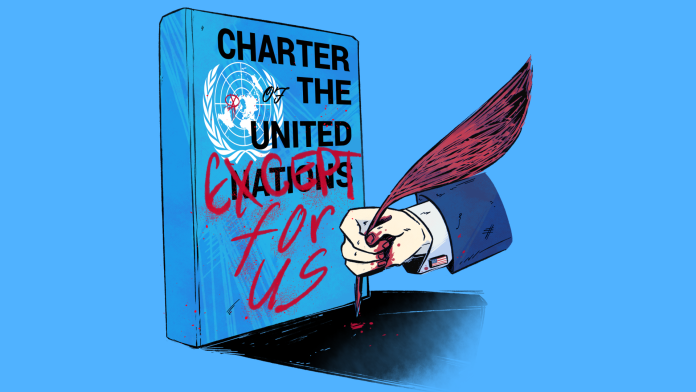
Rising from the ashes of WWII, states recognized the desperate need for a legal framework that would establish equality and sovereignty among nation-states. In 1945, representatives from 50 countries convened in San Francisco with the task of designing what would later be known as the United Nations Charter. This effort followed the failure of the League of Nations, whose limited authority proved incapable of preventing international aggression. The hope was that the newly formed United Nations (UN) would impose meaningful restraints on the use of force.
Article 2 of the Charter reflects that ambition. It establishes the foundational principles governing state behaviour. Including sovereign equality (Article 2 (1)), and the prohibition of “force against the territorial integrity or political independence of any state” (Article 2 (4)).
The US serves an important role within the UN system: it’s a Charter signatory (another way of saying that it’s a founding member), a permanent member of the Security Council (with an incredibly powerful power of veto to protect its interests), and a party to numerous UN treaties (which means it has the legal obligation to uphold the terms of those treaties). Yet, what remains starkly absent from those treaties is the lack of ratifications on major human rights treaties (those that aim to protect children, women, and disabled individuals, among other marginalized groups). And what is perhaps most notable in this context: the Rome Statute of the International Criminal Court. Where this Statute helps prosecute serious international crimes (such as genocide and the crime of aggression, among others) — think of how Vladimir Putin, President of the Russian Federation, is currently at large for his war crimes, and will be arrested upon entering any of the states that has signed the Statute. US had initially signed the treaty in 2000, but withdrew its signature just two years later. An act that insulates their state from accountability on an international stage.
It is difficult to ignore the approximate timing of the US’ withdrawal from the Rome Statute — just one year before the invasion of Iraq. This event goes on to become a highly advantageous one, as it effectively protected US leaders from being held accountable for their crimes against humanity in Iraq. The continued unfortunate reality of the ramifications of this lack of international accountability is also at play for the crimes they have and will commit in Venezuela.
For this reason, Article 2 of the UN Charter remains relevant precisely because it articulates the standard the international community continues to violate. In continued militaristic operations that undermine sovereignty, the international community must be reminded that the standard that they are supposed to uphold is a legal obligation. One that they seem to only exercise with weaker states. An unfortunate reality emerges from the power dynamic embedded in UN affairs: some states are able to transgress sovereignty simply because they possess sufficient power to do so.
The case of Iraq offers an example of this transgression. Just two years after the 2003 invasion, Iraq was estimated as holding 10% of the world’s oil reserve. This is when it became clear that the motivation for the US-led coalition had other, materialistic, motivations. Where, publicly, US had declared a necessity of invading Iraq to destroy its reserve of weapons of mass destruction — which was, quickly, figured out to be untrue.
These questions resurface in Venezuela today. In an interview with Jon Stewart last year, Prime Minister Mark Carney pointed out the relevance of Venezuela when it pertains to US’ oil rush. Particularly amid discussions of US energy dominance. Venezuela holds the world’s largest oil reserve, with 17.17% of the world’s reserve as estimated in 2025. Interestingly, Trump left no room for speculation regarding his motivation for this illegal transgression over sovereignty. Trump’s declaration that the US is “going to have our very large United States oil companies — the biggest anywhere in the world,” highlights the premise of US’ involvement in Venezuela. This militaristic act is to extract resources for profit.
US has had a past of intervening in Venezuelan affairs that often undermined the country’s sovereignty and stability. Meaning that much of its political insecurity has stemmed from US meddling in national affairs. Unfortunately, this attack is a more direct militancy that sets a “dangerous precedent” with ramifications that extend into Venezuelan and international levels!
The most direct cost of this pursuit will be, primarily, endured by civilians. While the official death toll remains unclear, Reuters shared Venezuela’s estimate, as posited by their interior minister, of the death toll of 100 people. This estimate doesn’t specify whether the casualties were civilian or politically involved individuals.
Importantly, we must acknowledge the most immediate consequence of this military strike as a deepening humanitarian crisis. The strikes on Caracas have damaged infrastructure, disrupted access to electricity, and will cause (and really, have caused) an environmental calamity. Several humanitarian organizations have flagged their worry over this militaristic aggression.
As the world, and myself, continue to watch, Venezuela stands as a chilling reminder that sovereignty is violated and humans and the environment suffer irreversible damages.
The images that a younger me had witnessed, will now be experienced by little kids that don’t understand why other kids get a safe home and they don’t.
Temporal, spatial, and interrelational passages from The Lyre 16’s team
By: Clara Xu, SFU Student
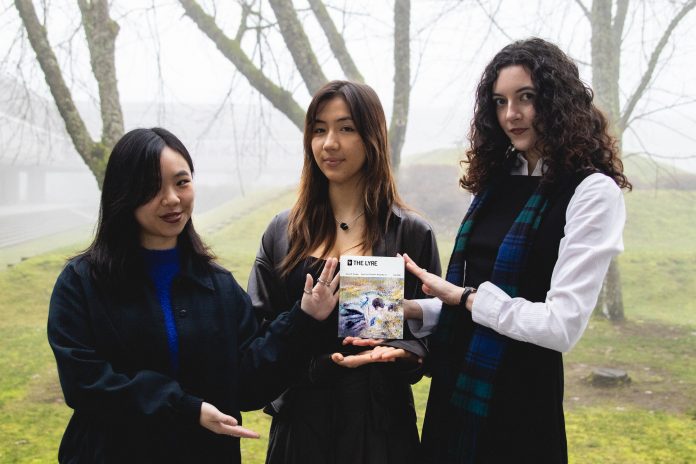
The Lyre Mag, one of SFU’s longest current running undergraduate journals, published their 16th edition in October 2025. Operating out of the department of world languages and literatures (WLL), the “student-led literary journal” publishes annually, featuring undergraduate student work spanning “poetry, prose, translations, and visual art.” The Peak sat down with The Lyre 16’s editors-in-chief Isobel Sinclair and Callie, and editorial designer Yoona Charland, to discuss their experiences during the editing process.
The following interview has been edited for concision and clarity.
What type of work did you do for The Lyre?
Isobel: Callie and I, as EICs, had meetings every week, planned what should be discussed in the meetings with the associate editors, and we made sure we were in line with the timeline we created at the beginning of the year.
Callie: I started out as an associate editor, which is like our reviewers, for all of our submissions. It was a nice intro into working with The Lyre. Basically, you go in there, they assign a piece, you review and give feedback for the piece, but it’s very community oriented, which I liked. When you actually go in with working with The Lyre, you work with a faculty liaison. We have Dr. María Barraza; she’s wonderful.
Yoona: As editorial designer, in the summer, I put the magazine together front-to-back and sourced images, and put in some of my own artwork if needed. And then Isobel and Callie gave their input. I think we went through four rounds of edits. We really wanted to execute our vision.
What was the inspiration for your theme, “Passage?”
I: For a while, we were trying to make the theme “bridging” work. We settled on “passage” after distilling it more.
C: We were looking back at old issues and the first five were completely different. It had a different logo that we noticed. Some of us weren’t sure what it was.
I: We looked at it and were like, “Is that a chicken?” It’s a lyre bird, which is a bird whose tail looks like a lyre instrument.
C: In the first edition, there was an explanation of, “What is a lyre?” — it can be a bird, it can be an instrument, but they wanted it to be up to your interpretation. I thought that was a nice core message that The Lyre is student-shaped, and it can be whatever you want it to be.
I: And that we could remould it.
C: It was something we wanted to return to, as we were talking about our new logo design. As we were doing all that, we were really thinking of this experience with the passage of time and looking at how things have changed throughout the years.
Y: Since we’re in the world literature program, we were also thinking about how passage can have a lot to do with time, with physical passage like migration.
What was it like to work with multiple languages?
I: We’ve got a great team coming from the WLL department, and from hiring associate editors that know an additional language.
C: This year was a really strong year for translations, since WLL brought back a translation theory course that hadn’t been taught in forever. We went into that class and were like, “Everyone here will have to submit a translation to The Lyre!” Translation is such a creative process because of how you choose the translated words. How close do you want to be to the source language? What are the creative decisions someone made to get to this translation?
Y: Speaking on the design side of it, it was just finding all of the fonts. I remember the first copy: the Cantonese font I used didn’t have all of the correct characters.
I: It’s not just making sure you have the correct translation; it’s also making sure that, when we have it in print, that it’s doing justice to the text and to the translation. That’s for all pieces that we have submitted, part of the design process isn’t just laying it out nicely, it’s also making sure that you are keeping all of the line breaks, and the layouts of everything that has been submitted, so that they retain the same intent.
What editing process do your submissions go through?
C: Everyone gets feedback, they’re heard even if they don’t get published. It’s like they have a sculpture, and the editors are collaborating to help chisel it into the same vision the writers have.
I: Once the associate editors have gone through a couple stages, then we compile everything into one big spreadsheet. We read them all out together, and discuss whether we feel they fit with the theme, if we enjoy them on a thematic or visual level. Then we whittle down our shortlist until it becomes the final list.
What impact do you wish for The Lyre to have on SFU undergraduate students, and on the SFU community?
C: We did an interview with the founders of The Lyre, Daniel Poirier. It’s cool to see how he went from EIC to being a creative writing instructor at Langara.
I: It’s a sense of communication — connecting yourself with others, and connecting yourself with your own sense of self.
What do you hope to see, or work towards, in The Lyre’s future?
Y: I’m continuing next year as EIC with Callie since Isobel’s graduated. Callie and I were talking about having copies of The Lyre in local libraries for free.
C: I want to keep up the direction we had this year, since we made a lot of changes last year with the logo and cover.
I: More short fiction! Even if it’s just a little excerpt. Even if you’re working on something and just want to submit a couple pages of it.
If you had one piece of advice for the writers and artists of SFU, what would you tell them?
I: Submit! When we go through the submissions, even if it doesn’t get accepted, there was someone in that room that liked it. Keep trying if you don’t get in — you might get in next year.
Read The Lyre, including all previous issues, digitally at journals.lib.sfu.ca/index.php/lyre. You can also pick up a physical copy on the “fifth floor of the AQ in the corner closest to the Trottier Observatory. Prints are stored in the display case outside of AQ 5121.” For more information, please email [email protected] or visit their Instagram, @thelyremag.
Sam Wiebe says a career in the arts is possible
By: Maya Barillas Mohan, Staff Writer
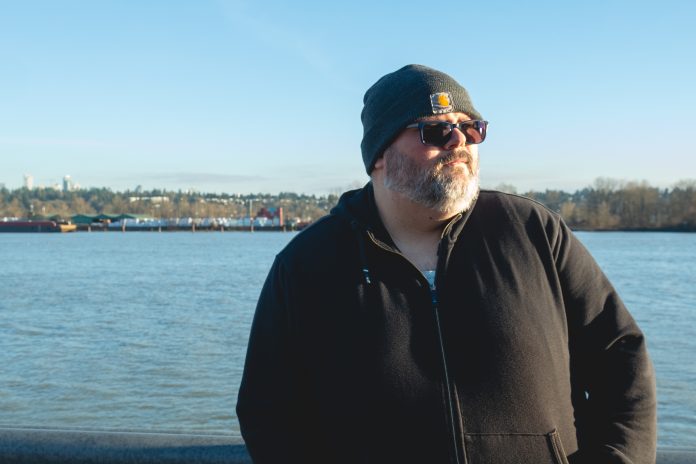
Looking beyond the fog of midterms and assignments, a career in the arts is actually quite possible in misty Vancouver. A case in point is the SFU English department’s Writer-in-Residence (WiR) program, which bridges aspiring writers to published ones to provide a valuable source of insight and mentorship. The Peak reached out to distinguished author and 2023 WiR consultant Sam Wiebe to gain some wisdom on what it means to be an artist living in Vancouver. Having published over 10 novels, Wiebe tells us that the daunting concept of “career artist” dissolves into something tangible through effort.
When asked to define what a “career artist” is, Wiebe is not exclusive with who he considers an artist. He stresses that one can consider themselves an artist, as long as you continue to do it. Wiebe furthers that being an artist can mean getting paid for what you make, or just simply supporting it with a job outside of the arts. Acknowledging the accelerating social problems Vancouver conceals under its beautiful glassy exterior, Wiebe reminds me that Vancouver is “incredibly expensive.” He adds, “I don’t blame anyone who cannot survive on what an artist makes.” He incorporates issues like gentrification and income disparity into his work and composes books that he believes are “richer” for their reflection of these issues.
Wiebe candidly shares that he has had “full-blown side gigs,” but is now primarily an artist, living off books and articles. He tells me that, with his first novel, he didn’t have an agent and was way out of his depth. When crediting his success as an artist at this current point in his career, Wiebe tells me that it begins with reading everything and putting in the effort.
“Most people don’t finish what they start, and that is the key thing.”
— Sam Wiebe
“Like, not only working to the end of the story, but having the courage to send it out. Saying OK, people might hate this, they might not like it, but it’s no longer mine.” In addition to having an agent, part of his commercial success is treating his work like a professional at a day job. Wiebe demystifies the “fabled artist” (someone who only works when inspiration strikes) by explaining his ethos like that of a “lunchpail worker”: he shows up in the morning, puts in the grunt work of writing and researching, and sustains his career.
Championing the use of resources like the library and archives, Wiebe urges students to attend conferences and appreciate what they have access to at SFU. He refers to resources, including things “out of your wheelhouse (or comfort zone),” as crucial to making art. Even well after starting out, Wiebe tells me he engages with media out of his comfort zone for his current project. The only way to get through something is to do it, and it doesn’t require fancy equipment, besides a computer and self–motivation. Wiebe refutes the assumptions made about students today, saying that it’s just as true that “people still love literature and the written word and are willing to put in the time.”


