Peak Associates Nick Bondi and Austin Cozicar sit down to discuss this week’s sports news.
Created by: Paige Smith


Peak Associates Nick Bondi and Austin Cozicar sit down to discuss this week’s sports news.
Created by: Paige Smith
Aloha is about, um, it’s about. . .
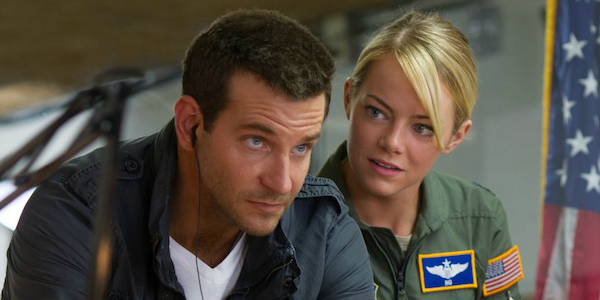
Okay, let’s start with the basics: Brian Gilcrest (Bradley Cooper) is a contract worker for the military who has come for a brief stop in Hawaii to convince a group of native residents to trade their land. He is escorted around the island by a cute captain named Allison Ng (Emma Stone), who, despite being overbearing and rough around the edges, grows on him. Things get a little more complicated when Allison discovers Brian’s connection to a dubiously-intentioned businessman and an ex-girlfriend who is now unhappily married with children.
This new rom-com from Cameron Crowe, one of the most inoffensive filmmakers working today, stirred controversy among a group of native Hawaiians for not properly representing their culture. Although casting the pale, blonde Emma Stone as a character who is a quarter Hawaiian is a bit of a stretch, it is the very least of this film’s worries.
In his early work, like Jerry Maguire, Say Anything, and Almost Famous, Crowe was a master at creating one kind of “movie moment”: when the mundane is exaggerated to express heightened human emotions. Although these kinds of films aren’t grounded in circumstances we can identify with, they capture an essence of our everyday experiences by inflating them.
These movies provide this kind of unabashedly nice wish-fulfilment. In general, his films often feature great soundtracks with an eclectic taste of pop tunes that give us the warm and fuzzy feeling that something down-to-earth and ambiguous might miss.
Our lives don’t have a soundtrack by Peter Gabriel, but we can see ourselves wanting to be John Cusack holding that boombox over our head. It’s a little ridiculous and more than a little cheesy, but it gets at an aura, an emotion, a dream only the movies can give us.
Aloha has glimpses of these moments, but too often the film settles for another kind of “movie moment”: those absurd and contrived instances where we’re supposed to just go along with ridiculous coincidences, gaps in logic, and muddled motivation, because the characters do. Aloha seems totally oblivious to the fact that it too often indulges in this.
Much of this story is incomprehensible: why does the military need that specific piece of land where the group of Hawaiian natives are living? What is the military’s motive in privatizing satellites? Why did Brian Gilcrest get shot in Afghanistan? How does Brian take down the satellite at the end of the film?
Even the understandable plotting is flimsy with leaps of faith that are about as plausible as the Hawaiian myths in the film. For example, the film’s most crucial plot development — when Allison discovers that the satellite is secretly being weaponized — is contingent on at least seven assumptions: (1) that a pre-teen boy would bring a camcorder everywhere; (2) that he would sneak out to film random things at night; (3) that he would be able to stumble upon the location of the satellite; (4) that the workers arming the satellite would leave the doors to the factory open; (5) that he would be able to get past a fence and security (unless we are to believe there is no fence or security); (6) that he would be reviewing his footage on a television perfectly visible by Allison as she walks into the house unannounced; (7) that the boy wouldn’t tell his mother or Brian about the video.
Aloha has good intentions, but it feels like it’s from another planet.
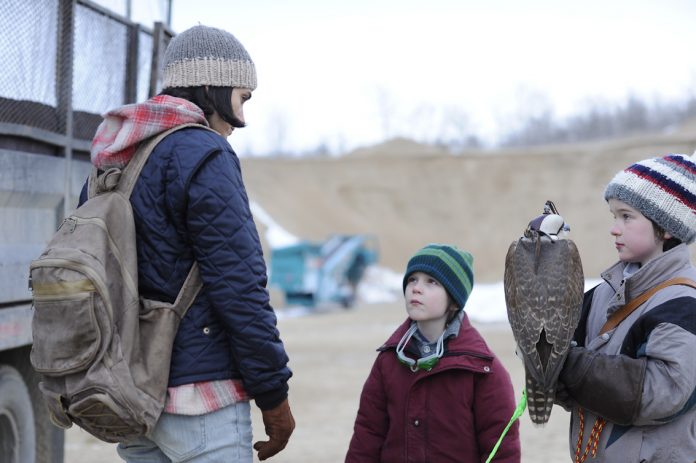
Here are some things you can look forward to in Aloft: a pig giving birth in the opening shot, numerous sex scenes where the characters seem to be enjoying themselves as much as the aforementioned pig, and a pigish mother who is glorified for abandoning her children to become a faith healer.
Sound like your cup of porky miserabilism? This is the feel-bad movie of the year that makes you feel even worse once you realize it’s all for nothing.
The story jumps between two time periods. The earlier one follows a mother’s struggle to raise her two sons — one of whom is fatally ill — after the death of her husband. The second timeline takes place about 25 years later as a journalist and the older son journey to a reclusive place in the northernmost part of Canada.
Beautiful, ponderous shots of ice and forests imply that you should take this movie very, very seriously. It deals with essential themes of memory, loss, grief, and faith; it’s about searching for meaning and healing in a cold wasteland and finding warmth through the search. And then there’s some indistinguishable meaning behind some falcons and nature and art.
Admittedly, the reason everyone is so sad is eventually unveiled after over an hour of unnecessary confusion. Like Atom Egoyan’s Exotica, all the characters are aware of a tragedy that has occurred, but it’s not revealed to the audience until much later in the film. This device works very well in Egoyan’s work because it allows us to focus on the universality of the characters’ suffering rather than the particulars of their situation.
Though, where Exotica’s great reveal actually revealed something of human nature, Aloft simply uses it as a contrived plot device to try to hold the viewer’s interest in what is otherwise a dull melodrama.
The most crucial character change is the mother’s acceptance of her role as a faith healer. It creates the strain in her relationship with her son, but more importantly, it links the two timelines together. You would think we would be given a reason for her drastic and abrupt shift from skepticism to devotion, but it’s simply not in the film.
Aloft doesn’t think coherence matters. Rather than tell a conventional story, it wants to be a tone poem or a parable that doesn’t need to make logical sense. Despite the dreamy mood created by a cold visual palette and the often discontinuous editing, the issue with this film’s deeper layer is that the development is muddled the same way as the plotting.
“But nature does not judge the darkness or the light and so it is unpredictable,” the mother says at the end of the film, as an image of the falcon projects onto the screen. This final speech is meant to define the metaphor, but it tightens things up as much as a belt that sags on the loosest belt hole. Not only is her statement nonsensical lip-flap, but it makes even less sense with the context of what the falcon does in the film.
Do you get it? If so, maybe you’re the falcon — as high as the sky. How’s that for a metaphor?

Korean hip-hop group Epik High took the stage by storm during the Vancouver stop on their North American tour, living up to their reputation as one of Korea’s most talented hip-hop acts. Playing a sold-out show at the Vogue Theatre, the group proved yet again that music can break cultural barriers.
Composed of rapper Mithra Jin, DJ Tukutz, and leader Tablo, the trio have been creating music that fuses hip-hop with alternative sounds for over twelve years, collaborating with dozens of famous Korean artists such as Beenzino, Dynamic Duo, Verbal Jint, and BIGBANG’s G-Dragon and Taeyang.
The concert itself can only be described as electrifying. Two parts energy and three parts charisma, the group kept the crowd jumping and completely engaged throughout the entirety of the show. The trio was able to combine older and classic songs such as “Love Love Love,” “Fan,” and “One” with their newer titles, such as “Burj Khalifa,” “Rich,” and “Happen Ending,” all from their 2014 album Shoebox. It created the perfect mix of familiar and fresh sounds, building up the anticipation of what was to come next.
The group’s stage presence was a force to be reckoned with. I was overwhelmed with how they were able to bring the stage to life, conducting the crowd from virtually all angles. That, coupled with the music and lights, kept the crowd cheering and waving their hands along with the various beats.
During the Q&A session half way through the show, the three artists responded to questions regarding their personal impressions of Vancouver and musical inspirations.
While Tablo generally kept his answers sincere, claiming at one point to be inspired both by his daughter, Haru, and by Epik High’s fans, DJ Tukutz made the crowd laugh with his humorous responses. It was refreshing, and a shining example of how Epik High’s personalities make the group admirable and down-to-earth.
One thing that really stood out to me was the passion Epik High has for their fans and their ability to interact with the audience on a personal level.
Throughout the entirety of the concert, the group was consistently asking the audience questions, dedicating songs to the crowd, and even taking numerous group photos. It felt like they were there for the fans, not vice versa, which is something I have never experienced at a concert before.
At the end of the night, Tablo voiced his desire for the crowd to feel inspired by Epik High’s performance and to feel motivated to pursue our dreams. It was refreshing to hear this from the former Vancouverite, and he repeatedly reminded the crowd that Epik High are living proof that things do get better.
With the performance they presented, I can honestly say that I believe it. The night was inspirational and captivating for me in a way that no other concert experience has ever been.
Oh my God, that was the most awesome movie I’ve ever seen.
Yes, yes, I know, no written work, let alone a film review, should start with those words, but it’s truly the only way you can talk about San Andreas aside from making the loud grunting noises of an excited ape.
From a film critic or snob’s point of view, it’s a terrible movie. The plot depends on every cliché in the book — if there was a book on writing disaster movies, this movie would probably be sued for plagiarism.
Let’s do a checklist of clichés in this movie. Likable single dad? Check. Said dad has emotional issues that led to his wife leaving him, but his ex-wife is still on good terms, and the dad, despite having an “emotional distance,” is sociable and everybody likes him? Check. Dickhead stepfather? Check. Disaster brings the family together? Obviously.
Dwayne “The Rock” Johnson plays Chief Raymond “Ray” Gaines, a search and rescue helicopter pilot for the LA fire department. He has a team, and they apparently came from the military together, but that’s not really important; his team just disappears after the first ten minutes. They don’t die, but The Rock is just a one-man team, I guess.
His family life has suffered since the tragic death of one of his daughters, however his other daughter (Alexandra Daddario) is going to college, while his wife (Carla Gugino) surprises him with divorce papers (she’s dating a millionaire real estate developer (Ioan Gruffudd)).
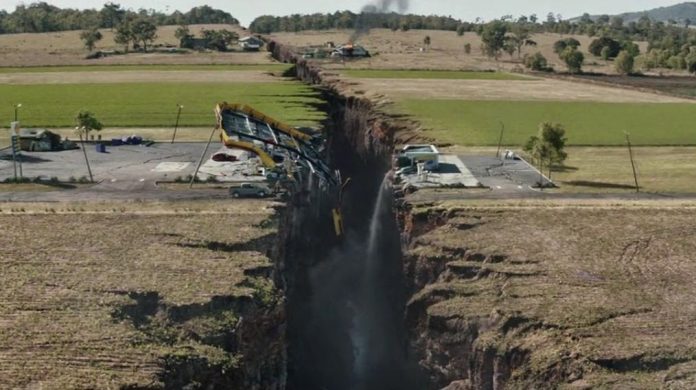
Meanwhile, the clichéd scientist character (Paul Giamatti) has some new theory to predict earthquakes. He and his scientist partner (who might as well be named Redshirt McDead), go to Las Vegas where there’s seismic activity, but no supposed fault lines. McDead suffers a heroic death, as there’s a big earthquake that destroys the Hoover Dam. Giamatti doesn’t have any time to grieve as he finds out a big one’s headed for San Francisco.
The Rock’s daughter has gone with her stepfather to San Fran on her way to college, while her mother is meeting with Kylie Minogue for some reason. The daughter meets some British kids, which is lucky because Mr. Fantastic turns out to be a complete coward when the earthquake hits, before eventually going full heel and pushing people out of his way. The British boys save The Rock’s daughter, and hang out with her for the rest of the movie, while The Rock tries to save his family.
You’ll never guess how it ends.
It’s always awesome to see a big city get destroyed (in the movies). The Rock is actually a pretty good actor — I nearly cried at his dramatic monologue — and the rest of the cast performed pretty well too.
My only qualm is that the movie drags on a bit too long; with a running time of 114 minutes, it could have afforded to be a bit closer to an hour and a half.
I may have exaggerated a tad, calling it the most awesome movie ever — that title belongs to either Flash Gordon or Highlander — but seriously, it’s the best. Everything’s so cheesy and formulaic that it just. . .works.
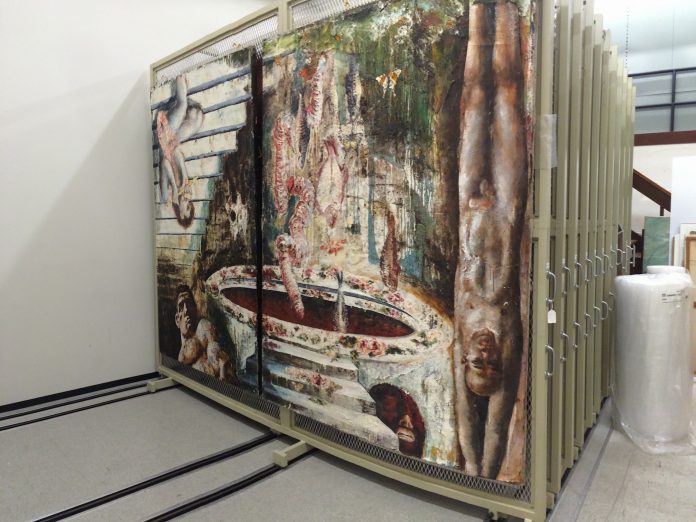
On a massive canvas, tar, enamel, varathane, oil, and corduroy create images of bodies which frame a circular opening. Adorned with flowers, the opening looks like a ceremonial basin with ribbed bodies of fish descending into the opening, along with fleshy intestinal viscera that hang like sausages over a stove pot.
Attila Richard Lukacs’ painting, Trial & Error, also includes a young, nude male sitting upside-down on an inverted staircase. He holds a flute and is draped by an intestinal feather boa while another male body, also upside-down, is elongated on the opposite side of the surface.
The painting sits within the SFU Art Collection vault. It is dated 1986, which means it was completed within the year following the Young Romantics exhibition at the Vancouver Art Gallery. This landmark exhibition of Vancouver painting was curated by Scott Watson and included Lukacs, along with Graham Gillmore, Angela Grossman, Vicky Marshall, Philippe Raphanel, Charles Rea, Derek Root, and Mina Totino.
Almost all of the artists represented in Young Romantics were recent graduates of Emily Carr College of Art & Design between 1979–85, and had already participated multiple shows together in the years leading up to large exhibition at the VAG.
In much the same way as the term ‘Vancouver School’ collects artists such as Jeff Wall, Ian Wallace, Ken Lum, Vikky Alexander, and Rodney Graham as photoconceptualists, the designation of ‘Young Romantics’ functions to group these eight artists within a particular style of painting.
While the former term has come to be thought of as representative of a regional aesthetic (aided in part by the term’s site-specific and pedagogic associations), the latter’s influence is less obvious to the non-Vancouverite. As outlined by Scott Watson “Toronto’s new painters are concerned with subject-matter and construct a didactic stance[. . .]. Vancouver’s young painters practise a métier and are concerned with the manipulation of their materials to an extent that sets them apart.”
This concern with materials is evident in Trial & Error, as well as in other works by these artists included in the SFU Art Collection. One work by Angela Grossman, titled The Wedding, is a large, multi-panel painting executed on old theatre flats using enamel, oil, and tar. These materials create an uneven surface upon which anthropomorphic forms haunt the intransigent lines of architectural decay. In Sound and Vision, Charles Rea represents the interior of the Pantheon in Rome by painting oil onto a surface of books.
With the exception of a few paintings scattered around the SFU Burnaby campus by Graham Gillmore, Vicky Alexander, and Derek Root, the majority of the works by these artists reside within the collection’s vault. While there are some massive works that would be difficult to install based purely on scale — such as Grossman’s The Wedding which, when assembled, measures approximately two by three metres — even the works on paper could be logistically difficult to display on the walls of SFU, since they need to be framed.
Scott Watson wrote that “today’s painters[. . .]react to the slick, polished look of the world of manufactured images they live in.” Thirty years on from when this was written, Watson’s words still ring true.
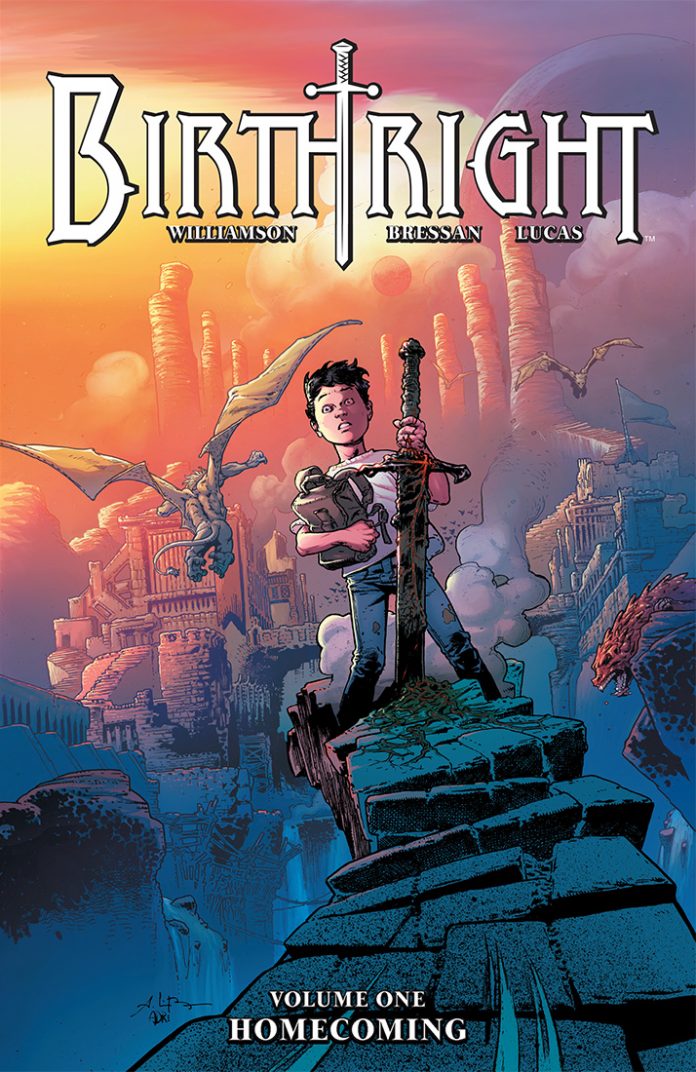
At first glance, Birthright seems like a hodgepodge of ideas audiences have seen a hundred times over. It has the usual smattering of concepts readers have come to expect from the fantasy genre.
The story is as follows: a young boy named Mikey Rhodes is misplaced from his family and is thrust into an unimaginable new world filled with danger and intrigue. He is tasked with overthrowing an evil despot of insurmountable power.
His supporting cast is a vibrant mix of mythical creatures, ranging from a pack of gibbons to a ferocious warrior ogre. The main character’s chief love interest is a strong female character who chastises him frequently. And, last but not least, there is a prophecy to which the main character is connected, one he is tasked with completing.
On the surface, the story seems impeccably paint-by-numbers. Birthright, though, has more to it than you would expect.
While readers are given intermittent bits and pieces of Mikey’s wild adventures, they are never the true focus of Birthright. The real focal point of the story is Mikey’s family and how they have dealt with his disappearance.
Williamson and Bressan bring to life a heartbreaking look at how a child’s disappearance can shatter a once well-knit family. Brought to us from the perspective of Mikey’s older brother, we feel the anguish of losing a sibling. We see a marriage dissolve under the accusation that his father murdered his young brother. In only a few pages, readers can feel the heavy burden of the characters and emphasize immediately.
However, everything changes for the shattered Rhodes family when they are brought together by the FBI. At long last Mikey Rhodes has returned, but he is not the same little boy they remember. Only a year has passed, but Mikey is now a full grown man and a fearsomely strong warrior. While his return is a means for celebration for the Rhodes family, the real reason behind Mikey’s homecoming is far more foreboding.
Joshua Williamson produces a story accessible for an audience young and old that expertly juggles pulse-pounding action with strong character development. He weaves the dual storylines of a young and old Mickey Rhodes seamlessly; readers will never prefer one story over the other. Each tale brings its own amount of intrigue to other evoking wonder about what the character has gone through and what his deceptive agenda holds.
Andrei Bressan brings both worlds of the story to life in stunning fashion. Every page is diabetic, shock-inducing eye candy. Bressan’s action sequences and emotionally charged panels leave readers turning the pages to see what beautiful image he will bring to life next.
Birthright is a welcome breath of fresh air for readers, an overdue and welcome change from recent fantasy stories that gives hope for the future of the genre. It is a fantastic reminder you should not judge a book by its cover — a sentiment we all tend to forget from time to time.
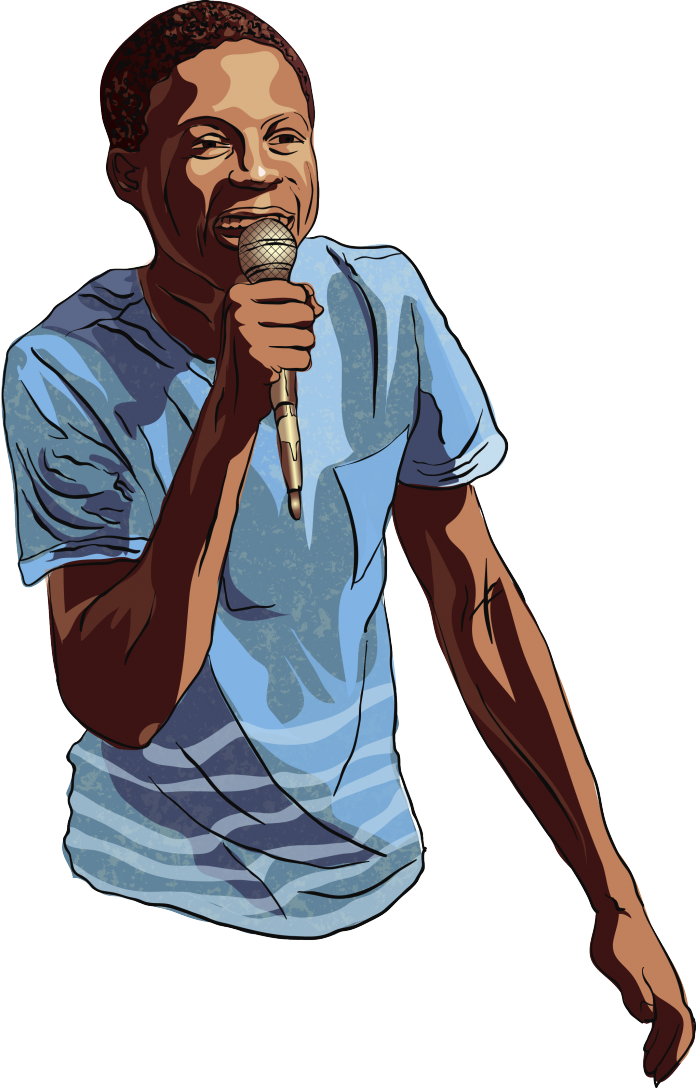
Ryan Mutama is a stand-up comic living in Vancouver who uses comedy as a way to explore more serious, social issues. The Peak caught up with Mutama to discuss race humour, how living in Vancouver has affected his comedy, and what the next step is.
[Interview has been edited and condensed for print]
So, where are you from?
I was born in Manchester, England and we moved to Vancouver when I was two. Then we moved to the States for five years, and finally we moved back to BC. I’ve lived in Vancouver for 16 years now.
What are your views on Vancouver?
I guess I don’t have the most positive opinion of Vancouver, but I am grateful for having grown up here. I wouldn’t be the same person I am without having lived in this town. The perspectives that make me a comedian were made in Vancouver. If I grew up in Chicago, I would have questioned things less. The biggest theme in my stand-up comedy is race relations. I have such an opinion on it because I grew up in a place where I always had to be an observer. If you’re the only black kid in an elementary school, you think, “Where are the people who look like me on TV?” I got to think a lot about race and culture and differences between people. Being unique forces you to analyze things.
How would you describe your comedy to someone who hasn’t seen it?
Random observations about race relations, seen through the lens of pop culture or politics. Most of the time, I’m analyzing race relations, but I’m analyzing them in a certain way. I have this joke about Morgan Freeman and why he’s always helping out white people in every movie. I like pointing out things that people may not have noticed. I like to throw people a snippet of a bigger issue in hopes that they think about that bigger issue or will walk away being slightly enlightened about race.
Regarding comedic IQ, do you think people can learn to be funny?
Yes, people can learn to be funny. I get annoyed when people underestimate comedy. People have this impression that comedy is for stupid people doing stupid things and anybody can do it, but it isn’t. It is such an art. The smarter you are, the better you are; the more observant you are, the better you’re going to be at it. When I write a joke, I ask myself, “Why do I find this funny and why will the audience find it funny?” Asking yourself those questions strengthens your comedic IQ.
People have said that your type of comedy is reinforcing black stereotypes. What is your response?
When you do race humour, there is always a question of, “Am I being responsible with my humour? Is what I’m doing reinforcing stereotypes?”
In order to do race humour effectively, a lot of people will interpret what you are doing as being irresponsible and reinforcing stereotypes. With Dave Chappelle, a lot of his sketches were about race and racial stereotypes.
There will be two types of people receiving his material: stupid people who say, “Yeah, that is what white people do” and there are smart people who look at that same material and say, “Oh, he is making fun of what people think white people do or he’s making fun of what people think black people do.” Two sides of the same coin: reinforcing stereotypes or lampooning what people think stereotypes are.
People have a comedic IQ and it’s something that can be gained. You can then learn to see past the surface and whether what a comedian says has real depth or if it’s just shallow.
Where do you see yourself seven years from now?
The next step for me is entering the arena of television and broadcasting. I want to know how to make a television program. I want to know how to direct, produce, and write efficiently. Also, I want to work on myself and my personality. I want to make sure that I am confident enough, experienced enough, and funny enough to be on camera.
If you were to sum up comedy in one sentence, what would it be?
“Necessary for the sanity of humanity.” Comedy is such a beautiful thing because it is curing. If you’re having a crappy day and something funny happens or someone tells a joke or makes you laugh, it’s a great release.
Everybody should have a sense of humour; everybody should laugh. You gotta keep sane, and I feel like humour is the best way for someone to keep mentally healthy.
For more on Ryan Mutama, you can go to his website, Black Geek Media, or you can check out his YouTube channel, also Black Geek Media.
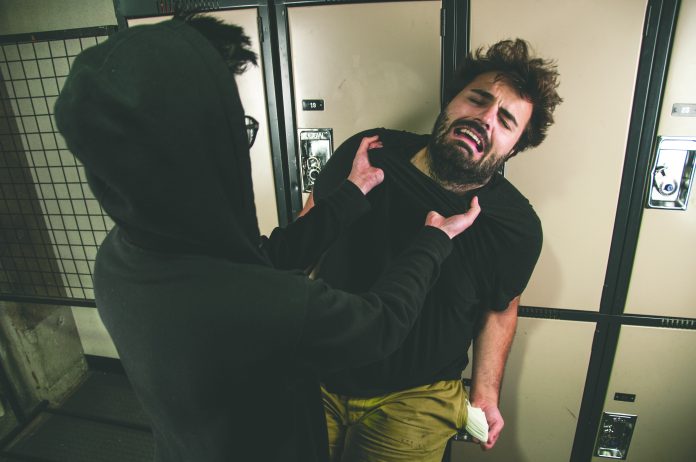
With the SFU’s bookstores now accepting Bitcoins in exchange for textbooks and other callously over-priced course materials, several campus bullies who regularly beat students up for their lunch money are reporting that they will also be accepting Bitcoins effective immediately.
“We were skeptical when Bitcoins first came onto the scene,” said Travis “Knuckles” Barkley, a second-year Communications student and self-proclaimed wedgie king, “but over the years we’ve watched Bitcoins develop into something we’d be foolish not to embrace.
“I saw the slogan ‘new money for a new world’ on one of the new automated vending machines in the bookstore. It’s a saying I like to think we embrace as the social regulators of SFU.”
With Bitcoin vending machines unveiled at each of SFU’s three campuses late last month, it’s never been easier for students to acquire or transfer Bitcoins — a move that could also bring change to the bullying landscape at SFU and beyond.
“It’s really the natural progression for bullies to take,” Sarah Lebowski, a financial planner for Vancity credit union told The Peak. “The target demographics for most bullies are nerds and dorks, two groups who are among the most enthusiastic about a digital currency becoming more popular. If bullies want to take full advantage of this trend before it takes off, now’s the time to be tripping people they think might be smarter than them and tormenting them in ways that’s both scarring and financially beneficial.”
First made available in 2009, Bitcoins are a form of digital currency that allows for immediate transactions between individuals without the involvement of a third-party. Other benefits to Bitcoins also include lower fees than most banking institutions and a greater transparency to users through an online database that includes information on all Bitcoins.
But some critics are saying it’s too early to tell which way Bitcoins are heading, and that the safest thing for bullies to do is keep shaking down dweebs for cold-hard cash instead of Bitcoin redeemable codes.
“People love jumping on bandwagons they think are great but know very little about,” says Steve McBride, one of the few bullies at SFU who only accepts physical money or cigarettes as payment, “that’s all Bitcoins are. Some millennial jerkoffs trying to convince you Bitcoins are worth something while they take your real money.
“If any nitwit tries to give me Bitcoins instead of his actual money, I’m just going to beat them up even more!”
When asked to comment if he or his similar-minded cronies were worried about the long-term sustainability of Bitcoins, Barkley said that it wasn’t a concern and that The Peak should really stop hitting itself.





