Home Blog Page 96

Indigenous voices must be prioritized when fighting climate change

0
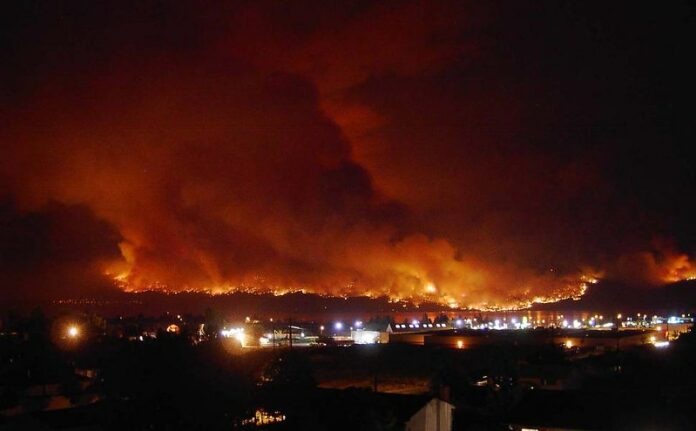
A large orange fire covering the sky above a town.
PHOTO: Province of British Columbia / Flickr

By: Hailey Miller, Staff Writer

The effects of climate change disproportionately harm Indigenous communities, yet their voices are often overlooked. Many Indigenous communities, especially those outside large cities, rely on natural resources for livelihood and sustenance, and are at a higher risk of health problems due to exposure to wildfire smoke. They’re also being displaced from their homes at significant rates due to wildfire evacuations. Climate action should prioritize the voices of those most affected by climate change, and Indigenous Peoples have been protecting the environment for thousands of years.

BC’s worsening wildfire conditions have resulted in an increase in drought and disruption to ecosystems. This includes harmful pollutants and toxic gases from wildfire smoke, alongside extreme weather conditions and a lack of fresh water supply. BC’s wildfire season has begun exceptionally early this year, following last year’s record-breaking season. Many communities have been affected by the wildfires, including Skeetchestn, near Kamloops. Here, the wildfires have threatened the salmon habitat, as well as food and medicine supplies

Many Indigenous communities rely on fishing, hunting, and plant harvesting as a means of food supply and ceremony. For instance, on Truth and Reconciliation Day last year, Líl̓wat Nation and N’Quatqua First Nation closed down Pipi7iyekw (Joffre Lakes Park) for a harvest celebration. Some Indigenous Peoples also use plants for traditional medicinal purposes, and land for ceremonial and burial purposes. Climate change threatens the availability of these natural resources, and by extension the ecological security of Indigenous Lands and Indigenous communities. While climate action has gained traction in recent years, Indigenous Peoples have been caretaking for the natural environment for millenia.

Community-led action involves staying connected to and taking care of both the environment and communities. Some ways Indigenous Peoples are doing this are by using renewable energy, curating climate conversations across generations and communities, and using Indigenous traditions and languages. Montana First Nation’s Green Arrow Corp, which was founded in 2012, is the first Indigenous-owned solar energy company in western Canada, which is operated by their community members. Similarly, Indigenous Climate Action curates programs across the country that raise awareness about the climate crisis and emphasize how Indigenous rights are essential to climate justice.  

The climate crisis is also disrupting communities. Extreme weather events result in community displacement and reduced access to food and supplies, which threatens cultures and traditions. Alongside physical and often irreversible damage to lands and species, human health risks are a significant threat to communities. Climate-related conditions such as chronic respiratory diseases, cardiovascular disease, and cancer are just a few results of the climate crisis. 

Indigenous Peoples are disproportionately impacted by the climate crisis, yet the Canadian government often leaves them out of climate talks and resolutions. To successfully combat the risks of climate change, we must work with Indigenous communities and leaders to respect their Lands, and allow Indigenous Peoples full liberty to initiate collective care of the environment. Prioritizing Indigenous rights will shift our efforts beyond climate awareness to equity and collaboration.

Wannabe influencer goes to the retirement home to tell her grandparents she’s replacing them with Marcus Pork and Grandma Droniak

0
Young girl showing something on her phone to her grandmother who is standing behind her.
PHOTO: Andrea Piacquadio / Pexels

By: C Icart, Humour Editor

It’s a sunny Thursday afternoon, and Stacy is heading to the retirement home to visit her grandparents. She originally planned on going on Tuesday, but it was raining on Tuesday and filming a vlog in the rain is not a practice Stacy is interested in engaging in. That’s right, Stacy is an influencer. Or at least she wants to be. So the camera is always rolling, waiting to catch a viral moment. Stacy walks into the building. 

Stacy: Oh my gosh, there are so many old people here! Oop, one just looked at me. Did I say something offensive? This is actually so good for me. Such a great reminder to wear SPF. Remember everyone, aging is a choice and so is Botox. OK, we are finally here. Let’s knock.

Grandmother: Stacy? Is that you? Why are you filming me?

Grandfather: What are you talking about Murielle, Stacy never comes here — Oh Stacy! 

Stacy: Hi grandma and grandpa! Say hi to my followers! Oh wait, maybe move your chair over there grandma, the lighting is better. 

Grandmother: Oh my goodness, what a surprise! We’re so happy to see you. 

Stacy: Yes, I needed to come here to tell y’all some super exciting news! 

Grandfather: Murielle, we’re about to be great-grandparents! 

Stacy: No, grandpa. You know how I’m so obsessed with fashion? I thought my family should reflect that as well. So, I’ve decided to replace y’all with Marcus Pork and Grandma Droniak

Grandfather: Murielle, did you understand what she just said? Why is she talking about pork? I thought the dinner tonight was going to be shepherd’s pie.

Grandmother: Stacy, please put the camera down. You can’t replace us. We’re family. 

Stacy: No, no this is really good content! And it’s already set up! I reached out to them and I’m sure they’ll agree to collab! Marcus will make a unique fashion design for us and Grandma Droniak and I will feature it on our respective channels as OOTDs

Grandfather: Murielle, why did Stacy come here to speak to us in gibberish? 

Grandmother: Stacy, who are these people? 

Stacy: Famous grandparents that will help turn me into the next viral fashionable grandchild! Plus it’s not like I’ll stop visiting y’all, just that I won’t claim y’all as my grandparents online. 

Grandfather: Murielle, how can she stop visiting us when she never started? 

Stacy: Grandpa! You know it’s difficult for me. This place is so out of the way and so inconvenient for me to go to because there are no cute coffee shops on the way. But that didn’t deter me from making the 20-minute drive to the retirement home today. I only got lost twice, which isn’t bad when you consider the fact that I’ve never been here. 

Stacy starts pushing the chair her grandmother is sitting in. 

Grandmother: Ow! What is happening?! 

Stacy: I told you the light is better over there and we’re probably going to need to refilm because I need you to be more excited about my chosen family. I brought some shirts for you to wear as well. 

Stacy hands them the shirts and her grandparents read them out loud. 

Grandfather: Climate change is cringe?

Grandmother: Free bleed Friday? But I don’t. . .

Stacy: And mine says, “I slay while my haters lay.” It’s this iconic thing Grandma Droniak says because she keeps outliving her haters. 

Grandmother: Hun, we’re not wearing these shirts. 

Stacy: But Marcus Pork and Grandma Droniak would wear them!

Grandfather: I don’t even eat pork! 

Grandmother: Stacy we’re going to be late for Bingo night and I’m sure Bertha is already waiting for us. 

Stacy: Bertha? Bertha?! You can’t be friends with Bertha! She’s NOT invited to Grandma Droniak’s funeral! You have to realize how bad the optics are when it comes to us being seen with her! 

Grandfather: mumbles under his breath. Who said you were invited?

Grandmother: Joe! 

Stacy: Oh my god, y’all aren’t doing anything viralllll! I won’t be able to use any of this footage and . . . FUCK! Marcus is out, he said he can’t be my grandfather because apparently he’s 34? Dang . . . he needs a better skincare routine. I guess it’s back to the drawing board. I will be famous before I die, I’ll make sure of it.

Stacy leaves the retirement home without saying goodbye. Her grandparents are not complaining. Bertha skipped Bingo night to scheme about how to steal Grandma Droniak’s boyfriend. 

Fin

HalfSoul chronicles the struggles of mental health, identity, and morality

0
The cover of the book featuring an individual with short green hair. Bony fingers feel around their body and face as they peer through a panel of wood with a hole ripped in it.
PHOTO: Courtesy of Cloudscape Comics

By: Kaja Antic, Staff Writer

Content warning: mentions of death and trauma.

For local freelance and comic artist Scarlet Wings Kaili (Kelly Chen), HalfSoul began as a project without much of a plan — one that has now continued for seven years.

“It actually started when I was in hospital and bored out of my mind. And I just wanted to make a short story, but it didn’t end up being short,” Kaili explained in an interview with The Peak.

The story revolves around a group of young adults working for the Halfsoul Extermination Association (HSEA), whose jobs are to kill “halfsouls” — those who traded half of their soul for a wish. Halfsouls have such a negative implication in this universe that the HSEA is a legal entity dedicated to their total annihilation. The four main characters — Tale, Nalia, Zach, and Scarlet — all have their own connections to halfsouls and the HSEA, along with personal challenges and traumas that are explored throughout their corresponding tales.

“Each book is through a different character’s perspective,” Kaili elaborated. “I wanted to give different challenges for them.” 

Each book, consisting of three cases, focuses on a different member. Halfsoul: Zach, the third and most recently released instalment, focuses on Zach, the son of HSEA leaders. He struggles with coming to terms with his past, as well as how his upbringing has affected his sense of self, safety, and morality.

“I wanted him to have conflicts about what’s right and wrong, and also how your perception of what’s right and wrong is influenced by your upbringing and your parents, and what happens if you have dysfunctional families and how you can manage that.”

“Even though the series is fantasy, I put a lot of my own experiences in a way that I try to process it through fantasy.” — Scarlet Wings Kaili, HalfSoul comic artist

Much of the character arcs throughout HalfSoul revolve around mental health and the non-linear path to recovery within a fantasy setting. The dark ink on the comic pages deepens in the more emotional sequences, with Kaili’s details adding even more dimension to the complex story. Though the characters traverse this shadowy world drenched in darkness and smog, much of their experiences mirror Kaili’s experiences in real life.

They said creating the comic has “been quite hard because a lot of the content is also very emotional for me, so I also have had to take breaks and reprocess what I’m going through before starting again. Because even though the series is fantasy, I put a lot of my own experiences in a way that I try to process it through fantasy.”

Drawing on their style influences from manga, Kaili expanded their artistic flair as the comic went on. Expressive panelling, detailed backdrops, experimental layouts, and sharp contrasts add to the story as characters evolve through their respective yet overlapping journeys.

The grey areas between good and bad, the struggle for belonging from adolescence to adulthood, the eternal dilemma of nature versus nurture, and the internal struggles of dealing with mental illness bloom in the ink illustrating Zach and the HSEA unit’s stories.

“The entire story is very mental health-based.” Kaili said. “It’s really about the process of having a mental illness, how it’s not linear. And even though this book ends, the journey is still an ongoing idea.”

You can read HalfSoul online on Tapas.io to follow along as Zach’s journey continues, along with Kaili’s website, social media, and Twitch channel — where you may even be able to find them streaming while creating comics.

From Turtle Island to Gaza

0
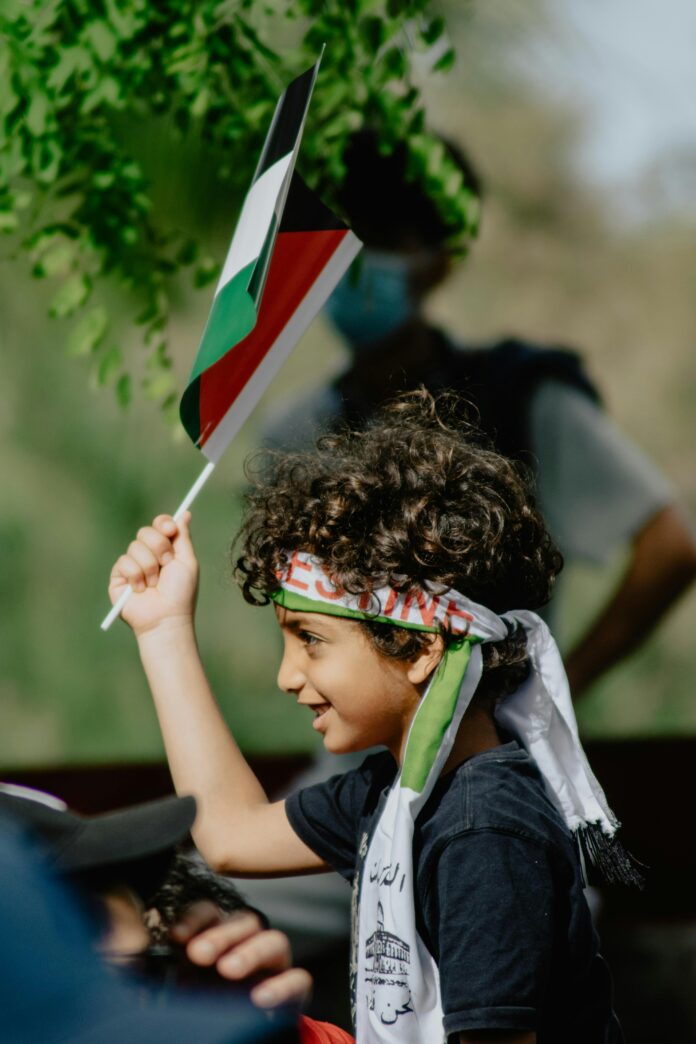
Boy in blue and white shirt holding a Palestinian flag
PHOTO: Latrach Med Jamil / Unsplash

By: Yildiz Subuk, Peak Associate

Content warning: mentions of genocide and residential schools.

Orientalism by Edward Said, published in 1978, examines the way western society views “the Orient,” which was known as South Asia, East Asia, and the Middle East. Said was a Palestinian scholar, an outspoken activist, and writer on western denial of Palestinian statehood. Said gave prominence to the field of postcolonialism, which reclaims the history and agency of oppressed people and critiques the enduring impact of colonial rule. His book critiques western works of literature and art by highlighting how they perpetuate stereotypes about non-western cultures, and how that ultimately leads to the colonizers “legitimizing” their colonialist pursuits. Orientalist paintings like Napoleon in the Plague House at Jaffa by French painter Jacques Louis David have been criticized for portraying the East as “a place of backwardness, lawlessness, or barbarism enlightened and tamed by French rule.” It demonstrated how colonizers often reduce cultures that they do not understand as “the other” through exotification, and pushing the agenda that the colonizing culture is the dominant one. 

Settler colonialism is a result of mass migration: when colonizers settle into the land of an Indigenous population by force, bureaucracy, and ethnic cleansing, they become responsible for the erasure of the Indigenous population’s culture and rights. Under colonialism, Indigenous Peoples are denied statehood and displaced, and colonial governments use violence to try and assimilate Indigenous Peoples into colonial society. 

There are various ways in which Indigenous communities in Palestine and so-called Canada — also referred to as Turtle Island — are denied their statehood. The first step in denying statehood and the rights of Indigenous communities often comes in the form of  a colonialist piece of legislation. For Indigenous Peoples in Canada, this document was the Indian Act, established in 1876. Essentially, this piece of legislation, labeled many Indigenous Peoples under a single identity, —“Indian” — and were entitled to a limited amount of rights. It then established a set of colonialist rules designed to erode Indigenous cultures and identities, making the process seem “legitimate.” This arbitrary and immoral piece of legislation restricted Indigenous Peoples’ mobility outside of reserves — portions of designated land set aside by the government, for the Indigenous population to live in. It also prevented them from having self-determination, placed restrictions on finances, and banned Indigenous traditions, like the Potlatch ban

For Palestinians, the colonialist legislation was the Balfour Declaration, established in 1917, which focused on establishing a Jewish homeland in Palestine. However, the Zionist movement, which pursues the establishment of a Jewish state, came through the erasure of Palestinian statehood and identity. It was first conceptualized in 1897, over 50 years before the creation of Israel in 1948. Zionism was given significance by the Balfour Declaration, written by the British Secretary of State, Arthur James Balfour. Jewish people have religious and ancestral ties to the land. However, for Palestinians such as historian Rashi Khalidi, having a religious connection to the land or the possibility of having ancestors from the region doesn’t give the right to establish a settlement in Palestinian lands.

The contents of the Declaration, which is composed of three deceptive sentences written with just the right amount of ambiguity, is best analyzed by Khalidi, in his book The Hundred Years War on Palestine. Khalidi points out that in the Declaration, Palestinians, who belong to various religious identities are reduced to “existing non-Jewish communities” — the Indigenous population that was non-Jewish at the time was 94%. In the Declaration it is stated that “nothing is to be done” to the Palestininans civil and religious rights, but leaves out any mention of Palestinians getting political rights, such as the right to vote, or reject the basis of the Declaration. Once again, the Indigenous population is reduced using disingenuous terms, and has had their rights to land stripped by a colonialist piece of legislation.

After such documents are officiated, displacement ensues. For Indigneous communities, it was being forced to live on reserves, for Palestinians it was the Nakba in 1948. During the Nakba (or “catastrophe”), the Israeli army forced over 700,000 Palestinians to flee their homes. During this violent displacement, around 15,000 Palestinians were killed, and 78% of Palestine was occupied by Zionist settlers. The Palestinian population was forced to relocate to what is now the Gaza strip and the West Bank, also known as occupied Palestinian territories. 

Indigenous populations in Canada were moved to reserves, which were small parts of lands, often far away from settler society. Their purpose was for European settlers to control the mobility of the Indigenous population, and ensure that there was land available for more Europeans to come. 

From 1880s to 1990s, about 150,000 Indigenous youth attended 130 federally funded residential schools. The focus of these schools were on the erasure of Indigenous identities. In Palestine, an area where many religious groups previously thrived before the establishment of Israel, Palestinians resisted the forced transformation of their homeland into a Jewish state, as many Indigenous communities did not identify with being Jewish. In so-called Canada, residential schools were justified under the notion that assimilation was “necessary” for peaceful coexistence, but in reality, both settler colonialist narratives forced the erasure of religious heritage. 

The effects of settler colonialism is still ongoing. Currently, there is constant violence and displacement towards Palestinians, as the Israeli government furthers their genocidal agenda. As of now, over 150,000 Palestinians have once again been displaced from the Palestinian city Rafah, which was designated as a “safe-area” by Israel, with Israel killing over 35,000, mostly civilians. In Canada, Indigenous communities are often ignored, and while the government claims to attempt to reconcile, they often go back on their promises. Despite efforts to decolonize Canada, up to 618 Indigenous communities are still not supplied with clean and safe drinking water. Other forms of lasting colonial impacts on Indigenous communities in Canada include: the ‘60s scoop (the forced removal of Indigenous children from their families by welfare authorities), as well the over-representation of Indigenous people in prisons, who are usually unjustly convicted.

Despite the devastating effects of settler colonialism, resistance and resilience among Palestinians and Indigenous communities on Turtle Island prevails. An important method has been the use of self-representation in the media, and emphasis should be placed on this rather than mainstream media. When self-representation is present, communities can take agency to document their issues how they want to be portrayed, and advocate for themselves.  Examples of this include content creators documenting their experiences on Instagram, like @wizard_bisan1, or brothers Mohammed and Omar (@omarherzshow), who have been documenting life on the ground amid the genocide in occupied Palestinian territories, or in the works of Indigenous documentary film-maker, Loretta Todd. Others might fight for their justice in the form of organizing grassroots movements and cultural events to preserve and celebrate their heritage. For example, in the late ‘60s Indigenous groups in Canada gained political recognition, advocating for their people in the political sphere of the country. Self-representation has always been a useful tool to combat the distorted settler view, which wrongly paints Indigenous societies as the inferior “other.”

The BC government should pay for therapy

0
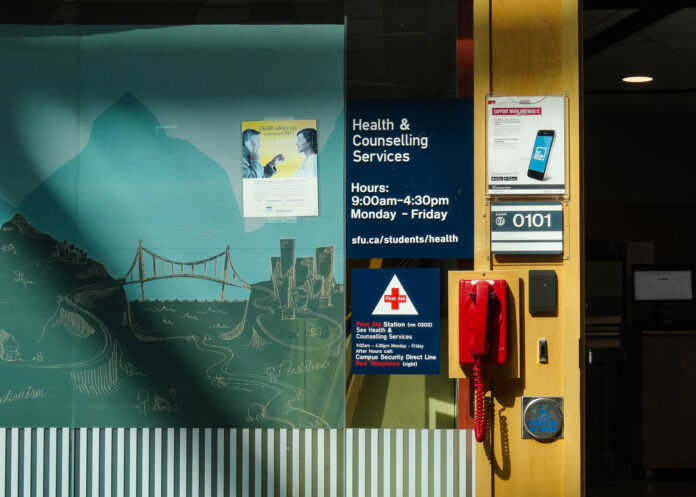
The door to SFU’s Health and Counselling Centre.
PHOTO: Puneet Aulakh / The Peak

By: Yasmin Hassan, Staff writer

Right now, about 17% of BC residents are experiencing issues with mental health and substance use. If you’ve ever considered therapy or counselling, have you wondered if you’ll have to pay out of pocket? Psychotherapy services are not covered by the provincial Medical Services Plan (MSP) unless prescribed by a psychiatrist. Even then, treatment typically only covers a limited number of sessions, and wait lists span up to two years. The government should subsidize mental health services that are essential to the wellbeing of so many people in BC.

The BC government states MSP doesn’t typically cover services from counsellors or psychologists outside hospital settings. There are some non-profit organizations that offer low-cost or free counselling, but the problem lies in the scarcity of treatment. And even with extended benefits such as those offered by SFU, coverage includes a very limited number of sessions. SFU’s free counselling only includes “three to four appointments” on average, and the Studentcare health plan covers up to $600 a year in mental health services. Counselling sessions range from $50–240, so even extended benefits only cover a handful of sessions. According to Global News, covering the cost of psychological services prevents mental health issues from “escalating to more severe cases.” This would in turn lead to “cost savings,” on top of “decreased wait times” in emergency rooms.

Preventative care comes in different forms depending on each person, ranging from developing healthy habits to talk therapy. When possible, assessment and treatment should be implemented before people reach mental health crises. This would lessen the load on hospitals and allow people to live their lives without worrying if the next paycheck will be enough to cover counselling sessions. Incorporating psychotherapy into the public healthcare system would encourage early intervention for mental health conditions, preventing them from escalating into more severe conditions. 

A recent proposal would put psychotherapy under the provincial government’s oversight. This could provide a framework for public funding. While there are some lowcost options from organizations across the province, that “low cost” can still be debilitating at $25–80 a session, especially with the cost of living in the Lower Mainland. People shouldn’t have to pay out of pocket for essential services, and mental health is essential. 

While there are some low cost options from organizations across the province, that “low cost” can still be debilitating.

When I think about public healthcare, I think about long lines at the walk-in clinic because hardly anyone has a family doctor anymore. It’s clear our healthcare system needs fixing, and mental health care isn’t any better. For example, there are limited options for adult ADHD diagnoses in the public system, let alone the high costs that come with them. When one woman tried to get assessed for ADHD through the public system, she was told it’d take up to two years. Imagine how many other BC residents breathe a sigh of defeat upon seeing that kind of waitlist. 

It’s no secret the Canadian healthcare system is a bleak thing to marvel at. Extreme waitlists, family doctor and staff shortages, consequent burnout of staff and patients —  you name it, most people have experienced it. Many have spoken about how federal and provincial governments must invest in fixing our broken healthcare system, considering Canada spends less on public healthcare than many other countries. But, it’s not enough to only fund physical health. Mental health directly impacts your physical health — if left untreated because of inadequate access, those serious cases of depression or anxiety could sprout into actual physical ailments

Dr. Karine Gauthier, president of the Coalition of Québec Public Network Psychologists, said psychologists in Canada have a “lack of professional autonomy and salary recognition.” On top of lower salaries, psychologists in the public sector also have lower benefits and pension plans. So, while we as the receivers of care need to be taken care of, so do our caregivers. Mental health professionals should be fairly compensated for the services they provide, otherwise they may move to the private sector.

As we engage in discussions about improving the Canadian healthcare system, mental health should also be a consideration. Something that’s incredibly important is encouraging preventative care, and subsidizing that would be nothing short of beneficial. Easy access to psychotherapy has physical health benefits, reduces mental health crises, and helps people stay engaged with their communities. Reaching out for help can be daunting, but it shouldn’t be a financial setback.

The genocide of Palestinians is not up for debate

0
A Palestinian flag.
PHOTO: Ömer Yıldız / Unsplash

By: Amanda Taylor, SFU Student

Content warning: mentions of the Holocaust and death.

On June 16, Prime Minister Justin Trudeau attended the Ukraine peace summit and said Russia is committing “an element of genocide.” This is true, and it’s important Canada stands for peace in Ukraine. However, along with other Canadian officials, Trudeau has continually shied away from calling Israel’s ongoing violence and occupation of Palestine a genocide, which shows a double standard. While there are many factors that influence who and what receives open support from governments, political power is at the forefront — and Israel is certainly not lacking in it.

The United Nations (UN) recognized genocide as an international crime in 1946, shortly after millions of Jews were killed or displaced during the Holocaust. Two years later, the International Court of Justice (ICJ) brought forth the Genocide Convention, which has been agreed to by 153 states. Even states that have not agreed to the Convention are still bound by it, according to the ICJ. The Genocide Convention defines genocide as “any of the following acts committed with intent to destroy, in whole or in part, a national, ethnical, racial, or religious group.” Some of these acts include “killing members of the group, causing serious bodily or mental harm to members of the group,” and “deliberately inflicting on the group conditions of life calculated to bring about its physical destruction in whole or in part.” Israel is committing many of these acts in occupied Palestinian territories. And yet, the Canadian government doesn’t find the truth convenient enough to admit. 

This January, the ICJ reported it’s “plausible” that Israel has violated the Genocide Convention. They voted near-unanimously that Israel must take “‘immediate and effective’ measures to ensure the provision of urgently needed humanitarian aid and basic services.” One month later, Israel made it clear they had no intention of complying with this demand. According to Amnesty International, they “have failed to ensure sufficient life-saving goods and services are reaching a population at risk of genocide and on the brink of famine.” Since October 7, 31 of 36 hospitals in Gaza “have been damaged or destroyed.” In recent months, Israel has begun targeting refugee camps in Rafah, killing “at least 45 Palestinians” in one day and putting even more at risk of illness. The number of Palestinians killed since October 7 surpassed 30,000 in February, with reports that the actual number was likely higher. As of June 20, at least 37,431 people have been killed in Gaza alone.

This January, Canada froze arms export permits to Israel due to the risk of weapons being used to violate international law. In March, they announced they were extending this restriction until they “can ensure the weapons are used in accordance with Canadian law.” There are no excuses for supporting a militia that’s provenly committing genocide — no amount of time passed during a “freeze” will make it OK. 

Canada should also be concerned with the disturbing level of Israeli lobbying that undermines any façade of political neutrality. 

It’s unsurprising that Trudeau was willing to call the Russian invasion of Ukraine a genocide, yet avoided the word when asked about Gaza. It’s easy to criticize Russia, a country with weakening diplomatic ties to the US and Canada. Israel, on the other hand, is one of the US’ largest economic and military allies, receiving billions of dollars every year in assistance. Canada, with close military and economic ties to the US, has notably stayed silent when it comes to calling the Palestinian genocide what it is: a genocide.

Despite fewer ties to Israel in comparison to the US, Canada is not immune to anti-Palestinian lobbying. Last year, The Centre for Israel and Jewish Affairs (CIJA) hosted a conference on antisemitism which was attended by Justin Trudeau, Pierre Poilievre, and Jagmeet Singh. According to The Breach, CIJA formally requested that the Canadian government “‘officially recognize’ that anti-Zionism is a form of antisemitism.” Zionism is a “Jewish nationalist movement” that supports the forced establishment of a Jewish nation state in Palestine. Independent Jewish Voices, a Jewish organization that supports justice in Palestine, responded: “There is every reason to be concerned about the rise of Jew hatred . . . but we cannot allow efforts to combat these social scourges to be hijacked by those whose purpose is to justify and defend the racist policies of the state of Israel.” The Maple also reported that CIJA has engaged in lobbying with “at least 56% of MPs or their office assistants,” including “taking MPs on fully paid trips.” 

While the Canadian government should absolutely take action to tackle antisemitism, that doesn’t equate to unyielding support for Israel’s crimes. Canada should also be concerned with rising anti-Palestinian sentiment, and the disturbing level of Israeli lobbying that undermines any façade of political neutrality. 

For a country that proclaims its supposed commitment to Truth and Reconciliation, the safety of Indigenous Peoples in other nations appears to be a low priority. Numerous countries and organizations have condemned Israel’s attack on Palestinians, including the UN and ICJ. Nonetheless, Justin Trudeau has the gall to call attention to one genocide while undermining another that is the “deadliest rate of conflict of the 21st century” so far. The question is not if Israel is committing a genocide, but how. It’s not enough to support a ceasefire once it’s convenient, after many other nations have already done so. When the Canadian government looks back on the Palestinian genocide one day, there may be some temptation to believe they were on the “right side” of history — but silence is complicity. Delayed support is complicity. Pandering to lobbyists is complicity, and complicity in genocide is just shy of support for it. Never forget that Canada sat back when their support was direly needed.

SFU Queer Collective’s webinar tackles 2SLGBTQIA+ rights in universities

0
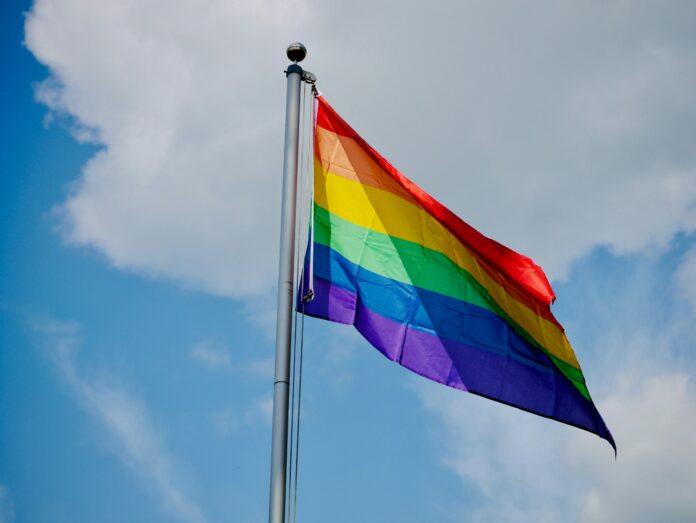
This is a photo of a pride flag, on a flag pole, blowing in the sky.
PHOTO: Sophie Emeny / Unsplash

By: Kaja Antic, Staff Writer and Kelly Chia, Peak Associate

On June 5, SFU Queer Collective held their first webinar since the organization’s revival earlier this year. The network includes SFU graduate students, postdoctoral fellows, faculty, staff, and alumni who hope to foster an inclusive environment for the 2SLGBTQIA+ community at SFU. 

The online event focused on the role universities like SFU should play in creating spaces that welcome queer individuals, and combating the recent waves of anti-2SLGBTQIA+ attitudes across the country. The panel included Jude Mah, coordinator for the SFSS’ Out On Campus department, Jen Marchbank, SFU gender, sexuality, and women’s studies professor, Norma Lize, trans activist and communications manager for Rainbow Refugee, and Mackenzie Kolton, director of learning for Egale Canada.

“We know that in other provinces, the conversations around the queer community this year is not very positive,” Lize said. For example, the Premier of Alberta, Danielle Smith, announced numerous anti-trans policies for queer youth in February 2024. This included a wide variety of restrictions for trans and non-binary youth, “banning name and pronoun changes at school,” and allowing the option to forgo discussions about the 2SLGBTQIA+ in classes.

Lize emphasized the importance of educators making classrooms safe and inclusive, and how universities should be training faculty on supporting 2SLGBTQIA+ students. 

Speakers discussed “othering” effects in inclusivity curricula. Mah cited their own experiences of being othered while learning at SFU. Othering is a dialogue of “us vs. them,” made to exclude or insult groups of people. In the context of 2SLGBTQIA+ communities, “feelings of otherness are fueled by the heteronormative structures” in society, which includes “the assumption that everyone is ‘naturally’ heterosexual,” rather than integrating the understanding that it shouldn’t be assumed whether someone is not queer.

 “We will always be here within these classes, so why is it not a normalized thing?” Mah said incorporating queer and trans experiences across curricula is more useful than confining learning to gender and sexuality classes. 

Kolton added, “Oftentimes when curriculums are developed, it’s developed about a community — forgetting that that community is often sitting in the seats that you’re teaching to.”

At the institutional level, Kolton added it’s also important for senior leadership to uplift and make changes for students. “Brock University comes to mind with their name change policy. They launched and created that pilot within a year,” she said, referring to the university’s policy that no longer charges students to change their name on their student card. It was brought forth by student organizing. “This isn’t the time to take five–six years to implement [policies protecting queer students.] We have to act now.” 

 “This is a larger systemic issue that involves partnership that goes beyond a pride presentation.” — Mackenzie Kolton, director of learning for Egale Canada.

Lize noted universities can “issue clear and strong public statements” and “engage with policy makers to provide expert testimony, research, and data that support 2SLGBTQIA+ rights.”

Lize also mentioned the need for an intersectional lens in post-secondary inclusivity efforts, especially for asylum-seekers and refugees in Canada. These communities have different accommodation needs such as specialized legal or mental health support networks, which are often inadequately supported by post-secondary institutions. 

Kolton noted where she sees these programs often fall apart is when the university is too focused on checking a box rather than long-term change. “This is a larger systemic issue that involves partnership that goes beyond a pride presentation,” Kolton said. To create lasting impacts, Kolton stressed working with and listening to queer organizations. 

“I’ve had a lot of international students who don’t necessarily have the words to talk about their identity, sexuality, or their gender, and they want to know themselves,” Mah said. “Growing up in small rural Alberta, I didn’t have the lingo that I have now, and didn’t come into my gender and sexuality until I was in university, so I think it can be really detrimental to students when we don’t offer that space for learning.” 

Mah added, “It’s really easy for universities to say they prioritize EDI [Equity, Diversity, and Inclusion] and that they’re inclusive and that they’re for the rights in supporting queer and trans students but I think it’s putting it into practice and actually acting on these in good faith that doesn’t always happen.” They also note that it’s been challenging to find institutional support through SFU given recent budget cuts. “The people we used to go to answer these complaints to fix [ . . . ] they’re no longer here, or they’re at capacity.” 

Marchbank asked, “We get a lot of flag waving, but what happens in December?” in reference to a lack of year-round support for the 2SLGBTQIA+ community from post-secondary institutions, saying combating bigotry is larger than an annual parade walk. 

“Prioritize what queer and trans students, staff, faculty are asking for,” Mah said. “At the end of the day, these are the most knowledgeable people. What their demands are, what their asks are — are pointing out the gaps in these systems. That’s where the universities should start with their policies.”

SFU Queer Collective hopes to expand the conversation regarding SFU’s role in fostering an inclusive community for 2SLGBTQIA+ people. 

Minimum wage worker doing the job of three people is excited for 65 cent wage increase

0
A hand putting money into a piggy bank but it's falling out the bottom surrounded by the words “cost of living,” “inflation,” and “rent.”
ILLUSTRATION: Victoria Lo / The Peak

By: Hailey Miller, Staff Writer and C Icart, Humour Editor

News anchor: Alexa, play “7 rings” because the minimum wage is increasing to a whopping $17.40 in BC. I sat down to interview an excited Minimum Wage Worker (MWW) about how his life will change now that he’ll be rolling in cash! Take a look at the footage. 

A clip of the news anchor trying to ask a fast food worker questions in the middle of their shift starts playing. 

News anchor: Good afternoon, Minimum Wage Worker. How are you feeling about today’s news regarding a minimum wage increase?

MWW: Ah, yes, well, I was just itching for you to ask! (to the crowd of angry customers) Order number 463! 463! Not you, ma’am, I know you didn’t order this. (to the news anchor)  I feel warm, fuzzy, and splendid after hearing about the minimum wage increase. I might be able to afford to only have seven roommates instead of eight. But only if my landlord stops threatening to evict us so his imaginary family member can move in. 

News anchor: That’s amazing! So, what will you spend your extra funds on going forward? 

MWW: I’m so glad you asked! I simply cannot wait to splurge. Instead of choosing between my favourite cruciferous vegetables at the grocery store, I’ll buy both broccoli and cauliflower next week! (to the entitled customer who is yelling even louder than the others) No, sir. I did not charge you for ice cream because we don’t sell ice cream. We keep the machine broken, hoping you won’t come back. (to the news anchor) Are you going to buy anything? 

News anchor: (ignoring the question) Talk about money bags! How would you like to thank those who made this increase possible, you know, the big wage increase bosses? 

MWW: Ah, yes, well, boy, do I have a mouthful for them! Nothing brings me more joy than finding out that I’ll get a bigger wage and then realizing that it won’t even be remotely close to liveable. At this point, I might as well just live in a shoe. The government swoops in thinking they’re the financial saviour and all, but they’re jet-setting around the world, living in mansions, and blowing money like raindrops of climate change that aren’t coming down! This broke bitch ain’t affording a house anytime soon, or even a cardboard box-converted tiny home, for that matter. (to the customer who just walked in, definitely making the building overcapacity) Ma’am, I told you last week that that rare venomous snake is not a service animal! Order 465! 465! Cheeseburger, no cheese that is most certainly not a hamburger! 

News anchor: Wow! It’s so great to hear about the joy you’re experiencing! Can you elaborate on other ways this increase is changing your life? 

MWW: Ah, yes, well, if it weren’t for this minimum wage increase, I’d still be . . . drumroll please . . . broke! Trust me, I’d love to be rolling in so much dough that I could pay off my grocery and rent debt combined, but please, that only happens in fantasy land! I guess I better fly to Disneyland, where all our livable wage dreams come true! — Excuse me, I need to go; there’s an influencer trying to clean our bathroom again. 

MWW starts running after a woman who is spraying pink cleaning foam everywhere. The camera cuts back to the newsroom. 

News anchor: Well, this heartwarming story wraps up our broadcast for tonight. Thanks for tuning in, and if you got a raise, make sure not to spend it all in one place! 

la lune rocks on with songs of disparity

0
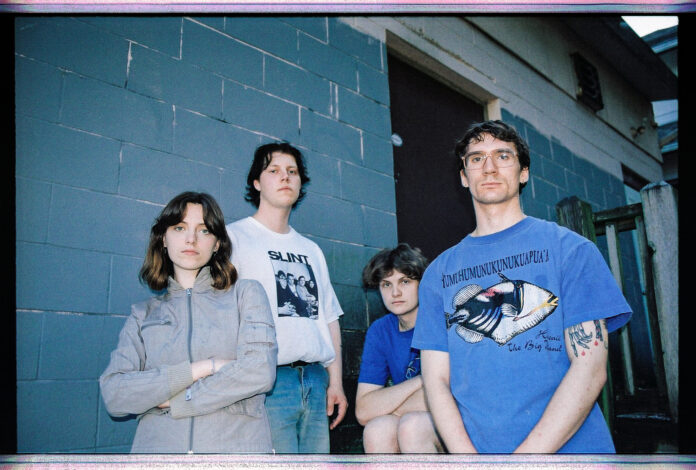
Four individuals standing in front of a blue-painted wall. Two have their arms crossed while the other two have their arms down loosely.
PHOTO: Gudrun Wai-Gunnarsson / The Peak

By: Hailey Miller, Staff Writer

Disparity is defined as “a noticeable and usually significant difference or similarity.” However, in the case of Vancouver indie-rock and shoegaze band la lune, disparity also refers to the hard-hitting soft beats of their most recent EP. Released on April 19, the EP has shown “songs that reveal themselves” as la lune plays them.

Consisting of Ethan Rebalkin (guitar, vocals), Olivia Wells (bass, backing vocals), Ben Lock (guitar), and Taylor Pawsey (drums), the band formed in 2022 after a few jam sessions among the friends-turned-bandmates. Having been roommates and coworkers, and after getting to know each other better, the band decided to embark on their passion for music.

The dreamy, vocally-obscured shoegaze element is prominent on disparity, though Pawsey told The Peak he’s “always just thought of [la lune] as a rock band.” la lune is working on more new music, which he said will be “broader,” but considers it adventurous alternative rock.

PHOTO: Gudrun Wai-Gunnarsson / The Peak

The more the band evolves, the more they draw on inspiration from other artists. “We’re constantly writing,” said Lock. They lean into the writing process and influences from artists like “electronic slowcore band” duster and alternative-rock band The Smashing Pumpkins. 

la lune is interested in pushing the envelope with genres — particularly shoegaze. disparity’s tracks drip in guitar distortion and cutting jabs of feedback that make it feel like youre floating around a starlit galaxy. The songs “despondent,” “disparity,” “spiral ((down)),” and “i feel like im pretending,” will bring you into the ethereal realm of cascading riffs and distorted feedback. 

“When you play the songs you learn so much more about them.” —Olivia Wells, la lune’s bassist and backup vocalist 

The EP lives up to its name, showcasing a plethora of guitar shreds, drum fills, and catchy bass lines. Songs like “a little life” start out slow and build up to a heavy rock vibe

It’s been really fun to reacquaint with the songs,” said Lock, regarding the time between studio recordings and now playing them live.

PHOTO: Gudrun Wai-Gunnarsson / The Peak

A unique part of the band’s musical development is how they feel out the tracks and alter them onstage. Recently, they’ve been playing an unreleased song live and have received positive reception from audiences. Wells noted that having recorded disparity months prior, and now performing the songs live, has been a good way for the band to develop their onstage presence versus what they had recorded in studio. 

“When you play the songs you learn so much more about them,” said Wells, adding that the studio is a good place for “solidifying” everything, as aspects of the tracks change over time.

disparity feels new because we just put it out, but some of these songs we’ve been playing for a long time,” said Pawsey. “We’ve been hyped on writing a lot recently,” added Lock. 

“We’ve all been pretty grateful for the reception,” Pawsey said of the release of disparity. “It feels good that people are just enjoying it and connecting with it.”

Following their two recent shows at the Green Auto this month, la lune will be playing at the Fox Cabaret on July 6 and The Pearl on August 1. They’re looking forward to the upcoming gigs, releasing more music, and hopefully planning a future tour. 

PHOTO: Gudrun Wai-Gunnarsson / The Peak

“Rock and roll evolution,” acknowledged Lock, and surely, that’s what la lune will continue to do.

Follow @lalunelalunelalunelalune on Instagram to keep up with the band.

Theatre Under The Stars’ CATS features two SFU dance majors

0
Four individuals wearing cat-like makeup with fluffy cat ears. Two on the outsides stand on one knee, while the two in the middle are slightly crouched. All four have their arms bent and posed as if they are pouncing at the camera.
PHOTO: Courtesy of Theatre Under The Stars

By: Yasmin Hassan, Staff Writer

From July 5 to August 24, Theatre Under the Stars is coming back to Stanley Park’s Malkin Bowl. One of their featured productions this season is CATS, a dazzling ensemble musical of feline characters who gather for the Jellicle Ball. This ball is held ceremoniously to decide which among them will be granted a new life in a sort of rebirth. What makes this musical so special? Two of our very own SFU dance majors, Elijah Sam (pictured, far right) and Tia Gunhold (pictured, wearing white), will be performing as Coricopat and Victoria respectively! The Peak had the pleasure of speaking with them about their musical tails (and tales).

Eljiah Sam is currently a third-year dance major at SFU, performer, and instructor who works with kids. “Coming from SFU with this training and many different dance styles has helped me jump right into the work,” Sam said. He talked about how collaboration between different departments at the school, such as theatre and film, support the ability to be adaptable to new things. His experience helped him “collaborate with a wide range of different creative people,” which is needed for a show like CATS.  

Tia Gunhold, a third year undergraduate student double majoring in psychology and dance, said that her “competition-heavy background” resulted in “a shift in movement styles and performing.” She also mentioned the differences in things like comfort with physical touch between dancers and non-dancers. 

“Coming from SFU with this training and many different dance styles has helped me jump right into the work.” — Elijah Sam, SFU dance major 

“The musical is a great musical, first of all, for dancers because it’s a dance heavy show,” Sam said when asked about his take on the show. Gunhold backed that up by mentioning how the performers “sing the entire time; there’s only one very very short monologue in the whole show, which is different from a lot of other musicals.” 

Gunhold mentioned how many people may be enamoured with the singing and dancing of the show, but often don’t understand the storyline. “The storytelling and dancing go hand-in-hand,” Sam said, emphasizing how each element plays a part in telling the tale.  

An aspect that I admire about the show is how it’s an ensemble, truly establishing every role whether big or small as a key part. “You need to have the whole tribe of the cats present on stage for the story to make sense,” Sam said. 

Not only will the impressive set design take the stage, the modernized costumes that are detailed to suit each actor as well as their character will be certain to catch the audiences’ eyes. “The way that they orchestrated the costumes is so ingenious,” Sam told The Peak, noting how the costumes suit each cast member perfectly. As Gunhold stated, “The casting was so well done, because I feel like a lot of people, the actors/our cast are so well suited for their role.” 

Support our fellow SFU stars by seeing CATS this summer! Tickets can be found at etix.com