Home Blog Page 920

Ballet BC kick off 30th anniversary season with three stunning works

0
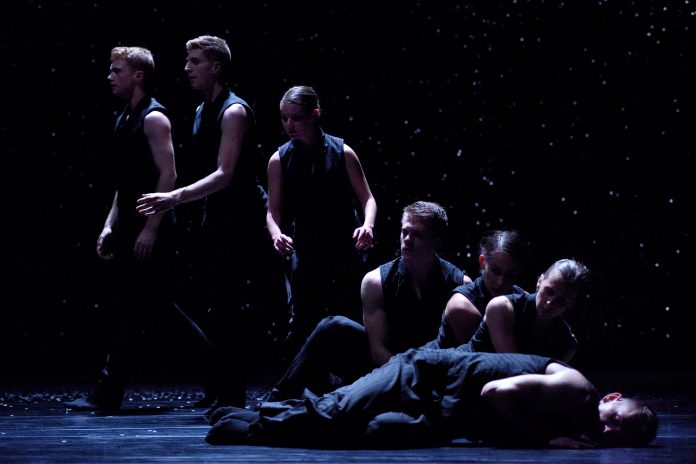
Seven dancers moved as shadows of one another in Crystal Pite's Solo Echo.

Ballet BC has come a long way over the past 30 years, and the opening program of their 30th anniversary season shows their strengthened vision of being a bold, contemporary company. All three works on the program were very strong, and showed off the skill and refinement of the dancers.

Cayetano Soto’s Twenty Eight Thousand Waves had its world premiere with Ballet BC in 2014, and Soto, now the company’s resident choreographer, has remounted it with them this season. It’s a striking work of energetic, abstract forms and partner work that never stops evolving. The lighting design is unique as the stage lights, which are spread out along a bar hanging above the stage, move up and down to create shadowed areas and stark contrast between light and dark. Soto describes the work as being about the thin line between life and death, and that fleeting, ephemeral quality comes through beautifully.

Up next was Awe by Belgian choreographer Stijn Celis. Sharing the stage with the dancers of Ballet BC was the male vocal ensemble Chor Leoni, providing exquisite choral sounds to accompany them. The pairing of their voices singing “De Profundis” and “Wandering Heart,” featuring text by Leonard Cohen, was mesmerizing. The choir was set back in the shadows upstage, which gave them an otherworldly quality, and when the lights came up at the end of the piece to reveal their faces, the audience roared with approval. I would love to see more collaborations like this from Ballet BC.

Former Ballet BC member Crystal Pite is now a world renowned choreographer, and she returns to her roots to present Solo Echo, which premiered in 2012 at Netherlands Dans Theatre. Set to the music of Brahms, Yo-Yo Ma on cello, and Emanuel Ax on piano, the piece was soothing and reflective as a steady stream of artificial snow fell at the back of the stage. Dressed in all black and resembling ninjas, the seven dancers moved in unison and in canon as if they were shadows of one another. As expected, Pite’s choreography was intelligent and intricate. As the dancers broke away from each other one by one to leave the stage and the last one lay down upstage allowing the falling snow to cover his body, a hush fell over the audience.

Performing the works of three diverse choreographers and making them all feel unified is no easy feat, but Ballet BC does so by making them their own. If this program is any indication, this upcoming season should be one of the company’s best yet.

Vancouver Canucks get a shot of adrenaline

0
Bo Horvat and Jared McCann are two of the young players that have fans pumped for the future.

It’s been a long time since you could say the Vancouver Canucks are having a youth movement. Not since the 1998–99 season have the Canucks had three rookies start on the team. There hasn’t been a concerted effort to integrate youth into the lineup since the team started playing two baby-faced twins from Sweden. And it’s giving the fans something to be excited about.

It’s been well documented how shit the Vancouver Canucks drafting has been throughout the years. From 2006 to 2011, the Canucks drafting produced two NHL regulars, Michael Grabner and Cody Hodgson. Grabner, after scoring 34 goals in 2011 with the Islanders, has struggled to score goals consistently, while Hodgson is now a Nashville Predator after being bought out by Buffalo.

And don’t even get me started on their drafting in the 1980s. The Canucks routinely passed on future hall of famers for guys that never panned out, missing out on players such as Al MacInnis, Gary Roberts, and Brian Leetch. And Cam Neely, the one good player they did draft, got traded away for some scraps.

The team’s history of poor drafting is what makes the recent emergence of Jake Virtanen, Jared McCann, Ben Hutton, and even Bo Horvat super exciting as a fan. In just a couple of years, Canucks general manager Jim Benning has turned drafting, scouting and developing into one of the team’s major strengths. McCann is leading the team in goals, and both Virtanen and Horvat scored against the Flyers last Monday.

This hot start does not mean that McCann, Virtanen, Hutton, and Horvat will be this effective the whole year, but these rookies are providing the organization and the fanbase with hope for the future. For too long the Canucks have lacked young talent pushing into the team and earning roster spots. Not only does it potentially provide depth that can take pressure off the Sedins, but it provides cheap talent. In a salary cap league, it’s imperative that you get the most out of your entry-level contracts. If McCann can get at least 20 goals on an entry level contract, it would be considered a massive success.

These young guns are providing cheap, quality talent for a Canucks lineup that no one is quite sure what to make of just yet. With their play showing tons of potential, the future looks bright for now.

2016 NHL Draft Preview

0
Auston Matthews is the clear favourite for the 1st overall pick

Introduction

It’s the most wonderful time of the year.

No, not Christmas, the NHL draft! It’s not until June, but I must confess that I love the NHL draft — so much so, it’s probably my favourite day of the whole NHL calendar. With most junior seasons already underway, draft eligible players are gearing up for more attention and more scrutiny, trying to stand out in a sea of players. That’s why it’s fun to see if we can pick out some players now who will be head and shoulders above the rest by the time the draft rolls around.

Plus, there’s something fun about trying to project how these players will do when they get to the NHL level, and it’s fascinating to see the different strategies teams have when it comes to drafting players.

This year’s class is a bit different from last year’s. It lacks the big name generational talent like a Connor McDavid, but there are still lots of quality players near the top of the rankings, especially big body wingers. Here are some players to look for this time around, and where they could end up going.

I’ll be looking at hockeyprospect.com’s top 30, ISS hockey’s top 30, Future Considerations’ top 30, and well as Bob McKenzie’s rankings to get a feel for where I think some of these players will go. And of course, I’ll be watching YouTube clips to make my own personal judgements.

Auston Matthews

The big name from this year’s draft class. If Matthews had been born just a couple of days earlier, he would have been drafted early on in the 2015 draft. The American took the unprecedented step this year of going to play professionally in Switzerland, forgoing NCAA hockey and the Everett Silvertips, the latter of whom held his CHL rights. So far, this move has paid off. He has 16 points in 14 games so far this year, and he’s playing against grown men. Barring a significant fall in play, he will go number one.

Prediction: 1st Overall

Jakob Chychrun

The consensus number two pick this year. American-born Chychrun is projected to be an impact defencemen, in fact Bob McKenzie says that he is “capable of being a complete number one blueliner.” He has an NHL caliber shot, and is an excellent skater. Only 17 years old and listed at 6’2”, 196 pounds, it’s not unreasonable that he could put on another 20 pounds of muscle and become a force in the NHL. With 10 points in 14 games to start the season with the Sarnia Sting, he is the best defenseman available in the draft.

Prediction: 2nd Overall

Jesse Puljujärvi

Puljujärvi burst onto the scene last World Junior Championship. As a 16-year-old, he seemed to hold his own against players two and three years older than him. Listed at 6’3” and 196 pounds, he is able to use his body very effectively and plays much like a North American player as opposed to a European one. Playing for Kärpät in the Finnish SM Liiga, Puljujärvi has scored nine points in 19 games playing against grown men like Matthews. He’ll go in the top five due to the combo of skill and size, but which place will depend on the need of the teams that can draft him.

Prediction: Top 5

Patrik Laine

Another big Finnish winger who could go fairly high. He doesn’t have the name recognition of Puljujärvi, but Laine has quietly put together a strong case for a top five spot. He’s scored seven points in 12 games so far in the Finnish SM Liiga, and had eight goals in seven games at the 2015 U18 world championship, a competition that has traditionally been an indicator of success in the NHL. His draft ranking will be determined by the upcoming World Juniors. If he has a good tournament, his place within the top five will be cemented. If not, then Laine could slip a bit down the draft board.

Prediction: 5th to 7th

Tyler Benson

Let’s switch it up a bit and talk about a player a bit closer to home. Tyler Benson was drafted first overall by the Vancouver Giants in 2013, and big things were expected of him. After putting up 146 points in 33 games in his draft year, people thought it would be a matter of time before Benson translated those numbers into the WHL. That hasn’t been the case. Playing only 62 games last year he put up 42 points, and this year is off to a slow start, with only two points in five games. Ranked anywhere from 13th to 22nd and not even mentioned by Bob McKenzie, he’s looking like a low first-round pick to me.

Prediction: 18th to 23rd

Matthew Tkachuk

If you think the name sounds familiar, that’s because it probably is. Tkachuk is the son of former NHLer Keith Tkachuk, and just like his dad, Matthew uses his body very effectively to get to high scoring areas. So far with the London Knights the American has scored 24 points in 15 games, 19 of which were assists. Because of his last name, he gets the benefit of the doubt when it comes to rankings. Three of the four sites have him exactly at number five, so that seems like a fair place to put him.

Prediction: 5th Overall

Alex Nylander

Another son of an NHLer, Alex Nylander is an extremely highly skilled player. He’s got great hockey sense, but unlike his brother William who was drafted in the first round by the Maple Leafs, Alex is playing his draft year here in Canada with the Mississauga Steelheads. Playing in the OHL may help his draft stock rise, but the upcoming World Juniors is where his chance is to impress the scouts. With 21 points in 16 games so far, he is on track for a solid year, but may be passed over due to his size relative to the other players.

Prediction: 7th to 10th

No one at SFU is prepared for an earthquake

1

How many of you remember fire drills in elementary and secondary school? I know I went through a couple per year. As kids, we used to think they were great — we had no class and became caught up in the excitement of that crazy loud bell. As  adults, people don’t appreciate fire drills and look for any opportunity to avoid them. My workplace, however, doesn’t avoid the fire drill and actively embraces them. Working at a major tourist attraction, you would hope that the staff know how to safely evacuate people in the case of a fire. 

Mid-October, my work introduced something new: an earthquake drill. We live in a city where the conversation around quakes has gone from ‘if’ to ‘when,’ and yet I will fully admit I didn’t really know what to do if one were to hit. Until that drill, I thought standing in a door frame was ‘what you were meant to do.’

Don’t do that, by the way, it’s apparently really stupid; one of the many things you think you know but actually don’t. Oh, common sense, you’re so fun.

My earthquake drill was facilitated by an event called Shake Out BC. It’s like Earth Day in the sense that you are encouraged to participate, yet it is essentially voluntary. I was at work downtown when the “shake out” occurred, and I could actually hear alarms ring out for a short time around the city.

Did you all know that SFU was part of the drill as well? Neither did I. That’s because no one I know on campus that day heard any alarms. I checked the SFU website, and there were only three places between all of the campuses where there was a drill: Burnaby campus’ Saywell Hall Atrium, the WAC Bennett Library, and the Vancouver Harbour Centre Concourse.

It got me thinking: what is going to happen when an earthquake does hit? How many of us know that it’s the safest to get under a table or bench and hold on? I understand that organising a drill across a huge university can be a royal pain, yet as Shake Out BC showed, a drill can be as simple as a one-minute demonstration at 10:15 a.m.

Everyone who is in class is either packing their bags and ignoring the prof’s final sentences, or getting ready for a break. Is it really that difficult to inform all the profs and TAs and to put a few posters up?

I’m not saying we should have all evacuated the school like we did in grade three. Simply that if I were in one of the C-9000 classrooms, I’d want to know what the heck we are meant to do in the case of a quake — especially since I’m too tall to properly fit under the seats. A simple drill that could very well save lives shouldn’t be something a school encourages you to volunteer to practice, but something that you are voluntold.

Nimona is an uproariously heart-wrenching epic of friendship

0
Nimona

Contrary to popular belief, a sidekick is not a flamboyantly dressed crime-fighting assistant confidently sporting emerald fish-scale panties. Although I can see where you might have drawn that conclusion.

No, a sidekick is much more than just embarrassing fashion choices and corny catch phrases. At their fundamental core, the sidekick is a dear friend, a relentless partner tasked with assisting a confidant to the best of their human (or non-human) ability. They are the foundation of any dynamic duo and the glue that keeps every good team afloat. And like any cherished colleague, they have it in their power to help make us better and worthier people than we can ever imagine.

In Nimona, we come to see the beautiful side to the historically underrated ward and how they can be a defining part of our lives.

Lord Ballister Blackheart is a man with a thirst for revenge. After losing his arm and being wrongfully banished from the Institution of Law Enforcement and Heroics, Blackheart turns to a life of villainy. While scheming up a plan to expose the unvirtuous quality of the institution, he happens upon an unexpected interloper by the name of Nimona who breaks into his lair. Nimona, inspired by Blackheart’s turpitude, offers her services to him, albeit eccentrically. Begrudgingly, the malefactor agrees, unleashing upon himself a jocular caboodle of escapades.

Nimona is a charming character who, despite being childish, does anything but annoy. Shamelessly headstrong and unswervingly honest, she helps to make every page an utter joy to read. Even better though, Nimona is not some cheaply crafted one-liner machine; she is a character written with such tactful depth you’d swear she was a real person living upon every panel of the story.

Although Nimona is the title character of the graphic novel, the story’s focus is placed mainly on Lord Ballister Blackheart, who is a compelling if not tragic lead. By himself, Blackheart would have been a more than sufficient protagonist to uphold the comic’s yarn. However, the majesty of Nimona’s success rests in the sidesplitting conductive relationship between its two electrifying criminals.

Blackheart plays the straight shooter to Nimona’s quirky endeavors, rolling his eyes and losing his temper in tune to the rambunctious actions of his energetic squire. Every page the two characters share is a delight. Whether allocating time to a heart-to-heart or frolicsome squabble over the dumbest of topics, readers can get really entrenched in the dysfunctional relationship the two share and how they help each other grow.

As for the artwork — well, it’s absolutely breathtaking. To call it eye candy would be too cheap a connotation to bestow upon it. Nimona is nothing less than a visual libation your eyes could drink until the end of time with no need for alternate sustenance.

In a sea of sometimes superfluous similar works and multitudinous choices, it can be a grandiose conquest just to find something unique (never mind something ultimately enjoyable). However, Nimona is a reminder that if you look hard enough you can still find a treasure or two in a bookstore packed of monotonous remakes and ridiculous knock-offs.

Noelle Stevenson crafted a work so mesmerizingly wonderful that splashes of her heart can be seen on every page you turn. Nimona is a whimsical tale which will leave your sides aching from laughter and your tear ducts drained as you wish the experience could last just another page more.

Nightwood Editions launches four new poetry collections

0

At the Lost + Found cafe on Hastings street on November 1, Canadian publisher Nightwood Editions launched four poetry collections by emerging Canadian writers. Copies of the four titles were sold by Pulpfiction Books.

Silas White, publisher of Nightwood Editions, explained that “with the decline of community bookstores, book launches are crucial to fostering a sense of community for the writers.” This strong sense of community was apparent at the launch in both the authors and guests. Supported by family, friends, peers, and readers the four authors read excerpts from their newly published books, and gave words of thanks to those involved in bringing them to print.

Nick Thran, currently the writer-in-residence at the University of Calgary, presented his third collection of poetry, Mayor Snow. Joe Denham’s fourth publication, Regeneration Machine, is a requiem to the ghost of an old friend, reconciling the unexpected violent end of a non-violent young man. Sheryda Warrener teaches Creative Writing at UBC, and Floating is Everything is her second poetry collection, a collection that explores ways of belonging by drawing on an unexpected cast of characters.

Perpetual, written by Rita Wong and illustrated by Cindy Mochizuki, is a collection of poetic essays on the power and presence of water. Wong is a Calgary native and associate professor in Critical and Cultural Studies at Emily Carr University of Art and Design, who received her PhD from SFU. Cindy Mochizuki is an Interdisciplinary Artist with an MFA from SFU’s School of Contemporary Arts.

Perpetual continues Wong’s long-term interest in water, spawning from a 2007 callout to protect sacred waters by Dorothy Christian, an interdisciplinary artist and scholar from the Secwepemc Nation. Rita Wong chronicles her discovery of water from the lost creeks of Vancouver, through the Fraser river, to the tar sands of Alberta, exploring memories of place and stewardship along the way, through indigenous knowledge and its connection to the land.

Wong described the importance of “being conscious of where you are, and where your water comes from,” as it forms such a crucial part of our interconnected world. Her volume references issues around our sources of water, as well as how we value, secure and conserve it. This frames water as a crucial part of the conversation around sustainability, one which she described as an excellent opportunity to work together to find a solution. Audiences could see this collaborative mindset at play in Wong’s book launch reading, where she opened by expressing her “respect for those that work in, profit from, and protest the development of the tar sands.”

Cindy Mochizuki’s compelling illustrations support Wong’s writing by expanding on the text in both a documentary, and surreal manner. Laid out in the style of a graphic novel, the illustrations are done in a simple black and white line-art palette that creates an environment that is distinctly personal and dream-like. Perpetual’s essays read as part educational documentary, part discovery and self-reflection. This combination makes for an approachable and enchanting look at ideas around water.

Through her writing, Rita Wong continues a tradition of activism by university scholars, one recently visible in our own Lynne Quarmby and Stephen Collis, SFU professors who formed part of the protests against the Trans-Mountain Pipeline expansion here on Burnaby mountain.  In Perpetual, Rita Wong’s reflective and conciliatory tone and Mochizuki’s ability to personalize this narrative are characteristic of a shifting approach in activism from confrontation, to reconciliation.

Sports Briefs

0
Freshman Christina Dickson was awarded a major award

Christina Dickson

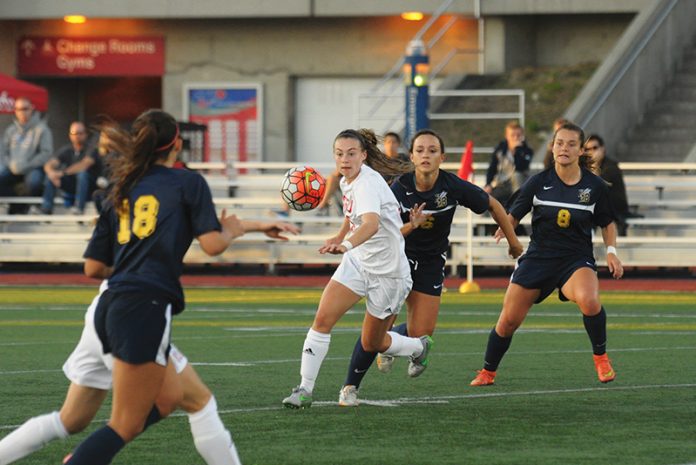
Forward Christina Dickson has been named GNAC freshman of the year for women’s soccer, and First Team All-Conference. The native of Burnaby, BC played in all 15 games for the Clan this year, scoring seven goals and three assists. She was a unanimous choice for First Team All-Conference, and according to Head Coach Annie Hamel, “her future is going to be very bright.”

Men’s Wrestling

Both Cruz Velasquez and Ciran Bell won their weight classes last Saturday, as the Clan’s season got underway. Velasquez won in the 61 kg category, winning three straight matches to claim the crown. Bell, competing in the 90 kg category, won all four of the matches to win the category. He also competed in the 94 kg category, finishing fourth.

Cross Country

Two cross-country players have been named for the GNAC Academic All-Conference team. Lorenzo Smith, a senior from Chilliwack, BC, had the highest cumulative grade point among athletes selected, with a 4.03 cumulative grade point average in Biomedical Physiology. Fellow senior Cameron Proceviat has also been selected to the team, with a 3.85 CGPA.

Laugh Track: An interview with Kyle Bottom

0
Illustration by Christina Kruger

Vancouver’s Kyle Bottom is a man who wears many hats. Aside from nearly a decade and a half of stand-up experience, Bottom’s also the artist booker for downtown favourite The Comedy Mix and showrunner for Comedy Bucket, a monthly riffing show he started at Hot Art Wet City. (Even as I meet up with Bottom for our interview, he’s working on a script for an upcoming The Debaters episode, where he’ll be arguing that video games are not a waste of time.) Read on to learn more about how stand-up in Vancouver’s changed since the early 2000s, what to expect from his monthly comedy show, and why it’s Comedy Bucket instead of Comedy Jar

How would you describe your comedy to someone who’s never seen it?

Onstage, I’m just a big weirdo, I’m super sure of myself, very opinionated, arrogant, and with a little spice of offensive. I don’t really tell a lot of stories; I react to whatever’s going on in my life. My stand-up’s very personal or derived from personal experiences, more inward-focused.

How has the stand-up scene in Vancouver changed since you started in 2001?

It’s changed in that some people are missing. A lot of them have moved on, because if you’re good at stand-up, there’s no real future in Canada.  So a lot of people have left to go to the States or to England — those are the two big options. I also feel like there are more people who do stand-up now. The group of amateurs is a lot bigger than when I was starting out, and it’s become more social over the last couple of years.

If you could, what’s one piece of advice you’d give to 19-year-old Kyle Bottom regarding stand-up?

I’d probably tell myself to get a recording device sooner. I only started recording my sets when I got an iPhone, so I missed out on six years of recording my sets. I would also tell myself to not take any breaks, because when you take breaks from stand-up, it really wears down your skills.

What’s one piece of advice you’d give 19-year-old Kyle Bottom, not regarding stand-up?

Don’t wait to have sex. Love is not important.

Where did the idea for your  monthly show, Comedy Bucket, come from?

It’s based off of a show by Paul Provenza called Set List, where they take a bunch of really top-level comics (who aren’t allowed to prepare anything in advance) and Paul uses a projector screen. The comics get onstage and he just throws up a random string of words, like “necromancer gangbang,” and the comedian has to talk about that until Paul’s satisfied and puts another thing up there. I saw Set List in Montreal and thought it was the best show ever, and I wanted to do something like that. I wanted to do a riffing show, which is getting more and more popular in the stand-up world. People like riffing. Prepared material is great but it’s nice to have a change of pace.

Is there any submission you’re tired of pulling from the bucket?

Sometimes people want to do the show, they want to riff, but then they get a suggestion that they weren’t expecting and maybe it’s something a little dark or weird, and they freak out about it. One that we’ve gotten in the past that people just lose it on is “breast cancer.” Someone pulls out and reads breast cancer and their brain melts. They have nothing they could possibly say that would be funny. And yeah, it’s a dark and messed-up topic for jokes but if you just let your mind wander and start talking, you never know what you’re going to find. That’s why I like doing Comedy Bucket. It forces me to talk about things that I would’ve never even considered talking about in front of people. So I’m not sick of anything. In fact, I like the mix. I like that people put in normal, every-day stuff like “cookie” and then the next one is breast cancer. That’s such a weird arc for a set to take.

How does one go about doing comedy or making light of something that is serious, like breast cancer?

What it comes down to is whether you can find something that’s funny about it to you. So if you have a dark topic and you can find an angle or way of approaching it that’s funny to you, then you can pass that onto audiences. It’s a lot of trial and error because the first time you tell it — especially if it’s a dark joke — there’s a good chance it’ll bomb, because you don’t have the right confidence going into it. You need a little bit of perseverance. If you can find an angle on something that’s funny to you, then you can make it funny for an audience, even if it’s some messed up topic like necromancer gangbang.

Is the “comedy bucket” a literal bucket?

Yeah. I bought it at the dollar store. It’s a little metal garden bucket with a handle. It’s an actual bucket, if just for the ease of reaching into. It can’t be Comedy Jar, because what if someone’s hand is too big and they have trouble getting in and out?

Do you have any advice for someone who might be interested in entering the Vancouver comedy scene?

If you want to get into comedy, try it and be honest about it. Some people are good at comedy and never pursue it, and some people are bad at comedy and pursue it anyway. Just because you can do comedy doesn’t mean you should. You can form a band that makes bad music, but that doesn’t mean you should be in a band. Try it, be honest with yourself, and if you think there’s something there, that you have the ability to look at something with a fresh perspective and you’re actually being funny, then yeah. Go for it. But don’t just dip your toe in and say, “Look at me! I’m a comedian! I’m doing it!” There are levels of progression and it’s a horrible journey, but it’s alright.

Fill up on laughs with Kyle Bottom’s Comedy Bucket, happening November 12 at Hot Art Wet City in Vancouver.

SFU prepares to host hockey analytics conference in April

0

Simon Fraser University has announced that it will host a conference on the emerging field of hockey analytics on April 9, 2016 at the Harbour Centre campus. It will take place from 9 a.m. to 5 p.m., and the conference will feature some of the brightest minds of the analytics community, to be announced closer to the date of the conference.

“The motivation behind it is that hockey analytics are becoming more popular,” explained Tim Swartz, professor in the Department of Statistics and Actuarial Science. “Every team is hiring analytics people to do their work, to gain a competitive edge. Fans are interested in this, and I think it fits in well with SFU’s vision of engagement.

“We plan on not just having academics at this meeting, but people from media — television, print — and casual fans.”

Hockey analytics has exploded in recent years. Some of the metrics, such as “Corsi” and “Fenwick,” have even started to enter the average hockey fan’s vocabulary. Sports analytics in general have become more popular in recent years, mostly due to the proliferation of data that is available both to teams and the fans themselves. Sites such as War on Ice are able to give the average fan a plethora of data that they can choose to use as they see fit.

“It’s the use of data to make informed decisions concerning the game. It’s widespread,” added Swartz. He further explained that analytics can be used to make decisions about players’ salaries, answering questions such as, “should you pay someone one million dollars a year or two million dollars a year?”

Swartz gave an example of how data can be used to make in game-decisions. “I wrote a paper a few years back about pulling the goaltender, and the convention [at the time] was to pull your goalie with about a minute left to play. But I think our work has influenced people a little bit. So you’re gradually seeing the goalie pulled earlier and earlier.”

Patrick Roy, head coach of the Colorado Avalanche and legendary former goalie, was one of the earliest adopters of this trend. Said Swartz, “My collaborators at Laval University gave the paper to Patrick,” hinting that Roy may have been inspired by his work. “I don’t know if it influenced Patrick at all, but we know he had the paper.”

Sports has always been a passion for Swartz, so it was natural for him to get into its analytics as a statistician and to help organize the conference. “I’ve played sports and watched sports all my life [. . .] I’ve been working on sports problems for a long time. The range of sports I have worked on has included highland dance, soccer, baseball, hockey, and cricket.”

Registration is free; however, a donation of 10 dollars is suggested. If you can’t make the conference but are still interested in analytics, a sports analytics club has recently been formed at SFU. The club meets every second Tuesday of the month.

My battle with the West Coast Trail

0
Number one rule of hiking: don’t overpack.

The most thrilling aspect of participation in sport is the total pursuit of victory against elite competition. Athletes frequently say the greatest satisfaction is victory achieved with maximum effort despite incredible adversity. For those who do not play sports at a high level, backcountry hiking is an example of a local activity where one can experience the emotions of victory, struggle, and perseverance.

In 2009, I decided to hike British Columbia’s legendary West Coast Trail. I recently had started car camping and thought I could figure out what would be required to do the 75 km Vancouver Island hike. I naively picked up an 80 Litre pack and bought a compact tent.

The only thing I did right in my preparation was making sure that my hiking shoes were broken in. I had no rain gear, no hiking poles, no thermals, a cheap sleeping bag, and my pack weighed a crippling 90 lbs! My pack was so heavy because I brought food like peanut butter and tins of sardines and salmon. I also brought three thick, hardcover history books. The hike would turn out to be one of the toughest and most rewarding experiences of my life.

My first day hiking was absolutely brutal, as it involved difficult navigation over roots and through the mud of the rainforest trail. There were also significant rises and drops in elevation gain as well as the ladders. The West Coast Trail has dozens of extremely long ladders which are quite scary to climb when soaked and slippery.

The first day, I hiked only six kilometres in five hours. My knees were throbbing, and after a frigid night, I hid in my tent from the rain while rehabbing my knees. I also did not realize that my pack was not waterproof; I left it outside the tent and everything got completely soaked, including my unsealed toilet paper. The icing on the cake: a bee stung me twice in the neck as I was trying to relax and read.

I had to dig deep the next morning to achieve victory over the trail. I slipped and fell multiple times, enduring several cuts from sharp barnacles as I climbed over massive beach boulders. My persistence ultimately would pay off, though. The rest of the hike included spectacular scenes of shorebirds flying in poetic unison, cute crabs scurrying on the rocks, bald eagles, sea lions, and rich ocean life in the tidal pools. I slept on beaches every night entranced by the roar of the ocean.

On the last day, the sun came out and I finally could see the beautiful ocean at the end of Canada. I hit the marker for kilometre 75 singing in celebration after conquering the West Coast Trail. Each summer since then, I have hiked a new national park with different challenges in my duel with nature.

If you are looking for a competitive challenge, the backcountry might be for you.