Home Blog Page 908

A new governmental appreciation of science holds promise for climate change

0

[dropcap]A[/dropcap]fter nine years of silence, scientists who work for the Canadian government are once more free to speak to the media. This means that Canadians will again be able to hear about publicly funded research from the scientists themselves, and not statements released by a team of government spin doctors.

This is likely to usher in a new era of understanding climate change and how it will directly affect Canada. While climate research is being undertaken by scientists around the world,  since 2006 there has been a distinct lack of Canadian research into the area. It is a poorly-kept secret that the Conservative government under Stephen Harper didn’t really care about climate change and was more concerned with bolstering the economy, especially through the exploitation of fossil fuel resources.

The new Liberal government with Justin Trudeau at the helm is ushering in a new era of governmental respect for scientists. There is now a new cabinet position — Minister of Science — bringing the total number of science ministers to two; the other one being Minister of Innovation, Science and Economic Development. Also, there has been a rebranding of the Minister of Environment — now Minister of Environment and Climate Change.

The creation of a new cabinet position and the expansion of the duties for which the Minister of Environment is responsible should be of some indication that the new Liberal government is on track to value scientists and what they can do; not just for the research surrounding vaccines and other health issues, but for the work they can do to help preserve the health of the Canadian environment.

I am looking forward to seeing governmental policy guided by scientific findings instead of the promise of short-term economic gain.

All Canadians should take climate change and the health of the Canadian environment seriously, as it not only affects coastal communities through sea level change but also those who live in the nation’s interior. Those who live in the interior do most of the nation’s agricultural production. The fact that climate change affects the weather patterns across the country should be of great concern, as it begins to affect access to affordable food. By working towards improving the Canadian climate as a whole, the overall health of the nation can be improved.

So what should be most exciting with regards to our unmuzzled scientists isn’t that they can talk to the media again, it’s that they will be openly valued by this government for what they are; incredibly skilled people who know way more about one specific thing than most people will in their entire lives. And as a result, when making policy changes, the new Liberal government will openly consider what they know.

I am looking forward to seeing governmental policy guided by scientific findings instead of the promise of short-term economic gain. If the new government manages to keep its promises surrounding climate change and the importance of scientists — which, given the creation of a new cabinet position and the renaming of another, doesn’t seem like too much of a stretch — then our country will not only have re-entered the 21st century, but will have made dramatic progress on the world stage from 2006 when government scientists were wrongfully silenced by the Conservative government.   

The Arts Club brings back their beloved holiday classic, It’s a Wonderful Life

0

Sometimes we forget how good we have it. It can be easy to get depressed if we focus on what we don’t have or what we envy about other people’s lives, but It’s a Wonderful Life shows us that it’s important to practice gratitude and recognize all the wonderful things we have in our lives already. The Arts Club first presented this production in 2007, and after a three-year hiatus in 2012 the show is back once again. Directed by Dean Paul Gibson, the show features the same all-star cast, beautiful sets, and festive charm of its previous iterations.

The inimitable Bob Frazer stars at George Bailey, a responsible family man who takes over the family business at Bailey Building and Loan when his father unexpectedly passes away. After this, he watches his brother go to college, travel, and experience things outside of Bedford Falls that he himself had once dreamt of. As time passes, he becomes disenchanted with his life, and an $8,000 blunder by his uncle sets him on a path of self-destruction.  

Watching in the wings, while waiting for his own set of wings, is Clarence, the angel in training. He is shown George Bailey’s life story in order to lead up to the present moment when he needs to save his life. Bernard Cuffling’s performance as Clarence was full of subtle hilarity building until the climax of the play when he finally takes action.

Jennifer Lines plays George’s wife, Mary Bailey, and the combination of Frazer and Lines together on stage was the highlight of the show. It’s clear that they have an immense amount of respect for each other, and their friendship leads to wonderful chemistry. The only thing that briefly brought me out of the story was struggling to imagine the two of them as 18-year-olds while they frolicked in the street in borrowed clothes that they grabbed after falling into the high school pool.

I enjoyed the staging, which had the actors coming down the aisles a few times and bringing us into the action. Scenes from the film, played behind the actors at certain key moments, drew a nice parallel between the two versions of the story. The intricate sets were also instrumental in pulling us in and out of different scenes, such as Mr. Gowar’s drug store, Bailey Building and Loan, and the Bailey family home. The antique phones and period clothing helped to locate the story in time, though I couldn’t help but wonder if anyone in the audience would be confused by Mary Bailey calling the operator and asking to be put through each time.

When George returns home after his alternate reality experience with Clarence, he doesn’t care about anything except seeing his wife and kids. Bert, the local police officer phones to say George is under arrest for the mixup with the $8,000, and all he can say is “that’s nice — have you seen Mary?”

This heartwarming, classic Christmas tale is sure to get you in the spirit of the season, and I’m glad it’s back for another run to remind us that appreciating what you have is more important than being upset about what you don’t.     

It’s a Wonderful Life is presented by the Arts Club Theatre Company from November 19 to December 26. For more information, visit artsclub.com.

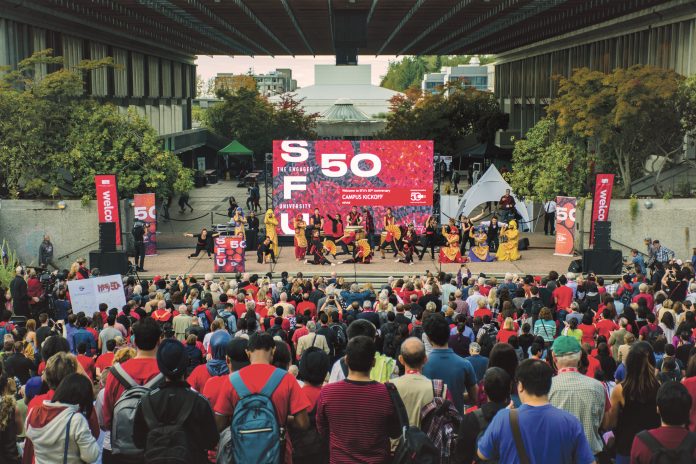
SFU’s 50th anniversary hangover

4
For a university that brands itself as "engaged," SFU's students are more estranged than ever.

[dropcap]W[/dropcap]hile walking to class on Burnaby campus, it’s hard to miss the vibrant chalk drawings adorning the pillars of Freedom Square, remnants of SFU’s extravagant birthday bash earlier this semester. “Flower power,” reads one particularly colourful entry. “Happy birthday, SFU!” read a few others.

Apart from these and a few other decorations, you would hardly know we celebrated a milestone here at all — status quo is everything at this school, and things have quickly returned to normal after the hustle and bustle of a celebratory September.

Now that the dust has settled on our 50th anniversary celebration, we can look at this university’s first half-century with a bit of much-needed hindsight. And I’ll be honest: it doesn’t look good.

For a campus that was once heralded as Berkeley North, our radical history has become little more than a sales pitch. The Convocation Mall, which was specifically designed to facilitate student protests and gatherings, sees more action these days during clubs days and organisational fundraisers. A student body that was once united in opposing governmental corruption, fighting for civil rights, and advocating for better treatment of students and staff has become apathetic and disconnected.

Today’s SFU would be unrecognisable to the radical trailblazers who gave the school its reputation, and I can’t help but think that many of the charter students invited to SFU’s Celebrate and Savour garden party were disappointed in its frivolous display of affluence.

Our radical history has become little more than a sales pitch.

This semester alone has shown just how separated SFU students are from the issues that affect them. The TSSU strike, a product of poisonous university policies that consistently devalue the people working to educate us, resulted in an avalanche of misplaced anger over TAs and sessionals withholding student grades. Skyrocketing international student fees and tuition hikes barely managed to elicit a yawn from all but the most keenly involved students. And the Build SFU project, one of the only issues capable of inspiring students to action, only attracted about 300 voters to the SFSS AGM this year — about one per cent of the student body.

These are issues that students would have fought tooth and nail 50 years ago. Today, most students are barely aware that these problems exist.

But it’s not just the students at fault here. Having celebrated a milestone that would have been unimaginable to the architects and planners building the “instant university” in 1965, SFU’s administration has consistently proven that they’re uninterested in fixing or even addressing the problems that plague our institution.

Our course registration system is broken. Student satisfaction placed 12th out of 15 comprehensive schools in the Maclean’s rankings this year, despite our first-place academic finish. The Kinder Morgan pipeline — which, contrary to popular belief, didn’t just disappear — still threatens the environment and safety of Burnaby Mountain, and our president is unwilling to take a stance towards it. Residents of the Louis Riel House still struggle to find permanent housing after mould concerns prompted the residence’s closure. Our school for contemporary arts is funded by a gold mining company infamous for its disregard for public health and the environment, and the campus itself has actively contributed to the ongoing gentrification of the Downtown Eastside.

And the list goes on.

Ultimately, the Simon Fraser University that you attend today is a far cry from the dreams of our radical progenitors. Our school was envisioned as an alternative to the corporatism and bureaucracy of larger, more historical institutions like UBC, yet we’ve spent the past half century inching closer and closer to that model in hopes of competing for students and funding. What was once the choice for students hoping to receive a different sort of education has become yet another cookie-cutter neoliberal assembly line, churning out devalued degrees to indifferent students and calling it “engagement.”

So why didn’t we hear more of these objections in September, when SFU was emblazoned in red and grey and celebrated as the best thing since sliced bread? I admit that even I joined in on the fun, partaking of sponsored hors d’oeuvres and Instagramming flashy light shows. It’s easy to get caught up in the spirit of celebration and difficult to cast a critical eye — but that work is valuable, especially when so few seem willing to do it.

Ultimately, SFU is a business, its students are its customers, and they will take any opportunity that they can to sell the school to you and to others.

Prickly topics like labour relations and divestment don’t make for effective advertising campaigns, and it’s easier to point towards some nebulous idea of radicalism than to actually live up to that legacy. Once we’re ready to admit that SFU is no longer the radical campus it once was, we can begin tackling the problems that we all face as students and as part of the system.

This isn’t a call to arms. I’m not asking you to sign a petition or volunteer for the SFPIRG or picket Kinder Morgan. What I am asking is for you to pay attention to what happens on your campus and on your dime. Even if you’re only here to get a degree, these issues affect you: namely, in how much you pay for your education, and the quality of the education you receive.

Left unchecked, the administration will continue to bleed you dry. They will keep paying their TAs and sessionals a wage well under the poverty line while refusing to hire new faculty, they will allow big corporations to thread oil pipes through the mountain on which your campus sits, they will deny you access to resources and refuse to fund the services upon which you rely, and most of all, they will revel in the fact that only one out of every thousand students is willing to stand up to them.

If anything, the 50th anniversary of our campus is not an opportunity to celebrate the university. It’s an opportunity to celebrate the students, and to empower us to fight for what we deserve.

Laugh Track: An interview with Jacob Samuel

0
Illustration by Janis McMath

When it comes to comedy in Vancouver, Jacob Samuel is the epitome of a multitasker. In addition to producing the monthly WHY? Stand-up and performing his own stand-up, Samuel also regularly publishes original comics on the website The Daily Snooze. (He also contributed comics to your favourite SFU newspaper, The Peak, back in 2012.) Read on to learn more about how The Simpsons plays into Samuel’s comedic origins, his proudest moments in comedy, and reflecting on being a terrible young person with his new show Teenage Dirtbag.

When did your relationship with comedy first begin?

I think it started because I watched The Simpsons, like three to four times a day every day after school. It’s a certain brand of comedy that really turns you onto other types of comedy. I was actually never that into stand-up growing up; I wanted to be a writer, and my ideal job was to be a writer on The Simpsons. [. . .] When I was growing up I mumbled a lot, and I wasn’t really a performer, so that’s why I got into cartooning — to become a joke writer in any way possible. And then I sort of realized there was no way to meet anyone or network. You had to perform, otherwise no one takes you seriously; you’re just typing at home.

When I started doing stand-up, because it was never a dream of mine, I figured I had nothing to lose with it. I was expecting to kind of fail and not be good at it, so that made it easier, emotionally. But it was the right way to go about it.

How did you get into drawing comics?

I did my undergrad at McGill and there’s a humour magazine there called the Red Herring and I enjoyed reading it, so I thought I’d contribute. I showed up late to a meeting and everyone was introducing themselves and I tried to make a joke and no one laughed, so I left and never went back. I was so afraid of rejection from strangers. I had a few cartoon ideas I was trying to get someone else to draw, but they weren’t getting around to it, so I just did it. Even though I was really, really bad at drawing, I enjoyed the process a lot. So I’d post them on my blog and my friends would see it and people would be very nice and complimentary, so I started to think maybe I can be funny.

Our family friend is the cartoonist for the National Post, so I met with him and said I was interested in it, and he said “It doesn’t really matter how good your drawings are, as long as you’re getting your idea across and being funny. Being funny is more important than drawing.” So it was pretty encouraging.

What’s the proudest moment that’s come from comedy, either from stand-up or cartoons?

For cartoons, probably the second time I sold one to The New Yorker. Because the first one, I thought it might just be a fluke, so I wanted to get at least more than one. So the second time meant a lot. With the first one, there was so much doubt. I thought, “Really? They picked THAT one?” and I thought they made a mistake. Between the first and second one I got a lot rejected, which is really tough.

With stand-up, I don’t know if there’s a single moment. What’s gratifying is looking back and seeing what I’ve gotten better at since I started. Even before you go on stage, thinking about how much more comfortable you are now. Honestly, the most gratifying thing about stand-up is my parents have heard my material and aren’t ashamed of me.

What do you remember about The Peak from when you contributed years ago?

I was actually pretty raw as a cartoonist. I showed my stuff to the editor and he thought they were great. I would just send in cartoons, and it felt really good because that was one of the first places where I got them published. I didn’t really have much contact with people in The Peak, but it was one of those steps along the way to, “I can do this.” It was a big deal for me at the time.

What can people expect from the new show you’re going to be producing at Hot Art Wet City?

The show’s called Teenage Dirtbag, and you can expect different performers — stand-up, improv, sketch — telling stories and jokes about their most painful memories of growing up. It’s about exploring the idea of why teenagers are shitty, and your relationship with your past self. I like the idea of reflecting on your growth as a person. I meet people as adults and I always wonder what they were like as a teenager, or what they would’ve been like in high school.

Do you have any advice for someone looking to get involved with the Vancouver comedy scene?

Try out different forms of comedy. Just because you’re not right for one doesn’t mean you can’t thrive in another. You might be someone who’s not good at performing, but you’re really good at producing shows. [. . .] Maybe you’re good at stand-up, or sketch, or a podcast. A lot of people give up when they’re bad at one thing, but there are a lot of different things you can do to be part of the comedy community.

Check out Jacob Samuel’s co-produced show WHY? Stand-up December 2 at Tangent Cafe, and mark January 16 on your calendar for the debut of his new show, Teenage Dirtbag.

Dont kiss this bug!

0
Kissing bugs transmit Chagas by biting people’s faces and defecating into the wound. - Illustration by Christina Kruger-Woodrow

[dropcap]S[/dropcap]FU researchers have teamed up with scientists around the world to deliver a report on the disease-carrying ‘kissing bug.’

More formally known as the Rhodnius prolixus, kissing bugs feed on the blood of mammals, birds, and reptiles.

They transmit Chagas disease when they simultaneously ‘kiss,’ a much more romantic way to say bite, a person’s face and defecate. Transmission occurs when the feces gets rubbed into the bite wound or another entrance to the body, such as an eye or mouth.

The group of researchers is made up of scientists from Guatemala, Colombia, Brazil, Argentina, Mexico, the United States. Their goal is to further the development of insect control methods in order to reduce the impact that Chagas disease has on certain impoverished areas of Latin America. Their report contains new information on the insect’s evolution and biology.

Chagas disease, discovered in 1909 by Carlos Chagas, affects roughly 7–10 million people worldwide, according to the Centers for Disease Control and Prevention. While only affecting approximately 300,000 people in the United States and around 5,000 to 10,000 in Canada, most of whom are immigrants from Latin America, an overwhelming majority of those diagnosed are currently living throughout Mexico, as well as Central and South America.

The leading cause of cardiac disease in Latin America, the disease disproportionately affects those living in poverty. This is because the kissing bugs that transmit the disease are often found residing in the cracks and holes of substandard housing.

Transmission can occur from contaminated blood transfusions, infected organ transplants, from mother to child, and most rarely, contaminated food or drink; however, the most common method of transmission is from kissing bugs, of which there are over 100 species.

SFU Biology Professor Carl Lowenberger, one of the authors of the report, explained that “understanding the molecular biology can allow researchers to more easily identify kissing bug-specific genes or processes that can serve as targets for new transmission reducing drugs or insecticides.”

App that tracks the homeless is simply dehumanizing

1

[dropcap]W[/dropcap]hoever first claimed that all publicity is good publicity had either lived a very charmed life until that point or invested in a very large bottle of vodka that night. Depending on the circumstances, naively placing someone under an unsolicited spotlight can be downright cruel, no matter your intentions. Right now, nobody knows that better than the homeless population of New York City.

Recently, residents of the metropolis have taken to social media in an attempt to address the prominent issue of homelessness in their city, where over 57,700 people live in shelters, and many more have nowhere but the cold streets to call their own. Their goal is allegedly to draw the city’s attention to the problem of homelessness and push them to address it.

For instance, Facebook group Third & 33rd was created as a space where people could “share photos of disturbing things they see [in the streets] and push collectively for change,” according to group admin Lauren Pohl. Meanwhile, smartphone application Map the Homeless, developed by Murray Hill resident David Fox, allows users to upload photos of homeless people to identify which areas have the densest homeless populations. Photos can be submitted with accompanying hashtags like #NeedsMedicalAid or #PassedOut, to alert people to the plights of the subjects.

Fortunately, the majority of New York’s participating citizens appear to be morally sound in their motives — helping both the disadvantaged and the city. Unfortunately, the relative privilege of your average New York citizen has blinded them to the idea that they may not, in fact, know how best to handle this issue.

These photos paint people in a humiliating light, framing them as a problem to be solved.

None of these “activists” appear to have actually consulted members of the homeless popular on what kinds of aid they would benefit them most. Rather, they’ve decided for themselves what the ideal action plan would be. Never mind that the vast majority have neither experience with homelessness nor any other notable qualifications for taking charge of this situation.

It’s a very condescending way to offer assistance. They may be trying to help, but ultimately they’re treating homeless populations not as equals in need of aid but as children who don’t know what they’re doing and who aren’t in a position to understand these people’s  needs.

Frankly, being showcased on the Internet in this manner might be the very last thing the homeless in New York need right now. These photos paint them in a humiliating light, framing them as a problem to be solved rather than as disadvantaged individuals who deserve better.

When selecting hashtags, how often do you suppose the average user of Map the Homeless asks for a person’s name? Their story? What they want, what they need? How often do you think people so much as stop to ask for permission to post that photo they just took?

Probably not often, if at all. That’s really dehumanizing.

New York City cannot magically end homelessness and poverty overnight, no matter how much its citizens complain about it. Raising awareness sounds nice, but at the end of the day, if the city had a method to alleviate the issue, they would have to be truly monstrous not to have implemented it by now.

If people really want to help the homeless, perhaps they should take action themselves rather than complain to others on social media. One thing that any disadvantaged person can agree on is the value of a meal, or clean water, or shelter. There are volunteer and charity opportunities, and so many other ways to provide aid; methods that don’t compromise people’s privacy, and allow them to retain their dignity.

SFU White Student Union is an opportunity for dialogue, not anger

0

[dropcap]O[/dropcap]n Tuesday November 24, a group called the SFU White Student Union surfaced on Facebook, bringing the issue of white privilege and ignorance to the forefront of discussion on campus. Unsurprising in the least, student responses to the page have been heated and volatile since the page’s activation, with many immediately calling for its removal.

While the cries for the group’s banishment are justified, a majority of students are squandering an opportunity to open the gates of meaningful discussion on the grounds that they’d rather throw a fit on social media than talk productively with the other party.

Am I fan of a white student union? Not in the least. But, others tend to think otherwise, and the very least we could do is hear what they have to say about it. Whether they’re right or wrong is honestly unsubstantial — what is important is that we have the discussion in the first place. Respectfully listening to each party’s thoughts on the matter and engaging in worthwhile discussion could lead to both parties considering alternative perspectives in a critical manner.

Instead, however, we have grown adults throwing tantrums on message boards. This is frankly as embarrassing as it is disheartening, given our status as university students. As the leaders of tomorrow, we should be held to a higher standard of practice. We should facilitate meaningful debate as opposed to an abrasive assault on the part of students with ignorant tendencies. After all, we came to university to learn and to become better people, not to tar and feather those in need of a reality check.

Sarcastic online comments are comparable to a one-page cheat-sheet in a first year Earth Science course.

The fact of the matter is that people like being called racist just as much as they like being called stupid. It shouldn’t be a surprise to anyone why someone would be less inclined to gravitate towards discussion when they’ve just been compared to Hitler.

At the end of the day, a cheeky meme or angry criticism on a message board is about as unproductive as the creation of a white student union. Sarcastic comments on social media are comparable to a one-page cheat sheet in a first-year Earth Science course. If you think it’s going to be helpful, you’re sadly, sadly mistaken.

Part of the problem lies in how students present their arguments towards those in favour of something like such a union. Too often, educated individuals choose to impart knowledgeable insights to those with deficit with the tactful exuberance of Shylock collecting debts with a Louisville slugger. If people actually took the time to talk candidly and, dare I say, with some compassion, we might see some worthwhile results for a change.

Now, it’s worth taking into account that, recently, CBC and other news outlets report the rise of similar “White Student Union” Facebook pages in response to recent posts made by white supremacists on the Internet. This still doesn’t make it any less of an important topic to discuss. As we speak, White Student Union Facebook groups are sprouting up across the US as well as in Canada. This is reason alone to push away from our keyboards and begin to do something a touch more productive than posting a meme of Gene Wilder smirking.

Geekenders present “nerdlesque” Jurassic Parody

0

Dinosaurs roamed the earth 65.5 million years ago. For those of us who were not alive back then, Jurassic Parody brings these amazing creatures back to life. Through some DNA splicing, this jukebox musical filled up the York Theatre from November 17–21. Brought to us by the “nerdlesque” group Geekenders, the show was a true parody, full of clowning and caricature.

The costumes were absolutely gorgeous. The sparkly green dinosaurs stood out on the stage, with brilliantly clever headpieces to denote the types of dinosaurs represented. The rest of the cast was bedecked in acutely accurate costumes to their film counterparts, helping the audience identify all the iconic characters.

Brilliant acting choices studded the performance, especially in portrayals of the main characters. Standouts on this front were Stephan Blakley (Dr. Alan Grant), Rob Gillespie (John Hammond), Ryan Caron (Tim Murphy), and Graeme Thompson (Dr. Ian Malcolm). An especially hilarious and excellently delivered Old Spice commercial-inspired monologue from Thompson was one of the highlights of the show.

There were some great moments from the chorus of dinosaurs. Numbers such as “Toxic Love” and “Eating All the Kids” both boasted clever choreography and great vocals. The physicality of the sickly triceratops was exceedingly excellent, as was every number Alison Jenkins (Tyrannosaurus Rex) performed. Jenkins’ voice and stage presence, as well as the vocal talents from Caitlin Carhoun (Lex Murphy) and Jesse Alvarez (Mr. DNA, Dr. Wu, Dodgson, park guide), were high point of the show, as was her incredible stage presence.

The all-ages friendly performance also had great lighting design, with an effective use of gels and gobos (colours and shapes) to set each scene. The electric fence used throughout the performance was a genius idea cleverly implemented.

Unfortunately, some mic issues marred the show, as well as a few memorization stumbles. Additionally, the performance of “Putting It Together,” as well as some larger group numbers, were regrettably confused and off-key. Yet, despite these issues, the performance overall was enjoyable and entertaining.

But why Jurassic Park? Fairlith Harvey, writer of the musical and artistic director of Geekenders, says that “people who see that film love that film.” Stephen Blakley added, “I don’t think any movie I’ve ever seen captures that feeling of wonderment” in the same way as Jurassic Park.

Known for performing original pieces often based on iconic works, Ryan Caron said that the Geekenders love “telling stories in different ways.” The balance that must be maintained, says Harvey, is “making the performance accessible while still giving it layers.”

Jurassic Parody was certainly a spirited performance, full of stellar moments and memorable numbers. It was a hilarious romp into the land of the dinosaurs, and one I would gladly watch again.

The five best albums of 2015

0

Adele – 25

Released November 20

Step one: pile your car up with your closest of friends and several blankets. Step two: drive in silence to a beautiful, scenic park — one in which you can star-gaze (perhaps up on top of the mountain). Step three: plug Adele’s latest album into your CD player. Step four: hit play, crank the sound up real loud, and lay on the your blanket while staring at the sky. Oh, and don’t worry about getting cold — your tears will warm you right up. You will feel things that never seemed real. Adele’s 25 presents an out-of-body experience, one that will you will never forget.

WEB-Big Grams-Epic Records

Big Grams – Big Grams (EP)

Released September 25

When a rapper and an electronic rocker announce an EP together, it’s hard to predict just how well they will pair. It could either turn out like Triple O’s questionable peanut butter and jalapeno burger, or it could become a 21st century classic like Netflix and chill. Just like the latter, Phantogram and Big Boi’s debut EP killed it. In my eyes, their album is not merely one of the best of 2015, but of all time. Each of the seven tracks belonging to this black and gold album is crafted meticulously to get you to feel things. Personally, I feel like jamming out. You can’t not — I dare you.

WEB-Kendrick Lamar-Top Dawg Entertainment and Aftermath Entertainment, Interscope Records

Kendrick Lamar – To Pimp a Butterfly

Released March 15

In 2008, he blew us away with Section.80. In 2012, it was Good Kid, M.A.A.D City, and this year, it was To Pimp A Butterfly. Beginning with the early release of his track “i,” audiences worldwide could already tell that Kendrick Lamar had something incredible in store, and boy, did he ever. Aside from winning a whole bunch of Grammys over the past several years, there’s something about Kendrick that most of other rappers lack. To Pimp A Butterfly remains a unique, creative, and passionate experience. My favourite tracks on the album are “Alright,” “King Kunta,” and “Wesley’s Theory.”

WEB-Lianne-La-Havas-Warner Bros Records

Lianne La Havas – Blood

Released July 31

Singer/songwriter Lianne Charlotte Barnes is a British-born star. Her very first album won her iTunes’ album of the year back in 2012. Her second album, Blood, is just as good, if not better. Havas’ vocals are authentic, like Adele’s but in a different genre. She is more a combination of soul, folk, and R&B, and her voice is so, so beautiful. I recommend this album when you’re feeling good, or even not so good. I recommend it when you’re driving, when you’re crying, when you’re showering — this album is so distinct in its genre and yet fits every occasion perfectly.

WEB-ZHU – Genesis Series-Columbia Records

ZHU – Genesis Series (EP)

Released November 6

I think I’m slowly discovering that I am no longer a concert person. But, when it comes to ZHU, I would hop on a boat, a plane, a train — anything, really — to see him perform. ZHU doesn’t just give you EDM served on a platter. With him, you’re in for a 10-course meal, ranging from reggae to jazz. On this latest EP, one which he deviously released a track at a time over several weeks, he produces sounds so smoothly and uniquely you’ll find each one of his six songs at the top of your Most Played playlist. Fun fact: every single song on the EP is a single. If that doesn’t make you realize that this is easily one of the best EPs of all time, I’m not sure what will.


Shout-outs

These albums were pretty great, but didn’t make the final cut.

The Weeknd’s Beauty Behind The Madness, Snoop Dogg’s Bush, Major Lazer’s Peace is the Mission, Tame Impala’s Currents, Ratatat’s Magnifique, Bryson Tiller’s T R A P S O U L, A$AP Rocky’s At.Long.Last.A$AP, Mick Jenkins’ Wave[s], Nate Ruess’ Grand Romantic, and Justin Bieber’s Purpose.

Comic Connoisseur: Hobo Mom will leave you heartbroken and wanting more

0

At a slim 66 pages, Hobo Mom can seem a little underwhelming as a graphic novel, given that most mainstream comics are about twice the size. However, as the old adage goes, one should never judge a book by its cover — or, in this case, its thickness. Sure, it’s cliche, but that is beside the point. In a fraction of the pages of a typical graphic novel, this story packs an unquestionable emotional wallop leaving its readers with one contextually complex story of heartache. 

Hobo Mom follows the story of Natasha, a homeless mother who returns home to her estranged family. After many years apart, the wayward matriarch seeks to mend the past with her embittered husband and rekindle a relationship with her daughter, Sissy. Disguised as a friend of the family, Natasha begins to fashion a strong bond with her young child, much to the displeasure of her spouse, who still harbours a chip on his shoulder. However, as the family begins to come together as it once was, Natasha cannot help but feel drawn to escape the life she has just returned to.

The strength of the narrative rests not on what is provided in the story, but on what is missing from it. While a lack of exposition can in many situations contribute to confusion on the part of the audience, it works to the strength of Hobo Mom, enriching the overall experience for its readers. Part of what enlivens the tale is coming up with your own theories and ideas surrounding the origins and motives of each of the story’s characters.

Another one of its strengths lies in its three main characters, all of whom help make the reading experience both balanced and captivating. We can enjoy different levels of perspicacity as they focus on each character’s story arc coming full circle. Interactions between the story’s leads are poignant and tender, serving as a strong reason for the comic’s success.

Most engrossing of all, Hobo Mom explores the implication surrounding the right for all of us to be happy, and how this concept is inherently problematic. Through its pages, we can see firsthand the proof that happiness comes at great personal sacrifice — a price not as easily paid as some would have you believe.


It’s short and bittersweet; Charles Forsman and Max de Radigues have put together an engrossing and emotionally draining masterstroke of fiction. Chalk full of near-infinite depth and complexity, Hobo Mom might look like a graphic novel to pass up, when in actuality it is worthy of remembrance well after its final page.