Home Blog Page 901

Women’s basketball lose hard-fought game battle to Central Washington

0
Ellen Kent (#5) drives to the basket in Women’s Basketball action

The Simon Fraser University Women’s Basketball team suffered a 6450 defeat to the Central Washington Wildcats this Thursday. The loss drops the Clan to 46 on the season overall with a 2-3 GNAC conference record.

Early in the first quarter the Wildcats jumped out to a 1911 edge on the strength of three consecutive three-point baskets. In the final minute, point guard Ellen Kent drained a three-pointer, and forward Samantha Beauchamp converted one of two free throws to cut the Wildcat lead to 2317. The Second Quarter saw the Clan execute a nifty fast break where Kent hit forward Rachel Fradgley in stride for the layup. The SFU offence then bogged down, committing three consecutive turnovers prompting a timeout by Head Coach Bruce Langford. Shooting Guard Elisa Homer knocked down a three-pointer to trim the Wildcat lead to five. The Wildcats then scored the last four points of the quarter to hit the locker room up 39–30 at halftime.

The third quarter saw the Clan play their best defensive basketball of the game, limiting the Wildcats to just nine points. With 4:26 left in the quarter Elisa Homer knocked down another three to make the score 4342. The one-point Central Washington advantage was the closest the Clan would get to taking the lead in the second half.

Other highlights in the quarter were a nifty turnaround jumper in the post by Rachel Fradgley and a smooth runner by Elisa Homer. Central Washington converted a last second jumper to make the score 48–44 for the Wildcats entering the decisive fourth quarter.

In the fourth, SFU was outscored 166 despite their determined play. The lack of depth with just eight players on the roster may have been a factor in the poor shooting percentage the team incurred in the last quarter. Reflective of this was the 39 minutes Ellen Kent played in the game.  The Clan play a switching style of defence and Kent often found herself matched up with the Wildcat forwards battling for rebounds in the low post. The scrappy floor general hit the court several times in the fourth quarter fighting through screens and competing hard on the defensive end despite getting into early foul trouble.
After the game Kent reflected on the team’s roster size, stating: “I wouldn’t say it is affecting us. [Rather] it is giving a lot of people opportunities.” The difficulty she explained was in practice, where the coaches have had to “bring in other people just to do five on five” team drills. Kent also noted how lack of experience by the young team was a possible factor in the fourth quarter. “We’re a young team, and experience helps in that kind of situation.”

WEB EXCLUSIVE: Canucks Corner with Jason Romisher — Canucks treading carefully in local player Jake Virtanen’s development

0
Virtanen had a very poor tournament, finishing with only one assist

Canucks Corner with Jason Romisher is a brand new web-exclusive column, featuring Jason Romisher’s views on what’s happening with the Vancouver Canucks. Check back every Thursday for new content!

____________________________

[dropcap]J[/dropcap]ake Virtanen was born in New Westminister, moved to Langley briefly and then to Abbotsford where he starred on local rep hockey teams. At the age of 15, he was selected first overall by the Calgary Hitmen in the 2011 WHL Bantam Draft. Virtanen’s skill and physical play saw him repeatedly selected for international play as part of Team Canada. He also demonstrated the attributes prized at the professional level and shot up the NHL draft rankings.

“What could have unfolded as a dream come true narrative of a native son returning to his ancestral homeland instead was nothing more than a failed opportunity.”

In 2014, the Canucks selected Jake Virtanen sixth overall in the NHL Draft. It is rare that a team spends such a high draft pick on a local product. That year, he continued to play for the Calgary Hitmen and was a productive player on last year’s Gold Medal winning Canadian squad at the World Junior Championships. This year, Virtanen cracked the Canucks lineup, at the tender age of 19.

To boost his confidence and give him some more big game experience, the Canucks elected to release him for competition in this year’s World Junior Tournament. Unfortunately, Virtanen struggled posting just one point in four games and taking two penalties which led to the game winning goal in Canada’s 65 defeat in the quarterfinals against Finland. Virtanen’s father was born in Finland and the tournament took place in Helsinki. As such, what could have unfolded as a dream-come-true narrative of a native son returning to his ancestral homeland instead was nothing more than a failed opportunity by a young player struggling to develop.

The Canucks are now at a quandary concerning Virtanen’s immediate future with the franchise. He has struggled in the NHL posting just one goal and three assists in 19 games while averaging 9:49 of ice time. The team can elect to send him back to Calgary where he would get more ice time and play a more prominent role.

However, if he were to remain with the team he would continue to gain valuable tutelage from veteran players such as the Sedin twins. There is also an economic factor to Virtanen’s status with the team. If he should play in 40 or more games, he will enter free agency one year early. For now, the Canucks have elected to keep him with the team. The team will need to tread carefully, though, to ensure the local product blossoms into the front line force he is projected to be.    

Hollywood North Burnaby

0

[dropcap]I[/dropcap]t’s been a top secret government laboratory, an evil corporation, NASA, the headquarters of the CIA and the FBI, a military academy, a military academy in space, the planet Caprica and a portal from a Stargate to another universe.

It’s where Keanu Reeves was interrogated about an Alien invasion, where Ryan Phillippe cracked a worldwide computer conspiracy, and where a hockey-playing chimpanzee once mopped floors on rollerskates. It’s been dressed up, dressed down, and exploded into a million pieces.

While you may know SFU’s Burnaby campus simply as a place you take classes, it also leads a secret double life — it’s a bonafide movie star.

From its first starring role in the early 70s to its boom in the 2000s, the film industry has a deep love for Arthur Erickson’s famed brutalist tribute to Greek architecture.

But that love is not always requited.

Since the first film crew travelled up Burnaby Mountain more than 40 years ago, there has been a certain amount of tension between the university as a learning institution and as a filming location. Once very accommodating to filming, SFU has become increasingly reluctant to dedicate energy into being a location site for feature films and TV shows.

Neither the local film community nor the university have any resentment towards one another, however there is obvious frustration on both sides.

While SFU will probably always be Vancouver’s go-to ‘vaguely evil looking location’, its long and complex history with filming make it difficult to predict whether it will continue to be a major player in the film location game – or if it even wants to be.

bravenewworlds

[dropcap]W[/dropcap]hen SFU opened in 1965, it didn’t just give British Columbia a new post-secondary education option — it gave the world a new architectural masterpiece to marvel at.

Inspired by the Acropolis in Athens, architects Arthur Erickson and Geoffrey Massey gifted Vancouver with a look that did not previously exist anywhere nearby. It was big, futuristic and powerful. The public instantly fell in love with it, and so did the camera.

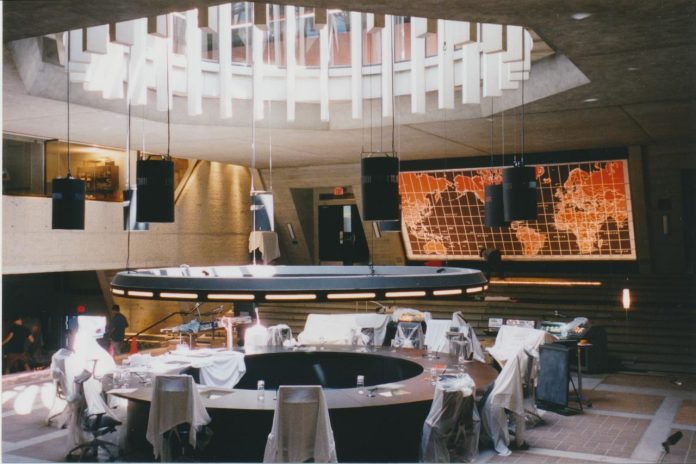
The first people to set movies on top of the hill were undoubtedly the early ‘students’ at the SFU Film Workshop, a part of SFU’s Centre for Communications and Arts — a non-credit fine arts program which existed in SFU’s early days — but it was Hollywood that gave SFU its first big break in the early 1970s.

Although the first movie to make a deal with SFU was an adaptation of Aldous Huxley’s Brave New World, which had an agreement in principle to shoot in 1971, the deal fell through and a less acclaimed sci-fi film entitled The Groundstar Conspiracy took its place.

Nini Baird, the director of the Centre for Communications and Arts, who was responsible for the production coming to campus, remembered not having any procedures in place for filming at the time.

“There weren’t any guidelines, we were making it up as we went along,” Baird explained about her involvement in the movie. “They filmed 24/7 . . . for three weeks.”

Groundstar’s production designer, Cameron Porteous, remembers SFU as being an “absolutely perfect” location for the movie and they took full advantage of a large portion of the campus.

“We did quite a bit at SFU. The university was designed to be some sort of great centre for investigation, similar to the CIA,” Porteous recalled.

According to Porteous, there were no problems with filming on campus and as they shot during the summer, there was little disruption to students and almost no fanfare. There was one visitor who did capture his attention however.

“I remember one day Arthur Erickson came to the university and I was introduced to him and I sort of was embarrassed a bit because I had, in a sense, doctored up his architectural dream,” Porteous recalled saying he had just built an observation centre on top of the mall roof for the movie. He needn’t have worried though because “[Erikson] said, ‘No, no … the whole idea behind architectural structures is they must adapt to the needs of the people and it’s adapting beautifully to your needs and that’s all that matters.’”

Groundstar1

On May 11, 1972, The Groundstar Conspiracy held its world premiere at the Vogue Theatre with proceeds going to fund an SFU student aid bursary. Although, in their coverage of the event The Peak gave the film the less than flattering review of a “two-star television movie,” SFU’s film location experiment was an overall success and SFU was now open for “film” business. It would take a while to heat up though.

[dropcap]W[/dropcap]hile there certainly was some student filming done at SFU in the years following 1972, there wasn’t another major Hollywood production on campus until the late 1980s.

On December 17, 1985, SFU instituted a policy for ‘Visiting Film Companies’ that states that “in support of B.C.’s film industry, [SFU] is prepared to permit the use of its facilities by film companies for productions which do not detract from the image of the University.” Aside from a revision in 1993, this policy remains intact to this day, along with the “charge of $2,500 per day for each day the film company is on campus.”

While the policy also suggests that “the Vice-President, Finance & Administration is responsible for protecting the interests of the University, negotiating agreements, and making appropriate arrangements,” this responsibility was delegated to the Facilities Service department, which the VP oversees.

Although the reason for instituting this policy at that exact time is unclear, it seems to be due to both a sudden massive rise in filming in Vancouver in the mid-eighties and potentially the aftermath of some sort of unfortunate filming event at SFU.

While the specifics aren’t clear, in a 2015 interview with The Peak, SFU Facilities Services Supervisor of Client Services, John Briggs – the man who deals with all filming on campus today – mentioned that a reason SFU has the policy in place, is that there “have been pornography movies made [at SFU . . . that] weren’t intended to be, as far as we knew.”

Location manager, Ann Goobie, confirmed this story, as a legend at least, telling The Tartan that “some of [SFU’s paranoia] about being seen in the wrong light is based on some movie from the 70s that filmed up there. They thought it was Buck Rogers or something, and it was some porno film,” though she clarifies that she didn’t know the specific truth behind the incident.

Either way, in 1988, the film The Fly II chose SFU as one of their major locations and became the first production to deal with SFU’s new official policy.

As a new responsibility for Facilities Services, the job of handling incoming film companies was given to a 25-year old building technologist in his second year with SFU named James Atamanchuk. The responsibility ended up suiting him perfectly.

“I wasn’t like anybody else in the office so they thought I was a perfect personality to throw [filming] at,” Atamanchuk explained. “It was just something that happened once and then that was it.”

The experience of shooting The Fly II in 1988 was described as quite pleasant by the film’s assistant location manager, John Penhall, who remembered how great dealing with Atamanchuk was.

“He was wonderful [and] he knew the buildings really well,” Penhall remembered. “He walked me around and showed me the stuff that was really cool about SFU.”

Penhall said that SFU, through Atamanchuk, was very accommodating to the production despite having their natural concerns about not disrupting classes or causing damage. While Penhall said that he didn’t work on a film at SFU again, he loved the experience and recommended it to many directors during his 10 year career as a location manager. He did admit, however, that it does get a bit typecast.

“SFU always plays the evil corporation. And it does have that kind of look [. . .] that’s what we were going for in The Fly II,” he explained. “[It’s always] used for films like that where it’s supposed to be an impersonal, industrial campus.”

americanboyfrends

The second movie shot at SFU however was the one movie that broke the mould and played just a normal university, a place called Simon Fraser University.

Almost 20 years after graduating, SFU Film Workshop alumna, Sandy Wilson, returned in 1988 to film scenes for a sequel to her hit movie My American Cousin  — which won six Genie Awards for excellence in Canadian film —  entitled American Boyfriends.

Wilson’s recollection is that they were only on campus for a few days and had no problem securing SFU as a location. “[We had] a lot of trouble with almost every other location,” Wilson recalled. “We did some shooting at the Waldorf, that was a nightmare. We did some shooting down in the United States and that was a triple nightmare! But the SFU part was kind of fun.”

Throughout the 90s, SFU became a fixture for filming in Vancouver,
especially for TV shows. The campus appeared in shows like Viper, Sliders, Stargate SG-1 and the X-Files, and also briefly in the TV-movie I Still Dream of Jeannie and the family comedy film MVP: Most Valuable Primate.

For the most part, SFU and visiting film crews got along quite well. Atamanchuk remembers fielding hundreds of requests throughout the 1990s, with around two or three shoots actually taking place every other month. However, at the turn of the century, one production caused SFU to rethink its role as a filming location.

[dropcap]A[/dropcap]fter a decade of almost exclusively filming television at SFU, at the end of 1999, SFU was turned into a major motion picture movie set when the Arnold Schwarzenegger movie The 6th Day requested the campus’ services for a major car chase scene.

For those working on the movie, filming at SFU was a great situation. As Paul Lougheed, an assistant location manager for the film’s first unit, who were only up at SFU for about a night, said “We were up there with Arny [and] we had a helluva good time out there.”

From SFU’s side however, it wasn’t all fantastic. The film was a much larger production than anticipated. While it was initially estimated that filming would take about 10 days on campus, the second unit ended up being at SFU for more than a month, completing set-up and stunts for what ended up being a two minute scene in the movie.

6thday_1

They also needed to make significant alterations to campus to make a car chase through the Academic Quadrangle and the mall possible. According to an SFU News article from February 10, 2000 entitled “Arny’s Army Invades Campus,” several “highly visible changes to the campus” were required. This included “the draining of the AQ pond so a new bridge could be built, the removal of several stairs leading to convocation mall so a more shallow set could be constructed, and the appearance of banks of lights and other equipment across campus,” all of which were completed by film crews over an extended period of time.

The major problems occurred during The Sixth Day’s third and final visit to campus in January 2000 when the second-unit was filming stunts. The problems were accelerated due to a CUPE strike that caused Atamanchuk to be temporarily unable to act as SFU’s liaison for filming.

“Somebody else took over […] management, and they’re not familiar with film companies. Unfortunately, it was very bad timing for everything,” Atamanchuk recalled. “It was too big for the campus and the amount of damage that had occurred to heritage architecture and stuff [was unfortunate].”

The difficulties of housing such a major film were further brought to light by an incident that occurred on January 31, 2000 covered by The Peak, in which some fumes caused by the production found their way into the library and caused an early closure after some students reporting feeling ill. Although SFU was reimbursed for everything, it caused a lot of trouble for the university.

“People got really pissed off. They went up to the VP. It actually went to the board of governors. So it was very bad,” Atamanchuk recalled. “So filming was ceased, for a short period thereafter.”

Comments made by associate VP-administration Rick Johnson indicate that the university was not happy with the general condition of cleanliness of the production and it caused serious doubts about allowing filming in the future.

sixthday

“After this particular film, we’ll be assessing whether we’ll do anything of this nature again,” Johnson was quoted as saying at the time, and explained that “most films are restricted to localized areas on campus, and don’t have the broad impact that this one has had. Filming of this scope has presented many challenges in terms of our ability to coordinate it.”

Despite the difficulties however, SFU was rewarded handsomely, receiving approximately $150,000 in site charges and recovery costs. From 1991 to 2000, the university collected nearly half a million dollars with almost half of that — $225,000 — coming from 1999-2000 alone. And while a review of their filming practices was held afterwards, it didn’t stop being a site for major films. However, in The 6th Day aftermath, SFU gained a reputation of being a difficult place to film, a feeling that permeates to this day.

[dropcap]D[/dropcap]espite the massive hassle that The 6th Day caused for administration and students alike, the affair did not cause any significant changes in SFU’s filming policies. The pleasant, agreeable situation described by location managers before the year 2000 has since been replaced by a less straightforward or compromising system.

While Atamanchuk said no major official changes were made, after 2000 there were more people involved in making filming happen. “I was more managed. There were more people watching,” he explained.

Bruce Brownstein, who worked as the location manager on both Antitrust (2001) and Agent Cody Banks (2003) — the next two major shoots on campus — described the experience of securing the SFU locations for those films as “very difficult, expensive and time-consuming compared to filming at UBC for example.”

Brownstein believed that following the problems with The 6th Day, filming at SFU began to be “always very difficult and extremely bureaucratic,” and even recalled having to go up and beg to allow Antitrust to film on campus.

“The Location License Agreement was another thing that went back and forth forever,” Brownstein explained, recalling his first experience with the university. “Once one production jumped through the myriad of hoops, it confirmed that [SFU] felt they were on the right track to protect the campus and weed out frivolous productions.”

Ann Goobie, the location manager for the 2008 film The Day the Earth Stood Still, who did extensive filming at SFU, had similar feelings about doing work at the university, and said that it is the location license agreement that is the major problem.

“It’s not the easiest place to film sometimes,” Goobie, who graduated with a degree in Communications from SFU in 1989, explained. “[There is] this clause that they have in the contract […] it gives [SFU] the right to enjoin the movie — to stop the movie from being distributed — if there is something in the movie that they feel is showing the university in a bad light.”

According to Goobie, this ‘enjoinment’ clause has caused problems for almost every production that comes up to film at SFU, and it often causes larger movies to move their filming elsewhere. “They can’t put their product in jeopardy because of one entity.”

This situation occurred most recently — to the knowledge of the public — with the Seth Rogen movie The Interview, which wanted SFU to pose as North Korea for some scenes in the summer of 2013. After a long dispute of trying to make changes to the agreement, and having SFU refuse, they begrudgingly chose not to film on campus.

In an article published in The Peak in February 2015 concerning The Interview situation, the SFU representative John Briggs claimed that it is SFU policy to not change the agreement, and that he made that very clear to Rogen’s team from the beginning. He also said that he couldn’t even remember the “minor, insignificant things” that they requested be changed.

According to Goobie, however, the problems with the location agreement are not minor, and while SFU is reluctant, they have made amendments to it before.

“I’ve gotten that changed in the past, with quite a fight going on to get it done mainly with the guys on the Burnaby Campus rather than the guys downtown,” Goobie recalled. “I had the film commission and a VP from the downtown campus help me. And, I don’t know who he called, but they basically said, ‘you make this change’ and we paid to make the amendment and we got the change.”

Goobie says that she has often received phone calls from other location managers requesting the amendment she received, and that the location manager of The Interview even suggested that their production was facing the exact same problem that hers had more than five years prior. She claims that SFU should be well aware of the problems with the agreement by now.

“The film commission has been through it. They’ve gone up there a gazillion times to sit and talk with them about this stuff,” Goobie explained. “It’s just really gotten nowhere and there’s no rhyme or reason why, quite frankly. You know it’s easily resolved with different language in a contract.”

In his interview in The Peak in February, Briggs took the complete opposite stance however, stating that very few productions had any problem with the agreement and that the occasional large production that did have a problem wanted no more than to “change the sentence or the wording of a sentence sometimes, just to suit themselves.”

While Briggs’ opinion seems reasonable, it runs into problems when you consider that what he describes as a waste of time is exactly the procedure at UBC, the school that SFU initially modeled their procedure and rates after. There is no standard contract at UBC, which allows minor changes to be made when it seems reasonable to do so.

[dropcap]T[/dropcap]he large disconnect between BC’s two biggest schools has major implications for SFU’s confrontational reputation in the film community. Many complaints from location managers aren’t necessarily focused on how SFU is difficult, but how easy UBC is to deal with in comparison.

At UBC, filming is being done constantly with an average of over 40 productions shooting on campus per year over the last seven years. While they charge the same daily rate as SFU, UBC has invested more into making it a regular activity, perhaps seeing it as a good source of revenue.

Greg Jackson, whose only experience at SFU was back in 1991 as an Assistant Location Manager for the TV movie I Still Dream of Jeannie, but who has been part of the film community for over three decades, explained that for one reason or another UBC has made it their business to be a filming location and SFU hasn’t.

“[UBC] is extremely film friendly and has a very smooth process for scouting and choosing locations,” Jackson explained, saying that unlike SFU, UBC has a dedicated person who deals only with filming. “SFU, up on the hill, for whatever their internal reasons are, they don’t look at it that way.”

According to Goobie, having that one person dedicated to filming at UBC makes it run smoother than at SFU, where a representative from Facilities Services — who has a lot of other responsibilities — is in charge. She explained that this allows UBC to read every script they get and properly protect themselves against any damage to their reputation.

“SFU is not interested in reading the script. They want you to provide just a little synopsis,” she explained. “It’s an easy thing to change in their contract that would still cover them off for inflammatory stuff, and fair enough, but anyway, it’s not a priority.”

It frustrates me because you know I’m an alumnus, but that’s their process.”

Once again however, while Atamanchuk only commented on the way things were between 1987 and 2007, he said that while UBC and SFU are both universities in BC, they share nothing else in common when it comes to being a filming location.

“We are completely different campuses, completely different everything. The Burnaby campus is quite compact overall whereas UBC is quite spread out,” Atamanchuk explained. “[At UBC] they could be filming in one corner and nobody would ever know. They’re independent buildings, they’re all separate. SFU’s quite connected.”

[dropcap]D[/dropcap]espite the complaints from location managers about some of the difficulties they’ve had with SFU, they all admit there are still some positive aspects about shooting at SFU and do appreciate what the university has been able to do for them, to an extent.

“It all worked [and] once we got in there for The Day the Earth Stood Still it was really quite good,” Ann Goobie said, explaining that she just wished the process could be a bit smoother.

David Brisbin, who worked as the production designer for The Day the Earth Stood Still, was especially appreciative to have gotten the chance to showcase SFU.

“I’m incredibly grateful when people who have [interesting spaces and extraordinary architecture] are willing to try and bend and twist a little to allow those of us who make films to make use of it, because it’s a way of allowing that architecture to resonate through media culture,” he explained, mentioning that he had also met Arthur Erickson before he passed away and was honoured to show SFU to the world. “I think it’s great for his good work to be propagated a little bit further, even beyond what’s propagated among the students who use it.”

Although SFU’s relationship with filming is definitely not simple, despite the tension on both sides, ‘SFU: the film location’ is by no means dead. Just last year, the TV series iZombie filmed in the hallway of Saywell Hall, and the Surrey and Downtown campuses have begun to accommodate a number of productions every year, with location managers seemingly universally positive about their experiences there.

Already this year, according to Facilities Services, as of November, the university has received $4,103 for filming in 2015-16 and in the last two years pulled in $11,738 and $30,972 respectively. While it is not the whopping $220,000 they got in 1999-2000, or the $327,036 they earned in 2010-11 when Underworld Awakening was filmed, it does meet the $20,000 average they were earning for the nine years prior to that.

The situation could be better, however. According to Facility Services statistics, although SFU does not keep a log of how many requests for filming they receive per year, they estimate about 20 to 25 per year and accommodate one or two. With a set fee of $2,500 a day, a deposit of $5,000, and a number of other charges, SFU could be making plenty more for their general revenue if they accepted more offers and had the frequency of filming that UBC does, which allows on average 50 productions to film each year.

At the very least, a dedicated SFU filming person or department could make filming revenue consistent instead of changing drastically from year to year, as was the case between 2010-11 and 2011-12 where filming revenues went from over $300K to a total of $424 respectively.

While SFU, rightly, puts education first and sees their role as a film location as a favour to the film industry more than anything, having a single dedicated person in charge of filming at SFU and a little more flexibility to amend their Location Licence Agreement could go a long way in repairing their relationship with location managers and film studios, and earn some money for the school.

Hollywood may always cast SFU as the villain — the ominous, scary building on a hill — but it doesn’t need to be that way off camera too.


Oh, Maggie

0

By: Tessa Perkins Deneault

“I think of her often still,” says local author Helen Potrebenko as she thumbs through her 1998 book, Letters to Maggie, an ode to her dear friend, sitting in the cafeteria of the building named after her friend — the Maggie Benston Centre. She describes the book, which was published seven years after Benston’s death, as a collection of stories that Maggie would have enjoyed.

“I still talk to her sometimes; tell her things she would have liked to hear.”

[dropcap]M[/dropcap]argaret Lowe Benston was born in 1937 along with her identical twin sister Marian Lowe in a small town south of Seattle.

With a PhD in theoretical chemistry from the University of Washington she was hired in 1966 to teach chemistry at SFU. She gradually shifted to teaching both chemistry and computing science, and in 1975 she helped to found the Department of Women’s Studies.

Along with fellow professor Andrea Lebowitz, Benston presented her plan to the SFU senate who were skeptical of a program in women’s studies. One even said that allowing women to have a women’s studies program was “tantamount to allowing prisoners to create a prison education program,” wrote Diane Luckow in a 2006 issue of SFU News.

Luckily, Pauline Jewett, SFU’s recently appointed president, was on their side and the vote passed. In January 1976, the first women’s studies course ran with 40 students. Now the department offers a number of programs including a masters and PhD. In 2009, the senate approved a name change to the Department of Gender, Sexuality, and Women’s Studies.

After founding the department, Benston’s academic appointment evolved to be a joint appointment in both women’s studies and computing science.

“Maggie loved to say that she was then in two fields for which she had no credentials,” remembered Marian Lowe on the phone from Seattle.

Benston’s influential and pioneering research was at the intersection of how technology affected women and work. She spent almost 24 years as an assistant professor at SFU, and was promoted to associate professor shortly before her death in 1991.

Lowe shared a similar academic path as her sister and was for many years a member of the Chemistry Department and of the Women’s Studies faculty at Boston University. Despite the distance between them, the twins remained close and took advantage of sabbaticals to visit each other.

“I miss her all the time,” said Marian Lowe. “People used to ask us ‘what’s it like to be a twin?,’ but you know your own reality, and that was ours. For the past twenty-odd years I’ve felt like part of me is missing.”

[dropcap]P[/dropcap]otrebenko, who remembers Maggie as an activist, scholar, feminist, teacher, and most importantly as a close friend, met Benston somewhat accidentally.

Potrebenko was a mature student taking a course at SFU in the late ’60s which was taught by Benston’s partner.

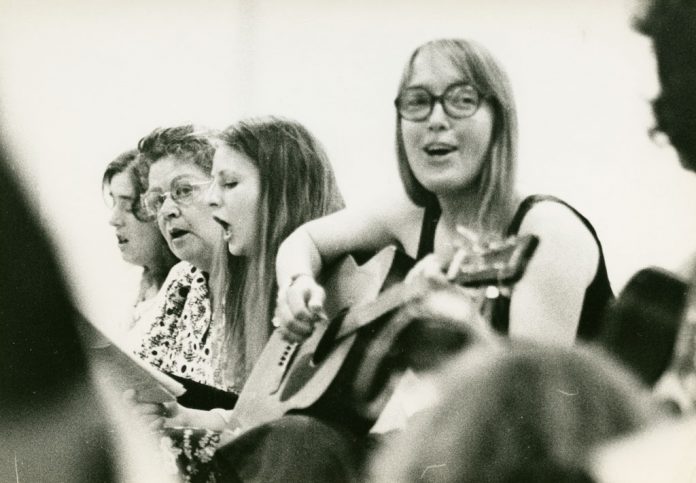
Potrebenko phoned him, but got Benston instead. The two talked for quite a while and realized they had much in common. Thus began their long friendship and artistic collaboration through Benston’s musical group the Euphoniously Feminist and Non-Performing Quintet. The quintet was a performing group that would sing at rallies, protests, and on picket lines to support the activists.

When Benston became a Canadian citizen, Potrebenko was one of her sponsors, and she recalled the multitude of questions that the RCMP asked Benston to make sure she wasn’t an extremist or a threat. Her reputation as an activist was well-known, and they had records of all her speeches and involvement in protests, recalled Potrebenko.

For a time, Potrebenko and Benston both lived in a large house with many suites, and Potrebenko remembers her coming home with a guitar one day.

“To my amazement she said, ‘I’m going to learn to play the guitar.’”

Benston was never shy of a challenge, and took on new endeavours with a passion. She was the type of person who never said no to an opportunity or new experience.

As one of her PhD students Ellen Balka reflected, “She was generous with her intellect and spirit.” As Potrebenko said, “She was a happy person, and satisfied – she liked stories and singing, and she was always doing 10 things at once and running late.”

Potrebenko also reflected on Benston’s contribution to the Women’s Caucus that began at SFU, saying that Benston advocated for equal pay, childcare, labour rights, and various causes to improve the equality and the status of women.

Although there has been some progress, and women’s rights have improved, Potrebenko feels that women are now worse off than they were when Benston was alive. She cited the unacceptable levels of violence against women and the as yet unequal level of pay and positions of power granted to women.

Marian Lowe agreed, saying that there has been progress, but in some ways things have slipped backward. She thinks there is a general complacency now and a sense that feminism is no longer relevant or necessary.

“Women get to go to war now, but I’m not sure that’s progress,” she continued. “Hilary Clinton’s campaign has some sexism underlying it, but it’s not acknowledged. I think it’s seen as politically incorrect to be racist, but people still get away with saying sexist things.”

[dropcap]U[/dropcap]nlike many professors who focus primarily on their research, Benston felt that a university was for the students and that it should be involved in its community. It is very fitting that the student centre was named after her in 1996, but Balka finds it sad that Benston wasn’t able to have that recognition during her life.

“Every single time I drive past the Maggie Benston Centre, I imagine her laughing hysterically at having a building named after her,” laughed Balka.

Benston’s sister thinks Maggie would have loved having her name on the building and loved that her two favourite places on campus – the pub and the bookstore – were there. She also mentioned that Benston would have found it funny that, as a Marxist socialist, her building was directly across from the W.A.C. Bennett library, named after a conservative premier.

Balka, who was near completion of her doctorate when Benston passed away, met her at a conference in Toronto when she was studying in another graduate program. Benston suggested that Balka apply to the new Women’s Studies program at SFU, and even invited her to come to Vancouver for a visit.

“She offered to have me stay overnight at her house,” remembered Balka. “But I was too shy.”

After that initial visit, Balka was convinced and transferred to SFU. She would carpool up the hill with Benston and go for hikes with her on the weekend. She was much more than a professor to Balka, who described the way Benston would arrange dinners at her house to introduce Balka to influential figures such as Ursula Franklin, a physicist from the University of Toronto who wrote about the political and social effects of technology.

“She was an absolutely delightful person,” remembered Balka.

When Benston came out of remission and her cancer made her too ill to teach, Balka was asked to take over her teaching load. “That was one of the most difficult things,” she said, due to the emotional impact and the pressure of taking on her courses.

[dropcap]M[/dropcap]uch of Benston’s research studied the connection between socialism, feminism, and technology. Her first political paper, “The Political Economy of Women’s Liberation,” published in 1969, was extremely influential and was read around the world.

Marian Lowe remembered traveling to Chile with her sister in 1973 and meeting feminists there who had heard of Benston and her article. They also learned that there were groups of feminists in various parts of the world calling themselves “Benstonistas.”

It was clear that her work was having an impact, and her name was recognizable among feminists and those working for social change.

Through all of this, Benston remained steadfastly against the idea of being a leader, and always worked to empower others, work collectively, and never do anything simply for recognition. As Marian Lowe wrote in an article in the journal Canadian Women’s Studies, “Maggie believed strongly that an egalitarian, feminist, materially sustainable society was not possible without changing science and the way technology was developed and used.”

Along with her scientific research, Benston was involved in many other endeavours. She was a social activist, a feminist, an author, a teacher, and a musician. On top of that she was a skilled horsewoman and she knew how to sail. She was also an ardent supporter and volunteer at the Vancouver Folk Music Festival.

Sandy Shreve, a poet now living on Pender Island, was the Departmental Assistant in women’s studies while Benston was at SFU. She remembers Benston as “one of those people who made everyone feel comfortable.”

Shreve admired Benston’s insight, relationship with the students, and ability to be involved in so many initiatives at once. She was a very positive person, and Shreve said that through all of her cancer treatment, she handled it with dignity and never let her positivity fade.

Shreve wrote “Snow Sestina” for Benston shortly before she died, and explained that the poem is about the intersection of art and science that she felt Benston embodied: “The beauty of geometry in snow / is like a poem and the grin on your face / when I said I loved the math in words.”

Shreve wasn’t the only poet to honour Benston through their work. Potrebenko wrote “A Song for Maggie,” an emotional ode to her close friend which was set to music by Phil Vernon and performed at her memorial service. Benston had a very close group of friends, and as they each took shifts at her bedside, they referred to themselves as Maggie Companions. “MCing” they called it, recalled Potrebenko.

Benston’s goal through all of her many projects and associations was to change the world.

“It was all connected with her view of the world,” said Marian Lowe. “Maggie always said ‘you need to understand the world in order to change it.’”

And that’s exactly what she was doing through her research, activism, and teaching.

“She was suffused with the idea that things were wrong and could be fixed,” said Potrebenko. Benston was full of hope and she had a vision; she felt that rebellion was essential.

“You never really win,” Potrebenko reflected. “But the struggle and the fight makes you and society better.”

Marian Lowe and Potrebenko both feel that times have changed and although Benston would have been continuing with her activism, it seems increasingly difficult to affect real change.

“Things get harder and harder to find what to do in order to change things,” said Marian Lowe. “I think about Maggie when I think about what to do to change the world.”

SFU’s Box in the Attic

0

[dropcap]S[/dropcap]FU stands steadfast at the literal peak of a mountain, blessed with rain, wind, and occasional snowstorm. Despite having only just celebrated its 50th anniversary this academic year, it has grown well beyond its expected capacity, went through immense growing pains during its founding years, and has stood as a rebellious, radical campus with the only NCAA varsity sports system in all of Canada. It has also produced great minds and great research, and will undoubtedly continue to do so.

All of this is supported by a widely unseen system of document processing and handling. As big as SFU is as an organisation, with both academic and administrative offices, the documents produced by SFU can be a staggering amount. We, as students, never stop to consider how our administrative needs are met, but in order for the show to go on, someone must work tirelessly in the background.

Much of this is done at two very necessary offices of SFU — Special Collections and the Archives — two important centres for document processing, handling, and storage at SFU. They work to ensure that SFU’s special research needs and history are carefully recorded and maintained.

Special Collections is up on the seventh floor of the W.A.C. Bennett Library, and despite the high volume of students moving in and out of the library, Special Collections has not received its fair share of attention. For most students, the library ceases to exist after the sixth floor, and even the sixth floor is used primarily for silent study spaces and some good sofa space to finish that paper due last week.

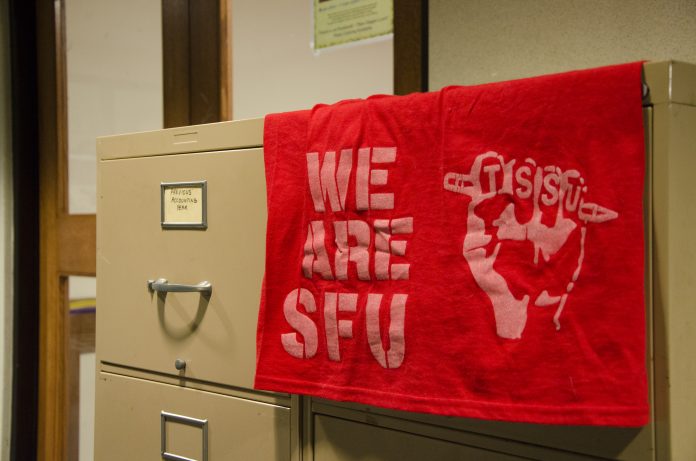
For many students, even less attention is given to the Archives, which is housed on the bottom floor of the Maggie Benston Centre at the end of a long and winding hallway. While the Archives is sometimes used by students as a research source for assignments, they’ve only recently been in the spotlight with the TSSU strike action, when grades were withheld and stored in the Archives. Their role as the official repository of the university’s records, however, is largely unseen, but is one of the most important administrative duties needed for SFU to operate smoothly.

[dropcap]S[/dropcap]pecial Collections, officially called Special Collections and Rare Books, works under the mandate of the Library to collect, safely store, and make accessible special and unique collections, ranging from posters, books, manuscripts, and photographs. The main difference between Special Collections and the rest of the library’s collections is that their collections do not circulate, meaning that they can only be viewed inside Special Collections and cannot be borrowed. Special Collections staff ensure that these collections are well maintained, catalogued, arranged, and stored for easy access.

Despite being named “Special Collections”, access to Special Collections and its literal vault of collections is permitted to students, faculty, and the general population — nearly everyone — with a few exceptions due to privacy or preservation concerns. It also houses a great view, with the entire city sprawled out before your eyes and the North Shore Mountains and the slopes of Mount Seymour on the other side of the seventh floor.
The overarching idea of the collections available in Special Collections is that they are either published material, such as books and posters, or they are unique records pertaining to a subject studied by SFU researchers. It contains both primary and secondary sources, allowing researchers to both see original pieces and secondary analysis or debates surrounding topics.

The process of acquiring and maintaining its collections is not a simple task, a task the acting head archivist Melanie Hardbattle and division staff tackle every day. The process can start in many different ways, ranging from a Library staff member identifying a suitable item or collection, a third-party approaching Special Collections with a donation, or an SFU faculty member expressing a need for a specific item.

IMG_8254

Any acquisitions must be considered with relation to the current collection policy. They must ensure that both a standard of quality is met for all collections considered, and that the acquisition would play an obvious role for the SFU community.

While Special Collections has a small budget to purchase pieces worthy of collection and that align with current collection policies, many pieces have arrived through generous donations. These donations are not just dusty old boxes being dropped in front of the Library’s doors, but require a series of meetings and considerations made for the role of Special Collections, the cost of maintaining the new collection, and the space needed for it. If those conditions are met, then a formal donation agreement can be signed.

Once an agreement has been met, and financial considerations have been settled, the next step would be the accession of the new collection, which would see the collection be given a unique number as an identifier along with an overall description.

After accession, a catalogue entry would be produced for the new collections. Like any Library collection, Special Collections ensures that a sense of order is maintained for its collections to ensure that similar items are grouped, and users can quickly look for desired collections.

An archivist or Library staff member would examine the pieces to both write the entry and ensure that it is ready for use. The material is also rehoused, if necessary, to provide optimal storage conditions for preservation. In some cases a conservator would be consulted, and necessary steps would be taken to safeguard the collection, or to recommend restrictions to protect its fragile state.

For example, Special Collections possesses an extremely rare page, or leaf, of the Gutenberg Bible. The Gutenberg Bible was the first bible to be printed with the movable type, the little wooden blocks with letters that can be rearranged — the start of the mass-production and popularization of books in Europe. It is sealed in a Mylar cover with the entry included with the binding to allow for observation while ensuring that the integrity of the very valuable piece is preserved.

This process of acquisition, accession, and cataloguing can go without problems for many rounds, but as collections get larger and needs get specific, it may be necessary to split collections into numerous smaller but specific collections, all requiring new or modified entries and tags.

For the foreseeable future, Special Collections will continue to expand their current collections. Many of their collections have been digitized and are available via the Library’s Digital Collections page. One challenge they will face is the inevitable change to records in digital format, where entire documents may be published exclusively in bytes, and how to change the procedures in Special Collections to preserve these types of records.

[dropcap]O[/dropcap]fficially named Archives and Records Management, the SFU Archives hold SFU theses, financial documents, reels of film and VHS tapes, Peak newspaper publications, and many university-related documents. Like Special Collections holdings, the collections do not circulate and cannot be borrowed.

According to its website, the SFU Archives “[supports] teaching, research, and university administration by acquiring, protecting and enabling access to university and private records of historical value.
Archivists at SFU spend their time filtering the regular inflow of documents and records for their potential value to the SFU community.

Even though deposits by University offices are voluntary, and the fact that offices retain some of their records for continued business purposes, the department receives piles and piles of documents and a constant stream of requests for access and information. They ensure that important documents are kept, while unnecessary ones are disposed of confidentially, and that collections are updated and expanded to fit the needs of the SFU community.

Generally, the Archives will accept three classes of material — those created at SFU, material created by the SFU community (representing organisations like the Student Society, the TSSU, and other registered clubs), and those related to current SFU research exploits. Special Collections has a more liberal mandate of acquisitions that allow them to collect around subjects without a direct SFU relationship. The Archives has a strong focus on SFU members, SFU history, and SFU research exploits, with a focus on primary sources.

IMG_8267

Special Collections and the Archives may seem to have different, sometimes opposing roles, but during the early years of SFU, the Archives worked under the umbrella of the Library, and librarians carried out archival duties. It was not until 1978 that the Archives was administratively separated from the Library, and not until the 1990s when the Archives settled into the new Maggie Benston Centre.

[dropcap]A[/dropcap]ll deposits — whether it is a donation from a third party, or a record transferred from administrative offices — must first be examined to determine if they are fit to be handled by the Archives. Some documents may be more suitable for Special Collections, while others simply may not fit with SFU Archives’ acquisition mandate.

Records Retention Schedules and Disposal Authorities (RRSDAs) guide archivists to determine which university records should be archived, and which should be confidentially destroyed. Some records can be retained for short periods of time, until they are disposed of at the end of their useful life cycle. Records deemed suitable for archiving are assessed in a separate process for classification in the holdings.

New archival holdings can enter the system in two ways. The first method would be under the Records Management Program, and this path is taken by documents produced within the “walls” of SFU — administrative offices, department offices, and individual faculty members. Common records transferred to Archives from an SFU department include a semester’s set of course outlines, which serve to represent a department’s cycle of classes — a keepsake of that time.

The second method would be through private third-party donors. The main point of consideration with private entries would be if it is applicable under the acquisition mandate — a good example would be donations from a faculty member’s family, perhaps pertaining to research conducted at SFU. If the conditions have been met, then a donation agreement can be discussed and signed between the Archives and the third-party, finalizing the donation. The discussion between the two is a very important step in the acquisition, as it will ensure that both parties understand the origins, future plans, and any privacy concerns for the donated material.

After accepting a new set of records, archivists can either create a new collection or fonds, or in the case of accruals — collections that already exist — add the new records to one that already exists.
Regardless of how entries arrived in the system, archivists must ensure university records that are no longer needed are confidentially shredded according to retention schedules and disposal authorities. This ensures that documents are examined on a systematic basis, and that only the necessary documents are held. Usually certain classes of documents, such as financial documents, can be disposed of based on a “lifecycle” — they are automatically disposed of at the end of a predetermined time period.

Maintaining the balance between functional public access and privacy laws is a crucial overarching idea to Archival holdings, so much so that a Freedom of Information Privacy Officer is responsible for managing the balance and to accommodate applications for access to certain collections. Because of the Freedom of Information and Protection of Privacy Act in BC, many of the holdings in both the Archives and Special Collections are partially or wholly restricted.

[dropcap]A[/dropcap]t this point, it may have crossed your mind why SFU even needs a Special Collections or an Archives. Why not just go without the two and re-allocate that funding elsewhere? This is an important question that needs to be considered, especially since through student fees, every single SFU student has contributed to sustain and continue to grow its collections.

As a student of the sciences, one may never need to take a trip up to Special Collections or down to the Archives as part of any course, and even the Humanities is limited to short trips, perhaps for a research paper.

The costs to maintain a Special Collections may be higher than the equivalent amount in books and research papers, especially with special acquisitions like the Gutenberg Bible, and the enormous climate-controlled vault to carefully maintain these collections.

But Special Collections and Archives are more important than its holdings.

Special Collections serves to facilitate the more unique needs of researchers through its acquisitions, and for students, it serves to provide a physical existence to the material taught.

There is a difference between going on Google to look up the Gutenberg Bible and its significance in the history and development of publication, and physically seeing an original leaf of the Gutenberg Bible.

It also serves as a single office for the correct handling and care of unique and valuable pieces, saving costs for individual departments.

archives_sign

With the Archives, one must recognize that like any group of likeminded individuals, SFU is a unique society, serving as a microcosm within our society. It is not the actions and decisions of one body or person that makes SFU unique, but the collective actions and decisions taken on a daily basis throughout the decades that give SFU its “voice” — its place in history.

As much as the Archives is the functional arm of document preservation and privacy protection, it serves to be its voice in time— to preserve SFU’s heart and soul. It serves to personify these cold concrete walls we attend. Like the box of Polaroids, old yearbooks, and vinyl records (or whatever you may collect) we all have somewhere, it serves to show snapshots of SFU’s past.

Any collection of buildings can be a university, any group of students can be a student society, and whatever events and research conducted can be done and published, but as a repository of those events and memories, the Archives captures SFU through its holdings, and must continue to do so.

Just like the box in our attics, or the photos we have framed in our living rooms, they can represent the public face of us, the moments we can share with everyone. But the photos in that box show a more intimate picture of who we are. It shows the memories we carry with us from house to house, as we progress and continue to change through time. It serves as a place of static calm in our ever-changing and rapidly-moving world, where we can take a moment to look back.

The SFU Archives is the metaphorical box in our attics, showing SFU in snapshots from the inside, an intimate history of SFU’s conception. We see everything from its growing pains to its current state as a school.
Even though Special Collections and the Archives may not be a direct part of our day-to-day lives up at SFU, their roles at SFU are undeniably a part of what makes our university unique.

Ever since the doors of SFU opened to the public, Special Collections and Rare Books have been acquiring, preserving, and making accessible, valuable pieces to aid our research needs. Their collections range from local event posters, unique manuscripts, all the way to pieces of global significance.

The Archives and Records Management, originally working under the mandate of the library, continues to accrue new holdings, showing among other topics, the history of SFU, unique snapshots of research and activities that have taken place at SFU, and SFU’s research exploits and topics of interest. They also temporarily hold and confidentially destroy important documents, maintaining the balance between privacy and public access.

Whether for simple documentation, research, or for the chance to look back in the past, the two departments are not only the gears that help SFU with valuable document processing, but are important resources for anyone at SFU.

Like a box in the attic, you never know what you’re going to find.

A Culture of Detachment

1

[dropcap]H[/dropcap]alfway through this past fall semester, there was one morning where I shuffled into class a few minutes late. I literally had to climb over my classmates to get a seat, in what can only be described as a shoebox of a classroom. I didn’t want to be there – and I doubt anyone else did either.

Lately I have had a lot of difficulty getting inspired about my studies at SFU. This was hard for me to admit and even harder for me to tackle. When I came to SFU in 2012, I was bright-eyed and ready to learn everything underneath the liberal arts umbrella. So why was I in a slump?

At first I thought it was a mid-youth crisis – that I was having second thoughts about my major in Political Science. But anyone who spends more than five minutes with me will quickly learn that I’m not short of any passion in that department. So why was I having so much trouble engaging with my work?

What I didn’t realize then, on that rainy fall day – as I sat in my chair, which was bolted to the ground, which was one of many in my row, tightly pressed up against the people sitting near me – was that SFU was not the engaging, progressive school it marketed itself as. Rather, in recent years, SFU has actually become an institution rooted in detachment. Students growing detached from their studies, the faculty from their students, and the administration from SFU’s educators … slowly, on all fronts, SFU is dividing.

When I began my research for this article, I didn’t know this would be the conclusion I would reach. Initially, I envisioned writing a detailed history of organized labour at SFU – but the interviews I conducted pushed me to evolve that theme.

[dropcap]N[/dropcap]o amount of throwback stories from SFU’s archives can replace the testimony I collected from students and educators. These conversations helped me understand why I felt so detached from my studies, and opened my eyes to ways in which SFU has become detached from us. Writing this piece was a cleansing process for me, and I hope that anyone else who has experienced a slump during their degree can find some closure in this article as well.

Some of the most interesting conversations I had while doing research for this piece were with SFU students. None of them labour specialists, none of them involved personally with the issue, all of them just undergraduate students trying to get by.

I felt that relying on my opinion alone would simply not be enough; so I spent a day roaming the AQ, the MBC cafeteria and convocation mall, approaching strangers, hoping they would give me five minutes of their time. I didn’t ask for their names or their faculties, I wanted them to be anonymous, so they would feel comfortable talking — and for the most part, everyone was willing to talk and speak frankly about their experiences.

“Do you know what the TSSU is?,” was the first question I asked every student I approached.

And the responses I got from SFU students ranged from “Nope, I have no idea,” to some who knew exactly who they were and all about the latest bargaining update. This diversity was present in nearly all the questions I asked – all but one.

When I asked SFU students how they felt about the recent labour dispute between the TSSU (Teaching Support Staff Union) and SFU Administration on campus, and subsequent temporary disruption we were experiencing as students, not a single person expressed any contempt, anger or frustration.

I was taken aback by this. I was expecting public opinion to be much more divided. Especially since the exchanges between students happening on public social media pages made this topic seem much more polarized. So while detachment seems to be present in many parts of the institution, as I will get into shortly, the disconnect between students and TAs seems to be quite minimal.

There was one conversation in particular that stood out to me during this process. During one of my interviews with an SFU student, I asked if growing class sizes was something they were worried about. One woman said that in her department, which was Education, large class sizes goes against their pedagogy, so she had no reason to be worried about becoming one in 250. She told me about how she has been taught that smaller, more collaborative, discussion based settings foster intellectual growth.

This conversation stood out to me because as it turns out, SFU doesn’t always practice what it preaches. In the interviews I conducted after this, I learned that in several departments, it seems tutorials are being scrapped from first year courses and lecture halls are getting larger. Other than this one woman, students were worried that their lectures were going to keep getting larger.

While the Education department may be on the right track, others are becoming out of sync with the tutorial-based model that SFU had prided itself on. And frankly, as a student, I was quite upset to hear this. As Melissa Roth, a trustee for the TSSU confirms, this is one area where SFU is letting students down.

“Undergrad enrolment is going up, and graduate student enrolments and the number of professors are staying the same — that can only mean bigger class sizes,” Roth told me.

[dropcap]A[/dropcap]fter speaking to SFU students, I wanted to talk with people from within the labour movement on campus. Roth was one of the TSSU members who reached out and let me ask her some questions about how labour relations has evolved on campus, and what it all means for students.

From the moment Roth sat down at the table across from me, I could tell she was proud to be a part of organized labour at SFU – she wore a black TSSU button on a white blouse, she was not afraid to let the world see that part of her. She told me about her history with the union, and what her experiences have been since getting involved.

The question I wanted answered the most desperately was simple, since her getting involved with the TSSU, did she feel that the relationship between the university and the union had evolved. I wanted to know how she describes labour relations at SFU.

“It depends what level of administration you are dealing with. On the whole, when we talk with just departments, overwhelmingly it is comfortable and easy. The vast majority of issues that are brought up are solved informally over emails and a single meeting,” Roth answered. “So, excellent.”

I will admit that wasn’t the answer I was expecting. The TSSU was, after all, just coming to the end of a 19 month long labour dispute.

I think she must have been able to tell from the lost expression on my face, that wasn’t the response I was predicting. She continued, “The thing that people hear the most about is bargaining.”

And she had a point. Unless we’re hearing whispers of picket lines, students don’t seem too enthralled by labour relations at SFU.

But as Roth pointed out, day-to-day relations with faculty members is simply not comparable to the union’s dealings with the administration.

“They are professors, they are staff [who work] with our members on a day to day basis,” she explained. “They see our members as ‘Melissa’ or as ‘George’, not as a bottom line. They see that having an issue with let’s say, the classroom, directly relates with the quality of education, that it’s not some sort of arbitrary demand.”

But then we moved away from just faculty, and we started talking about the administration as a whole, and she added, “I’ve been in situations with people from higher levels, and it does start getting detached, their understanding and perspective is different.”

[dropcap]A[/dropcap]fter speaking with Roth, I knew that I wanted to go further back into SFU’s past. After looking into SFU’s history with unions, I knew that this story would be told very differently by someone who lived it. And that’s when I decided I had to sit down with Karen Dean, the TSSU’s grievance officer, who was also a student at SFU during the early 70’s. She was brought on to the union’s payroll in 2008 – she is the first, and only, employee that isn’t of the union’s own rank and file.

Up until 2008, the TSSU was run entirely by its own members – they never needed a bargaining professional. So Dean’s hire reflects a massive change at SFU. After 2008, the TSSU felt they were no longer able to effectively negotiate with the university themselves.

When I first sat down in her office on the fifth floor of the AQ, the first thing I noticed (other than the enormous photocopier) was a massive wall of binders. From floor to ceiling, all of them filled with the TSSU’s past agreements, and history. It was then I knew I was in the right place.

Dean’s relationship with labour on campus is a truly unique one. She told about how she was a part of the team who bargained the first collective agreement between the student society and the university, and that some of the original elements that she had bargained for are still in place today. Dean compared those early days to “growing pains”. The university was expanding rapidly, it was growing in size, student population and of course, staff. So the labour disputes then, according to Dean, were more a by-product of an institution trying to keep up with a university that was quickly beginning to sprawl over Burnaby Mountain.

But now SFU is 50, and is expected to have the systems put in place to effectively communicate and negotiate with unions. Yet, according to Dean, labour relations on campus today, are actually worse than in SFU’s early years, and this is most evident in who SFU is putting at the other side of the bargaining table.

“When I came to work here, one of the things I had to do is research the history of the articles in the collective agreement […] and when you go back, what you see is a real change in how the university has been working with the TSSU,” Dean continued. “I pulled down an old bargaining binder, it was the ‘98 round [of bargaining], to check on an article, and I realized while I was looking at it, when we were at the table in 1998, the associate VP of academic was across from us, on their committee.”

In this last dispute, the TSSU didn’t see the same kind of people meeting them at the table. Instead of letting those who come from the world of academia – and those who understand the issues that the union wants to negotiate, like protection from overwork and underpay – SFU’s bargaining team was comprised largely of staff from Human Resources.

“In this round of bargaining, and in the last one, one of the things we realized is how difficult it is to bargain with people who don’t know what it is that you do,” Dean added. “How does one successfully get language in your collective agreement that reflects your work, if no one on the other side of the table has ever done the work?”

While SFU has every right to send HR representatives to the bargaining table, as it was being explained to me, in doing so they are decreasing the likelihood of a quick and fair resolution.

“In recent years, the TSSU has had to fight to get someone on the other side of the table who actually knows what we’re talking about,” and by this what Dean meant is that the TSSU had to initiate job action in order to be guaranteed that at least one professor would be a part of the university’s bargaining team.

Since the early 2000s, every time the TSSU has gone to the bargaining table, they feel that they have gotten stuck there. Dean told me about how in this most recent round of bargaining, they rejected her description of a TA as someone who is there to bridge the material for students, to help them engage with it and understand it, and that they are not subject specialists or lecturers, that being a TA is as much a learning opportunity for the graduate students as it is for the undergrad student.

Anyone who has ever taken a tutorial at SFU knows that’s exactly what a TA is. And yet the people bargaining on behalf of SFU, on behalf of us, didn’t agree with the TSSU’s interpretation of a TA’s role. It’s this shift, according to Dean, in labour relations that has led to long and truncated bargaining sessions.

[dropcap]A[/dropcap]nd long bargaining sessions aren’t the only red flag.

According to Dean, TAs aren’t been given enough paid working hours to attend lecture, meaning a lot of them are working several hours every week for free. And that blew me away. How could we ask any TA to put in unpaid hours? Guaranteeing that all TAs are paid for all working hours is at the forefront of the TSSU requests, but SFU hasn’t been willing to negotiate this issue. And according to Dean this is because the administration knows that any TA who wants to run a good tutorial will go to the lecture regardless if they are paid or not.

“If a TA begins to feel exploited, the only thing they can do is not go to the lecture, and then students are impacted,” said Dean.

I believe SFU’s changing relationship with unions and employees on campus will begin seeping into the quality of our education.

And this is what I mean by detachment. The administration is looking at SFU through an HR and corporate lens and either can’t or won’t put themselves in the student’s or TA’s shoes. No matter what side you are bargaining for, everyone at the table needs to understand the other’s perspective.

So clearly things at SFU are changing, whether we want to admit it or not. I see corporatization slowly eroding the university that I have loved and called my own. This culture of detachment is popping up all over campus. SFU is becoming all gloss, and no substance. Next time you are walking past our new and shiny observatory, that’s less than a year old, take a look at that sidewalk — it’s already cracking. The brand new cracking cement is the perfect metaphor to sum this all up. It’s just gloss, slowly we are losing our substance.

I believe that this evolution, or rather devolution, can also be tied to the arrival of Andrew Petter. I mean no disrespect to our president, but from the outside looking in, he appears to be more concerned with aesthetics than substance.

“The president used to be a hands-on, ‘chair’ if you will. Like the chair of a department but on a much bigger scale. Their job was to help find solutions […] but now we have a president who raises us money and who does the PR piece,” Dean noted when I asked her what role Petter played in this corporatization of our university.
And Dean wasn’t the only one who had something to say about how we’ve used marketing to cover up the changes happening on campus. I sat down with Derek Sahota, spokesperson for the TSSU, who affirmed this idea that SFU is selling an image that doesn’t correspond with the reality on campus.

“There is a lot of fakery,” Sahota said. Looking at events such as SFU’s 50th anniversary celebration and the slogan of “from radical roots to engaged university,” it appears as if SFU is building a façade rather than actually tackling growing issues on campus like class sizes and opportunities for graduate students.

And I find this disheartening. We were once a truly progressive institution, but we have built a culture of detachment over top of that past.

Everywhere you look you will find traces of this detached culture. I personally have noticed a rise of iClickers and a similar product called TopHat in my classes, both being devices used to track classroom participation. And at first I didn’t think much of their presence, but this article has forced me to think more critically about this technology.

clicker

When you get right down to it, what these tools have done is replace thoughtful, in-depth conversation with multiple choice quizzes. So I ask you, is that really engaging for students? Is anyone truly gaining anything from that experience? Or is it, rather, a way of artificially creating participation in a class of 100 people?

The larger a class gets, the harder it is to have discussion, and these iClickers become the only way of finding out who’s been paying at least an ounce of attention. As Dean puts it, “you may get some information in your head while sitting in a lecture, but you don’t own it until you’ve done something with it, until you discussed it and thought about it.”

And she is spot on. In my opinion, the way in which we address participation issues should not be introducing a piece of new technology that replaces conversation, rather the solution is to offer two sections of the course so that students can work in more appropriate sized groups.

This culture exists on a small scale, like iClickers, but it’s also making some appearance in SFU’s bigger picture. I spoke with three people from the labour movement on campus and all three of them at one point mentioned Guard.me as a classic example of how detached SFU is from its students.

[dropcap]F[/dropcap]or anyone who wasn’t around when this issue first surfaced, Guard.me is an insurance plan initiated by SFU administration in which every international student is automatically enrolled. On February 25, 2015, concerned members of the TSSU presented a petition against Guard.me to SFU administration with approximately 600 signatures from international students and community members.

The TSSU’s biggest concern was that Guard.me automatically enrolled students in the plan, which would in turn cost students money they didnt have.

As Sahota was explaining it to me, when the TSSU questioned SFU about Guard.me, there seemed to be little concern on their part on how students were going to afford the insurance plan that he described as being packed with unneeded services. Having met, and having been a student abroad, the assumption that international students will have no issues paying an extra few hundred dollars is a troublesome one. The fact of the matter is most students today live from hand to mouth. But as Sahota remembers the Guard.me controversy, SFU didn’t share his concerns of affordability.

As Dean pointed out, SFU’s interest in this health insurance contract seemed to be entirely rooted in the 5% kick back the university was receiving.

The TSSU believes that there were much cheaper options than Guard.me, and as Roth told The Peak in 2014, “[SFU was] using it to fund the basic budget”.

When I asked Dean about the controversial insurance plan she chuckled and told me that even now they aren’t sure what problem SFU was trying to solve since, to her knowledge, no international students expressed any interest in the private insurance.

After speaking with members of the TSSU about their opposition to the Guard.me program, I asked Tim Rahilly, Associate Vice-President of students, how SFU choose Guard.me, and what sort of consultation the university did with students before they made their final selection.

According to Rahilly, there had been a long history of international students choosing not to purchase any sort of medical coverage before their MSP kicked in. This was an issue for the university as they require all students to buy into a health coverage plan. So in Rahilly’s recollection, SFU saw Guard.me as a way of making sure that all students were adhering to the university’s conditions.

When I asked how SFU consulted its students before choosing the Guard.me option, Rahilly said that there were many openhouses and surveys done before the final selection was made, and that this insurance plan was reflective of students’ needs — SFU observed an increase in students seeking out mental health and councilling services through the school, and in his mind, this suggests that Gaurd.me was a necessity.

So while Rahilly supports the insurance plan, sighting its long list of benefits as a positive for students, there is still a strong opposition to the insurance plan. The Guard.me controversy even today remains a sticky subject. In my eyes, however, forcing students to be locked into a certain medical plan is another example of the corporatization of the university experience.

So you’ve stuck with me this long, but before I end this piece I want to take you back to that cold and dreary day in the fall for just a moment — over 20 of us sat packed into a room that was meant for 10 or 15 students.

SFU removed the desks and replaced them with those rows of chairs where a table only big enough to hold a cup of coffee folds out from the side. These chairs, that are glued to the ground and squish students together, without a doubt restrict conversation and erode that collaborative environment tutorials are meant to be. If you ask me, these seats were installed so that they could fit more bodies into a classroom and make class sizes just a little bit bigger. They are in my mind, the perfect representation of how SFU has started to change.

And this, to me, is the corporatization of our education. Our degrees are no longer about us finding our passions and becoming better educated and more driven people – it’s about using us to meet someone else’s bottom line. And I believe that this will devalue the degree we are all working towards. SFU, in my mind, hides behind great marketing. We pump out flashy ads, throw parties on campus and brand ourselves as “the radical campus” who leads in research and engagement – but I think it’s a scam that will cost me, and probably most of you, over $30,000 by the end of our time here.

When I began looking closely at SFU’s labour relations, I didn’t know this was the direction the article would take me in. However, poor labour relations on campus appears to be a symptom of a much larger problem – SFU is going down the corporate path. I fear that they will sell out my education (and yours) to save some money. I see the university’s relationship with our TAs as a reflection of the university’s relationship with the students, and things are not looking good for the future.

I’m not going to sit idly by and let this corporatization of SFU detach me from my studies. My mid-youth crisis was a byproduct of what I believe is the culture SFU is creating on campus, and there are probably many of you who have had similar experiences. Our slumps are not necessarily rooted in a lack of drive, motivation or campus life, but I believe that they stem entirely from the environment SFU is creating for us in the classroom.

Renaissance Man: Parminder Parhar

0

If you’re like most students, a morning’s cup of coffee is as much a necessity for functioning as going to bed the night before. For 19 years — since opening the first Renaissance Coffee location in February 1996, initially as a six month trial — Parminder Parhar has made himself an integral part of the SFU community. Along with providing us our caffeine fix, he’s also a dedicated philanthropist, raising money for the Parhar Endowment Fund, which he aims to grow to $1 million to support students in years to come. Here, we talk to the Mumbai born and raised businessman about the coffee shop he named for “rebirth”:

When and why did you come to Canada?

“I came to Canada on August 10th, 1990. My father passed away and my family became lonely without him and my brother who was a father figure had moved to Canada [. . .] I started working at 7/11 as a Manager to gain managerial experience — this was the first opportunity I found in Canada.”

Why did you explore SFU of all places and schools?

“When I came to Canada I explored many different places including UBC and other schools. When I come to a new country I always explore. When I came to SFU in 1990, I could feel a sense of community was missing and I wanted to change that.”

What’s something people might not know about Renaissance Coffee?

“My wife and I are both owners of Renaissance Coffee. My wife came with me from India and then we got married in Canada. [. . .] Renaissance Coffee was first located in the corner of the AQ and only three staff members people could fit in the workplace.”

Why are you fascinated by coffee?

“I have no idea [. . .] it is was something that came natural to me right when I was growing up [. . .] it just came to my heart. My hunch is, I was attracted to coffee because it was part of my destiny and it certainly did become my career and ultimately, my destiny.”

Are there any childhood stories that began your passion for coffee or business?

“My passion for business came to me at a young age and it was something I was 100% certain of from the get go. When I was studying for my Business Degree, I never applied for a job because I knew I was going to become a business owner.”

Who was or is your mentor that inspired you to start your own business?

“I read the book ‘Think and Grow Rich’ by Dr. Napoleon Hill and this became the essence of my life and my business operations. The key element I took from the book was, in order for success you need to create your own unique idea. My idea was not to just create a coffee shop but to create a little community where people could come together to connect, relax and exchange ideas.”

What is important to you?

“An important thing I have learned in my life, is to treat everyone the way you would like to be treated and not with a double standard. When we don’t have the same standard in giving that is when we have big problems.”

Tell me about your staff, how did you decide to recruit members on your team?

“I have a great team of staff. They know my expectations and I often hire from their recommendations as I ask them, ‘Do you know someone like you?’ as I value their opinion. I look for people to work at Renaissance who can fit into my philosophy, to treat everyone how you want to be treated, to be happy at work, as customers may be stressed and we want them to have a soothing moment at Renaissance Coffee and we want to spread happiness.”

When you are not busy creating your community coffee shop, what do you enjoy doing?

“Learning, I read a lot of books. I also learn when I am at Renaissance Coffee. I look at people and learn from them without them knowing it. I see students and professors working hard and are truly motivated and I say, if they can do it, so can I! It is not easy being a student or a professor and their strength motivates me.”

How would you describe Renaissance Coffee?

“I would describe Renaissance Coffee as a community coffee shop, to get people together, to stop and chat with friends, a warm comforting meeting stop — a kickstarter to your day or an afternoon refresher.”

Why does Renaissance Coffee sell Fair Trade coffee?

“17 years ago, an SFU student brought to my attention the importance of Fair Trade coffee and how it changed lives and this is how Fair Trade coffee at Renaissance Coffee was launched.”

Why is supporting SFU’s education important to you?

“I see students working hard everyday here to achieve their dreams. I know the student life is not an easy life and I would like to help them out [. . .] Julie was one of my everyday customers and became my friend and educated me on the importance of an endowment fund. Renaissance Coffee has already given out five $1000 bursaries to SFU students who excel in their academics and also contribute to their community.”

What is your favourite order at Renaissance Coffee?

“My favourite order at Renaissance Coffee is a Cafe Latte which is my days’ award when I go home. I am the kind of guy who could live on coffee for a few days but if I am hungry, I also enjoy Renaissance Coffee’s veggie wrap.”

Any last thoughts?

“In this big corporate world, I am happy there is still a place for a little guy like me and a community coffee shop. This is not my coffee shop, this is SFU’s community coffee shop and let’s continue together to build a stronger sense of community at SFU.”

History of Art

0

[dropcap]H[/dropcap]alfway down the South Concourse of the Academic Quadrangle, there are a pair of indescript glass doors distinct from the sea of wood paneling. Over it, a sign says SFU Gallery — admittedly not a particularly imposing entrance.

A relatively small space, it exhibits both contemporary art created primarily but not exclusively from Canadian artists. As the only dedicated Art space on the Burnaby Mountain campus, you’re more likely to stumble inside between classes, than to actually seek it out.

The small space doesn’t do justice to the long and dynamic relationship between the arts and Simon Fraser.

The current SFU Gallery system consists of three spaces: the SFU Gallery in Burnaby, the Audain at Woodwards, and the Teck at Harbour Center.

The SFU Gallery runs semesterly programming, and tries to connect an undergraduate population from diverse backgrounds and disciplines with Contemporary Art.

The Audain is a public Contemporary art space with diverse programing, it includes a spring and summer exhibition, undergraduate and graduate shows, and a fall artist-in-residence program, balancing the School for the Contemporary Arts with a city wide public audience.

Meanwhile, the Teck functions as a short term public art space with year long projects in a multi-purpose function and study space in the Harbour Center Atrium. The arts at SFU and the SFU Gallery have a longer history that predates this current set-up.

[dropcap]O[/dropcap]ur University opened its doors in 1965. At the time, its approach to education was unique in many ways, along these lines was the potential for interdisciplinary exchange in the liberal arts and sciences.

Those founding years were filled with excitement about the potential in that approach. The Centre for Communication and the Arts was one of the initial bodies to be created. Formed under the Education program, it is the predecessor to the School for Contemporary Arts and the SFU Galleries.

The Centre was an incubator for the arts that existed as a non-credit hive for programs, workshops and events open to the entire University community. It fostered artists and performances with a nationally recognized faculty in an environment with few boundaries and barriers.

Many of SFU’s initial experiments in education did not survive long. The Centre was no different, and it was restructured. Eventually, the Centre for Communications and the Arts shifted away from the radical freedom of its early years and eventually transitioned into the credit based program we know today as the School of Contemporary Arts. This reflected broader trends at the university for a return towards the entrenchment of long established ways of thinking and working.

Artist Iain Baxter& — who at the time was simply Iain Baxter, adding an ampersand to his name in 2005 — founded SFU’s visual arts program and was the creator of SFU’s original logo. He was responsible for fostering a lot of that initial freedom and experimentation at the Centre for Communications and the Arts.

One of his notable attempts was when he taught what was supposed to be a semester long class — 13 two-hour lectures — as a 26 hour marathon session instead, an experiment born out of the free-wheeling mentality of artists at the time and the freedoms afforded in a Centre running on a non-credit system.

Without a dedicated gallery space, this was an environment where art could, and did, happen all over campus.

1969’s Catalog for the Exhibition, organized by Seth Siegelaub is one such project. It included participatory and durational pieces by artists like Sol Lewitt and Lawrence Weiner, which were situated around the campus.

Jan Dibbet’s “Perspective Correction” for instance, involved the cutting and removal of a perfect square of grass in perspective from the lawn next to the theatre. This was then photographed and made into postcards available in the theatre.

[dropcap]O[/dropcap]ne of the Centre’s key figures in the early years of SFU was James Felter, a visual artist and curator who joined the Centre in 1968. He advocated strongly for a gallery space at SFU — a goal he achieved in 1970 when then President Ken Strand established the Simon Fraser Gallery and named Felter as its first director, a position Felter would hold for sixteen years.

Under Felter, the gallery would exhibit and work with many renowned artists and curators, while simultaneously developing the young, but strong collection of artworks by Canadian artists that the University started in 1965.

It was a prolific time in the gallery’s history, with 127 exhibitions being held in the first ten years, an impressive rate of an arts exhibition per month. Felter also developed a program of circulating exhibits that could be sent on tour to other public galleries in Western Canada and beyond, venturing into the traditional territory of much larger galleries with expansive collections.

This was an initiative cut short by the University’s growing budgetary crisis in the 80s.

[dropcap]I[/dropcap]n the years following James Felter, the Gallery would be separated from the successor to the Centre, the Department of Fine and Performing Arts.

With this new found independence, the gallery would no longer be run by Visual Arts faculty. Now under one of the University’s vice-presidents, the appointment for Gallery director would draw from other faculties and departments. With this administrative separation of the gallery came an ideological one as well. As the gallery took a more conservative approach to art, and as the Visual arts faculty continued to develop and experiment within a contemporary environment, their direction would diverge considerably.

The openness to public art and experimentation that existed prior to the gallery was partially fed by the shifting ideas on the purpose of galleries in general.

Contemporary artistic discourse was exploring the idea that art didn’t need to be relegated to a devoted gallery space. The thought was that it could, and should, be part and parcel with the world and the public sphere. The idea of the ‘white-cube’ as a meaningful mode of explanation, with the gallery as a blank slate for the exhibition of work also came under fire.

This was a period where the gallery and institution were criticized for their role and conservatism, creating a generation of artists that would question the role and exhibition of art. The movement in this direction by artists and faculty contrasted with the direction of the gallery under non-art directors.

Though the conversation around public art would continually develop and change, the familiarity between the university community and public art would continue, through permanent works installed around campus, but also through temporary exhibitions and programs.

One notable example is the first year campus project — a project where first year students develop and create a site-specific public art piece at the end of their second semester.

Until the completion of the Woodwards complex and the final movement of the School for Contemporary Arts downtown, this was a project that formed a regular part of the Burnaby Campus. A lasting tradition of taking art outside the gallery space, that met with the mixed results of first year students developing their nascent artistic practices.

Another particular moment in the development of art came in the 80s, when Jeff Wall, a rising and soon to be leading artist of photoconceptualism in Vancouver, began giving classes in his studio on the 100 Block of West Hastings. With time, Wall would join the Visual Arts faculty, and the program would move into the same building.

This arrangement included a gallery space that showed a variety of artists, not restricting itself to students or graduates. It was a gallery space in line with the developing artist-run centre culture of the time. With the moving of the Visual Arts program to its current location at 611 Alexander Street in 1993, this location of the gallery would cease to exist.

However, this didn’t leave the University without a downtown exhibition presence — a gallery space came with the 1989 opening of SFU Harbour Centre in the renovated Spencer’s department store building.

This is the Teck Gallery space at the far end of the Harbour Centre atrium, and it would be joined in 2010 by the Audain Gallery on the ground Floor of SFU’s Goldcorp Centre for the Arts. Throughout the years, despite the shifting locations, administration and nature of the arts, SFU’s various gallery spaces provided an important opportunity for students and members of the public to be exposed to art, and its development in the city and beyond.

F-61-1-2-0-23

[dropcap]B[/dropcap]eyond exhibiting work, the SFU Galleries are also responsible for the SFU Art Collection, an important collection of local and regional artwork. This collection covers work of historical and contemporary value and stands at over 5,500 pieces. Large parts of this collection are either hidden away in short term storage in the AQ, or long term storage under Strand Hall. Though occasional portions of the collection that are in storage occasionally come out as part of exhibitions, the majority of those remain largely unseen.

However, a substantial portion of this collection is displayed around SFU’s various campuses, this includes over 1000 public sculptures, murals, large format paintings, and prints. The original two pieces of the Art Collection are amongst those found on display — Gordon Smith’s mosaic murals, commissioned in 1964 and installed in 1965, form a permanent part of the Academic Quadrangle.

Located atop the monumental staircase that rises from the Mall to the AQ, they face each other across the central east-west pedestrian axis that defines the university’s design. Their commissioning for the new university, and prominent site make them a fitting start for the Art Collection.

The murals are amongst the best known works in the collection, frequently used for photo-ops, and promotional photos. They have presided over the Quadrangle and Mall throughout SFU’s history, and frame the yearly processions of students who graduate having successfully slogged it through years of a university education to make it to their convocation ceremony.

Their visibility is one utilized for SFU’s 50th anniversary campaign, as the murals found themselves used as the backdrop for signage and promotional material across printed and digital media.

On the western side of SFU’s Burnaby Campus, on the opposite end of the spectrum, sits the most recent acquisition. This is the large Damian Moppett sculpture Large Painting and Caryatid Maquette in Studio at Night (Sculpture Version), that was installed over the Residence Dining Hall Building. It was originally commissioned for the Vancouver Art Gallery’s offsite public art space on West Georgia, and was on display from November 2012 to April 2013.

Here at SFU it joins a long-running tradition of public sculpture that began with Gordon Smith. Adding to the many examples of public art permanently located around the AQ and throughout campus.

Donated by the artist, the Caryatid Maquette took two years to prepare and install. As it had been commissioned for a different site — a specific site — relocating it meant finding the right site on campus and also adapting the work to meet it, all while following the procedures and considerations of the University.

According to the current director and curator of the SFU Galleries, Melanie O’Brian, “It was a process unique to working in the arts within a large comprehensive institution.”

Bringing the Caryatid Maquette to SFU was a long process that sometimes had to take a step backwards in order to continue. The initial approval, was followed by site selection, and consultation with facilities to seismically test the site, and engineer it for safe installation, a process that had to be repeated when the site was changed.

Compared to a free standing sculpture like that of Terry Fox, or Mahatma Ghandi, this process was considerably more complicated since the sculpture was to be installed onto a building.

As well, the previously free-standing sculpture was originally a layered three dimensional array that referenced the artist’s studio as a stage set. To fit its new home, it had to be flattened and welded back together into a new unique arrangement that didn’t interfere with the original vision.

Despite the long process, it’s one that O’Brian would like to do again. As projects like it set the tone for her desire to “bring Contemporary Art up to campus and contribute to a culture of vibrancy,” something that can happen through paintings like those in the AQ concourse, “but sometimes requires bigger statements.”

[dropcap]A[/dropcap]nyone entering the SFU Gallery in the Fall of 2013 would have encountered Samuel Roy-Bois’ Not a new world, just an old trick. It was a large white construction, whose exterior could be used to study, or to lounge and sit amongst cushions and blankets.

In the interior, were two small rooms that held a selection of the work from the SFU Art Collection that Roy-Bois curated as part of his installation. These works included such diverse things as photographs, drawings, paintings, sculptures and some silverware that would not have felt out of place in the proverbial North American home of our grandparents, or in a period piece on HBO.

As Christina Hedlund, the collections manager with SFU Galleries, put it, “No collection is perfect, all collections will have weird and unusual works.” Developed over the years from purchases and donations, it has grown in an organic and uncontrolled fashion.

The SFU Art Collection has a variety that includes grandmother’s silverware, but only has a limited amount of contemporary photography or SFU talent — an absence important in our local context due to the recognition of Vancouver as an important place for the development of conceptual photography.

This is curious considering SFU has a strong arts tradition tracing back to the Centre for Communications and the Arts, that focuses on contemporary art and critical thinking, and has always had a strong cohort of alumni, professors and students.

These kind of gaps are amongst the issues the Gallery seeks to address, to the extent of its ability with limited options for space and storage. In this context, small steps are being made when they can, such as the handful of works from SFU artists joining our collection following last summer’s exhibit, Through a Window: Visual Art and SFU 1965-2015.

In the past three years, Melanie O’Brian has focused on both small, and large movements. Improving things behind the scenes, silently reinforcing the Gallery’s status as a professionally recognized art space, while simultaneously making big statements. This work includes curatorial experiments such as last Spring’s Geometry of Knowing Series, and last Summer’s Through a Window.

The former consisted of four interrelated exhibits held at both the Audain and SFU Galleries throughout the spring semester. Three of the exhibits were curated by SFU Galleries, with a fourth curated by a third year School of Contemporary Arts Visual Art Core Studio cohort.

The setup allowed for the development of dialogue around related themes across the two galleries.

Through a Window consisted of concurrent exhibits at all three SFU gallery spaces providing a particular historical summation of the arts at SFU.

This approach to exhibiting stems from O’Brian’s desire to think about programming together across the Gallery spaces, exploring the potential crossover between ideas and audiences in the process. The focus on combined programming started with the rebranding of SFU Galleries as a coherent three gallery system, beginning with a new logo, a new website and a single program guide.

It continues through programming that bridges the physical distances between the galleries, and through the Gallery’s foray into publications.

This reassertion, and heightening of the visibility for SFU Galleries, within and outside the university is a continuing and multifaceted process, that they have to do while maintaining the socio-politically involved contemporary artwork that the University and the Gallery are known for.

Despite attempts to bring them together in new and interesting ways, the three gallery system presents challenges.

“They can have distinct audiences and distinct shows, and operate with their own sense of conditions,” said O’Brian.

It is fitting that the three gallery system reflects the structure of SFU itself, split into three different campuses, each with their own ways of thinking. Bridging this structure presents unique opportunities to create, in the spirit of that initial freedom and experimentation that started with the Centre for Communications and the Arts.

“I Can’t Get Into My Classes Again!?”

3


[dropcap]“[/dropcap][dropcap]C[/dropcap]ourse enrolment pisses me off. If seats are full we should have the option to either stand or bring our own stool to class,” read a recent comment posted on the SFU Confessions Facebook page.

After 20 minutes, the comments had received 40 likes; after an hour it had over 100. By the next day, it had garnered almost 1,000 likes, making it one of the most popular comments on the group in the last while, by far.

The message conveys a distinct frustration that students experience while registering for courses each semester. In surveys, SFU undergraduates routinely report encountering full courses, scheduling conflicts, courses not offered frequently enough, students’ late scheduling dates, and courses reserved for other students. These frustrations have students — predominantly from the Arts and Social Sciences, the Faculty of Communication, Art and Technology, and the Beedie School of Business — pulling their hair out in anger.

“The course selection process is extremely difficult and frustrating,” claimed third year Criminology major Yvonne Hanson in a video by The Peak. “I’ve been struggling with it the whole time. If you haven’t declared your major yet, you can’t get into any classes you need. So you wind up with the most bullshit little courses.”

“I had a horrible time with enrolment this year,” said second year IAT and Business major Gabriel Yeung. “I wasn’t able to get into most of my [IAT] major courses [. . .] I tried for eight courses, and I didn’t get into them. Now I’ve ended up with a semester of electives.”

“When I get [an enrolment] date I can already tell that I’m going to have a disadvantage,” responded yet another student. “I’m looking at the availability of courses, and then once my [enrolment date] reaches, the majority of them are already closed.”

These negative sentiments are reiterated in last year’s SFU Undergraduate Survey “course availability” section. Popular comments including “offer more courses,” and “better class availability,” further confirm student frustrations.

Issues with course enrolment have affected SFU students for years, as indicated in the 1998 Undergraduate Student Survey highlights, which convey that only 60 per cent of undergraduates were able to register for the courses they wanted. Since then, student satisfaction with registration in the courses they want to complete their degree has not improved. In Fall 2005, only 56 per cent could enrol in the courses that interested them; in 2008, it was 54 per cent; most recently, in 2014, it was 58 per cent.

Furthermore, in 2005, just over half (53 per cent) of the undergrad population found they were taking longer than expected to complete their degrees — a number that hovered around 57 per cent until 2013, before jumping to 64 per cent in 2014.

SFU’s 2010 Degree Completion Experience Survey shows that students complete their degrees on average 2.1 years past the traditional four-year time frame, a number which must come as a surprise to the 70 per cent of students in the same survey, who said they expected to complete their education in explicitly four years, and the 85 per cent from the Fall 2013 Undergraduate Student Survey who claimed graduating within their expected timeframe is important.

SFU’s Institutional Research and Planning (IRP) office conducts an annual undergraduate student satisfaction survey to “provid[e] essential feedback on academic experiences and concerns,” which usually garners a 20 to 30 per cent student response rate. They also prepared a variety of in-depth studies specifically into resolving course availability issues from 2007 to 2011.

The 2007 study states on its first page that “SFU’s course availability has been deteriorating,” and that “compared with other British Columbia universities, students at SFU experience considerably more problems with course availability and timely degree completion.” And despite several reports, surveys, and recommendations, the statistics in student satisfaction have more or less remained the same since the first online report was posted in 1998.

Many students at SFU clearly have trouble enrolling in many of the courses they want — an issue that is caused by multiple facets of the university system, and which could ultimately increase student attrition rates and damage the school’s reputation.

[dropcap]“[/dropcap][dropcap]W[/dropcap]e’re working on it,” Gordon Meyers, SFU’s Associate Vice President Academic, explained in regards to students’ enrolment concerns. “We know that course access is a serious issue.”

Meyers directly oversees all enrolment planning at SFU, and keeps in contact with SFU’s IRP office for patterns in course access research findings. He sits on a Senate Committee for Strategic Enrolment Management — which reports to SFU’s Senate with findings and proposals regarding course registration.

SFU’s course registration issues are caused by a variety of interconnected problems, all of which are related first and foremost to the ever-looming budgetary constraints that every university faces.

Meyers mentioned that once government funding (which decreased another two per cent for the 2015 fiscal year) has made its way to SFU, the money is then dispersed among the faculties in accordance with how many enrolments each faculty receives.

“It’s a student-centred budget,” stated Meyers. “If a faculty gets more students choosing courses from that faculty, they’ll receive a bigger budget [. . .] This gives [faculties] the resources to solve course access problems because it gives them the money to put on those extra courses.”

The problem seems to lie not in the allocation of government funding but an overall lack of it. In fact, the most recent five-year academic plan Faculty of Arts and Social Sciences states as one of its weaknesses that “insufficient base funding has [. . .]  created significant and sustained losses in research expertise in a number of our departments and schools” and that “these losses threaten the quality of [its] undergraduate programs, [. . .] graduate programs and [. . .] international reputation.

[dropcap]A[/dropcap]major factor contributing to SFU’s budgetary constraints is its unique trimester system, a way of operating that Meyers acknowledges is more expensive than the traditional semester system, but one that is not without benefits.

“The trimester system was [established] so that we’d use our buildings for the full year, and we can therefore save resources,” Meyers explained. “We don’t need as many buildings to educate the same number of students if we’re running all year round. It also provides additional flexibility for students, for example you can start any semester.”

While these factors have merit, SFU’s trimester system was mired in controversy from its very origins.

Hugh Johnston details, in his 2005 book Radical Campus, that during the university’s construction, higher-education was being given an infusion of public money while members of the public and politicians alike criticized universities for expecting this increased funding and yet operating only on a semesterly (fall and spring) basis.

“The course selection process is extremely difficult and frustrating.”

— Yvonne Hanson, 3rd Year Student

While university presidents tried to explain that summers were coveted by professors to keep their research current, SFU delegated academic planner Ron Baker — who would soon grow to dislike teaching within the trimester system himself — to examine the question of whether or not to open the school year-round.

According to Johnston, while extensive evidence from American universities proclaimed a year-round system to be more expensive than the traditional route, Baker hurriedly calculated SFU would save costs within the trimester system. Radical Campus  conveys that “after the university had been running for a few years, [Baker] could see that the savings were not there,” and in fact “[by] 1972 a management consultant firm calculated that the trimester system was costing SFU an extra 19 per cent per full-time student.” But by this time the system was so ingrained in the school’s culture that the administration “expect[ed] that SFU would lose students without it.”

Back when the trimester system was implemented, the idea was that schools operating year-round would be more deserving of additional government funding, but SFU is given more or less the same amount as its comparator universities who operate on a traditional academic calendar.

SFU received a grand total of $293.5 million in government funding for its roughly 35,000 students in 2015, around $8,400 per student. Similarly-sized schools such as Ryerson received a close-figured $7,500 per student, while the University of Victoria, a smaller school, received roughly $12,250 per student.

This means that while students at UVic or Ryerson have access to all academic resources during the fall and spring semesters, many students at SFU — especially the 35 per cent who currently attend the school only during the fall and spring semesters — do not have access to the school’s full range of resources during these periods. The significant difference is stretched over to operate the third semester while keeping all expensive facilities fully operative.

Johnston also states that Baker incorrectly assumed the trimester system’s advantages for students, as “he calculated a decided financial gain for students heading into professional careers if they decided to forgo summer jobs so they could start their careers a year earlier.” Johnston suggests that taking three full course loads per year isn’t practical for most students, who take part-time jobs to support themselves while in school.

As it stands today, a significant population of students work part-time while attending SFU. According to the Fall 2015 undergraduate enrolment report, SFU enrolled 13,160 full-time undergraduates along with a striking 12,161 part-time. Moreover, the previous summer semester saw 4,163 full-timers dwarfed by over 12,000 part-timers.

The Canadian University Survey Consortium (CUSC) states that 37 per cent of SFU’s first-year students in 2013 worked off-campus while attending school as compared with the average 25 per cent from comparator universities, while middle-years from 2014 and graduates from 2015 work 46 and 49 per cent respectively, compared with the 40 and 41 per cent comparator averages. Hence, there are more undergraduates at SFU who are employed while completing their educations, than there are at any comparator universities.

While SFU may provide educational flexibility for students who work part-time, the trimester system may actually be influencing students to find a means to finance their own education while they attend school.

SFU’s 2010 Degree Completion Experience Survey confirms one third of delayed graduates actually reduced their course load because of course availability issues, and not because of part-time work, thus prolonging a degree that becomes more expensive as the trimesters add up.

As such, SFU’s administration faces difficulties of scheduling classes in accordance with the times students are available and not at work, thus further limiting the quality and diversity of course options during registration.

This is especially tough for students interested in co-op, and frustrates their schedules further if they choose a co-op term that conflicts with preferred or required courses. Difficulties also arise for students who have yet to declare a major, and thus aren’t given priority registration dates.

The trimester system is uncommon in Canada, and in addition to SFU, has only been adopted by the University of Waterloo and the Université du Québec.

[dropcap]W[/dropcap]hen it was adopted, the trimester system was supposed to use classroom space more efficiently than a semester system since the university was in operation year-round. But not only has the overall growth of enrolment at SFU outpaced the creation of teaching space, the year-round system causes special problems for building maintenance.

According to Rella Ng, the Associate Registrar at SFU, spatial constraints play a large factor in whether or not courses are offered. Ng works at Student Services and makes sure that the course schedules submitted by the faculties can be properly implemented into the scheduling system in a way that allows for the class capacities to be assigned to the appropriate rooms on campus.

“We only have a certain number of large classrooms and theatres,” Ng said.

Ng is not the only SFU employee to vocalize spatial problems. Aoife Mac Namara, Dean of the Faculty of Communications, Art and Technology (FCAT), expressed her concerns that “probably the biggest resource we don’t have is space. So even if we had 10 faculties and whoever to teach the course, there wouldn’t be any room for it.”

SFU has also grown in population over the past few years, and the school’s most recent five-year Capital Plan released last year indicates that total full-time undergraduate enrolment “has grown by 59% during the period from 2001/02 – 2012/13,” and that “space inventory during this time has not kept pace, increasing by only approximately 47%.”

Moreover, Beedie School of Business’s 5-year academic plan states as one of its current “threats,” that “space limitations across all three campuses compromise the effective delivery of undergraduate and graduate business programs, and future program opportunities.”

SFU is especially struggling to accommodate the exponential student growth at its Surrey Campus which places further constraints on courses offered due to increased competition at this location.

“Surrey’s [full-time enrolment] (FTE) is over capacity by a long shot,” explained Elizabeth Starr, development planner at SFU Facilities and Services, and co-writer of the five-year Capital Plan. “FTE capacity in Surrey is 2500 [. . .] And we know we’re incredibly under-serviced in Surrey.”

SFU’s most recent Surrey enrolment report confirms that FTE enrolment for Fall 2015 was at 3,380 — placing SFU Surrey’s population at 35 per cent over capacity. Currently, SFU plans to expand the Surrey campus to allow for 5,000 FTE students, but this project has yet to be officially approved.

In addition to spatial constraints, SFU also has maintenance problems which affect the number of course offerings. As an associate registrar, Ng said she “quite often” removes classes from the registration system entirely, due to the abundance of deferred maintenance issues plaguing this half-century old university.

The five-year plan states that out of SFU Burnaby’s 35 academic buildings, only 10 are in “good” condition, while 13 are in “fair,” and 12 are labelled as “poor.” Because of this, the Plan has made restoring the school a priority.

Ng said that because there are fewer courses offered during the summer, SFU can make efficient use of this time to take classrooms offline in order to make the necessary repairs, but many times this isn’t the case.

“In Fall and Spring we get calls from Campus Planning and Facilities who say, ‘this room needs to be taken offline because it’s leaking,’” Ng explained. “Then we struggle to find [new] classrooms, and sometimes we [visit the departments] to discuss moving these classes around.”

SFU relies on government funding for the major maintenance repairs it needs and while it would take an estimated $532 million to make all the necessary upgrades to SFU Burnaby’s “poor condition” buildings, in an email, Associate Vice-President of Finance, Alison Blair, stated only “$3.9 million [was given] earlier this year, and $3.3 million more recently.”

Mac Namara does claim that a “big deferred maintenance [deposit]” from the provincial government is likely heading toward SFU, which “will be the first in line given the state of [the] facility.” An email message from the Associate VP Academic did not indulge in the rumour, stating that while there are “indications that the sector will receive additional deferred maintenance funds [. . .] there is currently no certainty.”

“We know that course access is a serious issue.”

— Gordon Meyers, Associate Vice
President Academic


[dropcap]D[/dropcap]espite the web of interconnected systemic factors contributing to SFU’s less-than-satisfactory course enrolment system, the Dean of FCAT feels that the issue really isn’t that difficult to solve, just one that requires a culture change in student course planning advising.

Mac Namara stated that FCAT’s course enrolment is the top priority issue she’s currently working to resolve, and that she has a three-pronged plan.

The first prong is to have the university uniformly understand what constitutes a full course load. SFU currently labels a minimum of nine credits (three courses) as “full time,” a number which MacNamara alludes is too low.

“What I hear all the time is that students can take only three [courses] because the workload is too high, and that shouldn’t be the case [. . .] Ideally, we should be able to tell students that if you come and do a full course load the whole way through, then you should be able to finish [a degree] in four years or five with co-op [. . .] When you don’t have a full course load it’s much harder to predict how many people are going through at what time.”

“The first thing we need to look at is what workload is involved in our courses, and then we need to ask students and advisors why we keep encouraging people to take fewer courses.”

The second prong  would require first-year students to sit with an advisor and fill out a planning sheet for their entire four to five-year degrees. This will force them to understand from the beginning that there’s a relationship from one course to another, which will give them a better understanding of the hurdle-prerequisites they’ll have to meet to take what they’re really interested in.

Mac Namara believes that “there has to be a social contract between the students and the administration [stating] that we’ll both work together to help the student progress in a timely way.”

The third prong is to construct better networks between the advisors and different faculties in order to broaden faculty knowledge of similar course offerings.

“For example, if you wanted to do a course and it got cancelled there [will] often [be] courses [in other faculties] that are similar,” she explained in reference to better networks. “[They probably won’t be] the same — but they might give you something from another faculty [to substitute].”

Executive Mark Roman, who took his position as SFU’s Chief Information Officer (CIO) in September 2015, echoes Mac Namara’s notion of strengthening administrative relations, and reveals that there is large disconnect between the faculties. Each currently uses their own computer systems to plan and manage only their sectors.

“For example, Beedie School of Business has a system called Tracs, which [allows] them to see the faculty visually, to see what course they’re teaching and in what term, and they can start to plan for faculty workload.

There’s a number of systems out there and they’re all different [. . .] Once faculties receive a system they have to change large percentages of the system’s code to adapt to their own particular needs.”

Roman currently has a vision for “one Information System” in that SFU’s systems behave cohesively and the people work more collaboratively. He relays that SFU will soon be receiving $75 million dollars from the Canadian government to set up one of Canada’s four high computing data centers.

Integrating SFU into one system will take at least a couple of years, but Roman hopes that a unified information system will allow the administration to work cohesively, and that SFU “can start to do more integrative planning with (this) data” in terms of not only smoothing out course access issues, but all facets of administrative systems.

[dropcap]G[/dropcap]ordon Meyers, along with Rummana Khan Hemani, Director of Student Success and Strategic Support who also sits on a Senate Committee for Strategic Enrolment Management, are also reportedly attempting to determine ways to improve course access and are “constantly looking at survey data” from the IRP office.

“We look at which classes are full at the end of week one during class registration [and] one of the first things Rummana and I did was we simply sent a list of courses that were full to the deans and associate deans to have them tell us what the deal was,” said Meyers.

Meyers said that through the process of relaying course statistics to the faculties, they feel they’ve recently noticed some improvements in course registration data.

“[We’re] leading a joint project where we’re studying the question of course access,” Meyers continued. “A year ago, the former registrar and I went to talk to the Chairs and Directors, and asked them questions. [Because] we got some sense in the last couple years that things have been improving [. . .] we’ve decided to sit down and see if that’s actually correct by doing another study, rather than just being satisfied with the one from five years ago.”

This study reportedly involves a new data capture method.

Hemani stated that along with examining course enrolment data from students with undeclared majors in order to better understand what students are interested in, Student Services has begun to capture data from students’ course planners, located on the Student Information System, which allows students to place potential courses in lists for future semesters, as a means of helping them plan their degrees.

Hemani said, “Students are actually starting to tell us through the system [. . .] ‘well I want to take this in the Spring [for example].’ [. . .] We’re not using the data right now, but we’re starting to capture it. There’s a lot more I think we can do just through mining our own data and actually using it a bit more effectively. We have the capacity now with the system to do that sort of thing. It’s just [a matter of] figuring out the best way to do it.”

“What I hear all the time is that students can take only three courses because the workload is too high, and that shouldn’t be the case.”

— Aoife Mac Namara, Dean of FCAT


[dropcap]O[/dropcap]ne of the most prominent challenges SFU’s administration currently faces lies hidden behind the obstacles of the trimester system — it’s difficult to learn, analyze and provide resources for student educational preferences when courses are selected on a term by term basis.

At a university with a two-semester system — such as UBC — students plan and lock-in their courses a year in advance, which allows the institution to effectively schedule and resource those courses, and to predict future course offerings, thus leaving students far more satisfied overall.

SFU does not currently have this advantage and is left navigating other less concrete or effective routes to understanding what students want. To further complicate matters, it could be said that many SFU students themselves don’t exactly know what they want because they have no idea when their preferred classes will be scheduled, thus further influencing constant switching and dropping of courses — combine this with part-time employment, and SFU is left with a steady cycle of confusion, frustration, and inefficient planning.

Hemani indicated the possibility that administration would consider allowing students to schedule two or three semesters in advance.

“We’ve talked about it a number of times [. . .] Departments are actually scheduling a year in advance. They know what to offer, and they adjust and adapt [. . .] But what is preventing us from allowing students to enroll for the year? I don’t know the answer to that. It’s an important perspective, and we can probably start to gather that information from students in terms of asking whether that would be helpful.”

But what if SFU were to rid itself of the trimester system entirely to potentially alleviate many of SFU’s problems including course enrolment frustrations?

“My personal view is that [the trimester system] is likely something that needs a study to know whether it’s a smart idea or not,” said Meyers. “I hear discussion about it with the faculties, but the building thing is big and there is a loss of flexibility. People don’t really take a full course load so [a student] ends up taking more than four years. It’s been a long time — 50 years since we’ve adopted it.”

[dropcap]T[/dropcap]he numerous studies that SFU’s IRP has conducted over the last decade or so clearly indicate that this university has long had a major course availability problem that threatens the integrity and efficiency of the institution.

This university seems to be an anomaly within a society that has distinct cultural and financial expectations when it comes to post-secondary education. A trimester education, as opposed to the semesterly one, defies the cultural standard, inconveniences students, and ultimately burdens the administration — a notion enhanced by the fact that SFU only allows its students to pick courses one semester in advance.

It might be best for this university to consider switching to a semester system, which would ultimately save resources, provide students with access to more courses and professors, and provide the institution with concrete knowledge on students’ preferences.

Structurally, SFU’s internal operations could indeed run more efficiently. As Dean Mac Namara expressed, faculties should consider establishing consistent, detailed communication with each other and the rest of SFU regarding what they’re doing to improve courses access within their faculties and departments. Faculties could further be encouraged to make publicly transparent their actions; while many of the faculties cite course access improvements in their academic plans published every five years, perhaps preparing a yearly public report on course access improvements within their sector would further enlighten and ensure the public that actions are being taken.

In the short term, it may be in students’ best interests to login to the SIS and add prospective classes to their course planners. If SFU is truly beginning to capture and analyze this data, then apart from visiting an advisor directly, this could prove a useful option to help administration. Conversely, SFU could seriously consider allowing students to enrol multiple semesters in advance, given that departments are reportedly churning out their schedules as such.

While it may be perceived to have taken far too long, it’s refreshing to see that the Executive has this complex problem on its priority list, and perhaps if SFU’s developing system technology proves itself, as Hemani expressed, progress just may move at a swifter pace.

Therefore, in order to capture the data they need, the executive should increase their efforts to encourage the faculties and departments to make the SIS course planner more transparent. Additionally, executives should make their specific actions and progress more transparent altogether — perhaps through more frequent meetings and reports from the Senate Committee on Enrolment Management and Planning.

And in order for the school to establish much-needed consistent relationships with students, the executive should expand departmental advising staff, and request that advisors work longer hours during the high-demand periods of the semester, as the current FCAT five-year academic plan cites “inadequate advising” as one of its internal weaknesses.

In the end, communication and understanding is key; the Faculty of Arts and Social Sciences has transparently recognized in its academic plan that it has “been largely ineffective in communicating its [. . .] needs to develop an effective communication strategy with clear goals for success,” and that “inadequate [. . .] communication with Student Services has resulted in errors and frustration for students and advisors.” Because course access is a such a multi-faceted issue, it’s crucial that all components of the administration, and the students alike, work together to improve the student experience as much as possible within the unique constraints of this institution.

If we continue to make academic life as much of an inconvenience, then SFU will continue to be a dissatisfied ‘radical campus.’

The Best and Worst Movies EVER Filmed at SFU Burnaby

0

THE BEST:


Fly2_1

The Fly 2


The film tells the story of Martin Brundle, a young man whose life changes when he mutates into a human-fly hybrid, a condition inherited from his father. The Burnaby campus shined as the ruthless Bartok Industries. The Convocation Mall, Freedom Square, and the inside of the AQ — specifically the corridor where IMAGES Theatre now resides — make up the cold, corporate facility where the young Brundle is treated like a lab rat.  Out of the movies filmed at SFU, this is my favourite because of its practical effects, rather than relying on CGI to get things done.


Underworld

Underworld: Awakening


Kate Beckinsale, appearing as Selene, the good girl vampire, is awoken after a 12 year cryogenic sleep in Antigen’s (evil corporation alert!) laboratory — played by Burnaby Campus. Yes, once again, SFU plays an evil corporate science lab, with the Bennett Library portraying Antigen’s exterior. Unlike previous instalments, where Selene had only vampires and werewolves to deal with, now humans have evolved to bad guy status, and she has to kill them too. Other locations at Burnaby Campus that are featured include the Convocation Mall and Freedom Square, which give performances as a courtyard and security guard post for the main entrance into Antigen.  Even the side of the AQ that faces Freedom Square and the Convocation Mall are featured as the outside of an elevator shaft that leads into Antigen’s main building. Watch this film for a gritty performance by SFU Burnaby and to watch Beckinsale kick both supernatural and natural butt.


daytheearthstoodstill_1

The Day the Earth Stood Still


An alien traveller named Klaatu, played by Keanu Reeves, arrives on Earth to start a phenomenon that will ultimately destroy all of humanity, unless Dr. Helen Benson, a scientist, can convince him otherwise. In the remake of the 1951 sci-fi classic, Klaatu is  yearning to understand what humanity is — while trying to destroy it to save the earth. The relationship between Benson and her stepson is quite touching, and Klaatu learns a bit of humanity (spoiler alert: humanity survives). Despite the convincing performance by Reeves as a largely emotionless alien, the best actor on screen is probably SFU — the Burnaby Campus makes an appearance as a military base. From what we’ve listed, it’s a deviation of sorts for the campus, instead of playing a cold, heartless evil corporation, it’s a cold heartless government base. Featured in the film are the Transportation Centre, Terry Fox Field, and Convocation Mall.


WORST:

codybanks1

Agent Cody Banks


Cody Banks may appear to be an average school student, but he is really an operative for the CIA who is tasked with preventing the villainous plot of an evil and ambitious mastermind from taking shape.  Unfortunately, he also appears in a below average movie filled with clichés and a cheesy villain, that can’t be saved by a solid comedic performance by Frankie Muniz as Banks. The one saving grace is, you guessed it, SFU. The transportation centre on Burnaby campus is featured as the CIA “War Room”, while the AQ Pond is featured as the exterior for the CIA headquarters — where we catch a glimpse of Bennett Library and Convocation Mall. Also there’s presumable CIA agents riding hover scooters over the pond, so that was kind of cool.


MVP_1

MVP: Most Valuable Primate


Jack is a smart and humorous chimpanzee that has lived in the confines of some university.  When he finds out that he’s going to be sold to another university as a research subject, he flees and arrives in Nelson, BC, where he meets two siblings, named Steven and Tara.  Surprisingly enough, Jack has impressive skill in hockey and is soon trained by Steven’s hockey team to become the first chimpanzee hockey player. I found the film’s humour weak and characters underdeveloped. Although the film was not to my liking, SFU once again cheered me up a bit. Though the “some university” mentioned wants us to believe it’s some generic American university — even using an establishing shot of a different school — the interior is clearly SFU. Jack and his janitor friend (a friendship I didn’t buy) wash the floors of the AQ hallway in rollerblades, while the bad guys scheme in the AQ stairwell. Also Jack lives on the SFU Theatre stage — I guess he has a knack for the theatre.


6thday1

The 6TH Day


When Adam Gibson (Arnold Schwarzenegger) realizes that he has been cloned without his knowledge, he is suddenly being pursued by the very company that caused this ordeal.  Gibson must now find out how he got cloned in order to get to the truth. The film, like many Schwarzenegger vehicles, lacks character development, and has bad guys who seem only to exist to die by Schwarzenegger’s hands — and be conveniently cloned. Also the CGI sucked. But in what seems to be a recurring theme in these worst movies (and best), the one reason to watch is SFU — and it just might be worth it. In a brief scene, Schwarzenegger drives his car over the steps outside the AQ and through Convocation Mall. BONUS: Not SFU related, but look close at the end as the coliseum-like Vancouver Public Library is blown up, as it plays the bad guy’s headquarters.