Home Blog Page 897

Ballon D’or voting is a joke

0
Some voters had some strange opinions as to who deserved the award.

Last Monday, Lionel Messi won the Ballon D’or, a yearly award given out by FIFA to the top player in world soccer. Each country’s national team’s head coach, captain, and one journalist gets a vote. These people are allowed to vote for three players; the first player gets five points, second gets three, and third gets one. But like all things FIFA, the process by which this award is voted on is an absolute joke.

However, in a rare instance of transparency within FIFA, we can actually look at the ballots cast by all participants. My main issue with the voting process is the obvious strategic voting, blatant homerism, and in some instances, straight-up ineptitude.

Let’s start with the strategic voting process. As captain of Argentina, Lionel Messi is eligible to vote for the award. He didn’t vote for himself, but he did vote for three of his Barcelona teammates in Luis Suarez, Neymar, and Andres Iniesta. He conveniently left off his main competitor, Cristiano Ronaldo, and put Neymar second, probably to give himself a better chance of winning. Ronaldo wasn’t much better, as he voted three of his Real Madrid teammates — Karim Benzema, James Rodriguez, and Gareth Bale — as his nominees. At least Neymar voted for Messi for first.

There are some prime examples of homerism on this list, and you can start with German National Team manager Joachim Low, who voted for Manuel Neuer, Thomas Muller, and Toni Kroos, all German players. Belgium captain Vincent Kompany voted fellow Belgians Eden Hazard and Kevin De Bruyne first and second respectively, although he did vote for Messi third. Peru captain Claudio Pizarro just straight up voted for his teammates at Bayern Munich. Cote d’Ivoire media member Khalil Adam voted for fellow countrymen Yaya Toure as his first-place vote.

But perhaps the best examples are the voters who submit ballots that make you question if they watched the sport at all in the past 12 months. Perhaps the weirdest ballot I found on the list is Fiji media member Sanju Prasad, who on his ballot ranked Toni Kroos third, Thomas Muller second, and Javier Mascherano first. Now I’m not saying Mascherano is not a good player. He certainly is. But ranking him above Messi and Ronaldo is totally ridiculous.

Other ballots that are totally out there include Tom Saintfiet of Togo, who thought Kevin De Bruyne was the best player of 2015, and the head coach of the Pakistan national team, who voted for Arjen Robben as the best player for some reason.

This whole process is ridiculous, and it could be made a lot simpler. The votes here should not count for the final winner. Instead these votes should be for who gets nominated for the top three. From there, an expert panel can pick who the winner is. Although the right winner was chosen, it’s worrying that this award is in the hands of voters who seem like they don’t really know what they’re doing.

Until FIFA fixes the voting process, I’m going to have to take the winner of the award with a healthy dose of skepticism.

You can find the entire list of who voted for who for the Ballon D’or here. 

Men’s Hockey takes back-to-back games on road trip

0
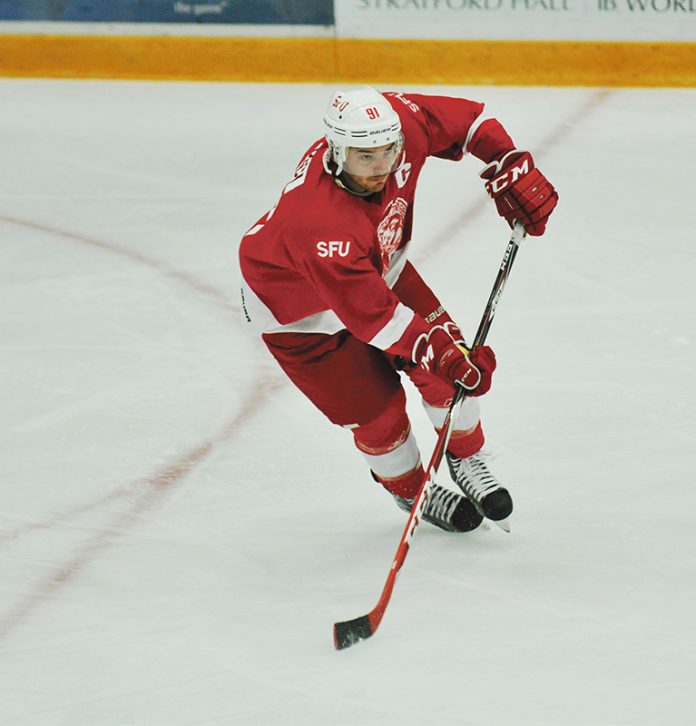
Jono Ceci got two assists in Saturday night’s game, extending his all time BCIHL scoring lead.

It was a mixed bag over the weekend for the Men’s Hockey team. The Clan won both games, but in extremely different fashions. The first game featured SFU coming back from a three-goal deficit and the ejections of their top defensive pairing to win in a shootout — the other saw SFU roar out to a 5–1 lead before winning 6–4.

“It was good to get on the road early in the second semester and come away with four points,” said Head Coach Mark Coletta talking to The Peak. “[It was a] good bonding trip for the boys, and we had some new guys in the lineup,” he said.

The first game on Friday night got off to a horrible start for SFU. Easter Washington managed to score two goals by the 8:56 mark of the first, both at even strength. It went from 100 to 0 for SFU real quick after that, as their top defensive pairing in Williamson and St. Pierre were both ejected for fighting. Eastern Washington scored on the ensuing powerplay to make it 3–0 and put the Clan in a huge hole.

However, SFU was able to battle back. A scoreless second led to an early goal by Brendan Lamont in the third, and goals from Robson Cramer and Saylor Preston tied the game at three heading to overtime. The game went to a shootout, where forward Tyler Basham scored the winner to give SFU an improbable three points.

“Well Friday night we had a bad start overall,” explained coach Coletta. “A couple of fighting majors that, while the referee’s discretion is always going to be his own, we didn’t think they should have been majors. So you’re down two defencemen right away, and then you’re down three to nothing.

“We got an early goal right away on the powerplay in the third, to make it 3–1, and that sparked the boys even more to find a way to battle. We just stuck to the systems and didn’t panic.”

Saturday’s game was a different tale. SFU was able to hold a 5–1 lead after two, thanks to some great shooting, as they scored three goals on nine shots in the middle frame. The third period saw Eastern Washington score three to make the Clan sweat a little at 5–4, but Matthew Berry-Lamontagna scored to restore a two goal lead and put the game to rest.

“I thought [the team] played really well,” said Coletta. “We came out in the first period and the second period way better than we had the night before. Our start was good, we kind of laid down in the beginning of the third there. But I think we weathered the storm and then went back to the game plan. We’ve been preaching stay the course, stay within the systems all year so far, and not trying to do stuff individually when you’re down a goal or two.”

The back-to-back situation meant a few players were able to make their season debuts. Dyllan Quon, Mak Barde, Mitch Crisanti, and Spencer Quon all made their debuts over the course of the two games.

“Dyllan Quon on the back end did a good job of jumping in and playing good defensive minutes for us,” coach Coletta elaborated. “Barden, Crisanti, and Spencer Quon did a good job of just finding their groove after four months of not playing any hockey games, and just practicing. [. . .] To be honest, there’s no substitute for practice versus games. I think they’re pretty tired after Saturday night.”

Men’s Basketball Suffer Blowout Loss to Western Oregon

0
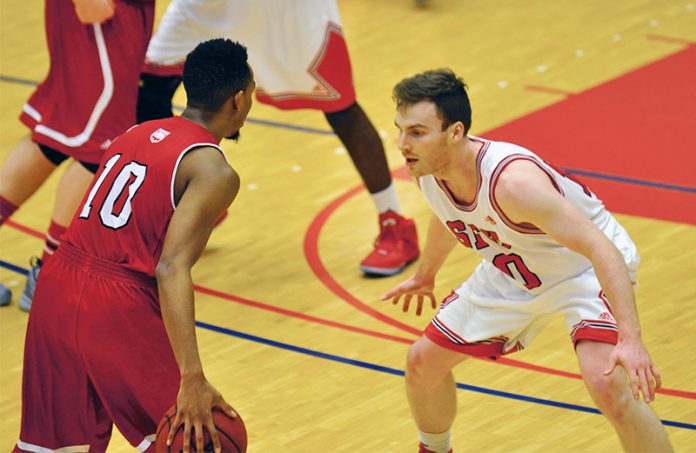
Michael Harper (right) finished with a team high 17 points.

The SFU Clan Men’s Basketball team was defeated 90–67 by Western Oregon Thursday night to fall to 1–12 on the season and 0–7 in GNAC Conference play. Western Oregon is now 6–1 in Conference Play and 13–2 on the season.

The first half looked very promising for the Clan with the team building an early 28–20 lead after Junior Guard Hidde Vos scored five consecutive points. This is when Western Oregon stalwart Andy Avgi began to take control of the game. Avgi was named the GNAC player of the week last week, averaging 29 points per game. The Senior Forward hit a fadeaway jumper and was fouled for the ‘and-one’ to tip the momentum in Western Oregon’s favour.

Clan Senior Guard Michael Harper drove down the lane for a basket and then scored on an ‘and-one’ in the closing minutes of the first half as the two teams traded blows in an intense stretch of action. With less than 10 seconds left in the half, Sophomore Guard JJ Pankratz drove to the basket and sunk a lefty layup to pull SFU within one. Unfortunately, Western Oregon sunk a buzzer beater to take a 42–39 lead into the half.

“I call him a silent assassin” – Head Coach Virgil Hill on Point Guard Andrew Williamson

The second half was all Western Oregon. Avgi took the game over in the opening minutes of the half scoring on jump shots, fade aways, drives to the basket, running the fastbreak, and setting up teammates for easy buckets. In the first 12 minutes of the second half, Western Oregon ripped off a 36 to 10 run that made the final eight minutes essentially garbage time.

Michael Harper led the Clan with 17 points and Point Guard Andrew Williamson scored 15 points in the first start of his SFU career. Coach Virgil Hill explained that the decision to start Williamson for the injured Max Barkeley was only made that morning. Hill stated how Williamson “had a great week of practice. I call him a silent assassin. Quiet guy [. . .] who plays with a sense of confidence and poise.”

Coach Hill also commented on the game and the team’s upcoming matchup. “Unfortunately the game is forty minutes and it’s a tale of two halves. We’ve come across this again and again, where we will be in a [close] game at the half [. . .] and then the first five minutes we just can’t seem to summon that next gear that the other teams do” he lamented.

Hill also discussed the challenge of defending a player like Andy Avgi. “We said we were going to pick our poison and not double team him. We let him get twos instead of [allowing open] threes.”

On the prospects for a victory this Saturday against Concordia University, Hill explained how it is “a very winnable game [. . .] we have been bullseyeing for the last week or so.”

Student inspires girls to “BeaYOUtiful”

2
BeaYOUtiful founder and SFU student, Taylor Hui. - Photo courtesy of Caroline Ross

In a society where the media dictates beauty standards, oftentimes a mirror can be a girl’s worst enemy. SFU student Taylor Hui has set out to change that mentality with her not-for-profit organization BeaYOUtiful. The program — which is aimed for girls in grades six and seven — spends six weeks focusing body positivity, self-confidence, and helping these girls to redefine ‘beautiful.’

The program was inspired by her experiences growing up. As a child, Hui faced negativity, competition, and bullying. Despite facing adversity, support from friends and family helped her get through the difficult times and propelled her into even bigger challenges, like facing the modelling and acting industries. Hui acknowledges, though that she was the exception among her friends.

“My parents were my biggest supporters, and helped me get through. Unfortunately, my friends had self-esteem issues, eating disorders, [and] very little support [. . .] my friend realized the importance of her looks in grade three,” Hui explained. “No girl should feel that at such a young age.”

So Hui made it her mission to help young girls. In grade 11, she came up with the current curriculum that BeaYOUtiful mentors teach throughout the six weeks. In grade 12, she was able to implement the program in schools.

Despite the enthusiasm that Hui felt for the program, members of the school board challenged her on her qualifications. However, Hui was determined to show the school board why she was fit for the job, despite her young age and lack of a degree.

“You can give me a textbook, sit me in lectures, make me memorize definitions. . . but you can’t be taugh+t experience,” she said. She stressed the fact that she didn’t want the program to be an extension of school, but a chance for them to connect with other girls and the mentors in a safe environment. “We’re not there to be a teacher or a counsellor. We are there to be a sister.”

Having heart-to-heart conversations, listening to speakers, and creating dream boards are some of the many ways that BeaYOUtiful instills confidence in the young girls. Hui asks that the girls be vulnerable so as to get “the most out of the experience.”

Since its inception, the program’s core team has expanded with people who share Hui’s passion for making a difference.

Alyssa Magahis, BeaYOUtiful’s events coordinator, first got involved when a friend asked her to join. After successfully mentoring a group of girls, Magahis was eventually asked to take on the role she currently has.

“I wanted to make a difference in other people’s lives, but didn’t really know how,” she said. “This program really warmed my heart and helped me achieve this goal.”

BeaYOUtiful, now beginning its fourth year, shows no signs of slowing down.

In 2015, Hui and BeaYOUtiful created the “Spoil Me Royal Project” to help one lucky girl have the ultimate prom experience complete with a dress, make-up, and a limo — a dream that many girls in the Lower Mainland are unable to afford due to financial struggles.

Possibilities for expansion into other parts of British Columbia, Canada, and the rest of the world are long term goals for Hui, but for now, Hui’s focus is set on reaching as many students as possible.

For those students that are looking to make a difference, Hui urges them to consider becoming a mentor for BeaYOUtiful.

Whether Hui is in front of the camera or travelling around the world, she ensures BeaYOUtiful will always be a “passion project” that keeps her grounded.

“[BeaYOUtiful] reminds me always that I am beautiful, and I hope that other girls will learn to see that in themselves.”

Sydney Shortt’s love of field hockey knows no limits

0
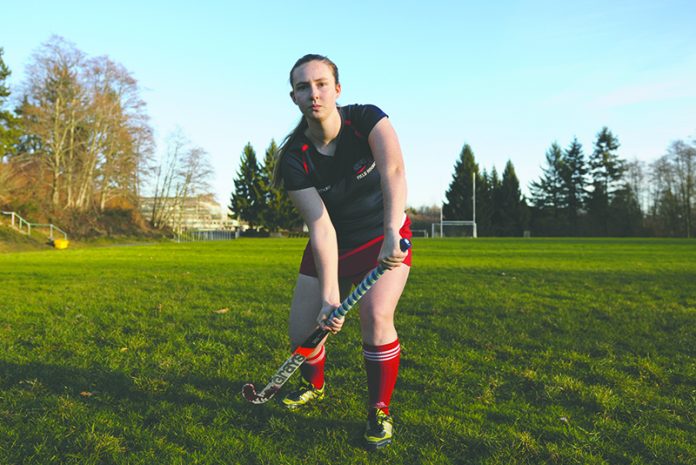
Sydney has had to balance field hockey with a heavy course load in Mechatronics.

Sydney Shortt is one of only 16 members of Simon Fraser’s women’s field hockey team. Combining an athletic schedule with an academic schedule, Sydney goes to two practices a week and at least one game every weekend.

While this may not sound overly time-consuming, consider this: the women’s field hockey team has nowhere to practice or play their games on SFU’s campus. This is because none of the fields on campus have the appropriate marking lines for field hockey. Instead, Sydney must take the bus, a ride from anywhere between 30 and 60 minutes (assuming the buses are on time) to her hour-and-a-half long practices, as well as her weekend games.

In total, what could be just 90 minutes of her time if the practices were at SFU’s campus, turns into about four hours total. The games themselves are four hours alone, not including travel. More than once throughout the term, Sydney has begun the transit to her practices only to receive a call 45 minutes into the trip that, due to poor weather conditions, practices have been cancelled.

“On the way back from a field hockey team event in mid-October, Sydney fainted and fell over, and was rushed to the hospital.”

With an athletic season that lasts six months from September until March, that time adds up, and the blatant waste can have a huge impact on Shortt’s academic schedule.

An engineering student, Sydney takes two math classes and a physics class with labs for each, as well as two Mechatronic System Engineering courses, each of which include lecture and lab components. Since all her classes are in Surrey, her day includes taking transit to those as well. Obviously very busy with a challenging course load, Shortt often has difficulty finding enough hours in the day. Maybe it’s just in the family genes.

Sydney’s mom Liz, whom Sydney describes as “adorable and pretty incredible,” played soccer all throughout university while obtaining a math degree. Now, she plays field hockey with a bunch of other moms. Sydney claims it’s “honestly the cutest thing I’ve ever seen.” The resemblance between their passions is uncanny.

Once or twice Sydney has been able to call her mom for help, whether it be for math or computer science. Most notably, however, was the time when Liz was called due to Sydney fainting on transit and waking up in a pool of her own blood.

On the way back from a field hockey team event in mid-October, Sydney fainted and fell over, hitting her head on the concrete ground in the Production Way SkyTrain station. Likely caused by her naturally low blood sugar and low blood pressure, she woke up surrounded by blurry faces and a pool of blood around her body. She called an ambulance and was taken to Richmond hospital. On the ride there, she called her mom, who immediately booked a flight for that same day from Calgary to Vancouver to take care of her daughter. It was determined that Shortt had nearly broken her nose and had received a minor concussion.

Sydney was out of field hockey practices for two weeks and out of games for an additional two weeks until she was cleared by doctors. She explained how frustrating the situation was, but stated that, “considering my major, my mental well-being comes before sports.” She also was able to spend time with her mom, and “had a really good time with her, even though I was only partially aware of what was going on.”

Back in the game now, Sydney reflects on the past four months. Despite not having earned as many wins as the team would like, she recognizes the odds against them: the team has no official coach, no home playing field, has no funding from the university, and isn’t considered a varsity team.

Reduced to club status, their funding comes mostly from the players themselves and the fundraisers they host. Sydney says that any external funding they received now would probably go towards a coach, a role they’ve been without all season. They recently found a temporary coach, Abigail Raye, who competed with Team Canada and appears to be a good fit, but they only have her for a month due to money issues.

So while Sydney is confident that this new addition will be a great help to the team, it’s a very short-lived victory. Sydney remains hopeful that the budget situation will improve over the following months and that Spring term will bring more wins, fewer injuries, and maybe even a coach.

Fun Fact

When asked what Sydney likes to do outside of school and sports, she replied, “All I do is play sports and be a nerd.” She hopes to one day design and engineer robots intended to go into space and mine asteroids.

Board Shorts

0

Build SFU moves forward

Build SFU General Manager Marc Fontaine announced that this past December, SFU signed a loan for $44.3 million for the building of a new Student Union Building. The loan, which is set at a 4.135 per cent interest rate, will be for a 20-year term commencing on December 31, 2018 and continuing until 2038. In the next few months a contractor for the building of the new SUB will be searched for.

Construction is scheduled to begin sometime this summer.

New U-Pass contract

VP Student Services Darwin Binesh announced that the SFSS had come to an understanding on a new fee for the U-Pass system and the SFSS is preparing for an upcoming referendum to approve the new fee. He also noted that the new contract might change the way that opt-outs are handled.

Currently five per cent of students are eligible for opt-outs by falling into a specific category, with one per cent being eligible for a discretionary opt-out typically reserved for students who live in areas not serviced well by transit. Currently this one per cent cap is being pushed by demand and so the new contract may create a new category in the five per cent for these students.

Kinder Morgan NEB hearing

Both the SFSS and Graduate Student Society (GSS) will present oral arguments in front of the National Energy Board (NEB) on January 22 at the Delta Hotel in Burnaby over the proposed Trans Mountain Pipeline Expansion that will see another pipeline added to Burnaby Mountain. They will be voicing their opposition to the pipeline.

SFU athletes team up for Consent Matters video

0
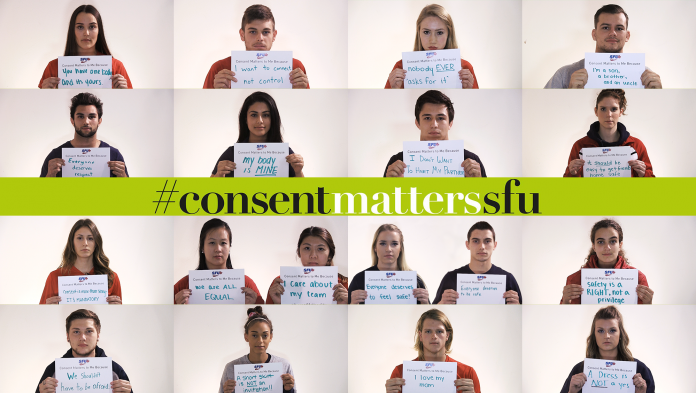
Representatives from every varsity sport appeared in the video explaining the value of consent.

Sexual assault on universities campuses across BC is a real and pressing issue, and the athletes of the SFU Clan are doing their part to put a stop to it by collaborating on a video discussing the topic. The video was put together by the Student Athlete Advisory Committee (SAAC), a group consisting of representatives from all SFU varsity teams, including the football, basketball, volleyball, and track and field teams.

“All NCAA schools are required to have a campus SAAC,” explained Ryan Yewchin, one of the representatives for the Men’s Wrestling team, as well as the representative for the GNAC conference at the NCAA Division II level. “SAAC provides a way for student athlete engagement and acts as a liaison between student athletes and administration at the institutional, conference, and national levels of the NCAA,” Ryan said.

The video is part of a larger, top-down initiative by numerous Division II schools, as part of the US White House’s “It’s on us” initiative. It features athletes from various SFU athletic teams describing why consent matters to them, indicated by a written card.

“As a member of national SAAC it’s one of my responsibilities to ensure initiatives at the National level are communicated to and acted on by SFU and the GNAC as a whole,” said Yewchin. “On a personal level, I am very motivated to address and engage with topics surrounding sexual assault and interpersonal violence. Being able to speak publicly and work with Health and Counselling to engage and dismantle rape culture is a powerful opportunity.”

“I want people to know about consent, and be aware that it does matter.”

          – Helen Yan, Volleyball Player


“It’s always been an important issue, just morally and ethically speaking,” explained Helen Yan. She is one of the representatives of the Volleyball team, and is featured in the video. “I think it’s important to show, especially from both female and male points of views, why it’s important to each person individually. It’s not something that people like to talk about typically, but people need to talk about it. It has to be put out there publicly, that it’s not OK without consent.

“I grew up in a predominantly female household,” Yan continued. “My dad had to work somewhere else, and I had a lot of friends who had gone through issues with consent. But when I was younger we didn’t know any better. But now that I’m older, looking back I realised people should have probably helped [those friends] — they should have talked to someone. So now, growing up and reflecting on the past, I want people to know about consent, and be aware that it does matter.”

The video was made with the assistance of SFU Athletics, who helped in the production aspects. The two organizations worked in tandem to insure that the message came across in a powerful way.

“Vital work for both the video and the Consent Matters campaign as a whole was also done by Rebecca Langmead, a former basketball player now working in health and counselling,” elaborated Yewchin. “Steve Frost, our sports information director, and Gabe Lynn were also fantastic to work with from the production aspects of the video,” he continued.

As of publication time, the video has over 1100 views in over a week on YouTube. Ryan attributes the success of the video to the way the message was delivered, as well as the production quality of the video.

“The reception to the video has been overwhelming positive,” said Yewchin. “Gabe Lynn did a phenomenal job filming and editing the video. It does a great job allowing the student athletes in the video to express why dealing with sexual assault matters to them. Seeing my friends and teammates have the courage to show why this is such a personal topic is extremely powerful.”

You can get involved with the #ConsentMattersSFU campaign by visiting their information booths at the Burnaby campus on 20th, and 27th, and Surrey Campus on the 26th, or by sharing your answer to “Why does consent matter to you?” on social media using the hashtag. Members of the community are encouraged to familiarize themselves with SFU’s sexual assault website: www.sfu.ca/sexual-assault.

Stop looking for reasons not to be a feminist

50

[dropcap]F[/dropcap]eminism is the F-word of 2016.

I like to think that most people in this day and age are feminists — self-proclaimed or not. Yet a lot of people I encounter are very against this movement, and some are even offended by the word itself.

“Oh no, I’m not a feminist!” they say in a hushed whisper, like I’ve just accused them of murdering their own family. The conversation will then suddenly shift, and then they’ll give me their “reasons” as to why they aren’t a feminist. And frankly, their reasons suck. Here’s a few I’ve encountered, in order of popularity.

Reason 1: “I don’t hate men!”

First, let me pull out my trusty dictionary, because you seem to have confused feminism with misandry. Feminism is the belief that all genders should be treated equally. Yes, different schools of feminists have different ideas behind the resolution of the world’s current inequality, but, at its most basic, this definition is what feminism is. Equality for everybody. If you think all feminists hate men, you’re sorely mistaken.

Reason 2: “Feminism isn’t equality since it’s all about women.”

Feminism is precisely about equality. It is called feminism because in the gender binary of male/female identities, privilege has mostly been granted to males over females as Western society has been traditionally patriarchal. It is not about the limitation or denigration of men, as many people mistakenly believe. Rather, it is about elevating the position of women, and other less privileged groups of people, to an equal status.

If you think all feminists hate men, you’re sorely mistaken.


Reason 3: “I don’t like the name. I consider myself a humanist/egalitarian.”

All of these terms are relevant when we talk about equality, but they are not interchangeable. Feminism focuses on the disparity between the societal power of the genders and aims to eliminate that difference. Humanism and egalitarianism predate feminism, because they came before the idea that women should legally be seen as persons.

So just to be clear, humanism focuses on equality, but mostly in regards to secularism. It is predicated on acknowledging that religion is not a requirement for ethical reasoning. By and large, humanism focuses on the use of logic to advocate for freedom of thought, tolerance, representative politics, and education for all.

In contrast, egalitarianism focuses on a fundamental equality that entitles everyone to certain resources (such as food, shelter, social status, respect, etc.) in the hopes that an equal allotment of goods will achieve overall equality. Egalitarianism, as a resource-centric approach, it doesn’t carry forward the same nuanced conversations about gender.

Despite the fact that all three advocate for a version of equality, the inequalities focused on within each theory are different. Ultimately, this is why they are different terms and not interchangeable. If you think all genders should be treated equally, then you are a feminist. There’s nothing more to it.

Reason 4: “I’m a guy. Feminism doesn’t do anything for me.”

Au contraire, my friend. Sadly, this is a response to feminism I hear frequently. Sometimes it stems from ignorance, other times from a place of insecurity. There’s the fear that if others are evaluated at an equal level, men will be pushed aside for their female counterparts. And though it is an unfortunate, divisive fear, it is nonetheless a real one.

Unjustly real, however, because feminism doesn’t just help women or underprivileged genders — it helps everyone, including men. Part of feminism lends itself to the breaking down of traditional gender roles. Although these vary from culture to culture, there are some gendered stereotypes that transcend those differences.

Feminists want to do away with socially-imposed limitations on what somebody has to be (or not be, for that matter) in order to be accepted by society. What the abolition of such restrictions will do is free all genders, males included, to be themselves however they choose. For instance, men are generally seen as the providers rather than the caregivers — a role women traditionally fill. Along with this title comes a handful of attributes that are seen as ‘manly,’ and which all men are expected to be; tough, stoic, and unemotional, to name a few. These in place can suggest that men should not be otherwise.

Reason 5: “It’s 2016. Do we even really need feminism?”

Reminding me that it’s 2016 isn’t proof that we don’t need feminism. But to answer the question, yes, in 2016 we still need feminism. While we may have come a long way, gender inequalities are very real today. I have experienced gender discrimination first hand, and I know that we need to continue to take steps against misogyny and prejudice.

This is my story. I used to be a senior line cook. I had a good gig being the night shift supervisor at a nice little bar. I was in charge. Now, I’m assuming you don’t know much about the politics of the culinary realm, but you should at least know that female chefs and cooks are pretty rare. We can’t take any shit and we have to be better than any guy in the same position. It’s tough.

A woman you care about has a story just like mine.


So cue me being a badass, running the kitchen with a new guy I’ve never worked with before. Now, kitchens have a clear hierarchy. The “new guy” is lowest you can be on the pyramid, and that means dish duty. No glory in the dish pit. You scrub, you rinse, and you prep stuff for the line cooks. Everyone starts there.

In that regard, kitchens are egalitarian. But on the guy’s second shift — and keep in mind he barely knew the menu, didn’t know how to plate the dishes properly, and hadn’t memorised where things were kept — he decided that taking orders from a woman was not something he was willing to tolerate.

I’m the supervisor, so I was filling orders and asking him to fetch things so that everything would run smoothly. But three hours in, during the middle of the dinner rush, he just stopped in his place, and said that he was done being the ‘kitchen bitch’ and that he was going to cook because that’s what he was hired to do.

“You’ve spent two days on the job, you don’t graduate that quickly to the line,” I told him. “When you know what you’re doing you can cook, but that’s not now.” I was trying to diffuse the situation, and get him back to his job so that I could do mine.

“I know how to cook and you aren’t going to stop me.” He almost sneered when he said it before he disappeared into the front. Two minutes later the bar manager walked in. He kicked me to the curb and let the new guy run the show.

My pride was hurt and I had to save his ass a few times that night, but everyone got their food — and that’s what’s important. Cut to the end of the shift, when we were cleaning the kitchen in a testy silence. “What the hell is your problem with me?” I finally asked, because frankly I deserved to know.

He snorted, full of derision. “I don’t take orders from girls.”

This is why we need feminism. No one should be derided, shown prejudice towards, or otherwise discriminated against because of their gender. It’s all too common of a problem. My story is not unique. Any woman can tell you her story of being discriminated against simply for her gender; a woman you care about has a story just like mine.

Feminism is not about bringing down males to the position of everyone else. It’s about lifting everyone else up to that plane of privilege, where someone is evaluated by their abilities and not solely by their gender identity.

So if you’re not a self-identifying feminist, I only have one question: why? Seriously, stop looking for reasons to not support gender equality. It’s 2016.


SFU prepares to cut a rug for annual Dance Marathon

0
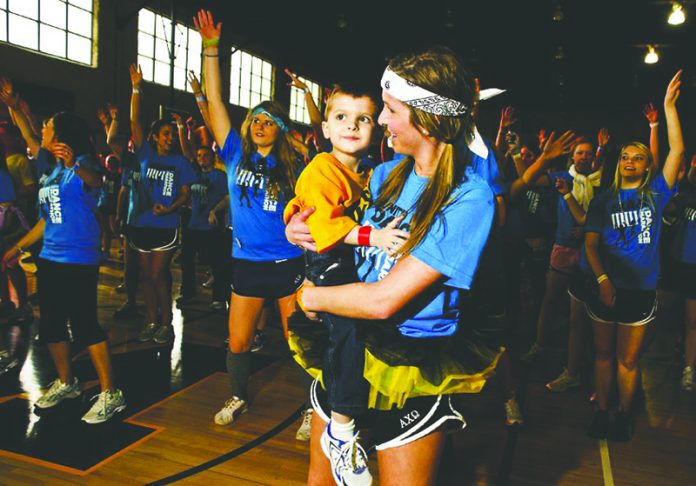
This year’s Dance Marathon is promised to feature 10 full hours of dancing. - Photo courtesy of SFU Dance Marathon

SFU will be putting their dancing shoes on once again for the third annual SFU Dance Marathon (SFUDM), an event organized by a dedicated team of students in order to raise funds for the patients at BC Children’s Hospital.

In the 10-hour event packed with games, activities, and a whole lot of dancing, SFU students will be participating to raise funds for the kids at BC Children’s Hospital. “SFU Dance Marathon is not only a philanthropic event on campus, but we are part of a greater movement across North America,” said Caitlyn Schwab, co-president of SFUDM. “Over 300 high schools and universities work in part with Children’s Miracle Network to run Dance Marathons. Together we have raised over $106 million dollars for local children’s hospitals.”

Participants will also have the opportunity to win prizes throughout the night, as well as hear speeches from BC Children’s Hospital’s miracle children. The team is already hard at work fundraising for the kids, as they held a “Bowling for Miracles” night in December and partnered with Chop Shop Hair Salon in New Westminster, with the proceeds of each haircut going towards their cause.

Amy Gill, the team’s Public Relations Officer, outlined the vision of the marathon this year. “The goal for this year is to raise $25,000 for the BC Children’s Hospital,” she explained. “Apart from that, another major team goal this year is to raise more awareness about SFU Dance Marathon — not only within the SFU community, but across all of the Lower Mainland.”

Each executive team member has their own personal reasons for getting involved with the cause. Schwab’s nine-year-old cousin was born with a severe heart defect, and underwent three open heart surgeries at BC Children’s Hospital.

“If it was not for the incredible work done by the staff at BC Children’s Hospital, my family would not be so lucky as to have my cousin [here today],” she said.

This year’s marathon will be held on February 20, 2016, and registration for dancers to join individually or on a team is now open on the SFUDM website, and volunteer applications are also live on the site until the countdown for the big day. Yasamin Houshmand, internal relations officer, said of SFUDM’s opportunities for students, “We are helping students gain valuable leadership, sponsorship, event planning and technical skills [in the process].”

For community outreach coordinator Marlena Ornowska, the Dance Marathon has a special place in her heart. “It is hard to describe [how special the event is] to someone who has not attended a dance marathon before,” said Ornowska, “but the message and sentiments of this movement stay with you for so much longer than just the duration of the event itself.”

It’s about who you’re with, not where you’re going

0

jaimequebec janis Mcmath

[dropcap]E[/dropcap]veryone, at some point in their lives, fantasizes about travelling the world and exploring different cultures. I am no exception. I would find nothing more fulfilling than the life of an explorer: constantly travelling, learning new languages, and immersing myself into different cultures. That is the reason that, on my high school road trip to Ottawa, Montreal, and Quebec City, is an experience I wouldn’t exchange for anything else. That fast and fleeting trip, which was about four years ago now, when I was 16, transformed my travel dreams into a reality.

My experiences provoked a life-changing moment for me about the significance other people have in our lives. This trip allowed me to see how, by and large, a culture is based off the people within it. As someone who prefers her own company rather than large group settings, it was jarring to realize how important locals are when you are getting to know a city. As intriguing as the new culture was, it was the people I travelled with and the new people I encountered that made the experience life changing.

Being on the bus was an experience in and of itself. Hours were spent traveling to cities and moving about within them. The bus rides in between our destinations were as every bit exciting as the cities themselves. The energy on the road was electric. We spent countless hours laughing and being silly. I always smile when I think of how we all formed a line on the isle of the bus to sing and dance to some cheesy Brazilian pop song. I cringe but laugh at all the immature things we did, like taking pictures of ourselves “smoking” fake cigarettes we bought in a gift shop and sending those photos to our parents.

Despite our childish antics, this was still a time of great personal growth for me. It felt like a more confident and social personality was replacing the quiet, shy person I was before. This trip helped me re-invent who I was and how I engaged with the world around me.

It was the people I travelled with that made the experience life changing

The most interesting thing about francophone cities in Canada is that they all have very different personalities. Ottawa was calm and serene. Montreal was vibrant and chic. Quebec City was quirky and intriguing. It felt like each city was a different country. I remember the trips in fragments. I remember eating deep-fried beaver tails and poutine, speaking my terrible French frequently, interacting with street artists who were drawing cartoon portraits of people, and marvelling at the centennial flame.

While most tourists try to blend in, our group embraced the experience of being a tourist by wearing white hoodies with J’aime Quebec written across the chest. In Montreal, we danced on the streets as the locals laughed and took pictures. In Ottawa, my friends teased me because I could never move fast enough for a decent jumping picture.

All the cities I visited were breathtakingly beautiful and aesthetically pleasing. The food was amazing and the attractions were captivating. But it’s people that created the space for me to feel free to break out of my shell that made this experience what it was.

Would I have discovered my love for travel if my travel companions were uptight and anti-social? Would I have laughed as hard if the locals did not laugh along? Would I have shown my weird and silly side if other people did not embrace those things?

I don’t know. All I am sure of is that my impression of the cities were influenced by the company I traveled with and the locals that shared their culture with me. I am lucky to have been around a group of people that were open and positive.

If you travel the way I did, you’ll never want to come home.