Home Blog Page 872

Campus group advocates for on-campus sexual assault centre

0

Studies show that one in five women will be sexually assaulted on a university campus as students. These incidents are an unfortunate reality on post-secondary campuses — and SFU is no exception.

Student groups at SFU have been campaigning to open a centre for sexual assault prevention and support on campus to raise awareness and to offer resources to survivors of sexual violence. SFU is one of the few Canadian universities not to have already established one.

An independent, student-run working group was formed in August, 2015 to develop a proposal for a Sexual Assault Prevention & Support Centre at SFU (SAPSC), that would ne inclusive to all genders, not just women.

“Anything less than a centre would be inadequate on campus,” stated Kaayla Ashlie, a fifth-year gender studies student who sits on the committee for the SAPSC.

Although there are services in place on campus, Ashlie believes that it is not clear enough where victims should seek help — and that one localized and dedicated centre would make help more accessible for those in crisis.

Current resources at the university include Campus Security, SFU Health and Counselling, Out on Campus, and the SFU Women’s Centre, which offers a 24-hour safe space for women, to name a few.

The idea behind the creation of the SAPSC would not be to develop new resources from the ground up, but to create a hub that can connect people to the services already in existence, thereby relieving the burden on groups that are going beyond their mandate to support victims of sexual assault.

Ashlie expressed a need for “ongoing educational campaigns to really shape the culture of SFU, and what is acceptable and not acceptable on this campus.”

Laura Scheck, who also sits on the committee, commented that it can take people a long time to come to terms with something that has happened to them — and it’s not always black and white. “Unless you believe that a blatant crime was committed against you, you’re not going to go to security,” she said.

“A lot of people don’t identify as being in crisis when they’ve experienced sexual violence. And this has to do with those weird grey areas, where you’re not sure what happened to you and you’re not comfortable with it.”

She explained that it would be a starting point for seeking help, and provide support if people wanted to go to counselling, have a rape kit test done, or take legal action.

Administration has stated that SFU takes the issue of sexual assault very seriously. Associate Vice-President, Students Tim Rahilly told Burnaby Now, “This is very serious business and has a huge impact on the lives of people when this happens, so we take it very seriously.”

The Consent Matters campaign was launched earlier this semester to open up a dialogue around consent and to educate the SFU community about how to prevent sexual violence.

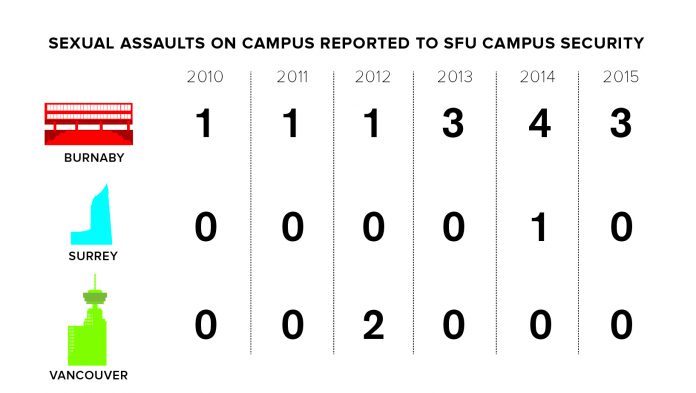
There were three reported assaults across SFU’s three campuses in 2015, and five total in 2014. While these numbers may seem comparatively low to other institutions, research shows that these statistics across Canadian universities are not an accurate representation of sexual violence on campuses, which is believed to be largely due to underreporting of sexual assault occurrences.

For the working group, the centre cannot be established soon enough. The student-led committee plans to ask for support from the student body by referendum in Fall 2016. Their final proposal will be based on consultations with various SFU offices, faculty, administrators, and student groups, as well as research on similar centres running at other Canadian universities.

The group’s original aim was to put the question to Simon Fraser Student Society (SFSS) members in the upcoming general election, but the referendum has been delayed while their legal status as a non-profit society under the BC Society Act is pending. The group will continue consultations with the SFU community as they work on the proposal.

The current cost the group has calculated puts the proposed student levy at $2 a semester, but that figure is subject to change as more research is done and efforts have been made to involve other groups on campus that could potentially pay into the centre as well.

The SFSS board of directors passed a motion to look into what sort of services could be offered through the SFSS to aid in prevention of sexual assault and to provide support to those who have been assaulted.

The centre would be run autonomously from the university. SFSS VP External Relations Kathleen Yang said, “I think independence with these types of organizations is absolutely critical.”


Boxer Briefs

0

Seven-year-olds come out for first annual pre-fetus Chitter gathering

[BURNABY] – Makers of the popular confession-app Chitter held their first gathering for pre-fetuses, a term coined by the Chitter community to refer to those who have yet to become the adult age of 18. The event took place right outside the Highland Pub on Saturday. Participants had shots of chocolate milk and created their own makeshift identification cards by drawing on cardboard with crayon — all while Chitting about it, naturally.

Fraser library game room taken hostage by sleep deprived students

[SURREY] – A group of students suffering from the common condition nofucksgivenitus hijacked the Fraser Library game room last Friday. The group of 20 extremely sleep-deprived students resembled a zombie herd, reported witness Guidi Gardio.

“They also had terrible taste in video games,” Gardio told The Peak. “They were playing the Ice Age 3 game on the Wii, Xbox, and PlayStation for a solid three hours.”

Elderly travellers mistake SFU’s downtown campus for airport

[VANCOUVER] – A couple heading to Brazil for a weekend getaway missed their flight as they mistook the study areas at the Vancouver campus for their boarding gate. They had ‘checked in’ at the student services counter and sat comfortably in their seats for a good two hours. “I was loving how lax the airport security in Vancouver was,” marvelled Antonio Bandera, an elderly gentleman from Portland, Oregon. “Then I realized that stress-free travel is still a dream.”

Men’s basketball season review

0
Oshea Gairey (right) averaged 13.3 points per game, and was in consideration for GNAC Freshman of the Year.

Some nights they’d look competitive. Heck, on some nights they’d even have a lead at the end of the first half. But even on those nights, usually the other team took over and dominated the second half, leading to yet another loss.

“We would have [good] halves here and there, but it could never be two halves in the same game,” said Head Coach Virgil Hill. “We showed moments — brief flashes of solid play — but we just couldn’t be consistent enough stringing that together for an entire game.”

In the end, the men’s basketball team finished with a 2–24 record, and won just one conference game.

“Ultimately, it’s about winning and that’s what we weren’t able to do.”

The other win came against Douglas College, who plays in a lower level league and whom SFU regularly trounces — last year SFU beat them by 90 points and three years ago handed them a similarly impressive 70 point loss. This year? A relatively close 78–58 victory.

This is a team that underwent an 18 game losing streak. After finally winning a surprisingly dominant game 90–70 against Concordia, for their first and only conference win, in the middle of some very competitive losses, the team closed out the season with five straight losses — losing the last three by 20 points or more.

It’s an understatement to say that this team didn’t fare too well in the wins column.

“The challenge was probably greater than my expectations, I mean I expected that we were going to be able to manipulate some wins and coach them up a little bit and be able to surprise people and perhaps get more wins than we did,” said Hill. “Internally, we had higher expectations for ourselves as coaches and as a team. I think we found out the hard and cold truth, that we weren’t as good in all facets and we have to get better.”

To say it was unexpected, however, is not a true assessment of the season either. The team lost its four top scorers from last season: senior point guard Sango Niang, who led the Great Northwest Athletic Conference in points per game and was 13th in the entire NCAA Div II; junior Roderick Evans-Taylor transferred to Cal State-LA; senior Justin Cole; and promising 6’8” freshman Patrick Simon transferred across town to UBC.

With the combination of the loss of graduating seniors, and a high turnover caused at least in part due to a change in coaching staff — Hill taking over from coach James Blake, who had coached the team for five years, the result was a rebuilding year.

“Ultimately, it’s about winning and that’s what we weren’t able to do. So if you look at it in that perspective, it certainly wasn’t successful,” said Hill.

“Would I call it a failure? Partially, but it’s part of the process — you don’t win overnight and the program has struggled, especially in the era of the NCAA, and we haven’t quite found the right formula, in terms of how it’s going to be successful moving forward. And that’s what I’m trying to do now, trying to find that right formula, in terms of the right guys you need to recruit, given our budgetary constraints, how that’s going to play out.”

The term success — if it could be used to describe this season — would perhaps be used to describe the development of some of the younger players.

Oshea Gairey came in ready to play in this division in his freshman year, averaging 13.3 points per game and hitting the 20 point mark four times this season. If he stays for four years, he will almost certainly be the star of the program.

Redshirt freshmen Andrew Williamson and Bowen Bakken, two players Hill said he “didn’t expect anything from [. . .] at all,” have come into the lineup and become effective role players. Bakken has shown an ability, at times, on the three point line, playing more minutes than in an ideal situation — averaging 20.25 minutes in February after only averaging 8.9 minutes a game before that. Williamson has emerged as a workhorse, regularly putting up 30+ minutes in his last three games, with an ability to produce points, hitting double digits in those games.

“You don’t win overnight and the program has struggled.”

Redshirt-sophomore JJ Pankratz could also put up points and looked impressive on the three point line. He will be undoubtedly expected to jump into a bigger role in his junior season.

Gibran Sewani, who is in his junior season and as of now will be SFU’s only senior next season, showed flashes of brilliance, often making or attempting impressive plays like slam dunks or alley-oops, but couldn’t find consistency. If he finds that consistency, he’ll probably be one of the most exciting players to watch. And with senior Michael Harper’s departure, they’ll need it.

Perhaps the biggest disappointment, aside from the losses of course, was the departure of junior transfer Max Barkeley. He led the team in points per game and was always exciting to watch, with a visible passion on the court. With four games left, he left the team, and his absence was particularly noticeable in the final three games — one of which SFU shot only 58 points. However, being a junior, Barkeley only had one more year, and would not have fit into long term plans.

One of the biggest things Hill believes the current players need to work on is their “strength, getting bigger and stronger” and being “able to play at the next level of speed and be productive” at the Division II level.

“We need to get more athletic. To me, that’s obvious. You look at other teams in warm-up and we’re the least athletic team in the entire conference,” explained Hill. “Now, there aren’t many great athletes in the province of BC, so that begets another problem, now you have to go outside of the province to find that type of athleticism. That’s expensive, it’s hard because now you’re trying to recruit people where you’ve never really met them,” which makes it difficult to get a feeling for their character, says Hill. “You can be the best athlete, and if you’re a low character guy, it doesn’t really matter.”

As of now, the men’s basketball team has two new signees. Guard Kedar Wright, who played two seasons at UBC, was supposed to play for SFU this year, but will instead play next year. Wright averaged 11.8 points per game, and put up 23 points in 40 minutes in a CIS playoff game.

The other signing is Chase Hobenshield, 6’7” centre from GP Vanier Secondary on Vancouver Island, where he plays under SFU alumni Larry Street. Street told the Comox Valley Record that Hobenshield “may be the best post in the province.” Hobenshield is expected to redshirt.

Hill hopes that next season the may even compete for a playoff spot.

“I don’t know if this is realistic or not, I mean I’m being optimistic when I say this, but battling for that last playoff spot, battling for sixth place, that sort of seventh or sixth spot,” explained Hill. “But again, I don’t know how realistic that is at this point without recruiting. Obviously recruiting can change those fortunes quite quickly, and all of a sudden we go from the one win to 10 wins in a hurry.”

“Everyone just has to get better, and they don’t understand that you  have to be ready for this — mentally, physically, emotionally, technically, you have to be ready in all phases — and a lot of the guys just weren’t, and they didn’t really know.”

Mathew Berry-Lamontagna’s journey with hockey

0
Berry-Lamontagna is third on the team in scoring this season, with 19 points in 23 games.

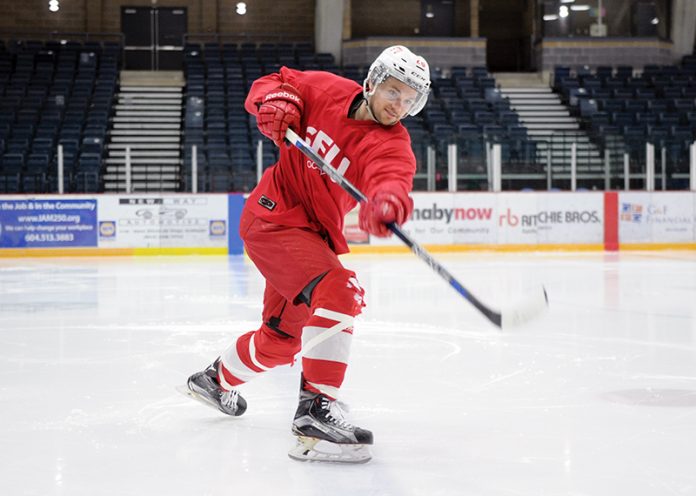
It takes a great amount of commitment to get to a high level in hockey, and Mathew Berry-Lamontagna is a perfect example of this commitment. Having started playing the game at an early age, he has been to many towns and a part of many leagues — including the highest level of junior hockey in Canada — before coming to SFU to join their hockey team.

“I would have been probably around four,” said Berry-Lamontagna on when he started playing hockey. “[I] played in the basement with my dad and just started skating around. He was the one that really got me into it. I’ve been playing ever since.”

From there, Berry-Lamontagna was picked up at 16 by the Prince Albert Raiders, a team in the Western Hockey League.

“I was playing Major Midget in my region, which is the Vancouver region. I played two years there, when I was 15 and 16. In my second year, I kind of had a bigger role [. . .] I was captain, got to develop a bit more.

“[The team] approached me after one of the games — I guess they had been watching me for a while, they had put me on their 50-man protected list, so I became their property, they owned my rights in the WHL. I went to spring camp, and then the main camp in the fall, and they offered me a contract.”

In Prince Albert, Berry-Lamontagna had the chance to play with and against elite level players, including teammate Mark McNeil, a first round draft pick of the Chicago Blackhawks.

“It was really cool,” he said. “You get to play with some really highly talented players. First round picks, guys that are sent down from the NHL back to their WHL teams. I kind of learned what it’s like to be a professional, see how those guys conduct themselves and work ethic, and stuff like that. So that was good learning experience for me.”

After two years in the WHL, it was off to the BCHL. He played a full season for the West Kelowna Warriors, before being traded to the Coquitlam Express, and again midseason to the Cowichan Valley Capitals. That made it four different cities in three seasons for Berry-Lamontagna.

“It’s really cool, actually. You get to meet people you probably wouldn’t get to meet otherwise,” he said on moving around so much. “You live with billets, so these people open up their homes to you, to live with them and experience living with a different family and living away from home for the first time.”

We have a pretty special team this year and there’s guys that we want to win it for.

“My first time I was away, I would have been 16 when I went to Prince Albert. [. . .] It makes you grow up pretty quick. But all the families I stayed with were great and made my transition really easy.”

Players “age out” once they hit 20 in junior hockey, meaning they are no longer eligible to play. That’s when SFU Hockey Head Coach Mark Coletta came calling.

“Mark Coletta contacted me my last year of junior. [It was] kind of getting to the end of the year and around the time where he starts his recruiting. I got a call from him, we talked, went through the recruiting process, and decided this was a good spot for me.

“I had never met [Coletta] before. Just through the phone calls. My coach in Cowichan at the time, Bob Beedie, he had known Mark, so I kind of had an idea what he was about, knew he was a good guy, good intentions, so it made it a little easier.”

It has turned out to be a good decision. Berry-Lamontagna has become an integral part of the team, and a constant on the back end. He is third on the team in scoring, with 19 points in 23 games this year, including a three-goal, six-point performance earlier in the year against rivals Trinity Western. The hat trick was the first of his career. “That was kind of cool, something that doesn’t happen too often for a defenceman,” he said.

“It was a weird game, a high-scoring game. [. . .] Our play play went four for five, we scored on our first four ones. It’s one of those things where everything seemed to be clicking, especially for myself. Shots from the point sometimes don’t get through, sometimes they get blocked, but that day they were getting through and hitting the back of the net.”

With the playoffs approaching and their spot ensured, the team is solely focused on winning the elusive BCIHL championship, something that came very close to happening last year before they fell to Selkirk College.

“I know the guys here, from last year especially, are pretty bitter about it. We got guys [like] Jono Ceci, he’s been here for five years, all-time leading point getter in the BCIHL, and he hasn’t won it yet. We don’t talk about it too much, but I think everybody knows that we have a pretty special team this year and there’s guys that we want to win it for, like the senior guys. We have a special team, but it’s going to be a lot of work.”

After school, Berry-Lamontagna plans to try to make it professionally, wherever that may be.

“I’ve kind of always liked the idea of trying to go play pro somewhere overseas [. . .] I’ve put so much time and hard work into the game I think it would only be fair to myself to give myself that opportunity if it came. Obviously school, to get my degree comes first. But after school is done, I’d like to try to do that.”

Fun Fact

Mathew Berry-Lamontagna is no muggle. “I’m a big Harry Potter fan, to be honest with you. I grew up on the Harry books. I was a big Harry Potter fan when the movies came out.”

Why I’m done with Starbucks

3

[dropcap]S[/dropcap]tarbucks, why you gotta play me like this? I thought we had something special. Now you’re throwing away what we had and are replacing it with something awful.

The general principles of your Rewards system remain the same — register a Starbucks card, spend money, get stars in return, and use stars to redeem free rewards. But your new system you’re rolling is ridiculous compared to your current one.

First, instead of three levels in the Rewards system (Welcome, Green, and Gold), the new system will only have two (Green and Gold). Instead of beginning in the Welcome level and progressing to the Green after attaining five Stars, everyone is automatically given Green status. To progress to Gold in the current system, it only takes 30 Stars. In the new system, it takes 300.

The way to earn Stars has changed, as well. Instead of earning one Star per transaction, the new system awards two Stars per dollar spent (or one Star per fifty-cents spent). To redeem these Stars for rewards, the 300-Star Gold level must first be achieved. After this, for every 125 stars collected, a person obtains one free reward.

Simply put, you’re fucking over me and tons of other tight-budget students with your new and “improved” Rewards system. Please tell me it’s just a dream, because I cannot jump from 30-star to a 300-star Gold status, along with all this other ‘rewards’ baggage.

Maybe this is where we part ways, my old friend.

Sure, you’re trying to soften the blow by offering monthly ‘double Stars’ days, but when you already send me email-offers for extra Stars in the current rewards system, I can’t help but feel cheated because a Star goes a lot farther right now than it will in April when you officially introduce your revised program.

How about this — after collecting 125 Stars, I get a share in your company.

One hundred twenty-five stars for a free drink? That’s a whopping $62.50 to get those stars! And you only get that free one once you’re a Gold-level customer, which requires 300 stars on top of that.

And I’m sure you’re thinking that I should just take my coffee business elsewhere. You’d be losing out on couple hundred bucks a year — a mere drop in the bucket for you. But multiply that $200 by every other student who can find more buying power at another coffee chain and maybe you’ll understand why this is such a crap deal for us and for you.

Don’t tell me it’s because you can’t afford to keep the system as is, Starbucks. Don’t lie to me on top of breaking us apart. If you can afford to pay Howard Schultz, your CEO, $149.8 million in 2013, I think you can afford any money you’d be ‘losing’ without your new program.

So how about this — with every purchase, I collect my Rewards Stars according to your ridiculous new ratios, and after collecting 125 I get a share in your company (valued at about $78 CDN at time of publication). That would make this a win in my book. Or, you know, instead of screwing yourself over by giving me more in stock than it would cost you to just keep things the way they are, you could just forget about this entire bad idea.

Think about it: all the reprinting costs, new marketing, and media strategies, the blowback from people like me who’ve crunched the numbers and decidedly deemed that this is whole ordeal is crap — you could avoid all of this. Personally, I believe spending less money for better return is always preferable. Especially when things like post-secondary education cost money.

It was good while it lasted, mi amore, but now you’ve lost me forever. Farewell, Starbucks.

SFU hold third division Toronto FC II to a goalless draw

0
Adam Jones (centre) and teammates were not able to crack a tough TFC defence.

The SFU Clan men’s soccer team showed that they could play with the big boys after they went out and drew 00 with TFC II on a rainy Friday evening.

TFC II plays in the USL, which is the third division in the American/Canadian soccer pyramid, and they are a feeder team for the MLS side Toronto Football Club. On paper, TFC II should have torn the Clan apart, but the reality was a much different story.

From the get go, it was clear that both sides were in pre-season mode. There were quite a few uncharacteristically sloppy passes and touches, and neither team was able to get anything going in the opponent’s third. SFU was happy to keep possession for long periods of time, and whenever TFC II held onto the ball, the Clan was comfortable enough defensively to keep the attackers at bay.

“We did some good things; we did some bad things in a game like that,” said coach Schneider about his team’s play. “It was a time for us to try some players out, try different things out, and I told the guys to go for it, try to play.”

The first genuine chance actually fell to SFU in the 10th minute, when a piercing through ball by Kyle Jones went wide to #2. He then who put in a dangerous cross, but it was intercepted by the TFC II goalkeeper.

In the 25th minute, Jones once again set up #2 with an excellent splitting pass, and he would have been through on goal if not for the quick reaction by the TFC II goalkeeper the slide out and catch the ball.

The most exciting moment of the half was in the 40th minute, when Magnus Kristensen realized that the TFC II keeper was doing his best Manuel Neuer impression, staying 20 yards off his line, so he took a shot from inside his own half. The bamboozled goalie was left completely in no-man’s land, but was bailed out as the shot ended up only inches wide. It was scoreless when the referee blew the halftime whistle five minutes later.

The second frame contained much of the same, with both teams holding much possession in their own half, but unable to get the final crucial touch in front of goal. TFC II put in a lot of crosses, but the stellar Clan defense was able to deal with all of them. SFU, in turn, had a few decent counterattacks, but they couldn’t get past the big, burly TFC II defenders. Both teams cancelled each other out, and the game ended 00.  

After the game, coach Schneider was clearly happy with the Clan’s overall performance.  “Obviously we still haven’t conceded a goal here at home, which is great, and I’m proud of the guys. It was gutsy. It was a good performance, and we’ll move on.”

The Clan’s next game is against UBC on Wednesday. Kickoff is at 7 p.m. here at Terry Fox Field.

Josh Farro needs to gain confidence as a singer to shine

0

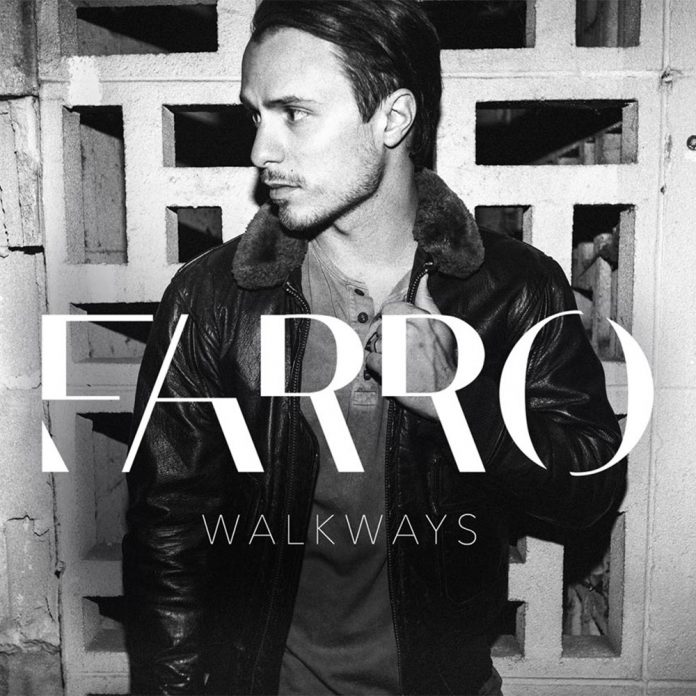
Josh Farro, an ex member of Paramore, has finally returned to the music scene with Walkways after the failed band Novel American. If you’re looking for a 2007 / 2009 Paramore substitute — you’re barking up the wrong tree. On Farro first solo album, the closest you’ll get is his song “On a Wire.”

Though Farro hasn’t been a lead vocalist before, his voice is up to the challenge. It’s not very powerful, but it is suitable for what he does. Farro’s music is the kind that can stand alone — his voice doesn’t try to steal the show, rather he blends it in as more of a harmonizing instrument. If you like The Postal Service, Coldplay, and Owl City / Sky Sailing, that’ll give you some idea of what he sounds like.

His song-writing skills have not gotten rusty in their accidental hiatus. It’s easy to tell that Farro was once an integral part of the album-making process for Paramore. The music comes together in a nearly flawlessly. That being said, it’s not suitable for much more than chill study music. It’ll lift you up in an almost unrelentingly optimistic way.

“Cliffs” is the first single off the album, and it sets the tone. It’s the song you spin if you need a little extra push to take a leap of faith. As such, it perfectly reflects how the album is Farro’s turn at jumping off cliffs and taking the plunge.

If you’re looking for some great drumming — provided by Farro’s brother and fellow ex-Paramore member Zac — “Color Rush” is the one for you. It starts off sounding like it’s going to be a super-catchy upbeat tune. It even has an almost bit of whimsy to it. Then when the vocals hit, it changes up into something still upbeat but withdrawn almost. The power in his voice peeks out through the chorus, and it just kind of makes you lust for more of that confidence throughout the album.

“On a Wire” is my favourite song — again the power of his voice creeps through the tightly-knit music. There’s a rawness to the regret transparent in the guitar riffs and lyrical delivery. The lyrics are bang on, and really the entire album has rock solid lyrics. “A glass of wine, a medication for the past. The hands of time can’t turn around, can’t take it back.”

Farro wraps up his album brilliantly with “Home.” In both the lyrics and the music, you are guided to an ending. “And this time I found my way back home. Back home.”

The one thing I hope for Farro, if he releases new music, is that he cultivates the snippets of confidence and power in his voice. Once he does that, I think he’ll have a perfect blend of musicality to complement his talent.

New Music Friday

0

By: Sarah Finley, Courtney Miller, and Jessica Whitesel

Follow The Peak on Spotify to stay up to date on New Music Friday.

“Untitled 03 | 05.28.2013” – Kendrick Lamar

Jessica Whitesel: You know Kendrick is talented when he can drop an unmastered EP and it’s fire. This song didn’t quite do it for me in this semi-unfinished state, according to the date in the title this is an early song, but it clearly became foundational.

Sarah Finley: God bless Kendrick Lamar. Kendrick’s smooth voice enters the song accompanying feminine back up vocals and the plinks of various mallet instruments, rapping about the dichotomy between white men and black men in the music industry. Keep fighting the good fight, Kendrick. We all love you.

Courtney Miller: I feel that songs with lyrics such as “pussy is power” should maybe be rethought and given substance. I don’t disagree, but there are better ways to phrase the sentiment.

“SEPARATE LIVES” – HÆLEOS

JW: I’m not going to lie: after the intro to this song, I wasn’t expecting much of anything, but it did get better. It’s not the best song I’ve ever heard, but it wasn’t as generic as I expected from the intro.

SF: This song is entirely hypnotizing. The British trio utilizes vocal crescendos and instrumentals that edge on feeling eerie to complete the track, leaving the listener feeling wholesome at the end.

CM: It starts off sounding a bit like early Tegan and Sara. I like how the melody improves upon itself as you go through the song.

“People Change Their Minds” – William Fitzsimmons

JW: Normally I love William Fitzsimmons, but this song was a rare miss. It kind of reminds me of Iron and Wine, but not one of their strong songs, also I’m not loving the accompanying female vocalist as much as I feel I should or as much as I want to.

SF: The combination of soft male vocals, gentle guitar picking, slow cello, and a mesmerizing female vocalist counterpart make this track a 10/10 slow track. The lyrics about mothers will likely make you homesick, but no need to fret: it’ll probably make you drift off to sleep in no time anyway.

CM: I really love how guitar-reliant this track is before other instruments come in piano, cello, maybe a viola or violin at the same time. His voice is soft, yet raspy in a mature way, and movingly emotive.

“For U” – Miike Snow feat. Charli XCX

JW: What is it with songs having bad intros? I almost turned the song off before that disaster was finished. But I persevered and got a sort of okay song I guess. I can see it blowing up and becoming a dance or club favourite, but it’s not either of their best work.

SF: When I saw that Miike Snow and Charli XCX collaborated on a track, I was endlessly excited, but it wasn’t that strong. The combination of their music styles didn’t flow seamlessly, and all I felt was flustered. It’s like when two very different types of food on your plate touch and now both of them are ruined.

CM: Sounds like the chipmunks on acid, remixed as a backing track for the first 45 or so seconds, shifts into something way more palatable, and then moves back to high rodents this change ping-pongs throughout the song. If I could isolate those blissful moments in between, this would be a solid winner.

“Outta Control” – Sean Paul feat. Yolanda Be Cool and Mayra Veronica

JW: I don’t know where Sean Paul went, but now he is back. And everything about this song is peak 2009 / 10. It feels like an homage to #TBT, which isn’t a bad thing, but is unexpected. Just don’t look to this song for stylistic consistency.

SF: It’s not often that you find a dance pop track that begins with accordion, but that’s exactly what happened here. While the beginning was catchy, the weak attempts at bass drops throughout the song were simply cringey. I would need to have at least three drinks in my system before I could dance along.

CM: No idea what he’s saying, but I could see this as one of those early songs they play at clubs. It’s fun to dance to.

“Get Out” – Frightened Rabbit

JW: I’m a sucker for a more upbeat indie song and this one fit the bill. It was good, but there just really isn’t that much else to say about it.

SF: The song begins smoothly with cute, lovesick, indie vocals, slightly sporadic drum beats, and a repetitive bass line. Out of nowhere, the song transitions to what I can only describe as a hot mess, the lead singer yelling, “Get out of my heart.” Yikes. This repeats throughout the entire track.

CM: This track is mellow, while at the same time the vocals and track are almost disconnected.

“Already Love” – Great Good Fine Ok

JW: I feel like I’ve made a mistake calling this New Music Friday. This song has a very 1999 feel to it. We are just one wind machine and fake tan away from peak forgettable boy band.

SF: Head voice vocals and a solid synthesizer vibe makes the romantic lyrics not just sweet and endearing, but also super catchy. Unlike anything I’ve ever heard from other artists, Great Good Fine Ok somehow made it possible for love to intertwine with soft electronica.

CM: I love this. Super groovy, catchy, and fun. Great musicality.

“Do It, Try It” – M83

JW: I feel like this is song for 35-year olds who can’t really say no to clubbing, but need to have it toned down a couple of notches to enjoy it. It’s not a bad song, but the piano keeps it from being an awesome club banger.

SF: M83 never fails to impress me. Chaotic piano chords take the lead, pulling the listener into the classic M83 sound 30 seconds in. Synthesizers get heavy, vocals get more desperate sounding, and I fall in love again with one of my favorite bands.

CM: Hella Daft Punk style, except not quite as good or as catchy. Still enjoyable though.

“Dissonance” – Hammock

JW: Much like being in an actual hammock this song is relaxing, but there is an undercurrent of impending something. It never actually lulls you into a sense of calm which is really what I wanted. So, I guess the title is accurate.

SF: This is one of those songs where there’s simply too much noise at the beginning. You can’t discern between instruments, and you’re just waiting for some kind of clearing from the audial fog. Spoiler alert: you never get it.

CM: Contrary to the title, this is not dissonant in any form. It has an almost ethereal quality, so it might be really good on a trip.

“Kiss The Sky” – The Knocks feat. Wyclef Jean

JW: It is danceable and singable. This song will either die after a few weeks or it will never leave our collective memories. There will be no in between.

SF: Regular hi-hat percussion make this song immediately catchy. The chorus is much stronger than the verses that nearly change the entire style of music every time they arrive.

CM: This track is fun, but it’s like a single-use kind of fun because it gets irritating if you listen it to it more than once.

“Unbelievable” – All Tvvins

JW: Well this sure is a song. It is like a weird electro / pop-punk / indie fusion we-want-to-be-The 1975-but-we-never-can hot mess. So while technically this is a song, it is trying to be about 6 different ones at the same time. It is unbelievable it got released at all.

SF: This song seems like it was a failed attempt at a banger. The voices are far too autotuned, and the rhythm and trio-bursts of sound every measure aren’t anything that we haven’t heard a million other times.

CM: I don’t mind this, but it is a little homogenous and repetitive. Not bad as chilling or studying music though.

“How Now” – Snowblink

JW: There is something sensual about this song. I think it is the way the lyrics, vocal stylings, and backing track all blend together. It’s almost if like if The Weeknd became a woman, and then ditched the overt sexual overtones, and turned up the sensual boudoir vibe.

SF: I’m a sucker for angelic feminine and masculine vocals meshing together, which is exactly the focal point of this track. The lyrics, while extremely repetitive, are beautifully sung and ethereal.

CM: A slower tune, almost a little sultry near the beginning; this is pretty mellow. My only complaint is that they overuse the repeat feature throughout.

Girls Rock Camp Vancouver gears up for their first fundraiser of 2016

0
One of the bands formed at the camp. Taken on the day of the final performance.

After a quiet 2015, which included the first campless summer in six years, Girls Rock Camp Vancouver is back in full-force to make this a year to remember for volunteers and campers alike.

“We are happy to be back and excited for another successful year,” says Alyce Becker, a long-time organizer who’s been a volunteer since year one. “It’s always a little different every year, because of different campers and volunteers. The set-up is the same, because it’s easy to recycle that blueprint, and every year we tweak it to get better. We’ve just continued to grow and learn each year.”

Inspired by Portland’s Rock ‘N’ Roll Camp for Girls, which started in 2001, Girls Rock Camp Vancouver is a collective of local musicians and community members who help coordinate programming year-round in Vancouver, as well as orchestrate an annual week-long summer camp for girls ages eight to 17. Since 2009, the registered non-profit has used music as a way to better the lives of young women through mentorship and skill-based workshops.

“For us, music is just the vehicle for the program that instills the confidence and the skills in the youth,” explains Becker. “If someone doesn’t play music again for the rest of their life, that’s totally fine. For us, it’s showing up, being interested, collaborating with people, building those communication skills, and that skill set to bring into life.”

Workshops from previous summer camps have included music-centric ones such as songwriting and gear set-up, while other workshops centred on topics like zine-making and screen-printing campers’ own band T-shirts. The kids also form bands at the beginning of camp, and develop their musical skills over the week, culminating in an end-of-camp showcase where every group performs one original song together on the same bill. Music from past Girls Rock Camp Vancouver bands can be found online through the organization’s Bandcamp page.

Everyone involved with Girls Rock Camp Vancouver, from the organizers who spend most of the year planning to the people running workshops during actual camp week, is a volunteer, with Becker describing it as “a co-operative” and “very DIY.” However, there are still costs that come with running a week-long camp each year, which the organization funds through a combination of donations and fundraising — enter their next benefit show on March 8.

“We’re very grateful for all the community support over the years,” says Becker. “Fundraisers and donations essentially let us keep our admission fees sliding scale, so we can stay financially accessible.”

Taking place on International Women’s Day, the benefit show — the second of its kind organized by Vancouver band The Love Buzz — features eight local bands and a DJ, all for a mere $10 donation. The evening’s proceeds will then help Girls Rock Camp Vancouver cover some of their expenses, which include lunches for the campers and equipment rentals and repairs.

And while there are a number of facets and intricacies that come with keeping Girls Rock Camp Vancouver running each year, what it seems to always come back to are the connections made and the community that comes with it.

“Ultimately we want to see youth continue to play music and create projects outside of camp, and to feel empowered that they can,” describes Becker, “Girls Rock Camp Vancouver involves so many people, it really creates new relationships with people you might have never met, and opens a lot of doors for friendships.”


Show your love for Girls Rock Camp Vancouver by checking out The Love Buzz’s International Women’s Day benefit on March 8. A donation of $10 at the door gets you access to eight great local bands (including Lié, Cave Girl, and Les Chaussettes) and proceeds from the show go towards this year’s summer rock camp.

SFU groups among hundreds marching for climate justice

1
Protestors converged on the convention centre where the PM was meeting with premiers.

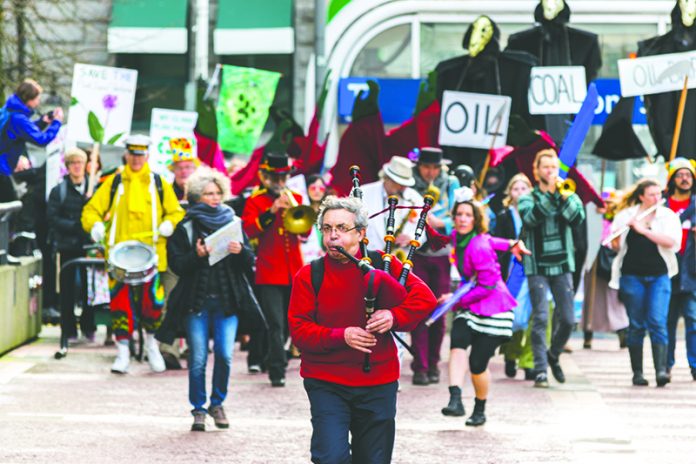
[dropcap]The[/dropcap] droning of bagpipes mingled with New Orleans-style jazz as SFU’s School for the Contemporary Arts and other activists paraded to the First Ministers’ Meeting this Thursday. The parade ended at the Vancouver Convention Centre where the Prime Minister and Premiers were discussing the economy and climate change. Last Thursday, the ministers signed the Vancouver Convention which, among other things, agrees in principle on a national carbon tax.

Parade-goers were costumed as various aquatic life forms, as well as the remnants of carbon-based fuels, while hoisting signs demanding action on climate change. SFU professor Laura Marks carried a banner made from 80 letters addressed to Prime Minister Trudeau and BC Premier Christy Clark.

The letters were written at a “happening” — an event — hosted at SFU Woodward’s on Saturday February 27. Passersby concerned about the environment were invited to write letters to the Prime Minister and Premier of BC, as well as give a statement on video.

On the other end of the spectrum, the Vancouver chapter of activist group Raging Grannies sang cheeky protest songs to the tune of ‘Puff the Magic Dragon’ and other classics. The group was founded in Victoria in 1986 in order to protest the presence of US Navy nuclear-powered ships in Victoria Harbour, and have made regular appearances at events in Vancouver. They called the government to account for remaining idle on climate change, singing, “The world needs action, heaven knows / listen up, you carbon schmoes!”

At the end of the parade, a crowd of about 200 gathered outside to hear speakers from environmental and indigenous groups, all of whom demanded that the government does more to combat climate change.

During the opening ceremonies, First Nations activist Audrey Siegl accused the government of saying “a few condescending words and then it is business as usual” in reference to a statement by Trudeau that supported exporting oil in order to fund the transition to a low-carbon economy.

Speaking to the dangerous effects of climate change, Chief Bob Chamberlain of the Kwikwasut’inuxw Haxwa’mis First Nation plainly stated that, “it’s going to be the First Nations on the front line of suffering yet again,” explaining that many communities are dependent on the land for at least part of their sustenance.

Marks explained that the “happening” was meant to strike a different tone than a typical protest. Said Marks, “this event is to let people know that activism can be fun and ‘cool’ and enjoyful,” and to celebrate the successes that have happened. When The Peak asked why SFU students should care about climate change, she replied plainly that “we know SFU students care about the climate,” noting the “great deal of environmental activism at SFU,” from various student groups such as Embark and SFPIRG.

The upcoming First Ministers’ Meeting may have implications for local energy projects, such as the proposed LNG plant on BC’s coast and the TransMountain Pipeline expansion. In late January[dropcap][/dropcap], the National Energy Board (NEB) heard final arguments for and against the proposed expansion set to be constructed on Burnaby Mountain.

Many environmental groups, as well as the Province of British Columbia, the City of Vancouver, and the City of Burnaby have voiced their opposition to the project, which would allow the pipeline to transport 890,000 barrels of bitumen per day. The NEB has until May 20 to make its final recommendation on whether or not to approve the pipeline.