Home Blog Page 831

SFU prof’s plain packaging project aims to kick cigarettes’ butts

0
Students can check out the display to see how different countries stack up.

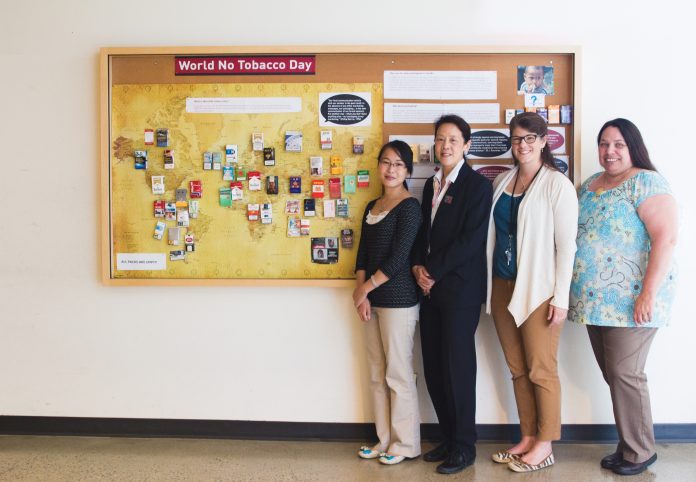
If you’ve walked down Blusson Hall recently, you may have noticed a display case featuring gruesome images of what cigarettes can do to your body, and a world map with cigarette packages from around the globe pinned to their respective countries.

These were collected by SFU health sciences professor, Dr. Kelley Lee. With World No Tobacco Day’s  global plain packaging campaign on May 31, Dr. Lee has been drawing attention to the issue locally.

“My research is around tobacco control in general, and plain packaging is one aspect of it,” she stated. The movement aims to streamline and standardize all cigarette design and marketing. Currently, about 75 percent of a cigarette package is dedicated to a graphic health warning, which still leaves some room for cigarette brands to appeal to smokers.

“Companies really find that the packaging is important to them to get their branding across,” she said. “They call them ‘mini-billboards.’ So they put a lot of emphasis on them — they spend millions of dollars designing these packages to appeal to particular targets; to young women and to young people.”

Dr. Lee first started collecting cigarette packages from around the world to use as teaching tools, some of which used hearts within the filters, candy-like flavours, pretty colours, and novelty images to entice consumers.

When asked why she believes tobacco should be treated differently by the government than other legal harmful substances, Dr. Lee stated “you can’t smoke a cigarette safely.

“Tobacco is the only legal substance that, if used as directed, will kill half of its users. You can’t say that about alcohol, and you can’t say that about unhealthy foods. It’s a substance that if you invented it today, it would not be legalized.”

An issue Dr. Lee is tackling closer to home is updating SFU’s smoking policy. The Advertising, Selling, or Smoking of Tobacco on Campus policy has not been updated since 2009. It currently states that students can smoke 10 metres away from university buildings, but Dr. Lee wishes to implement an update which would limit smoking to designated areas.

“We surveyed students, faculty, staff, community members, and 75 percent of people agreed that was the way we should do it because of the forest fires, because of cigarette butts everywhere, because of secondhand smoke wafting into people’s offices and workplaces,” she said.

As for the broader context of Dr. Lee’s anti-smoking efforts, she believes that Canada is doing fairly well with cigarette packaging regulations. However, there is definitely room for improvement.

Canada is now considering adopting a completely plain and standardized packaging policy.  “The Liberal government said they would have a three-month consultation. That means that people — you and me, anybody — can submit about whether this is a good or bad policy.”

This, however, means that tobacco companies will have ample opportunity to oppose the motion, and could potentially spread some misleading information. “Our research has also been looking into how they’ve been using third parties like think tanks to fund research that sounds independent,” said Dr. Lee.

Not everyone believes that plain packaging is the best way to disincentivize smokers. According to associate dean of the faculty of development and research at the Beedie School of Business, Dr. Judy Zaichkowsky, “fooling with the packages is a side-issue, almost. It’s not the core of the motivation to start. The core of the motivation to start is to be older; more mature, to belong.”

Both women touched on the significant correlation between puberty and starting to smoke. Dr. Zaichkowsky described it as a time when “you do everything you can to look and feel more mature.” Dr. Lee outlined 13 as the average age at which people start smoking, and the demographic to whom tobacco companies aim to advertise.

“It’s a dirty business,” she stated.

Dr. Zaichkowsky believes that though the plain packaging movement is well-intentioned, using fear tactics such as jarring imagery on packages is the wrong method. “When the fear gets too ugly or gruesome, people look away. They tune it out. [. . .] They understand it, but they don’t want to pay it any attention.”

Instead, she believes that “a moderate, social fear appeal is much more effective than ‘smoking will kill you,’ because that’s too fearful. People will say, ‘not me.’”

NOTE: Dr. Kelley Lee’s display has been moved to the casing across from the Djavad Mowafaghian Lecture Theatre.

Peak Comics: APPLE ST

0

COMIC-POOT (1)

CJSF 90.1 broadcasts test answers from fifth floor AQ bathroom

0

In a recent bid to gain listeners, SFU radio station CJSF 90.1 FM has begun broadcasting test answers. The hope is that students will finally tune in, if only to pass their next midterm.

At first the CJSF used a brazen approach, simply announcing test answers at select times. However, SFU administration was quick to crack down, and they were forced to use more subversive methods.

A complicated code language was created using Led Zeppelin as a base. Their songs were edited and looped so that the pitch and tempo of Robert Plant’s moaning noises would indicate what the answer was. However, the administration soon caught on to this new trick and the radio station was warned to cease aiding cheaters. As a result, more extreme measures were employed.

CJSF began to play edited rap songs under the guise of mixtapes in order to broadcast answers. The works of Drake, André 3000, Ice Cube, and even Meek Mill were edited together to spell out test answers, such as “Started from the bottom now the answer is muscular dystrophy,” and “Straight outta the textbook, crazy muthafucka named page 67.”

The radio station claimed these were not test results, but rather were “unreleased and experimental collaboration tracks.” The administration caught on once again. This was the last straw, and the radio station was taken off the air.

Two days later, however, the CJSF was back up, broadcasting from a bathroom at the top of the Academic Quadrangle, calling itself the true “Pirate Radio” and babbling some nonsense about ‘fighting the good fight.’

When asked about the controversy, SFU student Jordan Clemens summed up the general feeling amongst the student body, saying “I didn’t even know we had a radio station until now. Hell, I didn’t even know people still had radios. I thought they stopped making those like 80 years ago!”

Study reveals that executive student unions exist only to pad resumés

0
EPSON MFP image

SFU has over 100 clubs and student unions, all of which are excellent avenues for networking, gaining experience, and the occasional ego boost. However, a new study suggests these organized social gatherings might exist for more ulterior motives.

According to a study produced last week by SFU, approximately 70 percent of all executive members from Departmental Student Unions (DSU) and clubs hold the position purely to pad their resumés.

“We polled about 80 execs from across SFU and found that the majority felt their resumés were weak and needed some filler,” said lead researcher Dr. Doris Blankfein. Dr. Blankfein confirmed the majority of exec members “have no real responsibilities” and “don’t give a shit.”

“Our findings showed that an overwhelming majority have the position just to have the position, and don’t really do anything.”

We spoke with one executive member who wished to remain anonymous. He said, “I mean, my official title is co-vice president of external relations, or something like that, I can’t remember really . . . I guess I took the job so I could pad my resumé. It also makes me feel accomplished. It’s incredible the effect this title has had on my ego. Now, when I talk to people, I have a reason to be self-righteous and snobby!”

“It’s been wonderful,” said another DSU member. “With my new title of co-director of marketing engagement, I can actually offload my work onto the other co-director and other members of exec.

“I don’t do much, but my title does the work for me!”

The report concluded that about 15 percent held their position because they “actually do the majority of the work,” while another 15 percent had their position by default because nobody else wanted it.

The Crank Files: Was Curious George Originally About A Human?

0

Beneath the veneer of normalcy lies a world of dark shadows and the macabre. Bizarre cults, conspiracies, and creatures abound. One man seeks to get to the bottom of them. Some may call him a crank, but to others he is a truth teller. The Peak‘s resident investigator of all things strange, Tyler Knoll, is on the case over at the Crank Files!What is reality? It’s a question that keeps me up at night, although regular consumption of caffeine might also be a factor. For many, reality is merely existence in and of itself. But then again, the masses are nothing but a bunch of un-woke sheep, content to shill themselves to the secret masters who’ve enslaved their minds.

Clues exist that reality is really a mere simulation — a “Matrix” if you will — of which we humans are not in control. One of the most damning pieces of evidence is the children’s book series, Curious George.

You might think, “What a load of shit, they’re harmless children’s books.” But think again, sheeple. In these books lie the sinister secrets to the infuriating truth of our existence. On the always-reliable and factual forums such as Godlike Productions and TinWiki, many are recording their suppressed memories of Curious George being a book about a human boy with a fully-grown ape as its owner and master.

This role reversal is part of a larger phenomenon known as the “Orangutan Effect.” The Effect involves memories people have of orangutans forcing them into induced sleeps through suspended animation, which naturally hints at a larger ape-takeover of the Earth.

That’s right: the apes are running the zoo, people, and we’re all animals being goggled! Remember Harambe, that gorilla over whose death we all got outraged? Well, he’s probably laughing his ass off in an alternate reality while looking at our fake memories through a remote viewing device!

Our minds are enslaved people, and until we all wake up, we won’t be able to do anything about it. And when we wake up . . . well, I’m not exactly sure what to do then. I mean, I guess we could type in “What is the Matrix” on Google and see what happens. If that doesn’t work, then we could just get really angry and go on rants on Reddit.

Take that, you damn dirty apes!

COLUMN | THE POLITICAL EYE: Why pipeline expansion isn’t the worst idea

0

[dropcap]P[/dropcap]ipelines: they’re hotly debated, especially at SFU where major protests against the Trans Mountain Pipeline expansion have occurred in recent years. So, I will provide some arguments in favour of pipeline expansion in Canada, aside from the usual ‘growth of jobs and economy’ take.

Where does Canada get its oil? The National Post reports that the top source countries are the US, Saudi Arabia, Nigeria, Angola, and Algeria. Of these, Canada is a Western, liberal democracy with strong social programs and a commitment to human rights. When we import the $20 billion of oil, like we did in 2014, we directly support these foreign countries’ ruling governments and not our own.

Saudi Arabia, one of the top countries in world oil production, is a monarchy. There, women are not allowed to drive, and have to limit the amount of time spent interacting with men outside of their families. Contrast this with Alberta oil capital Fort McMurray, whose mayor, Melissa Blake, is a woman. Saudi Arabia also performs executions for crimes such as blasphemy, adultery, homosexuality, and even witchcraft and sorcery.

Canada also imports Nigerian oil. The Nigerian National Petroleum Corporation “manages the government’s interests in the Nigerian oil industry,” according to its website. The Niger Delta has seen immense environmental degradation and humanitarian crises as a result of oil production. Recent attacks on oil installations by the Niger Delta Avengers, a new militant group protesting the lack of resources for inhabitants of the Niger Delta, has cut production from 2.2 million barrels a day to 1.6 million a day.

Canadian oil sands are developed by private companies which, according to The National Post, are “subject to the rule of law, accountable to public shareholders, and disciplined by market forces.” Oil and gas contribute almost 11 percent to Canada’s GDP and about $20 billion in tax revenue per year. So, why don’t we reduce imports of foreign oil and move toward energy independence through projects like the Energy East Pipeline?

When we import the $20 billion of oil that we did in 2014, we directly support foreign countries’ ruling governments and not our own.

Pipeline expansion is also good for environmental reasons — wait, I’ve got to be joking, right?

This is not to say that Canadian oil development is clean and environmentally friendly. It isn’t. But our oil development is heavily regulated, more transparent, and much safer than in other countries.

When oil is extracted, natural gas flares. This gas flaring contributes an estimated 400 million tonnes of CO2 into the atmosphere yearly, and wastes about 5.5 percent of the world’s natural gas. Nigeria’s gas flaring contributes more CO2 to the environment than all of Sub-Saharan Africa. Alberta, BC, and Saskatchewan have all implemented regulations to reduce flaring. Canada didn’t even make the top 10 for gas flaring between 2007 and 2012, even though it was fifth in the world for oil production in the latter year.

How about oil spills, which are arguably the key concern for pipelines? The National Energy Board estimates Canadian pipelines move roughly 1.3 billion barrels of oil per year, and approximately 1,084 barrels were spilled each year between 2011 and 2014, meaning pipelines safely moved 99.99 percent of the oil to its final Canadian destination.

The alternative to pipelines are trucks, rails, or boats, which are far from perfect themselves. Quebec’s Lac-Mégantic rail disaster in 2013 killed 47 people and spilled or burned a reported six million litres of oil. And let’s not forget the massive Exxon Valdez spill.

Pipelines aren’t perfect. Oil and gas won’t last. We need to switch to renewables and break our dependence on the carbon economy. But ideological opposition to pipelines simply doesn’t fit into current times, because pipelines are arguably the best and safest available method of transporting oil — a necessary evil, if you will. An increased Canadian share in global energy markets would be good for our economy, and could boost global environmental health and human rights.

Amazing Grace N. Howl: Co-op D’État

0

In the wake of a godawful and miserable loss to some nobody for SFSS president, I have decided that I, Grace N. Howl, will instead be setting my sights on something bigger. I have locked my hawk-eyes on something much more prestigious and rewarding than any silly presidential race. Why play imaginary president when you can take over the boss of your company and dominate your workplace, one measly co-worker at a time?

That’s right, nerds. Eat your heart out, because Grace N. Howl is coming to your workplace, destroying the competition, and coming out on top as queen of literally everything.

I’ve decided to take a break from school this semester and work with (hopefully) mature adults who won’t complain about microscopic things like endorsements, or who go around misplacing perfectly fine newspapers as a way to vent their anger. This is child’s play, and Grace has left the playpen.

Instead of flaunting myself around campus, I am currently on a co-op term with the City of Surrey. I work in this unit that focuses on Urban Planning and Community Development, but if you ask me, that sounds like a killer excuse to begin my eventual takeover of the city. It’s like fate that I’m here, working in a place that deals so closely with how to make the city a better place. I know that I will be just the person to do it.

I brought great ideas to my supervisor, like building walls around Surrey’s city borders and connecting our SkyTrain system to Coquitlam and getting them to pay for it, but she just laughed and shook her head and told me to scurry off to my little cubicle and continue my data entry. How am I supposed to thrive in this mind-numbing environment with straightforward numbers that even a raccoon can input? This is nonsense! The city won’t become great if you just keep track of how many bike parking spots we have or where we can put some stupid sculpture up.

With my expertise and cunning ability to be everything, to be the best, I will no doubt take over this ship. No problem. Call it the SS Surrey Storm.

*All documentation has been personally received by Rachel Wong*

Fierce Fencers: An interview with two SFU students gunning for a gold

1

[dropcap]I[/dropcap]n late May, two SFU student athletes earned bronze medals at the 2016 Canadian Fencing Federation’s National Championships in the University Division.

If you’ve never heard about SFU’s fencing team before, it’s because we don’t actually have one. In fact, even as Marie-Rose Bruskiewicz and Isaac Velestuk stood up on the podium to represent SFU, the university was completely unaware of the talent in their halls, and the achievements that were being earned under their name.

The Peak itself might have never uncovered the story of these two athletes if it hadn’t been for the determination of Marie-Rose, Isaac, and their coach, Jonathan Hutchinson, to make their story known. I sat down with the trio to discuss fencing, life lessons, and hidden talent at SFU.

The beginnings

If you were to see Bruskiewicz, Velestuk, and Hutchinson sitting together around a table at a coffee shop, the comfort and ease they share would lead you to assume they had been lifelong friends. Even the three fencers themselves attest that it feels like they’ve known each other forever — even though it’s only been two years.

The three are all at various stages of their SFU careers. Velestuk will begin studying economics at SFU this upcoming fall, while Bruskiewicz is currently attending SFU as a kinesiology major; meanwhile, Hutchinson was in the criminology program at SFU three years ago, but after taking a kinesiology course that got him interested in coaching, he transferred to Douglas College to study sports science.

Bruskiewicz and Hutchinson met while both attending the university. “We met through residence,” Bruskiewicz said. The two started dating shortly after meeting, and six months into their relationship, Bruskiewicz began her fencing career.

Hutchinson and Velestuk met through Dynamo Fencing Club in Richmond, where they both competed. Velestuk got his start in fencing thanks to his mother, through a deal at their local club where parents got to fence for free if their children fenced as well. “I did two years of fencing so my mom could go for free,” he joked. Ultimately, it was the environment and the friends he made in the fencing community that made him stick around.

Bruskiewicz had competed in a multitude of sports in her life, including competitive figure skating and soccer, both of which she was becoming serious about at the time. She first tried fencing as a way to learn more about her boyfriend’s world. “[Jonathan] had his club on the Sunshine Coast, and so I decided to try it out,” she explained. “He thought it would be funny to watch his girlfriend try to fence.”

But it soon became apparent to Bruskiewicz that fencing was unlike any other sport she had played: “What draws you initially into the sport is the uniqueness of it,” she said. “I didn’t take it very seriously at first [. . .] but what keeps you in the sport is its competitive nature. It’s the most challenging sport I’ve ever taken up.”

“Masters of fencing, masters of life”

While pauses in the interview were always punctuated with jokes and laughter, there was a certain intensity that grew in the group as they explained their passion to me.

Hutchinson elaborated on how fencing stands apart from other sports: “[In combat sports], when the risk of losing is getting knocked out, you train very hard,” he pointed out. “[In fencing], if you lost, you would get hurt, stabbed, killed [. . .] That’s what factors into the brutal training. Strength, conditioning, and sprinting until you puke — that mentality bleeds into a lot of different training sessions.”

Bruskiewicz vehemently nodded her head at this, testifying to the brutal training sessions she’s been subjecting herself to since she began fencing.

“I was the only girl [at the club],” she explained. “Before [Jonathan] would teach me any fencing technique, he said, ‘We need to get you strong.’”

Perhaps the pinnacle of their training sessions would be what the group called “Mount Everest.” Mount Everest lives up to its name, and it goes something like this: you start with one sprint, three push-ups, three jumps, and three sit-ups. And then you double it and do it again. You keep doubling the routine until you’ve gone up to a rep that includes 32 sprints, 96 push-ups, 96 jumps, and 96 sit-ups. And then you go back to one sprint and three of each.

“When I started, I would do the mini version,” said Bruskiewicz. “I couldn’t keep up with the boys. But eventually I did.

“I started with knee push-ups, and now I can do 100 regular push-ups. I’m so much stronger than I ever was before. Mentally stronger, too.”

Fencing, for Bruskiewicz, is the most stressful endeavour she’s ever pursued. Her experience in competitive figure skating, soccer, and academics — another important part of her identity — pales in comparison.

“I was always so nervous coming into my first year of finals,” she recalled. “I wouldn’t be able to think straight. But there’s nothing more stressful than being down one point with 10 seconds on the clock in fencing. It teaches you to compose yourself.

“Finals are nothing anymore. I handle them like a champ,” she grinned.

“You’re not destined to become an Olympic athlete just because you started training [before] me” – Marie-Rose Bruskiewicz

Velestuk related to the mental control that fencing has allowed him to develop: “Outside of this competitive environment, I’d never have learned how to beat someone mentally in just 15 minutes.”

For Hutchinson, fencing led to him building his strongest relationships. Despite growing up in a very small community, he’s kept in touch with only a single person from that community. But to this day, he remains friends with the six or seven people he trained with, day in and day out, at the Dynamo Fencing Club — one of whom was Velestuk.

For Hutchinson and Bruskiewicz, balancing their romantic relationship with their professional one hasn’t always been an easy task. “It was tough at first,” Bruskiewicz confessed. When your boyfriend becomes your coach, it’s safe to assume there will be an adjustment period. When asked how they managed to make both partnerships work, Bruskiewicz and Hutchinson shared with me the concept of ‘the coaching cap.’ On a trip to Alaska, Hutchinson purchased a baseball cap. This cap is now how the two distinguish when Hutchinson is speaking to her as a mentor or as a boyfriend. When he puts on that cap, he means business. But when the cap comes off, she can turn to him for emotional support. “It can be tough to hear that you let your emotions get the better of you in a competition,” Hutchinson continued. But he stressed how valuable that feedback is. Hutchinson joked that sometimes Bruskiewicz just needs a hug before he puts on the cap and gives her technical critiques.

Despite hiccups in the beginning, the two are every bit as happy together now as they were when they first started dating.

Olympic aspirations

When describing the intense training sessions he prepped for his players, Hutchinson threw out phrases such as “high-performance athletes” and “dedication to reach the Olympic level.” When I inquired further into these notions, asking if Bruskiewicz and Velestuk were genuinely working towards fencing in the Olympics, I barely had a chance to finish my sentence before Velestuk responded.

“Yes,” he declared. “Having a good coach, working hard, financial hurdles, a healthy body and mind . . . I think those are all hurdles I can overcome. There are going to be challenges, but [if] I weren’t to make an effort, I’d feel like I was surrendering.

“If I’m [aiming for the Olympics], it’s because I can’t see myself stopping [fencing].”

Bruskiewicz added her own perspective on the Olympic-level dreams: “Olympians used to feel like celebrities to me, like ‘untouchables.’ But I was reading The Champion’s Mind once which said, ‘If you can spot greatness in others, you have greatness in yourself.’ And two years down the road, and I have a national medal which I’m very proud of.

“I have a lot left to do,” she admitted, “but I’m catching up, and I feel I’m on that path.

“You’re not destined to become an Olympic athlete just because you started training [before] me. It’s the hours and hours of deliberate practice that you put yourself through, that I believe I’m putting myself through, the mentality, you need to be hard-working and have that drive, and constantly make sacrifices,” she said.

SFU’s golden opportunity

It was made clear to me that one of the main reasons these three superstar athletes were so eager to sit down with The Peak was to raise awareness about their sport and get acknowledgement from the SFU community.

“We want to start a varsity team or club,” declared Bruskiewicz.

Velestuk, deemed the brains of the operation, mentioned that the research he’s been doing has led him to the conclusion that they could “easily start a club.” Getting into the National Collegiate Athletic Association (NCAA) is another issue entirely. “We wouldn’t be able to go to NCAA-sanctioned events,” he clarified. “But we could create and attend club competitions.”

At the minimum level, the athletes are urging SFU to provide training space and minor funding for basic equipment for training. In addition, Bruskiewicz and Velestuk want fencers at SFU to be recognized as athletes of the university, so as to receive similar academic accommodations as other SFU sports teams. They’re also hoping to gain financial support to have their coaches accompany them to their tournaments.

This year, Hutchinson was unable to pay for his ticket to the championships. “So our SFU student didn’t have her coach, the person who trained her. I ended up coaching her on Skype between rounds,” he said.

Bruskiewicz recounted an experience she had trying to secure a place to train as an independent party. She believed there to be a lack of cooperation: “I tried to rent out the squash court for one-on-one lessons with my coach, but [SFU Athletics] wouldn’t allow it.” For her, communication with SFU Athletics was not as easy as she was hoping. “So I tried a classroom, but the floors were too slippery. Eventually I found the Forum Chambers, and now I go there from 9 p.m. to midnight,” she added.

“We want to start a varsity team or club.” – Marie-Rose Bruskiewicz

For Bruskiewicz, currently attending SFU, and Velestuk, looking forward to attending SFU next year, just the commute to and from the university and their training studio drastically cuts into both their training and their studying time.

“Last term, my class ended at 3:20. I’d be carrying my fencing gear around school all day. And then I’d jump on transit for two hours to my fencing studio, and then two hours back,” recalled Bruskiewicz.

“That was four hours total on a regular school night. Four times a week.”

Hutchinson provided his perspective on the matter as a coach: “[Marie-Rose and Isaac] are high-performance athletes. They are unable to train, in my opinion, in a way that high-performance professionals train because of the travel time here and stuff like that.”

By creating an environment that nurtures fencing at SFU, the trio argued that the university could be taking advantage of the wealth of untapped fencing talent present in the Lower Mainland.

Bruskiewicz spoke about her fencing peers at Dynamo — “people on national teams,” interjected Hutchinson — who are interested in SFU, but dismayed at the lack of fencing opportunity. Velestuk corroborated her experiences by attesting to the multiple athletes who relocated to the States to fence in the NCAA.

Hutchinson passionately described his vision for SFU: “This place is such a wealth of talent, and has future potential for Olympians. When I talk to guys that I train with, they say the best wrestlers come from SFU. In half a second, the best fencers could come from SFU. Olympic medalists could come from SFU.”


FENCERS_WEB

NEW MUSIC FRIDAY

0

By: Courtney Miller, Jessica Pickering, and Jessica Whitesel

Follow The Peak on Spotify to stay up to date on New Music Friday.

“Pick Up the Phone” – Young Thug feat. Travis Scott and Quavo

Jessica Whitesel: When T-Pain dies they will play this song to bring back his ghost to haunt the world. In place of a human sacrifice the blood from the ears of those unfortunate enough to hear this monstrosity will bind his ghost to this earthly plane. I wish I was being overdramatic, but I am not. Trust me.

Courtney Miller: Without the vocals, I could dig this after a couple rounds at the bar. With them, I am anywhere this song is not. Can’t discern what they’re saying most of the time, too much messing with the pitch and auto-tune.

Jessica Pickering: The backing track of this song is really distracting to me. The whole song all I could focus on was the weird auto-tuned piano. Seriously, I think I heard what he was saying in the chorus once and that was it. If that’s what you’re into, you’d probably love this song.

“Rabbit Hole” – Blink-182

JW: I feel like I am 12 again, which is never a good thing. I mean I used to love Blink-182 when I was 12, but now at 25 I just want something a little bit more. This will not give you more, but it will remind you of how awkward you were, and will make you wish Tom DeLonge was still in the band.

CM: Classic Blink-182 style. If you have a hole in your heart where pop punk used to be, this is exactly the song to get you whole again.

JP: As someone whose entire working knowledge of Blink-182 is “All the Small Things” and “Adam’s Song,” this song seems to maintain their style while being more upbeat. It’s the perfect length too: it’s kind of repetitive, but didn’t go on forever. Par for the course as far as Blink-182 goes.

“Lucky Black Skirt” – Blondage

JW: If you’ve been following NMF you will know that I love a laid-back electronic track, and this one fits the bill perfectly. It has enough of a beat to be catchy and slightly up-tempo, but isn’t so over the top that it makes you want to throw a rager and forget what your own name is the next morning.

CM: “Call me if you’re tipsy” is a place many of us have been, and something we’re probably not proud of. However, this song is pretty good and will help erase those residual feelings of stale regret. It’s got good rhythm, a bit of a groove, and a great beat to show off some less than sober dance moves.

JP: I really like the intro to this song, it feels very ’80s. Not sure about the guy’s voice though. Compared to the music, it’s kind of a buzzkill. The creepy whispering after the chorus is weird. If you meet this guy at a club, run.

“Bury It” – CHVRCHES feat. Hayley Williams

JW: So this is probably a weird opinion but I’m not a fan of Paramore but love Hayley Williams so this track was great for me. All around it is a solid track but nothing special. But it is better than having to listen to “Airplanes” when I want to listen to her.

CM: Awesome rhythm, spot-on vocals, I can totally see myself jamming to this in the car. Honestly, I can’t get over how much I like this. Usually there’s not a lot on this playlist I actually like. Maybe I’m just a sucker for Hayley Williams.

JP: I’m probably biased because I love Hayley Williams, but this song is one I will be listening to for the rest of the summer. I’m not sure how I feel about how they edited the vocals, especially in the chorus, but this is definitely a song I can see myself doing the dishes to.

“Heartlines” – Broods

JW: I like this one. It has a stripped down feeling while maintaining all the layers of a well-crafted song. It would be a good song for driving to, or sitting and thinking about things like life and love.

CM: A whimsical yet serious song, incorporating a heartbeat bass drumline. The vocals go perfectly with the music. No, it’s not like it’s a brand new sound no one’s ever heard before. But it’s still a great listen.

JP: This is going to be one of those songs that I can’t stand simply because one of the lines is trying too hard. “I want to feel your heartlines”? What does that even mean? This sounds like the same song every artist on Top 40 radio stations is putting out right now. It’s kind of nothing.

“Stressed Out” – Kina Grannis

JW: Nope. I really want to like covers of songs by people who have great voices — arguably better voices than the original artists in some cases — but I just can’t. Grannis has a really nice voice but, nope. I would love to hear her come out with some original music before I pass too harsh a judgement on her.

CM: My first thought after hearing the lyric “My name’s Blurryface and I care what you think,” is that Grannis must love twenty one pilots, because they have an album called Blurryface. There’s an emotional honesty, and I get the singer-songwriter vibe from this. The minimalistic approach, where it’s just Grannis and a guitar, is well-executed.

JP: Oh man, I love a good cover. This one starts out strong: Kina Grannis has great vocals and I like the slow, guitar-based music to start with but I think one of the strengths of the original is it sounds like someone who is stressed out.

“4000Hz” – Jaded

JW: I can relate to the name of the artist since I am pretty jaded at this point. However, this song makes me think of what a zoo would be like if some dipshit decided to feed all the animals molly. So, just like you shouldn’t feed zebras molly, you shouldn’t listen to this.

CM: I’m not sure what the point of the song is. There doesn’t seem to be any intent behind the lyrics. I mean, it’s a catchy track and it’s fun, but I’m not sure I would classify it as good per se.

JP: I don’t like this. What is happening? This is a girl saying nonsense in a baby voice accompanied by those sound effects radio stations use to make what they’re saying more interesting. I feel like this is the kind of music they play at clubs, which is probably why I’m so uncomfortable right now.

“Satan Pulls the Strings” – The Avett Brothers

JW: This is a nice country-rock type song. I didn’t think I would ever say that, but here I am saying it. It makes you want to kick back, drink beer, and see where the night will take you. But just be prepared for it to go either way: fucking or fighting.

CM: It’s pop, but there’s some fiddle that gives it a soft country edge, especially when combined with the slightly drawling singing. It does make you want to dance to a certain degree though, and I’m certain inebriation would magnify that greatly.

JP: It started out like a rock song but now there’s a banjo? It feels like a country song mixed with the White Stripes. Even that doesn’t feel accurate, but it’s the best comparison I have. I think this is a group that’s trying something weird to stand out and it’s not working. Jokes on me, I just looked it up and they have over 180K Twitter followers.

“Some Other Arms” – Benjamin Francis Leftwich

JW: I love Benjamin Francis Leftwich. I just find the music so calming that it doesn’t really bother me that all of his songs sound pretty much identical. Normally I am against same-y sounding music, but I think that since I find it very calming I’m OK with it in this case.

CM: The wispy vocals match the softness of the guitar, even melding into the guitar notes at times. Drums come in near the end to pick it up, but it’s a slow-burner through and through. If that’s your style, you’ll like this.

JP: I think the reason I’m not feeling this song is because I’m not in the mood for it. I like it, but it’s kind of slow and talking about hoping the person you love is happy even if it’s with someone else. It’s not what I’m looking for right now, maybe some other song will make me happy (I instantly regret this “joke” but I’m leaving it here).

“Auld Wives” – Bear’s Den

JW: I feel like this would be one of those songs that grows on you. It isn’t super spectacular, but I don’t find myself hating it. I want to hear more of their music. Ultimately I will probably listen to this one again, but if someone recommended I listen to another band I would probably listen to that first.

CM: Excellent for soulful head-banging. Confident and emotional vocals on top of melodic music make this a song worth listening to.

JP: I love the music: the intro was so good. I don’t know how I feel about the song as a whole. The vocals are good, but I don’t like the harmony. I’m really on the fence about this one. The longer I listen to it the more I like it, but the music just doesn’t match the vocals and it’s throwing me off. I’m probably going to listen to this song 10 more times though.

“The Ocean” – Mike Perry feat. Shy Martin

JW: The backing track has been done so many different ways recently that I think I might be beginning to experience Stockholm syndrome towards the music industry. The vocals weren’t that great either, leaving me with some pretty mixed emotions.

CM: The intro reminds me a bit of Owl City. Evocative vocals, sensual piano, and then a liberal dusting of synthesizer has me bopping along, but it doesn’t require more than one or two listens.

JP: I feel like a hypocrite because this song also sounds like every popular Top 40 song on the radio but I love this one. I don’t even know what I like about this song, I just know I do. I like the twinkly bits during the intro and ending. It’s fun.

“Into the Fire” – Vinai feat. Anjulie

JW: Oh man, I remember that Anjulie had a song in 2007 or 2009 that was on Much all the time. I was starting to wonder what happened to her, but then I was reminded that she wasn’t that great in the first place and was only just a hair above or below average, depending on how you were feeling that day.

CM: It took more than a couple of attempts to not zone out during the song. It’s unobtrusive and easy to ignore, which might make it good study music at best. Nothing popped out or caught my attention.

JP: There’s something about the vocals that reminds me of Gwen Stefani. It’s not bad but it’s not my favourite. You know those songs that come on the radio and it’s not bad enough for you to change the station but you wouldn’t listen to it in any other situation? That’s this song.

President Sharma’s resignation is a new low for the SFSS

0

[dropcap]T[/dropcap]he Simon Fraser Student Society (SFSS) is described on its website as a “student-led organization that represents and advocates for the interests of the 26,000+ undergraduate students at SFU.” They provide food services, the U-Pass BC program, extended health and dental plans, and a legal clinic, among other things. But all these useful services aside, they certainly didn’t represent “the interests of students” when SFSS president Deepak Sharma resigned from his position last week.

In a plot twist that seems akin to House of Cards, Sharma apparently did not meet the “membership eligibility status,” as The Peak recently reported. The further I read, the more upset I became. According to the SFSS Constitution, a student’s membership in the Society will be deemed invalid if they fail to register for courses for two consecutive semesters. This, allegedly, is the reason for Sharma’s leaving office.

Sharma was able to run, and ultimately he won the election fair and square. But it wasn’t until May 19 that the board realized Sharma’s presidency was in question. While Sharma did not act as president from that point forward, he wasn’t officially relieved of his position until June 2 — it took nearly a month.

Further still, the SFU public wasn’t given an official notification of the issue from interim president Larissa Chen until June 3.

This all begs the questions: how did Sharma not know that his presidency would be in question when the term started? And once the SFSS finally discovered the issue, why did it take so long to inform the student population? Unfortunately, we probably won’t receive any potential answers or learn of further courses of action until the SFSS’s next board meeting on June 16.

This isn’t a high school student council where you plan one dance and have a budget of maybe $200.

Former SFSS president Enoch Weng posted a public Facebook comment in response to student anger and confusion, stating that “[Sharma’s] in-eligibility [sic] this semester has nothing to do with the [Independent Electoral Commission], as there would be no way for them to anticipate the future.” To me, this sounds a bit like he’s passing the buck. Sure, the IEC may not have a crystal ball and predict Sharma’s fall from grace, but as one commenter responded, “No one said ‘hey make sure you take a summer class so you’re eligible’?”

This isn’t a high school student council where you plan one dance and have a budget of maybe $200. The SFSS is able to provide all manner of fantastic and expensive services because we, the students, are paying for them. Our Student Services fee is expected to go up another two percent for the coming school year to a total of $44.37 per semester, which sadly means we’ll be giving more of our money to the hands of a group of unorganized and unprofessional students.

Beyond the many people working behind the scenes, Sharma himself should not have  continued with such a prestigious and important position if he suspected, in any capacity, that his eligibility might be in question. Given the fact that he was obligated to resign indicates that he was unaware of his eligibility status heading into his first term as president. A responsible president would have done their due diligence to research the requirements of the position before taking it.

For a group of students that holds so much influence over student life while managing copious amounts of money each semester, an oversight like this really makes me question the credibility and competency of the SFSS — a bunch of embarrassed undergraduates with already hectic lives as students. It’s true, we are all human and we all make mistakes. However, some mistakes have greater impacts than others, and this black mark will undoubtedly haunt the SFSS for the next while.