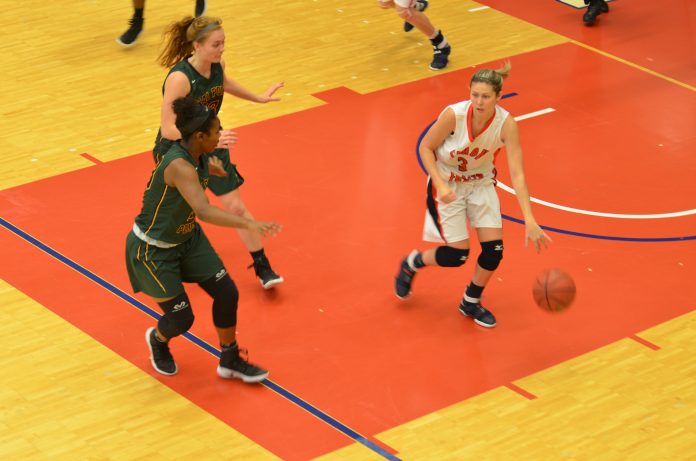
Tayler Drynan (#3) finished with three points in a season high 23 minutes.
It was a rare noon tip-off for the women’s basketball team on Friday, but that didn’t hinder them from rolling over Cal Poly Pomona. On the back of a strong defensive performance, SFU came away with a 68–50 win over the Broncos.
“I thought we were pretty good defensively at the start of the second half,” said head coach Bruce Langford afterwards. “I thought we were just OK defensively in the first half, but we gave them some looks and they just missed some shots. In the second half, we really shut them down in terms of having any looks.”
The game was attended by a horde of young children, and they brought some unbridled enthusiasm rarely seen in the West Gym. After a rough start where the opening tip-off led straight to three Cal Poly Pomona points, SFU played well defensively, only allowing one three-point attempt the whole half — which was missed. Senior Ellen Kett played 18 of the 20 minutes in the first half, going three for four from behind the arc with 11 points.
However, it was in the second half where SFU started to flex some muscle. They outscored the visitors 37–25, and limited the Broncos to just 33.3 percent from the field. It also featured big minutes from freshman Tayler Drynan, who played in place of Ellen Kett when she was rested.
The standout performance of the game was easily turned in by freshman Ozi Nwabuko. She finished with 19 points, with 15 of those coming in the second half. It was the third straight game she has either led or tied for the team lead in points. Langford had nothing but high praise for her afterwards.
“Ozi’s very, very good defensively. We were a little concerned that she was going to get in the way offensively,” said Langford. “But as you can witness, she’s the fastest kid I’ve ever coached by a mile. And I’ve coached some national team Olympic athletes. She is quicker than you can shake a stick at.”
Another storyline was the players who didn’t get minutes, as there could be some injury concerns going forward. Despite being seen on the bench before the game, redshirt junior Elisa Homer did not play and was not on the bench during the game. Arguably SFU’s best shooter, she is suffering from the effects of a concussion and “won’t be playing tomorrow for sure,” according to Langford. The team is hopeful she will make the trip up to Alaska next week.
“She’s the fastest kid I’ve ever coached by a mile.”
– head coach Bruce Langford on Ozi Nwabuko
Vanessa Gee injured her ankle three weeks ago, and is “ready to come to Alaska” but like Homer, will not feature in tomorrow’s game.
That game will be against Cal Poly Pomona again. With it being the second straight game against the same opponent, the key will be remaining levelheaded, according to Langford.
“We did that in the CIS [Canadian Interuniversity Sport] for years,” Langford said on playing back-to-back nights. “We use to have the CIS complex, which is the team that wins the first night loses the second night because they think they’re God’s gift to the human race, and the other team is a little pissed and comes back. So we have to make sure our kids don’t get God complex.”
With a 7–1 record to start the season, SFU looks like the team to beat in the conference. And unlike last year — where the team was at one point down to six players and mostly relied on the trio of Ellen Kett, Elisa Homer, and Alisha Roberts to drive the offence — the Clan now has a deep bench and impact freshmen such as Ozi Nwabuko, Tia Tsang, and Tayler Drynan able to get points and eat up minutes. With all these ingredients, it’s shaping up to perhaps be a memorable season for women’s basketball.
The Tourist Company’s new album, Apollo, is out of this world, if you’ll forgive the pun.
But seriously. The album is catchy and fresh, foregoing the typical guitar-driven indie sound for of keyboards and synths. On top of this expansive base they’ve layered everything from tambourines to trumpets, with echoey vocals and lyrics that yearn for the expanse of outer space.
On the album we see songs like “Sputnik,” “Astronaut,” and “Weightless and Stranded.” Where did this space theme come from? On the phone with The Peak, lead vocalist Taylor Swindells said it stems from his childhood.
“When I was five or six I was really obsessed with outer space; I was fixated on it. I remember we used to watch these documentaries, and a few years ago all that imagery came flooding back to me,” he explained.
Apollo was born during the Peak Performance Project in 2014, when the Tourist Company was busy proving their worth against other local bands, placing third overall. Swindells said he brought the substance of the album to his bandmates — Jillian Levey (vocals/keys), Josué Quezada (bass), and Brenon Parry (drums) — and they added their own flavour and parts to the mix.
The new album has pushed the band away further from their folk origins into a new expansive electronica. This is partly due to Swindells’ choice to write from a piano rather than a guitar. “I started as a classical piano player, so I wanted to step back and write this record from the keyboard, which was a big shift,” he said. “Making the piano the driving force, with guitar as an accent, definitely leaves more room for other sounds and makes the music a lot more cinematic.”
The Tourist Company rejects being confined to one genre, but in terms of musical influences they cite a mixed bag of orchestral-electronic musicians and local indie groups, including Son Lux, Death Cab for Cutie, Arcade Fire, Royal Canoe, We are the City, and Jordan Klassen.
At the moment, the four band members are on a whirlwind cross-Canada tour with Apollo. Working their way through over 20 shows in seven provinces, from Halifax to Victoria in just over a month, they’re truly living up to their name. Swindells told The Peak the tour has been great, and one of the surprising highlights so far was their show in Quebec City.
“It was kind of a last-minute addition to the list, but the venue was right down the street from the old city [in Quebec] and the old city walls. The owner was really fun and boisterous and it was kind of a perfect storm of all these things we weren’t expecting,” said Swindell.
They’re rounding off their tour in BC this week with shows in Kelowna, Rossland, Victoria, Nanaimo, and then finally Vancouver on November 26. What should we expect for their show at the Fox Cabaret? The entirety of Apollo album played “good old-fashioned indie-style,” with tons of energy and lots happening on stage.
A train runs along the Evergreen line earlier this week in preparation of opening today.
“We realize, that on this tour, the large majority of people have never heard of us.”
At least that’s how As It Is front man Patty Walters described opening for Sum 41 and Senses Fail on the Don’t Call It A Sum-Back Tour at the Commodore Ballroom. They wasted no time during their half-hour set, playing songs from both their forthcoming album Okay, and their debut album Never Happy, Ever After, which was released in April of last year.
“I always give everything I have live,” said Walters, and it showed when he sang song after song whilst jumping off anything that he could. One of his more impressive feats was jumping off the drum kit and still managing to stay in perfect pitch.
As It Is knows the importance of getting the crowd pumped, getting everyone to clap to the beat and start a mosh pit front and centre, because nothing makes a pop-punk concert more pop-punk than a mosh pit. They also know that coolness is overrated, as Walters shouted to the crowd, “I don’t care how fucking cool you think you are, I want to see everyone jump up and down!”
After the show, I got to chat with Walters in the alleyway behind the venue. In a world where musicians can act like entitled pricks and get away with it, Walters’ humble attitude was refreshing: “It’s a very careful balance between being confident and being arrogant. You can’t come off as, like, a dick.”
Since late 2014, the band has been signed to pop-punk powerhouse Fearless Records. This has been a change from being independent, but not in a bad way. “[Fearless] doesn’t ask us to change a whole lot of anything. The writing, the integrity of our band isn’t any different. It feels better because we have so many more opportunities now,” reflected Walters. They feel especially lucky to be able to work with producers they admire and to go on amazing tours.
The first two singles off Okay, “Pretty Little Distance” and “Okay,” sound incredibly happy at first, but once you listen a few times, you realize that they are quite introverted and sad. Walters calls this “the As It Is special.” Growing up, these were the types of songs that the band listened to, especially from bands like Jimmy Eat World and Death Cab For Cutie. This was the theme on their debut album, as well. However, with the new record, they’ve let themselves be a little more honest and confessional. They’ve written a bit about their families, personal struggles, and vulnerabilities.
These first two singles have more of a pop vibe than their previous releases did — a far cry from their EP, This Mind of Mine, which was released in 2014. I asked Walters if this is a trend that will be further cemented on their upcoming album. “Yes and no,” he said. “On this record, there are going to be songs that are a lot darker, going back to earlier stuff . . . but there are also poppier songs . . . [We are] kind of doing the darker stuff darker and the poppier stuff poppier.”
While As It Is ‘came a long-ass way to be here,’ their future is looking more than Okay.
It was 10–4 last week, to get back to the winnings ways. If you missed it, Washington absolutely destroyed Green Bay on Sunday night, led by the strong play of quarterback Kirk Cousins who had 375 passing yards and three touchdowns. Cousins, who only got a one-year deal in the off season to prove he was a top-flight quarterback, was so fired up after the game that he screamed in his general manager’s face, “How you like me now?!” In other action, the Cowboys, Raiders, Patriots, and Seahawks all took care of business and continue to look like the front runners for the Super Bowl. Looking ahead to this week, I must begin with a happy American Thanksgiving to you all. Two of the three Thursday games should be highly entertaining and are Game of the Week worthy, with only the Colts vs. Steelers looking like a dud due to Andrew Luck’s injury. This week also features a Grey Cup Preview, which features a player I actually have coached against.
Minnesota (6–4) at Detroit (6–4), Thursday 9:30 a.m.
Having lived in Ontario for most of my life, these early kickoff times are just unnatural. American Thanksgiving is a time call in sick, drink beer, and watch football. A 9:30 a.m. start is just too early for such pastimes. Nevertheless, this game is critically important as the winner will claim first place in the NFC North. The Vikings are coming off a big win against the Cardinals to avoid a fifth consecutive loss. The Lions have been mediocre all season with most of their games, including last week’s comeback against the lowly Jaguars being decided by extremely close margins. I’ll take the Lions at home in this one as I have more faith in Matthew Stafford than his quarterback counterpart Sam Bradford.
Prediction: Lions 23 Vikings 20
Game of the Week
Washington (6–3–1) at Dallas (9–1), Thursday 1:30 p.m.
A divisional rivalry game with two hot teams playing in Big D on Thanksgiving — you’ve got to love sports! Washington is riding high with back-to-back wins over the Vikings and Packers. Their offence is clicking on all cylinders with Kirk Cousins distributing the ball with authority to the likes of Jordan Reed, Pierre Garcon, Jamison Crowder, and DeSean Jackson. Washington has also established the running game with Rob Kelley rushing for 87, 97, and 137 yards his last three games. The Cowboys meanwhile have set a franchise record with nine consecutive wins. They are also just the third team in NFL history to compile over 400 yards on offence in eight consecutive games — a streak which is ongoing. What is dangerous for opponents is that star receiver Dez Bryant seems to be rounding into form. With the league’s leading rusher in Ezekiel Elliott and a resurgent Bryant, rookie quarterback Dak Prescott should have the opportunity to play even better. The Cowboys beat Washington earlier in the season 27–23 in Washington. In this matchup, look for a muffed Cowboys kick in this season of awful NFL kicking to propel Washington to the upset win.
Prediction: Washington 31 Cowboys 30
Pittsburgh (5–5) at Indianapolis (5–5), Thursday 5:30 p.m.
The Colts are a mediocre team with Andrew Luck. Without him, they will not have enough to beat the Steelers even at home. A big factor is that backup Scott Tolzien has a short week to prepare for this matchup and has had limited practice reps with the first team offence all season. Steelers take care of business.
Prediction: Steelers 27 Colts 17
San Diego (4–6) at Houston (6–4), Sunday 10 a.m.
The Chargers are coming off their bye week, and are facing a Houston team on a short week after a hard-fought Monday night loss to the Raiders. I think the Texans are the worst team leading a division in the league, whereas the Chargers are the best AFC team with a losing record. I like the Chargers defence to be the difference in this one, sparked by a big game by rookie pass rusher Joey Bosa.
Prediction: Chargers 24 Texans 21
New York Giants (7–3) at Cleveland (0–11), Sunday 10 a.m.
The Browns cannot seem to catch a break with the schedule. They’re 0-11, and the Giants with their five consecutive wins roll into town. Last week the Browns gave up eight sacks to the Steelers and got their rookie quarterback Cody Kessler knocked out of a game for the third time this season. Both Robert Griffin III and Josh McCown have also been injured this season behind the Browns’ shaky offensive line. Look for big games from Giants defensive ends Olivier Vernon and Jason Pierre-Paul as the Browns head closer to 0–16.
Prediction: Giants 34 Browns 17
Cincinnati (3–6–1) at Baltimore (5–5), Sunday 10 a.m.
When is desperation time going to set in for the Bengals? Last week they managed just 13 points against a mediocre Bills defence at home, and now face a very good Ravens defence on the road. The Ravens should also know that they need to win to keep pace with the Steelers for the division lead. The Bengals are further limited by injuries last week to all-world receiver A.J. Green and shifty running back Giovani Bernard. The Ravens channel their inner Edgar Allan Poe and declare to the Bengals, “Nevermore!”
Prediction: Ravens 26 Bengals 16
Arizona (4–5–1) at Atlanta (6–4), Sunday 10 a.m.
The Falcons are rested after their bye week and are at home in the dome against a Cardinals team playing back-to-back road games. The Falcons are a dominant team at home and will be buoyed by the return of running back Tevin Coleman. When Coleman is paired with Devonta Freeman out of the backfield, the results have been electric. Keep an eye on the matchup between Falcons receiver Julio Jones and Cardinals cornerback Patrick Peterson. These two elite players facing off should be a lot of fun. Atlanta wins a close one.
Prediction: Falcons 29 Cardinals 28
Los Angeles (4–6) at New Orleans (4–6), Sunday 10 a.m.
The Rams’ outstanding defence can only do so much when their offence cannot score more than 10 points. For much of last week’s game, the Rams’ D held the Dolphins scoreless before two second-half touchdowns sent the Rams to a 14–10 defeat. The Saints at home are an extremely difficult team to stop for 60 minutes. I can’t see the Rams and rookie quarterback Jared Goff scoring enough points to outpace the Saints. Look for a big game from Saints rookie receiver Michael Thomas who will get back to being Drew Brees’ favourite target.
Prediction: Saints 24 Rams 15
Jacksonville (2–8) at Buffalo (5–5), Sunday 10 a.m.
One of my favourite moments as a kid watching football happened in 1998 when a former CFL star quarterback named Doug Flutie ran a naked bootleg for the game winning touchdown as the Bills beat the heavily favoured Jaguars. In this matchup, the Bills are favoured to win and rightfully so, as they are facing the woeful Jaguars. Bills quarterback Tyrod Taylor will keep the Bills in playoff contention in this matchup. Look for a big game from Bills linebacker Lorenzo Alexander, who is tied for the league lead with 10 sacks. Alexander was a career special teams player who waited 10 years to be a regular defensive player, and is making the most of the opportunity.
Prediction: Bills 36 Jaguars 24
San Francisco (1–9) at Miami (6–4), Sunday 10 a.m.
Miami gutted out a tough road win last week against the Rams, which highlighted how much their quarterback Ryan Tannehill has improved as a player. Tannehill’s growth and the Dolphins’ surprising 6–4 record is making head coach Adam Gase look like a very smart hire and a potential coach of the year candidate. They should improve to 7–4 against a 49ers team that is low on talent and facing a long trip to humid Florida.
Prediction: Dolphins 34 49ers 24
Tennessee (5–6) at Chicago (2–8), Sunday 10 a.m.
At 5–6, the Titans are still very much alive for a playoff spot, because of how unimposing Houston at 6–4 is at the top of their division. The Titans have a very favourable matchup this week despite playing on the road, because they play a Chicago team which has lost two straight after an improbable win over the Vikings. Compounding matters is that Bears quarterback Jay Cutler may not play this week due to injury. The Titans and their “exotic smashmouth” offence will put up enough points to send the Bears spiralling further to a top three pick in the 2017 draft.
Prediction: Titans 38 Bears 21
Seattle (7–2–1) at Tampa Bay (5–5), Sunday 1:05 p.m.
Tampa Bay is suddenly right in the thick of the playoff race on the strength of back-to-back wins and by being just one game back of the Falcons. They pulled a shocker last week by going into Arrowhead and beating Kansas City. With star receiver Mike Evans, a good young quarterback in Jameis Winston, and with running back Doug Martin returning last week from injury, this is a stern test for the Seahawks on the road. With all that being said, the Seahawks are looking like they’re a Super Bowl team again and Russell Wilson will find a way to win this game one way or another. Look for Wilson and Jimmy Graham to both have big games in a close Seahawks wins.
Prediction: Seahawks 33 Buccaneers 31
Carolina (4–6) at Oakland (8–2), Sunday 1:25 p.m.
Oakland is coming off a big win in Mexico City last week against Houston and will face a Panthers team which beat New Orleans last week to keep their playoff hopes alive. The Panthers will probably be without former NFL Defensive Player of the Year Luke Kuechly which will significantly hurt their chances. I like the Panthers to nevertheless steal one against a Raiders team on a short week which was disrupted by an international game. Cam Newton finally plays like an MVP in a big-time road upset.
Prediction: Panthers 37 Raiders 33
Upset Special
New England (8–2) at New York Jets (3–7), Sunday 1:25 p.m.
Patriots quarterback Tom Brady might be playing the best football of his career at age 39. Since serving a nonsensical four-game suspension, he has thrown for 1,915 yards, with 16 touchdowns and just one interception in six games. He is also just one win away from tying Peyton Manning for first place among quarterbacks with 200 wins and needs just 57 yards to be the fifth quarterback in NFL history to reach 600 yards. Not bad for a sixth round draft pick who only got his chance to play because of an injury to franchise starter Drew Bledsoe. There is cause for concern in this matchup though, as the Patriots are playing consecutive road games against a divisional opponent who is coming off a bye. Jets coach Todd Bowles is also a very good defensive mind and will have a strong game plan in place. Their quarterback Ryan Fitzpatrick returns to the starter’s role after an injury and should know that this very well could be his last NFL start if he has another poor performance. Fitzpatrick is a grizzled veteran who has played for six NFL teams and will leave everything on the field against a hated foe. The Patriots also have not played great defence this year and have had trouble forcing defensive turnovers. The Jets find a way.
The Seahawks are looking like they’re a Super Bowl team again
Prediction: Jets 28 Patriots 27
Kansas City (7–3) at Denver (7–3), Sunday 5:30 p.m.
These divisional rivals face off in a game with major playoff implications. While both are 7–3, it remains to be determined if either is really playoff calibre. Both the Chiefs and Broncos are offensively limited and will need to step up their overall play to be Super Bowl contenders. I like the Broncos at home off their bye week to beat a Chiefs team which was upset last week at home against Tampa Bay. The Chiefs’ defence has not looked as stout as Denver’s and that will be the difference in this matchup. Look for Broncos receiver Emmanuel Sanders to make a few big plays to give their mediocre offence some juice.
Prediction: Broncos 23 Chiefs 19
Green Bay (4–6) at Philadelphia (5–5), Monday 5:30 p.m.
In their last four games, all defeats, the Packers have given up 33, 31, 47, and 42 points. Last week, their former MVP quarterback Aaron Rodgers had a terrific game with 355 yards and three touchdowns. Great quarterback play cannot make up for an atrocious defence, though. I would speculate that if the Eagles hang 30 plus on Green Bay that defensive coordinator Dom Capers may have to look for another job. The Packers are playing consecutive road games and are in major jeopardy to miss the playoffs for the first time in eight years. Facing them is an Eagles team that started the season 3–0 and has crashed back to earth with losses in five of their last seven games. The Eagles’ five losses have been by close margins though, and they boast a stout defence. That should be enough for them to send the Packers to their fifth straight defeat.
Prediction: Eagles 27 Packers 24
Bonus 104th Grey Cup preview
Calgary (15–2–1) vs. Ottawa (8–9–1), Sunday 3:30 p.m. in Toronto
After an outstanding regular season, the Stampeders crushed the BC Lions 42–15 in the Western Final. They will be facing an Ottawa team which finished first in a putrid Eastern Conference and advanced to their second consecutive Grey Cup with a narrow win in the Eastern Final over Edmonton. The key question in this matchup is whether the Redblacks can pull off a monumental upset over a Calgary squad which has looked like the best team in the CFL from start to finish. The top storyline in this matchup is the opportunity for revenge that 41-year-old Redblacks quarterback Henry Burris will have against the team that unexpectedly traded him away five years ago. Burris has had an up and down year with an injury early on and may be playing the final game of his career. Nevertheless, this is a dream matchup for him and a win would provide a storybook ending to a long and distinguished career. Calgary is led by quarterback Bo Levi Mitchell who threw for 5,385 yards, 32 touchdowns and eight interceptions this season and looks like the front runner for CFL’s Most Outstanding Player.
Look for a big game from Stamps running back Jerome Messam. Messam rushed for 1,198 yards, and had 54 receptions for another 485 yards with 12 total touchdowns. I had the chance to coach against Messam in 2004 when he played for the Brampton Bulldogs in the Ontario Varsity Football League. He was an outstanding player with a rare blend of size, power and speed. That season, he had a five-touchdown and a 300-yard performance against Oshawa. That winter, Messam impressively rushed for 300 yards again for Team Canada in a gold medal win over Team USA in the NFL Global Junior Football Championship where he was named tournament MVP. In our matchup, the Huronia Stallions defeated Brampton 19–9 and we held Messam to 16 carries for 76 yards and no touchdowns. The key play was in the first quarter when they went for it on fourth and goal at the nine-yard line on a toss play to Messam that saw our safety Greg Van Bolderen make an open field solo tackle. In this matchup, Messam will crush Burris’ dream finale by returning to the GTA and having a huge game to propel the Stampeders to a Grey Cup victory.
The annual Clan Cup International on November 18–20 at the Margaret and Paul Savage Pool was a success for SFU, as the team led every day of the tournament. “The competition was very successful, with SFU winning the Clan Cup,” said head coach Liam Donnelly. Coach Donnelly definitely has a lot to be happy for, as many new records were set by the swimmers and quite a few surpassed expectations.
On day one, SFU closed the night with three wins out of eight against Whitman College and the SFU Aquatic Club. Swimmer Mackenzie Hamill set a new time record in the finals of the 800m freestyle, surpassing Adrian VanderHelm’s record from last year’s event. With a couple more wins from other swimmers, SFU stood at 335 points.
Day two brimmed with victories, as the men and women’s team dominated the competition by securing 13 of 16 events. Notable performances were executed by swimmers Jessie Gibson, Meaghan Frenks, Lauren Diehl, and Sidney Peake of the women’s team. The day finished with 901 points for the Clan as the team held its ground at the top position.
The Clan did not fail to impress on the last day: eight different swimmers seized individual titles, while the men and women’s team raced to win the 400m freestyle relays. Day three of the Clan Cup International ended with a high score of 1,401. Breaking down this score, the women’s team brought home 783 points while the men achieved 618 points.
“Jessie Gibson achieved an ‘A’ standard for the NCAA National Championships and automatically qualifies to compete in early March in Birmingham, Alabama,” said Donnelly. Senior Claudia Mathieu said, “It really showed what the swim team was made of. People were tired and beat by the end of it, but right until the last relay everyone gave it their all. With already one woman making the ‘A,’ and a dozen making ‘B’ cuts, it could only mean great things for the team.”
Gibson, Hamill, and VanderHelm broke SFU records at the end of the Clan Cup. Donnelly added that 28 “B” standards were achieved by 11 different swimmers: Kristen Olvet, Lauren Swistak, Miranda Stever, Meaghan Frenks, MacKenzie Hamill, James Cormier, Adrian VanderHelm, Andrew Woinoski, Gabriel Lee, Tim Woinoski, and Daniel Kilmaster.
“I think the team has seen what they are capable of accomplishing and it’s given us great confidence going into our next big swim meet next weekend in Seattle,” said Mathieu.
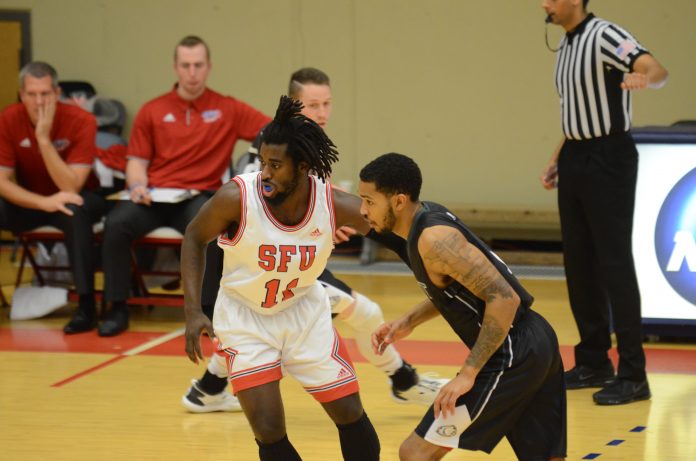
Kedar Wright (#11) is not expected to play this weekend due to injury. Wright led the team in scoring in exhibition play and was expected to carry much of the offensive load this season.
After claiming back-to-back wins against Lindenwood University last weekend, the men’s basketball team heads to Riverside, CA to take on California Baptist University Friday and Concordia University Irvine Saturday.
With the two wins, in four games, the men’s basketball team already has more wins against NCAA Division II competition than the team did all last season, when they earned only one, and a late one at that, coming February 11.
But the big question is: can SFU keep up the momentum with a shortened bench? On the weekend, the Clan dressed only nine players and gave minutes to just eight. Most notable of those absences was guard Kedar Wright.
Wright, who had led the team in points in exhibition play with 63 points in the three games and was expected to carry a bulk of the offence this season, was injured in the game before against Lindenwood on a foul. Wright was wearing a sling around his arm Saturday, and for now, the timetable for his return is unknown.
“We don’t know. Right now, it’s kind of day-to day, and we’ll have to talk to the doctor and see where he’s at, but he had a slight separation in his shoulder and we’ll just see how he responds to rehab,” said Hanson after Saturday’s game.
Gibran Sewani hasn’t played since the exhibition game versus Quest University, suffering the effects of a concussion in a September practice. He was expected to return to practice this week
Redshirt freshman Aleks Vranjes hasn’t played since their first game against Douglas College, where he put up 24 minutes and looked like he’d be a big part of this team. Bowen Bakken has also not played since the Quest game. Vinnie Safin did not play last weekend, but was in the lineup the weekend before at the Sodexo tipoff.
Freshman Bongani Moyo does not appear to be officially redshirted — he was dressed for Saturday’s game — but has not played a minute in the regular season. His play in exhibition was limited to 16 minutes over three games, receiving only two minutes each in the first two games.
However, the team appears confident that it can rise above a shortened bench.
“Good teams have to be able to play with nine, 10, 11 guys every night,” said Hanson. “Our practices have to prepare us for playing when you’re tired, making good decisions, so [Saturday] was a great game to see how we cope in tight game situations.”
A big key to that is getting big performances out of both the new additions and players who don’t typically score. Redshirt-freshman Michael Provenzano played 36 and 39 minutes last weekend, scoring 14 points, after having played 14 and 26 minutes in his first two games. Sophomore Tyrell Lewin had a career-high 14 points Saturday, after putting up eight points in his first three games and only putting up double digit points three times in his pure freshman season.
The play from the bench will be important, and Andrew Williamson and Hidde Vos in particular will likely be relied to play some big minutes. Williamson and Vos both played over 20 minutes Saturday, coming off the bench, after playing eight and 11 respectively on Friday.
“[The key to sustaining this momentum is] riding on the energy that we’ve had from these two games,” said Lewin on Saturday. “There’s definitely some stuff to fix still, but I’m sure as long as we keep the energy and positive frame of mind, keep attacking, we should do well in the next couple of games.”
“We’re going into the dragon’s lair,” said Hanson, referring to Friday’s matchup in particular. “Our guys will be in tough and it’s going to be a real challenge, getting ready for practice this week. I think it’s great though, to play the best teams in the nation and see where we stack up. It’s going to be really tough.”
California Baptist are ranked ninth nationally, having won their two Division II matchups, and were competitive in an 81-73 loss to the Division I University of California Berkeley Bears.
And on Saturday, though Concordia University Irvine have not fared well in non-conference play so far, going 1-4, last season they were a force in the NCAA Division II PacWest conference, going 22-6 overall, and 15-5 in the conference — tying for best conference record.
It will be an important test to see if SFU can pull off a win or two, and if not, remain competitive in both games with a shortened bench.
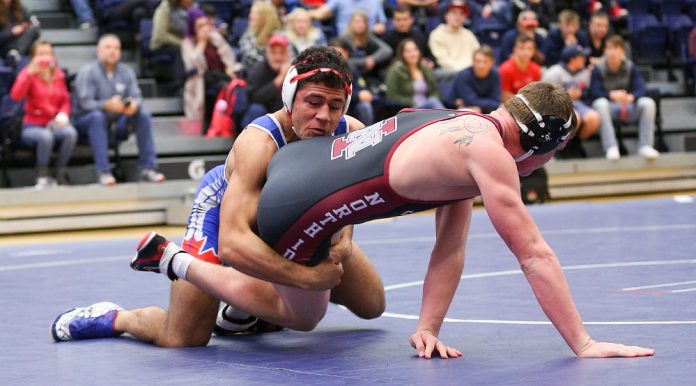
Morgan Smith (centre) is now 11-0 to start the season.
The SFU men’s wrestling team wrapped up a successful trip to Spokane, Washington this weekend with a second place finish at the Spokane Open. This tournament is one of the first for the Clan and usually attracts some of the best talent in the Northwest, including several NCAA Division I schools.
“Overall it was a good performance from a group that’s missing two of our leaders. With seniors Tyler McLean and Josh Kim out of the lineup with injuries, the rest of the squad stepped up and really competed hard,” head coach Justin Abdou said of the team’s performance overall.
The Clan had several impressive individual performances as well, with Sean Molle (HWT), Reid Watkins (174 lbs), and Kenji Yamashita (149 lbs) all taking third place.
“Kenji avenged two losses from earlier this season to his North Idaho opponent, which was a real positive for him after missing all of last season due to injury,” Abdou said. “Reid has already had as many matches this year as he did all of last year, which was cut short from injury. If he stays healthy and continues to improve he will be a real threat come March.”
Cruz Velasquez (133 lbs) also had a successful tournament, as defended his championship from last year’s Spokane Open, once again placing first. When asked about his performance thus far this season, Abdou did not hesitate to say, “He’s been great so far. Opponents are finding him very hard to score on.”
At 197 lbs, there was an all-SFU final between Morgan Smith and Ciaran Ball. Interestingly, these two athletes not only go to SFU together, but also were training partners in high school when they both attended Meadowdale High School in Lynnwood, Washington.
“Wrestling Ciaran was exciting. I’m always glad when a teammate makes it to the finals, I just don’t expect to wrestle them. We do train a lot together, and he’s my best friend. I think we have made each other better. I don’t think about that tuff before I step on the mat. My mental preparation is always the same,” Smith said when asked about wrestling his teammate.
Smith recently bumped up to 197 lbs, as he wrestled in the 184 weight class for all of last year. The bump seems to be working out well for him, as he has yet to lose a match in his new weight class.
“[He] dominated all of his opponents this weekend with 4 pins and 2 major decisions. He is 11-0 on the season,” Abdou said of Smith’s wrestling over the weekend.
When asked if he did anything different to prepare this year, Smith said, “I wrestled all summer and competed in tough tournaments [. . .] Last year didn’t end how I wanted it to, so I’m doing everything in my power to make sure I don’t feel that way again. Nothing has changed really in terms of work ethic, I’ve just learned a lot about wrestling.”
“I feel like our team is a very tight-knit group and I think that we have yet to see our full potential” he continued” We started off slow but we’re picking up steam, which has to do with cutting weight properly and getting our minds right. Our identity as a team is that we’re intelligent and extremely hard-working, which to me is a deadly combo.”
The Clan compete next in a series of duals in Great Falls, Montana next weekend before wrapping up the first part of the season at the Reno Tournament of Champions. The Clan International wrestling tournament will also take place in West Gym on December 2nd and 3rd.
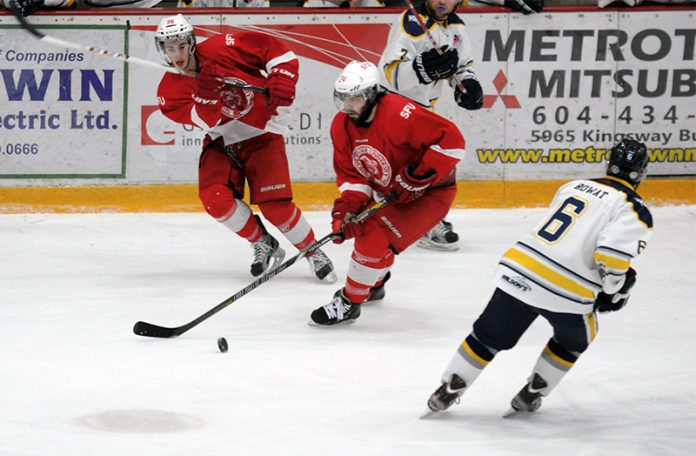
SFU is for now top of the BCIHL with 15 points in 10 games.
Saturday’s game marked the return of forward Tyler Basham, but he alone was not able to get SFU hockey into the win column. The Clan lost to the Trinity Western Spartans 3-1 on the road.
“The first period was kind of sloppy by both teams” head coach Mark Coletta told The Peak. “Second period I thought we did well to come out of the gate, but we took a penalty and gave up a shorthanded goal which changed the tide a bit. We did tie it up but never really got a groove in the second. I thought the third period we were definitely the better team and pressed [. . .] we caused some pressure but we couldn’t score.”
SFU’s lone goal was scored by the aforementioned Tyler Basham in the second period. It was Basham’s first game since injuring his shoulder on October 22nd against Eastern Washington.
“I think he’s always going to be a little apprehensive, with the shoulder” remarked Coletta. “In hockey, you use them all the time, whether you’re making a hit or protecting yourself from a hit. [. . .] he did a good job, and he’s [now] comfortable after a game under his belt.
However, the Clan could have, and probably should have, scored more goals. SFU peppered Trinity Western goalie Silas Matthys with 35 shots, but were only able to get a single goal. For his efforts, Matthys was named first star of the game.
“It’s not always going to be 11 and 6 goal outbursts, we have to really focus on shooting with a purpose is one thing” said Coletta on how to improve goal scoring. “Getting traffic to the net, sticks on the ice when you’re going to the net. Getting to that neck front and creating havoc for not only the defencemen but the goalie as well. Traffic is obviously a cliche, but we definitely want to be going to the net the proper way, not just going there to go there.”
Jordan Liem was in goal for SFU and “played well” according to Coletta. Next’s week starter is yet to be determined, but if Liem does start again, it will be his eighth start of the season.
Next up for SFU is a game against rivals Selkirk College. If the Clan can defeat them in regulation, they’ll be three points clear of them in the standings.
“We have to use our team speed and our aggressiveness on our forecheck” said Coletta on how to get a result against the Saints. [. . .] When we went up there in the beginning of the year, we played a real in your face style, and we were successful.”
Alison McKay finished with 19 digs in her final game in the West Gym.
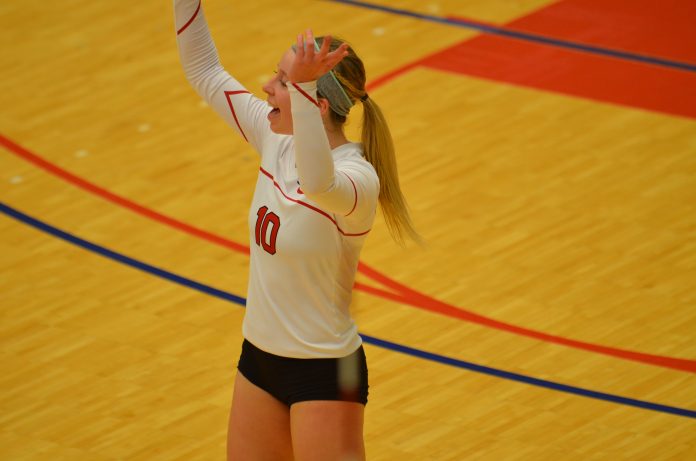
The SFU Clan volleyball team (21-7) hosted Montana State University Billings (7-23) for their last regular season game this past Saturday. They wrapped up the season nicely, winning three straight sets on senior night to seal the win. It was a great sendoff for some of the great senior talent that SFU has and that have served the program well.
Four seniors were in the starting lineup for the Clan this Saturday. Emma Jennings, Alison McKay, Devon May, and Tamara Nipp all played their last games in West Gym, each contributing to the win.
“We wanted to play well on senior night and I think we did that. A lot of people contributed and I thought we did a good job with our offense. Everybody was in rhythm tonight. Overall a great team performance,” head coach Gina Schmidt said of the team.
When asked if the rest of team felt the need to perform for their senior teammates, she added, “Yeah, it’s always special playing your last home game, and also last match of the season against the home crowd. They wanted to play well for the seniors and the team as a whole after a good overall season to finish on a high note.”
The offense was certainly in rhythm, as Nipp racked up a staggering 45 assists in the contest. The Clan was strong in their defense as well, as McKay added 19 digs to her season total.
The two-time GNAC defensive player of the year finished her last regular season game proud of her teammates’ effort. “It was nice getting the win because it shows the improvement of this team and everything we’ve worked for. It was nice to end on home court with the W and everyone played really well,” she said when asked about how she felt ending the regular season on a high note.
It’s always special playing your last home game, and also last match of the season against the home crowd
The Clan will now wait in anticipation for the selection results for the NCAA national tournament. Currently, the Clan sit in third place in the West Region. To qualify for nationals, they will need to hold onto at least a top five finish.
When asked if the team will now turn their attention to playoffs, a place SFU has never been, coach Schmidt indicated that they are already on her mind. “That’s definitely what we’re preparing for,” she said. “I think knowing the competition and having seen a couple of the other teams let’s us go in with a mindframe that we’re not just happy to be there. There’s more to accomplish.”
McKay echoed her coach’s statement, saying that, “I think we’re pretty pumped. I think after tonight we’re definitely going to start prepping for that and getting some good practices in.”
All attention turns now to the selection show today at 430, where the Clan will find out for sure if they will be competing in the postseason. After wrapping up their best regular season of all-time, it seems only fitting that they move onto to the NCAA tournament.
The Vancouver housing market, as many desperate renters and potential homeowners hope, might turn out to be one pleasant bubble fuelled largely by foreign speculation. As things stand now, though, it looks more like an annoying zit plaguing beautiful BC, and she doesn’t want to wait it out.
Before delving into details, let’s assess the issue through some stats. According to census data, the non-resident occupancy rate (measuring the percentage of homes either vacant or occupied by non-residents) stood at 3.5 percent in 2001. That figure almost doubled by 2011, and is still increasing. Similarly, the number of homes occupied across Metro Vancouver by non-residents grew from about 27,564 in 2001 to about 58,229 in 2011.
Put bluntly, those numbers have been on the rise for over a decade. While it would’ve been helpful for lawmakers to place greater importance on this issue before it grew so dire, looming exams and elections seem to draw the best from students and public servants, respectively.
In any case, the 15 percent foreign buyers tax from earlier this year and the new one percent tax appear to be “band-aid” solutions, applied to a deep wound that really requires surgery. Having said that, we do need to start somewhere.
Housing shouldn’t be like company stocks, or bullion — a field of speculation, where you buy or sell based on whether the market’s ripe or sinking. Nevertheless, it’s turned out to be just that, more so in historically populous areas like Toronto and Vancouver than, say, towns in the Prairies.
With the demographic shifts of the new century — where people living in rural locales, especially those entering the middle class, are looking to move to the big cities — the influx of people is not going to flatten out. Our public policy experts and city planners will eventually have to grapple with the same housing issues that their counterparts in San Francisco, Tokyo, or Mumbai deal with.
Given the circumstances, this is the perfect time to see the emergence of affordable housing as a human right, in an official way. More importantly, any housing policy must be targeted towards the concerns of the people actually living in the city.
The flat one percent tax does have potential to add volume to the market, as it attempts to disincentivize keeping a second home vacant. However, one percent annually seems like too little, while the daily fine rate for loophole seekers is absurd. Instead, a progressive tax rate would yield better results.
The ostensible crackdown on Airbnb also won’t solve the issue. On average, only about 13 percent of the homes occupied by non-residents are occupied by temporary (e.g. Airbnb) or foreign residents. The mechanics of reporting and verifying the status of homes and the business of catching offenders is going to cost the public exchequer anywhere from $2–2.5 million in the coming years, and there needs to be more clarity on that.
Additionally, while there are some provisions laid out for exemptions, such as those for snowbirds and part-time residents, there need to be additional exemptions to account for other situations, such as deceased owner, owner in residential care, change in ownership, and the like, to avoid legal hardships for individuals.
While the strategies against the housing crisis aren’t perfect right now, they’re the beginning of countermeasures that could really be effective. Right now, the priority should be continuing to refine this response, and to learn from this experience: the sooner we address Vancouver’s problems, the better.