Home Blog Page 785

Two major issues could threaten to undermine the sexual violence policy

0
Little is known about the "Central Resource Office" - including what it will eventually be named - and the lack of information has become cause for concern.

Throughout the questions and comments raised at the feedback sessions for the Sexual Violence and Misconduct Prevention, Education and Support Policy draft, there were two issues that became a lightning rod for the Simon Fraser University community: the “Central Resource Office” and how a sexual violence report will be investigated and resolved.

The office, which at this point is no more than a concept, is “literally going to be an office that is central and have resources,” according to Dr. Jonathan Driver, former vice-president academic and provost for SFU at the town hall session last Tuesday.

Meanwhile, concerns have been raised that the University Board of Student Discipline, which the policy states will handles all the student misconduct cases. The board is composed of faculty, students, and staff at SFU.  

At both the town hall and the student feedback session last week, the resource office became one of the most discussed issues, with talks ranging from what it should be named to how it will be implemented physically to how it will be staffed, both with frontline resources and administrators running it.

Both Driver and the policy draft working groups respect that this is something that requires delicate care.

“I think we need to be very careful about what we name it, as a number of people commented. We need to be very careful about how we physically locate it,” said Driver.  

“We’re dealing with who say ‘It must be really obvious where you have to go,’ but other people who say ‘Look, if you make this a place that people go to when they’ve suffered from sexual misconduct, that people may be reluctant to go through the door.’”


One of the concerns that surprised was the insistence that the whatever it’s called, the resource office will be made up of experts on sexual violence and the other appropriate services it will offer.

“There’s also been concern expressed, and I must admit this surprises me, that we should staff the office with experts. Well, we staff all areas of the university with experts, we write job descriptions very carefully,” said Driver.

The difference between being an expert and believing you’re an expert is the main concern, as President of Academic Women at Simon Fraser University Elise Chenier pointed out when discussing the University Board of Student Discipline.

“The concern I expressed at the forum is that people already believe they have the expertise,” said Chenier. “This is not only hugely problematic because people who sit on that board as caring and as informed as they are have no expertise whatsoever in dealing with these cases. As I said at the forum, often think they can understand them based on quote unquote common sense knowledge.”

While the Central Resource Office could still take any shape (or shapes, if they decide to have one at every campus), it seems it will do so without actively seeking input from a group of students who have spent the last year and a half trying to build a similar resource on campus, as per comments made at the town hall.  

There has been a group on campus trying to build a Sexual Violence Prevention and Resource Centre, and while it has been said that there is a possibility of collaboration between the groups, as of yet they have not been consulted for what they know.

“It is striking that the policy group has not taken advantage of the opportunity to work with people who have already been actively researching this question. I don’t know why they did not take advantage of the opportunity, but that certainly seems to be an oversight on their part,” said Chenier.

This may be why concerns were raised over what experts look like, and why the Central Resource Office and the University Board of Student Discipline will be the most scrutinized issues going forward. As the crucial period of the edits comes up for the policy draft, it’ll be interesting to see how this will be dealt with. 

La La Land captures old school cinematic magic

0
Emma Stone and Ryan Gosling capture the magic of the classic Hollywood musical as Mia and Sebastian in La La Land.

The classic Hollywood musical gets an updated look while staying true to the genre with Golden Globe darling La La Land.

You know you’re in for a cinematic treat when the opening scene is a fully choreographed number set during one of Los Angeles’ infamous traffic jams. Everyone is listening to different music in their cars until one woman gets out of her car and starts singing. In a matter of seconds, more and more people join her until the sour mood has been turned upside down.

Other than the “Oh my God, it’s Ryan Gosling” moment that I had when he appeared on screen in the role of Sebastian, I was completely entranced by his character. Gosling and Emma Stone (Mia) poured their hearts into their characters and for a moment I forgot Mia and Sebastian weren’t real.

Set in contemporary Los Angeles, but with the streets mostly empty of cars and people, it almost feels like the 1940s again. The walls are covered with murals and music bars are on every block.

After Mia hears a lonesome piano while walking around after a party, she heads into one of these bars and finds Sebastian playing jazz. The rest of the world fades away and it’s just them.

Instead of placing a kiss scene in this moment, the story changes to focus on Sebastian and we learn these two are very similar: both are old school dreamers, she’s a struggling actress and he wants to open his own jazz bar.

In every romantic film, there’s a moment where everything is going a little too perfectly: Mia has written and will be performing in a one woman play and Sebastian is recording albums in a band whilst touring the country. However, burdened by the stress of her play, Mia lashes out at Sebastian for never coming home. After she performs her play to an audience of basically no one, she goes home to her parents’ house to rethink her life. Not all hope is lost, as she gets a once-in-a-lifetime audition for a movie.

However, this is not where the film ends. Director Damien Chazelle takes us five years into their futures to give viewers an epilogue filled with unexpected twists and turns. While some viewers might feel betrayed by the nature of this epilogue, the unexpected nature of it was a pleasant change from normal cinematic fare.

Even in musicals, never before has a soundtrack been so perfectly incorporated into the story. “City of Stars” is featured three times — for good reason — as it’s one of the most beautiful and timeless songs to ever be in a movie.

The plot, performances, cinematography, and soundtrack all work beautifully together to tell the old school romance of two dreamers who just want to make it in the entertainment industry. Whether you’re a fan of classic musicals or not, this movie will have you feeling the magic in no time.

Crucial period of sexual violence policy edits underway

1

Simon Fraser University was never going to write the perfect policy on their first attempt.

There was a lot going right for the Sexual Violence and Misconduct Prevention, Education and Support Policy (SVMPESP) after the first draft was released on January 4. For an initial draft, it was a very motivating beginning after months of work. The team behind the policy released all the feedback they had received online, showing what people wanted to see from it.

Members of the advisory committee were also open about the process that went into creating the SVMPESP, showing a great response to the demands for transparency from the original town hall meetings in May of last year.

However, at the town hall meetings this week, members of the SFU community came armed with copies of the draft that they had edited extensively, worried about the language, the process of disclosure, and the currently named “Central Resource Office.” They raised concerns and questions for the entirety of the two hour meeting, and likely could have kept going on.

And this is a trend many see as encouraging.

Concerns over the policy

“It is, in fact, a draft,” said Elise Chenier, president of Academic Women at Simon Fraser University. “That’s the process. They are following exactly the procedures and steps that are proper to a university environment so everything is on the up and up.”

Chenier attended the town hall at the Burnaby campus, and raised concerns about how some parts of the SMVPESP draft need to be reworked so that they don’t damage the policy as a whole, including the Central Resource Office.  

Read more: Two major issues threaten to undermine the sexual violence policy

“In my view, the entire project is really undermined by the fact that this new [Central Resource Office] will not provide counseling services. If we are to go by [former vice-president academic and provost, Dr. Jonathan] Driver’s explanation, it says that they will coordinate existing services, and that’s a problem,” she explained.

She also brought up the adjudication policy and off-campus incidents, among other concerns.

With all the demands and inquiries, the tone could easily be misread as tense, especially from those who were watching a livestream of the town hall or attending via conference call from the Vancouver or Surrey campuses. In fact, a source told The Peak that “SFU admins here are like beet red” during the discussion, and that “Tension is clear. They’re holding back their words.”

Policy makers were hopeful for this kind of response

However, advisory committee member Kathleen Yang (who attended and live-tweeted all the events) found was impressed with the sessions being held this week.

“Those who showed up definitely came prepared and it was really great to see folks who clearly had a lot of expertise,” she said. “It is critically important to have a range of folks participate in this process as their participation is going to be crucial to ensure the success of this policy.”

“We are a research institution. If we didn’t have folks who were willing to give us an extensive, critical analysis, I’d be worried.”

This sentiment is shared by Dr. Driver, who was the host of the town hall on Tuesday.

“The town hall session, I would say, probably reflected people who had read the policy very closely, and wanted to propose some changes to the policy,” said Driver. “A lot of people pointed out that we could be clearer, we could use language that was more direct, so I think there’ll probably be some changes made.”

He said that the working group and advisory group who were in charge of creating the SMVPESP draft felt that the draft policy that they had crafted for the beginning of January is really close to what the university needs, and anticipates the final draft being approved at the March Board of Governors meeting.

“Everything I’ve heard so far suggests that we have actually covered fairly well the issues and concerns that people have wanted to raise,” he said, adding that the Board of Governors meeting will be open so that anyone can see what the final wording of the proposed policy will be.

For Chenier, seeing exactly what those comments were and the people who raised them meant a lot to her, as it did for many others involved with the university.

“I was so appreciative of hearing all that input. It was an amazing experience. It was really beautiful to see how much thought, care, [and] attention people put into reading it and offering their feedback. It was really extraordinary.”

Stuff we like and don’t like

0
(Elena Hsu / The Peak)

Stuff We Like — Little Saigon in Yaletown

This is honestly my favourite restaurant. The Yaletown location is the most transit friendly of the three lower mainland locations, but the food is delicious at all of them. This place is a must try for anyone who loves Vietnamese food. One of the things I love about this place is that you can pick one of their favourites or build your own meal. There are gluten free and vegetarian options for every diner. My personal go to is their build your own vermicelli bowl with prawns and spring rolls. And of course there are the drinks. A personal recommendation: Little Saigon Ice Tea for all ages, Miss Saigon for those looking for an alcoholic option. – JP

Stuff We Like — Almond Milk at Starbucks

After the disappointment that was the introduction of coconut milk (a term that I’m going to use loosely since it was less coconut and more filler) Starbucks has finally brought another milk alternative to its menu — almond milk.

While it still contains added sugar and some additives to keep it from separating, the list of ingredients is significantly shorter than that of the coconut milk. And you can tell that based solely on the taste. Where their coconut milk always tasted a little fake — like someone added too much Coffee Mate to their beverage — the almond milk manages to strike a balance between alternative milk and regular milk in terms of taste.

If you’re looking for an alternative to soy, coconut, or dairy, give the almond milk a try, but remember it does have added sugar. So, if you want to skip a super sweet treat, ask for reduced syrup in your drink! – JW

Stuff We Like — The Ramen District

In Vancouver’s West End, there is about a three block area around Robson and Denman that has a disproportionate number of ramen restaurants. It’s fondly referred to as The Ramen District by some — myself included — and it’s probably one of my favourite food destinations in the city. I live in Surrey and on more than one occasion, I’ve transited the 90 minutes so I could then stand in line for an additional 30 minutes just so I could eat ramen. I’ve been called crazy for doing this, but when I end up craving ramen, I know that buying the instant kind from the grocery store isn’t going to cut it.

The nice thing about having so many of these restaurants so close together means that you can find something for everyone in your group. While most restaurants make the traditional pork bone broth, there are others that make their broths with chicken or with vegetables. So if you don’t eat pork or meat, you won’t miss out on the deliciousness that is non-instant ramen. – JW

Daniel Kelloway running out of time

0
This season, Kelloway finished second at the UW Indoor Preview in the 400-metre.

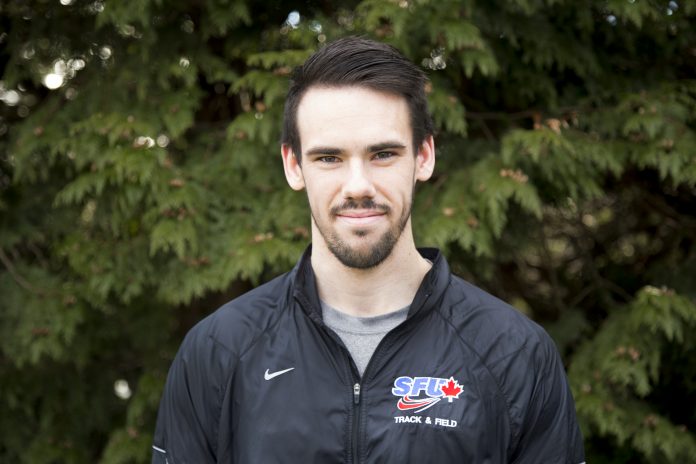
Travelling over 7,000 kilometers is quite the distance, no matter what you’re travelling for. But that is what faced Daniel Kelloway in his decision to come to SFU. The native of Mount Pearl, Newfoundland, since coming to the west coast, has become one of the most dominant runners in the Great Northwest Athletic Conference (GNAC).

“Brit [Townsend] just kind of contacted me after a meet,” said Kelloway on the first steps to coming to SFU. “I did a year and a half at Memorial and the first summer after my freshman year, track was just going really well for me that season [. . .] She offered it up to me and said, ‘If you want to come out, [you can].’ I kind of just jumped on the opportunity.”

Initially, there was a bit
of hesitation.

“Coming out of high school, I only applied to Memorial University. I was very set on staying at home; I didn’t want to leave. It was kind of a very spontaneous decision. I was a little hesitant.
I don’t have any family out here. I didn’t know anyone at all.”

He credits the seniors at the time for showing him the ropes and helping him get comfortable.

“By the time I moved out, [residence] was actually full so [I] ended up moving in with some guys with the team. That actually ended up being super useful; they kind of helped me out quite a bit.

So how does it feel now that he’s one of the elder statesmen on the team?

“It’s pretty cool. It seemed like everything went by so quickly,” he explained. “I feel like I haven’t been out here that long. It’s kind of cool because the seniors back then gave me a lot of advice and I’d like to think that I am helping out the freshman the same way they helped me.”

Since this early adjustment period, Kelloway has become one of SFU’s most consistent and dominant runners. In his second season with the team, he was able to win the 2015 GNAC 400-metre title.

“I was more happy with the time than the title,” he elaborated. “It was a personal best for me at the time, and my first personal best since coming to SFU. I was really happy with that. Everything just seemed to come together that day. I was pretty pumped. I know all the coaches were pumped.”

After that, Kelloway repeated in 2016. And now, even though it’s not for a few months, Kelloway has his eyes for a three-peat in the 400-metre.

“You kind of have to taper your training a bit so that you peak at the right times,” said Kelloway on how he plans to prepare throughout the season. “So it’s just [about] picking the right races to run at the right times, so that you try not to burn out. And your training is kind of adjusted accordingly as well.
Kind of just higher intensity, less volume as you approach these bigger meets.”

“Everything just seemed to come together that day. I was pretty pumped.”

However, until then, there is still a lot of work to do, and a lot of meets to prepare for and compete in. Kelloway was able to train back home over the winter break indoors, but he and his teammates had to resort in some unorthodox training methods — namely running in the AQ.

“It’s kind of weird,” said Kelloway on the new training methods. “There’s not very many people there because it’s a Saturday morning, wbut people will be looking at you like ‘what are you guys doing.’ [But] it is the best we can do, and we’ve been making it work.”

So far, it’s seems to be working. In the team’s first meet of the 2017 season, Kelloway finished second in the 400-metre with a time of 48.46. Not only was it a personal best, it was the best time out of anyone from the GNAC at the meet.

In his last semester, and pursuing a degree in earth sciences, Kelloway at the moment is not sure what his future holds,
but has narrowed it down to
two options.

“I’ve been kind of debating recently whether to go back to grad school or take a year off and work a bit. So I have to decide that soon because it’s currently my last semester. Right now it’s one of the two.”

However this season ends, it will be the end of a spectacular and memorable time at SFU.

Fun Fact: Favourite place you’ve traveled with SFU?

“I really enjoyed San Francisco. It thought it was a really cool city; we got to sight see a little bit when we were down there.”

World News Beat

0

USA — Celebrities Cher, Robert Denero, Michael Moore, and Robert Di Niro head to anti-Trump rally

On the eve of president-elect Donald Trump’s inauguration, celebrities were among the many that engaged in anti-Trump protests across the USA. Among the thousands that joined in the protest that aimed to show unity across the states, celebrities such as singer Cher and actor Mark Ruffalo revved up the crowd with a rendition of “This Land Is Your Land,” while documentary filmmaker Michael Moore and actor Robert De Niro led speeches outside of the Trump International Hotel and Tower. The protests have been described as a possible indicator of further protests over the next four years with a Trump presidency.

With files from The New York Times

Italy — Over 25 people missing in hotel following an avalanche

On January 18, major earthquakes across Italy instigated a major avalanche which hit the Rigopiano hotel located in the Abruzzo region. Only two people were rescued, as they were outside of the hotel at the time the avalanche. Due to the severity of the avalanche, emergency response could only access the area on skis. Search and rescue teams have continued to search for the missing individuals though there is little sign of life.

With files from BBC News

Mexico — Drug Lord El Chapo extradited from Mexico to the US

El Chapo, a known drug lord whose cartel is possibly the largest illicit drug cartel, was extradited on Thursday, January 20. The drug lord has received charges of drug trafficking, kidnapping, murder, and money laundering. While his lawyer, Juan Pablo Badillo, has criticized this extradition as “not inside the law,” El Chapo arrived in New York and could face life in prison. He has previously escaped two high-security prisons in Mexico.

With files from BBC News and Global News

UK — Britain’s Prime Minister outlines the 12 priorities for Britain to exit the EU

Prime Minister Theresa May announced during a speech that Britain would take a “hard Brexit approach” when negotiating a deal to exit the European Union (EU). Among her top priorities, she mentioned that Britain must fully surrender its membership from the EU’s single market, while also placing more stringent controls on Britain’s borders. In regards to the future of Britain’s economy, May stressed the importance of building relationships with countries outside of the the EU in order to build a “global Britain.” While many pro-leave supporters praised the speech, including British foreign secretary Boris Johnson, many pro-remain supporters criticised the restrictions on immigration as a negative approach to improve the economy. The speech was also criticised that the new deal expressed many similarities to full EU membership.

With files from The Guardian

Faculty of Arts and Social Sciences roll out new courses for Canada’s 150th

0

The SFU Faculty of Arts and Social Sciences (FASS) has launched a unique line-up of courses and lectures for the occasion of Canada’s 150th anniversary. The semesterly three and four credit courses and speaker series aim to prepare students to confront national problems and issues in coming years.

“I hope we are able to reach quite a few citizens and have them think about their own relationship to Canada and the Canada they want to see,” said FASS associate dean Dr. Catherine Murray.

The program launched on January 18 with a lecture by SFU economist Krishna Pendaker on economic mobility and inequality in Canada. The lecture series is geared towards students new to the faculty to help them “feel more comfortable with the range of ideas, the diversity of arguments, [and become] familiar with academic ways of thinking about very complex national events like the Canada 150,” explained Murray.

The FASS also awarded grants ranging from $2,500 to $25,000 to nine courses across the faculty, some new and others revised from department curricula, to incorporate Canadian content and cover travel and honorariums for special guests among other costs. In addition, three FASS elective courses are scheduled to provide students with experiential learning opportunities.

The elective course curricula designated under the course numbers 150, 250 and 350 include opportunities to obtain credit for the lectures series, partnership with community organizations to organize events around the Canada 150, and student-run public events on the occasion of the national anniversary respectively.

Murray called the 150th anniversary “a turning point” in Canadian history and hopes to engage the SFU community in questions around citizenship and national narratives through the program.

“It’s causing us all to think forward to our next one hundred years,” noted Murray. “While we represent a certain set of values of citizenship which are celebrated around the world, there’s a lot of work to be done.”

This semester, two special courses are being offered, a history and urban studies course on design in Canadian cities and a micro-economics course featuring three guest lectures by a specialist on the Canadian context. Upcoming lectures will touch on aspects of diversity, happiness, and crime. According to Murray, the faculty chose presenters whose research has been academically recognized and is important to Canadian issues.  

“This is their wish for Canadian academics and students going forward,” said Murray.

The faculty hopes the program will prompt participants to explore the meaning of Canada and redefine citizenship.

“We will be quite happy if people learn a little bit more about important issues in Canada,” Murray noted. “There are choices ahead and [students] will be the leaders of those choices.”

SFU alum, Hasan Namir, on Islam and intimacy

0

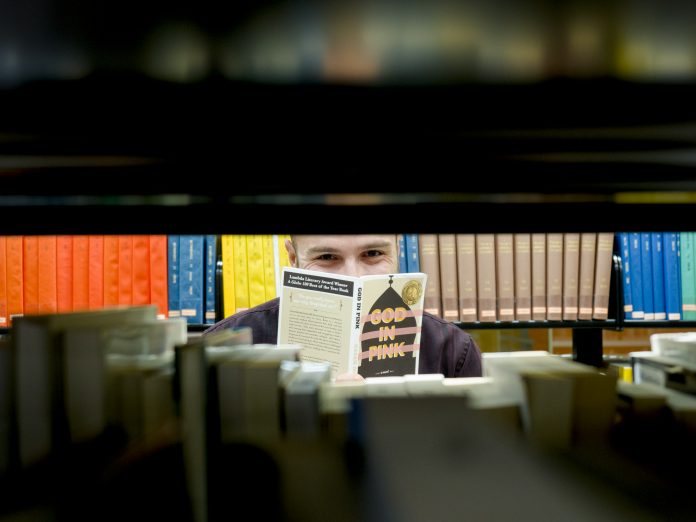
[dropcap]F[/dropcap]earlessly and unapologetically, SFU alumnus Hasan Namir tackles homophobia, religion, and coming-of-age in his award-winning debut novel, God in Pink. The novel is set in Iraq in 2003 and tells the story of Ramy, an orphaned homosexual university student who seeks guidance from Ammar, a sheikh at his local mosque, as he struggles to reconcile his culture and religion with his identity.

On the second anniversary of Namir signing the publishing contract for his novel, The Peak sat down with him to talk about his personal story of coming out as queer, his journey with religion and spirituality, and his SFU experience all which served as inspiration for the bold novel.

Talking with Namir was an incredibly warm and easy-going experience; he overflows with excitement about how well his novel has done it has won a 2016 Lambda Literary Award and been named a Globe 100 Best Book of the Year as well as gratitude and a deep appreciation for life in general. Namir describes himself as a social butterfly, and, between the easy and endless conversation he holds as well as his accounts of his friends and husband, the description seems to fit. Namir is so at ease with himself, it’s hard to imagine there was a time when he hid, and tried to change, who he was.

Coming out

Until the age of 10, Namir lived with his family in Iraq before moving to Canada. In a YouTube documentary based on his book, Namir talks about how he’d always known he was attracted to men. When he came out to his older sister at the age of fourteen, he remembers she laughed and replied, “Yes, Hasan. I know. I’ve always known.”

Through his childhood, Namir tried to hide or mitigate his sexuality in front of his parents, but when the family went on a trip to Europe in 2010 and his father became aware of his sleeping with men, their relationship fell apart. “He just couldn’t accept the fact that I was gay,” Hasan recalls, “So he said ‘you have two weeks, and I’m going to kick you out of the house. You’re not my son anymore.’”

After the fallout with his family, Namir entered a period of depression and experienced suicidal thoughts. The pain Namir feels over his estrangement from his family shows clearly on his face when he speaks about his parents: “My mom was the closest thing to me and sometimes I just wish I could see her.”

Moving on from discussing his rocky familial ties, Namir’s face lights up when he starts to talk about his husband, Tarn. Namir met Tarn in 2011, and he can still perfectly recall the moment he first met him: “When I first saw him, my heart just skipped a beat. And for a moment, I just saw my entire life through him.” Namir’s sister speaks of Tarn’s entrance into Namir’s life as “the push he needed [. . .] to stand up for what he believed in, put family aside, and follow his heart.”

“Well, I’ve read the books, too, and I’ve come up with my own interpretation.”

However, following his heart has come at a price to Namir. Nothing has since been the same for the torn family. No happy occasions or milestones pass without tears. While he’s received overwhelmingly positive feedback from his sisters, cousins, and husband, Namir’s parents haven’t read the book.

It’s been six years since Namir last spoke with his father, but he hopes that someday his parents will read the book dedicated to them and understand where he’s coming from.

Conflicting identities: religion and homosexuality

Namir admits that he still grapples with his faith, and this journey of his, as well as the polarizing portrayals of religion in the media, is what emboldened him to tackle the sticky topics of religion and homophobia in his own novel.

“Religion is not black and white,” he adds, “there are complexities that really fascinate me.” While Namir’s family was never very religious he only went to a mosque in Iraq once he personally testifies to being a very spiritual person, having studied various religions including Judaism, Christianity, Hinduism, Sikhism, Buddhism, and Islam. Reading religion from different perspectives and analyzing different interpretations especially interests Namir. “People’s ideologies and thoughts lead them to come up with their interpretation,” Namir explains.

“Well, I’ve read the books, too, and I’ve come up with my own interpretation.”

Despite his openness to faith, it’s unclear for Namir whether his faith is open to him as he is still trying to reconcile his religion with his identity as a homosexual. “I’ve lived my whole life trying to find answers by reading the Qur’an. In some ways, I think religion accepts me,” Namir affirms, “but in other ways, it doesn’t. It’s conflicting and I still haven’t found full answers.” For Namir, penning his characters’ struggles with their religion brings him one step closer to untangling his own.

In God in Pink, not only does Ramy struggle with his faith, but so does the sheikh of the local mosque, showing a discrepancy between the sometimes rigid way religion is taught versus how flexible Namir truly believes it to be. Namir wants to bring this feeling of tolerance and inclusivity to eastern religions, which can sometimes seem mysterious or foreign to western interpreters. “I don’t ever want to force thoughts,” Namir made sure to clarify. “I just want readers to come up with their own interpretation. Religion is all about interpretation, and my book is the same.”

For a multitude of reasons both personal and political Namir has decided on religion playing an important role in all his works. Despite his rocky relationship with his faith, today Namir still firmly stands by his faith: “I believe in God it’s what kept me strong through all these years.”

Growing at SFU

When I asked Namir about his experiences at SFU, I was expecting perhaps a courteous nod towards the institution which provided him with his BA in English, but what I got was an outpouring of love for the university.

“I owe so much to SFU,” Namir declares.

He recalls his most valued and educational experience at the institution as being the workshop sessions in his English creative writing classes, where he actually got to work in a peer group setting and get feedback on excerpts from God in Pink. The process of sitting down in a group of like-minded aspiring authors, going through each person’s work, and constructively critiquing it shaped Namir as a writer “I’m very indebted to that experience,” he says.

Namir honed his skills and gained confidence as a writer during his years at SFU. He was awarded the Won Ying Chen Creative Writing Student Award from SFU, and spoke fondly of Jordan Scott and Jacqueline Turner as his influential mentors during his development as a writer.

“I’m very happy with my experience at SFU,” Namir gushes. “I met a lot of amazing people, writers, and peers.”

Moving forward

While he enjoys the acclaim his first novel has been receiving, and goes on book readings and talks, Namir is also planning for future publications. Currently, he’s looking to get his book of poems published. Some of the poems were also workshopped during his time at SFU, and he hopes the poetry collection will show his versatility as an author.

He predicts that his second novel, still in its early stages, will deal more heavily with themes of religious extremism, but with the same touch of tolerance and empathy for character ideologies and actions as displayed in God in Pink. Namir’s favorite critiques from his first novel were protests from readers that it wasn’t long enough, so he anticipates his second story to be longer, more complex, and to continue to develop the ideas of cultural appropriation, religion, and gender identities that he introduced in his first novel.

Namir’s most ambitious goal as an author is to become a bestselling author: not for the fame or profits, but rather to expand his reach as an author. God in Pink has already been translated into Turkish, and he hopes it will be also translated into Arabic and other languages as well.

“I want to give the silent a voice, to inspire others out there,” Namir says of his motivation for his writing. “The ones who feel lost, who are in the closet and fall in love with someone, and can’t be who they are. The ones in the parts of the world where they can’t be who they are.”

Namir writes from experience, and from the heart.

Vancouver joins worldwide Women’s March on Washington

1

“This would not have happened if every one of you hadn’t stepped up,” organiser Lisa Langevin told a vocal crowd of nearly 15,000. “It takes a village to raise a child, and this village raised this child.”

The crowd was gathered in Jack Poole plaza for the Women’s March on Washington – Vancouver, held downtown on a brisk Saturday morning.

The event was just one of a series of gatherings across the globe, with millions marching everywhere from the United States to France to Ghana. While ostensibly an anti-Trump rally, the march in Vancouver also addressed broader efforts to combat racism, sexism, and other forms of injustice through protest and other forms of activism.

After a short concert, the event began with presentations from several speakers, including representatives of the Musqueam, Squamish, and Tsleil-Waututh peoples, on whose unceded land the event took place.

In an emotional address, Rhiannon Bennett, one of the organisers and a member of the Musqueam First Nation, shed light on the unique struggle of indigenous women in Canada, pointing to the hundreds of unsolved cases of missing and murdered indigenous women across Canada.

“It is disgusting that there is a highway known as a Highway of Tears,” said Bennett. “If those were any other women, something would have been done by now.”

The addresses also referenced Canada’s colonial history on the eve of its 150th anniversary, with one organiser expressing the hope that the next 150 years would see more positive change and reconciliation efforts from the federal government.

The march began around 10:30 a.m., filling the streets and spanning several city blocks. Some attendees held signs quoting prominent activists such as Audre Lorde and Martin Luther King Jr., while others sported slogans like Pussies Grab Back and Love Trumps Hate.

Many also wore knitted pink toques as part of the Pussyhat Project, a campaign meant as a way for both attendees and non-attendees to show their support.


“I think everyone here is taking a stand and saying ‘no’ to patriarchy, to misogyny, to racism, to nationalism,” said Kathleen Millar, an assistant professor of anthropology at SFU who marched with the group SFU Academic Women. “[We] need to learn to come out and be in solidarity against multiple forms of discrimination and oppression.”

The march culminated at Trump Tower on West Georgia street, where many left their placards and banners. At one moment, a young girl was hoisted above the crowd on her father’s shoulders, holding a poster that read Girl Power. Others held middle fingers up to the building’s large Trump sign.

After the march concluded, several attendees returned to Jack Poole Plaza for a series of closing speeches, including one from SFU student Samaah Jaffer.

“I think it’s really important that in the conversation on women’s rights, we acknowledge that systemic racism and our colonial history in Canada are so closely tied to patriarchy, and any kind of conversation on women’s rights needs to include conversation on the rights of people of colour in general,” Jaffer told The Peak.

“We cannot talk about the equality of women if we’re not talking about the equality all people.”

Jaffer’s speech also focused on the notable absence of Vancouver’s Black Lives Matter chapter at the event. In a statement on their website, the chapter said that they had “not been contacted in any way by the organizers of the Women’s March in Vancouver,” and maligned the lack of inclusion of black or trans voices in the event’s organisation.

This is in contrast to the event’s description on its Facebook page, which promised that participants in the march would “rally together in solidarity, equality, diversity and inclusion.”

For her part, Langevin expressed joy at the amount of support the march had earned. Addressing a smaller but no less engaged crowd in the final moments of the event, she noted that the fight for equal rights across Canada was far from over, and urged listeners to continue making their voices heard through protests and other actions.

“If not you, then who,” she asked the crowd, “and for heaven’s sake, if not now then when?”

NEW MUSIC FRIDAY

0

Follow The Peak on Spotify to stay up to date on New Music Friday.

“Living Single” – Big Sean feat. Chance the Rapper and Jeremih

Jessica Whitesel: I honestly don’t know what to say about this song. Like, the beat is good and the rapping is on point, but I don’t really know if this song is actually about living single, or if it’s about being in relationship, or if it’s about just sleeping with as many women as possible. I JUST DON’T UNDERSTAND THE THEME OF THIS SONG.

Jessica Pickering: …what? The intro makes me so uncomfortable. Actually, all of it makes me uncomfortable. I’m scared and confused and I want to go home.

Rita Ovis: This song posits some truth about modern dating. It’s the grooviest way to weigh the pros and cons of being a relationship. Chance the Rapper also makes a very solid guest appearance which can make any song 35% better.

“StraitJacket” – Raleigh Ritchie

JW: I still can’t get over that this is Greyworm from Game of Thrones. I loved his first album and this song does not disappoin. It might be unexpected given the content of that album, but like, I’m down for this.

JP: It’s not the worst song I’ve heard on the NMF playlist (which isn’t saying much if you listened to the first song), but it’s not my favourite either. Huge improvement from last week’s ENTIRE playlist though.

RO: This guy has a James Blake-y/Frank Ocean-y vibe and I’m feeling it! There are some points where there is definitely too much going on in this though, like way too many instruments at one moment, but you can get past it to enjoy this smooth R&B ballad.

“Text From Your Ex” – Tinie Tempah feat. Tinashé

JW: What? Who was the text from? I don’t know if it actually comes through with the song. JK, it totally does and I’m not loving this at all. You think it might get better, but it doesn’t. If anything, it gets worse. Much, much worse.

JP: This could low-key be Carly Rae Jepsen. But like, a shitty version of Carly Rae. The voice sounds similar to her, but the rest is terrible. I’m going to go listen to E•MO•TION to make myself feel better.

RO: This song made me laugh out loud a little. They get really deep into a text from your ex. But also, girl, are you really going to steal your friend’s ex-boyfriend? C’mon.

“You Look Good” – Lady Antebellum

JW: Is it a country song if beer and trucks aren’t mentioned? Maybe or maybe not. We’ll never find out since this song mentions both about five seconds in.

JP: Noooooooooooooooooooooooooooooooooooooooooooope.

RO: This is pretty much a classic pop country song. That is all.

“High for Hours” – J. Cole

JW: Woke AF. However, he did spend a good chunk of time rapping about why this song is called “High for Hours.” But, still woke and that’s when rap is at its best.

JP: The dude just explained why his song was called “High for Hours.” I could be wrong, but isn’t that like explaining the punchline of a joke? If I don’t get it on my own, it’s not that good. There’s a great message in this song, but I’m just focusing on the fact that he explained his title to me.

RO: Oh man, this song is intense. J. Cole is basically explaining that American politics are messed up and it makes him want to get really high to try to forget about it. This could be appropriate for our current political climate — J. Cole in general has been super political lately, so I’m not surprised.

“Så så så säg” – Thomas Stenström

JW: What year is it? I feel like I should be surfing in the early 1960s before going to malt shop. But in Sweden! Do with that information what you will.

JP: Beach Boys meets techno. This might be what they play in Hawaiian night clubs. Also, is it in English? Is it in Swedish? Who knows! It’s all very confusing.

RO: No idea what language the bulk of this song is in, but it doesn’t matter because this song is extremely peppy and danceable! It’s in the language of music. Ha. Ha. Ha.

“Doomsday” – Ryan Adams

JW: I always think that there should be more harmonica solos to open songs. Actually, that’s a lie. If you are going to do a harmonica solo do it in the middle of a song and not one that sounds like a Bruce Springsteen B-side.

JP: Ah, harmonica; played well by few, played often by others. This is like a weird U2/Neil Young/Bruce Springsteen vibe. I feel like my mom’s CDs all fused together and this is what came out. Also, harmonica at the beginning is a Springsteen thing and you can’t pull it off, so fuck you.

RO: Honestly, I think this is just a really cheesy song pleading for love, he sounds desperate and dude, you could seriously do better.

“Over the Edge” – Borgeous tyDi Dia

JW: What is up with the group’s name? Why are there so many fake words and weird capitalizations. I do not like. It also sounds like country techno, and it makes me uncomfortable.

JP: Are they from X-Factor? They always seem to be from X-Factor. Sorry, by them I mean shitty high pitched “trendy” singers/band. Is it a singer or is it a band? I don’t know.

RO: I would describe this as Lana Del Rey at a rave in space.

“Broken Dreams” – Anti Pony

JW: What is an Anti Pony? Is it like a tiny cow? I really want to know what an Anti Pony is. But I’m scared to Google it because the internet can be a dark and scary place. This song is scarily bad enough that I don’t want to go further down the rabbit hole.

JP: This is probably not true, but I’m hoping this name came about because someone was really upset about the Ginuwine song. “Ride your pony? No! I will not! I will. . . Anti pony. Oh shit! What a great band name!” — how that conversation went, probably (hopefully).

RO: This song is actually quite unique in a lot of ways — the girl’s voice is unlike anything I’ve heard before it’s rich and wispy at the same time. The instrumental part is kind of electronic-psychedelic-rock-y which is also very interesting.

“Crying on the Bathroom Floor” – MUNA

JW: The ’80s are over. Maybe that was when the last calendar was put up in the studio. Who knows? I just know that I want to cry on the bathroom floor after hearing this, because that sounds like it would be more fun than listening to this.

JP: If I made music this bad, I would also be crying on the bathroom floor. If everyone could stop trying to be Lana del Rey, that’d be great.

RO: Ooh this has some ’80s vibes, that’s a good thing! It’s kind of a sad song though, she has a lot of feelings. I’m sending my good vibes her way. I hope the ’80s can help save her!

“Boys Like You” – Whitehorse

JW: I saw Whitehorse at Calgary Folk Fest this summer and they are a husband-wife duo with talent to spare. I think that they might have played this as a teaser for their new album, I don’t really remember; I may or may not have been drinking. However, it falls flat without their stage presence (which is amazing by the way).

JP: Holy shit did Beck get a band? Like, not actually, but basically. Either way, I don’t care for it. Their website is shit, too.

RO: This is cool! Reminds me a bit of Beck actually. I especially like the lyric: “Boys like you they live with their mothers for ever and ever.” I think I know what kind of boys they’re talking about.

“Swimming in Strange Waters” – The Wooden Sky

JW: It is so echoey!!!! Like when you put wax paper over a toilet paper roll to make a kazoo, that kind of echoey. Also don’t go swimming in strange waters. What if there is a riptide? Know before you go. Then swim to your heart’s content.

JP: I WANT TO GO SWIMMING SO BAD OMG. I know that’s not what we’re talking about, but I don’t care for this song and I love swimming. Why is winter here so cold? Someone take me to Mexico.

RO: I could imagine this song playing at an outdoor music festival and everyone bobbing their heads and smiling. It’s good, but it’s the kind of song that I think would be better live? Is that weird?

“Night Bus” – Gabrielle Aplin

JW: Piano! And then more electronic stuff. Why is everything electronic? But, like, Gene Belcher keyboard kind of electronic. However, this is actually not a bad song and having been on many night buses I would listen to this on one and not be sad about it.

JP: I like the background of the album artwork. Very pretty. The song matches the image. Best song I’ve heard on NMF for a while (like a 7/10, but that’s not bad).

RO: We all know that staring out the window on the bus moodily makes you realize things. This song captures that notion. The flow of the song makes me imagine a bus cruising through the city. This is just a solid song in general. I don’t usually like this style of electronic-pop music, but this song is an exception!