Home Blog Page 753

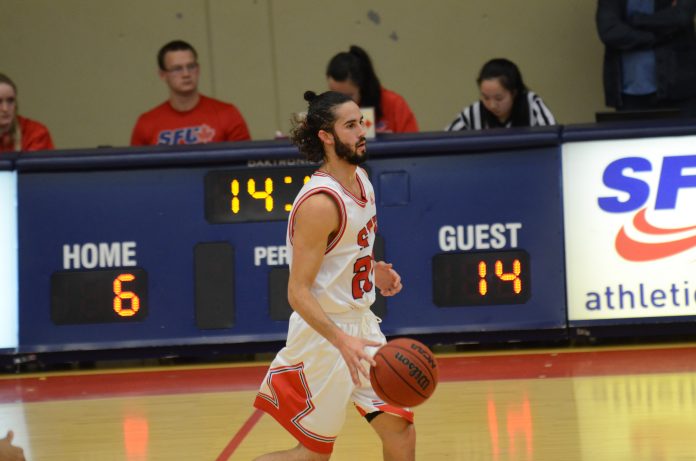
Simon Fraser struggle offensively, lose 73–66

0
Samantha Beauchamp (#20) had 10 points and eight rebounds coming off the bench for SFU.

Heading into this game, Simon Fraser was riding a four-game winning streak and winner of 12 of the last 13 games. In this one, however, they struggled throughout. When coach Bruce Langford was questioned after the game, he simply said “I didn’t think we were ready to play.”

Things started well for the Clan, as Elisa Homer nailed an open three-pointer right after tip-off. Everything after that, however, seemed to come with difficulty for both teams. Coming off a career night in which she played 34 minutes, Ellen Kett’s fatigue showed early as she went 0–6 from the field in the first half. She was still able to have a positive impact on the game, however, with back-to-back beautiful assists to Samantha Beauchamp to give the Clan a 13–8 lead early. While offensive deficiencies were noticeable, Simon Fraser finished the first quarter with a 13–10 lead.

The second quarter was more of the same for both teams. They remained neck and neck throughout the frame, with a focus on the defensive end. Central Washington took a three-point lead near the end of the frame after a Rachel Lorentson layup. Simon Fraser countered, and a Beauchamp layup gave Simon Fraser a 27–26 lead heading into the half. In what was an ugly first half for the Clan, in which they shot 35.5% from the field, defense is what kept them in the game.

Ozi Nwabuko’s energy on the defensive end was noticeable, as she played a team-high 19 minutes in the first half while guarding the opposing point guard Jasmin Edwards — holding her to 1–5 shooting. “I thought her defence was really good in the first half,” said coach Langford.

This grind-it-out style of basketball would continue into the second half. After a turnover to start the quarter for Simon Fraser, Nwabuko got in the lane to score on two straight possessions. In the sixth minute, a Sadie Mensing converted and-one gave the visiting side a 35–34 lead, before Rachel Fradgley and Meg Wilson scored on back-to-back possessions to regain the edge. Going into the fourth quarter, the game was 45–44 for Simon Fraser.

The game would not be decided in the fourth, however, as Mensing hit a deep three to tie the game 60–60 with six seconds remaining. After a Simon Fraser timeout to advance the ball, they were unable to convert on the inbound play. The game would be decided in overtime.

“I didn’t think we were ready to play.”

– head coach Bruce Langford

Simon Fraser’s offensive woes were magnified in the overtime frame, as they failed to convert a field goal until there were 55 seconds left. They would eventually lose 73–66, after Kett hit her first field goal of the game with 13 seconds remaining.

When asked if fatigue was a factor, coach Langford responded with: “Why would we be more fatigued than they would?” It was simply a game in which the Clan did not show up to play.

After a huge night on Thursday, Ellen Kett went 1–9 from the field and finished with only three points. Meg Wilson led the team with 16 points, while Samantha Beauchamp had a nice game off the bench with 10 points and eight rebounds.

This loss marks an end to Simon Fraser’s four-game winning streak. They are now 11–3 in conference play and 18–4 overall. They remain in third place in the Great Northwest Athletic Conference (GNAC), with a two-game lead over Seattle Pacific.

Next Game: Simon Fraser will head to Washington next week to play Saint Martin’s University. They sit dead last in the conference with a 1-13 record, and are near the bottom of every major statistical category — except blocked shots, in which they are third.

Tip-off is at 5:15 p.m.

CJSF launches new show Speak Up!

0

SFU’s radio station CJSF has launched a new spoken word segment called Speak Up! It consists of an hour of volunteer-made spoken word programming, and encompasses a wide range of topics. The station typically has a variety of talk and music programming all mixed in together, so they are hoping that by having a more predictable schedule, people will be able to tune in regularly. Speak Up! is the result of a collaborative effort between Jesse Wentzloff and Robin Eriksson, who wanted to change things up at CJSF.

Wentzloff and Eriksson are staff members at CJSF. Wentzloff — Public Affairs and Talk Coordinator for the station — oversees the production of all the spoken word programming. Robin — Programming Coordinator — oversees all broadcasts and ensures they follow regulations. They created Speak Up! to attract volunteers and present them with an opportunity for learning.

The program allows volunteers to collaborate on the entire program and gives the opportunity to produce smaller segments. Wentzloff believes that with this approach, volunteers will be able to feel more comfortable coming in and contributing to the program. “There are so many skills involved in making radio. I’d like to make it so that you can come in and focus on just one of those skills at a time,” explained Wentzloff.

Eriksson shared her hope that making it easier for students to get involved would do more than just encourage participation, but also present an opportunity for learning. She expressed that making talk radio works on a variety of skills — such as presentation, research, interviewing, etc. — all of which can be applied to other situations. Eriksson believes that “if people come and they learn how to do public affairs radio, they can do anything.”

Another aim is to make it easier for volunteers to produce content. For starters, volunteers can contribute content on whatever topic they would like. Wentzloff mentioned, “If it’s an interesting story, I want to hear.” The radio station has a strong focus on providing a platform for the under-represented. “With the consolidation of media around the globe those local stories are getting harder to find at a grassroots level [. . .] we’re becoming that under-represented voice,” stated Eriksson.

Both Wentzloff and Eriksson emphasized the importance of local stories being covered by the community, not just big media platforms. To mark their first week, Speak Up! (and the other spoken word programs) aired documentaries produced with a grant that CJSF received in 2015 from the Community Radio Fund of Canada. Previously aired programs can be found on their website.

Speak Up! airs on 90.1 FM at 10 a.m. weekdays, excluding Wednesdays. If students want to get involved with the show, they can stop by the station Wednesday to Friday or sign up for volunteer opportunities at cjsf.ca/signup.

SFU lose 18th straight game of season to Alaska Anchorage

0
Michael Provenzano was the only SFU player in double digits for scoring, finishing with 13 points.

Coming into the game, Simon Fraser knew they were given a tough task. They were facing a top team in the Alaska Anchorage Seawolves, who were winners of their last five, and Simon Fraser were losers of their last 17. Everything seemed to play out exactly as you would expect it to.

Throughout the game, the top ranked defense in the Great Northwest Athletic Conference (GNAC) suffocated the Clan, as they were unable to get into any flow offensively. On the other end of the floor, Simon Fraser held Alaska Anchorage below their season average in field goal percentage, but it was not nearly enough to make up for their inefficient offense.

A pair of three-pointers and free throws by Sekou Wiggs helped the Seawolves get off to a 10–2 lead early, and they were in control for the rest of the game. By the end of the first half, more free throws by Wiggs gave the home team a 30–13 lead. Wiggs was single-handedly outscoring the Clan, as he went off for 20 points in the first frame. Kedar Wright’s five points marked the team-high in the half for Simon Fraser, as nobody was able to get into any rhythm offensively.

At this point, Simon Fraser was 5–25 from the field (20%), without hitting any three-pointers.

The second half started even worse for the visitors, as the Seawolves got off to a 9–0 to start the frame, making the score 42–13. The Clan then briefly found their shooting touch, as they hit three threes on four possessions. Simon Fraser started to show some energy, and went on to compete with Alaska Anchorage. After Wiggs and Vos Hidde traded three-pointers, the score was 60–38. This is as close as the Clan would get, but it marked a seven-minute stretch where they outscored the Seawolves 25–18.

Other than those seven minutes, however, Alaska Anchorage were by far the better team, eventually winning 73–45. They were led by the two leading scorers in the game, as Sekou Wiggs finished with 34 points and Spencer Svejcar finished with 22. The two of them combined to outscore Simon Fraser by themselves, and hit nine three-pointers between them compared to the five the Clan had as a team.

For SFU, starting point guard Michael Provenzano was the team’s only double digit scorer with 13 points. He was a perfect 6–6 from the free throw line and finished the game with no turnovers. The entire team struggled tremendously on offense throughout the game, as they shot a measly 28% from the field.

With this, Simon Fraser has now lost 18-straight games. They are now 0–14 in conference play and 2–20 overall. Unsurprisingly, they are dead last in the GNAC.

Next Game: Simon Fraser will host the 5-9 Concordia University Cavaliers on Thursday. Concordia are currently 9th in the GNAC and were the only team that SFU beat last year in conference play.

Tip off is at 7 p.m.

Living wireless: Day four? Has it really only been four days?!

0

This is the fourth post in a week-long web series that documents Preethi’s day-to-day experiences while forgoing a relationship with her cellphone. Check back daily for the next article.

Sunday was unpleasant. I had a lot of things to get done, but procrastination reigned supreme. My left leg hung loosely off the side of my bed as I stared at my ceiling with no intention of moving for the next three hours. I immediately knew that my fourth day was going to pass very slowly.

I shouldn’t be mentioning this, but there were multiple times when I grabbed my phone and thought I could peep on my social media for a quick two minutes. My brain’s reasoning: “I went three days without touching my phone. . .” Obviously, my brain isn’t to be trusted. I looked through emails on my computer, tackled my weekly chores, and headed to the library on campus. I just needed something — anything — to do.

What does this kind of behaviour imply? We are social creatures, and we think social media fills the void. We continue to indulge because it forms a convincing mirage of meaningful relationships. This becomes clearer to me the more I reach for the phone I can’t use.

By commenting on uploaded pictures or other such activities, we conceive a connection with people that are not immediately around us. The word “connect” has become meaningless in our lives, pushed to its usage limit. I can’t even decide what “connect” even means anymore. But I can say, with certainty now, that convenient connections aren’t connections at all. To be in the proximity of a person and having to look at them while you converse — now, that’s something we should strive for.

Being at a “lit party” is only lit if you are conscious of the people around you. Using Snapchat to take pictures and holding up alcoholic drinks are some of the most iconic and celebrated pictures that I often notice on my Instagram feed — what do these images portray? The mirage continues.

Some part of me wishes I could see what my friends are up to; convenient access to my friends was just what I had gotten used to. I hadn’t talked to my parents abroad, and I wished I could call them. I saw a beautiful black car parked up against a blue sky backdrop, and wanted to take a picture of it. Besides these usual urges, I’m slowly getting used to not having my phone on me.

These thoughts come to me as I reflect on day four. Without having to reflect, such perspective would have probably ceased to exist forever in me. My productivity continues to be off the charts because my phone hasn’t been distracting me. With my newfound liberation and productivity, though, does come a fear of missing out, a sense that I’m losing touch, and crippling boredom.

The trade-off is high, but is it worth it? I don’t think I can answer that yet.

Voluntourism is just soft colonialism

0

Voluntourism — a portmanteau of “tourism” and “volunteering” — is a rising phenomenon. Volunteers from abroad work a few hours a day building schools, hospitals, libraries, etc. In their free time, they tour and partake in cultural activities.

Interest in voluntourism has grown tremendously over time; organizations specifically target middle- and high-schoolers. But is voluntourism really a practical instrument of good? I’d say it’s just another practice borne of modern colonialist thought.

Voluntourists might tell themselves that they’re aiding the places they visit, but some report their work to be less efficient than what local labourers could accomplish alone. Blogger Philippa Biddle, who wrote about her experience in Tanzania, called her group’s work building a library there so shoddy that locals had to work at night to compensate.

She ‘worked’ just 33 hours in the 20 days she was there — and spent upwards of $6,000 on the experience. There’s a reason people pay to do this work: it’s less about helping and more about the feeling of helping — the novelty of travel.

For instance, Free the Children (a multi-million dollar charity) has been accused of “[promoting] emotional experience over education” when it comes to recruiting students for ‘humanitarian trips’ to countries such as Ecuador, India, Kenya, and several others. Their website has been criticized for “[advertising] exposure to a variety of cultural practices” as a selling point — as if humanitarian aid was a fad to buy into.

Voluntourists even relate being assigned tasks essentially for the sake of doing them. For instance, Jingting Kang, former volunteer in rural China, was surprised when the students to whom she was teaching the alphabet picked it up so quickly.

Later, she discovered that she was the seventh person who had taught it to them.

“The alphabet wasn’t something the kids were prepared to learn,” she reported. “It was just something the volunteers were prepared to teach.”

True, voluntourism exposes relatively privileged Canadian kids to harsh realities like scarcity and poverty. These trips, which often include politically and culturally grounded interactions with locals, could give people a more diverse and nuanced understanding of society and culture, equipping them to make more long-term positive differences in the world.

Yet that theoretical outcome often isn’t realized. Just look at social media’s portrayal of voluntourism. Travel videos often showcase students’ great difficulty with so much as pronouncing the name of the country they stayed in. Photos seem to focus less on actual cultural learning, and more on giving Instagram and Snapchat accounts an aesthetically pleasing ethnic vibe — or letting people brag about their altruism.

“One person can change the world,” Me to We’s website states. “We all have unique gifts to give, and when bonded together, we build a movement that’s diverse and exciting.”

While inspirational, the notion that someone with no technical skills or understanding of where they’re going can help a community, without any real training, is toxic. There’s no movement here; voluntourism is a business model designed around young millennials yearning to create change.

Usually, there are no real positive changes made — unless you count the volunteers who feel better about themselves. We’re just propagating the notion that privileged westerners have the solutions to completely change other societies, who should embrace us for it. Sounds like modern colonialism to me.

Government regulations are great, because some people are awful

0

This is in response to the previously published article “Canada, stop nannying your people.”


The world is in a rocky place right now. We have a bloody war being fought in the Middle East, rapidly spreading viral outbreaks, and a cartoonishly expensive housing market. No, I’m not even going to touch what’s happening in the United States.

But what I think should be somewhere in the bottom third of our concerns right now is how our government is regulating food and tobacco.

While I agree that the government does influence many, if not all, facets of our lives, there’s substantial evidence that we need to regulate some things to prevent average people from being screwed over.

An early-ish example of this is the absolutely terrible, and sometimes fatal, working conditions of the Industrial Revolution. Factories often fined their workers for doing the smallest thing wrong, and forced them to work with horrific chemicals without protective gear. Potential side-effects of working in a match factory included having your jawbones dissolve. It took unions to push for safe working conditions, and even today, plenty of people are still exploited in this way.

Let that sink in for a second: it took innumerable deaths and a political movement to get some employers to (partially) stop being assholes.

But wait; there’s more, even in 2017. When an industry stands to make a lot of money, they tend to push back against pesky things like research that shows their product is making their customers sick. Paper after paper has examined the tobacco industry’s interference with science that showed irrevocably that smoking causes lung cancer and a host of other diseases.

People at some level knew that they were selling something harmful, and they tried to cover it up so people would keep buying it. I know, this sounds like the cliché-ridden plot of a left-leaning Saturday morning cartoon, but it actually happened.

Even now, the industry is pushing back against planned plain packaging legislation that will take effect in Canada in 2017. Tobacco companies are saying that the law, which will replace the remaining part of the cigarette pack label with plain text, is misguided and irrelevant.

But in their internal communications, they’re still reportedly making decisions on branding because sales show that the packaging does matter. Despite what they claim, they care so much that one tobacco manufacturer, JTI-Macdonald Corp, has set up a website and social media campaign called “Both Sides of the Argument” in order to rally opposition against the plain packaging law.

They’ve even done a survey that they say shows broad Canadian opposition to the law, but the company that they hired to do the survey has been criticized for sketchy methods in the past, including cherry-picking the same phone numbers to call repeatedly, leading to an inflation of the same sorts of responses.

When a company is prepared to spend huge amounts of money to keep their skeletons in the closet and generate grassroots style support, I don’t think that everyone will be able to see their product for what it really is.

Obviously, I get that some companies are actually trying to do the right thing. I’m also not saying that everyone who smokes has been ‘duped.’  It’s just that there is a long history of people treating each other like absolute trash. We’ve needed government-level regulations to help protect people from industries in the past, and I really doubt that we’ll stop needing them any time soon.

SFU and the path to a fairtrade campus

1

SFU being a fair trade campus shouldn’t be news to anyone. In addition to meeting the requirement standards as set by the Canadian Fair Trade Network, SFU has pushed the Starbucks franchises on campus to adopt fairtrade practices on campus.

But with any larger initiative comes benefits as well as shortcomings, and SFU’s fair trade ‘utopia’ is no different.

So what is fair trade?

Fairtrade Canada tells us that better working conditions, fair wages, and environmental justice are the major lures. With ideals like these it’s not hard to see why SFU was attracted to the initiative.

SFU has preached fair trade for a few years now, leaning heavily on how it can deepen SFU’s commitment to sustainable living and global equity. There is, however, strong opposition to the movement, with arguments such as poor quality product and internal flaws to the system undermining the initiatives stated benefits.

While the consensus on the project may be left unsettled, as far as SFU is concerned, fair trade is the future.

Finding fair trade on campus

Since 2012, SFU has been dedicated to implementing fair trade policies at every SFU administered dining service. Fair trade tea, coffee, and chocolate options can be found at almost all major food retailers on campus. Even the SFU bookstore has started stocking the shelves with fair trade chocolate bars.

In a survey last fall, 40% of students said that fair trade at SFU was “Very important,” 44% said it was “Somewhat Important,” and only 16% said “Not Important”.

Over 85% of Starbucks’ coffee is fair trade, and in 2013, the franchises on Burnaby mountain began to offer a fair trade espresso option. This initiative bore fruit to the university in the form of an inaugural award for “Campus of the Year” by Fairtrade Canada in 2014. SFU has been using brands such as Ethical Bean, based in Vancouver, to try and support the local economy as well.

“I believe the true reason Tim Hortons avoids offering fair trade coffee is because it hurts their bottom line.” – Mark McLaughlin, executive director at Ancillary Services

While SFU has been trying to develop a fair trade portfolio, the same can’t be said about every group on campus. Tim Hortons — a franchise that attracts great demand from the student body — has had no obligation to adopt the same fair trade position as the university. The heated conversation with Tim Hortons has been fired up for a couple years now and will surely continue.

Students fall in love with fair trade

How can the student body help SFU’s fair trade vision? In an attempt to implicate the student body, SFU and the Canadian Free Trade Network (CFTN) sponsored students to visit Costa Rica’s mountainous region of Talamanca to acquaint themselves with the origins of fair trade.

The students mentioned that they had gone on the trip feeling skeptical, but returned with a very pleased view on fair trade and its possibilities. Upon return, students Sarah Heim, Prodpran Wangcherdchuwong, and Joana Bettocchi brought with them valuable insight on why making the switch to fair trade is worth the while. The trio spent seven days in Costa Rica learning the history, challenges, and benefits that exist in implementing a fair trade system. “Fair trade isn’t charity,” stressed Wangcherdchuwong.

“The cooperatives we visited in Costa Rica mainly cultivated coffee and cocoa, as well as bananas. A cooperative is essentially an organisation where farmers collaborate to sell their product as a company,” added Heim.

“It was eye-opening to see that this cooperative had 6,000 members, but also disappointing to know that only 10% of their produce is sold under fair trade,” Wangcherdchuwong continued. The students bring back compelling arguments from their travel as they learned that 90% of produce is sold under conventional prices even though all the produce is cultivated under fair trade terms.

“Operating since the ‘60s, these cooperatives have come a long way. They use their profits altruistically for communal good and a big thing for them is ecological conservation,” explained Wangcherdchuwong. “They don’t use chemicals on their crops, replant trees, and are constantly educating locals to adapt these means of cultivation.”

After understanding the powerful impact cooperatives have on prices and practices, the two students were convinced about the magic that is created in Talamanca. However, in retrospect, the students questioned whether fair trade works in all situations.

Referring to the low requirement standards by the CTFN, Wangcherdchuwong explained that this has enabled every university to get on board with the program. However, there will soon be levels added to the fair trade program such as bronze, silver, and platinum that SFU will aim to climb.

Perhaps such specific certification will answer people who are skeptical about fair trade practices on campus.  “There are certain limitations to fair trade as it works within and against the market,” elaborated Heim. She explained why fair trade cannot accommodate all products in reflection of what she learnt in Costa Rican cooperatives.

When asked about their thoughts on fair trade initiatives at SFU, both Wangcherdchuwong and Heim agreed that SFU’s efforts are genuine. “Students are a huge market for commodities such as coffee and a push from the students on fair trade products could be impactful,” said Heim.

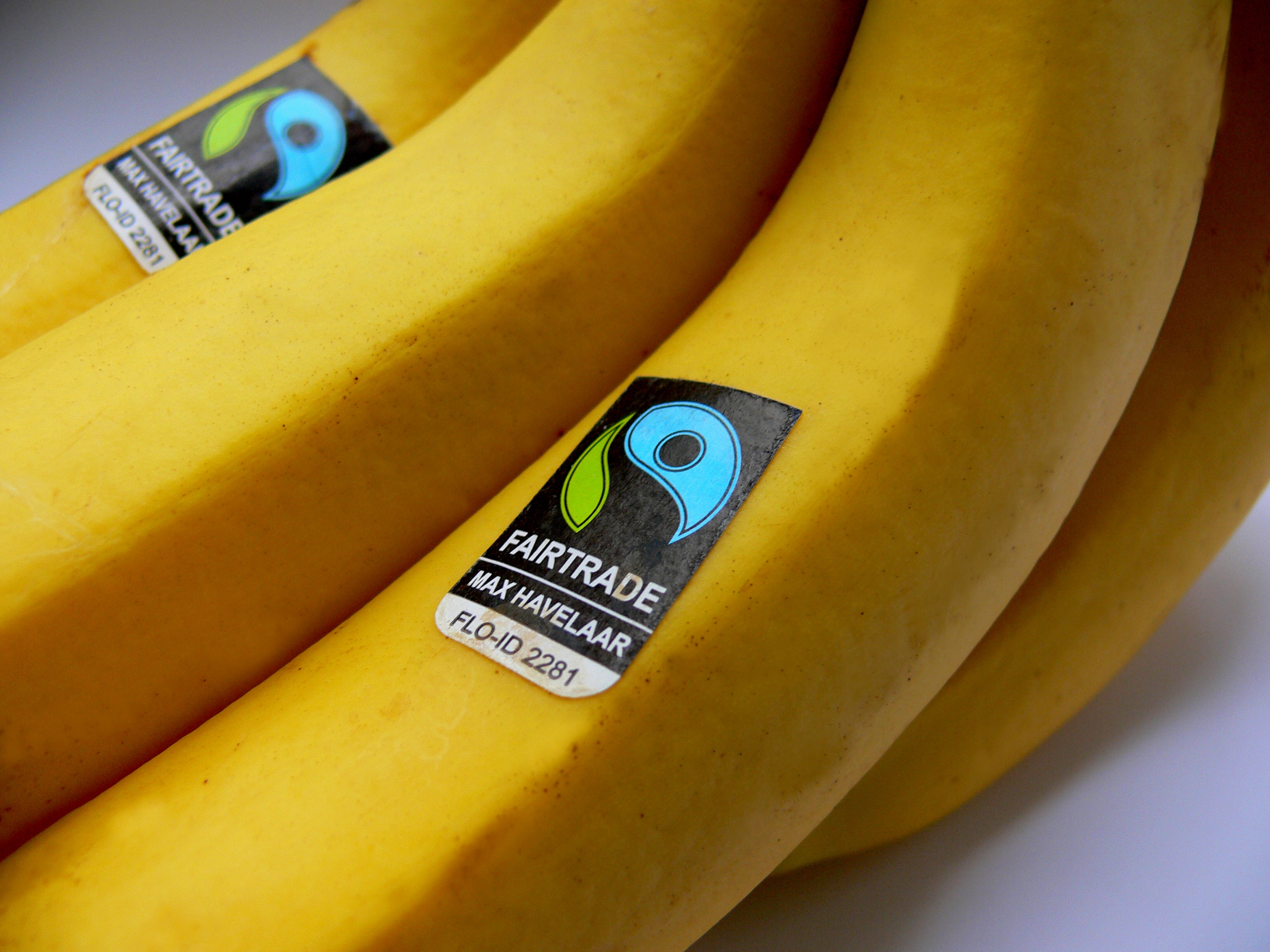
Wikipedia-Fairtrade-Max_Havelaar_Bananen

“Students could shift to fair trade coffee, perhaps, as the pricing isn’t drastically different. But, the same can’t be said with other products. In such situations, a larger institutional push is required,” Wangcherdchuwong continued.

Building on that same idea of an institutional change, Heim added that “SFU could potentially have courses around fair trade and could send more students on origin trips, such as the one we went on.”

While these students might have returned home with a strong pledge in their heart, they feel other SFU students might not share their passion. “I felt that students have a fair amount of indifference to this cause. After returning, I have made changes to my consumption habits such as looking at labels to see fair trade percentages,” Heim said.

Working behind the scenes

SFU’s fair trade initiative has grown over the years thanks to student engagement and the administrative team that works under the umbrella of SFU’s sustainability program. Getting Starbucks on board and providing fair trade sugar and chocolate options are milestones that we can be proud of.

Besides having Fair Trade Campus Week once a year and communication through social media, SFU currently lacks a framework for further implementing fair trade products. As a result, the administration is planning to assemble an integrative committee that would include all stakeholders to address fair trade issues soon. Such a committee could slowly solve the challenges that a commitment to fair trade brings with it.

Jana Vodicka, manager of Campus Engagement and Sustainability, explained the crux of the situation. “Working with established brands means that we have to abide by their business model. To get them on board, we have to be strategic about the types of brands we partner with and provide on campus to meet SFU values, while still meeting the purpose of providing the dining services students and staff expect and need.”

Vodicka’s concerns bring us back to Wangcherdchuwong’s assessment — that there are simply too many conflicting interests. However, Vodicka optimistically expressed that the purchasing power at SFU is far too great to not be taken advantage of, and believes that student awareness would only thrust it forward.

Double double standards?

Mark McLaughlin, executive director at Ancillary Services, explained how students buying fair trade products, especially coffee across 36 universities at Starbucks, has measurable and positive change for farmers in developing countries. But he agreed that much work still needs to be done.

“As we pushed Starbucks to change its procurement channels, we have been pushing Tim Hortons. We called Tim Hortons management to meetings at SFU and  UBC over the years, and just last October we teamed up with UBC, McGill, Ottawa, and Brock and met their management at their corporate headquarters in Oakville,” explained McLaughlin, only to inform that Tim Hortons still hasn’t turned a new leaf.

When asked about our dear Timmies’ central resistance on the transition, McLaughlin explained that “back in 2013, Tim Hortons told us that their logistics prevent them providing a fair trade option as they only serve one blend.”

However, Tim Hortons has introduced new roasts. “They replaced the [original roast] with dark roast, since then. I believe the true reason Tim Hortons avoids offering fair trade coffee is because it hurts their bottom line they want to pay the least possible for coffee beans, satisfying their shareholders, but often to the detriment of farmers.”

As often is the case with any profit-seeking business, it is with no doubt that this will be a longer struggle than Starbucks, and one that calls for students’ attention.


TIM’S BIT: America shouldn’t make Canadians forget their own news

0

#NotMyPresident. No, really! The orange coloured capricious individual — the only person on Earth actually closest in colour to a Lego-man — is not my leader. Yet I am reading more about Trump’s crazy in Canadian papers than I am about what our own politicians are doing. That’s not good! I think it’s time for the national media to take a deep breath and reassess story importance.

I’m not naive. I know that, due to the prolific globalized world we live in, Trump will cause impacts almost everywhere — that has been the same for any American president over the last few decades. Is it good to be aware of what he and his congress are up to, especially when he’s going exactly to the nutty extremes he said he would? Yes. Should it overpower our own federal, provincial, or even municipal politics? No.

Yes, he is making changes that will affect Canadians. His first week in office was a flurry of executive orders, many of which will have implications here. And yes, I want to know what the MPs who we elected to deal with other countries face.

https://youtu.be/lSKdQh1Dd9c

The Trans-Pacific Partnership is unlikely to continue without the US. The removal of privacy protection on foreign data means that all our information that is shared by Google, Facebook, and even private email or data centres (which outsource to the US) will have even fewer protections than they did before. Our leaders will continuously have to reassess how they broker new deals, and adapt to Trump’s whims.

But my issue is this: the whole past few weeks, and even prior to his election, it’s Trump’s actions which are making headlines here, and not our leaders’ actions about how they are going to deal with a Trumped-up America. I don’t want to hear any more alternative facts propaganda from the White House; I want to hear about what we’ll be doing in response.

Even aside from that, there’s plenty of entirely unrelated news that the media should be updating Canadians on. In BC, there’s an election coming up, and I’m willing to bet that more than half the people reading this can’t even name the leader of the NDP or Green Party — John Horgan and Andrew Weaver respectively — let alone their own constituency candidates.

For months, the BC government has been bragging about its new upcoming “modernised” liquor laws. Now, the update is here, and the only real modernisation I can see is that they are allowing for more licences to be awarded.

And in a move towards reconciliation, the City of Vancouver is holding events using funds earmarked for the Canada 150 Celebration. These events have been designed to foster healing with, and education about, the indigenous nations that were stewards of the land before colonialism.

The need to be informed is important to democracy. The media as the fourth estate is meant, in part, to help me, the citizen, be aware of what is happening in government — our government. If all I hear every day is trumpeting from our loud downstairs neighbours, I can’t do that. If we can’t turn them off, let’s at least turn our own music up to 11, so that we don’t forget about it.

SARRS rampages through SFU, start of outbreak could be deadly

0

Even though there has been no case of Severe Acute Respiratory Syndrome (SARS) reported worldwide since 2004, there’s a new type of SARRS in town — and it’ll leave you feeling just as sick.

A new club on campus, fueled by the rise of nazis in America as well as the general indecency of people today, is focused on bringing down the “harmful” stereotypes of being white men. They call themselves Students Against Reverse Racism and Sexism (SARRS), seemingly unaware of the disease associated with them.

“It’s been really hard to be a white man lately, and this is supposed to be our chance to be ruining other people’s lives,” said Josh Spencer, the self-dubbed CEO of SARRS. “If you’re going to say that racism and sexism are real things [editor’s note: they are], then obviously reverse racism and sexism are even more real [editor’s note: they’re not] and so we’re just doing our civic duty and making life good for us again.”

When asked about realizing the association that people had between SARRS and the epidemic virus SARS, Spencer said that he felt that SARS was a “historical” term, and that it’s wrong to assume that two things that sound the same are the same.

“SARS with one R is a historical term that is not going to resonate today thanks to unpleasant associations due to it killing a bunch of people back in 2004, and I think that people who say SARRS with two Rs is a whole new kind of thing,” said Spencer.

“We’re not SARS, we’re SARRS!” he insisted, oblivious to the fact that he was just shouting the same thing over and over.

Despite the fact that the club seems like it has been around since forever, they only became official very recently — but that hasn’t stopped them from already hosting events.

Last week, they played Call of Duty for 72 hours straight to raise awareness over the lack of a “Men’s Studies” major at SFU. Yesterday, they had an event where they just stood outside the Women’s Centre and yelled at them for hours.

Many on campus are arguing that groups like SARRS are incredibly toxic to any community, not just a progressive place like a university campus. Those claims have been largely ignored by anyone in power, claiming there should be a wait-and-see approach.

“Look, they’re new, and who knows what they are capable of accomplishing?” argued a university representative, seemingly oblivious that those were the same fears they were dismissing. “We just don’t have enough evidence at this time to say that SARRS is harmful and that we should quarantine to prevent a potential disaster.”

The Peak reached out to multiple people who were opposed to the presence of SARRS on campus, but they almost all said the same thing so it is tough to credit just one person. Basically, they maintained that SARRS was harmful to everyone, there was an overwhelming amount of evidence to support this, and that by ignoring its existence, it gave SARRS free reign to infect as much of campus as they can. [editor’s note: they’re right]

Pressed for a follow-up to these claims, Spencer refused to speak and instead had his press secretary issue the following memo:

“YOU DON’T KNOW ANYTHING ABOUT SARRS. WE’RE REALLY GREAT! WE’RE DONE HIDING IN THE CORNERS. THERE ARE NO FACTS ABOUT SARRS THAT PROVE THAT THERE IS ANYTHING BAD ABOUT SARRS. JUST NO FACTS AT ALL.”

[editor’s note: there are]   

If you are concerned about the risk of SARRS on campus, The Peak recommends being a decent fucking person and educating yourself on what you can do to help those who need it most right now.   


In the news…

0