Home Blog Page 747

Othniel Spence flies with career-high 29 point game despite loss

0
Spence’s 29 points were the highest recorded in a single game by an SFU player all season.

While he had a couple of good threes in the first half, that was all Othniel Spence had on the board in six minutes of court time in the first 20 minutes. Few would have expected him to explode as he did in the second half.

He finished the game with 29 points. That’s the best individual point total anyone on the team has put up all season. He was just everywhere in the second half, putting up confident and exciting plays. His 23 second-half points came in 18 minutes of playing time, a remarkably efficient performance.

As a freshman straight out of high school, whose minutes can vary game-to-game — maxing out at 24 minutes to sometimes sitting the entire second half — it’s a very promising sign of one of the Clan’s futures.

“Othniel plays with a lot of speed, and in our offence, a guy like Othniel can really succeed. He’s been putting in a lot of time in the gym — a lot of extra time in the gym — in the last month and it’s really paying off,” said head coach Steve Hanson.

In the end, Spence finished the game 11-for-15 (73.3%) from the field and six-for-seven (85.7%) from the three-point line.

Despite the remarkable offensive outburst by the 6’1” point guard, SFU was unable to beat the Saint Martin’s Saints in their penultimate home game, falling 102–78. SFU put up some decent offensive numbers, but were unable to stop the Saints — who were playing for their playoff lives — and unable to go drive-for-drive against the Lacey, Washington-based team.

The lopsided loss is all the more disappointing after a stretch of four relatively close games, including a win, where SFU seemed to make definite progress.

“I said [before the game], ‘We’re playing a desperate team and we’ve got to come out hard,’ and we didn’t. So that’s really disappointing,” said Hanson. “What was tough was when we did get a couple of stops, we just missed. Too many mental mistakes; we looked like the team back in early December tonight, unfortunately. We regressed tonight, for sure.”

Saint Martin’s jumped out to a 10–0 lead before SFU put up their first two points 3:14 in. It didn’t take long for the Saints to further build that lead up to 18–4.

SFU was able to go on a 13–5 run to get the game within six points, but just as quickly as SFU was able to get back into contention, Saint Martin’s was able to pull away.

The half finished 54–36 in the Saints’ favour. Saint Martin’s was shooting at an incredible rate, sinking 69.9% of their shots from the field — a trend that slowed only moderately in the second, as they finished with an overall 66.0%.

Graham Miller got to see some action in the first, putting up 12 points in 10 minutes of play. Despite some mistakes, his offensive performance showed potential.

“[There were] too many mental mistakes; we looked like the team back in early December tonight, unfortunately.”

“Now that his concussion’s gone and he’s just getting back to the swing — it’s really tough when you sit almost a month with an injury — he’s been looking a lot better in practice,” Hanson said about the 6’7” redshirt freshman. “The game speed is not there, his foot speed is not there for games, but we know he is going to be good in a couple of years, so we give him some minutes.”

While he didn’t put up any more points, Miller saw a further seven minutes of action in the second.

In the second half, Saint Martin’s played sloppily at times, and despite their high shooting percentage, left some drives without a shot. SFU looked like they might be able to take advantage of this, at one point reducing the deficit to 12.

However, SFU was unable to sustain the momentum.

Outside of Spence, Miller and Michael Provenzano, who had 11, were the only players with double-digit point totals. Spence also led in rebounds with four, three of them defensive.

The typical big-minute players saw their time on court reduced, with Provenzano playing only 25 minutes and Kedar Wright only 22 minutes. Wright finished with six points and two defensive rebounds. Vinnie Safin, Bowen Bakken, and Bongani Moyo — who have been used sparingly — received minutes.

Next Game: It’s the last game of the year for the men’s basketball team. More importantly, it’s the last game of seniors Hidde Vos’ and Gibran Sewani’s careers.

While they aren’t fighting for anything in the standings, and the win total will still be low, it would be huge to send off Vos and Sewani with one last home win, in front of what’s probably going to be a big, loud crowd.

It won’t be against an easy team. Despite being ninth in the conference, and having lost their last game, Seattle Pacific has won three of their last five games.

“They’re a big physical team. There [are] not a lot of guys on our team physically that can match up with them,” said Hanson. “When we played at SPU, they were in a different world. I mean, a lot of senior leadership, a lot of big, strong kids they have, and they took it to us the first game of the season.

“We’re going to see what we’re made of Saturday, because we’ve got to play with some pride and I told our seniors, ‘You’ve got to go down swinging.’”

Hanson emphasized the importance he stressed to Vos and Sewani about shooting more — even if it means more misses.

“[I told them,] ‘Hidde, if you’re one-for-five, let’s go two-for-ten, take shots, and Gibran same thing,’” he explained. “I’m excited for them Saturday, and we’ll see how we bounce back.

“I just want to see — regardless of the score — how hard we compete against them.”

Seattle Pacific’s Tony Miller is fifth in scoring and third in rebounding in the GNAC.

Tip-off is at 7:30 p.m.

SFU edges out Alaska Fairbanks with last-second Meg Wilson basket

0
Meg Wilson finished with 10 points and four rebounds in 34 minutes of action, including the winning basket with 0.3 seconds left.

The tried and trusted combination of Ellen Kett and Meg Wilson proved the game-deciding difference on Thursday night. SFU women’s basketball claimed a dramatic 73–71 win at home over Alaska Fairbanks to move to 15–4 in the Great Northwest Athletic Conference (GNAC).

With the scores tied at 71, Kett’s pass found Wilson in the shadow of the basket, with the forward’s shot hanging for what seemed like an eternity on the rim. Finally, it dropped with 0.3 seconds remaining to settle the game in the Clan’s favour.

However, it was a true team effort from the home team as coach Bruce Langford used the bench to significant — and often game-changing — effect. Samantha Beauchamp impressed with a vital contribution of seven rebounds during her 10 minutes of action, whilst Tayler Drynan shot 100% from three-point range in a match where there was never more than a seven-point difference between the two sides.

Both sides came into the encounter with playoff ambitions and it was, perhaps, no surprise that the first quarter saw defences on top. Despite Rachel Fradgley registering the first points of the night for the Clan, the home side soon found themselves 8–4 down with four minutes to go in the quarter. Coach Langford made the bold call to remove both Kett and Wilson early, and it paid off; Sophie Swant and Tayla Jackson made telling contributions to bring the scores back level at 12–12 at the end of the first 10 minutes.

Kett and Wilson returned to the court. SFU opened the second period with the first three-pointer of the match via Vanessa Gee. Kett began to find her passing range, despite coming into the game having struggled with illness in the lead up. An eye-catching assist for Fradgley was one of a total of nine on the night, breaking her own GNAC season record in the process. Drynan’s three-pointer with 23 seconds left in the half saw SFU take a 31–26 advantage into the halftime break.

“Ellen and I have played together for so long and she’s such a great teammate, so it was exciting to end the game like that.”

– Meg Wilson on the winning play

However, with the second-highest scorer in the division, Jordan Wilson, in their ranks, Alaska Fairbanks came back at the Clan. SFU traded baskets before edging ahead after Swant was punished for a technical foul. With seconds left in the third, Gee’s second three-pointer of the night gave the home side the narrowest of leads going into the final quarter.

Once more, it was SFU that started the quarter the better; Ozi Nwabuko opened the scoring before turning provider with an athletic assist for Wilson as they opened up a 53–48 lead. Yet the home side could never quite put their visitors away, as the Nanooks continued to fight their way back into the game. The lead changed hands time and again before Kett was on target. Two free throws with 96 seconds remaining gave SFU a five-point cushion.

Again, though, Alaska Fairbanks refused to go away. Despite trailing by three with less than a minute to go, three free throws from Jaylee Mays drew the visitors level. It was only through the cool head of Kett and the latest of late interventions from Wilson that the Clan was finally able to celebrate a hard-fought win.

Speaking after the game, Wilson said, “We started off slow — we definitely weren’t hitting shots like we can. They did a good job of taking us away from what we wanted to do, but we never gave up.

“Ellen and I have played together for so long and she’s such a great teammate, so it was exciting to end the game like that.

Coach Langford was pleased with the contribution of his bench, but admitted his side was below their usual standards.

“I didn’t think we executed so well tonight. We stuck it out and snuck it out, and everyone scored and contributed, but I didn’t think we were sharp.

“I think our bench has outscored every team we’ve played for a while now [SFU’s bench finished with 29 points, 13 more than their counterparts], and I was really pleased with their contribution aside from Sophie [Swant]’s technical.”

Next Game: On senior’s night, SFU will face arguably its toughest test of the season as they face the unbeaten Alaska Anchorage Seawolves. Both Wilson and Langford anticipate another tough encounter at the West Gym.

“Knowing we can come out and finish games is important,” said Wilson. “I know it’ll be a close game on Saturday, so we need to get rested and get ready.”

Langford agreed, saying, “We’d like to do our best against them. We enjoy playing them and enjoying upsetting them. I think we play them as well as anyone and, if we come out and play, it’ll be a hell of a game.”

SFU edges out Alaska Fairbanks with last-second Meg Wilson basket

0
Meg Wilson finished with 10 points and four rebounds in 34 minutes of action, including the winning basket with 0.3 seconds left.

The tried and trusted combination of Ellen Kett and Meg Wilson proved the game-deciding difference on Thursday night. SFU women’s basketball claimed a dramatic 73–71 win at home over Alaska Fairbanks to move to 15–4 in the Great Northwest Athletic Conference (GNAC).

With the scores tied at 71, Kett’s pass found Wilson in the shadow of the basket, with the forward’s shot hanging for what seemed like an eternity on the rim. Finally, it dropped with 0.3 seconds remaining to settle the game in the Clan’s favour.

However, it was a true team effort from the home team as coach Bruce Langford used the bench to significant — and often game-changing — effect. Samantha Beauchamp impressed with a vital contribution of seven rebounds during her 10 minutes of action, whilst Tayler Drynan shot 100% from three-point range in a match where there was never more than a seven-point difference between the two sides.

Both sides came into the encounter with playoff ambitions and it was, perhaps, no surprise that the first quarter saw defences on top. Despite Rachel Fradgley registering the first points of the night for the Clan, the home side soon found themselves 8–4 down with four minutes to go in the quarter. Coach Langford made the bold call to remove both Kett and Wilson early, and it paid off; Sophie Swant and Tayla Jackson made telling contributions to bring the scores back level at 12–12 at the end of the first 10 minutes.

“Ellen and I have played together for so long and she’s such a great teammate, so it was exciting to end the game like that.”

– Meg Wilson on the game winning play

Kett and Wilson returned to the court. SFU opened the second period with the first three-pointer of the match via Vanessa Gee. Kett began to find her passing range, despite coming into the game having struggled with illness in the lead up. An eye-catching assist for Fradgley was one of a total of nine on the night, breaking her own GNAC season record in the process. Drynan’s three-pointer with 23 seconds left in the half saw SFU take a 31–26 advantage into the halftime break.

However, with the second-highest scorer in the division, Jordan Wilson, in their ranks, Alaska Fairbanks came back at the Clan. SFU traded baskets before edging ahead after Swant was punished for a technical foul. With seconds left in the third, Gee’s second three-pointer of the night gave the home side the narrowest of leads going into the final quarter.

Once more, it was SFU that started the quarter the better; Ozi Nwabuko opened the scoring before turning provider with an athletic assist for Wilson as they opened up a 53–48 lead. Yet the home side could never quite put their visitors away, as the Nanooks continued to fight their way back into the game. The lead changed hands time and again before Kett was on target. Two free throws with 96 seconds remaining gave SFU a five-point cushion.

Again, though, Alaska Fairbanks refused to go away. Despite trailing by three with less than a minute to go, three free throws from Jaylee Mays drew the visitors level. It was only through the cool head of Kett and the latest of late interventions from Wilson that the Clan was finally able to celebrate a hard-fought win.

Speaking after the game, Wilson said, “We started off slow — we definitely weren’t hitting shots like we can. They did a good job of taking us away from what we wanted to do, but we never gave up.

“Ellen and I have played together for so long and she’s such a great teammate, so it was exciting to end the game like that.”

Coach Langford was pleased with the contribution of his bench, but admitted his side was below their usual standards.

“I didn’t think we executed so well tonight. We stuck it out and snuck it out, and everyone scored and contributed, but I didn’t think we were sharp.

“I think our bench has outscored every team we’ve played for a while now [SFU’s bench finished with 29 points, 13 more than their counterparts], and I was really pleased with their contribution aside from Sophie [Swant]’s technical.”

Next Game: On senior’s night, SFU will face arguably its toughest test of the season as they face the unbeaten Alaska Anchorage Seawolves. Both Wilson and Langford anticipate another tough encounter at the West Gym.

“Knowing we can come out and finish games is important,” said Wilson. “I know it’ll be a close game on Saturday, so we need to get rested and get ready.”

Langford agreed, saying, “We’d like to do our best against them. We enjoy playing them and enjoying upsetting them. I think we play them as well as anyone and, if we come out and play, it’ll be a hell of a game.”

SFU Blood for Life encourages students to get involved, save lives

0

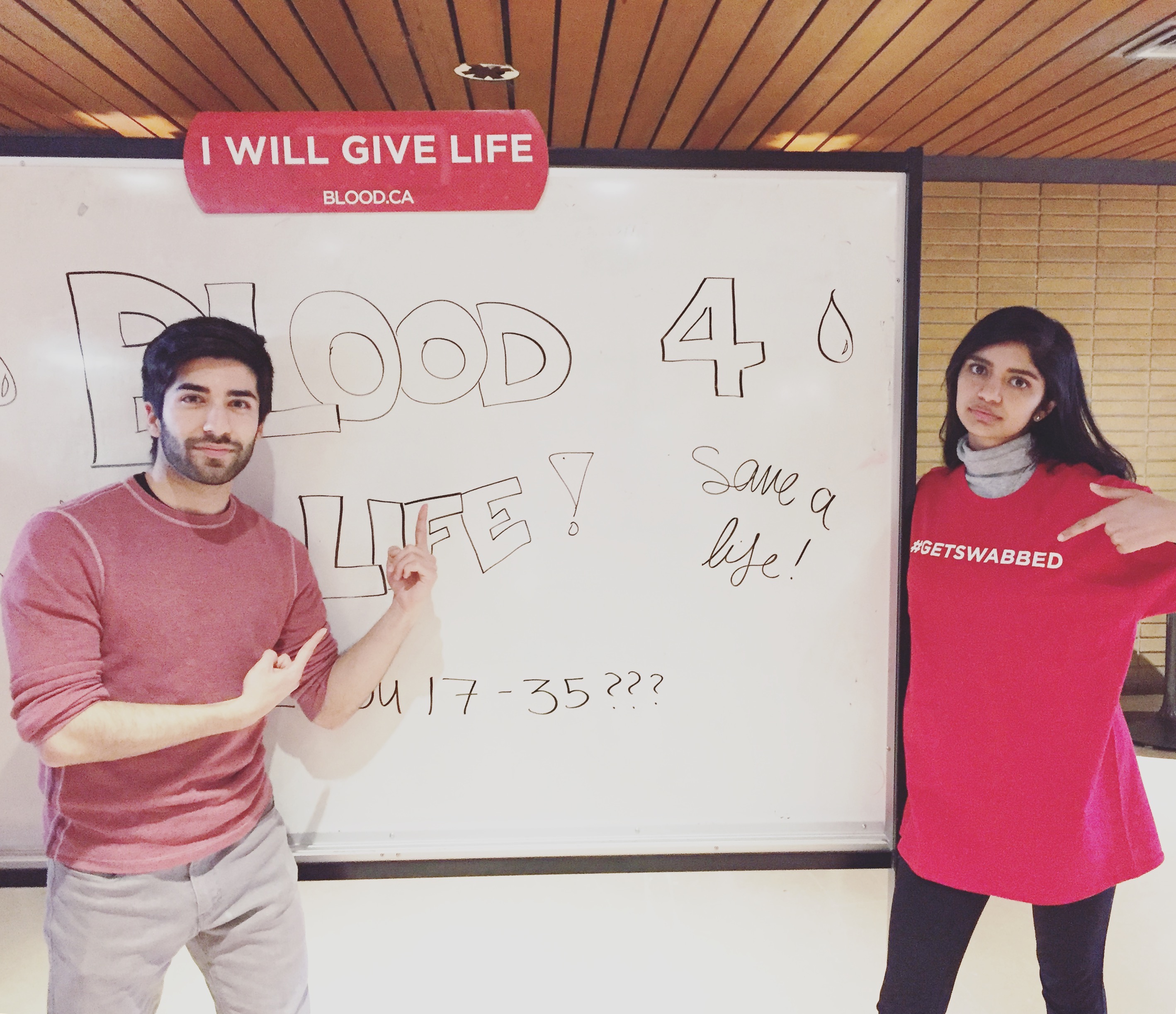
SFU Blood for Life is bringing students together over a shared interest in saving lives, one pint of plasma at a time.

Having established themselves on campus in spring 2016, this year promises to be a big one for SFU Blood for Life. The group has set goals to increase awareness, as well as access, to the process of blood donation.

As executive director Iman Baharmand explains, the club is looking to bring back the connection between the university and Canadian Blood Services (CBS), and remind students that blood is ‘in us to give.’

In the club’s early stages, Baharmand recalled that the majority of the planning was centred around a simple question: how do we bring blood donation opportunities to campus?

“The idea came when I was volunteering with the CBS in the wider community outside SFU, and I thought to myself ‘Why don’t we have a regular blood donation drive on campus?’ After that initial question, I began looking more and more into it, and we learned that there used to be regular donation drives on campus, where they would have these trucks and you could walk on and donate,” Baharmand added.

That founding idea has been the focal point for the club so far, as they work closely with CBS in their efforts to increase both blood donation and, more recently, stem cell donation.

According to the CBS, over 80 conditions can be treated with stem cell transplants, yet the register is hampered by a lack of ethnic diversity. With SFU’s multi-ethnic campus, it was perhaps no surprise that the Blood for Life team decided to step up to the plate, and help students get involved in the donation process.

“We recently held our first stem cell drive, which was a big success,” said Baharmand. “We’d aimed for registering 100 people, and got 147. I think the way we operated that drive was really important, in terms of making sure students have the knowledge they need and are fully informed on what they’re signing up for.”

Monique Sekhon, the club’s community director, agreed: “It’s really important to inform our candidates that they need to be committed if they’re going to sign up for this. In our spiel with them at the beginning, we give them all the information they need in relative layman’s terms so they can get a full understanding.”

Sekhon stressed how important asking questions is to the process, not only from the student’s part but theirs as well. “We do our best to ask ‘Is this something you’re comfortable with?’ or ‘Do you understand you could literally be saving a life?’”

The passion with which Baharmand, Sekhon, and the rest of the Blood for Life team run the society is evident, perhaps never more so than through their enthusiastic explanations as to how they initially got involved with blood donation.

“Everybody has a different story for some people it’s like a family tradition once you turn 17; for others, it’s a different story,” said Baharmand.

“Personally, it was in high school. I hadn’t really thought about blood donation, but we had an outreach event at my high school. [The volunteers] said, ‘Hey guys, if you want to donate blood, you get to miss the last block of school.’ So me and my buddies jumped in a car and away we went.”

For Sekhon, it was a slightly more circuitous route. “It’s always been ingrained with me by my family that giving back to your community is really important, and obviously blood donation is one way to do that. It kind of stemmed from that.”

With one highly successful event under their belts already, SFU Blood for Life has already made a name for themselves on campus. Having attracted significant interest at Clubs Days, what does the future hold for the club?

“We’re aiming to do at least one big stem cell drive per semester, so our next one will probably be in [the] fall,” said Baharmand.

“However, the best way to find out what’s going on is to head to our website sfubloodforlife.com or our Facebook page, SFU Blood for Life. Through any of our channels, there [are] ways to get involved in our events as either a participant or a volunteer.”

Baharmand hopes that as the club continues to grow, more students will get involved and have their say in the clubs’ development. “Any suggestions from the student body are totally welcome, too. We’re a club foundationally built upon collaboration and the sharing of ideas. There’s no sense of hierarchy.”

“Volunteering is a great way to get involved” added Sekhon. “If this is something you’re passionate about and can make time for, that’s great come on out. A lot of people are really interested in the club so far, so the response has been great.”

It seems, then, that SFU Blood for Life is a club heading in the right direction. If you’re interested in donating, keep an eye open for the next campus blood drive.

IMG_0885

Minutes from February 22

0

Peak Publications Society Board of Directors Meeting Agenda
February 22, 2017
The Peak offices
Chair: Jessica Pickering

RCMP warn students about sexual assault on Burnaby campus

0

In a time where Simon Fraser University is currently in the midst of developing a sexual violence and misconduct policy, another horrific reminder of why it is necessary took place on Burnaby campus.

Royal Canadian Mounted Police (RCMP) are warning students to be on alert for a tall male who sexually assaulted a woman who was walking from her night class to the parking lot around 7:30 on Tuesday night. He was described as “medium to heavy build,” with a “deep voice with no accent.”

The survivor was able to ward off the assailant, and is reported to not be physically harmed. The suspect fled the scene after he overheard people nearby, according to the RCMP.

We want to caution the public when walking at night to stick to well lit areas and stay off your electronic device to increase your situational awareness,” said Staff Sergeant Major John A. Buis in the RCMP’s release on the incident. He also advised that should any student feel unsafe travelling on campus, they should call SFU security.

If anyone has any information about the incident, they are urged to reach out to the Burnaby RCMP at 604-294-7922. Alternatively, if they wish to remain anonymous, they can call 1-800-222-TIPS or make a report at www.solvecrime.ca

SFU track and field finish with four individual conference champions

0
Tsygankov won both the 400 metre and the long jump events, the first time that's ever been done.

The 2017 Great Northwest Athletic Conference (GNAC) indoor championships were marked by a number of outstanding performances for SFU, along with a lot of firsts. Four members of the team Chantel Desch, Ella Brown, Vladislav Tsygankov, and Addy Townsend ended up winning conference titles.

“I would say it was an epic weekend,” said head coach Brit Townsend talking to The Peak. “We’ve probably never had the depth and the quality of performance that we had on this past weekend. We had probably five or six more people that are on the rankings list. We came within a couple of points of winning the championship, which we’ve never done. Our men finished in the highest placing ever, and just missed third place.

“I think overall, it just showed we are definitely going in the right direction.”

Chantel Desch won her first-ever indoor title in the 400-metre, Ella Brown won her first ever title indoor or outdoor in the triple jump, and Addy Townsend continued her strong season with a title in the 800-metre. But perhaps the highlight of the event for SFU was the performance of Vladislav Tsygankov. Not only did he finish first in the 400-metre, but also in the long jump event the first time that has ever been done.

“He’s just a great athlete,” said Townsend on Tsygankov. “He’s somebody who, if you introduce him to something, he’s got that body awareness and he’s a really quick learner, too. [He’s] very coachable.

“We had him in the four-by-four last year, and he proved to be a really great contributor. This year, his four-by-four splits were becoming so fast that we thought ‘you know what, we’re going to try him on the Sunday of last weekend in a flat 400,’ which he hadn’t done in a long time. He actually ran faster than Daniel had on that track in Seattle. We said ‘it’s your best chance of making it to nationals, so let’s give it a try at the GNACs.’

“He did that, and honestly, it was only two and a half hours later after the heat of the 400s that he had to do the long jump, and he had his best result of the year.”

Other standout performances included those from Katherine Lucas and Valda Kabia, who finished second and third in the 200-metre respectively, and Nathan Mah, who finished third in the 200-metre.

The team now turns its focus to the upcoming NCAA Division II Indoor Nationals, taking place in Birmingham, Alabama starting on March 10. Townsend is hoping to send at least 10 people to nationals, but stressed how hard it is to make it there.

“It’s really tough to make it in track and field. There [are] over 300 schools, and they only take 16 competitors, so you have to be at least the 16th-best in the nation.

“Our goal will be to get people in the final,” she continued. “That will be fantastic. We had an all-American performance from Vlad last year in the long jump, and an all-American performance from our women’s DMR team. Our women’s DMR [distance medley relay] has a chance to repeat at that, I think Vlad has a chance, and I think someone like Chantel if she gets a break and gets through the heat to the final has a chance. Same with Addy.

“They’ve all gained a bit of experience and I think those individuals have a chance of moving through to All-American positions, which would be amazing.”

Agenda for February 22

0

Peak Publications Society Board of Directors Meeting Agenda
February 22, 2017
The Peak offices
Chair: Jessica Pickering

Don’t use age as an excuse to dismiss me

0

Last week, I was sitting in a French class outside of school. I was by far the youngest in the seven-person group: I stood out from the Yaletown yuppies and the third-agers. We were discussing something about having a better world whilst trying to improve our French-speaking skills.


Everyone was being very negative (a common attitude in today’s political climate). I, being the optimistic millennial I am, went on to explain how I still believe there are actions we as humans could do to help poverty, climate change, and constant war. A comment from one of my yuppie classmates soon followed: “Tu dit ça parce que tu es jeune.” Translation? “You are only saying that because you are young.”


I had no comeback. Growing up, we are shut down with similar variations of those words time after time: ‘You don’t understand,’ ‘you’re too young,’ and so many others. Yet here I was, having thought that at age 22, I’d have finally passed the finish line for ageist discrimination.


I went home wondering what exactly that woman meant. Yes, I’m certainly young, but this woman couldn’t have been more than 33. Did that make her much older than I am? Calling me young was just a way for her to position herself as the powerful one between us. The adult, a concept often linked to and confused with maturity and wisdom.


We see that all around social media, both lightheartedly and seriously: ‘adulting.’  What does that word even mean? Economic and social independence? Taking responsibility for your actions? Getting your life together?


Any of those answers would make some sense. What does not, however, is what this woman’s chosen definition of “becoming an adult” was to lose your ‘naive’ beliefs and to ‘understand’ that you can save neither the world nor the people in it.


Looking back, her comment wasn’t helpful so much as just cynical. I understand there is a thin line between ‘optimistic’ and ‘ridiculous,’ yet I refuse to admit that grasping how the world works and successfully ‘adulting’ simply leads to having a desk job, a good salary, a steady monotonous relationship, a mortgage, and a car.


If being an adult means being a pessimist, or a realist if that’s what you’d prefer to call yourself instead, call Peter Pan and fly me to Neverland, because I never want to be like you.

If it signifies that you’ve branded the world a lost cause, that you’ve accepted it as a ticking time bomb waiting to detonate, call me young as many times as you wish.


These past few days have been proof that youthful hope isn’t powerless. Look at Trump’s attempted immigration ban: a source of revulsion, despair, and wonder at how even in the 21st century, a man can cause such harm to thousands of people.


But despite the hopelessness, we saw hundreds of protests breaking out around US airports, lawyers working pro bono to help those affected by the ban, and solidarity from thousands around the world. The world might be dark and horrible, I’m very aware of that, but there are lightning bolts of action that can make it less gloomy.


I have no clue, and don’t think I can ever really expect to know, what being an adult actually means. However, I do know that if, 10 years from now, I’m sitting in a class telling a 22-year-old that she hasn’t grasped the real world because she still believes she could fulfill some of her dreams, slap me.

Dog meat: a matter of cultural dissonance, not cruelty

0

Dog videos make their way around Facebook faster than you can say ‘inspiration porn.’ One more serious story I’ve seen recently is the tale of dogs rescued from Korean meat farms and repatriated west for adoption.  Even as a ridiculously overbearing dog-owner, a longtime vegetarian, and a total nut about the animal trade, I consider this story a total joke.


Dozens of rescued pups were brought to North America, while six dogs made their way to the UK. According to the Canadian Federation of Humane Societies, Canadian shelters took in 35,000 dogs in 2015, and nearly twice as many cats. Why are we importing pets from abroad for the purpose of “rescue” when shelters already struggle to meet the needs of the neglected and abused animals in their care?


The initial outrage of the story the thing that makes it such a point of interest, and such a rallying point for drastic action comes from the shock we’re inclined to feel toward the idea of dogs being farmed for meat. But what seems ridiculous in the Western world of Lassie, Air Bud, and Paw Patrol is actually quite normalized elsewhere; our negative attitude toward eating dog meat is prejudice at its best.


Take China, for instance, a country where dog meat is just the tip of the culinary iceberg. When an estimated 134 million of your country’s people face hunger and 10% of your nation’s children suffer from stunted growth despite leaps and bounds in recent years, the cold-hearted truth is that dogs are easy and inexpensive to raise, and they offer nutrition to those who may have no other alternative.


Of course, the industrialization of animals’ lives, which places financial gain over animal well-being, is definitely an issue to discuss. Unethical farming practices, such as starving animals or cramming them in inhumane cages, are prevalent in the dog meat trade, and the health hazards of improperly handled meat (such as rabies) are undeniable.  


However, pointing out the cruelty of dog meat means pointing fingers at the meat industry as a whole, which includes beef, pork, and chicken and has its problems even on North American farms.  Shutting down inhumane dog farms in Asia and Africa does absolutely nothing to address the wider problem of unethical farming. Instead, it allows misinformed animal rights activists to point the finger away from home, rather than consider their own dinner plates more deeply.


The idea of consuming dog meat is so provoking because of our cultural links to dogs as companions, best friends, movie stars, service animals, and much more a link I understand and feel very deeply myself. But no matter how easy it is to apply our values abroad, it’s a risky and short-sighted practice especially if the conversation doesn’t start with asking ourselves how good we really are at taking care of animals.