Home Blog Page 677

Internship and co-op students face difficulties when filing their taxes

0
(Chris Ho / The Peak)

Students who are doing an internship or are on a Co-operative Education (co-op) work term may have a harder time filling out their tax return, according to tax experts, because the nature of their work is different compared to other jobs.

As the deadline for tax filing approaches, which is April 30 this year, students, especially those who are doing an internship or a co-op work term might be wondering how they should fill out their tax return, considering they have a different work status than part-time or full-time employees.

In order to make the process of reporting income tax easier, the Canadian Federation of Students and UFile Online, a consumer tax program located in Montreal, Quebec have joined forces to offer a free online tax filing service for all Canadian university students.  

Typically, earnings from an internship are regarded the same as employment income. In this case, the student’s employer would provide them with a Statement of Remuneration Paid slip (T4) that displays their earnings for the last fiscal year.

However, there are cases where the employer could pay the student in amounts that exclude withholdings, such as the Canadian Pension Plan, Employment Insurance, and income tax, according to Gerry Vittoratos, head trainer at Thomson Reuters and tax specialist at UFile. “In that case, they paid [the student] like an independent contractor. As a contractor, you are considered self-employed,” said Vittoratos.

In order to assess if the student’s internship falls into the self-employed category or not, they must look into how much control their employer has over their pay, and whether the student has a say in how much they should get paid for their services or not, explained Vittoratos. In addition, where the intern gets their supplies from to provide the service could have an effect on whether they qualify for the self-employed status or not as well, he added.

Vittoratos also noted that interns are often compensated unconventionally. For example, their remuneration could be in the form of gift cards or cash, which makes it difficult for them to know how to report these earnings. “An honorarium is considered [an] employment income. This income is taxable, and must be reported on your [tax] return,” he said.

Moreover, if a student completed their internship overseas, as long as they have their Canadian citizenship or Canadian permanent resident status, they are required to file a Canadian tax return like any other resident of Canada. “Any income you gain outside of the country is taxable in Canada, and should always [be] reported on your return,” emphasized Vittoratos.

It is important to note that if a Canadian intern completed a paid internship overseas, like in the US, they are required to pay income taxes for that country. However, pon filling out their Canadian income tax, they should still report their full earnings, as they may be able to claim a foreign tax credit, according to Vittoratos.

Vittoratos also emphasized that if a student owes tax to the government, files late, or does not file, they will be subjected to penalties from Canada Revenue Agency (CRA). Interest will be applied to any amount owing that has not been paid by the deadline date.

In terms of the credits that interns can claim, they are eligible for the same deductions as a regular employee, noted Vittoratos. “This includes tax credits that are automatically included on T4 slips, such as Canadian Pension Plan and Employment Income as non-refundable credits and withholding taxes as refundable credits,” he added.

If interns are unclear as to whether they are considered a contractor instead of as a standard employee, the general rule of thumb to remember is that interns are considered employees due to the nature of their work, stated Vittoratos.

There are many resources out there that students can access to learn more about filing taxes in Canada. “The CRA website offers a wealth of tax-related information, as does the UFile site. On [the UFile site], students can find the support they need, whether through our blogs or our virtual tax clinic Tax & U, where resident tax experts are on hand to offer easy answers to their tough questions about tax,” concluded Vittoratos.


Stuff we like and don’t like

1
(Elena Hsu / The Peak)

By: Jennifer Russell

Stuff We Like:

New Girl

If you’re looking for an entertaining show to binge on Netflix, look no further. New Girl, starring Zooey Deschanel as Jessica Day, is consistently hilarious from season 1 through 6.

     The show begins with Jessica discovering her boyfriend is cheating on her. She then moves out, and through a Craigslist advertisement, ends up becoming a roommate to three guys. The show follows the roommates as they deal with their messy love lives, strange work issues, and unique drinking games. The quick jokes and pop culture references happen so fast they might go over your head, so pay attention! It’s essentially Friends, but funnier — don’t even try to argue until you’ve watched it yourself.

Stuff We Don’t Like:

Riverdale
Riverdale is a drama series that is supposedly based on the Archie comics, but realistically the show simply takes the character names and that’s it. There is almost no other connection to the comics. Jughead doesn’t even eat a hamburger! Beyond the characters being different than expected, the writers seem confused about who their target audience is.

     When Riverdale was first released, I heard men and women from ages 25 through 40 eagerly awaiting new episodes, because they expected to be able to reminisce over the comics. The dialogue feels clearly targeted towards teens, and yet some scenes (such as the one where Betty pole dances) suggest this is for a slightly older audience. Beyond the inconsistencies, the plotline is honestly laughable. Even though this show feels like an unorganized mess, I must admit . . . it’s addicting.

EA admits they based their business model around SFU’s methods

0
Photo-illustration by Ahmed Ali

By: Ahmed Ali

Last week, Electronic Arts (EA) CEO Andrew Wilson spoke with shareholders about EA’s influence for the way they’ve been monetizing their games recently.

Wilson stated “You see, we looked for the businesses that ripped off their customers in the most greedy and unethical ways possible, and we also looked for those that were the most upfront and proud to give the consumer such little value for their purchases. After looking at multiples parasites such as the insurance industry and the music industry, we saw that universities were actually the perfect large scale implementation of omnipresent microtransactions and Day-One DLC.”

Wilson continued on about the inspiration EA got from SFU and other universities: “Based on their actions, we are now adding parking passes for your hover cars in Anthem (delayed to 2019) for $50 a month. Additionally, you can print out duplicates of your cards in FIFA 18 Ultimate Team for an additional $0.20 per card ($0.40 if you want to keep all the stats).”

Now, EA’s Day-One DLC and the like are based on how universities will sell you courses but then make you buy textbooks and the like for $1,000s. On this topic, Moore said “The university method is genius. They have made everything into a microtransaction paywall.”

In EA’s opinion, the best part is how they will also make their customers — who they’ve lovingly dubbed as “Student Application Profits” or “SAP” — work through a ton of filler content that often has nothing to do with the game they purchased, just as WQB requirements have nothing to do with the majors students pay for.

So in the end, when the SAPs are done, they have made EA billions and EA has provided the SAP with a sense of pride and accomplishment for unlocking different heroes — the same way diplomas give university students a sense of accomplishment despite the actual lack of worth in one.

Here are some Tweets from people who have responded to the story:


In response to all of this, there are rumours that SFU and EA intend to start a partnership in hopes of achieving their common goal to scam the entire world.

Long story short: My natural hair is a character of her own

0
Image credit Tiffany Chan

By: Grace Rose 

My hair changes about every 4–6 months. Sometimes it will be straight, sometimes in braids or twists, and other times hidden underneath a hat or a headwrap. She is a character of her own accord. Yet it wasn’t until about four months ago that I made the biggest change — I decided to wear my hair naturally.

Now this may not seem like a big deal, yet for a black woman like myself the decision to wear your hair without any sort of chemical processing or heat styling can be a big deal. Why? Well within the North American context, hair has been a site of trauma wrapped in misogynoir (misogyny directed at black women on account of race) and discrimination. As an example, in the late 1700s, The Tignon Law was passed, forcing women of African descent to cover their hair with a scarf. This was done to distinguish them from white women; many black women would adorn their hair with jewelry and trinkets, unwantedly gaining the attention of white men who would take black mistresses.

Beyond that, many black women face discrimination if they choose to wear their hair in a natural style, specifically within the workplace. This issue is not just an American one: a Canadian Zara employee was taken aside and told that her box braids were unprofessional. Another black woman was sent home from her restaurant job for wearing her tightly coiled curls in a bun. So as a black woman in Canada, to wear my hair natural is a statement.

And yet it is not. To simply exist as I have been made should not be this radical act. I should be able to live my life the way I wish without having it be understood as a radical political statement. Yet when you live in a body that carries a historical legacy of discrimination, to exist is resistance. While I did not choose to go natural purely for this reason, I also felt it was important to do so because if I was to preach about the importance of learning to love yourself as you are and to advocate for the voices of marginalized communities, I needed that to be reflected in my own life. I’m not going to be perfect at it, but I need to try.

So when I started to wear my hair with big curls and lots of body, I was a mess. I was in the midst of trying to finish my final semester of classes while also trying to embark on this new journey. So if I’m honest, the timing probably wasn’t the best. Yet I knew that nothing has perfect timing and sometimes you have to just take that step of faith and keep moving. So I did.

I started researching what kind of products to use and looked at different ways of washing and cleaning my hair. I began to follow natural hair bloggers on social media to learn different ways of styling my hair for everyday work or special occasions. Inspired by my best friend, I ventured into the world of headscarves and found unique ways to accessorize on days where I didn’t feel like messing with my hair too much.

Yet most importantly, I began a journey of self love. To learn to appreciate this part of me that seemed to have a mind of its own. To begin to take time out in my day to be conscious of putting myself together and embracing the natural curl of my hair. I began to get creative with the way I did my hair and found myself learning to enjoy how big and full it is. To release myself from the pressure of sleek tresses and to embrace the bold lion’s mane that I have been blessed with.

In these last few months, my hair has taught me so much. She carries the legacy and joy of the ancestors within her coils. She is bold and undeniably present many times in ways that I am not. She is constantly teaching me to embrace who I am without changes or alterations. She is teaching me to see myself as beautiful within the way I have been made. And that is the greatest Black History Month gift I could have ever received.

Ciaran Ball and Morgan Smith qualify for national championships in men’s wrestling

0
Ciaran Ball will be making his first trip to the national tournament. (Photo courtesy of SFU athletics)

By: Lauren Mason

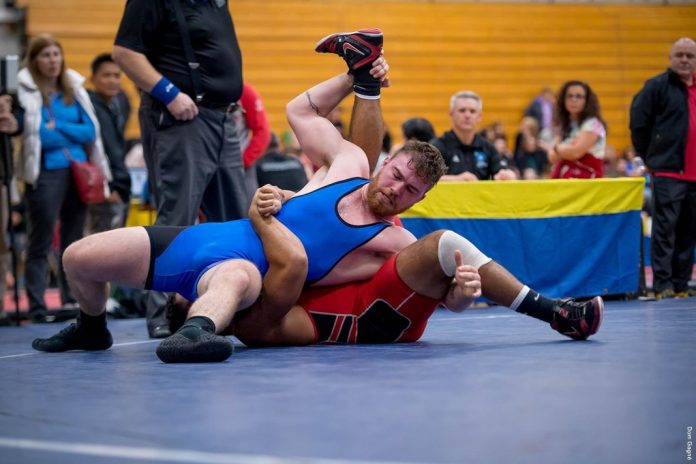
The SFU men’s wrestling team travelled to Las Vegas, New Mexico this weekend to compete in the National Collegiate Athletic Association (NCAA) Division II regional tournament.

Going into the tournament, the Clan was ranked number 10 as a team, with three individuals ranked in their respective weight classes as well. Cruz Velasquez ranked #7 in the 141-pound weight class, Tyler McLean ranked #2 in the 165-pound weight class, and Morgan Smith ranked #1 in the 197-pound weight class.

The Clan brought 10 wrestlers all with high hopes to place in the top four and move on to the national tournament. Unfortunately, there were only two wrestlers who will advance to the next tournament in the 2018 postseason.

Those wrestlers were Ciaran Ball and Morgan Smith. Smith will be returning to the national championships for a second time, while Ball will be competing at this tournament for the first time.

Smith started out the first round with a bye, then moved forward with two tech falls to advance to the finals. Smith fought hard but fell short of victory with a close 8–5 match, earning him a second place finish.

Ball began the tournament with two byes to advance him to the championship quarter finals. With a close 4–3 match in which he lost, Ball unfortunately dropped to the consolation side of his bracket. His next match, a 3–1 victory, put him in the running for third place. Ball ended the tournament with an impressive fourth place finish.

When talking with the two qualifiers after the tournament, they seemed excited to perfect their skills, and ready to take on the competition in Iowa in two weeks. Smith said that his “mindset really is just to hold nothing back, and wrestle through every situation.” And Ball stated how he was feeling “very excited, I want to be an All-American, baby!” With these two exciting places, the two will advance on to the NCAA championships in March.

The Clan’s performance at this tournament just goes to prove that these qualifying tournaments are very tough, and wrestlers must work very hard to prove themselves as some of the best in the country. Simon Fraser finished eighth as a team, ending the tournament with 44 points.       

Stay tuned for updates on the men’s team as they prepare to compete at the NCAA Division II championships in a few weeks!

SFU hockey sweep season series with 6–2 win over Eastern Washington

0
The Clan had 13 players on the scoresheet on the night. (Photo courtesy of SFU hockey)

By: Dylan Webb

In a Sunday afternoon tilt, the SFU hockey team made their last trip of the 2017–18 season to the Eastern Washington University (EWU) Recreation Complex. The game was a must-win for the Clan and their steadily dimming hopes for a second place BC Intercollegiate Hockey League (BCIHL) finish. Continuing to fight for the right to host a first round playoff series despite having lost control of their fate with an OT loss in Castlegar the night before, SFU continued its dominance of EWU with a 6–2 win. The Clan now face the challenging reality of needing a win in their final game of the season vs. University of Victoria (UVIC), plus a regulation time loss by the Selkirk Saints to the Vancouver Island University (VIU) Mariners on the same day, in order for the team to avoid heading back up to Castlegar to start the BCIHL playoffs in the second week of March. This combination of a Clan win and a Selkirk regulation time loss is the only scenario in which the Clan will host a playoff series this season and, with Selkirk having defeated VIU three of four times already this season, this possibility is unlikely.

The Clan’s dominance began early in the first with veteran forward Pavlo Zerebecky finishing off a glorious give and go play with Ryker Moreau to give SFU a 1–0 lead just a few minutes into the game. Another veteran, Tyler Basham, recovering from some recent shoulder issues, appeared to be in fine form with a beautiful snipe of his own to furnish the Clan and starting goaltender Lyndon Stanwood with a 2–0 lead heading into the second period.

The offensive onslaught continued immediately after the puck dropped to begin the second period with Mathew Berry-Lamontagna and Ian Mackey adding tallies just a couple minutes into the frame. While Eastern Washington would respond with two consecutive power play goals to halve the Clan lead, defenceman Austin Adam would continue his recent uptick in offensive production with another goal to ensure a three-goal lead heading into the third period.

The third period saw the team ride their lead to victory with Jaret Babych padding his goal total to round out the scoring that resulted in a 6–2 final. Clearly, the frustration of the loss the night before in Selkirk, and the playoff implications of the loss, didn’t distract the Clan from doing what they knew was necessary to put the pressure on Selkirk to win their final game on the final day of the regular season. Despite this pressure for Selkirk, clinching second place now simply requires a point in their final game of the season, or an SFU loss in their final game.

In goal, Stanwood picked up his league-leading 15th win of the season. Given the continued playoff implications of the final game of the season vs. UVIC, Stanwood is expected to start. He has started the most games in the BCIHL this season (23).

Despite the win in Cheney, the weekend left the Clan’s goals unsatisfied as they now await their likely playoff fate of a first round matchup with Selkirk in Castlegar. The loss for the Clan in Castlegar is undoubtedly one they will have to quickly recover from as they make plans to hop back on a bus to Castlegar in March and seek their first win of the year in that building. Undoubtedly, the Clan could easily erase their frustrating history in Castlegar this year with some playoff success in what is known as the most challenging building to play in in the league.

The Clan are back at it next Saturday, March 3, for the final game of the regular season. The team faces off against a fifth place UVIC squad that has struggled mightily since winning the league title last season.  SFU looks to sharpen up in their remaining game in order to prepare for what is now almost the inevitability of heading back to Castlegar for a tough first round series against the Saints.

You can catch the final game of the season at home at the Bill Copeland Sports Centre against at 7 p.m. While the possibility of home ice advantage in the first round is increasingly unlikely, the Clan will do everything they can in the remaining week of the regular season to give themselves a shot at hosting some BCIHL playoff action.

Page to screen: Ryan Coogler

0
(Photo courtesy of Georges Biard)

By: Alex Bloom

Ryan Coogler is a talented director who has already made a name for himself, directing Fruitvale Station and Creed — both films where he helped bring out magnificent performances from Michael B. Jordan — but he will forever be known as the director of Black Panther.

     Black Panther has been met with critical acclaim and unparalleled levels of excitement; Coogler can definitely take a lot of the credit for this (even though there were many individuals without whom the film would not have been so successful, such as Hannah Beachler, who was in charge of production design).  As a director, he did a fantastic job ensuring that each character was brought to life with strong performances from the entire cast. He was also able to keep up his streak of working with Michael B. Jordan, a relationship that is certainly beneficial to both actor and director. As Killmonger, Jordan delivered a startlingly nuanced villain — especially for a character named Killmonger.

     Coogler is consistently able to create believable worlds, and relationships between characters that feel real in all of his films. While much of this is owed to his skill as a director, a lot of this is already in the scripts for his films — which he always has a hand in writing. With Black Panther, Coogler shows that he, along with writer Joe Robert Cole, are capable of adapting the existing world of the Black Panther comics without compromising it or their unique vision.

Relationships, tech, and the future of our oceans

0
Likelihood of cheating can determined from face shape, find SFU researchers. (Photo courtesy of European Pressphoto Agency)

If your boyfriend has this type of face, you should be worried about him cheating

The title may sound like it’s directly out of a tabloid or teen magazine, but these findings are backed by hard evidence, straight from the mouths (and faces) of undergraduate students.

A study, led by SFU psychology researcher Brian Bird, found a connection between men’s facial width-to-height ratio (FWHR), higher sex drives, and greater chances of infidelity.

The first study had 145 Canadian undergraduate students — both female and male — answer questionnaires relating to sex drive and allow researchers to measure the width and length of their faces. It was concluded that FWHR has a positive relation to sex drive, in both men and women. In the second study, the sample was more than doubled to 314 Canadian students, and participants were asked to fill out a questionnaire about their attitudes towards casual sex and how likely they were to cheat on a romantic partner. This study reflecting the findings of the first and added that high FWHR is related to interests in casual sex, socio-sexuality, and infidelity, in men only.

Bird feels these findings can be attributed to the influence of testosterone, which affects both behaviour and facial structure: “Past research shows that the facial width-to-height ratio predicts dominant types of behaviour, such as aggression. [. . .] However, we also know that testosterone is not only relevant for dominant behaviours, but also for attitudes and orientations toward sexual activity.”


SFU-developed microscope is a game-changer for research and development

Pharmaceutical and adhesive companies will soon be singing the praises of SFU researchers Mike Kirkness and Nancy Forde, who have created a wireless, portable, and cost-efficient microscope that can spin contents at intense speeds.

Called the mini-radio centrifuge force microscope (MR.CFM), this invention is particularly helpful for researchers working with products that require an understanding of how materials molecularly bind together.

The MR.CFM stands apart from other more expensive, less portable products, costing a mere $500 to produce, and it is just slightly larger than an adult hand in size. It is also wireless and compatible with most commercial centrifuge buckets, making it an ideal product for the modern researcher and developer.

Kirkness and Forde tested out their invention in a study on collagen, a protein that makes up a fourth of the human body, including vital connective tissues. It was discovered that, contrary to widespread theories about collagen under pressure, collagen is destabilized when large amounts of force or stress are put on it. This research may be vital in treating those suffering from collagen degradation.


Toxic plastic debris pose threat to Vancouver aquatic wildlife

What did you do last summer? Bertrand Munier, an SFU environmental engineering student on exchange from Lyon, France, spent his summer picking up plastic debris from beaches in Vancouver, BC.

He picked up a total of 150 items, including plastic children’s toys, plastic bags, personal hygiene items, plastic food wrappers, cutlery, and containers, as well as car and bicycle parts. Upon further inspection, 14 different types of plastic were identified, many items containing PVC polyvinyl chloride, a widely-used plastic polymer, as well as copper, lead, zinc chloride, and cadmium.

The activity contributed to Munier’s research, under the supervision of SFU biological sciences professor Leah Bendell, into how both the macro (over 5 mm) and micro (less than 5 mm) plastics can leech trace metals, zinc, copper, cadmium, and lead into the food webs in our oceans.

There are many ways plastic litter can threaten oceanic ecosystems by compromising food sources, Bendell explains, including direct release of heavy metals from plastic itself. Smaller fish also ingest these plastics and metals, and the harmful effects are propagated up the food chain when these smaller species are then eaten by larger fish. Direct toxicity of plastic particles can lead to cell damage, inflammation, and other health problems for aquatic life.

“The World Economic Forum estimates that at current rates of plastic production, by 2050, the total mass of plastics in our oceans will outweigh the biomass of fish,” Bendell says.

POP: What Not To Do On A First Date

0

HOW TO TAKE CONTROL OF YOUR DAY-TO-DAY ANXIETY

0
Illustration by Cora Fu

As an anxious person, I feel like life can sometimes be made up of putting on an exceptionally brave and sassy face while also forcing every molecule of strength in your body to keep your asshole shut so you don’t spontaneously shit yourself because of all the fear accumulating in your bowels. Anxiety isn’t a bad thing, though, (regardless of the constant fear of sharting) because we live in a world FULL of infinite, terrifying, unpredictable fates and constant high-stress situations where death is constant, random, unavoidable, and always approaching . . . honestly, if you aren’t anxious, you’re wrong. For example, a non-anxious person might think, “Wow! It’s snowing AND I also have a midterm so I have to rely on SFU and TransLink to make the right call as to what will happen with service . . . things are gonna be totally swell, pal!” Whereas, faced with the same situation, an anxious person like myself might scream, puke, and faint simultaneously. While puking might be unpleasant, fainting would keep me from commuting and prevent me from encountering absolute chaos. I’ve found that anxiety can be both a blessing and curse, but more a curse, so it’s important to keep it under control. If you’re anything like me and understand the struggle of anxiety over miniscule bullshit, here are a couple of ways I suggest dealing with the following day-to-day anxiety-inducing situations:

1) Farting in public

When I was in grade six, I once farted loudly in a quiet bathroom full of intimidating 12-year-old girls. They all laughed at me and made fun of the exceptionally low-pitch of the fart I uttered (my butthole is a baritone). Ever since then, I’ve felt too awkward to fart anywhere, so I’ve just suffered the consequences of holding in farts — such as weird unnecessary shifting and staying completely and utterly still in fear of the fart suddenly exploding like a landmine. It seems clear that many people have fart anxiety since everyone is constantly diffusing the blame for their farts onto others. But, as I have recently learned, you’ve got to STOP accusing other people for your crimes. Be proud; fess up. There’s no shame in a little tooting. After you fart on a bus packed full of people, stand up, put your hand on your heart, and loudly declare, “I APOLOGIZE FOR THE MOMENTARY EXPULSION OF NITROGEN, OXYGEN, HYDROGEN, CARBON DIOXIDE, AND SULPHUR. I AM ESPECIALLY APOLOGETIC FOR THE SULPHUR. PLEASE EXCUSE ME FOREVER,” before getting off the bus calmly, walking away, and living your life.

2) Having a “stupid” question in class

Girl, you’re not any more stupid than anyone else. EVERYONE is stupid. If you have a question in class it means that you were smart enough to even listen to whatever the fuck the professor was saying! Most of the students in your class aren’t even going to be listening — they’re probably either thinking about going home to sleep or they are sleeping. What the worst-case scenario? The professor scoffs at how stupid you are? Professors can’t even make a YouTube video fullscreen or move the mouse off the progress bar! Why would their opinion on how smart you are have any weight?!

3) Answering the phone and making phone calls

Even hearing a phone ring far in the distance makes me nervous. I feel secondhand anxiety for the person who has to pick up that phone.  The solution? Take your phone out for a drive and abandon it deep in the woods without looking back. Afterwards, fully rely on Facebook Messenger and carrier pigeons.   

4) Saying “excuse me” repeatedly when you can’t hear something

If this information isn’t life changing, I don’t understand why you’re trying to relay it to me when we both literally cannot hear anything. It’s not like you don’t realize that it’s fucking loud in here and no one can hear ANYTHING — so please stop berating me with irrelevant comments like “it’s loud in here.” OBVIOUSLY I KNOW THAT! WHY ARE YOU MAKING THIS SO DIFFICULT FOR ALL OF US!!! Whenever someone is trying to scream something at you that you can’t hear and you’re already at your “excuse me” maximum, loudly yell “EXCUSE ME I HAVE TO GO TO THE WASHROOM.” Your conversation partner will apologize for not having heard that you said you had to go to the washroom, and now it’s their fault and not yours. Perfect.