Home Blog Page 619

SFU to offer transit service across puddles

0
Illustrated by Carolyn Yip

Written by: Maxwell Gawlick

We all know what’s coming: rain. As the fall semester comes into full swing, prepare to embrace soggy shoes, waterlogged socks, and cold feet. This year, however, all is not lost. SFU’s Safety and Planning Committee is developing an initiative to help students cope with the puddles plaguing the Burnaby campus.

According to the committee, the project is an recent revitalization of SFU’s gondola plans. A mini-gondola line will be placed at either end of major puddle sites (such as those below and around the Rotunda), allowing students to traverse the bodies of water one at a time. Trip duration is estimated to be three to six minutes for smaller puddles, and upwards of 15 minutes for larger ones.

SFU president Andrew Petter commented on the traverse speed in an interview with The Peak: “Engagement in the pursuit of dry feet cannot be rushed.” Petter declined to comment on the project’s technical plans, instead repeating this mantra for the duration of the interview until the reporter left out of sheer frustration.  

The committee also noted fees for the service. The project will be paid for by a mandatory premium now included in tuition for all SFU students, an additional fee equal to the cost of the U-Pass. In addition, SFU students will be charged a fare each time they use the service, payable in the form of loose-leaf textbooks, lecture notes, or blood sacrifices.

Despite the scant information provided, high cost, and the utter impossibility of such a project, polls show that SFU students are overwhelmingly in favour of the service. In fact, a study done by SFU’s psychology department proved that most students, upon hearing the word “gondola,” experience a powerful rush of elation, leaving them woozy, out of breath, and slightly lightheaded afterwards. The study also proved that students are incapable of doing background research when voting on such an important matter.

Construction of the gondolas is expected to begin fall 2025, and last approximately 15 years.

SFU Senators discuss admission cut-offs, finances

0
(Photo from Peak archives)

Written by: Srijani Datta, Assistant News Editor


On September 10, SFU Senate met for the first session of the fall semester this year. As the academic governance of SFU rests with its senate, the session focussed on issues that impact both teaching and research in the university. Some of the highlights of the first fall open session of Senate are listed below:


English language admission requirement to undergraduate studies raised

Revisions were made to the English language admission requirement for the undergraduate program. The senate introduced and carried the motion to increase the English language admission cut-off to 70% for incoming undergraduates, effective fall 2019. The change is with regards to grade 12 results and equivalent. Senator Daniel Leznoff stated that “this change was long overdue.”

“The revision to English language admission requirement is long overdue.” – Senator Daniel Leznoff

Senate did not provide any insights into how the new cut-off was decided on.


University and senate membership

President Andrew Petter announced that the fall session welcomed 5,125 new undergraduate students and 1,500 graduate students into the university this year, from 45 countries.

The senators also discussed the need to recruit more members of the university, both faculty members and students, into Senate.


Clarification on June Senate session issue:

The senators briefly reflected on an issue from the June senate session pertaining to SFU’s biomedical physiology and kinesiology (BPK) course BPK 326 Functional Anatomy. The question raised in the June session was if BPK 326, which is offered only to students majoring in the subject due to limited resources, could be offered to non-major students in a less resource-intensive form given its high demand among students. The senate announced in the current session that in lieu of BPK 326, minor and non-major students are offered BPK 325 Basic Human Anatomy, and BPK 326 would continue to be restricted to only majors.


2018 financial report

The Senators reviewed the 2018 financial report at the meeting. According to the report, the university’s revenue has grown by 5.2% to reach $724 million from $689 million of 2017. The report also stated that SFU’s expenses grew by 3%, which were fully covered by the institution’s revenue.


Board Shorts: a recap of the rotunda space discussion

1
(Chris Ho/The Peak)

Written by: Amneet Mann, News Editor


At the latest Simon Fraser Student Society (SFSS) board of directors meeting, the organizations operating within the Rotunda attended and discussed concerns regarding space in the Student Union Building (SUB).

Groups represented at the meeting included the Simon Fraser Public Interest Research Group (SFPIRG), the First Nations Student Association (FNSA), Students of Caribbean and African Ancestry (SOCA), campus radio station CJSF, and the mental health advocacy group Hi F.I.V.E.

SFSS vice-president external relations Jasdeep Gill began the conversation by stating that the current board “remain[ed] committed” to the shared-space model of the SUB which the 2017–18 board of directors had decided upon. Under this model, four of the SUB’s organizational suites would be split among various clubs. The society has not yet disclosed further details on how this model would work.

In light of the SUB’s delayed opening, Gill said that the society was willing to extend the Rotunda groups’ current subleases. The original eviction date indicated by the subleases was December 14, 2018.

“We would like to see if there’s anything that we’ve done that hasn’t been appropriate, and address those concerns directly,” said Gill.


Claims of institutional racism addressed

Computing science student and SFPIRG board member Adriano D’Alessandro expressed that SFPIRG seeks a sublease extension, SUB space, “accountability from the board to the students,” and acknowledgement of “how institutional racism has impacted these issues.”

“We’ve been out there talking to students everyday [ . . . ] we’ve collected 1,200 signatures, which is more than most of you were voted in on in terms of votes,” he said, referring to SFPIRG’s space campaign. SFSS president Jas Randhawa obtained the highest number of votes in this year’s election for the board of directors, being voted in by 1,206 students.

Vice-president student life Tawanda Masawi responded to the mentions of alleged institutional racism.

Addressing SOCA president Giovanni Hosang, he called SOCA’s approach “both unacceptable and unprofessional” and “misrepresent[ative] of our black community here at SFU.”

“Bringing forward illegitimate claims of racism minimizes instances of actual racism.” – Tawanda Masawi, SFSS vice-president student life

SOCA had recently published public letters to the SFSS, SFU, and students in which the organization condemned the student society for their conduct during space negotiations, calling it a “textbook example of institutionalized racism.”

“If you have claims of racism, I think you need to address them professionally and the SFSS will address any claims of racism accordingly,” said Masawi.

“I think there is a lack of understanding of what institutional racism is,” responded Hosang.

“Institutional racism is the collective failure of an organization to provide appropriate and professional services to the community of color. [ . . . ] It’s the [ . . . ] policies and others that disenfranchise people of colour, that most disproportionately affects people of colour,” said Hosang. “Right now, evicting a black student group on campus is the definition of institutional racism.”

Hosang also noted that in 2016, an anti-racism policy was repealed within the SFSS.

The policy, “AP-5: Anti-Racism” in the SFSS Policy Manual in effect in 2011, officially “recognize[d] racism as a form of discrimination” and committed the SFSS to maintaining racial and cultural diversity.

AP-5 was repealed during a policy overhaul in a 2016 board meeting. An analogous policy was not included in the current SFSS board policies.

“If the SFSS refuses to make amends for this situation, we call on all the board of directors to apologize and resign,” said Hosang. “This is an embarrassment [to] the SFSS. You need to remove the CEO as the CEO of the SFSS. [ . . . ] You all need to do better.”


Objections to the shared-space model of the SUB

“I’m seeing a shared-space model as problematic,” said Steven Hall, a FNSA member and double-major student at SFU. Previously a Langara College student, Hall recounted Langara’s conversion of their LGBTQ-dedicated space into a shared space, where the school had students “rip everything out” that related to the LGBTQ+ community.

“If we’re going for a shared model, I have seen it and I’ve witnessed it. It doesn’t work.” – Steven Hall, FNSA member

SFSS applied sciences representative Kia Mirsalehi acknowledged that the SFSS had failed to adequately communicate with the groups present, but noted that the the board had not yet decided the details of the shared-space model.

“When we have 300 clubs and 50 student unions and only four spaces, [ . . . ] we need to take a look at it and, instead of giving one of our four rooms to one of our 300 groups, try to look at how to most effectively share,” Mirsalehi said.

Mirsalehi also stated that the “attacks against Martin [Wyant],” the SFSS CEO, were misinformed, as Wyant was in favour of giving SFPIRG and CJSF space. “The board was the people that went and disagreed to it,” he said, referring to the student representatives.

Kalamity Hildebrandt, SFPIRG director of research and education, did not consider bookable, shared space a viable model for organizations that work with marginalized groups.

“Bookable space doesn’t work for an organization with staff, [or] an organization that has to do ongoing, deep, meaningful work where there has to be continuity and equipment,” said Hildenbrandt. “Could the SFSS function, with its staff, using bookable space?”


Hildenbrandt urged the board not to represent “some sort of mythical, typical student,” but to “identify what sections of the student body face systemic marginalization and to take proactive steps to make sure those students’ needs are met.”

“If you’re not doing inclusive governance, you are by definition doing oppressive governance.” – Kalamity Hildebrandt, SFPIRG direction of research and education

“It is near-impossible anywhere in this city to have your cultural event without fighting the system,” said Shaneza Sharmila Bacchus, SOCA member and Burnaby campus employee. “To tell people on campus, ‘oh, you can find space somewhere else, you can operate outside of campus’ . . . you’re silencing them and you’re sending them into oblivion.”


Problems negotiating with the SFSS

Jesse Wentzloff, CJSF public affairs and talk coordinator, called CJSF’s space negotiations with the SFSS “entirely one-sided.”

“We’ve been sent messages of when a meeting is and not told what it is, what is going to happen during the meeting except on very short notice,” he said.

Multiple speakers brought forth concerns regarding the three-days notice they had been given for the current meeting.

Hildebrandt and Hall mentioned that many mebers of their respective groups were unavailable at the scheduled meeting time.

“For you to send a formal report three days before we have to present is unacceptable,” said former SOCA executive Stanley Rasahi. “How are we supposed to prepare and actually give you our grievances? ‘Cause there aren’t just grievances that have just happened over three days.”


Moving forward

“It’s a challenging thing to have this conversation,” said vice-president university relations Jackson Freedman.

Freedman felt the meeting would prompt a larger conversation among the board members in the following weeks. “We’re developing a model; we want to see what we can do to make this as effective as possible,” he said.

“It has clearly been found out today we don’t have an effective model for SUB space.” – Jackson Freedman, SFSS vice-president university relations

Freedman noted that there was room for further consultation with the groups, and that the conversation would continue in the following months.

Vice-president student services Samer Rihani commented that, following these discussions, the starting point for reopening negotiations would be to revisit the current subleases in the Rotunda.

“We can’t wave our wand and promise you guys a billion things and sign a contract [ . . . ] we cannot promise to jump right to the SUB because we haven’t gotten there yet,” said Rihani. “We can at least build a relationship within the Rotunda; let’s see where a positive relationship gets us from there.”

Hosang urged the board to not leave the decision to the following year’s board. “If you think the next board should take this up again, it’s emotionally draining on us to come again and explain,” he said.

“A lot of board members have been telling me on the side that this is a separation between personal and professional, but that’s not it for us. It’s our identities, it’s our very existence,” said Hosang.


Political Corner: Sweden’s election is making the country look eerily familiar to political climates elsewhere in the world

0
Photo by TT / Montage

Written by: Kelly Grounds, SFU Student

Sweden held their national elections on Sunday. Early exit polls from the election are showing strong gains for the Sweden Democrats — a nationalist party that is strongly against immigration, and partially founded by individuals with neo-Nazi ties.

Currently, Sweden is governed by a coalition between the Social Democrats, Left, and Green parties. While they most likely will continue to govern the country (exit polls show that they are in the lead with 28% of the vote), it will be in the form of a minority government. A minority that could see the Sweden Democrats become the official opposition.

In the past, Sweden has been known to have a very strong position on protecting human rights, a prime example being that they took in a huge number of refugees at the height of the Syrian Civil War. If the Sweden Democrats take the position of official opposition, many fear that the country’s position on human rights will become more nationalistic.

One of the Sweden Democrats’ main campaigning points was to limit the levels of refugees being admitted, as well as being significantly more selective in the immigration process. This, coupled with their desire to promote a Swedish Brexit (Swexit), has made them a polarizing party that potentially will gain the ability to promote their agenda following this election.

Seeing Sweden’s potential shift in government is another example of an unfortunate trend in politics. Nationalistic parties are gaining more traction and the results are quite simply unnerving. First, Donald Trump won the United States election on a campaign of anti-immigration and nationalistic pride. This was followed by Brexit, another political movement fueled by nationalistic feelings. Now, we are seeing Swedish politics take on the same tone, and one cannot help but wonder how much farther the trend will go.

Going undercover with the raccoons

0
Illustrated by Cora Fu

Written by: Jennifer Low

SEPTEMBER 4, 2018 – DAY 10: They have accepted me as one of their own

The raccoons still have not seen through my disguise. I credit, of course, my own terrific arts and craft skills in creating the realistic paws, mask, and tail, and my many months of rigorous training. Hours of late-night binge studying in the W.A.C. Bennett Library and excessive consumption of caffeine have finally made me nocturnal. My extensive knowledge of foraging on campus for affordable food and textbooks has made me a capable scavenger.

SEPTEMBER 5, 2018 – DAY 11: The benefits of dumpster-diving

The group has moved westward, and infiltrated West Mall. I have proved myself to be an asset to the team on account of being large enough to easily set off the automatic door sensors granting the group access into the building.

With its typically long line-ups and frequently distracted customers, Tim Hortons and its surrounding trash receptacles, in particular, have proved a valuable scavenging ground. The best part? I got to try everything on their menu, and I didn’t even spend a single cent.

SEPTEMBER 9, 2018 – DAY 15: Crisis averted

We’ve been caught on video! Whilst completing a raid near Maggie Benston Centre, a few rather excited-looking students (likely delirious from sleep deprivation) managed to catch us on their smartphones.

Rudely, the students proceeded to verbally insult my group and I, drawing sarcastic connections between our lifestyle and their habit of eating junk food. The group leader was absolutely disgusted by their behaviour and moved to attack, but I managed to defuse the situation and convince everyone to retreat before any blood was spilt or smartphones destroyed.

SEPTEMBER 10, 2018 – DAY 16: Ah, to be young and in love

While traveling down a particular section of SFU’s underground parking, our group came across two students arguing over a parking spot. The group paused out of curiosity and as the only “raccoon” who spoke fluent human, I was sent to investigate.

The first student seemed to be waving their arms in an aggressive fashion, and used a few choice words to indicate that they were, in fact, the first to reach the spot. The second more calmly suggested that, as their car was already taking up most of the spot, the first person should let it go. Both froze suddenly, and I realized that my rather bulky fake paws made a horribly loud sound on the concrete.

I expertly dived behind a parked car, but failed to conceal my artificial bushy tail. Upon seeing the tail, the students tones both softened and one commented on my expert tail craftsmanship. They took a few pictures and commented on the cuteness of the group, and of myself in particular. Afterwards, the two parted ways amicably and exchanged social media contacts as the second student had snapped a photo of my tail. I am confident that they will be seeing one another again soon.

The other raccoons do not seem to understand — and refuse to support — my new business idea of student matchmaking services.


B.C. government launches campaign addressing sexual misconduct in post-secondary institutions

0
The campaign is based around poster dissemination and raising awareness on social media. (Chris Ho/The Peak)

By: Srijani Datta, Assistant News Editor


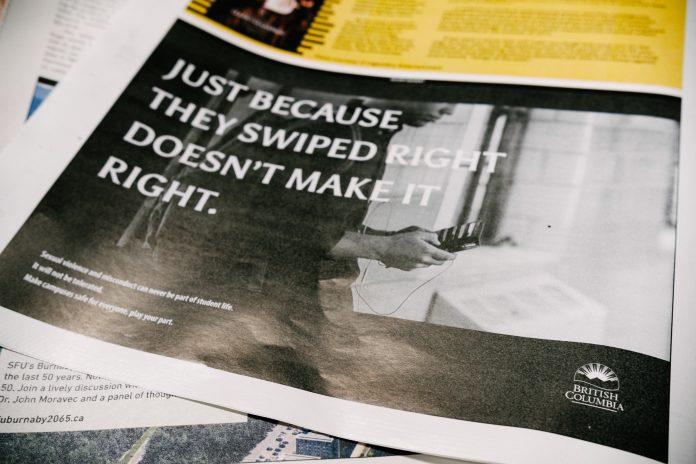
A new campaign launched by the provincial government aims to address sexual violence and misconduct in post-secondary institutions. The campaign is based largely on social media and via posters which focus on male students while highlighting the message that “sexual violence and misconduct can never be part of student life.”

According to statistics prepared by the government, one in every five women will face sexual violence while attending a post-secondary institution. The new campaign includes all 25 universities and colleges in the province.

“Student life should never include any type of sexualized violence or misconduct,” said advance education minister Melanie Mark to Global News.

We know that roughly two-thirds of sexual assaults on campus occur during the first eight weeks of school.” – Melanie Mark, advance education minister

On Aug 17, SFU’s Sexual Violence Support and Prevention Office (SVSPO) was contacted by Mark announcing the launch of the campaign. The campaign will take effect between August 27 and October 22, covering the first eight weeks of the present school year.

The campaign will involve dissemination of information through posters in student newspapers (including The Peak), around public spaces in campus, and in local bars. Social media channels like Facebook and Instagram are being used as promotional platforms as well.

CJ Rowe, director of SFU SVSPO, told The Peak that, as of September 11, they are still awaiting more material on the campaign from the provincial government. Once they receive the information required, the SVSPO will integrate elements of the campaign with their own support and services and publicize across all three SFU campuses. Additionally, the SVSPO will also begin its own “consent matters” campaign at the end of September, which will complement the government initiative.

Rowe mentioned to The Peak that they appreciated the new campaign efforts of the provincial government as one part of a larger frame of work that is required to tackle the issue. However, Rowe also stated, “When I look at the campaign it appears very student-focussed. But in reality sexual violence impacts us all.

“So my question to the government would be, is the campaign to remain solely student-focussed, or will it in the future recognize the reality of sexual violence on campuses, that is that it impacts all members of the campuses who live, work and study here?”

Information from the campaign has already appeared in The Peak in its September 4 issue.

Currently all universities and colleges in B.C. are legally required to put up policies on sexual assault.

The B.C. government has reportedly changed its policy on campus-based sexualized violence, and has dedicated five years funding of $5.5 million to tackle the issue. The provincial government aims to strengthen the backing for sexual assault crisis centres in post-secondary institutes and lead to a policy framework for the whole country based around the issue.

In a statement on sexual violence prevention and response policies, published in December, Mark had emphasized that “safety and security on post-secondary campuses is an important issue. We cannot be bystanders. Any form of sexual violence or misconduct simply will not be tolerated.”


With files from Global News.

Sports clubs spotted at clubs day

0
A minimalistic illustration. A few lines and colours are draped from the top of the image, reminiscent of ropes of flags. The center of the photo reads: “Simon Fraser Student Society” and “Clubs Days”
What better way to find people with similar interests to you? Illustration courtesy of the SFSS

By: Amal Abdullah

SFU Cricket Club

SFU Cricket Club is a non-professional team sports interest club under the SFSS. They have four main objectives:

  1. Learning. Cricket isn’t a popular sport in North America, and the club focuses on allowing people to learn more about the game.
  2. Discussion. Cricket enthusiasts come together to discuss teams, players, and matches around the world.
  3. Watching games together. The club has events with livestreaming of cricket games and free food.
  4. Play. Club members come together to play cricket together. They aren’t allowed to support hardcore play, so they play with a soft ball instead of a leather ball.

Essentially, the club is a means for socialization, and they center cricket as an integral part of that.

SFSS Club Link: https://go.sfss.ca/clubs/789/info

Facebook: https://www.facebook.com/sfucricket/

Contact: [email protected]

SFU Badminton

A badminton team for all levels of expertise. They compete against other schools, but it’s a friendly environment, and anyone is welcome to join.

SFU Link: http://www.sfu.ca/students/recreation/active/sports/clubs/clubs/badminton.html

Facebook: https://www.facebook.com/sfuBadmintonclub/
Contact: b[email protected]

SFU Hip Hop

SFU HipHop club aims to educate its members about HipHop dance culture and everything that comes with it, from breakdancing to house. It offers students a way to meet new people with a love for the genre, and have fun while learning new skills.

SFSS Link: https://go.sfss.ca/clubs/286/info

Facebook: http://www.facebook.com/sfuhiphop/

Contact: [email protected]

SFU Ping Pong

SFU Ping Pong is an SFSS club that has events at different venues in Metro Vancouver, including the Greater Vancouver Tennis Association. They welcome people with different skill capacities, and they’re happy for more members to join the club.

SFSS Link: https://go.sfss.ca/clubs/502/info

Facebook: http://www.facebook.com/groups/pingpongsocialSFU/

Contact: [email protected]

SFU Field Hockey

SFU Field Hockey is a women’s team that plays in the Greater Vancouver Women’s League in Division 2. They have also partnered with Burnaby Bears, a club that has youth program with whom they volunteer, and a women’s team with whom they practice.

SFU Link: https://www.sfu.ca/students/recreation/active/sports/clubs/clubs/fieldhockey.html

Contact: [email protected]

SFU Quidditch

Quidditch is a growing collegiate sport, and one that allows students to make new friends while competing. We will be running an in depth story on them this week.

SFU Link: http://www.sfu.ca/students/recreation/active/sports/clubs/clubs/quidditch.html

Club website: http://quidditchsfu.wixsite.com/marauders

Contact: [email protected]

SFU Athletics Dance Team

SFU Athletics Dance Team is a team that trains in street jazz, contemporary, and other genres of dance. They perform at games at SFU (four times a game). While dance experience on the team varies, they’re looking for dancers willing to commit and learn. A new program they’ve started is the Training Team, an option for members who want a more relaxed dance opportunity. Auditions for the competitive team are once a year, but anyone is able to join the training team for a fee of $20.

SFU Link: http://www.sfu.ca/students/recreation/active/sports/clubs/clubs/dance.html

Facebook: https://www.facebook.com/sfuathleticsdanceteam/

Bonus Clubs:

SFU Board Game Club

A friendly, casual board game club that specializes in lighter social games and promotes companionship. SFU Board Game Club is here to have fun and make friends.

SFSS Club Link: http://sfssgo.net/clubs/75/info

Contact: [email protected]

SFU Altered Reality

Club members meet up, play board games, and run Dungeons and Dragons campaigns. They have meetings Tuesdays and Thursdays in the Rotunda, which run all day. People drop in and out all day long, play some board games, and have fun.

SFSS Club Link: https://go.sfss.ca/clubs/56/info

Facebook: https://www.facebook.com/groups/39506421514/

Twitter: https://twitter.com/sfuarc

Contact: [email protected]

Comedic Poetry: When I Have Fears that I May Cease to Drink

0
Illustrated by Cora Fu

Written by: Larissa Melville

It’s a long way home from here. But I tread

o’er the widesalk, arm linked with a stranger’s

and a light, bubbly air about the head.

I’m a little slort of sheep, but danger

disappears and up like a listless dream.

Metal bracelets chime; a voice like a bell,

but my mind drifts; I know not what it means.

I’m under a lovely blue and red spell.

What’s this? Do I know my rights? I’m confused

since I’ve studied law for seven years,

then I think I puke on the stranger’s shoes,

and his stern, mustachioed face appears.

          Then, we drive in quiet to the precinct,

          ‘till drink and shame to nothingness do sink.

What If: Office hours suddenly disappeared

0
Photo by Leon Sankathumar / The John Hopkins News-Letter

Written by: Gene Cole, Opinions Editor

Right out the gate, this would clear up a bunch of time out of our semester. We would no longer need to spend a large chunk of the first lecture specifying times and places for something that relatively few people will go to (to the point that many lecturers and TAs joke about the lack of people who come to see them).

For the students who need them though, it would become their responsibility to organize appointments. But as the main users of office hours are students in need of extra attention, or top students trying to improve further, this slight additional effort is probably reasonable.

That shift aside, the sudden disappearance of office hours likely would have different effects on professors than on TAs. The profs’ lives would be very pleasantly simplifed. Few students use office hours, and the utility the timeslot can provide is limited as it is. Most often, an email is enough for little questions, and larger questions can be asked during, after, and before their lecture.

TAs’ jobs might become significantly more difficult, though. Rather than having consistent schedules, they would be need to spread themselves out through the entire week regardless of how many students need to see them. If very few do, they still need to be on-call for all of this dead space. If students constantly need attention, they may be doing office hours every day of the week.

The sudden disappearance of office hours would certainly make things easier in a lot of respects, but not all parties would likely benefit. This fantasy is likely just more difficult and less effective than what we have now.

Funding uncertain for SFU’s Academic Summer Camp for Aboriginal Students

0
Earlier this summer, it was announced that the summer camp would be discontinued due to lack of funding. (Israrul Haque/The Peak)

Written by: Amneet Mann, News Editor


Updated September 21, 2018: Dr. Veselin Jungic has reached out to The Peak to indicate that the paraphrase at the end of this article which indicated that “he is convinced the camp’s future on this campus will be secured” was inaccurate. The article has been edited to reflect his quote more accurately.  


After running for five consecutive years, concerns regarding the potential discontinuation of SFU’s Academic Summer Camp for Aboriginal Students were raised due to uncertain funding.

The camp has been held annually on the SFU Burnaby campus after being co-founded by the Pacific Institute for Mathematical Sciences (PIMS) and Dr. Veselin Jungic.

At the time that the SFU camp was founded, PIMS was running a similar initiative at UBC. The UBC camp was discontinued following the summer of 2014.

The SFU camp provides advanced mathematics and English support to Indigenous students in grades nine through 11. It is estimated that the camp has had over 125 participants, and according to Jungic in an email interview, “over the five years all students that were accepted to the camp also completed the program.”

“In general, I am very proud with what we have achieved with the camp over the last five years,” wrote Jungic. “For certain we have touched many lives in positive ways [. . .] I believe that by hosting such a camp, Simon Fraser University strengthened its relationship with the Indigenous community.”

Earlier this summer, Jungic announced that the camp would no longer continue in subsequent years due to lack of funding.

Jungic had originally received funding support for the camp from a PromoScience grant from the National Sciences and Engineering Research Council (NSERC) which would help fund the camp from 2014–17. Additional funding and support for the initiative was provided by the SFU Office for Aboriginal Peoples, SFU Faculty of Science, SFU Department of Mathematics, PIMS, and the IRMACs Centre.  

The camp was hosted in SFU’s IRMACs Centre, which has since been shut down. The Peak reached out to Felix Breden, former executive director of the centre,  regarding the situation surrounding the centre’s closure, but did not receive a response by the publication date of this article.

Jungic also identified that key support and funding from SFU’s Office for Aboriginal Peoples was missing.

In an interview with The Peak, Ron Johnston, pro-tem director for the Office for Aboriginal Peoples at SFU, stated that the Office for Aboriginal Peoples did not have a dedicated budget line to fund the camp. In previous years, funding from the office was provided from resources that were left over at year-end in the form of “soft” funding.

“I think that’s probably one of the big challenges with the Aboriginal programs in general is there’s often soft funding and there’s not core funding provided through it.” – Ron Johnston,  pro-tem direction for Office for Aboriginal Peoples

Johnston referred to the Walk With Us Report, written by SFU’s Aboriginal Reconciliation Council (ARC): “One of the things that the ARC has recognized is that soft funding isn’t sustainable funding. This is an example of where something was being soft funded.”  

Principle three in the report’s calls to actions states that “SFU needs to find ways to establish core funding for programs or services that have been funded using ‘soft’ or discretionary funds.”

Johnston maintained that the office may have funding remaining at the end of the fiscal year that could be contributed to the continuation of the camp, but that the office was unable to commit to that contribution at the moment.

When The Peak reached out for comment from SFU’s vice-president academic Peter Keller regarding the camp’s discontinuation, Keller stated that he was not aware that the camp was being discontinued.

“Over the years, it’s always been the challenge of somehow clobbering together enough money to run [the camp],” said Keller. “I know that, once again, we are looking for ways to clobber the money together [. . .] I’m working with the community to see how we can continue to fund it.”

“As far as I’m concerned, no decision has been made,” commented Keller.

The Peak reached out to Mary-Catherine Kropinski, chair of SFU’s Department of Mathematics, for comment on the summer camp’s closure. Kropinski indicated that the announcement of the camp’s closing was premature.

“I’m hopeful that something can be arranged to ensure the camp’s continuation,” she wrote.

Jungic has since changed his official comment on the situation of the camp’s discontinuation, stating that he is “convinced that Drs. Keller and Kropinski will do everything what is in their power to secure the continuation of the camp.”