Home Blog Page 565

SFU student wins Nora and Ted Sterling Prize for work on fat activism

0
(Photo courtesy of Layla Cameron)

Layla Cameron, a journalist, fat-stigma activist, filmmaker, and PhD student at SFU is this year’s recipient of the Nora and Ted Sterling Prize in Support of Controversy. She is being awarded for her work on body size and image issues.

Cameron’s doctoral research is in the field of “fat studies,” whereby she is researching and analyzing the representation of fat bodies in reality TV. She is currently internationally touring the first film she has produced, a documentary called “Fat Hiking Club.” The documentary is focussed on the work of the Portland, Oregon based organization Fat Girls Hiking that strives to “make the outdoors accessible for everybody and every body.”

Cameron told The Peak that she believes she has always been involved in some type of fat activism since her childhood. “I have been fat my whole life. And when you experience any kind of discrimination, there is an incentive to understand it and to resist it,” she said.

With the help of her parents who bought her feminist magazines to read from a very early age and because of her innate nature of being “very political,” Cameron found her way to fat activism and subsequently to fat studies.

To describe the various layers of fat activism, Cameron referred to fat studies scholar Charlotte Cooper’s categorization of fat activism in categories such as the political process, micro-activism, ambiguous, cultural and community-building activism.

Out of the different forms, Cameron stated her appreciation for the micro-level activism process, whereby you can have a one-on-one conversation about the issue with people such as your peers, your doctor, and so on.

She also expressed appreciation for the ambiguous fat activism, which can involve ensuring that there is fat-friendly seating in your house or abstaining from dieting. “Even the act of not doing something can be a form of activism,” said Cameron.

An interesting part of fat activism for Cameron, in comparison to other forms of activism, is that it makes a lot of space for people to make contributions to the extent that they are able. Cameron explained that if someone is disabled and cannot attend a protest march, they can always find other equally appreciated and valid ways to participate in fat activism.

Moving forward from formal definition and categorizations, Cameron explained to The Peak the issues that fat activists work with, specifically focussing on obesity.

Cameron described how we have constructed “fatness as an epidemic today, that is called obesity.” This has made it easy for international health organizations, like the World Health Organization, to declare “obesity as an epidemic despite it not meeting the requirement to be called an epidemic or contagious disease.”

She described how being obese and obesity are usually treated as synonymous to being fat, and that a fat activist would reject that. “Obese is a medicalized term for fatness, that pathologizes fat bodies, and renders them as having some kind of a disease,” stated Cameron.

While in some worlds being fat and being obese would overlap, but in the fat activist world, the term “obesity” is just medical jargon.

“Even if fatness is ‘unhealthy,’ or threatens your livelihood in some shape, way or form, that does not justify the discrimination and oppression that fat people face everyday.” – Layla Cameron, SFU doctoral student

She stressed that a fat activist would tell you that “even if fatness is ‘unhealthy,’ or threatens one’s livelihood in some shape, way or form, that does not justify the discrimination and oppression that fat people face everyday.”

The different kinds of institutional and systemic discrimination against fat bodies include the medical, the social, and the personal. She pointed out that there is a widespread lack of structural accommodation for fat bodies such as a lack of big enough seats in lecture halls and on buses and airplanes, arbitrary weight restrictions on kayak rentals, and limited sizes of life jackets. All these factors together make public spaces inaccessible for fat people.

With her documentary and research, Cameron strives to shine light on organizations like Fat Girls Hiking that attempt to counter these discriminations and fat stigma. These organizations try to make the world more accessible for different kinds of bodies, described Cameron.

Cameron also described the backlash she received for her activism and research, and how it has been usually directed at her body and appearance, rather than at the content of her work.

She stressed that that even though the situation is changing today, there is much work to be done, and it is important to have more conversation on these issues and be open to those conversations.


With files from The Vancouver Sun.
 

Student group condemns SFSS for “institutionalized racism”

3
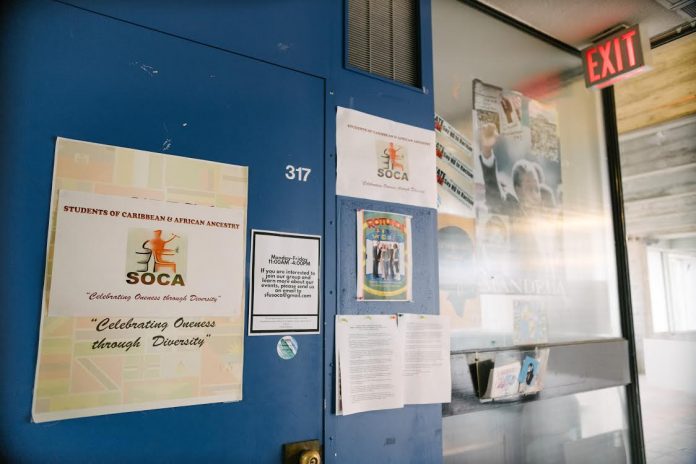
In the public letter, SOCA calls on SFU to intervene in their space negotiations with the SFSS. (Chris Ho/The Peak)


SFU Students of Caribbean and African Ancestry (SOCA) has published public letters on their Facebook page condemning the Simon Fraser Student Society (SFSS) for their treatment of marginalized groups on campus.


SOCA addresses the SFSS

In their public letter to the SFSS, SOCA noted that the student society’s conduct during negotiations regarding space for SOCA in the Student Union Building (SUB) “is a prime example of the SFSS using the power it has to suppress groups that the SFSS is supposed to work in alliance with.” According to SOCA, the SFSS has currently postponed meetings with the student group, failed to communicate clearly, and acted in “bad faith” during these negotiations.

Concerns regarding space allocation in the SUB by the SFSS have been previously brought forward by independent student groups in late 2017 and earlier this year.

SOCA has written that their experiences with the SFSS can be traced to “a lack of cultural and racial sensitivity training [within the SFSS] in dealing with marginalized people and marginalized groups.”

SOCA also raised concerns regarding the extent to which SFSS CEO Martin Wyant allegedly controls the SFSS’s space allocation decisions, writing, “we have become increasingly concerned with how operations are controlled by the CEO within the SFSS. Especially when those operations affect marginalized students.”

“There is a pattern with the lack of communication and an overall shredding of the relationships that SFSS has had with many groups including SOCA over the last three years,” added SOCA in their letter. “We wish the conscience of well-meaning board-members to hold itself to account [ . . . ]  and realize that it’s the students who are in charge and you can make the hard decisions to fix these systemic issues.”

“On these posts by SOCA, the board as a whole acknowledges the tough spot we find ourselves in and can assure their community of groups that reside within the Rotunda that we are currently in the process of working with them to set up a place and time to work out some issues that SOCA themselves have mentioned,” wrote vice-president student services Samer Rihani.

Rihani added that, as an opening date for the SUB had recently been set, the SFSS board of directors was willing to continue talks with SOCA about extending their sublease in the rotunda beyond December 14, 2018.


SOCA addresses SFU

In a more recent public letter to the SFU administration, SOCA called on the university to “publicly support SOCA in our fight to retain a space on campus.”

SOCA requested that SFU be present in future negotiations regarding space SOCA holds with the SFSS, and that Wyant be excluded from future meetings.

“[Martin Wyant] has caused emotional distress; used marginalized groups as scapegoats and has eroded trust in the SFSS’s intentions due to his lack of empathy in dealings with us,” wrote SOCA.

In an email interview with The Peak, SOCA president Giovanni Hosang mentioned specific interactions with Wyant which turned space negotiations into an “unpleasant experience” for the organization.

Hosang mentioned an instance during a meeting with Wyant about why SOCA felt the organization played an important role on campus and deserved space. SOCA’s executive team was making reference to recommendations made by the United Nations and the Canadian government regarding anti-black racism. The recommendations “implore public institutions to address anti-black racism and create specific pathways for supporting people of African Descent,” wrote Hosang.

According to Hosang, Wyant responded by indicating that the recommendations made by the United Nations were not applicable to the SUB space negotiations between the SFSS and SOCA.

Hosang wrote that in another instance, Wyant suggested that one of the reasons the SFSS was unable to provide space for SOCA was because it is common for many groups to seek space with the claims that they are marginalized.

The Peak reached out to Wyant via email for comment on the above instances alleged by SOCA, but did not receive a response by the publication date of this article.


“These interactions and the actions of the SFSS evicting a black student group [. . .] is a textbook example of institutionalized racism against communities of colour where new developments render the most marginalized groups homeless.” – SOCA executive team in public letter to SFU administrators

“I am concerned to hear the allegations,” commented SFU vice-provost students and international Tim Rahilly. “The university wants to make sure that people who identify as racialized or equity-seeking groups feel that they belong at the university and the university supports them as individuals,” he added.

Rahilly commented that the university is unable to intervene in the negotiations between the SFSS and SOCA as the SFSS is an independent student society. “Individual students at the university are members of the SFSS. And it’s their society. [ . . . ] The university has no control over the actions [of the society]. It’s really the board of the SFSS that is really responsible.”

Rahilly noted that, if both the SFSS and SOCA were willing to resume communication, the university would be willing to “help move this dialogue forward and try to find a resolution that works for the SFSS and for SOCA.”

“But we can’t wave a magic wand unfortunately,” said Rahilly.


SOCA addresses SFU students

In a third Facebook post addressed to SFU students, SOCA has called on students to help raise awareness for their situation through social media using the hashtags #SAVESOCA and #BLACKSPACESMATTER.

SOCA has invited SFU students to sign a petition on change.org advocating against SOCA’s eviction from the Rotunda on December 14 and urging the SFSS to provide SUB space for the student organization.

Hosang has commented to Global News that “if [SOCA] doesn’t get a space by [December 14], there will be a sit-in.”

The student organization has been occupying space in the rotunda since 1997.


With files from Global News and CTV News.

Hike in SFU Burnaby campus parking prices

0
Increased parking rates in North Lot are aimed at creating more available parking spaces on Burnaby campus. (Israrul Haque/The Peak)


Hourly and daily parking in SFU Burnaby’s North Lot and parking tickets have increased in price due to amendments to the university policy on Parking, Mobility, and Vehicle Traffic. The amendments were approved by the SFU board of governors on June 28.

The policy, which came into effect on September 1, varies the previously fixed hourly rate of $3.25 and daily rate of $13 which applied to all parking lots. Under this new policy, the North Lot will see a higher hourly rate of $5 as well as a higher daily rate of $25.

The hourly and daily rates in the other lots, such as the West Parkade and East Lot, will be maintaining their previous rates of $3.25 and $13, respectively.

These varying rates between parking lots on campus are meant to help manage parking supply and demand. According to SFU Communications and Marketing, these changes are meant “to help reduce parking congestion across the Burnaby Campus.”

Parking ticket prices are also being increased from $30 to $50. Any vehicle that has an unpaid ticket will be subjected to impound, while the student account associated with that vehicle can be placed on hold.

Additionally, SFU Communications and Marketing has announced that there is a new Residence West Lot where the all-day parking rate is fixed at $6.50, if the vehicle is parked before 10 a.m.

These changes are not to affect faculty and staff of the University who have monthly parking permits or who have bought “parking scrips.”

SFU Sports Analytics Club runs VanSash, a hackathon for students and by students

0
This will be the second year running VanSash for the SFU Sports Analytics Club. (Photo courtesy of VanSash)

The SFU Sports Analytics Club has been involved in many exciting projects in the past, working with professional organizations such as the Vancouver Whitecaps, the Vancouver Canucks, and Canada Basketball. What may be most impressive, however, is the club’s initiative to create their own sports analytics conference for other students in Vancouver. The second instalment of “VanSash” is set to kickoff in Vancouver this weekend, connecting students to the sports analytics industry.

We sat down with SFU Sports Analytics Club co-president Dani Chu to discuss this event. Read below for more!  

The Peak: So for people that don’t know, what is VanSash?

Dani Chu: VanSASH is the Vancouver Sports Analytics Symposium and Hackathon.  It’s an event organized by SFU students to give other students the opportunity to experience and learn about the sports analytics industry, and to give them the opportunity to get a foot in the door and put their talent on display. The event is taking place on Saturday, September 22, 2018 at the SFU Harbour Centre Campus and is free of charge to attend for accepted students.

P: How did this event come to be originally?

DC: The event originated in February, 2016 when two of my classmates and I were complaining that there were no student focused events for sports analytics on the West Coast. Inspired by our participation in the 2016 NBA Hackathon and the Dr. Tim Swartz and Dr. Luke Bornn’s 2016 Cascadia Symposium on Statistics in Sports (CASSIS) we organized the first edition of VanSASH in 2017. We wanted to make it accessible to all and so there is absolutely no entry fee.

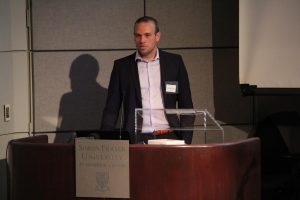
Josh Weissbock of the Florida Panthers explaining the challenges and strategies of working with qualitative scouts as an quantative analyst last year. (Photo courtesy of VanSash)

P: How did it go in your first year doing it, what did you learn from that?

DC: Our event was very well received in its first year. We had a great group of speakers from diverse areas of sports analytics. We had speakers from Academia take a look at sports through a statistical and a physiological lens and speakers from the Industry share their experiences. After a morning of speakers the participants had a day and a half to come up with data driven recommendations for the Vancouver Canucks and Vancouver Whitecaps. We learned a lot about how to run the day smoother and have made changes to narrow the focus of the event in order to give our participants the best opportunity to create an awesome project. Additionally, we learned about what food to order and not to order so our food selection will see a great improvement this year.

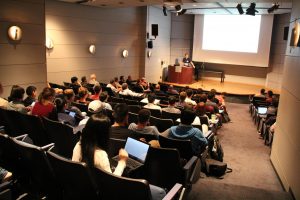
VanSASH participants look on at the Symposium last year. (Photo courtesy of VanSash)

P: What will the event look like this year?

DC: We are working just with the Vancouver Whitecaps this year and will not have the morning of speakers like last year. We feel like this will give our participants the time and energy to focus on their projects.

This focus has enabled us to broaden our base as well. So we have two big additions to VanSASH this year. The first is a Business Analytics Stream. We have been granted exclusive access to Vancouver Whitecaps sales and ticketing data, and have some very creative and interesting problems to tackle with it. This has made the event more accessible to students who are interested in learning how to make data driven decisions.

The second addition is that we have opened up beginner divisions within both streams. We have done this with the hope that not only are we giving students a platform to show their talent but also giving newer students an opportunity to learn new skills. We will be providing workshops for the beginner divisions taught by talented mentors from companies like EA, Cardinal Path, Flipboard, Keela, Dialpad, and SFU. Additionally, we have many high profile judges coming from SFU, Best Buy, the Whitecaps and even Major League Soccer (MLS).

Finally, the Whitecaps are offering a discounted rate for tickets to their game on Sunday, September 23 so our participants can hopefully continue to build the relationships they started at VanSASH.

P: How was any of this possible? Who helped you put this event together?

DC: First and foremost I have to mention our organizing committee. Lucas Wu, Matthew Reyers and Kristen Bystrom from the Department of Statistics, Eli Mizelman from the Department of Biomedical Physiology and Kinesiology and Andrew Ringer from the Department of Communications.

Second, I have to give a big thank you to our sponsors, the Vancouver Whitecaps FC who provided their exclusive data and prizes. Additionally, the Canadian Statistics Sciences Institute, Simon Fraser Student Society, Statistical Society of Canada, SFU Faculty of Science, SFU Department of Statistics and Actuarial Science, Statistics and Actuarial Science Student Association, and Sticker Mule, who are graciously providing us financial support, giving us the ability to provide our participants with better food than last year’s cheese pizza.

P: How did you gain the connection with the Vancouver Whitecaps?

DC: Our club’s relationship with the Vancouver Whitecaps started with Dr. Tim Swartz, a mentor and co-founder of our club, who had a relationship with the Caps. Dr. Tim Swartz is part of the Sport Analytics Group of professors at SFU and he organized research projects with his summer research students and the Caps. Additionally the students in the club have the unique opportunity where we help their scouting department film home games.

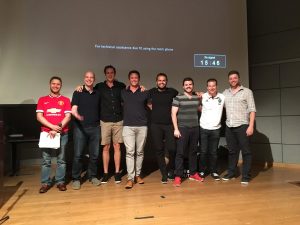
Last years winners of “Best Whitecaps Analysis”. (Photo courtesy of VanSash)

P: What can you say about the group of people who have registered for the event?

DC: We have a fantastic group of skilled participants who have applied and been accepted to the event. Some of the top sports researchers at SFU have teamed up to tackle soccer problems and across the board I see students with great technical skills, a passion for data, and an appreciation for the soft skills it takes to have your analysis make an impact.

P: What is the main goal for VanSash?

DC: The main goal for VanSASH is to give students the opportunity to be exposed to the sports analytics industry. Whether that’s getting access to exclusive data and presenting their analysis or learning tools and skills to be able to handle large data sets. It’s all about giving students a stage to perform.

P: What do you think about the sports analytics industry as a whole?

DC: I think it’s in a really great place right now and it’s only going to get better. You see more and more great public work being done and presented at Conferences across North America. We see reproducible research is on the rise within sports analytics and there has been a major push for more public data which will only make research better (to be specific I should shout out Ron Yurko and the Carnegie Mellon Sports Analytics Conference). Finally more and more top sports researchers are being hired by sports teams or by the leagues themselves.

P: Is there still room for people to join and how can they go about doing that?

DC: We are sold out of both Soccer Analytics Streams, but, we are still accepting applications for the limited spots that are available in the Business Streams. Students can apply through our website at www.vansash.com or at this link https://goo.gl/forms/MoUTmWYCFVJ9Jlv22. Additionally, if students cannot make this event in particular there many more opportunities to get involved with sports analytics at SFU. They can join the Student Club, or join our Sport Analytics Group journal club.

Editors Note: Andrew Ringer is a member of the SFU Sports Analytics Club and is a part of the VanSash team.

Majors in a minute: World Literature

0
Illustrated by Cora Fu

Can’t decide on a major? Been in uni for two years too long and still cycling through departments? Just can’t seem to pass that last PHIL 400 course? Have no fear — world literature is the major for you.

To list a few, here are some of the perks you’ll be looking forward to:

  1. Think you know how to close-read? Think again. In your first course, you’ll learn how to read so closely the grease on your nose will make patterns on your overpriced bookstore-bought copy of some-random-book-you’ll-never-read-again. When you finish the course, you’ll start to overanalyze everything without being aware of it — from that new Christopher Nolan film to your distant and disillusioned relationship. You’ll get so good at making arguments and theses on the spot that you’ll start making them out of nothing.
  2. If you’re a hoarder of books, then this is the major for you. You’ll end up sending thank-you letters to Amazon Prime and various websites that offer free PDF downloads of that impossibly-hard-to-find-18th-century-novel for saving your ass. That, or you try to cruise through the semester pretending like you have read three out of the six assigned novels. Ever heard the Japanese term “tsundoku”? It means to buy books and let them pile up unread. Accept it early — this is what you will become.
  3. You’ll start hoarding theories, too. Forget trying to remember all the pop culture you used to love, because all of your brain space is going to be filled with philosophers and theorists. You firmly believe in your capability to regurgitate their ideas, and you try to, except they somehow emerge from you phrased in the vocabulary of a fifth-grader. And even then, people still don’t understand what you’re getting at.
  4. You’ll have Dr. Deggan for at least one course per semester for four years. You’ll start speaking like him, and writing like him. Hell, maybe you’ll even dress like him. Your social life will slowly become performative, and your friends will start asking why you’re talking to them as if you’re playing a major role in a play. Oh, and get over your fear of public speaking, fast — seriously. Or tape your shaking hands to the podium. Because it’s all about presentations over here.
  5. Lastly, along with all these benefits, you’ll get the pleasure of working in close-knit settings with about 10 of the same people in each course per semester. Get ready to know the names that attach to those faces, because you’ll see them again and again (and don’t get caught being the one saying “Hey . . . you!”). Anyway, there isn’t anything better than having such an entertaining major — and as a bonus, having the same people to laugh about it with, too.

You need to pay attention to the SFSS, even when it’s “boring”

0
Photo by Chris Ho / The Peak

If you’ve been anywhere near The Peak, SFU Dank Memes Gang, or any other SFU-related online community, you probably know that the SFSS board of directors has recommended the impeachment President Jas Randhawa. A motion to impeach will be placed on the agenda of the upcoming annual general meeting (September 24), and Randhawa has been very clear that he will not be resigning or otherwise leaving his position as president in any other way, despite the complicated dynamic currently festering within the SFSS.

The news has already made huge waves. Even before The Peak was in any position to responsibly report on the developing situation, a “BREAKING NEWS” post on Facebook garnered eight shares, 21 comments, and over 100 likes. Other posts about the impeachment process and internal conflicts of the SFSS have also been popular, and people have had plenty to say in the comments. So clearly, undergraduate students are interested in this society that they “own.”

Here’s my question though: have you or anybody you know ever gone to an SFSS board meeting? They’re all public, with the exception that parts are just held in-camera for a various reasons. Do you even know how to find where and when board meetings are held? Honestly, I didn’t for a long time, and neither do many SFU students. While I don’t think anybody outside the SFSS knew just how bad a state the board is in, the fact that it’s not all rainbows and unicorns isn’t new.

Take Fall Kickoff, a cancelled event that also got undergrads upset — so much so that an online petition to save the concert was created. The Peak published a story about the cancellation on July 18, but on July 10 a Board Shorts recounting highlights from the SFSS board meetings noted that the SFSS was already struggling to find an appropriate date for the event, and didn’t even motion a budget for it. If students actually kept an eye on the board and its activities and meetings and plans, could they have known that Fall Kickoff was on the line before it was off the table? And isn’t knowing what’s going on on campus the first step of steering it into the direction you want to see it go to?

Another example: if you look at the comments on one of the most recent Facebook posts about the whole impeachment debacle (“Physical assault allegation made against SFSS President”), you’ll see students posting videos taken of members in the SFSS office, including two of the directors roughhousing. That is in no way appropriate workplace behaviour, but in the moment it was okay to be videotaped, and deemed acceptable. Why?

Because nobody gave an apparent, singular fuck about what the SFSS was doing. Nobody dropped by the board office, and nobody was keeping in touch. It’s only now that things have gone all cattywampus and people are watching that these videos are coming up as ammo to fuel one side of the argument, when really, this looks bad on everybody.

A 2011 Maclean’s piece makes a point I quite like: “When it comes to politics, boring is better.” Sure, we’re talking about student government right now, but the principle still holds. And yes, you should still care, even if it’s “just student government,” because according to their operating budget for the 12-month period ending April 19, the SFSS’ total expenditures is $2,692,767. That’s a lot of money — around of $750 from each full-time student if you look at their fees (excluding money they collect on behalf of other on-campus student societies). It goes to super useful things like the U-Pass and the Health and Dental Plan, and I’m not saying that the SFSS has no use or place on campus. But with that much of your money invested into the SFSS, don’t you want to keep tabs on how it’s being used?

Boring means that everything is running smoothly and efficiently. Think of a building when a fire alarm goes off: the noise is loud, everybody is moving, and there’s a lot of excitement and things to look at. But your building is still on fire. Wouldn’t it have been great if you’d kept an eye on it to make sure a four-year-old hadn’t accessed the matches by the door? It’s not quite as exciting, but in the long-run you’ve definitely won this scenario.  

Well, for this board, it’s a bit too late. All the matches have been struck and everything is on fire. It’s good that we’re paying attention now, but it should translate into students showing up at the AGM ready to vote — and to keep their eyes on the SFSS after the impeachment sinks or swims.

The Black Excellence in Blackkklansman

0


Editor’s note: Spoilers included!

If a film has the ability to exceed the methodical expiry date of trend-propelled plots, then chances are, its value in society is imperative.

      Blackkklansman, directed by Spike Lee and produced by Jordan Peele, is the story of an African-American undercover cop who fakes his identity as a white supremacist to infiltrate the KKK. From this plot alone, Blackkklansman is one of the most incredible and thought-provoking autobiographical stories in cinematic history.

     The film begins with Ron Stallworth (John David Washington) being interviewed for a position on the Colorado Springs Police Department. Initially, Stallworth is warned that if he were to become the first Black policeman in Colorado, he would experience a tremendous amount of racism. After being hired, this warning comes to fruition as Stallworth experiences a substantial amount of implicit and explicit racism, even from those on his own force.

      By far, what serves as the most exciting element of Blackkklansman is Stallworth’s courage, particularly in his effort to dismantle the KKK from the inside. With the help of his partner, Flip Zimmerman (Adam Driver), Stallworth uses a concocted identity to ascertain the plans of the KKK by attending each meeting and function. On a number of occasions, Stallworth and Zimmerman’s façade is almost found out, stealing the breath of audience members each time. However, with Stallworth’s name and Zimmerman’s face, the protagonists of the story manage to fool the group of terrorists long enough that the KKK’s plans of death and destruction are foiled.  

      The most intriguing aspect of Blackkklansman, however, is its relevance to today’s political climate. Although Lee’s film takes place in the 1970s, much of the social and systemic debacle present in the film is mirrored in real life today, most notably in Trump’s presidency.

      For instance, former grand wizard of the KKK, David Duke (Topher Grace), tells Stallworth in their correspondences that he plans to transfer his views on terrorism, supremacy, and racism into the world of politics. Now, four decades later, the real-life David Duke has proudly cemented himself as an avid fan and supporter of Donald Trump, tweeting things like, “Today Trump is a Hero! Trump is no Jesus but they hate him as much!!!!!!”.

     In addition to being an entertaining movie, this film intelligently exposes to audiences the deep history of America’s racist structures, and how they exists both in the criminal justice and political system. This is especially exemplified at the end of the movie, as Lee completed the film with footage of the chaos white supremacists enacted within Charlottesville in the summer of 2017.

     If you want a movie that will make you laugh and keep you on the edge of your seat, then Blackkklansman is the perfect choice for you. However, when watching the film, be sure to critically observe not only how racism and white supremacy operates, but also how these agents aren’t merely “things of the past.”

Band versus Band: SALES vs No Vacation

0


Stepping out of the heavy summer air and into the cool, dim red glow of the Biltmore, your eyes are drawn immediately to the far side of the room. You pass over a ragged Persian carpet as you make your way through a small crowd of people. The stage is a little cramped but inviting, lit in a soft blue and framed by the fairy lights that line the walls of the cabaret. As the bands step onto the stage, a quiet atmosphere falls upon the venue, and the intimacy of the show becomes apparent.

From humble two-piece dorm room beginnings to indie/bedroom-pop staples, female fronted SALES and No Vacation both offer smooth, contemporary blends of intricate guitar riffs, with airy, wistful vocals, and laid back drum tracks. While there are some obvious differences in each band’s respective musical style, both convey a warm, almost melancholic emotion in their music. This was made apparent by the thoughtful sentiments collectively expressed by the crowd at their show at the Biltmore Cabaret.

No Vacation

No Vacation wove together upbeat and intricate melodies, with soft vocals and reverb heavy guitar. They created a paradoxical collage of calmness and erraticism that left listeners in a dreamy trance. After a year-long hiatus preceding their most recent EP, Intermission (2017), the band hasn’t missed a beat. No Vacation wasn’t afraid to pull from their older repertoire, and kicked off the show with an adaptation of their 2015 release, “Lovefool.” Even though the band hails from New York, and this stood as their first show in Vancouver, No Vacation provided a great set list, a polished sound, and lots of interaction with fans which made their concert a show to remember.

SALES

As the opener packed up, more and more people began to pour into the venue — it became apparent which band the majority of fans came to see. Playing an entire set with only a three-piece band, SALES stayed true to their minimalist musical style. The result was an extremely clean sound. The light, repetitive melodic guitar patterns used so frequently in their music hung in the air like a mellifluous mist, while the usual crisp and jagged programmed drums heard on their studio album translated perfectly to a live drum set. Although the crowded venue made the set slightly less intimate, the enthusiasm shown by the fans more than made up for it.

The Verdict

A relatively even musical performance from both bands makes it difficult to distinguish clear winner between them. However, given the rich and refined sound they managed to pull from simplicity, I would give the edge to SALES. Their experience shines through in their music, and the crowd’s eager attention was only further evidence of that fact.


Board Shorts

1
Irene Lo / The Peak


Board approved a partnership between the SFSS and Refresh Financial

Vice-president (VP) finance Matthew Chow announced a new partnership between the Simon Fraser Student Society (SFSS) and financial services company Refresh Financial in the hopes of increasing personal financial literacy amongst the SFSS membership.

“I noticed a gap in terms of financial literacy and understanding how credit works,” Chow noted. He put this motion on the agenda and arranged the partnership in support of the SFSS’s pillar of financial wellness for students.

Refresh Financial will provide financial intelligence training to students free of charge in exchange for sending brand ambassadors to campus. According to the memorandum of understanding that has been established, Refresh Financial will also be fronting the costs for their brand ambassadors’ presence at events.


Board approved up to $691.31 for the club and student union collaboration event on September 11

This event will feature cupcake decorating to allow club executives and departmental student union executives to get to know members of the board of directors and ask questions that clubs may have regarding the SFSS. The original motion had to be amended to account for a higher number of RSVPs than anticipated, and to provide a vegan option to accommodate dietary needs.


Board resolved to accept the resignation of arts and social sciences representative Kailyn Ng

Ng submitted her resignation, which has been effective since that date, on August 24. According to the board chair Mohammed Ali, Ng’s resignation stems from her transfering to another university.


Board resolved to appoint science representative Natasha Birdi, at-large representative Mohammed Ali, and VP university relations Jackson Freedman as human resources representatives


Board discussed the upcoming Annual General Meeting

“There’s been a lot of confusion about what people can expect at the AGM, the process that’s been mentioned, any idea what’s going on [sic]. . .” said Samer Rihani, VP student experience. “The agenda has been set.”

The board reinforced that the special resolutions that SFSS president Jas Randhawa mentioned he would bring forward can no longer be passed by board, by Council, or by student petition. The board confirmed that Randhawa missed multiple deadlines to hand in his petition and “has not informed the board of any other decision he plans on making.”

“The special resolution for the impeachment of the President is the only additional item that has been approved by a majority vote to be on the agenda,” Rihani reinforced. “Any other resolutions will not be allowed on the agenda even if there is a petition brought forward [. . .] there is only one additional item that students can expect.”

The board also discussed making the vote on the special resolution a secret ballot vote, given the sensitivity of the issue. This is permissible according to Robert’s Rules of Order.

“There are a lot of people who are a bit concerned that [they are] friends with both sides of the special resolution,” Rihani admitted. The board hopes that the secret ballot will help students feel “no pressure while voting.”

According to the board, this will not stop students from finding out the results of the vote on the day of. Administrative supervisor Karen Atara is looking into establishing a neutral group of volunteers who are not affiliated with the SFSS or part of its membership to organize and tally the votes.


Board discussed the issue of SUB space

VP external relations Jasdeep Gill opened a discussion on the issue of space in the Student Union Building (SUB), drawing a link between the issue and the Board’s “internal conflicts.”

“In terms of SOCA, we’ve had this discussion multiple times, where the Board agreed that the SUB was a shared space model and every club and organization was supposed to use that model as equals,” Gill said. “Recently, what’s come forward is that Jas has been making deals on his own with these spaces, bringing forwards concerns that we’ve already discussed, that he’s personally voted against, but that he is now trying to use for his impeachment process that’s coming up.”

The board is firm in its first decision, and is hoping to develop a more in-depth response to the media attention the SFSS has been receiving. Rihani reiterated that Randhawa had previously sat on the Build SFU committee that had voted in favour of the shared space model.

Rihani noted that, as a date for the SUB’s opening has been set later than originally anticipated by the board, the board now has the flexibility to extend the subleases provided in the rotunda for longer the current end date of December 14. “So it is a good option that we could potentially explore the potential of a renewal of space.”

Rihani did point out that many of the groups in question were asking for a renewal of lease in the first place, but that by the time that the SUB would be open this board’s term would nearly be over, meaning that “it’s not a good idea for us to explore how that model would work, but we should definitely look into what the Rotunda will look like afterwards.”


Board takes steps to improve HR within the SFSS

On the agenda, the motion reads: “Be it resolved to appoint Jasdeep Gill and Matthew Chow to participate in identifying an appropriate third-party to work with the SFSS, CUPE, and employees to identify and develop strategies to resolve relationship concerns and workplace issues.”


The board discussed an agreement between the SFSS and Portside Pub

VP student life Tawanda Masawi brought the motion forwards to organize the first pub night of the year on September 27.

The event comes at no apparent cost to the SFSS as Portside Pub is hosting the event, although there was some unclarity regarding whether or not the motion needed to include an allocation of $300 for Portside Pub to arrange a coat check.

When some members suggested that the SFSS might supply a volunteer free of charge, it was deemed that the motion could not be passed until the board had more information.


Board discussed a motion to increase their Web Site & Tech Support budget by $9000 in order to redevelop the SFSS website

Communications, arts, and technology representative Amrita Mohar and the SFSS communications coordinator Sindhu Dharmarajah had previously recommended Ballistics Arts Media Studios Inc. as the preferred web development company.

“This is just the better, more efficient way,” Mohar concluded. “Basically, we pay this and it’s done. Also [. . .] I feel like we need to do this, just because we’re trying to make Campus Vibe and our website cohesive and one, so students are aware that Campus Vibe isn’t a part of SFU or whatever, it’s a part of SFSS.”

The original motion was amended by Mohar to replace SFSS president Jas Randhawa as one of the authorized signatories by vice-president student services Samer Rihani, along with Build SFU’s general manager Marc Fontaine. While the board agreed with this amendment, confusion persisted over where the funds for the $9,000 increase would be coming from.

“I think it’s a good initiative to pursue,” said CEO Martin Wyant, who was telecommuting to the meeting. “I just want to make sure that we identify where you’re going to pull the money from.”

“If you wish to have this website upgrade happen, then the money needs to be approved,” Fontaine said.  Later, he added that “If there’s concerns about the motion and it is not understood then I suggest that we should not vote on it today. It should be quite a simple motion, and board members should understand, since it was already discussed at FASS last week and at board the previous week or the same week. But if it’s unclear, let’s move on.”

The source of the funds remaining unclear, the motion was not carried.


Board resolves to approve up to $2,100 for SCC BBQ

In a motion added to the agenda by Gill, the board resolved that the Surrey Campus Committee (SCC) will match the contributions of the Mechatronics System Engineering Student Society towards the SCC BBQ for a value of up to $2,100.

“Recently we had the pancake breakfast at the Surrey campus which was very successful,” said Jasdeep Gill, vice-president external relations. “We want to carry forward that movement and make sure that people are still having some kind of activity after Fall Kickoff Week.”

The event will be held in September in the mezzanine, though the exact date has not been finalized.

Customer service confessions: Can I get a refund please?

1
Illustrated by Marcus Blackstock

Michelle scans the long weekend-day line as she walks towards the employee entrance behind the customer service desk for her afternoon shift, and sighs internally. It’s going to be a long day. She rings up a closed counter, and calls the next person in line.

A potbellied man in his mid-60s approaches. He is carrying a large cauliflower head in his right hand, and a shirt on a hanger in his left.

“Hello,” he says, “I’d like to exchange this shirt for another, and I’d like to return the cauliflower.”

“I can give you store credit for the shirt,” Michelle responds. “But we don’t return produce—”

“But you have a seven-day return policy,” he says.

“It doesn’t apply to produce, sir—”“Let me speak to your manager,” he demands. Michelle internally sighs again. This is going to be a really long day.

“What’s the reason for your return?” she asks.

“I bought this cauliflower here for $7. When I went home, I saw the same cauliflower in a flyer for $2. Why would I waste money on this cauliflower when I can get another one $5 cheaper?”

Michelle eyes the line of people behind this man who are beginning to get restless, and the length of this line is only getting longer by the minute.

“Okay, I’ll call up the manager,” she says, and rings Stacey, the acting manager on duty that day, who appears a short while later, the heels of her cowboy boots clicking against the cheaply-tiled floor.

Stacey is the type of woman who can strike fear into the hearts of men with one look. She’s six-foot-one, muscular, and the wearer of a glare that commands respect. The man eyes her with curiosity.

“What’s the matter here?” she asks in her thick Southern accent.

“I want to exchange this shirt,” the man says, raising his left hand, “and a return for this,” raising his right.

“We can give you an exchange for the shirt,” she says, “but produce is non-refundable. I’m sure Michelle’s told you that. I asked what the matter was.”

“Nothing’s the matter,” he responds. “If you can just process what I asked, I’ll be on my way.”

Stacey turns to look at Michelle, who nods with a knowing smile.

“And what is the reason for your return?” she asks.

“I can get a cauliflower head just like this one $5 cheaper somewhere else,” The man replies calmly. It’s downright impressive how the man has remained relaxed and unruffled this entire time. Any other customer like him would have raised a ruckus in pursuit of his ridiculous demand.

But Stacey wants to get down to business. “That’s all very nice, sir, but as I just told you, we can’t refund produce. Now, we can either do this the hard way, or the easy way. Either you accept what we just told you about your cauliflower, and Michelle here will give you store credit for your shirt. Or, I could have you banned from ever stepping foot again into my branch of this department store. Have it your way.”

The man hesitates for a second, looking Stacey up and down, taking in her athletic figure and her boots decorating her feet at the end of her black work pants. He can’t tell if she’s serious.

“Can I get store credit for the cauliflower too?” he asks cautiously. This one is an ambitious one, Michelle thinks.

“Michelle, turn the webcam on so we can put this man in our files—”

“Okay!” He exclaims. “I don’t need a refund for my cauliflower! But can I still return my shirt?”