Home Blog Page 503

Armchair Expert celebrates the human experience through compelling yet humorous interviews

0
The attic space where Shepard and Padman record Armchair Expert. Image courtesy of Jay L. Clendenin / The Los Angeles Times.

By: Tiffany Chang, Peak Associate

Actor Dax Shepard is best known for his television and film work in the early to mid 2000s, appearing in comedies like 2004’s Without a Paddle, and for starring in NBC’s Parenthood from 2010 to 2015. Today, he’s also proven to be successful in the new media era as a producer and host of the podcast Armchair Expert, which released its first episode in February 2018. When I first stumbled across the show, I was really curious to see how he would navigate this completely different entertainment platform.

After listening to nearly every episode so far, there’s no doubt in my mind that it is the most interesting, insightful, and hilarious podcast I have ever listened to. Incorporating just the right amount of witty input provided by Emmy-nominated co-host Monica Padman, Armchair Expert very successfully showcases “the messiness of being human.”

The podcast primarily takes place in a small attic where Shepard plants himself in an armchair (go figure) and guests sit opposite him on a couch, beside Padman. The show consists mainly of an interview with the guest, which usually lasts one to one-and-a-half hours. There is a unique “fact check” segment concluding each episode wherein Padman confirms if certain facts mentioned throughout the conversation are correct or not, usually after conducting research.

From A-list celebrities and journalists, to academics and medical practitioners, what continuously amazes me is how openly people talk about their lives on Armchair Expert. This includes things that I never thought they’d feel comfortable sharing: life-long insecurities, traumatic childhood experiences, complicated relationships, disorders, past drug experimentation, etc.

But what makes this podcast truly stand out is Shepard’s ability to facilitate meaningful dialogue based on the issues brought up, issues that he either relates to or that he feels interested in learning more about. The genuine curiosity and respect Shepard shows towards his guests as he delves deep into these conversations and debates, while still maintaining a light-hearted tone, are the qualities of him as an interviewer that floor me every time.

For instance, when comedian Jeff Garlin (The Goldbergs) was a guest, he and Shepard acknowledged their differing views concerning religion, with Garlin believing in a higher power and Shepard being an atheist. When this difference of opinion was established, Shepard responded enthusiastically with “Oh, good! Let’s hash it out.” Despite Garlin stating that he thinks “atheism is completely wrong,” both presented arguments as humble intellectuals. The difference in opinion evidently did not instigate any tension and Garlin clarified in the podcast that he “is cool with [Shepard] being an atheist.”

All of this is to say that Dax Shepard has established his weekly podcast as quality content. His engaging personality and charisma that I’ve seen (and heard) on camera over the years, without a doubt, shine through on Armchair Expert.  If you combine fascinating guests and a ton of chemistry between two hosts, it’s no wonder it was 2018’s most-downloaded new podcast on Apple Podcasts. If you’re looking for some refreshing material, Armchair Expert ticks all the boxes for a thoroughly enjoyable listen.  

Meet Alex Mac-Queen: How a local hypebeast paid his tuition by reselling Balenciaga sweaters

0

Written by Kayli Jamieson, SFU Student

The resell game among SFU students has always been quite strong in the textbook department. But who could anticipate the winning strategy of selling bougie clothing pieces from one’s closet to pay off tuition? 

I make my way into a 4,000 square ft. walk-in closet, with walls painted a shade of red deep enough to rival SFU’s new logo. I’m here to sit down with Alex Mac-Queen, an eighth year undeclared student at SFU, to learn his Master Plan™ to evade student loan debt. 

“You should close your mouth or one of my stag beetles ($89,000) might fly in,” Alex greets me with a once-over of my outfit and a slight frown — he might have noticed the beat-up Air Jordan 1s I found in a dumpster. He led me further into the room, strutting brand new spiked Louboutins ($1,600), which looked like they could hurt if they kicked the right area. We settled down on a roll arm sofa next to his pet chimpanzee, and the first question to roll off my lips was, of course, about his tuition.

“As an international student, my tuition costs upwards of $10,000, my right hand, and the virgin blood of a first year,” he explains.

Alex normally receives financial help from his father, but as he quickly elaborates, Mr. Mac-Queen was recently displeased with his son’s extravagant spending habits at Holt Renfrew; apparently, the credit card statements from these “casual shopping trips” were causing his father heart palpitations. Alex initially panicked, but his distress quickly ceased after pacing back and forth inside his closet — an exercise he often practices for mindfulness — that soon led to his eureka moment.

There are several streetwear resell groups on Facebook in Vancouver, and Alex figured that with a blend of aggressive bartering and high quality photos from his Instagram, @hypebeast_juul69, he could sell enough designer pieces to pay off his fall tuition. 

“The most grievous decisions had to be made!” Alex bawled, wiping his tears with a Gucci handkerchief ($175). I consoled him with a pat on the shoulder, being careful not to wrinkle his Valentino silk shirt ($1,150). 

Alex broke down the numbers in his quick math resale valuation of clothing pieces he sold: 

  • A red Balenciaga logo sweater ($1,190)
  • A Supreme x Comme des Garçons collaboration box logo hoodie ($700)
  • Balenciaga Triple S sneakers ($900)
  • Off-White x Air Jordan 1 Retro Highs in the “UNC” colourway ($2,500)
  • A Bape camouflage shark hoodie ($750)
  • an Off-White belt ($300)
  • A Raf Simons ‘I Love NY ’sweater ($1,200)
  • A Stone Island puffer coat ($1,600)
  • A pair of Yeezy Boost 700 ‘Wave Runners’ ($550)
  • A vial of Mac-Queen-original tears from after Kanye West’s concert ($250)
  • A classic Burberry collared shirt ($700). 

After writing down these mind-boggling numbers, I added them up to reveal a grand total of $10,640. Alex had made enough to not only pay his tuition for the semester, but also cover the cost of a new gold-encrusted Juul. 

Out of all the pieces, it was hardest for him to part with the Off-White Jordans, as he enjoyed “flexing on the new kids,” while strolling along Cornerstone. 

“It’s such a clean colourway by my guy Virgil,” he gushes in admiration, referring to the designer Virgil Abloh, who worked on Off-White’s collaboration with Nike. Alex gets up to gesture at a shrine in his closet dedicated to Abloh, complete with incense and a signed shoebox. 

I asked Alex how it felt to pay off his tuition on his own. Before answering, he takes a long puff through his brilliant, glittering Juul. 

“It was extremely bittersweet,” he murmured, the most softly — and candidly — he’s spoken yet. “But I decided to reward my dedication to myself by buying another Supreme hoodie.”

Clan volleyball kicks off 2019 season with trip to Utah

0
SFU volleyball at the Dixie State Classic in St. George, Utah - Photo credit / SFU athletics

By: Dylan Webb, Sports editor

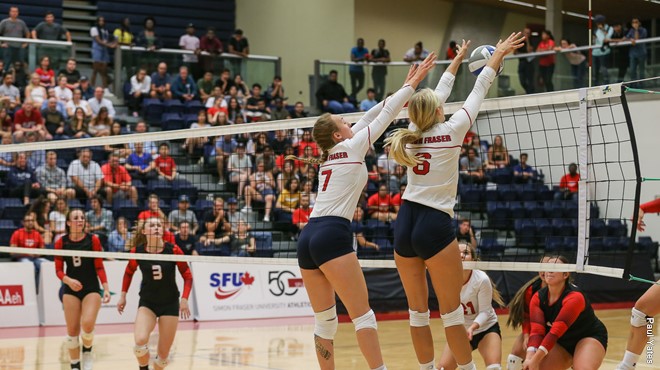
This weekend, The SFU volleyball team completed the first of two away tournaments that comprised their 2019 pre-season schedule with a solid showing in St. George, UT. In game one against the tournament host, Dixie State, the Clan won in straight sets aided by 15 kills from Tamara Clarke. 

Their other win was also in straight sets over Colorado Christian University with Betsie de Beers leading the way with 11 kills on 25 attempts. The team also lost 3–2 to Stanislaus State on Friday and 3–1 to St. Cloud State the next day. Having sandwiched two losses in between these solid wins in the season opening tournament, the team will now head to California for the NCAA D2 West Region Volleyball showcase in San Bernardino. 

These two road trips to start the year will hopefully support the integration of the new recruits and develop some team chemistry before the home opener on September 19 at 7 p.m. against Central Washington University. The hype is building for the opener as it has been dubbed ‘the Red Night Cup Cake Festival & T-shirt Giveaway,’ with goodies baked by the SFU Student Athlete Advisory Committee and t-shirts branded with the new SFU logo to be given away to fans at the game. 

As head coach Gina Schmidt prepares for her seventh season leading Clan volleyball from the bench, a few additions to the coaching staff have solidified the teams’ personnel for the season. Former star player Tessa May, who played as recently as last season as GNAC All-Conference First Team for the Clan, will join lead assistant Mengdi Cao alongside returning assistants Ben Ta and Matthew Armstrong. 

This coaching staff will have to deal with relatively high expectations for this season as a pre-season coaches poll tabbed SFU to finish fourth in the GNAC while the team also looks to extend a five season streak of at least 15 wins to six. Veterans Julia Tays and Betsie de Beers, recently named to the GNAC Preseason All Conference Team, will be vital in the team’s drive to, once again, win at least 15 games in 2019. 

SFU Snap has so much potential, but its bugs need to be fixed first

0
Oh snap, the SFU Snap app just crashed on me again. Photo: Chris Ho/The Peak

By: Kelly Chia, Staff Writer

Oh, SFU Snap. 

This app tries its best, but has fallen short so much that it’s often my last resort instead of being my go-to app for SFU content. I want to be able to check my class locations and exam times without the app loading like a snail. My Gen Z attention span cannot wait for it to finish before hurriedly loading go.sfu.ca and wondering why I didn’t do that first. That’s the problem — SFU Snap is not reliable enough to be used as a one-stop app for the variety of purposes the student community needs.

In the three years I’ve been at SFU, every time I’ve trusted Snap I’ve been betrayed by the app crashing or not loading at all. To be fair, this is probably because signals don’t travel well in some areas of our beloved concrete campus. In the past, the app would constantly boot me off, so staying logged in was a pesky issue too. SFU Snap’s unreliability has definitely prevented it from being the useful app that it clearly wants to be. That being said, it has been slightly more reliable this semester, so that’s something.

There is still room for improvement, however. Take the Room Finder feature. I’d like to be able to scroll or zoom in and out on the map to view different parts of the campus, and I can’t do that. This seems to be a recent problem for other students too, based on some reviews on the app page. This feature should be better optimized for more cell phones. I’m sure it would be super helpful for freshmen to be able to quickly find their room while running late for class, especially since the Burnaby campus can be intimidating to navigate with all of its weird basements and interconnected modules.

And wouldn’t it be neat to have some sort of event page on the app? In an ideal world, this app would be the first thing we check to know if there’s anything going on around campus. We can already check for severe weather through the app to keep from being trapped on campus, but it’d be cool if the app also showed events that were happening in that day, too. 

If SFU Snap showcased school events, it could have the potential to create more of an engaged school community. It would give all students, no matter where they are on campus, a surefire way of knowing when something neat is happening.

This might be a bit ambitious for an already buggy app, however. As it is, I just want SFU Snap to work properly. All the features they have are great and helpful, but I only notice this when the app isn’t crashing on me. All I can really do is continue giving feedback and hope it steadily improves before I graduate.


Join the SFU Kin Games team!

0
Kin games 2020 @ Brock University in St. Catharines, ON - Photo credit: Kin games facebook

By: Hannah Davis, Peak Associate

Do you like sports and other team-based activities? Do you like Kinesiology? Do you like making friends and making memories? If you answered yes to any of these questions, you should apply for SFU’s Kinesiology Games 2020 team!

The Kin Games is a national conference that will be held this year at Brock University in St. Catharines, Ontario. There will be over 30 teams competing at the Kin Games this year and SFU is hoping to build a competitive and good-spirited team to represent the school on a national scale. The Kin games events include: sports, dance, spirit, academics, and more. However, you do not need to be good at all of these things to get involved. Everyone has their strengths and the captains are hoping to use yours to make the team that much more competitive and well-rounded. 

If you have any questions about getting involved in the Kin games, feel free to email SFU’s Kin Games captains at [email protected]. You don’t even have to be a kinesiology student, as applications are open to students from all departments. If you are ready to apply, you can do so online. Applications close September 20 at midnight. 

What grinds our gears: Lengthy introductions are a mind-numbing way to waste class time

0
Pleased to meet you… and you… and you. Photo: Chris Ho/The Peak

By: Nicole Magas, Opinions Editor

Hello, my name is Nicole. I’m in my fourth year. There’s nothing particularly interesting about me. My major is “very little patience for this activity,” with a minor in “let’s just start the lecture already.”

I get that the first week of classes can be a bit of a slow start for students and instructors alike. No one particularly wants to jump right into things after those cozy few weeks of relative freedom from academia. I can even sort of understand the logic behind doing a round robin of all the names in the class, simply as a warm-up exercise to make sure that no one has completely forgotten how to interact with other humans while they’ve been away.

But do we really need to get into groups and interview a complete stranger about their fourth cousin’s cat Myrtle? Are the individual presentations on student biographies strictly necessary? Could we not just give our names and majors and go home an hour early with the time we save?

Or better yet, could we skip the introductions altogether? It’s not a very organic way to meet or get to know someone, and I’m sure a solid half of the students introducing themselves are either going to drop the course or vanish before the midterm anyway. 


The Farewell captures the nuanced complexity of family and cultural values

0
The Farewell is a family drama that explores the idea of personal identity. Image courtesy of Sundance Film Festival / Variety.

By: Kitty Cheung, Peak Associate

The Farewell begins with the words “Based on an actual lie,” alluding to the fact that this story was derived from filmmaker Lulu Wang’s personal life. Starring rapper-comedian-actor Awkwafina, the 2019 film centers on Billi, a Chinese-American writer who finds out that her Nai Nai (“grandmother” in Mandarin) has been diagnosed with stage IV lung cancer. Devastated, her family decides to carry on the cultural tradition of collective grief, bearing the weight of this news for Nai Nai — and keeping it a secret from her. Embarking on an elaborate ruse, they stage a wedding as an excuse to return to the motherland and see Nai Nai one last time. 

Drawing from a real-life story, the protagonist Billi is a thinly-veiled version of Wang herself. Most of the movie’s dialogue is spoken in Mandarin, with English subtitles and a majority-Asian cast. As the audience, we see how language and cultural barriers tie into family communication. In a household where multiple languages are spoken, the confusion and miscommunication running through Billi’s diasporic family aligned with Wang’s own immigrant experience. 

Navigating between Chinese and American cultural values, Billi’s struggle with her cultural identity is nuanced and complex. While grieving for her grandma, she is caught between the morality of withholding someone’s medical condition from them and keeping with her family’s collective promise.

The duality of these perspectives was touched upon by Awkwafina in an interview with comedian Margaret Cho: “As an American, it seemed very wrong to me at first. But as Asian people, we have an undying reverence for our elders, and when you think about it as a communication of love, respect, and generosity, you realize that it’s complicated, layered, and very profound.”

Already a fan of Awkwafina’s music and comedy, I was beyond excited to see her in her first dramatic role. While her acting as Billi was notable for her subtle emotiveness, actor Zhao Shuzhen, who plays Nai Nai, absolutely stole the show. Acting with both the cheeky sass and ferocious affection of a Chinese grandmother, she was at once sweet, brash, melodramatic, painfully stubborn, and charismatic.

The relationship between Zhao and Awkwafina is well worth lauding. Details in the film that especially warmed my heart came from their on-screen chemistry, such as Nai Nai patting Billi’s butt, or Nai Nai calling Billi “stupid child” as a term of affection.

Having been born in China and raised in the US, Wang speaks about the feeling of losing your culture in an interview with The Guardian: “In addition to saying goodbye to grandma, there’s this feeling of sand slipping through your fingers, of being unable to hold on to past memories and feelings — unable to find anything concrete that represents home.”

This feeling was especially prominent in a scene where Billi is driven through Changchun, Nai Nai’s hometown. The car passes by Nai Nai’s former neighbourhood, which has now become a construction site due to China’s rapid modernization. Having only caught fleeting glimpses of her grandmother’s old home, there is a desperation in Billi’s voice as she asks to be driven back, only to have Nai Nai herself say that she barely recognized the place.

Regarding the cinematography of this film, the framing of certain shots was artful, rife with thought and intention. Whether it’s placing the camera inside an MRI machine, on the lazy Susan of the circular dining table during family meals, or up close to a painting in the hospital waiting room, Wang’s artistic direction makes this film a calculated visual feast. The conversation illuminated by yellow streetlight that Billi has with her uncle and father as they smoke cigarettes, as well as the neon red of Billi’s hotel room, come to mind as examples of how the lighting and colouring of certain shots is artwork in itself.

Throughout the film, I noticed that Wang didn’t need to hold the audience’s hand and explain everything about Chinese culture for us. The drinking game scene is iconic; instead of explaining the rules to the audience, Wang believes it’s “more engaging” for an audience to wonder, ask questions, and catch up for ourselves. Rather than acting as cultural tour guide to different audiences, Wang is unapologetic as she writes from her own experience. She told The Guardian, “I had to take on that audacity of saying, ‘I don’t care if you don’t understand. This is my reality, and I’m going to assume you do.’

Overall, The Farewell is filled with many tender moments that explore the complexity of families and the idea of reconciling one’s ancestral culture with modern life. It’s a humble film that is rich with culture and questions about identity, which don’t always need to be fully answered.

Released in July, The Farewell is currently still playing in select theatres.

Pre-season tournament includes revenge and disappointment for Men’s Soccer

1
Mark Talisuna and William Raphael - Photo credit / SFU athletics

By: Keveren Guillou, SFU student

The Clan’s Men’s Soccer team kicked off their 2019 campaign this past week by hosting the Burnaby Showdown, a mini pre-season tournament, that featured three visiting teams from California. This tournament format gave fans a good first look at the opponents the Clan will face this year as they aim to follow up last year’s promising season by claiming their fourth straight GNAC title and finding success in the NCAA national tournament. 

Game 1 vs. Cal Poly Pomona Broncos

Over 500 fans filled the Terry Fox Field bleachers to cheer on the Clan in the first game of the season against their bitter rivals, the Cal Poly Pomona Broncos. The Broncos ended the Clan’s last season by eliminating them from the NCAA national tournament.  Despite an overwhelming insect presence at the game, the crowd brought an energy that rivalled that of Liverpool’s Anfield.

SFU kicked things off on the right foot with star forward Matteo Polisi getting a shot off within the first minute that rolled just wide of the net. Following this energy, the Clan continued to dominante for the next 30 minutes or so. Defender Eric De Graaf had an impressive first half as he smothered any pushes from the Broncos. 

The Clan would eventually open the scoring in the 27 minute as the ball was carelessly given away by the Broncos’ defence in their own half. In an impressive play, Connor Glennon and Mark Talisuna assisted Matteo Polisi in getting to the box, allowing Polisi to hold a defender off long enough to get a cross-shot into the bottom left corner. Polisi celebrated by running over to the roaring crowd while holding his armband, with the initials “B.B” emblazoned on it, to pay homage to fallen teammate Brandon Bassi.

The Clan added another two minutes later when team captain Marcello Polisi sent a beautiful floating ball into the Broncos’ box. His brother Matteo managed to get a head-on it which forced the keeper to deflect the ball off the crossbar, where it eventually bounced twice. SFU forward Raphael William converted on a bicycle kick right on the goal line; a tap-in worthy of Cristiano Ronaldo himself. 

The Broncos did grow into the game and would eventually be rewarded with a goal as midfielder Jimmie Villalobos managed to find room to get a shot off from just outside the box. SFU keeper Aidan Bain, who made a great save a few minutes prior, had no chance of making the save. 

Despite SFU seeming to dominate play throughout the match, especially with their use of aerial balls, the stats showed a different game. The clan only managed one more shot than their opponents and trailed in corner kicks 11–0. 

In the second half, new Norwegian player Christian Haunch-Olsen got a chance to leave his mark on the match. Forward Raphael William managed to chase down a terrific ball from Clan defender Jorick Schilken and find his way into the box, before cutting back and finding the Norwegian forward who casually struck the ball into the goal’s top corner. 

The attack also displayed its strengths as Matteo Polisi continued his offensive dominance. Raphael William also played a terrific match with a goal, an assist, and three shots-on-goal including one that hit the bar. William could be the perfect replacement for last year’s MVP, Mamadi Camara.

SFU ultimately came out on top after a well-fought match and secured revenge over the Broncos. 

Man of the Match: Mark Talisuna

Game 2 vs. Cal State San Bernardino Coyotes

The Clan played their second game of the day in front of more than 400 fans, but the game quickly turned sour for the home team as the Coyotes managed to find the back of the net less than two minutes in. The goal was scored off of a cross that Coyote attacker Pedro Arrellano headed past SFU keeper Aidan Bain. 

The game remained tight for most of the first half. In the 31 minute, while battling for the ball, San Bernardino midfielder Francisco Sierra stepped on Marcello Polisi to immediately earn a red card. Players from both teams were pushing and shoving each other before the referee inevitably calmed things down but, in the end, SFU had been given a massive lifeline in the match.

At the half, SFU players were visibly frustrated that they had not yet broken down the Coyotes’ defence but they could draw on the fact that they would have the extra man for the remaining 45 minutes due to Sierra’s red card.

San Bernardino started the second half with a clear plan to strengthen their back line and, in doing so, abandon all hope of scoring a second goal.

Despite this, the Clan pushed extremely hard for a goal. Marcello Polisi would prove to be a key player in this half as he controlled the midfield, doing so by sending balls wide to the wingers and finding space to support teammates.  

As the game progressed, SFU became more and more restless to equalize as they sent waves of long balls and crosses forward — to no avail. The last ten minutes were a race against time as the Clan searched desperately for the tying goal. 

As the final whistle blew, howls could be heard from the Coyotes’ bench as they triumphed in a well-fought match. For the Clan, the loss puts an end to their 33 game unbeaten streak at Terry Fox Field. While the Clan can be proud of the hard work and perseverance that earned them that streak, they now know that they still have work to do if they want to repeat last season’s success.

Man of the match: Marcello Polisi

Player of the tournament: Eric De Graaf

De Graaf was a huge factor in the Clan’s defence not conceding a shot throughout long periods of time. He halted many attacks by taking players on head to head and recovered quickly when beaten. He also showed his attacking prowess by sending critical long balls forward and pushing offensively when they needed a goal late in the second match.  

What’s next?

The Clan will take on Cal State Dominguez Hills in Lacey Washington before flying to Hawaii to continue their preseason. They’ll kick off their official GNAC season at Terry Fox Field on October 3 against St Martin’s University at 8:30 p.m. 

SFU Sports: The week ahead

0
Photo credit / SFU athletics

By: Dylan Webb, Sports editor

The SFU athletics schedule picks up this week with volleyball and football both playing at home for the first time this season. Here’s a brief round up of all the SFU sports action lined up for the week of Sept 15–22.

Men’s soccer:

The SFU Men’s Soccer team will travel to Hawaii for their final two pre-season games of 2019 this weekend. Chaminade and Hawaii Pacific University will both play host to the Clan as SFU prepares to defend their GNAC conference title.

Volleyball:

SFU sports fans will finally have their thirst for live action quenched as Clan volleyball returns to the West Gym this weekend. Following their trip to the D2 West Region Volleyball Showcase, the team returns to Burnaby Mountain for their home opener. Tip off is set for 7 p.m. on Thursday, September 19. Clan-themed cupcakes and apparel will be available to all fans in attendance. The second home game of the year follows on Saturday at 1 p.m. against Northwest Nazarene University.

Women’s soccer:

Sonoma State University will host the SFU Women’s Soccer team for an early season contest on Friday September 20. Kickoff is set for 4:30 p.m. at Seawolf Soccer Field in Rohnert Park, California. The Clan will continue their California road trip with a visit to Turlock to take on Stanislaus State University two days later. The second match starts at 2 p.m.

Football:

The Clan hosts the South Dakota School of Mines and Technology in their home opener and third game of the 2019 season. Kickoff is at 6 p.m. on September 21 at Swanguard stadium as the Clan will temporarily make their home off campus while the new stadium is constructed.

Athlete Spotlight: Patrick Zubick

0
New SFU hockey goaltender Patrick Zubick - Photo credit / Selkirk Saints hockey facebook

By: Michael Lenko, SFU student

After a BCIHL (British Columbia Intercollegiate Hockey League) career that began with the Selkirk Saints in Castlegar, goaltender Patrick Zubick is transferring to SFU to join the Clan on the ice and study biology on the mountain. The Peak sat down with Zubick to talk about the transfer to SFU, his time in the BCIHL and his junior championship experience.

The Peak: Though it will be your first year with the Clan, this isn’t your first year in the league as you’ve just transferred from Selkirk College. What was your experience like there on and off the ice?

Patrick: Selkirk College was a great place to start my post-secondary journey and collegiate hockey career. It gave me a great starting place and foundation, which I can now look back on with fond memories. It really helped prepare me for the jump to university life.

The Peak: On a personal level, your time at Selkirk was very successful with respect to on-ice performance, including having been selected as a 2 team BCIHL all-star. How do you think those experiences will help you with your transfer into a new environment with SFU Hockey?

Patrick: I think that I was put into a position to succeed a lot of the time […] with my coach and the team we had there. We had a great group of guys both of my years there, which enabled me to learn a lot about the game. I think coming into my third year in the league, I know how the league works and how the game flows at this level. I’m especially aware of the smaller, condensed schedule we play and how it magnifies the importance of each game. I think it’ll help set me up for success here as well.

The Peak: In your last season of junior hockey, you won an SIJHL (Superior International Junior Hockey League) championship with the Dryden Ice Dogs. How do you think that experience can help the Clan win a BCIHL championship?

Patrick: I think anytime you get a player — or players — that have championship experience, they kind of know the sacrifices that are necessary to get back there, and they know how hard it is to get there in the first place. I think when you get a group of guys like that together, that are able to lead by example and draw on those past experiences and what they had to do when things weren’t going well, that’s a championship recipe. To be able to translate those things to a new team–which I hope I’m able to help do here–will help push the team toward its goal of winning a championship. 

The Peak: In terms of academics, how are you finding the transition from a small two year college to a large public research institution that is nationally recognized such as SFU is?

Patrick: It’s definitely an adjustment period. I think I’m just starting to figure it out now. Obviously at Selkirk College I could walk across the campus in five minutes flat; even just geographically, Simon Fraser is a way bigger school. There’s so many more people. The class work, were just in our first week so it’s just introductory stuff so far, but it’s definitely eye opening to see what it’s like at a big school. It’s exciting too because you have so many more resources available to you and the faculty is top notch – and they’ve been doing research across the world. It’s a really exciting time and an exciting place to be. I’m happy to be here.