Home Blog Page 494

10 ways to spend $10 at Mini Mart

0

By: Talha Butt, Nicole Magas, Gabrielle McLaren, Marissa Ouyang, Marco Ovies, Brianna Quan, Andrea Renney, Paige Riding, Zach Siddiqui, Dylan Webb, Siloam Yeung

Photos by Chris Ho 

Dear Minimart, 

It’s us: The Peak. Maybe you don’t know us, but we know you. See, your fine establishment is only a brisk walk away from our home-away-from-home office. Back in summer 2018, when we thought you’d get evicted, a part of us nearly died. You have provided Peak staff over the years with emergency tampons, pads, Amazon green tea, party mix, cough drops, Pringles, copious amounts of ice cream, pens, and any other number of sweet and salty snacks to help us power through our production days. 

As a thank you, we figured we’d see just how much our staff can get out of Minimart for $10. Some of us will stay loyal to our values and use this $10 to acquire our most favourite snacks. Others will strategically cash this in to get as much food as possible and save Dining Dollars. Regardless: please find attached 10 pictures showing you 10 ways we spent $10 in your shop.

Sincerely,

The Peak’s staff 


Andrea: $9.84 

Brianna: $9.90 

Dylan: $9.61 

Marco: $9.77

Marissa: $9:10 

Nicole: $8.29

Paige: $9.99 

Siloam: $9.86 

Talha: $9.36 

Zach: $8.16

Mr. Iglesias tackles high school tropes with a comedic twist

0
Gabriel Iglesias stars in Mr. Iglesias, which premiered on Netflix in June. Image courtesy of Lara Solanki / Netflix.

By: Tiffany Chang, Peak Associate

You might know Gabriel “Fluffy” Iglesias from his comedy specials I’m Not Fat . . .  I’m Fluffy (2009) or Gabriel Iglesias: One Show Fits All (2019). Now, the renowned comedian stars in the comedy series Mr. Iglesias, which premiered on Netflix on June 21. He stars as Gabriel “Gabe” Iglesias, an inspirational history teacher to an eclectic group of secondary school students, who is also a fictitious adaptation of himself. After watching stellar stand-up performances from Iglesias, I was really excited when he announced this new project. Needless to say, I knew it would be a huge hit. 

The premise of the show is how Iglesias, his fellow teachers, the principal, the assistant principal, and the students navigate the public education system at Woodrow Wilson High, encountering hilarious (and all too familiar) mishaps along the way. However, similar to the themes of many Disney Channel programs, there are valuable lessons learned in each episode that I consider icing on the cake.  The episodes also incorporate several elements about the characters’ personal lives outside of the classroom — such as doomed crushes, complicated romantic relationships, and sobriety, to name a few.

The charming and talented cast from all different ethnic backgrounds expertly brings these purposely overexaggerated, stereotypical characters to life. We see some familiar faces too, including Sherri Shepherd (The View), Joel McHale (Blended), Christopher McDonald (Lemonade Mouth), and Coy Stewart (Agents of S.H.I.E.L.D). This is the first time I’ve seen Stewart take on a comedic role, so getting to witness a different dimension to his acting prowess was a lovely surprise. The chemistry flowing among the actors is evident and it’s refreshing to see diversity celebrated in such a humorous, but also good-natured, way.  

Mr. Iglesias is definitely a feel-good show. There’s no doubt that every cast member contributes significantly to the show’s success, but Iglesias steals the spotlight time and time again with his natural charisma. His pleasantness and the captivating qualities that are so often associated with his comedy are what he effortlessly emanates on the show — his innate ability to make the people around him burst out laughing is always a treat.

This show is a valuable addition to Netflix’s catalogue of original programming, and if you’re looking for some uplifting content, I highly recommend you give this series a shot. It was no surprise to me that Mr. Iglesias was renewed for a second season, and I look forward to what next season has in store.

Student recipe box: It’s soup season, my dudes

0
Matthias Müller / Unsplash

By: Gabrielle McLaren, Editor-in-Chief 

A fun fact about me is that I have a Pinboard called “SOUP SOUP SOUP SOUP.” I am not ashamed. In fact, now that sweater weather has rolled in, I am thriving. 

Here’s why soup is the superior food: minimal dishes because all you need is one big pot, yields huge quantities so you can cook once a week and proceed not to starve, and there are tons of ways to make this relatively cheap. Here to prove my point are five easy recipes that won’t break the bank, with ingredient costs calculated from Walmart Canada’s website. 


  1. Leek, sweet potato, and rosemary soup 
  • 2 leeks — $3.97 for 1 bunch
  • 4 sweet potatoes — Sweet pots usually sell by weight, but the website estimates $8.48 
  • Rosemary — $0.67 for a pack of fresh rosemary, but feel free to use powdered or dried if you’ve got it handy   
  • 1 L of stock — Pro-tip: instead of buying pre-made stock or broth, grab a pack of bouillon cubes to dissolve in water. One pack of Knorr’s has 8 cubes in it (you’ll need 2 cubes per cup of broth) and will cost $1.27

Recipe total: $14.39 

Yield: 6 servings 

Notes: This soup freezes really well! Suggested additions include garlic, onion powder, sage, and thyme. 


2. Tortellini Soup

  • 1 onion — $0.93
  • 4 garlic cloves (the recipe calls for 2, but you’ll want more) — $0.68 for a pack of 3 heads 
  • 1 L of stock — Use up those $1.27 bouillon cubes 
  • 1 package of refrigerated tortellini — Walmart sells two-packs for $5 and if that isn’t a game changer, I don’t know what is
  • 1 can of diced tomatoes — $0.97 
  • 3 cups of chopped spinach — Pack of baby spinach for $3.47 
  • From your pantry: olive oil and pepper 

Recipe total: $12.32 and you can enjoy your extra ravioli at a later date 

Yield: 6 servings 

Notes: If you have the extra cash or are really feeling yourself, you’ll absolutely want to get some parmesan to throw on top of this soup. Suggested additions include: italian spice mix (basil, oregano, rosemary, parsley, thume, chili flakes, and garlic powder) or fresh basil. You can also cheat by getting cans of diced tomatoes that are already seasoned up. 


3. Black bean and salsa soup 

  • 3 cans of black beans (save the liquid) — $2.64
  • 1 lb of salsa (I usually dump in a large can and call it a day) — $2.97 
  • ½ cup of cilantro — $0.97 for a bunch 
  • 1 head of garlic, minced (the recipe says 1 clove, but you and I know that’s wrong) — $0.68
  • From your pantry: 2 tsp of cumin — If you don’t have cumin in your pantry, a pouch of 97 g goes for $1.97 and it’s a sound investment! 

Recipe total: $9.23 

Yield: 4 servings 

Notes: The amazing thing about this recipe, other than how cheap it is and how easily it comes together, is how much wiggle room you have to adjust spice level depending on who you’re feeding. While the original recipe doesn’t call for that, I recommend blending up your soup.


4. Butternut squash and apple soup

  • 2 yellow onions — $1.86 
  • 2 butternut squashes — Squash is usually calculated by pound so prices may vary, but expect to spend under $10 here  
  • 4 medium apples — I usually get Gala apples, which would bring you to $1.08  
  • 3–4 cups of stock — Thank you, $1.27 bouillon cubes 
  • From your pantry: Olive oil, nutmeg, salt, black pepper, cayenne pepper (can be substituted for smoked paprika if you like) 

Recipe total: $11.25

Yield: 8 servings

Notes: Adding cinnamon to this soup intensifies its levels of autumn-ness by 99%. I also keep red curry paste around and I’m here to confirm that it also makes an incredible addition (add to taste). 


5. Egg drop soup 

  • 1 or 2 eggs per serving — $2.27 for a dozen of large eggs 
  • 2 cups of broth per serving — $1.97 bouillon cubes, saving the day
  • Green onions — $0.97 a bunch
  • From your pantry: Salt and pepper. You can also throw in onion powder, garlic powder, and literally anything else to liven up your broth. 

Recipe total: $4.51 

Yield: Recipe is per-serving 

Notes: Alright, so I don’t actually have a link for this recipe because I discovered it in first year and still refer to it as my “oh fuck I didn’t do groceries” soup. 

Start by making 2 cups of broth per person you’re trying to feed. Boil the broth and then, when your heart tells you to, crack the egg into your saucepan. Grab a fork and whisk the soup furiously — the egg will cook, but because you broke it up it’ll cook in long, noodle-like strands. 

Garnish and enjoy!   

Feel free to add any leftovers laying around your fridge — cooked veggies, chicken, potato chunks. . . 

Political Corner: India’s imperialist actions in Kashmir are a betrayal and a violation of human rights

0
Kashmir’s Muslim majority is under siege by Hindu nationalists. Photo: Dar Yasin/AP

By: Lubaba Mahmud, Staff Writer

The Kashmir valley is a highly contested region which is shared by India, Pakistan, and China. The Indian-administered part, collectively called the state of Jammu and Kashmir (J&K), is a Muslim majority state with a special partly-independent status.

Article 370 of the Indian Constitution previously gave the state of Jammu and Kashmir almost complete freedom by allowing it to have a separate state constitution as well as decision-making rights in a local context. The article also made it illegal for Indians outside J&K from holding economic or political interests within the separate state. However on August 5, India’s government revoked Article 370 with a presidential order. This is a clear portrayal of India’s recent aggressive nationalism — one the international community should not tolerate.

The current Indian ruling party, The Bharatiya Janata Party (BJP), is known for its Hindu nationalist movement. Many Kashmiris believe that the BJP’s motive behind this order is to encourage Hindus to settle in the region and change the Muslim-majority demographic. At a time when democracy and diversity are celebrated in most developed countries, systematically displacing people from a different religion is unacceptable.

In order to prevent protests and violent uprisings in response to the change, Kashmir has been under a security lockdown for over 40 days, with more than 8 million people under curfew. All means of communication, including cell service and internet, have been cut off. There have been reports of violent actions, including midnight raids and torture. Furthermore, thousands of Kashmiris, including politicians and activists, have been arrested for detention

According to the constitution, changes in Article 370 must be approved by the state assembly. However, the Indian government, having previously dissolved the assembly to install a governor in its place, has taken advantage of the absence to pass its order. This has been deemed a fraudulent act by some critics.

It is enraging that such inhuman acts still occur in this day and age. This is no less than imperialist violence. India’s first prime minister, Jawaharlal Nehru, had said that Kashmir belongs to the Kashmiri people and it is not the property of India. India has grossly betrayed Kashmir by dishonouring its promise to respect Kashmir’s right to autonomy.

Under the forceful Indian occupation, Kashmir is burning and bleeding. As part of an international community, it is our responsibility to stand in solidarity with Kashmiris under oppression and raise our voices to demand their freedom.

COMING UP AT SFU: OCT 7–11

0

Author: Zach Siddiqui, Humour Editor

Elections Canada

Canada’s election season is rapidly approaching, and SFU students have an early-access pass. On October 5–9 — that’s Saturday through Wednesday — students can vote at one of three locations at SFU Burnaby. Students can register in person at these stations, as long as they provide ID and proof of address/residence. Valid ID consists of a driver’s license, or card issued by a Canadian government with a photo, name and current address. Voters can also show any two pieces of ID with a name, where one of them has the current address.

“In 2015 we had 7000 people vote [at the advance polling stations], which is phenomenal” said Shina Kaur, SFSS VP University Relations. “We’re trying to break that this time, we’re [trying] to get even more people engaged, and even more people to vote.

You can find Vote on Campus stations at James Douglas Centre’s Safe Study Area, room 3000 in the Academic Quadrangle, or the third floor of West Mall. Stations close at 9 p.m. Monday through Wednesday.

Convocation

Dreaming of bagpipes again? You must be either a precognitive or a veteran SFU student, because it’s that time of year again: SFU’s fall 2019 convocation ceremony.

Ceremonies will run in Convocation Mall on Thursday, October 10, and Friday, October 11. Thursday’s ceremonies will celebrate the Faculties of Applied Sciences; Communication, Art and Technology; Health Sciences; and Arts and Social Sciences. On Friday, students will convocate from the Beedie School of Business and the Faculties of Science, Education, and Environment. 

If you’ve been invited to attend the ceremony to support a graduate, SFU advises you to arrive and seat yourself “well before the procession begins.” Students who do not plan to attend may want to prepare for especially crowded human traffic jams in the AQ.

How to Manage Stress + Pot Painting and Colouring

This Thursday, SFU International Services for Students is hosting “How to Manage Stress,” a midweek event featuring a full spread of activities to help alleviate student stress.

Happening mainly in rooms 2290 and 2292 in Maggie Benston Centre, the day’s itinerary includes pot-painting, colouring, and a peer dialogue session on the origin of stress. After the main event concludes, attendees may retire to room 2013 in the AQ — better known as the Global Student Centre — to chill with Mello the goldendoodle. According to the Eventbrite page, “he will give you lots of furry snuggles to help you de-stress.”

The event is free, but students who want to participate should register ahead of time on Eventbrite or on SFU’s event page.


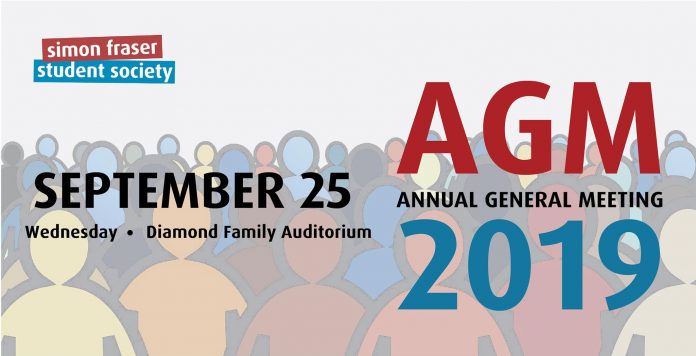
SFSS holds its 2019 Annual General Meeting

0

By: Paige Riding, News Writer and Gurpreet Kambo, News Editor

NOTE: The Peak will be following up with a separate article about the contents of the reports from the Board of Directors, VP Finance, and Auditor’s reports.

Once again, students had the opportunity to  exercise their right to holding the SFSS accountable at the 2019 Annual General Meeting. The AGM is where SFU members can find out where their money truly goes and have their say in a democratic and transparent setting. 

The meeting took place in the Leslie & Gordon Diamond Family Auditorium. Seated in the front were SFSS representatives Giovanni HoSang (President), Christina Loutsik (Vice President Student Services), Tawanda Nigel Chitapi (VP Finance), Sylvia Ceacero (Executive Director), as well as the meeting’s presiding officer Eli Mina. Students scattered around the room held their stark yellow voting cards boasting the phrase “This is my vote” in anticipation of the votes to commence.  All SFU undergraduate students are members of the SFSS, and have the right to one vote on each matter on the agenda.

A recorder of the minutes was to the tablers’ left. To their right, a video camera recorded the proceedings for future reference. On either side of the audience, two microphones stood tall for anyone interested in commenting or raising an argument to any of the matters at hand. 2019’s AGM was not as well-attended as the previous year, though the 2018 AGM had significantly more controversial items on the agenda such as the impeachment of former President Jas Randhawa. 

As the meeting did not have the required 250-person quorum at the outset, the meeting was paused for additional students to arrive. The non-quorate meeting proceeded at 1:51 p.m.; under the Societies Act, non-quorate meetings can vote on items essential to the organization’s continued functioning such as the annual budget. However, any bylaw amendments or special resolutions would require a full quorum. Following the call to order and territorial acknowledgment, the AGM proceeded with the appointment of Eli Mina as presiding officer. 

Most of the meeting proceeded as expected, and laid out in the AGM agenda. This included the adoption of the agenda and receipt of the minutes of the 2018 AGM by a vote of the students present. The AGM package that was distributed included the reports from the Board of Directors, the VP Finance, and the auditor (which The Peak will be reporting on in a separate article and can be found at this link). All of the reports were received by a vote of the AGM, and subsequently Tompkins Wozny LLP, Chartered Professional Accountants, were appointed as the auditor for the 2019–2020 year.

The final item on the agenda was the Open Space, in which members of the society are invited to ask questions of their elected representatives. Several questions followed from audience members. SFU student and 2019 board candidate Sheldon Bond asked several questions about the nature and cost of former CEO Martin Wyant’s “separation agreement,” and the reasons for his departure from the SFSS. 

VP Finance Tawanda Nigel Chitapi  responded “whenever there’s a separation of the CEO from an organization, there’s what’s called a severance package [ . . . ] and that’s what that amount is for.” 

Executive Director Sylvia Ceacero added that Wyant “decided to market his skills and his time elsewhere.” 

However, this did not satisfy Bond, as he further inquired why Wyant would receive a severance package “if he quit.” Chitapi answered that “it’s the law, it’s industry practice, whether you quit or you leave. If you are the CEO of an organization, that is something you have to get, it’s non-negotiable.”

The Peak requested clarification during question period, and pointed out that it is not the law to give severance packages to people who quit jobs. To this, Chitapi invited those inquiring to meet him in his office for further clarification. 

Ceacero added to the discussion: “I think it will be in appropriate for anybody here to comment on HR and personnel issues in an open forum.” Ceacero further added that the former CEO received a severance package due to the specifics of his contract, and that “we move on to the happier times that we have ahead.”

Multiple questions were asked by members about the status of the discussion related to the Rotunda groups and space allocation in the SUB, and in particular the alternative plan brought forward by HoSang to house the groups. HoSang responded to these by stating that the issue is still under discussion, and that “there is a motion that is tabled [ . . . ] it will be at a future meeting that the decision will be made.” 

There were also questions about the status of Fraser International College students as members of the SFSS, and whether they’d be getting the U-Pass. HoSang responded that FIC members are not members of the SFSS yet, but that the matter is currently under discussion.

Subsequently, there were no additional questions, and the body voted to adjourn the meeting. 


Election rundown: Trudeau’s racism scandal is just one of many eroding voter trust

0
Illustration: Can voters still trust Trudeau’s many faces? Alice Zhang/The Peak

By: Kelly Grounds, Peak Associate

In mid-September, Times Magazine broke a story that included a photograph of Prime Minister Justin Trudeau in brownface at a school event. In the following days, two more images depicting Trudeau in blackface were released to the media. Soon after the scandal Trudeau issued an apology statement, where he acknowledged the racism embedded in the photos and asked the public to forgive him

But the idea of asking for forgiveness seems almost hypocritical given that days before the scandal broke, Conservative leader Andrew Scheer faced backlash from Liberals after he said that he would stand by Conservative candidates who had troubling pasts if they apologized. Yet now, the leader of the Liberal party is asking his own party, along with the rest of Canada, to do just that. So, should we?

This is not the first major scandal to hit the Liberals as a result of Trudeau’s poor judgement. Under his leadership, the government bought the Trans-Mountain Pipeline. Trudeau was at the center of the SNC-Lavalin affair, which is still creating waves. We also can’t forget about the India trip which wound up costing the government over a million dollars.

Each of these scandals has attacked some aspect of the image that Trudeau cultivated during the 2015 election. The man who we elected was a feminist who was also environment, pro-mulitculturalism, and looking to promote progressive policies. In the four years that he has been in office, this image has been slowly corroded, one scandal at a time. 

The new question is not so much one of forgiveness but one of trust. The brownface scandal speaks to the slipping image of a man who once was, among many things, someone who many voters felt could be trusted to respect all Canadians. Can voters say with the same confidence going into the October election that this same man holds that respect for all Canadians, regardless of race? Can we trust this man to work to fight climate change after his government bought the Trans-Mountain Pipeline? Can we trust him to keep the promises that he will make during the lead up to the election this time around? 

The federal election is rapidly approaching. So do we take the gamble that Trudeau will keep these promises because we don’t want to vote Conservative?  

This isn’t the only option. The Canadian political system is a multi-party system. This means that, unlike our southern neighbors, voters have more than two options. We have variety and more than one left-leaning party. Maybe this is the time to finally look to the other parties and give them a chance this time.


What SFU Needs: Vending machines that cater to any situation

0
Vending machines selling only chips and pop are so last century. Illustration: Marissa Ouyang/The Peak

By: Nathaniel Tok, Peak Associate

If you’ve walked down the main hallway of the Applied Science Building or Academic Quadrangle, you may have seen those old and sad vending machines selling pop, chips, and various other junk food snacks. But is that the best we can do? Students need more than just a fatty, sugary rush to get them through the slog of classes.

What We Lack

Diverse vending machines that dispense the following:

1) Food options that taste of more than salt and sadness
2) Healthy food choices — fresh fruit anyone?
3) Drinks like tea without added sweeteners, or at least ones that aren’t overly sweet
4) Stationary that is cheap and accessible
5) Umbrellas or fresh socks when the rain catches students off guard

The Vision

Let’s face it, SFU students are seriously pinched for cheap, convenient items in times of emergencies. Introducing the E-Z Spirit Shop, a series of campus-wide, all inclusive vending machines! Vending machines around the world already sell everything from newspapers to clothes to computer parts. There’s no reason why SFU can’t do the same and install some vending machines that sell more than the usual unhealthy food fare. Break your pencil in the middle of your exam? There’s a vending machine for that just outside the room. Or maybe the weather forecast lied to you and it’s not actually sunny? BAM! Umbrella vending machine around the corner. Or maybe you’re like me and you stack your classes one after the other so that you foolishly have no time to wait in line for overpriced sandwiches during lunch hour. Instead of being forced to eat chips or whatever else you can find in your bag (mmm, granola bars?) there’s a vending machine for that too — hot soup on the go.  

 Why We Need It

SFU can and should install vending machines that sell real and nutritious food, freshly brewed coffee, or things that students could actually use in class. Vending machines are fast, so busy students don’t have to wait in long cafe lines during their breaks. The technology already exists and is being used in other places. Modern vending machines can squeeze fresh orange juice or grind coffee beans after the customer inserts their money. They could even sell SFU themed umbrellas if it would make corporate leadership happy. Just please, give us more than chips, nuts, ice cream, and soda in the machines. With these E-Z vending machines selling cool things that students actually want, first years will be overawed, students will be happy, and SFU can use the profits to fund their eternal construction around campus.


Ngũgĩ wa Thiong’o discusses the power of language at SFU Woodward’s

0
Ngũgĩ wa Thiong’o was a keynote speaker for the 2019 Afrocentrism Conference in Vancouver this September. Image courtesy of Steve Zylius / University of California, Irvine.

By: Isabella Wang, SFU Student

25/10/2019: This story was corrected from an older version. In a previous version, Ayan Ismail’s name was incorrectly spelled as “Ayan Ismaili.”

Editor’s note: This article covers the September 23 event titled “The Political Power of Language and Literature,” held at SFU’s Goldcorp Centre for the Arts. For information on the 2019 Afrocentrism Conference, please see The Ubyssey’s coverage of the conference.

On Monday, September 23, a full house gathered at the Djavad Mowafaghian World Art Centre at SFU’s Goldcorp Centre for the Arts for an evening with Ngũgĩ wa Thiong’o, in conversation with Juliane Okot Bitek. The night’s talk was titled “The Political Power of Language and Literature.”

Ngũgĩ is a Kenyan writer and activist, a Distinguished Professor of English and Comparative Literature at the University of California, Irvine, and the recipient of 11 honourary doctorates. Okot Bitek is a Vancouver-based writer, activist, and poet, whose poetry collection 100 Days was shortlisted for several writing prizes, including the 2017 Pat Lowther Award and the 2017 Dorothy Livesay Poetry Prize. 

The evening began with a warm introduction by Ayan Ismaili and Jackie Obungah, two SFU students who helped organize the event. As part of a thoughtful and deliberate speech delivered to the applause of the audience, Obungah said, “we wanted to recognize that Black African students are contributing to universities in ways more than diversity statistics.”

The Afrocentrism Conference, which supported this event and took place at SFU Harbour Centre a day earlier, was meant to centre the experiences of Black African students and staff, and it was what brought Ngũgĩ to Vancouver as a guest speaker. As stated on their website, the goal of the conference was to “challenge our Eurocentric frameworks and understanding of the complex socio-political and economic relationship between Canada, Africa and the diaspora.”

The evening began with a warm introduction from two members of the Afrocentrism Conference’s executive team. Ayan Ismail, SFU Sponsorship Coordinator, and Jackie Obungah, SFU Administrative Coordinator, are both SFU students who helped organize the event. As part of a thoughtful and deliberate speech delivered to the applause of the audience, Obungah said, “we wanted to recognize that Black African students are contributing to universities in ways more than diversity statistics.”

The Afrocentrism Conference, which supported this event and took place at SFU Harbour Centre a day earlier, was meant to centre the experiences of Black African students and staff, and it was what brought Ngũgĩ to Vancouver as a guest speaker. 

At this event, Ngũgĩ gave a memorable reading of two poems in Gikuyu, his mother tongue. His poems  on going to Venice for the first time were accompanied by music and vocals mimicking the sound of wind. Following the first readings, the poems were then read in translation; first in Italian, then in English. The performance was a demonstration of how bringing musicality, translation, and poetry into one room allowed for the dissemination of a “common language,” one that everyone had access to. On this, Ngũgĩ pointed to the fact that translation is a common language — the language of languages that allows for peoples and cultures to communicate. As he explained, it is only when certain languages are structured into a hierarchy that words become a weapon for propagating colonial causes, war, violence, and injustice against others within the same shared community.  

“Carbon monoxide,” Ngũgĩ began. “You know it’s a very dangerous thing. Monolinguism is the carbon monoxide of cultures.” To this remark, there was laughter in the audience. “Multiculturalism is the oxygen [ . . . ] but when they meet on a hierarchy, that is a parasitic relationship,” Ngũgĩ continued.

On monolingualism, Okot Bitek responded, “What about for those of us living in one language, who never had a mother tongue because it was not taught or taken away from us?”

Ngũgĩ paused for a moment, then went on to tell the story of how historically, English speaking people could not conquer Ireland while trying to settle the country. Eventually, an English writer published a book that gave insight into the tactics that would allow the colonizers to conquer Ireland, accomplished “through memory,” as Ngũgĩ explained. The first thing that the English erased was the naming system, through which stories are traditionally told and passed down. Next came the erasure of language. 

For people who have lost their mother tongue, who no longer speak it, or who have had it taken from them, Ngũgĩ showed how a new language could erupt through song, culture, and storytelling; so that in the end, it is not so much loss, but rather, resistance. Ngũgĩ ended his point by saying that knowing multiple languages is powerful, particularly when you are able to build upon your mother tongue — or first language — in a mutually interlocking way for communication and connection. 

The talk, having traversed the grounds of equality and relations, was brought to a close on the topic of the political power of language to unite peoples, languages, and song. To end the night, Okot Bitek asked Ngũgĩ what justice looks like for him. Ngũgĩ responded that we need to realize that “a glass castle for few, at the expense of imprisonment for many” is not justice. 

“Splendour for few, and depravity for many,” Ngũgĩ continued, is not justice. 

The night was concluded with this sobering thought, giving all of us a new idea to reflect on. 

Peak Sports Mailbag: Week 6

0
Photo credit / United Sport

By: Chris Turenne, SFU student

Hey Peak sports readers,

My name is Chris Turenne, and I’m this week’s host for the rugby themed Peak Sports Mailbag. Thanks so much to all of our readers for submitting their rugby-related questions, and my apologies if your question didn’t make it into this week’s edition. The Mailbag host will usually only answer three questions. Don’t worry though, as all questions submitted count for an entry into the raffle draw whether or not they are addressed in the Mailbag.

Question 1: “First, what is the most exciting rugby a sports fan can watch on TV or online if they want to start getting into rugby? Second, what is the most exciting rugby I can watch in the Lower Mainland area?” – Dakota 

Answer: In my opinion, the most exciting rugby that any fan can watch is the Rugby World Cup. This is an international tournament that displays the best talent from across the world. You are also in luck with the fact that it is on right now, taking place in Japan. If you are a night owl, or a very committed fan, you can catch these games live, with daily start times between 9:45 p.m. and 3:15 a.m. However, if you value sleep like me, you can always record them on TSN and watch them later. 

One step down from the World Cup are two annual international tournaments. The first is the Rugby Championship. This is an annual tournament played in the summer months between teams from the southern hemisphere (New Zealand, Australia, South Africa, and Argentina). The second is the Six Nations Championship, which is played by northern hemisphere teams (England, France, Ireland, Wales, Scotland, and Italy). This tournament is played in early February. These games are a little harder to find on TV, so online sources may be required for viewing. 

The best rugby out there, besides international play, comes from two professional leagues. Super Rugby is a southern hemisphere based league known for its fast pace and heavy hits. It can be viewed from February to July. This is some of my favourite rugby to watch. The other is the Pro14 League, which is played mostly in the northern hemisphere. This league features ball handling and technical ability. It runs from September to June, which means that, between all the above listed games, you should have a pretty steady supply of rugby all year.

To answer the second half of the question, you need not look further than BC Rugby, which is also the league that I play in. It has a bunch of men’s and women’s teams in the Lower Mainland, and beyond, that play every Saturday. All the games are free to watch, and we all love to see new fans. So find a club to support near you. 

On a final note, the best way to take part in rugby is to play it. I would urge anyone interested in rugby to give it a shot. I joined last year and it has been a blast.

Question 2: “Why are the New Zealand All Blacks such a famous team? What makes them so successful?” – Kyle

Answer: The All Blacks are such a famous team because, unlike most sports teams, they barely ever lose. Since their first test match in 1903, the All Blacks have had a win percentage of approximately 80%. They hold the most world cup wins and are the only team to win back to back world cups. Moreover, they have not lost at their home field, Eden Park, in 25 years. These factors account for them usually being the world’s top ranked team. 

To account for their success, I think of the conversations I have had with my kiwi teammate. He grew up from age five playing the game, watched it every Saturday with his dad growing up, and knew boys who got their education paid for by playing rugby. It is a part of New Zealand’s history and culture. I believe it is this, and the pressure to continue to be the best, that keeps the All Blacks on top of the world. I think it is comparable to the way many Canadians feel about hockey.

Question 3: “Where and how did rugby start?” – Nick

Answer: The origins of rugby are quite vague and almost mythic at this point. It is said to have begun with a young boy, William Webb Ellis, a pupil at the Rugby School in Rugby, England, who the Rugby World Cup’s trophy was named after. During a game of football (soccer) in the 1830–40’s, William picked up the ball and began to run, breaking the rules of the game to make his own. This is said to be the first game of rugby. 

The game would grow in the UK until two distinct forms of rugby emerged. These are rugby union and rugby league. Rugby union is more popular on a global scale and is the version most people think of when they hear the term rugby. Rugby also helped give rise to the American football we know today. 

Fun fact: scoring in football is still called a touchdown because a player in rugby must touch the ball to the ground in the end zone to score a try. 

If you would like to participate in future editions of the Peak Sports Mailbag and be entered in a raffle for an end-of-semester prize, here’s what you can send to [email protected]

  • Sports-related questions that our weekly host will answer
  • Weekly theme ideas to guide our questions

Or: sign up to host the Mailbag (and get paid)!

Thanks to all of you SFU sports fans for blowing up my inbox!

Next week’s theme is: NHL hockey

Next week’s host is: Dylan Webb

Send in your questions to [email protected]