
Home Blog Page 45

Breaking free from the screen

0
ILLUSTRATION: A university student with a bunch of papers trying to study, but with a laptop open, an ipad playing Modern Family or some other comfort show, and the student looking at their phone rather than the papers
ILLUSTRATION: Cliff Ebora / The Peak

By: Zainab Salam, Staff Writer

In this digital age, screens are central to nearly every aspect of our lives: work, education, entertainment, and socialization. While technology offers unprecedented convenience and connectivity, it also brings the risk of screen addiction.

While not officially classified as a disorder, there are various types of screen addiction, ranging from social media addiction, gaming addiction, streaming and video addiction to multi-screen addiction. These are very real addictions that go beyond enjoying a few hours of screen time a day. According to a certified addiction professional, screen addiction “is identified by a compulsive need to use these electronic devices, regardless of the negative impacts on daily activities and obligations such as work, school, or social relationships.” Some symptoms of screen addiction are being irritable, anxious or angry when you step away from the screen, spending beyond your means on screens (buying new devices or new games for example), and not being honest with other people in your life about how much time you spend on screens.  

Like most things in life, screen addiction rarely exists in isolation. Often, it serves as a coping mechanism for other, more profound challenges. Many people turn to their devices not out of mere habit but to escape stress, loneliness, or feelings of inadequacy. For example, video games provide a sense of accomplishment that might be missing in real life. Understanding the root causes, potential harms, and triggers of screen addiction can help us take more deliberate control over our screen use. 

As a budding psychologist, I observed how professors frequently highlighted marketing psychology as a potential career path. Applying psychology to marketing and branding underscores how principles of this science can be harnessed not just for well-being but also for profit; a reality vividly illustrated by the phenomenon of screen addiction. Screen addiction can be understood as a byproduct of the “attention economy,” where platforms are designed to captivate users’ attention for profit. Profit which is gained through selling ads — the more we scroll, the more data companies collect about our likes and spending habits, which they sell to advertisers. This economic model manipulates human psychology, keeping users hooked while often worsening their mental well-being.

Social media platforms are designed to keep users engaged. Through analyzing user data, software engineers, with the aid of psychologists, design algorithms to “create customized feeds, recommendations, and experiences that keep users on their platforms.” Studies have shown that interactions such as likes or mentions stimulate dopamine release, creating reward cycles. These bursts of dopamine are frequent in short-form media content, which is why platforms like TikTok “drive the formation and sustenance of addictions to the platform.” However, prolonged exposure to fast-paced, highly stimulating content can also lead to cognitive impairments, reducing attention span and making focused thinking more challenging. Time distortion is a significant issue where users lose track of how long they have been engaged with a device. 

“It’s important to develop a healthier relationship with screens. Where they serve rather than dominate. This balance is essential to preserving mental and physical well-being.”

Screen addiction doesn’t just consume time; it has measurable physical, social, and psychological impacts. Socially, the excessive use of screens can erode relationships. In situations where a person is highly focused on their screen while ignoring those around them, it can lead to damaging personal connections. Mentally, it can lead to anxiety, depression, and loneliness. The constant influx of information, combined with the social comparison often inherent to social media use, can lead to a deterioration in self-esteem. Physically, it can cause eye strain, disrupted sleep, and a sedentary lifestyle. Screen addiction can also interfere with interpersonal interactions, reducing face-to-face communication skills. 

Overcoming screen addictions requires a multifaceted approach that addresses both the triggers of excessive screen use and the underlying emotional or psychological factors. Recognizing personal triggers is a crucial step, whether it is stress, boredom, or loneliness and replacing screen time with healthier activities can significantly reduce dependency. Setting clear boundaries, such as scheduled “screen-free” periods or using apps to monitor and limit screen time, can help us become aware of our habits. We can also benefit from digital detox periods, where we consciously disconnect from devices. This can be especially effective when combined with offline activities that provide a sense of accomplishment or social connection. 

In addition to self-regulation strategies, social support and alternative therapeutic approaches can be transformative. For example, nature-based therapy, where time spent outdoors not only reduces screen use but also enhances mental well-being through natural sensory engagement. In other words, enjoying nature can help you exist in the moment and not focus on your screen as much. In more severe cases, cognitive-behavioural therapy can help people recognize negative thought patterns and develop healthier coping mechanisms. Lastly, engaging in digital literacy, learning to critically engage with content and understand the manipulative design of apps, can help us make intentional choices about our screen use. 

Screen addiction often reflects deeper issues rather than a mere love of the screen. Understanding this addiction requires us to look beyond the device to our stressors, habits, and environment. By acknowledging the root causes, recognizing the signs, and consciously managing leisure screen use, we can take back control from our devices and live more balanced lives. 

Instead of defaulting to passive scrolling or binge-watching, consider strategies like mindful scheduling, where you allocate time for entertainment, and digital hygiene, which involves turning off non-essential notifications. It’s important to develop a healthier relationship with screens. Where they serve, rather than dominate. This balance is essential to preserving mental and physical well-being.

Pack your summer with community at Slice Vancouver

0
PHOTO: The exterior of the Slice of Life Photo Studio, including their sign at the entrance (address: 1636 Venables St, Vancouver, BC V5L 2H2).
PHOTO: Emily Le / The Peak

By: Noah Jozic, SFU Student

Looking for a new hobby this summer? Hoping to meet artsy friends? Trying to develop your art practice, but lacking studio space? Look no further!

Slice of Life Vancouver, or “Slice,” is a community-oriented studio and gallery space in East Vancouver. From Monday to Sunday, visitors are welcome to browse the gallery free of charge and dig for unique handmade items in the gift shop. If youve ever been to one of Metro Vancouvers “Makers” markets, youll be familiar with the set up: local artists submit their collections — fiber arts, handmade trinkets, prints and paintings, or buttons and stickers — to be displayed and sold at the shop, and returns are split between Slice and the creators.

Maybe thats all youre interested in. You might browse, take some cute pictures of yourself or with your friends in one of the photo booths, and head across the street for a little treat at Uprising Breads. But Slice offers much more!

Want to work on your illustration skills? Try signing up for one of Slices weekly life drawing sessions on Tuesdays, Wednesdays, Saturdays, and Sundays. Admission fees are only $10, and includes drawing boards and easels. If you are looking for a discount, consider going for Slice’s monthly passes

Looking for a new hobby this summer? Hoping to meet artsy friends? Trying to develop your art practice, but lacking studio space? Look no further!

If drawings not your bag, no worries. Slice has all kinds of workshops, including weekly pottery meet-ups on Mondays. These are a great option if you want to try sculpting but dont have access to a kiln, or just don’t want to turn your house into a mudroom. Different sessions cost between $10 to $40, depending on the activity. 

For other events, you can stay tuned by following @slicevancouver, or by browsing their website. Theres always something new coming up! Maybe youre looking for a more obscure hobby? How about an early form of analog photography? You can get a taste for cyanotype printmaking on May 19 with host @hazelzhangyh. Admission for these workshops can cost a little more, running from $30 to $70, but materials are covered with admission and you benefit from the instruction of experienced artists.

Slice is a great resource for artists at any level. The studio has established itself as an accessible, inclusive hub for professional artists and those enthusiastic to build a career out of arts. The studio has rentable spaces for film and photo shoots, silk screening, clay firing, or even plain-old meetings. Creatives of all stripes are welcome to book the space for solo studio time and co-working. At the same time, workshops and meet-ups are beginner friendly, perfect for casual hobbyists hoping to work on their art skills while having fun and socializing. If either of these sound like you, check Slice out, sign up for a workshop, or simply try your hand at the gift shop!

Guy Who Knows it All advice column: Parking purgatory

0
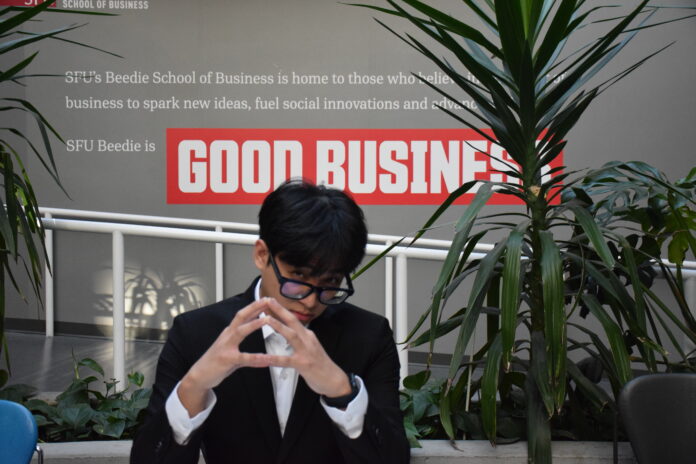
PHOTO: A picture of a guy dressed in business attire standing in front of something in West Mall Centre that clearly indicates that he's a Beedie student. His hands should be in this position and a cocky grin. The idea here is to show his cockiness as the piece is "written" by a Beedie bro who thinks he knows the answer to everything.
PHOTO: Audrey Safikhani / The Peak

By: The Guy Who Knows it All

I have a humongous problem on my hands. And I heard you’re the best at solving those since you’re a Beedie student! I mainly have classes on the Burnaby campus, and parking here is an absolute nightmare. I spend more time searching for a spot than I do in class. 

I’ve tried everything: arriving early, bribing friends, and even contemplating teleportation. Nothing works. What’s your expert advice on scoring a parking spot without going into road rage mode?

Sincerely, 

Frustrated in the Forest


Yo, Frustrated in the Forest, 

Ah, parking at SFU Burnaby, the true Hunger Games of higher education. A challenge so legendary, my macroeconomics professor provided extra credit on the syllabus to those who provided proof of proficient parking. But worry not! As the Guy Who Knows It All, I am here to bestow upon you a comprehensive and foolproof strategy that would make even the most seasoned valet weep with envy. 

I’m a Beedie Bro, so sit back, relax, and just trust me, bro. 

First, avoid arriving early. That’s what everyone expects. Instead, show up precisely 30 seconds before your class starts. This guarantees maximum chaos and will make any spot you find feel like a miracle.

Next, do not circle the lot. That’s a beta move. Instead, park creatively like an alpha. Tree branches in the north lot? Extra shade. Sidewalk? Think of it as elevated parking. Fire lane? Those are just VIP valet spots that the university is hiding from us. And if all else fails, simply park in a random UniverCity parking spot next to a townhouse; it’s not trespassing if you look confident. 

And who would I be if I don’t tell you about my homie, the raccoon valet? He can manage your parking needs for as little as twenty cents (he has e-transfer). He usually takes in new clients every Sunday, right by the lower staircase by the Recreation Center. And sure, your car might come back with mysterious scratch marks and smell faintly of pizza, but isn’t that just part of the university experience? 

If even one of those flawless tactics fails, it’s time to unleash the secret weapon: the overnight camping method. Set up a small but sturdy tent in your preferred lot. Make sure to decorate to uplift your spirit. I am a big fan of  “Grind, Conquer, Park” signs for aesthetic and thematic appeal. I usually set the vibe with my “Vibes Under the Moonlight” playlist, which I linked below. You just need to pay 50 BTC (Bitcoin, baby!) to access this curated glory. It begins with a slowed and reverb version of none other than the hit classic, “Eye of the Tiger.” Make friends with the resident raccoons, and toast to the fact that you’ve ascended beyond the concept of mere studentship, and now you are now a parking pioneer. 

The ultimate secret is this: make peace with the fact that parking at Burnaby is less about getting a spot and more about self-discovery. Who are you when all seems lost? Your mother’s disappointment? Or a true alpha male conqueror of concrete jungles

Finally, remember that true victory is psychological. Surrender to disorder. Don’t just park. Embody chaos. Screech dramatically whenever you see an open spot, even if you have no intention of parking there. Confuse your competitors (those sleazy students who are trying to get to their exams on time!! So selfish of them). Sabotage is just a fancy word for strategy. 

Happy hunting, 

The Guy Who Knows It All

My Summertime Classes by Sarah Sorochuk and Lana Del Rey

0
PHOTO: Of a student who looks emotional/overwhelmed standing at the SFU lower bus loop with a bunch of books in hand. We should be able to get the vibe that they really don't want to be on campus during the summer.
IMAGE: Gudrun Wai-Gunnarsson / The Peak

By: Sarah Sorochuk, Peak Associate

Going to bed with a DIY spray tan,

Summertime classes.

Waking up for an 8:00 a.m.,

My summertime classes.


I’ve got my backpack on today,

Dreaming of a day when I could be away.

Anywhere, but here in this lecture hall,

I’m listening in, but I’m just dreaming during it all.


Oh, my gawd. I see it in the air, they got the alc-o-hol

The summer parties are for all.

But none — for me — I’m stuck alone you see. 

Nothing changes in my life now.


My friends are partying on the beach with a bonfire, 

Smokin’ a cigarette or three. 

All the while, I’m sitting here in this lib-rary.

Writing notes on the pages, 

While my besties are living it up at rages.


I’m living this summertime, summertime sadness, 

While I’m doing these boring summertime classes.

Classes consuming all of me, 

Instead of my friends saving me.

Heeeeeeellllp, please just help me. 


I’ve got these summertime, summertime classes,

Dying in my summertime, summertime classes.

No, nooo no no-ohh. (send help please).

Fossil fuel companies shouldn’t influence education

0
photo of a k-12 classroom, kids raising hands or writing while a teacher stands at the front
PHOTO: CDC / Pexels

By: Yildiz Subuk, Staff Writer

A recent report from the Canadian Association of Physicians for the Environment revealed that 39 different fossil fuel companies across Canada have significantly influenced youth’s climate change education —  that is 39 too many. Enbridge, TC Energy, and Fortis BC were among the companies named. Young children are our future collaborators and leaders in a climate that is rapidly changing in harmful ways. Children are especially vulnerable to pollution as they breathe more and have smaller airways; pollution increases their chances of respiratory infection. Still, the education surrounding pollution is hardly ideal — it’s funded by the very companies that profit from it. Young people deserve a wiser approach to a factor that will not only impact but dictate their futures.

Petro Pedagogy” is used by the report to describe the different messaging strategies employed by fossil fuel companies. Since the 1990s, the industry has shifted from climate denial towards climate delay. The industry initially focused on attacking climate science, but soon realized that growing activism and public doubt in fossil fuels meant they needed a new approach to combatting climate change evidence. They resorted to strategies like “greenwashing” and “bias balance” to exert their influence. Greenwashing is the use of misleading information to make a company’s product appear sustainable, and a biased-balanced approach ensures that lesson plans are framed to include the industry’s perspective to appear less “biased.” This false neutrality positions the industry’s right to destruction as equal to our right to sustainability. Among these approaches peddled to Canadian classrooms, there is also a focus on lessons that shift environmental responsibilities to the individual consumer rather than addressing harmful policies and corporations. 

The curriculum successfully uses greenwashing to make oil extraction seem sustainable, while also shifting the blame to consumers for needing and being economically dependent on fossil fuel energy.

For example, Imperial Oil has hosted workshops for tree planting in Sarnia, Ontario, a community they have actively harmed with pollution from their oil refinery. The company gloats about sustainability on its website while polluting so heavily that Sarnia has an area known as the “chemical valley.” Through educational sponsorships and “opportunities” like these, companies build a seemingly respectable rapport with educational institutions and in communities. They appear charitable as a way to divert criticism. In 2014, Suncor partnered with Alberta’s provincial government to create curricula for kindergarten to grade three students, while Cenovus partnered to take care of grades four through 12. As of 2024, the province’s curriculum is to include that Alberta has a “reputation as the most ethical producer of oil in the world” while also reinforcing that energy is essential for the economy. The curriculum successfully uses greenwashing to make oil extraction seem sustainable and further shifts the blame to consumers for needing and being economically dependent on fossil fuel energy. What if instead, we encouraged our youth to innovate alternatives in the face of ecological disaster?

According to Statistics Canada, 62% of Canadian youth agreed climate initiatives should be a top priority. Organizations like Climate Education Reform BC have also emerged as youth mobilize — clearly, they are concerned. However, only 34% of educators feel confident when it comes to teaching about environmental issues. Provincial budget cuts to education are a major factor when it comes to addressing the gap in climate education. Because of these cuts, schools lose valuable funding which would otherwise go to strengthening educational plans. This makes room for the fossil fuel industry to invest in education. Sustainability within the curriculum can only be achieved once schools do not rely on funding and sponsorships from private corporations. Instead of allowing industries to influence and damage our futures, the provincial government should focus on providing adequate resources for educators to tackle the issue. But first, that means we need to convince our peers that education is worth voting for.

An alternative perspective on small businesses

0
Illustration of a row of small businesses including a barber shop, coin laundry, bookstore, and farmer’s market.
ILLUSTRATION: Cliff Ebora / The Peak

By: Yildiz Subuk, Staff Writer

Small businesses contribute to local economies by offering unique products, innovations, and creating job opportunities. In Canada, they employ over five million people throughout the country and make up nearly 98% of all businesses. However, the narrative around small businesses often focuses on the owners, and ignores the employees. 

CEOs and small business owners have some key differences. CEOs are often chosen by a Board of Directors, which is made up of investors who oversee a company’s entire vision. Small business owners are those who create and manage a business at a smaller scale, and tend to be more “hands on,” as they take charge of hiring, payroll, and other administrative roles. Both positions share a key similarity: they rely on the labour of others to grow their companies. Employees are the ones putting in the labour to sustain and grow the business. Businesses are built on the backs of the workers, who are often subjected to lower wages and limited benefits. While the growth of small businesses is important, emphasis must also be placed on improving conditions for the workers who are directly responsible for their success.

Conditions for employees

Although small businesses open up new job opportunities for locals, that doesn’t inherently mean they ensure the best labour conditions for employees. While there are obvious exceptions to this idea, there is clear evidence that small businesses don’t provide better work environments compared to large businesses. This doesn’t excuse the fact that many large corporations engage in unethical practices, but it does provide perspective into how small businesses are part of a capitalist system that relies on the control and exploitation of workers. 

Small business owners have a tendency to micromanage, monitoring their employees day-to-day tasks. Micromanagers often focus on critiquing instead of providing productive feedback. A small business owner wanting to micromanage makes sense because most small business owners are hard workers, who want to ensure everything is up to standard. The problem lies in the fact that micromanaging can cause a drop in job satisfaction and morale. While it is understandable for business owners to prioritize quality, efficiency, and cost-effectiveness, constant micromanagement can be extremely frustrating for their employees. At the end of the day, workers remain the driving force to success. In order to succeed, a team of competent employees is needed, and most importantly a manager who can allow their employees to display such competence. Micromanaging can often lead to employees feeling like the owner has doubts about an employee’s competency. It can be condescending and devaluing, as it shows the owner’s lack of trust in his employees capabilities.

Business blogs such as First Reference and CFIB have made the argument that minimum wage increases can be harmful to small businesses. As minimum wage increases, small business owners may struggle to keep up with paying their employees the legally required amount set by the province. While this is a valid argument, it ignores a crucial component of the discussion — the employee. This rhetoric prioritizes the well-being of the business while neglecting the employees who drive the business forward. While it is important for small businesses to receive support when minimum wage is increased, ensuring employees receive fair and adequate pay should take priority. 

Minimum wage is increased to improve the standard of living. It’s important workers are supported through a rising cost of living. Even then, minimum wage does not equate to livable wage. A livable wage is one that guarantees employees, live a comfortable life, not having to worry about whether they will be able to afford food, make rent, and have access to social benefits and education. This should be considered the bare minimum. The average liveable wage in BC is currently $27 per hour. The minimum wage, however, is only $17.40 per hour. So, those making less tend to have more difficulties with affordability. 

While businesses may take a hit when it comes to increasing minimum wage, we must ask what’s more important — the business or the quality of life of the employee? The latter is both the most reasonable and the most morally just choice.

The responsibility

So, while small businesses provide society with benefits, they have a responsibility to ensure their employees are put first. Small businesses aren’t perfect, or entirely ethical either. Ultimately, the entire point of a business is to generate revenue. So, when there is discourse about protecting small businesses, it often focuses on the owners, and less on the employees. The accomplishment of a business is communal, which means that discourse about supporting businesses should include, first and foremost, advocacy for the workers.

Monday Music: When soft weather brings hard feelings

0
ILLUSTRATION: A person with headphones contemplating the various aspects of life, in a state of wonderment (but not sad).
ILLUSTRATION: Noah Jozic / The Peak

By: Ashima Shukla, Staff Writer

Driving through X̱wáýx̱way (Stanley Park) this morning, I noticed something that jolted me out of my usual daze of cherry blossoms and sunkissed daydreams: trees, felled and fallen. The ones standing didn’t look much better, thin and brittle with decay. Their slow death is thanks to hemlock looper moths. Some have been removed. Others stand with abated breath, one spark away from igniting, a few moments away from decomposing and breathing new life into the soil. They stand there, witnessing their own undoing. 

The quiet horror of the remaining stumps of the once majestic trees mirrors the disquiet brewing in my mind for months now. Spring time in the city is a renaissance of pink confetti and community. But one thought has always clung to me like floating pollen during these few months. Are we also standing in witness to our own undoing? 

If you find yourself filled with a gnawing existential dread this spring, know that you are not alone. In the spirit of indulging in the absurdity of it all, I offer a soundtrack for sitting with your discomfort. These songs might not soothe you but they will offer you company as you look into this beautiful and broken world, and prepare for all your battles ahead. 

“Fruits of Disillusion” by Yves Jarvis 

To start, “Fruits of Disillusion” is a slow and meditative unraveling. Montreal-based multi-instumentalist Yves Jarvis creates music that feels like watercolour running across Hegel’s Phenomenology of Spirit, the famously unreadable guide to human consciousness. Whether you are sitting watching a dying tree or staring at the bumps and cracks in your ceiling, Jarvis helps you get in touch with what it feels like to watch the world bend out of shape. 

“Room Full of Human Male Politicians” by Ruby Gill  

Born in South Africa and raised in Australia, Ruby Gill’s music is sharpened by her classical training and feminine rage. In “Room Full of Human Male Politicians” she disarms you with acoustic guitar strings and follows it with gut-punching lyrics. At once confessional and furious, she captures the all too familiar feeling of unbelonging

“The Big Machine” by Angélica Garcia 

With Salvadoran and Mexican American heritage, Garcia stirs dread and hope with her every note. Blurring genres, “The Big Machine” combines a Latinx futurism with haunting synths in both protest and prayer. Otherworldly with hypnotic vocals, this song recalls Bob Dylan’s “jingle jangle morning” if the Tambourine man were a cyborg. 

“I am a Mountain (don’t be afraid)” by Thanya Iyer 

Blending jazz, chamber pop, and experimental textures, Iyer’s songs are like spells. “I am a Mountain (don’t be afraid)” offers a slow burn of revolution — a reminder that sometimes resilience is all about allowing the flow of change. Iyer invites us to ground ourselves but also to reach up, to come to terms with our fears but not be ruled by them. 

Nada” by Lido Pimienta 

Colombian Canadian artist Lido Pimienta’s influences vary from traditional Indigenous to Afro Colombian, part electro to part soul. With grief and the grit of survival, “Nada” is a quiet anthem of soft and stubborn strength. 

Instead of finding in the spring blossoms a mockery, let us learn from their stubborn survival. Let these songs remind you that sometimes resistance looks like embracing absurdity in the face of collapse. As Camus has said, “The only way to deal with an unfree world is to become so absolutely free that your very existence is an act of rebellion.” I hope these songs help you achieve just that.

Research assistants integrated into TSSU Collective Agreement

0
This is a photo of a black-haired girl researching on her laptop, with a textbook and notebook open on her table as well.
PHOTO: Surface / Unsplash

By: Corbett Gildersleve, News Writer

On March 28, SFU announced they reached a Memorandum of Settlement with the Teaching Support Staff Union (TSSU) to add about 1,000 research assistants (RAs) to the current TSSU collective agreement. This is a historic agreement as it is the first one in Western Canada. The Peak spoke with Kayla Hilstob, chief steward, and Derek Sahota, member representative, from TSSU to learn more about the history and impact of this change. 

TSSU members include sessional instructors, teaching assistants, faculty of education mentors, and graduate facilitators. The new members will now include up to 1,000 “RAs, and then research support, and other types of grant-funded researcher workers,” said Hilstob. This number may increase following an upcoming BC Labour Board decision. Those added to the collective agreement will now receive the same core benefits as other TSSU members. This includes extended health and dental, WorkSafeBC protections, job security, union representation during disciplinary meetings, an increase in wages, access to the TSSU member child care fund, and many other benefits. 

Hilstob said it was a “key priority” for TSSU that all RAs receive the same benefits—something SFU had resisted. In the event that a research grant does not cover RA benefits, a special fund set up by SFU opened May 1 for people to apply to. TSSU was also able to negotiate an international student health fee cover for RAs that will be implemented on November 1, as Hilstob stated SFU refused to cover it now. The Peak reached out to SFU for a statement, but they stated they did not have a statement to provide aside from their press release.

Those who have been added to the collective agreement will now receive the same core benefits as other TSSU members.

The unionization of research assistants has been a long road, going as far back as 1978. The latest effort started in 2014 with TSSU’s “Research is Work” campaign, which involved internal discussions between RAs and TSSU. Summer 2019 saw the campaign go into full gear with mapping departments and card signing, and a public launch with postering, social media, information sessions, and rallies. After SFU voluntarily recognized RAs in November 2019, several unsuccessful bargaining sessions occurred centering a debate around who should be considered a research assistant and what work was being done

TSSU escalated their strike action in 2023 to a full work stoppage, followed by bargaining being renewed for the fall 2024 term. The recent Memorandum of Settlement is the result of this latest round of bargaining. This is a “legal document that forms part of the collective agreement and highlights changes from the previous collective agreement.”

Sahota said there are still around 800 graduate students and workers funded through specific SFU grants yet to be counted as employees. This decision was to be made by the Labour Board mid-April, but has not been announced. Sahota noted that recognizing these students has been the “crux of the issue back all the way to 2019,” with RAs being “critical to the research enterprise of SFU, but they [SFU] continue to object.” 

The current SFU-TSSU collective agreement expired on April 30, however, its provisions will carry forward until a new agreement has been bargained. TSSU has submitted notice to SFU to begin bargaining, hoping to begin this summer.

TSSU rejects SFU’s proposed changes to its IP policy

0
This is a vibrant poster with yellow and red colours that reads, “SFU Plans to Steal Your IP Rights” as the main text. A lightbulb is the main graphic, with the rest of the text inviting the reader to read the new policy and sign the TSSU’s petition against it.
PHOTO: Mason Mattu / The Peak

By: Corbett Gildersleve, News Writer

Earlier this year, SFU released an updated version of their Intellectual Property (IP) Policy for community feedback. The Teaching Support Staff Union (TSSU) released a public petition on March 14, stating that, among other things, the new policy would “see the university steal the IP of teachers, researchers, and students across the university, without our consent.”

The current policy, approved in 2004, defines that IP is “the result of intellectual or artistic activity, created by a university member in a scholarly, professional, or student capacity, that can be owned by a person.” It goes on to state that this kind of activity can include “inventions, publications (including scholarly publications), educational materials, computer software, works of art, industrial and artistic designs, as well as other intellectual property rights.” This includes copyrights, trademarks, and patents.

After the draft policy was posted online, TSSU provided their concerns to SFU directly and later launched the petition. Sometime afterward, SFU’s draft was removed from their website, and an FAQ response was put up on April 10. SFU cited that the policy is over 20 years old and they aim to amend it to “enhance innovation, creativity, and transparency in research and innovation.” 

In the current policy, SFU notes it “retains a royalty-free perpetual right to use for scholarly, academic, and other non-commercial purposes all IP created through use of university resources.” According to the new proposal, a commercial purpose would involve a third party and could involve “assignment, licensing, manufacturing or production of IP” as well as creating a separate company. While the new policy states that educational material belongs to the creator, SFU also added a clause stating they receive a royalty-free non-commercial license. 

The Peak spoke with Kayla Hilstob, chief steward, and Derek Sahota, member representative, to discuss their concerns around section 5.1.1a of the draft policy. “The new policy proposal says anything arising from employment duties is SFU’s, and that’s a very, very broad capture. It doesn’t even mean you actually do it as part of your employment duties, it just arises from,” said Sahota.

“The new policy proposal says anything arising from employment duties is SFU’s, and that’s a very, very broad capture. It doesn’t even mean you do it as part of your employment duties, it just arises from.” — Derek Sahota, member representative, TSSU

Comparing the current policy with the proposed changes, details have been reduced. The Peak reached out to SFU for a statement, and was directed to their Frequently Asked Questions (FAQ) page. In question four of the FAQ, SFU responds to concerns about IP ownership by stating that it gains the IP rights to anything developed under employment duties, but that “faculty retain full ownership of their creations outside of university-assigned work.” The FAQ lists a few examples, such as “brochures, commissioned studies, or descriptive handbooks, whose production was commissioned by the university,” though voided from the new draft. As such, TSSU raised concerns as to whether course material created by an instructor today would be used by SFU in the future after that person has moved on. In 2021, at Concordia University, a student took a course overseen by one instructor and two TAs, only to find out the course videos they were watching were created, recorded, and presented by an instructor who had passed away two years prior. 

When asked about the benefits of SFU’s current IP policy, Sahota said, “Giving [workers] control over their own IP allows for the greatest amount of innovation, development, collaboration, and the best resources. It’s a grassroots model of those workers, whether they’re faculty, researchers, students together, not a corporate model of ownership from the top-down directing everything.

“That is different, but it’s what’s made universities so successful across the world — to become these developers of knowledge, developers of places of education, places of learning. And so it is different, it has worked at SFU for decades,” he continued. The current policy stresses the responsibilities of the university to provide safeguards for the equitable protection and distribution of property, collaboration, and fairness. Sahota stated that “the existing policy and SFU’s model of IP is it’s really egalitarian, that reflects the radical roots of the university. It applies to all, whether you’re a student, or you’re a faculty, staff, you’re precarious, or continuing, you get these rights.”

With the change in SFU’s IP policy concerning different groups at SFU, Sahota noted, “This process is completely and fundamentally flawed” by not directly involving TSSU, the Faculty Association of SFU, and others in developing the changes. “The changes that are being made to policy should be coming from us, not be directed at us. This policy change isn’t addressing a need that the community has found, and that should be the start of the policy process,” he said.

When asked what TSSU’s next steps were, Sahota said the petition has been submitted to senior administration, and SFU has paused the update to the policy. TSSU wants to “build pressure and momentum” to ensure that if the policy is brought back, the community is “aware and prepared to make sure the policy meets the demands of workers, meets the needs of the university and doesn’t have this corporatization built into it.”

All hail the artificial sun

0
A picture of a restaurant with three bright lights and a child under them.
PHOTO: Ksenia Chernaya / Pexels

By: Yasmin Hassan, Peak Associate

When I’m driving late at night, and there’s a Ford F-150 beaming its stark white LED deathray high beams at my mirrors, I do not shun away; I assert my dominance by staring directly into the light because I am not afraid. My retinas are troopers, OK? Just like I stare down the piercing white lights from a car, I am NOT scared of the big light in rooms! 

Society loves to villainize overhead lighting. We are constantly told that it is too harsh, sterile, and unforgiving. People act as though sitting under a well-lit ceiling fixture is akin to being interrogated by the FBI. But what if — stay with me here — the big light is not the enemy stand user? What if, instead, it is a beacon of clarity, a champion of productivity, a bold defiance against squinting and trying to figure out whether that is, in fact, a coat on my chair or the Hat Man?

Somewhere along the line, dim lighting became synonymous with sophistication and coziness. “Mood lighting,” as the kids call it, is pushed as the superior choice, a warm and gentle glow designed to lure you into a relaxed state while the boogeyman plots in the shadows. Sure, I’ll admit it: there’s a time and place for it — candlelit dinners, movie nights, and when you’re trying to disregard the film of dust accumulated on your furniture. But is it truly practical? The answer, my friends, is NO!!

Reading without straining your eyes? Big light. Making spaghetti without mistaking salt for sugar? Big light (unless you’re Buddy the Elf). Finding the sock that somehow wedged itself under the couch? Big li — wait . . . whose sock is this? I . . . don’t have a pair this colour, and I haven’t invited anyone over in months. Um, anyway, these are the fundamental aspects of life that should not be taken for granted! 

Does my love for the big light stem from my innate fear of the dark? What utter nonsense! What if I like to see the room I’m in? What if I don’t want to exist in a dimly lit purgatory, unsure if I’m reaching for my phone or the remote or . . . Larry the Cat? Have y’all seen The Foot from Diary of a Wimpy Kid? Yeah, just know THAT’S the type of malicious energy you’re inviting into the room with your 40% illuminated.

Of course, there will always be the die-hard lamp enthusiasts, those who will fight tooth and nail to ensure a room is vibey. Also part of the reason why I quit the lamp game, I refuse to be out of check with my surroundings. For those of us who refuse to live our lives in a semi dark haze, it’s time to embrace our love for the big light with pride. No more shame, no more quiet suffering as you struggle to walk down a “moody” hallway looking like Velma searching for her glasses. Let me be clear: we like our rooms fully illuminated, and we will not apologize for it. Next time you end up having wine with Samara Morgan who you mistook for your goth friend because of the “ambient lighting,” do NOT call me for help! Kisses!