Home Blog Page 427

I’ve become my tarot deck’s puppet

0
Photo courtesy of Jen Theodore via Unsplash

Written by Molly Lorette, SFU Student

Ever since I bought my first tarot deck, my fate has been sealed. 

“One card wouldn’t hurt,” I told myself. I pulled out a card, The Devil. Later that very same day, Karen asked to see my manager.

Truly, the resemblance proves to be uncanny.

The next day, I pulled out another card. Ten of Swords. On my way downstairs, I saw a kitchen knife sitting on my counter. I’m certain that the two are connected. The universe works in mysterious ways. 

Then, I began asking innocent questions. Will I make the track team? Does Brian like me back? What are the lottery numbers? When exactly will I meet my untimely demise? At first it was simple and noncommittal, answering my life’s conundrums through the cards. Soon, however, I began to spiral.

These days, I fear that I may have grown . . . a tad too attached.

The cards have become an ever-present item in my bag. I take them with me everywhere. They even stay next to me as I sleep, tempting me still even in the darkest corners of my unconsciousness. 

The Magician, he torments me in my nightmares. 

“Is this your card?” He asks me that over and over again. It’s not my card. It’s never my card.

I can feel his disappointment looming over me even as I wake.

“Should I go outside today?” I question, huddled under my duvet. I pull out The Hermit. Little do I know the gravity of its statement. 

“Will I survive the rest of my semester?” I huddle over my laptop, jittering from a bloodstream consisting only of red bull. Death. But of course, any esteemed tarot card writer will tell you that The Death is purely metaphorical. 

Day after day, the cards flow endlessly. They begin to dictate my every move. The Hermit has appeared more often than I can count. 

I soon realize that my deck only consists of The Hermit.

I write this now, huddled in my corner. I draw a card with trembling fingers. With a gasp, it flutters down to the floor before me now.

The Fool.

My own image stares back at me —

Oh god —

It was me all along. 


Andrew Petter, amongst others, provide statements in solidarity against racism

1
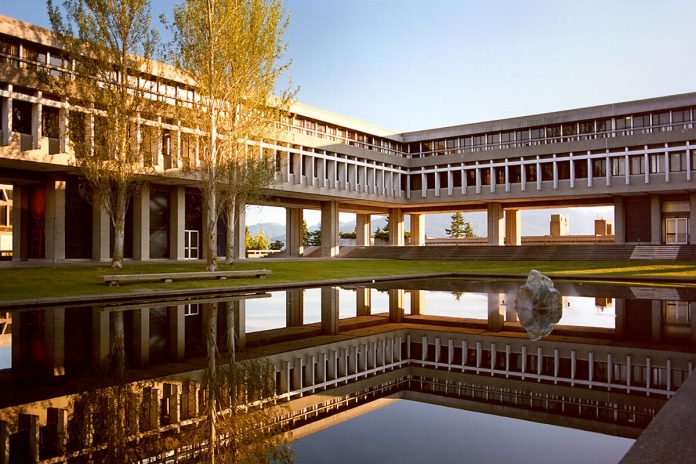
Photo courtesy of Simon Fraser University

Written by: Michelle Gomez, News Editor and Paige Riding, News Writer

SFU President Andrew Petter has released a statement on SFU’s stance against racism.

“The events of recent days add further urgency to this cause. Racism has no place in our society, and we have a responsibility not only to condemn discriminatory behaviour, but also to take action to support inclusion for all,” the statement said.

“At SFU, this starts with acknowledging the role we play in perpetuating systemic discrimination, and accepting that we have work to do to ensure that our ideals for a just society are reflected in our own practices, policies and procedures.”

SFU also Tweeted on June 5 a list of resources for “anyone looking to begin incorporating anti-racist activism into daily life.” 

The SFU library has also condemned anti-Black racism. In their statement is a list of commitments, including revising library policies and collecting works that “challenge anti-Black racism and support the work of dismantling white supremacy.

Various student groups have also made anti-racism statements. The Simon Fraser Student Society released a statement in solidarity with Black Lives Matter on June 1. 

The statement says, “We, as the SFSS, also acknowledge the harm that we have caused the Black community on our campus over the years. We have since committed ourselves to maintaining Black community space on campus, and will continue working with Black student organizers and allies.” The statement is followed by a list of Black-led organizations to donate to and other informational resources. 

Additionally, the Society of Arts and Social Sciences made a Facebook post in solidarity with Black communities.

The Students of Caribbean & African Ancestry posted a statement on their Facebook page on May 31. 

“The consistent disregard of Black bodies through police violence and the persistence of white supremacy within our society can be disheartening but we must not lose hope,” it read.

“We know the importance of community action and solidarity towards the goal of destroying systems of oppressions and injustice within our society. We will not look from the sidelines while our brothers and sisters are being murdered innocently. This is a worldwide systematic issue not just an America issue.” It also explained the importance of donating to fundraising efforts, the sharing of Black art, and the amplification of protests. 

SOCA also stated in a statement released to The Peak that the club is “encouraged by the numbers of people that showed up to stand in solidarity with the recent innocent victims of police brutality.”

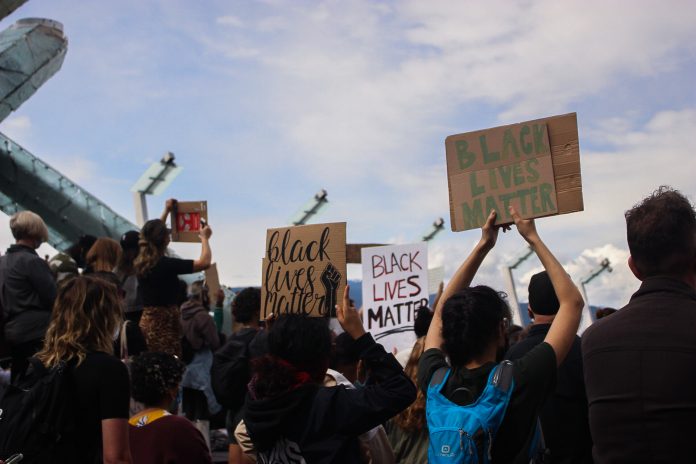
Black Lives Matter protests held in Vancouver

1
Photo: Kim Regala

Written by: Paige Riding, News Writer

Photos: Kim Regala

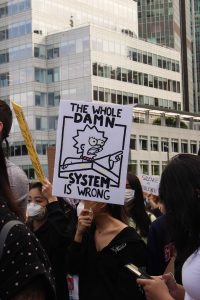
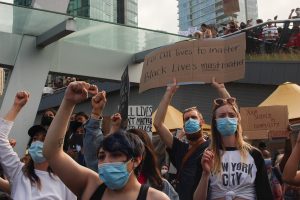
While the Black Lives Matter movement continues in the United States and around the world, Vancouver citizens have also taken to the streets in the form of anti-racism protests.

Two stationary demonstrations were held last week to protest police brutality and anti-Black racism. At the rally organized by Jacob Callender-Prasad on Sunday May 31, hundreds gathered at šxʷƛ̓ənəq Xwtl’e7énḵ Square in front of the Vancouver Art Gallery. 

On the following Friday, approximately 5,000 to 10,000 protesters gathered at Jack Poole Plaza at a protest also organized by Jacob Callender-Prasad, amongst other individuals


Landyn Imagawa, an International Studies student at SFU, described the protests she attended in an email with The Peak.

“I was blown away at the amount of people who showed up both times, despite the current pandemic. I was also so impressed that almost everyone I saw was wearing a mask and people were trying to keep their distance. For those who didn’t have masks, people were walking through the crowd handing some out, along with sanitizer to anyone who wanted some,” she wrote.

“I appreciated how anyone who wanted to speak was given the platform to. Many told stories about the racism and discrimination they had faced in their own lives, growing up in Canada. I think it was important to hear their experiences because so often we look at the US without admitting that the same racism occurs across our country as well.”

Beatriz Fernandes and Alex Senchyna, two SFU students who also attended the protests, spoke with The Peak in a joint interview.

They recalled BIPOC (Black, Indigenous, people of colour) speakers sharing personal stories about issues that they were dealing with in Canada, spoken word poems, and songs on the stages before the crowds.

“For me, this isn’t a political issue [ . . . ] it’s a human rights issue. And I think that, the reason why collective action is so important is because it actually drives change. I think that the voices of Black folks and people who have suffered from this for decades should be heard and amplified, and we should only be there to assist and protect,” Fernandes said.

Fernandes noted that with collective action, the efforts that have been led by Black individuals for years may better get the traction they need. She added that, while those around the immunocompromised or elderly may not go out and protest, those who are comfortable to do so should.

“The most you can do is the least you should be doing,” Fernandes said.


President Andrew Petter released a statement on June 2 stating SFU’s solidarity against racism, noting that, “It’s all of our responsibility to combat racism, but none more so than those of us who have benefited from white privilege.”

Fernandes emphasized the amount of tangible change that has resulted from recent protests. For example, the case of Breonna Taylor, the 26-year-old EMT murdered by police in her own home, has been reopened after two months.

The four policemen who had George Floyd in custody during his death had their charges increased or implemented following the protests. Derek Chauvin, the police officer who kneeled on Floyd’s neck had his charge raised to second-degree murder and the other three officers now face charges of aiding and abetting second-degree murder.

Senchyna noted that she doesn’t think the charges would have come without those taking to the streets and those speaking up about this act of brutality.

“I think it’s also important to recognize that you don’t get a cookie for showing up to a protest, and you don’t get a pat on the back for posting on Instagram. These are things that are necessary and it’s the bare minimum to do these things when you’re in a position of privilege,” Senchyna noted.

For information on how you can support the Black Lives Matter movement, whether that be by signing petitions, donating, educating others, or educating yourself, The Peak released an article detailing how you can begin to be a better ally. 

UBC Senate voted to have a fall reading break. Will SFU follow suit?

0
Photo: Global News

Written by: Paige Riding, News Writer

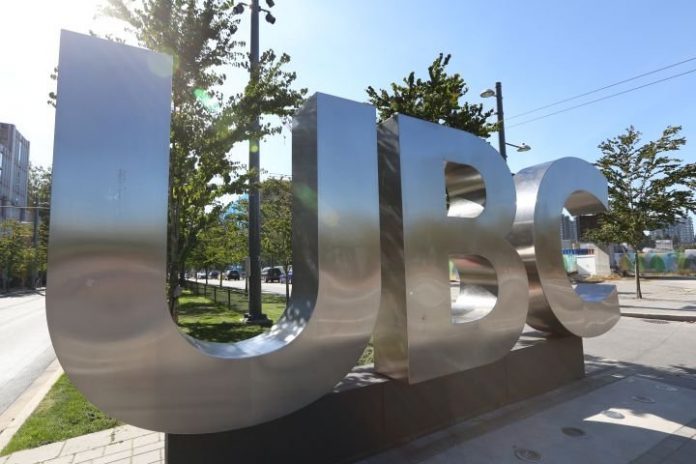
Announced at the end of May, the University of British Columbia’s Senate voted in favour of establishing a fall reading break, starting in the 2021-2022 school year.

According to The Ubyssey, the break will occur mid-November, at the expense of the university’s 16-day examination period, which will be cut to 12 days. Two weekdays off in the week of Remembrance Day will be added. In total, a five-day break —including the weekend— will be implemented.

The Peak spoke with the Simon Fraser Student Society (SFSS) VP University Relations Gabe Liosis over email about SFU’s view on a fall reading break.

“The idea of implementing a Fall reading break has been part of many different advocacy efforts over the years, especially during Senate elections, including multiple candidates from the last Senate election,” he began.

“I am not currently privy to any arising discussions happening within the SFU Administration following UBC’s decision, but this will definitely be a topic of discussion in the coming weeks.”

Liosis noted that the SFSS is in favour of implementing this break. The SFSS will continue working with Senators to see the necessary changes in the academic school year to work towards such a change in the calendar.

“This is a topic I’m sure Student Senators will continue to strategize on and bring forward to the Senate, and we as the SFSS will surely help to strengthen that work.”


Students shouldn’t have to sacrifice security for credits

0
Protecting your personal data online is a lot harder when classes use insecure programs. Photo: Maxwell Gawlick/The Peak

Update (15/06/2020): This article has been updated to clarify Zoom’s encryption and law enforcement cooperation policies.

By: Michelle Young, Staff Writer

Ever since classes scrambled to put their materials online, students have been attending courses via Blackboard Collaborate Ultra, Zoom, or other video conferencing software. They’ve also been prompted to use proctor software during exams, which monitors students via webcam and watches their screen activity. In the rush to quickly adapt to online courses, students have had to sacrifice their privacy to continue their education, and the absence of control over personal data in this transition is unacceptable. 

With the use of Blackboard Collaborate Ultra, personal user data — which can include names, email addresses, IP addresses, cookies, geographical location, and other identifying information — is shared with vendors, partners, and other third parties, and may be transferred outside of the country. Then, there have been Zoom’s alleged alarming privacy concerns. These include security holes that allow for unwelcome guests to appear in meetings if the host fails to implement proper checks, sending data through other countries, and giving the host a large amount of power to monitor attendees on a call. While Zoom has since resolved some of these issues with the implementation of strong encryption software for all users, and reassurances that security is its top priority, Zoom’s willingness to share user information with law enforcement when a “valid law enforcement request” is received remains an issue. This is especially concerning considering the ongoing protests regarding police criminality, both nationally and internationally

While all these security issues might not sound too concerning to some, students should have the choice about whether or not to use potentially compromised platforms instead of having to pick between missing attendance marks or sacrificing their data. 

SFU isn’t the only institution to rush to create a working remote environment, many businesses and organizations have also quickly shifted to accommodate the new circumstances, sacrificing data security in the process. Cybercriminals recognize this and have been taking advantage of these vulnerabilities. Internationally, there has been a spike of reports that concern cybercrime — including a 350% increase of phishing in March from January. With the mandatory use of these platforms, students’ cybersecurity weakens. If personal data isn’t stored correctly, the risk of sensitive information leaking and identity theft increases.

Another issue that has recently surfaced is the use of proctor software. While this seems to be justifiable for the purpose of preserving academic dishonesty, the use of these programs aren’t only an invasion of privacy, but are also a genuine risk to students’ data. In some cases, students may have to verify their identity via webcam with a government-issued ID or allow the exam supervisor to control their computer if the supervisor wills it. Students don’t have much of a choice other than to surrender their information and privacy if they want to take their exams and complete their courses. 


SEE MORE: Students raise concerns over use of proctoring software during remote exams


Many professors and teaching assistants insist on using these platforms because they’re convenient. Even in cases where users can tighten security, the onus falls on the host to do so. They can set up waiting rooms where the host has to accept individual attendees into meetings and use password-protected meeting links to ensure that only those who are supposed to be there are able to attend. Students can keep their software updated to ensure any bugs that might have been there previously are fixed — but that’s all the control they have.

Students shouldn’t need to potentially sacrifice their privacy and data via third-party applications just to access and complete their courses. It also shouldn’t be up to students as individuals to spend the extra time to try and safeguard their security in the very limited ways available for them to do so. As a research university, SFU should be stepping forward to address these concerns. As of yet, they haven’t given any indication that they are creating their own proprietary software to provide students with a better solution other than to use questionable outside programs. 


Latte recipes to soothe your soul

3
Illustration: Alex Vanderput

By: Michelle Young, Staff Writer

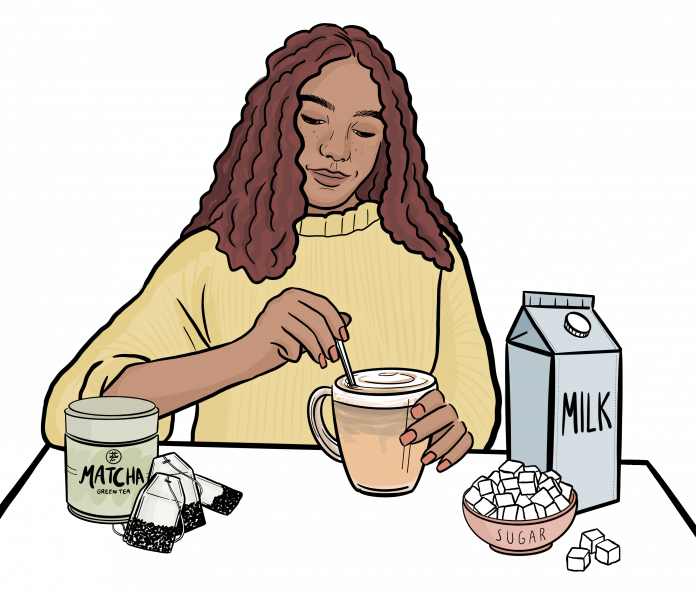
During these past few months as I’ve been isolating away from the world, I’ve been craving more sweet specialty drinks — but going out to buy one wasn’t an option. So I took it upon myself to start experimenting. While studying at home, there’s something comforting about having a nice latte on your desk, so here are my personal findings on how to make one.


Chai Latte 

Chai, a blend of black tea, is distinguished by its strong flavour: it features many spices like cinnamon and ginger. As my go-to order at various Caffès, this latte was my top priority to learn. There are two ways to go about creating this spiced delicacy.

The first, being the quickest and easiest way to guarantee good results, is to buy a chai latte concentrate. This way, you can mix the concentrate with your choice of milk (half concentrate, half milk) and heat it in a pot/kettle on the stove on medium for a few minutes (or you can just microwave it). 

The second approach, which is more prone to error, provides you with a homemade drink — though it might take a few tries to get it right. This recipe uses 2 chai tea bags, 1 teaspoon of ground cinnamon, ½ a teaspoon of ground ginger, ¼ of a teaspoon of ground allspice, ¼ of a cup of sugar, and 1 cup of milk.

The instructions on the original recipe said to use a coffee drip, however, I found that mixing it all together in a pot over the stove was fine. The tea bags will have to be steeped in hot water for about seven minutes, also depending on how strong you want your chai. Essentially, you dump the ingredients together and mix them until they’ve dissolved. Alternatively, you don’t need to add the extra spices, and you can just use tea bags and milk — but the chai will taste more milky than flavourful. If you have a hand blender or a regular blender, you can use it to blend your final creation and make your latte frothy. If you’d like to drink it chilled, put it in the fridge overnight. 

In terms of milk alternatives, oat milk gives you the thickest latte, but it drowns out the chai taste more than other milks. Almond milk (or better yet, vanilla almond milk) is the best because it provides a nice balance, even though it’s a little thinner. Coconut milk doesn’t taste bad either, however, I have to dump a lot more in the drink to get the thickness I want, and I’m not a fan of the little coconut strings that end up floating in my latte. 


Matcha Latte

Matcha is essentially the ground powder of green tea leaves. Normally, I would save these for a day when I go out, but after a while of being stuck at home, I wanted to taste the bittersweet comfort of a matcha latte. 

The easiest way to make this latte is to buy matcha latte powder, which already comes with milk in the ingredients, in the form of milk derivative (essentially powdered milk). Usually, these boxes will have separate packages where one bag is equivalent to one serving. Simply take the powder, add it to a cup of hot water, and mix. To make it cold, only fill about ⅓ of the cup with hot water, mix the powder, and then add cold water and ice on top — preferably the transparent ice used for parties, because then it won’t have that off-putting fridge flavour. 

Otherwise, you can buy matcha powder and follow this recipe I found from Japan Centre, which says to whisk 1 teaspoon of matcha powder into 2 teaspoons of sugar with 3 tablespoons of hot water until smooth. Then, warm up your milk and whisk it together until smooth again. While you could try to make a latte with green tea bags, the quality of the latte won’t be as thick or flavourful, so I wouldn’t recommend it. For a matcha latte, I would say that oat milk would likely work best for a creamy texture. The matcha should be powerful enough for the latte to remain flavourful. 


Caffè Misto

The classic caffè misto shouldn’t be missed in a list of latte recipes. First, you make coffee. You can use a coffee maker, where you would generally add 1 cup of beans to the filter and 1 cup of water to make black coffee — though this can also vary on the coffee machine and personal preference. Without a coffee maker, you can buy instant coffee, and portion it to be half instant coffee and half water. 

Once you’ve made your coffee, add milk (also portion it half and half), 1–3 spoonfuls of sugar, and mix. Caffè mistos can be spiced up by adding hot chocolate powder for a mocha or adding cinnamon for a spiced flavour. Hand blenders can also be used to achieve a foamy top. 

My favourite milk alternative for caffè mistos is oat milk — it keeps the texture creamy, and it retains a nice and caffeinated taste. In my experience, almond milk gives the coffee an almond flavour and coconut milk makes it a little more watery. 


Seven Black panelists break down Canada’s systemic anti-Black racism

0
In a long-overdue conversation, the panelists discuss the reality of being Black in Canada. Courtesy of Feminists Deliver

By: Meera Eragoda, Arts & Culture Editor

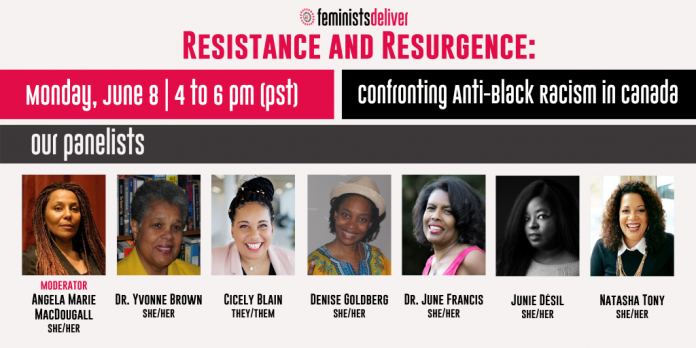
In response to the recent calls for anti-racism, Feminists Deliver, a BC grassroots organization, decided to host the talk Resistance and Resurgence: Confronting Anti-Black Racism in Canada. Feminists Deliver is an anti-oppressive, decolonial, and intersectional organization that aims to spotlight issues facing marginalized communities, connect grassroots feminist movements, and transform “the global women’s agenda” for all women-identifying and non-binary people.

The two-hour event featured several Black BC-based panelists: writer and historian Dr. Yvonne Brown; producer and community radio host Denise Goldberg; anti-oppressive facilitator Cicely Blain; poet Junie Désil; CEO of Elevate Inclusion Strategies Natasha Tony; and SFU’s director of the Institute for Diaspora Research and Engagement, associate professor in the Beedie School of Business, and co-chair of the Hogan’s Alley Society’s board of directors, Dr. June Francis. The event was also moderated by activist Angela Marie MacDougall. 

Opening the event, MacDougall acknowledged that the talk was taking place on stolen lands. Rhiannon Bennett, a member of the Musqueam nation, said a few introductory words. She stressed that Indigenous sovereignty and Black Lives Matter movements are both connected because their linked oppressions are a product of white supremacy. Bennett also emphasized that people need to stop pointing to one movement to say the other is not important.

The panelists covered a variety of topics regarding systemic racism towards the Black community in Canada, as well as the erasure of Black history. Given that Black women are often a footnote in history and in contemporary events, I was glad to see that the entire panel was made up of women and non-binary people.

The panelists discuss serious topics but manage to share a wry chuckle at the sheer performativity of the Instagram black squares.

Dr. Brown specifically noted how she decided to become a writer and historian in order to write her own history, so that those looking back from the future would not be able to erase her contributions. She also urged the rest of the panel to do the same and to create their own archive to ensure their stories would be told.

Dr. Francis spoke about how Canada has always painted itself as better than the US  for having slightly less-racist policies, despite the fact that Canada also had chattel slavery and segregation. Dr. Francis also referenced a 2017 UN Report which she described as “scathing” towards Canada’s anti-Black racism. This report highlights Canada’s history of slavery, as well as the history of Africville, the Nova Scotian community that was displaced, and calls for reparations. Adding to these comments, Blain spoke about how Canada embraced racist policies but concealed them with ambiguous terminology.

Blain also spoke about how the gender binary is a tool of white supremacy, and how Black Lives Matter means all Black lives, including women, trans, and non-binary people’s lives.

Goldberg addressed the medical industry and how racist it is toward Black women. She recounted her own experience going in for a surgery and not receiving any pain medication and when she alerted the medical professionals after the surgery, they argued with her. Eventually, they double-checked and apologized because she had been right all along. This brought to mind Serena Williams’ experience and how this, sadly, isn’t a unique occurrence for Black women.

Another interesting fact I learned was that Picasso — who I already disliked due to the fact that he was a violent misogynist — likely stole Cubism from African art.

Dr. Francis talked about how if you look at SFU or any other institution, their leadership is predominantly white. She explained that entering academia equates to the violence of having your history erased, pointing to a comment MacDougall made on how Black history did not start with slavery yet nothing about this is taught.

The conversation covered a lot of ground, and at the same time, not enough given that anti-Black racism has existed in Canada for a long time and pervades every institution from the medical industry to education to housing to academia to policing to so many more. 

Listening to all the panelists made me recommitted to wanting to decolonize my life and to burn the capitalist white supremacist system to the ground. 

I highly recommend all non-Black people go listen to the recording of the talk. It’s available on YouTube (with closed captions) and Facebook.

What Grinds Our Gears: I’m out-pacing my computer with these datasets

0
Come on buddy, don’t leave me hanging on 99%. Image: Maxwell Gawlick / The Peak, with photo courtesy of Richard Brutyo/Unsplash

By: Nathan Tok, Peak Associate

As I am writing this, my laptop is labouriously trying to load some data files for a class. And it is taking forever

Seriously? I am not a Big Data person or some hot shot researcher. Why am I being given all these absolutely massive datasets that take so long to load? I’m sorry if my laptop only has 8GB of RAM but you know, having a laptop with all the top specs is kind of expensive. 

I suppose there are some benefits to slow processing speeds. I can go find snacks to eat as I wait for these maps to buffer, or maybe I can contemplate my life choices that led to this moment as the software tries to run the datasets. I actually think I am learning to be more of a Jedi in these moments. To control myself and to be more mindful of the present and not letting my mind wander off to what could have been, and the future . . . 

Oh look the dataset has loaded. OK, now let me try modifying just one single parameter and . . .

Crash.

Well, guess I can go run a marathon or something while it loads again.


The culinary arts are more than just a hobby

1
Illustration: RESLUS

By: Devana Petrovic, Staff Writer

Coming from a household of cooking snobs, where the kitchen is one of the most crowded spaces in the house and family dinners consist of unwanted culinary feedback, it’s not surprising that I have always left the cooking to my more ambitious family members. But after two months of cooking show clips circulating my YouTube watch history, I’ve discovered a love for cooking when I least expected it: during a global pandemic. 

Back when the world wasn’t fearful of COVID-19, I purely relied on leftovers from my mother’s hearty Balkan dinners and Subway sandwiches; clearly, I’ve never been a meal prep kind of gal, let alone interested in experimenting with my culinary skills. But with an unholy amount of time on my hands and bounds of inspiration for recipes, I’ve found myself in the kitchen a lot lately. 

Initially, I started cooking pasta and stir fry dishes, mainly pushing every possible variation with the ingredients directly available to me and the very basic skill set that I possess. I have since gravitated towards more complex plates, where I’ve enjoyed pairing various proteins and vegetables with different spice combinations: salmon dishes, classic chicken and potatoes, and barbequed meats, just to name a few. 

On weekdays, everyone in the house is busy working from home, so I have been able to snag some kitchen time without getting in anyone’s way. Cranking up some tunes and whipping up a mean bowl of spaghetti bolognese has been a great way for me to unwind and destress. I’ve appreciated the level of focus required in cooking, as it has helped me mentally regroup myself and centre myself on a calming activity. 

Surprisingly, it has become more than just a hobby and form of stress release, but it has also rekindled my appreciation for traditional Serbian cuisine and brought me to studying recipes of my past relatives. I have found the most comfort and intrigue in learning to recreate the familiar dishes of my childhood: gibanica (filo rolled cheese pie), goulash (beef stew), and sarma (minced meat cabbage rolls) are some of the Slavic favourites. These foods that once made me feel outcast and different as a child, are now flavorful relics of my cultural heritage, and recipes that I aspire to perfect. 

In sharing this newfound hobby with my mother, she dug out my grandmother’s old recipe notebooks, in which every possible family recipe is scribbled across several pages. Unleashing all these culinary family secrets has given me a long term goal with cooking, which goes past any other hobby of mine. Once I figure out how to read my grandmother’s messy cursive Cyrillic, I am hoping to acquire the skills necessary to execute these dishes, and also pass them down to future generations. 

Learning to cook has bestowed several challenges for me: overcooking, undercooking, breaking cooking vessels, and setting off the fire alarm. It’s highly likely that I will only be cooking for myself for a while. Nonetheless, I have great amounts of respect for every family dinner my mother has single-handedly cooked and arranged. 

Although, I am most definitely still a less than amateur cooking enthusiast, uncovering my love for the culinary arts and elevating how I express my love for food, has been incredibly therapeutic and the perfect distraction. Not only have I expanded my knowledge and flavour palette, but I have acquired a newfound understanding of my own ethnic cuisine. 

Opinions in Dialogue: Systemic change can’t happen without racial solidarity

0
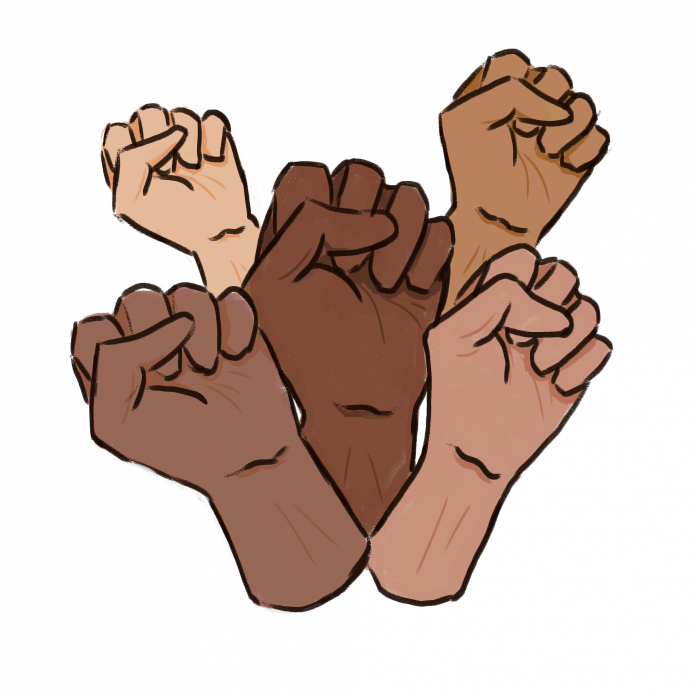
Everyone has a role to play in fighting racism. Illustration: Shaheen Virk/The Peak

By: Kelly Chia, Features Editor; Meera Eragoda, Arts Editor; Nicole Magas, Opinions Editor

Introduction

2020 has been a difficult year for a number of racialized communities. The pandemic spread of COVID-19, which precipitated violent anti-Asian backlash and which disproportionately affected Black communities, and the murder of George Floyd that sparked a world-wide resurgence of Black Lives Matter protests and activism are the two most recent examples. As racialized groups fight against systemic and individual racism for the right to exist without fear of violence, a recurring conversation on the need for solidarity across race has emerged with a call to stand up for each other’s causes.

In this special Opinions in Dialogue segment, Peak editors Kelly Chia and Meera Eragoda discuss the issue of solidarity and complicity amid systemic oppression, and how the battle against racism can’t be won without supporting one other.


Meera: As an intersectional feminist who belongs to the South Asian community, the recent murders in the US are highlighting both the lack of acknowledgement of racism within Canada and the perpetuation of anti-Black racism from within the Asian community itself. I’m floored by the hypocrisy of some Asians I know who are posting their support for Black Lives Matter, but who I’ve heard perpetuating covert and casual racism, and making comments that are anti-Black and anti-Indigenous. It is a problem that many Asians seem to be depicting racism as a US-only issue while ignoring the rampant prevalence of the same attitudes in Canada — especially toward Black and Indigenous communities. If we expect solidarity from these communities, we need to give it in return. We also need to stop contributing to their oppression.


Kelly: As a Chinese person, I can speak for how my family and I trivialized racism towards Black people. We referred to Black people as 黑鬼, or black ghost. We also correlated Black communities with high criminal activity. While I have since educated myself on my racial biases, many older parents like mine are reluctant to unpack their racism. I think this comes from a place of fear; to doubt these ideas and investigate why they existed would mean we have to be vocal about our politics. This scares my parents — many East Asian households strive to embody a “model minority,” but understand that this status is fragile. The fear of disturbing the “peace” — even if the peace is one that silences other marginalized groups — has encouraged my family to only speak up politically if they feel safe. 

The rise of COVID-19 has made the fragility of this mindset and the model minority myth even more apparent. Here in Vancouver, violence and racism against East Asians, including the Chinatown lion statues being defaced and instances of verbal and physical assault on public transit, have sharply increased. For the first time, I’ve felt a small portion of what it’s like to be a Black or Indigenous person in Canada every day. Being a “model minority” doesn’t protect you when systems of powers can attach fearful labels to your race just as easily as they elevate you. 

Now that racialized hurt is fresh in my community’s mind, I want to encourage them to stand up for those who face this sort of abuse on a day-to-day basis. We can only understand a fraction of what Black and Indigenous people face, and they are impinged by more institutional barriers than we understand. Speaking up for other minorities against an oppressive system will not harm, but rather help, all of us.


Meera: I think it’s really important that you bring up the model minority myth. Sarah SoonLing-Blackburn explains how the model minority myth depicts Asians as hardworking individuals who have achieved their level of success by following the rules and embodying the “pull-yourselves-up-by-your-bootstraps” immigrant striving. The insidiousness of this myth is that it presents us all as a monolith and erases our intra-group experiences. However, ultimately the creation of this myth in the 1950s was meant to divide us from Black communities, and continues to divide us from other racialized communities today. The perpetuation of this myth uses us as a tool against them to point to why they aren’t successful, while permitting willful ignorance of the systemic and explicit racism that’s targeted at them. 

Buying into the individualistic narrative of “well, if we can do it, they must be able to do it and if they don’t, it’s because they’re lazy or they’re criminals” erases how these communities have and continue to be violently overpoliced. It erases their history of displacement at the hands of colonial powers and minimizes their experiences both past and present. I think the danger of buying into the model minority myth is that it allows us to believe that we can achieve whitedom. 

In addition, the model minority myth evolves depending on who politicians upholding white supremacist beliefs choose to demonize. Not long ago, Sikhs, Muslims, and many other South Asians started to be reclassified as terrorists. In reality, as the vile COVID-19 racism and other racist actions have shown, we will never be accepted into whitedom, and it’s not something we should even want to strive for. We betray ourselves and each other when we side with oppressive forces, and we need to start undoing our internalized white supremacist beliefs.


SEE MORE: Allowing the RCMP to recruit on campus undermines reconciliation efforts


Kelly: I think you’ve illustrated why it is important to not ignore the institutional barriers Black and Indigenous people grapple with. I want to emphasize why East Asians should not be apathetic to these struggles. To say that speaking up for Black people is the least we can do does not measure it: my parents were able to immigrate to Boston in the ‘70s because Martin L. King helped sign the Immigration Act in 1965 in America. Our rights to build a future away from home were founded on the backs of the Black people who fought for them. 

We’re also no strangers to appropriating Black culture for our benefit — I initially adored Crazy Rich Asians because I saw my Singaporean culture reflected in a sensational movie, but Awkwafina’s blaccent (the imitation of Black language or speech) left a poor taste in my mouth. In an article about Awkwafina’s history as a “culture vulture,” Alysia Stevenson notes that Awkwafina’s “blaccent” faded proportional to her fame and success — a very common trend for people adopting then dropping Black culture when it’s no longer beneficial in privileged social circles. There is so much privilege in being able to adopt, to profit from, and to drop Black culture — especially because we don’t experience the institutional barriers that Black people do.


Meera: Lilly Singh’s appropriation of Black culture also comes to mind here with her also doing blaccents. The problem with her profiting off this appropriation and using it to further her success, is that Black people still face prejudice for their accents and culture. In fact, one of the reasons George Zimmerman — the man who gunned down Trayvon Martin in cold blood — may have been acquitted is because one of the Black witnesses faced linguistic discrimination for speaking AAVE (African American Vernacular English). There’s something fundamentally wrong about using someone else’s culture while being complicit in their oppression. 

And complicity really is the word. In the George Floyd case, the white cop killed him but the Asian cop looked away and did nothing to stop it. Yes, we as Asian people didn’t construct these white supremacist systems, we’re not the ones who hold power within these systems, and we still face plenty of discrimination within them. But when we call the cops on Black and Indigenous people, we are knowingly or unknowingly putting their lives in danger. As Hasan Minhaj recently said while addressing fellow Asians, “America’s story didn’t start when we got here. When you become an American citizen you don’t just get to own the country’s excellence. You have to own its failures. That is the deal.” Same with Canada. You can’t live here and not care about Indigenous rights and sovereignty, and you can’t not care about police brutality. That’s the deal. We need to be like the Rahul Dubeys, David Chois, and Ruhel Islams of this world.


Kelly: To reiterate your point about complicity, we simply can’t pretend that these aren’t our issues to fight for as non-Black people of colour. Black and Indigenous people shouldn’t have to keep explaining to us why they deserve to live too — it is on us to educate ourselves and the family members who are stubborn in their ways of thinking. I found Letters for Black Lives helpful: it is one of many resources available that explain the Black Lives Matter movement, and has been translated into many languages if you have difficulty communicating with your loved ones. 

Over the last week, I’ve seen many of my peers stay silent because they think nothing they do will matter. We have to encourage them to speak out, and to educate them on why these protests have reached the heights that they have. The reaction to Floyd’s death was a catalyst to hundreds of years of violence towards Black people. It is a strong reminder to us here in Canada to be more vocal against the police-instigated murders committed against Indigenous and Black folk that continue to be swept under the rug.

In fact, we inflict the most harm when we are silent in the wake of other minorities being hurt. It allows police brutality to be normalized. We may not be the attackers, but we are still the ones who are silent while the murderers get away, and that really is the harm of complicity. We signal to oppressive systems of power that we will continue to tolerate their violence for fear of being hurt ourselves, and that we have no power to fight back. 

But that powerlessness is a lie. Putting pressure on city officials through protest has resulted in the majority of the Minneapolis City Council voicing support to disband the police department in favour of a community-based safety program. Charges for Derek Chauvin and his accomplices have been upgraded. A bill that criminalizes aggravated chokeholds has been passed by the New York Assembly

Our solidarity has sparked meaningful changes, and we need to continue speaking up and educating ourselves about injustices to our fellow marginalized communities. 


For further reading on the history of Black and Asian solidarity from a feminist perspective, check out this reading list.