Home Blog Page 424

There is no good reason not to change the name of our sports teams

0
Is McFogg even a real Scottish terrier? Image courtesy of @SFU Twitter account

By: Nicole Magas, Opinions Editor

The recent Black Lives Matter protests around the world have turned a new page in the chapter of global anti-racist conversations. Locally, SFU’s athletics teams’ name has once again been the subject of critical scrutiny. Admittedly, playing under a name like “The Clan” isn’t great optics for a supposedly liberal university like SFU. It’s incredibly insensitive to the teams and players we compete against who associate such a name with the KKK — particularly those players in the US. Frankly, the name is cringy under the best of circumstances, and for too long awkward gestures to our supposed Scottish heritage have been used as an explanation for why the name hasn’t yet changed in our 55-year history.

Honestly, at this point in time, history is not enough to justify keeping a name that not only causes offense, but endangers our players as well. Those who cry the loudest against the removal of racist colonial icons or names appeal to history as a basis for resisting progressive change. Yet some histories — especially white colonial history — shouldn’t be put on a pedestal. Aside from the fact that using history as a justification to continue celebrating people and events that oppress others is a pretty shitty thing to do, the history that these appeals are based on is often romanticized at best or flat out incorrect at worst. In the case of SFU’s Scottish history, it’s a little bit of both.

Like our campus’s legendary prison architecture or the opening of the SUB, SFU’s Scottish “heritage” is more fabrication than fact. As SFU history alumni Georgia Twiss articulates, SFU’s connection to Scottish history was from its inception more about piggy-backing on the clout of established Scottish nobility than anything else. In Twiss’s words, “Simon Fraser symbolized a prestigious sense of historical continuity and heritage that was lacking in the locally-branded ‘Instant University’.” And while you may be thinking, “Of course, we’re named after one of the first European explorers in Western Canada,” you should know that’s not even the Simon Fraser she’s talking about.

SFU gets its name, its crest, its motto, and the name of its athletics teams from the much more contemporary “Simon Fraser, 15th Lord Lovat, Chief of Clan Fraser of Lovat” in a bid to adopt a sense of precedence it didn’t, at the time, possess. This is akin to sitting next to the cool kids day after day, until everyone else just assumes you’re cool too. There is nothing in the “manufactured history” of our Canadian university that is so inherently Scottish that it must remain beholden to names that are detrimental to our students and our relationships with other institutions. 

Our university was founded in the heart of the Civil Rights movement. It should have been apparent to anyone not dedicated to crafting prestige out of a faux connection with Scottish nobility that a team name like “The Clan” — or the Clansmen as it was originally called — was a bit problematic. But regardless of whatever cultural or ideological blinders the university’s founders had at the time, the fact remains that this name has been allowed to continue for 55 years. And while objection has naturally been raised in that time, the university has yet to meaningfully address what it calls a “difficult issue.”

Over the last half century our school has built a diverse community of students and faculty, with a rich, expanding tradition of campus activism. We long ago lost the need to associate ourselves with the upper echelons of an antiquated, foriegn class system — if we ever truly had such a need. Surely there’s some other name we could pull from our annals to rebrand our sports teams that’s better than “The Clan.”

After all, what’s in a name? A football team by any other name would still lose just as many games.


 

Abolition, not reform, is the answer to the problem of police brutality

1
It’s time to defund and dismantle our policing system. Illustration: Reslus/The Peak

By: Meera Eragoda, Arts & Culture Editor

The recent prominence gained by the push to “abolish/defund the police” has mainstream politicians like Trudeau scrambling to turn these movements into a conversation about police reform. Not only does the focus on reform miss the mark of what the protesters are calling for, it is also ineffectual in preventing police brutality. Police abolition sounds extreme, but nothing less will work to fix a broken policing system.

So what’s the difference between police reform and abolition?

Police reform is based on the idea that the police play a fundamentally beneficial role in society, in spite of the few “bad apples” that give them a bad name. The argument is that with proper training and more technology like body cameras, the police will be held more accountable and will, hypothetically, be less violent. 

As the implementation of body cameras in the US has shown, however, such measures don’t stop police brutality. As many Black people have pointed out, we shouldn’t need to see Black bodies being murdered to believe that police brutality is real and that the police are dangerous.

Police reform attempts to paper over this reality with more training and more resources. In doing so, however, it serves only to direct more funds towards a fundamentally violent institution designed to criminalize already marginalized people. 

Police abolition, on the other hand, seeks to weaken and ultimately eliminate the police altogether. Abolitionists recognize that police forces were created in order to protect the wealth and private property of a small percentage of white men. Black abolitionists in particular recognize that this definition of private property included their ancestors, and that early police forces were actually slave patrols.

This history is present in Canada as well. The RCMP was created in order to dispossess Indigenous people of their land and resources so that it could be commodified by the few. The RCMP was instrumental for displacing Indigenous communities and taking Indigenous children away from their homes and placed into residential schools. They also enforced the internment of Japanese Canadians during WWII and continue to criminalize poor and racialized folk.

Abolition means reckoning with this history of racism and dispossession by funnelling funds away from the police and towards other community initiatives such as mental health, education, and housing in order to make the police largely redundant.

Sandy Hudson — who has been instrumental in bringing the defund the police movement to the mainstream press in Canada — gives an example specific to Toronto how responded to fare evasion by adding more police officers at subway stations. She explains that if the City of Toronto redirected the funds they used for adding these extra officers into making transit free for all, this would eliminate the need to criminalize fare evasion in the first place. Given that the people evading fares are those who can’t afford them, policing fares equates to criminalizing poverty. Making transit free would make things more equitable and give everybody the opportunity of access.

This perspective can be applied to housing, mental health initiatives, education, and so much more. This is what Minneapolis just elected to do and in the Yukon, they’re experimenting with having unarmed community safety officers respond to calls instead of the police. Defunding the police and increasing funding for community care will help keep everyone safer and contribute to a more equitable world. 

In our city where the police budget is approximately $314 million — an increase of 140% from 2001 — but where homelessness has been rising year after year, we need to ask ourselves what we want to prioritize. Do we want these funds going toward making sure everyone in our city has proper housing, enough to eat, mental health resources, education, and more? Or do we want to continue to fund the policing people for trying to survive in a system built to oppress them?

There is a template letter to Vancouver City Council that will help add your voice to those calling to defund the VPD which can be found here. I urge you to fill it out and send it.


Closet Cases: Stories on when we came to terms with our queer identity

0
Illustration: Maple Sukontasukkul / The Peak

By: Kitty Cheung, Molly Lorette, Victor Yin

One of my favourite toys during early childhood was the household mop. My family kept the mop and bucket outside on the balcony of our Strathcona apartment. I would flip this mop upside-down and she would transform into my gorgeous dance partner. Together, we would twirl around on the balcony, executing dramatic dips as I ran my fingers through her “hair.” Even though my mom scolded me for touching the mop’s grimy strands, I remember our performances as marvellously free and fun. 

Reflecting on these kinds of memories now, it seems so clear that I am queer. As I entered adolescence and began to learn about sex and sexuality more in-depth, I would have identified as questioning. It wasn’t until after I graduated from high school that I became certain that I am pansexual: I feel like I could fall in love with anyone, regardless of their gender identity. 

I had always thought that once I knew I was queer, everyone would somehow find out. But that never happened. I felt comfortable keeping this truth to myself for the first few months, mulling it over until I was sure I had achieved full comfort and self-acceptance. I didn’t feel the need to tell anyone right away, but even if I did, I wasn’t sure how to bring up these topics. It didn’t feel right to just update my Facebook status to “I’m pan now uwu” and call it a day. Only intimate conversations (and I guess a Peak article) would do. 


As I made friends in university and grew a trusting support system, it became easier to come out during one-on-one conversations. I realized that when you come out, you come out multiple times, to each new person you choose to share this part of your identity with. 

I come out to my mom once every few months. I started with giving subtle hints such as “What if I want a wife instead of a husband?” Each time, I’m met with resistance and denial. The love is there, but I know we’ve got a long way to go if I’m to live life on my own terms.

These conversations with my mom are difficult, but they make me feel especially grateful for my close friends and chosen family. With this community, I love that we can have conversations where we both lament and celebrate our intersectional identities. 

– KC


Interestingly, I never had many moments of being unsure of my sexuality once I actually realized that I might not be 100% straight. The first time I had the inkling of attraction to someone of the same gender, I can recall going home and immediately consulting the internet before saying to myself, “Oh. That explains a lot.”

While I’m certain that I had several crushes on girls before I came out, in my mind’s eye I just really wanted to be their friend. While the complete and utter lack of self awareness was a large contributing factor, my well acquainted friend, “internalized homophobia,” played a large part in shielding my brain from my true feelings. Time and time again, I used to look at girls and think about how beautiful they were, and what it might be like to kiss them before reminding myself, “No. That’s gay. You aren’t gay. You like boys.” Now, I realize that most, if not all, the large playground crushes I had in my early days was compulsory heterosexuality.

Even after I realized that I was queer, I still dealt with internalized homophobia time and time again. Each time I allowed myself to get close to someone, I always found that a whisper from the darkest caverns of my consciousness would halt me, telling me that what I was doing was wrong. While I never found it hard to accept my sexuality, it was hard exploring my identity with others. Admittedly, while accepting attraction is easy, true exploration is something that I still struggle with even after being out for seven years. 

That being said, allowing myself to silence my internalized homophobia has been an amazing tool to be able to understand my true self. Silencing that voice has allowed me to become an unapologetically affectionate person. It has allowed me to understand that I am more than deserving of love from others. It has also permitted me to explore relationship structures that exist outside of the monogamous structures that have been laid out for me. While I never expected it as someone with intimacy issues, I have recently come to realize that my heart is capable of more love than I was fully aware of. 

In several ways, the journey to fully identifying as someone who is both queer and a part of a loving and healthy polyamourous relationship was both easy and difficult. Labeling myself has never been hard, but internalized voices shedding doubt upon my identity has proved difficult. The constant struggle, however, reminds me that my queer journey is never over, and permits me to express myself in new and exciting ways each day so that I might silence that pesky voice for good. 

– ML


I hit send and the bright screen stared right back. My heart was racing. I had just come out to my best friend over Line, because I couldn’t keep it a secret any longer. It was a late night under-the-covers type of conversation, the time when everyone is tired and inhibitions are down, so I had decided it was a safe time. Getting to that point was not easy. Coming to terms with your identity is not easy when you are an angsty teenager with crippling self-esteem issues living with conservative Asian parents who absolutely want nothing to do with those homosexuals

So I didn’t want to be gay. Just like how I didn’t want to be Chinese, because everything was just harder when you lived in a Eurocentric society. I was so anxious and scared as I waited for my friend to reply — she was half-Asian so I knew she would empathize with my fears. Looking back now, I don’t remember her exact words, but I know she was supportive and she told me how she was bisexual herself. I was so relieved. 

And so, began my very slow journey out of the closet. I came out again and again. When I said the words out loud to myself in the bathroom mirror. When I changed my Facebook status to “interested in men,” even though it was hidden on my profile. When I came out to my brother. When I tried coming out to my parents and it ended super poorly. When I saw Love, Simon in the theatre with my friends. When I went to my first Pride (last year!). It took me a long time and a lot of unlearning and relearning to put the pieces together and become comfortable with who I am, in every dimension, but I am so glad I did. Closets are safe, but being out is worth it. This is who I am, and I wouldn’t change a single thing.

– VY

Board Shorts: June 12, 2020

0
Image: Irene Lo

Written by: Michelle Gomez, News Editor

Here are the highlights from last Friday’s four-hour long Board meeting. 

Black in BC Community Emergency Support Fund contribution

The Board carried a motion to contribute $3,000 to the Black in BC Community Support Fund for COVID-19

The motion was put forward by At-Large Representative Balqees Jama. “We have stated that as the SFSS we’re standing in solidarity with Black lives, and a part of that is to make sure that we support the Black community financially,” said Jama. 

She added that UBC’s student society, the AMS, has donated $6,000 to the same fund. Since UBC has double SFU’s student population, Jama noted, the SFSS will be proportionally matching this amount. 

President Osob Mohamed expressed her support for the motion. “Times are rough,” she said, “not just because of COVID, but because of systemic racism that Black people are facing at the hands of white supremacy.” 

Jama added that the fund prioritizes individuals who have not been able to access federal support, including international students. 

Board votes to openly oppose the TMX project

The Board unanimously passed a motion to officially oppose the Trans Mountain Pipeline Expansion (TMX) Project. 

Science Representative WeiChun Kua explained that this project has been very controversial, and “has faced many oppositions from the City of Burnaby, from the provincial government, from environmental groups, from First Nations.” 

“It’s unsafe and it doesn’t make sense to continue on during COVID,” said Environment Representative Anuki Karunajeewa. 

Kua also noted that “we need to push SFU to take stronger action as well because I think as an institution they should be really doing more to pressure the government.” 

VP Student Services Matthew Provost stated, “The SFSS has already stood in solidarity with Wet’suwet’en [ . . . ] we need to always be mindful that we should be taking opposition to the pipeline.” 

The motion also mandates the Board to work with student climate justice advocacy groups to submit a letter to student unions across Canada and the United States to support them in calling on the Federal Government to terminate the TMX Project. 

The SFSS will look into hiring a Black Student Support Staff position

The motion that was carried authorizes SFSS staff to investigate hiring a staff member to “assist in effective support, advocacy, and service delivery for the space that has been allocated for the SFSS SOCA constituency group.” 

Students of Caribbean and African Ancestry (SOCA) is a constituency group that is currently entirely maintained and operated by students, noted Jama. 

Jama explained that all other constituency groups (i.e. Out on Campus, the Women’s Centre, First Nations Student Association) have a support staff coordinator of some sort. “I think having a support staff to maintain the space in the new building [ . . . ] it’s appropriate to have.” 

“This is definitely needed, and it has been needed for a long time,” stated Provost. 

Mohamed said, “Being Black while in university is difficult. The system wasn’t made for Black folks [ . . . ] I am very cognizant of the harm caused by the SFSS on the Black community on campus and I’m hoping this can be a step in the right direction.” 

SFSS staff are to report options for this position at a later Board meeting.

Playing with polymer clay

0
Photo: Elvira Chan / The Peak

By: Elvira Chan, SFU Student

During the first few months of quarantine, I had made a mental list of all the things that I missed doing, such as exploring Stanley Park on a sunny day, seeing my closest friends that lived nearby, and going to the pool or ice rink after a stressful day. But with the thought of the things I missed in life came a slow but gradual realization of what condition the world is currently in. Headlines, anxiety, and restlessness came crashing down on me week after week, and I decided it was high time that I found something soothing and time-consuming to occupy myself with.

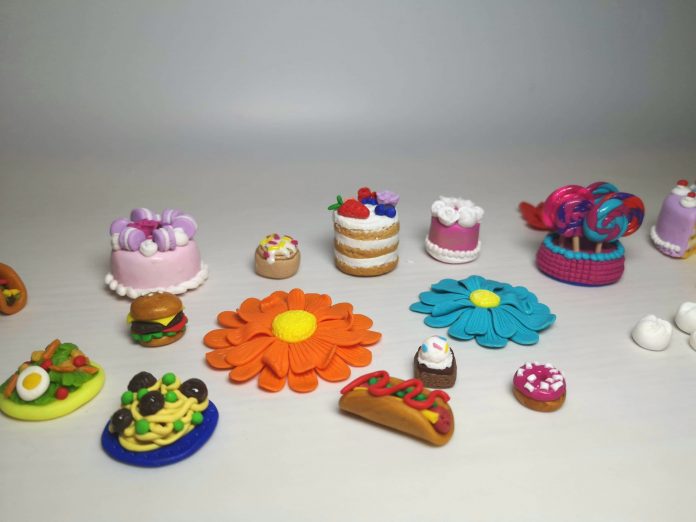
I ordered a kit of FIMO modelling clay with an assortment of colours that was left unopened, and started molding the clay without any expectations or experience. I started making basic things like miniature chocolate chip cookies, glasses of milk, and golden pretzels. I found that working with my hands was immensely therapeutic and productive. Eventually I began challenging myself to make more complex replicas, such as naked cakes with fruit and flowers, spaghetti and meatballs, and a colourful basket full of shiny, glazed lollipops. 

Photo: Elvira Chan / The Peak

Depending on the complexity, each piece could take anywhere from as little as 10 minutes to as much as a full hour. I found that the time tended to fly, especially if I had Netflix playing in the background. 

I would start out each piece by having a visual of what I’d like to create, then I would try different techniques to get the right size, shape, and texture. Then I’d finish off the item by baking them in a little toaster oven for 15 to 30 minutes, and using a glaze if the product needed to be sealed or shiny.

Before long, the entire FIMO clay kit had been finished, and I bought more tools and clay online, branching out to different brands of polymer clay, such as Sculpey. Compared to FIMO, Sculpey clay is a lot more malleable and soft, which can make it easier to shape and mold, but harder to make very small or detailed pieces as it can come apart easily due to the warmth of your hands. For beginners, I’d definitely recommend FIMO clay as it’s slightly more durable and easier to detail. A lot of the starter kits on Amazon such as Klutz or CiaraQ came with shaping tools and mini instruction booklets, though I found that everyday things such as a clean toothbrush, rolled up tinfoil, toothpicks, and butter knives cut, shaped, and texturized the clay just as well. 

As I started creating replicas more often, I began looking through video tutorials and reading instruction books on different techniques and tips so I could improve on my art. Specifically,  SugarCharmShop Gourmet, Maive Ferrando, and Mayu Sekiguchi’s tutorials on YouTube were my favourites because of their realistic replications at such a small scale. I also looked at the real version of some common desserts and tried to mimic the details accurately. 

Photo: Elvira Chan / The Peak

People always ask me why I’ve decided to focus on food that couldn’t be consumed, and my only response was that I loved trying to replicate the real versions. Food plays such a big part in every culture and revolves around sharing, tradition, and enjoyment. I found myself creating miniature clay replicas of the foods that I grew up with. I made things like the xiaolongbao and pad thai, or foods that you see at celebrations and parties, such as cakes and pastries. For me, being able to have a permanent and miniature version of the foods that I love and have great memories of something so special.

I’ve been branching out to make miniature creations for my friends and family, and when I see their eyes light up over the details or the miniature size, it truly feels worthwhile. It started out as a hobby to keep me busy during quarantine, but it also helped me realize that time was a true luxury. I could spend hours focusing on adding clay flowers to a miniature wedding cake or dreaming up ideas for the next creation because of that time on my hands, and that was something I never would have slowed down enough to enjoy if not for being stuck at home. 

For now, I’m going to continue challenging myself in creating replicas that are more realistic and complex and gifting them to family and friends. Although I love my hobby right now, I cannot wait until things are in a better place in the world and I can share some (real) food and drinks with my loved ones. 


Cooking up a conversation with co-founder of Dashi Eats, Nneoma Chiakwelu

0
Goodies such as chicken laps and chin-chin are available to order from @dashi_eats on Instagram. IMAGE: Meera Eragoda / The Peak with photos courtesy of Dashi Eats

By: Devana Petrovic, Staff Writer

Second-year Beedie School of Business student, Nneoma Chiakwelu, along with her business partners Ashia Jaji (Capilano University) and Doyin Agbaje (Douglas College) launched Dashi Eats, a Vancouver-based Nigerian meal service at the beginning of this June. The Peak had the chance to speak to one of the Dashi Eats founders, Nneoma Chiakwelu, about their start-up story, current means of operating, and menu intentions. 

Chiakwelu explained how the idea for Dashi Eats came into mind when she and her housemate were visiting a friend’s place. They all come from a Nigerian background, and in discussing their favourite meals from home, realized that Vancouver did not offer those staples. That’s when the three co-partners “decided to come together and bring the flavours of Nigerian meals to Vancouver.” Chiakwelu further noted that they “had been doing some research and planning since February to really put everything together,” but started taking pre-orders a couple of days before their official launch on June 1.

Nneoma Chiakwelu (top), Doyin Agbaje, and Ashia Jaji (bottom, left to right) created Dashi Eats to make Nigerian food more accessible. Photos courtesy of Dashi Eats.

While Dashi Eats is eventually planning on transferring their operations space to an alternative location, due to COVID-19 measures, they are currently operating from Chiakwelu’s own household kitchen. She clarified that it made the most sense “since two [out] of three partners live together.” Chiakwelu reassures, “We are all FoodSafe certified so we have been following guidelines for preparing food and also ensuring to take precautions when packaging and delivering orders.” 

When devising their menu, they intended for it “to have a feel of a proper restaurant menu.” Chiakwelu went a little bit into detail on the construction of their options: a finger foods and wraps section, a proteins menu (e.g. they offer grilled and crunchy chicken laps as well as a spicy grilled fish dish), a drinks and side menu (e.g. hibiscus infused punch and grilled plantain sticks), and a dessert menu. An entire menu is available on their Instagram page, where pictures of dishes are also posted. 

“We decided to start off with a few things in each category and then add others as we go along [ . . . ] we wanted each menu item to be satisfying in itself and then [also] be ordered with something else to make a full course meal,” said Chiakwelu on the their current menu, which they launched their business with.

They are currently taking orders through Instagram direct message, while they’re still working on creating a website for customer orders. More information and details on ordering logistics can be found on their Instagram and Twitter: @dashi_eats or for a secondary point of contact, they can be reached by email: [email protected]

Monday Music: Black with a capital “B”

0
"Monday Music" in giant yellow block letters with a red background
Monday Music: your weekly themed playlist. Image courtesy of The Peak.

All of the Monday Music for the Summer 2020 semester is now be available on The Peak’s Spotify Playlist, Monday Music Summer 2020. Don’t forget to follow thepeaksfu on Spotify to listen more easily!

By: Manisha Sharma, Peak Associate

As most of you are aware, with protests erupting all over the world, systemic racism and discrimination against Black people occurs everywhere — even here in Canada. Now more than ever we can take the initiative and support Black lives and businesses. One way to do that is by supporting Black Canadian artists by streaming their music. Here are just a few of the many talented Black Canadian artists and their songs to check out. 

“In Women Colour” – Haviah Mighty

Courtesy of Haviah Mighty

Haviah Mighty is a rapper from Toronto, Ontario. She’s a self-proclaimed feminist and has recently spoken about the importance of police reform. Mighty is an avid supporter of social justice on issues like police brutality and consistently tweets about reform movements. This rap song is powerful with lyrics speaking to her experiences of being a Black female artist as seen in the lyrics like, “Huh, yeah I’m darker than my friends, And finally they see it and they start to get the trend, I gotta do two times more to get four times less.” Check out the rest of her songs on her most recent album, 13th Floor.


“Pendulum of the Perturbed Soul” – TA’MIR

Courtesy of BBOUNDLESS

This song is part of a whole album that was created during quarantine. TA’MIR is a hip-hop/rap artist from Toronto, Ontario. His lyrics are often relatable and humorous with lines such as, “So stop Whatsapping me messages, mom,” but also meaningful like, “Cause I know, this can’t be all there is. It can’t be all pain, feelin’ lost and disdain.” A common concept he addresses is self-awareness, self-growth, and trying to find happiness amidst a lot of pain.


“Skin” – The Afro-Métis Nation

Courtesy of The Afro-Métis Nation

The Afro-Métis Nation are a band from Vancouver. This band incorporates drums and beats used in traditional Métis culture throughout this song, and intertwines the dynamics of being both Indigenous and Black. “Skin” itself is an emotional, soulful telling of their experiences of not fitting in because of the colour of their skin. I highly recommend listening carefully to the lyrics while playing this song — the lyrics are insightful and eye-opening. This song also touches on the experience of being considered too dark within your own culture, and how despite being Indigenous, Arab, or various other ethnicities, skin colour is a contributing factor to whether you are accepted or not. This is an issue that happens around the world but in this song we get to experience The Afro-Métis Nation’s own telling of their experience of this.


 “Watch me” – Missy D

Courtesy of Missy D

This rap song with hip-hop beats is incredible with lyrics calling out discrimination and racism against Black culture and people, all the while being a banger with beats you’ll want to jam out to. Missy D is an artist from Vancouver and blends her Rwandan, Cote D’Ivoire and Zimbabwe roots into her music. This song gives me energy (as I’m sure it will give you) with empowering lyrics about decolonization, resisting assimilation, and finding the power to be yourself. I love that this can be an empowering anthem for any minority, like it is for me.

This song says it all . . . period.

For more great Black Canadian artists, check out Bandcamp. Many artists on there have  proceeds going to the Black Lives Matter movement and other organizations.

As incoming chancellor begins her term, former SFU chancellor Anne Giardini reflects on her six years at SFU

0
Vrooman is SFU's 12th chancellor. Photo courtesy of Simon Fraser University

Written by: Madeleine Chan, Staff Writer

On June 13, Tamara Vrooman started as SFU’s newest chancellor, taking over from Anne Giardini, who has held the role since 2014. In an interview with The Peak, Giardini looked back on her past six years of service andsfu, outreach,  reflected on the highlights of the job. 

Of her time as chancellor, Giardini was most proud of being able to “meet SFU wherever [she] went.”

“SFU is a very connected university,” she said. “It has outreach all over the world [ . . . ] I was able to encounter SFU people, and SFU work, and SFU ideas, and SFU ways of seeing the world and help to spread it and amplify SFU. There was really nowhere that I went over the past six years that I didn’t think couldn’t use just a little more SFU.”

Giardini gave high praise to Vrooman as the incoming chancellor, describing her as a “remarkable person with an enormous amount of support for the university.” In passing the baton, the ex-chancellor hopes to see the continuation of SFU’s “engagement mantra,” and of the school remaining grounded in its community. Giardini saw her role as chancellor as the “champion of everybody,” and knows that Vrooman will maintain that legacy.

One of the most difficult parts of the job, Giardini found, was not being able to “go to everything.”

“All the talks, all the events, all the sports, everything. You just feel as if there is so much available to be experienced and to get involved in and to support, and at the end of the day you have to make decisions on the places you can go and the things you can do.”

She also stated that she “would have loved to get to know every single student personally.”

“That would have been the best possible way to spend the time, but that isn’t possible either. The challenge is just how much you want to do.”

Despite no longer acting as chancellor, though, Giardini doesn’t “plan to be a stranger” and aims to keep attending events as an SFU alumna and past chancellor. 

“It was the most fun in the world. What an honour it’s been to serve SFU in this way.”

On taking over as chancellor, Vrooman told SFU News it is an “incredible honour and privilege.”

“Education will have a significant impact on the well-being and sustainability of our communities as we move forward,” she said. “I’m excited to be advocating for SFU and the success of students and alumni as they contribute to a strong and sustainable future.” 

Vrooman was previously the CEO of Vancity Credit Union. She has also served as BC’s Deputy Minister of Finance, Secretary to the Treasury Board, and CEO of the Public Sector Employers’ Council. In 2016, SFU awarded her an honorary doctorate degree in law.

Your weekly SFU horoscopes: June 22–28

0
An illustration of a girl with long flowing hair. Astrological signs and stars shine around her.
ILLUSTRATION: Marissa Ouyang / The Peak

Written by Paige Riding, News Writer

Aries: You’re like the sticker on a window warning about the installed security system inside. Sure, you’re intimidating and all, but that “more bark than bite” cliché resonates more loudly than the alarm that will start ringing despite your tough-looking façade.

Taurus: You may know where your childhood stuffies and toys went, but do you ever wonder what happened to your favourite childhood dishes? That Elmo plastic plate was there for you from the start. And what did you do? You let it slip away after hucking Cheerios everywhere. Typical Taurus.

Gemini: You may find yourself wanting to unfollow a high school friend from whatever social media piques your short attention span at the moment. As Marie Kondo iconically says, “if it doesn’t spark joy, throw it out.” Harsh? Maybe. But you did agree with me for a minute there.

Cancer: Be gentle with yourself as you perform your unhealthy habits this week. Reading conspiracy theories off your phone until 4 a.m.? Turn on night shift for the sake of your eyes. Procrastinating doing your school assignment? Do some deep breathing to curb that growing feeling of despair Canvas gives you whenever you look at it.

Leo: This week, unbury one of your childhood teen idol posters and hang it back on the wall. You tell yourself you took it down because you aren’t into that band anymore, but we all know you were just jealous of people looking at it instead of you when they walked into your room.

Virgo: You still can’t get over how hard the extroverts around you were hit from social distancing. In all honesty, there wasn’t much of a difference at all for you. Okay, well, you can’t complain to yourself about the ridiculous AQ foot traffic, but other than that, not much changed.

Libra: For the egalitarian of the Zodiac, you sure self-pity a lot. How does it feel blaming the world for not giving extra love to you, despite thinking that everyone should get an equal amount of love from said world?

Scorpio: There will always be people better than you and worse than you at all that you do. Well, in your case, Scorpio, it would be interesting to find someone better at suppressing their concerns around what someone said to you. It’s a talent of yours, being so mysterious.

Sagittarius: Make this a week of pondering. Do you think British people randomly start using Canadian or American accents like some North Americans use British ones? What do you think is at the bottom of the sea that’s only 5% explored? Do you think dogs dream about us? Why did you choose to go to SFU?

Capricorn: If you don’t have one already, consider getting a sturdy phone case this week. I’m just not sure your current flimsy one can handle you throwing your phone at the wall when you see updates about the horrible state of the world.

Aquarius: This week, I challenge you to start a project at an appropriate time. Consider starting that class paper prior to the night before it’s due. Maybe clean your room before your manic yet euphoric energy burst at 2:31 in the morning. Take responsibility for your actions before they hurt you or someone else.

Pisces: There’s nothing more bonding for you than finding someone who shares the same obscure, middle school-age interest that you had. Let’s be honest, you still have it. You just refrain from speaking about it until there is someone else to carry the burden of embarrassing nostalgia with you.

Student opens up about unwinding from tedious household chores through tedious Animal Crossing chores

0

Written by Paige Riding, News Writer

Paul, an SFU student used to living with two roommates in a bachelor pad during the school year, found his life flipped upside down when ordered to fly home in the wake of the pandemic. Frazzled and worn, Paul’s face blinks into being on my screen as we sit down for a one-on-one Zoom call. We’re here to talk about his unfair situation.

This drastic change, Paul says, provided chilling reminders of why he had left his hometown in the first place. Already his hands seem (though I can’t know for sure) to smell of Scrubbing Bubbles and despair; his parents are apparently “ordering him around like a maid.” 

Paul’s voice raised to a wail as his father brought him in apple slices cut in the shape of stars.

“I feel like I should buy and wear one of those black and white outfits — you know, like the Halloween costumes? Maybe then they’ll see how they’re exploiting me,” Paul whispers as his mother appears in the background to pick up his laundry.

“When I’m at school under normal circumstances, I’m really busy keeping up that 4.33,” the C-minus student continues. “I sometimes don’t prioritize doing chores around the house. Who can blame me, right? I can’t let scrubbing toilets and dishes get in the way of my future.”

Now, though, Paul was home — and his parents were expecting so much from him. 

“I had to go get the mail today. Can you believe that? And I had to answer the door when the pizza guy came the other day. I’m being stretched so thin,” Paul’s voice raised to a wail as his father brought him in apple slices cut in the shape of stars.

His solution to this suffocating situation? Animal Crossing: New Horizons. The Nintendo Switch game, according to the student, is an escape from the overwhelming daily chores and the painful, jabbing reminders of reality that come with them.

“There’s nothing like planting rows and rows and rows of flowers in hopes of curating some hybrid colours,” Paul continues, a smile forming from ear to ear.

“When I’m feeling frustrated that my mom wants me to mow the yard, I turn on the game and get down to landscaping. I swear, I’ve spent hours terraforming my island, shovelling one cubic-metre at a time until I get the right shaped lake,” Paul says, his once-fatigued expression evaporating.

“There’s nothing like planting rows and rows and rows of flowers in hopes of curating some hybrid colours,” Paul continues, a smile forming from ear to ear at the mention of this cathartic, painstakingly drawn-out effort. 

Soon he returns to the subject of his parents’ cruelty. Frequently, they ask him to perform back-breaking tasks like handing over the remote from the table beside him — or worse, telling his brother that dinner is ready.

“Can you believe that they expect me to take time out of my extremely busy schedule to do something so difficult?” he asks, voice wobbling with exasperation. “They don’t even care about my villagers. Marshall lives on my island, dude. I need to spend time talking to that legend. They just don’t get it. I have turnips to organize.

It seemed like his hands smelled of sweat from holding the console for too long and not Scrubbing Bubbles after all.

“You guys are actually lucky I took time out of my super full schedule to talk to you,” Paul confides. “Nook’s Cranny closes in like 20 minutes and I have pockets full of hot items to sell. There just isn’t enough time for it all.”

At this point, Paul has actually grabbed his Switch and begun playing. He has it at a low enough angle that he thinks we won’t be able to see it. But the faint sounds of Timmy and Tommy talking have given him away. In retrospect, it seems like his hands smelled of sweat from holding the console for too long and not Scrubbing Bubbles after all.

Paul’s closing words: “My parents order me around as though I have all the free time in the world. Sure, I’m not taking any classes during the summer, and I don’t have a job, and I’m socially distancing inside, but they have to remember that I don’t have six arms or anything. All these chores are too much for one guy.”

Paul would proceed to pull pixelated weeds and chop wood for the next four hours, according to his brother, who spent that time vacuuming Paul’s room.