Home Blog Page 420

First Peoples’ Gathering House to be built on Burnaby campus by 2023

0
Photo courtesy of SFU News

Written by: Devana Petrovic, Staff Writer

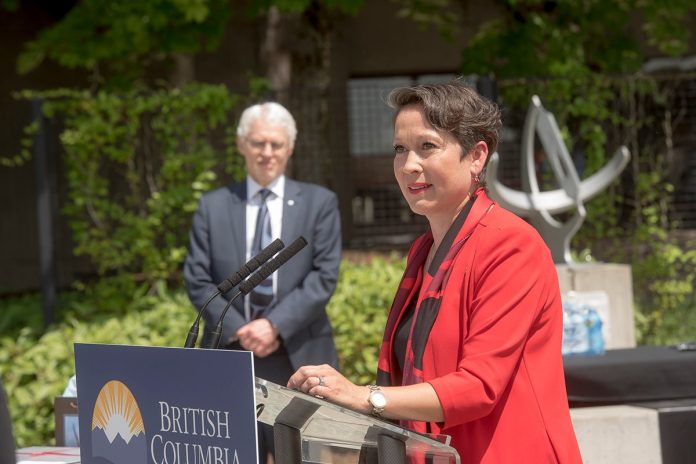
On June 19, SFU announced the building of a First Peoples’ Gathering House, meant to provide Indigenous students with a ceremonial and community space on Burnaby campus.

The Gathering House is being funded by both SFU and the provincial government, who have contributed a 6.4 million dollar fund in collaboration with SFU’s 8.6 million dollar fund. Funding from SFU is a part of SFU’s Aboriginal Strategic Initiative, which aims to invest in projects in support of reconciliation efforts on all campuses. 

The space will be located near the Trottier Observatory and will be 1,346square metres, featuring a ceremonial hall with a capacity for events of up to 300 people. The Gathering House will also consist of an Elders’ room, classroom, wellness room, dressing room, food service room, and an Indigenous peoples lounge. 

In a statement to The Peak, Matthew Provost, VP Student Services of the Simon Fraser Student Society (SFSS), explained that the building of the Gathering House “is just one of the ways we can recognize how the institution is changing.” Provost stated that even 30 years ago, providing space for Indigenous students in this way would not be seen. 

“‘Reconciliation efforts’ have really shown why these initiatives are important not only for Indigenous students but the community as a whole [ . . . ] This will be a reminder for others on campus [on] the importance of recognizing whose land we are on [ . . . ] For future Indigenous students this will benefit them in very positive ways and I hope they are able to see this as a safe space,” stated Provost. 

In a BC government news release, MLA for the Burnaby-Lougheed riding Katrina Chen, commented that, “Indigenous students at the Burnaby Mountain campus will have a beautiful new space to celebrate their culture and connect with their community.”

However, Provost has raised concerns in how the institution has gone forward with Indigenous-focused projects in the past, hoping “there is more consultation in the future with Indigenous students going forward with this project. Previous projects [ . . . ] have shown why this is necessary.” Provost provided the atrium, located by the Indigenous studies department, as an example. 

“This was intended for Indigenous students, but somewhere down the line it became [a] public space. I have high expectations for the university to do this work in a good way.”

Provost added, “This project has the ability to strengthen the relationship between SFU and Indigenous students and community [ . . . ] Going forward decisions made for Indigenous students without Indigenous student input is not reconciliation. Nothing about us without us.” 

On behalf of the First Nations Student Association (FNSA) board, Zachary Pelletier issued a short statement to The Peak: “The FNSA is very excited to see the gathering house built at SFU. It will be a place on campus where we can hold events in a more comfortable and decolonized atmosphere.” 

A clip of the announcement, conducted on the space where the Gathering House will be built, is on SFU’s official YouTube channel. 

Friends social distance by walking in giant “body walls” occupying whole sidewalk

0
Photo courtesy of Sean Stratton via Unsplash

Written by Zach Siddiqui, Humour Editor

VANCOUVER, BC — An increasing number of Vancouverites are keeping contact to a minimum by forming “body walls” as they walk down the street, repelling others who might approach.

“No one will bother coming near us if we destroy all hope of pedestrian movement in this direction,” says Rudy Walker. 

Body walls are traditionally formed by assembling a group of friends to walk in a horizontal line, connecting the two sides of the sidewalk. The body wall phenomenon, according to health experts, can happen “anywhere infested with self-serving, Tindered-out millennials” and therefore especially in the Yaletown region of Vancouver. COVID-19 has only exacerbated the problem; the six-foot rule means that body walls can reach a breadth of 30 feet.

“Last week we actually had a stare-off with an opposing body wall,” said Tati Lespich, a member of Walker’s six-person unit. “Very Romeo and Juliet, or as Rudy put it, Red Rover: Pandemic Edition. We made it through all right, but we lost Ken to those bastards.”

Ken Cushion, the friend in question, told The Peak in an email interview that he was safely at home, recovering from a migraine. He had bumped into someone from the other friend group and fallen, hitting his head. He attributed his absence of mind, which led to the incident, to everyone else on the sidewalk being beneath his notice. 

In the meantime, Walker and his remaining friends have continued their circuit along Vancouver’s breeziest waterside walking paths. At press time, at least three joggers had been absorbed into the body wall, never to be seen again.

The five love languages of Canvas

0

Written by Zach Siddiqui, Humour Editor

Trouble in remote paradise? Can’t find happiness in your lifelong commitment? Fret no more. If you and Canvas just can’t communicate with one another, there’s a simple possibility: you don’t know your Canvas love language! Look to these five Gary Chapmanian categories, and figure out your personal truth. 

Words of affirmation

To determine your affinity for words of Canvas affirmation, pay attention to what gets a reaction out of you. That “Nothing Planned Yet” message on your Dashboard, lined with calming illustrations of trees and mountains, greeting you and affirms that you really don’t have to do anything today . . . Does that set your heart aflame? 

Quality time

If you think your Canvas love language might be quality time, there’s just one statistic you should count: the number of minutes spent downloading the exact same reading file off of your weekly module over and over because you keep losing it, watching it evolve from “Mosco.pdf” to “Mosco (1).pdf,” “Mosco (2).pdf,” and even “Mosco (3).pdf.” Nothing else could be so bonding — not even real polygamy. 

Giving gifts

In a way, giving gifts is the Canvas love language of the common people. We all speak it. Because the personal data analytics Canvas quietly harvests from you are the greatest gift anyone could give. Read those terms and conditions, babes.

Acts of service

Do you feel unfulfilled when Canvas fails to accept your uploaded file? What about when it locks your discussion post in the middle of you typing it and you lose your participation marks for the week? Acts of service might be your Canvas love language if these acts of disservice are enough to scar you. 

Physical touch

Sometimes love is simple. It could be that you just draw joy from tapping your keyboard around Canvas’s horrific interface. That ulcer you get when Canvas traps you in another “unable to log in” loop, that’s just the site returning the favour. 

Anti-Indigenous racism in healthcare should have been addressed years ago

2
It’s no secret that Indigenous people suffer worse health outcomes in Canada. Photo: Daan Stevens / Unsplash

By: Nicole Magas, Opinions Editor

There are a lot of conversations going on right now about the issue of over-policing and ongoing police brutality in Canada — particularly against Black and Indigenous folks. While this issue is important and absolutely needs to be addressed as quickly as possible, it is equally important to not forget that systemic racism and its fatal consequences are not limited to just law enforcement. The healthcare system itself is steeped in anti-Indigenous racism — which results in shocking levels of neglect and abuse for an industry that has “care” as part of its name. 

Perhaps the most recent example of striking racism in the healthcare system is the revelation that E.R. staff at some hospitals in BC played a “game” of guess-the-blood-alcohol-level of their Indigenous in-patients. But the issue here isn’t so much the shock that such a racist game existed — Indigenous people have been aware for decades that racism is embedded in the healthcare system. Rather, it’s that these revelations suddenly came to light amid a national upheaval against systemic racism, when these problems should have been stamped out years ago.

The “game” played by doctors is based on a stereotype that assumes all Indigenous folks have substance abuse problems. This stereotype has deep roots in Canada’s brutal colonial past. It persists today as a justification for dismissing Indigenous folks on the basis of a logically flawed, racist moral standard. In the healthcare system, this means that Indigenous patients seeking care for the same problems anyone else in the population might go to the hospital for are often pre-judged as simply being intoxicated, rather than in medical distress.

This prejudice has very real and often fatal consequences. In 2008, Brian Sinclair, an Indigenous man living in Winnipeg, sought help at a local hospital for abdominal pain due to a blocked catheter. Disoriented from his growing bladder infection, Sinclair was dismissed by medical staff as drunk. They left him unattended in the waiting room for almost two full days to “sleep it off.” He died waiting for the help of people who refused to believe he could be anything other than intoxicated.

Instances of Indigenous folks being dismissed or denied care by the medical system are far from rare. A few years ago I listened to a CBC Radio episode that detailed the story of Sandy Mock, who was denied care at two hospitals after they misdiagnosed her stroke for intoxication on the basis of her Indigeneity. Thinking I could easily find this episode again for the purpose of this article I plopped “doctors mistake stroke for intoxication Indigenous health” into a Google search and received back a dump of other stroke misdiagnoses amongst Indigenous patients — none of which were even Mock. What does that tell you about the systemic racism that’s more than apparent in our healthcare system?

Which is why it’s so angering to hear BC Health Minister Adrian Dix claim that he was unaware of a report detailing anti-Indigenous racism in the healthcare system. It doesn’t take an official report to be cognizant that, as a marginalized community, Indigenous peoples suffer more from health inequities than any other group in Canada. An ounce of curiosity into the experiences of Indigenous peoples in healthcare would have uncovered the fact that racism plays a large role in these outcomes. Which, of course, is a completely separate issue from the fact that apparently a report called “Mapping the Harms of Anti-Indigenous Racism in the BC Health Care System” never even made it to the health minister’s desk.

Government agencies need to start taking a proactive, rather than a reactive, approach to solving the systemic racism that has been embedded in social, legal, and medical practices for far too long. It shouldn’t take people dying at the hands of the police or from neglect in our hospitals for real change to be started. The racism is real. The inequalities are real. They exist. Stop focusing on the symptoms alone and start seriously implementing a cure for the actual disease.


Political Corner: Last minute efforts cost Canada its Security Council seat

0
Trudeau could learn from the long-term strategies of the winning countries. Photo courtesy of Women Deliver via Wikimedia Commons

By: Kelly Grounds, Peak Associate

On June 17, the United Nations held a vote for five of the 10 non-permanent Council seats for the 2021–22 term. The countries that were elected to the Council for the next term are India, Ireland, Kenya, Mexico, and Norway. Canada was not one of them, losing to both Ireland and Norway in the category “Western Europe and Other States.”

Since 2016, the Canadian prime minister has pitched this vote and the election that preceded it as Canada’s path to a more influential role in the world. He attempted to turn this message into reality by trying to take a more active role in Canada’s partnership and the UN. There were 13 staff members employed to work on the campaign that had an estimated budget of $1.74 million. Despite this, Canada wound up losing its bid with less votes than during their previous campaign under the Harper government.

So what happened?

In the days leading up to the June 17 vote, Prime Minister Trudeau and his team called Fiji, India, Mexico, North Macedonia, and Pakistan to try and secure votes. The campaign team and the prime minister only started visits to Ethiopia, Germany, and Senegal, to discuss the campaign in February, four months before the vote. Following this, the campaign’s planned visit to the Carribean was cancelled due to the pipeline protests and was never rescheduled. 

While one could make the argument that the pandemic forced the government to reprioritize in the lead-up to the vote, it’s important to remember that this campaign has been ongoing since 2016. That is four years to meet with countries and create stronger relationships to secure votes, rather than simply calling them in the days leading up to the vote. 

Norway and Ireland understood this, having started their campaigns earlier than Canada did. This extra time allowed them to strengthen relationships with countries naturally and increase the international goodwill in a way that did not appear to be tied to the vote. It also allowed both countries time to plan events for the international community to strengthen their standing in the global system. If Canada had used the time that it had more effectively, it may have had a chance. Instead it waited until the last moments to push for the votes and it obviously backfired.

SFU needs to invest more in its language offerings

0
Languages are too valuable to students’ learning to omit them. ILLUSTRATION: Cora Fu/The Peak

By: Michelle Young, Staff Writer

Over the years, SFU has been slowly picking away at its language program. The Spanish Language Certificate was suspended in 2017, and there is speculation that Arabic and Persian courses will be the next to go. In a bid to save languages at SFU, the Language Training Institute has been merged with world literature to create the world languages and literatures department, and it’s not unreasonable to fear that this will result in the further dwindling of language courses. However, languages are an extremely valuable elective to take. Merging the program without investing in more professors and more course offerings will negatively narrow students’ elective choices and leave them with little opportunity to explore new languages at their home institution. 

The reason languages are being peeled away could be due to lack of demand. While overall course enrollment has indeed gone down, it isn’t nonexistent. To keep a broad range of languages available, sections could be reduced to fit the demand; but to completely remove a language option seems extreme and detrimental. Personally, I haven’t seen much promotion of language courses overall, and if students have to dig to discover them, it’s only natural that enrollment drops. Similarly, if only the “most popular” languages are offered, there is little opportunity for students to delve into specialized languages and gain skills that could prove to be extremely valuable in the future. 

The benefits of learning a language are overwhelming. Those who learn a foreign language build multi-tasking skills, improve their memory, enhance overall brain functionality, and can better fend off dementia later in life. Not only are languages great for exercising the mind, but learning a new one can aid in providing cultural insight, provide students with new worldviews, and propel travel opportunities. 

If students are interested in studying abroad, doing an international co-op, or graduate fieldwork in a non-English speaking region, learning a language may be a necessity for these experiences. However, if SFU doesn’t offer a particular language, or only offers a very basic level of study, students will be forced to turn to other institutions for language education, which may not count for credit. This means that the university loses out on tuition revenue and students have to take extra steps outside of their degrees to build up their futures.

On a casual level, multilingualism remains extremely useful in Canada. A 2016 study found that 6.8 million people have a first language other than English, French or an Indigenous language — this is roughly 19% of the population. Even if students aren’t taking a language for educational or career pursuits in day-to-day interactions (though increasingly, being bilingual can help in job searches), speaking multiple languages is extremely helpful. 

At minimum, the new world languages and literatures department should be preserving the current language offerings to ensure students have access to a worldly education. But our university shouldn’t be aiming for minimum effort. It should make an investment in more and diverse language offerings, and promote the benefits of language learning to make sure the courses can thrive into the future. After all, SFU’s slogan is “engaging the world” — it’s hard to do that if our students can’t communicate across languages.


Lights’ How To Sleep When You’re On Fire is a vibey, instrumental space jam

1
Lights’ new album removes focus on her voice and redirects it to her composition skills. Courtesy of Lights

By: Michelle Young, Staff Writer

Canadian electro-pop artist, Lights, recently released the album, How To Sleep When You’re On Fire. Starting out in the 2006 MySpace scene, the artist has evolved her sound throughout the years. Clean and electronified earlier works like The Listening turned gritty, experimental, and bass-distorting in later works such as Siberia. Rich and synthy, Little Machines solidified her style and provided a stepping stone towards the versatile, genre-blending Skin & Earth. 

All of these albums — and their acoustic counterparts — have positioned Lights’ vocals as a strong feature in her work. However, the most recent release, instrumental synthwave How To Sleep When You’re On Fire, is a departure away from this feature. Instead, it demonstrates her strength in bare composition while successfully creating an atmospheric release that listeners can delve into. 

The album starts slow, with gently layered synths that turn uptempo to create a track that feels like floating in the galaxy. The second track, “ExoSkeleton” picks up the pace — its rich beats and electronified hymns retain the album’s ethereal atmosphere. “SadBoy” is uplifting and ambient; chords quickly whirl to create a sense of lonely intimacy. “DarkMode” too, provides a kind of sad, late-night comfort in its upbeat synthesizers. 

After the series of fast-paced songs, comes slower “GreenTxt.” Unlike the smooth texture of the first tracks, “GreenTxt” is grainy, with pitter-patters of rain hidden amongst keyboards. How To Sleep When You’re On Fire reverbs throughout and songs blend into one another easily — each track has a clear beginning, musical climax, and slowly fades into the next track. 

“Softeeth” continues the trend of melodious, soothing synths mixed into whispers to create a mesmerizing and hypnotic track. The last piece, “PalmTrees” is the longest song, spanning seven minutes. It’s gradual and takes about two minutes for the track to start progressing in its composition. While it holds a certain sadness, it provides comfort in creating a sound that captures what it feels like to spend time with yourself — especially relevant when we’re all isolated from one another. 

The album feels like a hybrid of Lights’ pop and acoustic releases: it features an electro-pop sound that successfully meshes soothing guitar chords to provide a feeling of peace. Upon release, Lights wrote that she made the album “over the last few weeks of sleeplessness.” How To Sleep When You’re On Fire will leave you dreaming with the stars, serving as the perfect album to sink into before bed. 

How To Sleep When You’re On Fire can be enjoyed and bought on Bandcamp — all proceeds (after PayPal and Bandcamp fees) will go to Black Lives Matter Vancouver.

Research Roundup: SFU researchers develop AI tool to better diagnose COVID-19 cases

0
Photo courtesy of SFU News

Written by: Nathaniel Tok, Peak Associate

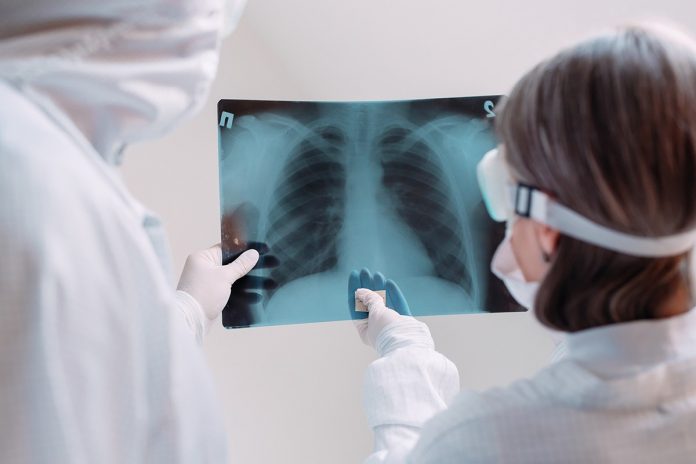
SFU Researchers and Providence Health Care (PHC) are using Artificial Intelligence (AI) to better understand how to detect COVID-19 cases.

The tool, which is currently under testing in St. Paul’s Hospital, will help clinicians distinguish between COVID-19 pneumonia and non-COVID-19 pneumonia. 

It works together with other diagnosis tools like Computed Tomography (CT) scans by analyzing a chest X-ray image to help confirm if the pneumonia’s characteristics are consistent with COVID-19.

Yağız Aksoy, an Assistant Professor in the School of Computing Science, helped create the machine’s learning algorithms that enables the AI tool to analyze X-ray images. “Instead of doctors checking each X-ray image individually, this system is trained to use algorithms and data to identify it for them,” explained Askoy. 

According to Askoy, this will allow resident and less experienced doctors to be able to identify COVID-19 cases even if a senior doctor is not present. 

SFU mathematician Vijay Naidu also helped to create a COVID-19 identifiers database used by the AI tool to better identify positive patients. 

The tool’s development highlights the importance of collaboration during the COVID-19 pandemic between researchers in academia and clinicians in healthcare according to Soyean Kim, director, Digital Products, Providence Health Care.

The tool is still under testing and evaluation, however once it is approved, it will be made available for free with the UN’s support. Fred Popowich the scientific director of SFU’s Big Data Initiative explains “Our goal is to advance COVID-19 response efforts and make this knowledge accessible to clinicians around the world.”

Long Story Short: It’s OK to struggle with adjusting to a new academic environment

0
Illustrated by Tiffany Chan

By: Devana Petrovic, Staff Writer

For most of high school, I was relatively strong academically. I mean, I never failed any classes and seemed to get by pretty easily, but I also was definitely not a top student. However, that doesn’t mean that I didn’t have strong views on what my strengths were and that I didn’t hold myself to certain standards. Since I spent the first two years of high school in an accelerated program clashing with highly competitive students, I internalized a lot of the unrealistic expectations that I saw in my peers. 

So, coming into university with a full course load and having an already overwhelmingly new experience was difficult. I was mentally and emotionally struggling, and I was completely over my head with expectations for myself. Plus, I was working a part-time job 12 hours a week. Yeah, it didn’t really start off too well. 

The first couple of weeks were manageable enough. As long as it was syllabus week and I had nothing due the next day, the whole university thing seemed doable. Talking to a lot of my friends in their final years of post-secondary, I had heard several stories on unexpected failures and adjustment issues with being a first-year, but just like every other human being, I obviously thought I would be the exception and disregarded this possibility for myself. Of course, looking back now, my reasoning lacked any sort of logic and was destined to make me feel like shit. Surprise — it didn’t take long for the authentic SFU experience to kick in. 

About less than a third of the way into my first semester, I had already nearly failed an English paper — which was probably a sympathy pass — gotten torn apart by more than one professor, and cried in a lecture and the bus ride home an unhealthy amount of times. 

See, in the past, I had treated school as something that required my utmost ambition. I never allowed myself to fail or even slip-up a little bit. It had always been a matter of achieving, not growth. Part of that came with having parents with high expectations, but also the learning environment in which I was accustomed to. So, seeing myself “fail” felt wrong and shameful, like something that had erupted from a personal flaw. I was confused and completely taken aback by my poor performance.

None of the struggles I faced in my first semester were failures, but merely opportunities for growth in my learning, which is exactly what should be happening in a university. 

I also come from a cultural background where struggling to succeed is a sign of weakness, and where it is not customary to be particularly open about mental health struggles in general. 

I had to ask myself, “Does my failure reflect on my abilities and skills? Have I been cowardly flaunting my confidence this whole time when I’m really not good at anything?”

Not to mention, I had no sense of community or a support system on campus. Being a commuter made it difficult to make friends as I would usually bus home immediately after finishing my classes for the day. It was always lonely, I had little communication with people and even started to sparingly see my closest friends. Everything felt like it was drifting from my control, and as the semester progressed I only felt more alone and isolated. The aspects of my life that had felt safe and secure before starting post-secondary started to feel like they were dissolving before me. 

In short, I felt entirely out of touch with myself.

I admit that a lot of what I’m describing is basically the standard for many students, and I’m not trying to prove that my struggles are worse or comparable to anyone else’s. I view my learning now as a completely different phenomenon and in retrospect, being so rigid with my education was probably a factor in why it was difficult for me to adjust.

I’m very lucky that I had an accessible, loving, and supportive group of friends to listen to me and to continue reassuring me that it would get better as long I was patient with myself. Having that safe place, where I could admit I was struggling, feel free of judgment, and also receive genuine and thoughtful advice drew me back to some form of rationality. 

I had spent the majority of my first semester at SFU trying to fight those feelings of confusion and uncertainty. I was in denial of the trouble I was having adjusting, and trying to adhere to the academic standards I had in mind for myself. In turn, it only made it a harder struggle. 

As soon as I allowed myself to be vulnerable with my conflicts, things started to seem clearer and less permanent. Once I understood what I was going through, I was able to help myself in my second semester by getting a job on campus, meeting new people in my classes, and working towards building a community for myself at SFU.

I was struggling to adjust to a new environment during a particularly fragile time in my life, and that’s OK. None of that is easy, and being so strict with myself over minor bumps in the road was entirely unreasonable. None of the struggles I faced in my first semester were failures, but merely opportunities for growth in my learning, which is exactly what should be happening in a university. 

It was a difficult semester for sure, but it taught me to be patient with myself, how important it was to unlearn and dispose of my fears of ‘failure,’ and that if I give myself a chance, new opportunities and experiences can be well worth it. 

Grad students grapple with lack of U-Pass as labs reopen

0
Photo courtesy of Simon Fraser University

Written by: Zach Siddiqui, Humour Editor

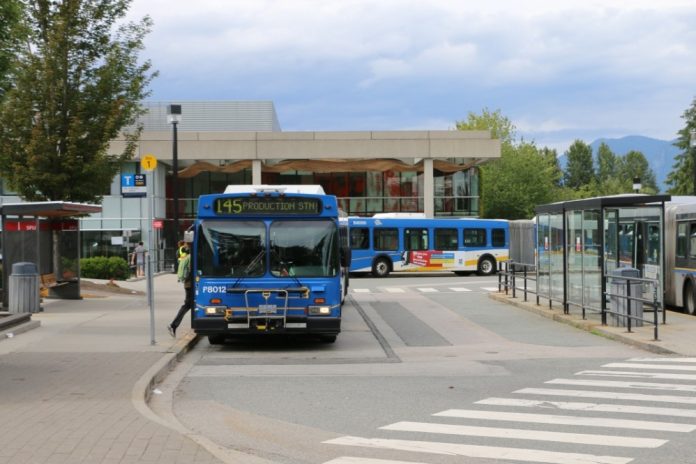
With labs reopening and the suspension of the U-Pass program, many grad students are facing additional costs on account of transportation, according to Matt McDonald, Director of External Relations at SFU’s Graduate Student Society (GSS). 

TransLink first announced they were suspending the U-Pass in early April, a decision purportedly made in concert with its participating colleges, universities, and student unions. SFU’s GSS was the last student union in Metro Vancouver to vote on the matter.

“Due to the collective participation nature of the U-Pass, we did not effectively have a real choice,” said McDonald, in an email interview with The Peak.

The U-Pass program is currently on hold until the end of August. With classes likely staying online for Fall 2020, McDonald expects a “split in opinion” between graduate and undergraduate students on whether to reactivate the program in September. He explained that graduate students need to travel to campus more, as their research often must be done in-person.

Students would normally pay $41 per month for the U-Pass, paid semesterly as a part of their tuition. Without the U-Pass, McDonald estimates that the average grad student would lose about $500 per term, based on the cost of a monthly 3-zone pass — a cost he stresses is “not easy to absorb.” 

“Our hope [ . . . ] is that some solution is worked out that allows graduate student access to the U-Pass program at least from September, as an earlier reactivation appears unlikely at this point,” he said.

McDonald reported that many grad students have emailed the society to protest the U-Pass suspension, while a “smaller number” have written in support of pausing it, “typically those who have their own vehicle or will not need to be on campus for the foreseeable future.” 

The GSS is in continuing communication with SFU and the U-Pass Advisory Committee. McDonald holds that the society is “actively and productively” working with the university on solutions to minimize future costs for grad students. 

“SFU has a role to play here either financially and in terms of advocacy – after all, the primary transportation need is connected to the academic progress of its graduate students,” he said. “Conversations are ongoing but we believe the administration understands this is an important problem that may get worse, and we have been encouraged by recent meetings discussing how they can tangibly help lift the burden on graduate students. 

“We also hope TransLink and the provincial government will realize the different needs and circumstances of graduate students in Metro Vancouver and help tailor a solution for us in the coming months.”

The GSS is currently offering a transit subsidy for grad students needing aid to cover travel costs, available via online application. SFU’s Student Services and Graduate & Postdoctoral Studies departments have also committed to contributing funds to the subsidy, according to a statement relayed by administration from Tracey Mason-Innes, the university’s acting Vice Provost, Students & International.

Osob Mohamed, president of the Simon Fraser Student Society (SFSS), says that there has “not been substantial demand for the reinstating of U-Pass for the summer” from undergraduate students. However, according to Mohamed, the SFSS is aware that students will likely be in greater need of public transit as the province reopens. 

“There are definitely still students who need financial support for transportation during the Summer semester, and we are exploring ways to potentially reimburse or financially support students who need transit passes,” says Mohamed. 

“Myself and Samad Raza (our VP External Relations) have also been working with other student societies in the Metro Vancouver area to develop a plan for the Fall and subsequent semesters, to ensure that we can come to an agreement with TransLink that is fair and affordable for our students.”