Home Blog Page 413

Powell Street Festival telethon takes intersectional importance to the internet

1
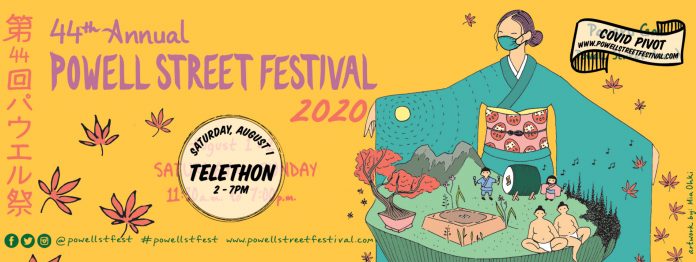
This year’s Powell Street Festival may be digital but is still packed with events. Courtesy of Powell Street Festival

By: Madeleine Chan, Staff Writer

Vancouver’s Powell Street Festival has been happening yearly since 1977 in the Downtown Eastside (DTES), and like many events, a pandemic isn’t stopping it this year. The festival will virtually kick-off on August 1 from 2 p.m. to 7 p.m. with live performances, and the addition of a telethon. 100% of the money raised will go to their new PowellStFest Community Kitchen program which will cook “200 meals for the unhoused and precariously housed in the DTES” every week. 

According to the Powell Street Festival website, it aims to celebrate Japanese Canadian history by showcasing Japanese Canadian artists, performers, and culture while engaging “the broader community through fun cultural activities.” They also do this throughout the year with events like the Hanami Cherry Blossom picnic and other community outreach initiatives. Their hope is to keep people aware of the continuing history of both Japanese Canadian and Indigenous displacement and to be “accountable as settler-colonizers.”

I had a chance to talk to SFU Writer’s Studio alumni and long-time Powell Street Festival volunteer Erica Isomura about the festival’s new format and the importance of demonstrating intersectionality.

The Peak: What is the Powell Street Festival telethon?

Erica Isomura: To give some context, Powell Street Festival has been happening at Oppenheimer Park in the DTES in what used to be known as quite a large Japanese Canadian community and neighbourhood, before the second World War and Japanese Canadian internment took place. So 44 years ago, the festival started at that park and it’s basically happened at Oppenheimer every year since then — except for years when we’ve moved to the street in solidarity with tent cities. This year, we are pivoting to a telethon in light of what’s happening with [COVID-19]. 

We’re raising funds for a new program that we’re going to be running in the fall called the PowellStFest Community Kitchen, which is going to be part of a broader community kitchen network in the DTES. [This] is supposed to plug into the existing programming that is happening but also recognize that a lot of the emergency funding that has been going to the neighbourhood because of [COVID-19] is running out. So the idea with the telethon is to raise money for more sustained programs year-round.

P: Why do you think the Powell Street Festival is important to hold this year, even though it’s all virtual?

EI: I think what I really like about the festival is that it really brings the community together in a way. The Japanese Canadian community is pretty dispersed in terms of not really having a centralized neighbourhood. I personally didn’t grow up with a lot of community outside of family, so it’s been really nice to connect to this festival that’s been around for so long and that has been a really great space for me to learn and connect with elders and with other older artists. It’s a legacy of the community. I feel like as an arts and cultural space to also be progressive and be aware of our community’s history and bring those values into the present is really important. 

But as a festival, even if you’re not political, it’s so inclusive and really has something for everyone, there’s really nothing like it. I just really appreciate what it offers. There’s so much joy. To be able to have it online I think is great in terms of being able to still build more connection in a time when people are isolated. Especially generationally isolated with [COVID-19], not being able to connect with lots of older people who are maybe immunocompromised. It’s just cool to see what people are going to be able to offer back through the program but also what people can connect to from home.”

P: Why do you think it’s important to demonstrate intersectionality and allyship with Indigenous communities and sovereignty?

EI: Obviously with what’s happening in the world, with so much light being shed on systemic racism and police brutality, it has really [highlighted] how many issues exist in our present day society that a lot of people have been talking about for many years. 

I think for organizations and  communities to show up and, to show solidarity is so much more, I don’t know if the word is empowering. But I think it can be really hard as an individual person who wants to make change without support from others. To be able to be in conversation with other people and learn alongside other people and learn across generations are things I really appreciate. As an accessible and family friendly festival, to be able to bring these values to the festival and try and encourage people who might not otherwise be thinking about some of these things in this way is impactful. 

We should be in this together to be making change and to create a better world than what we’re living in right now.

Check out the festival and donate to support the new PowellStFest Community Kitchen program at www.powellstreetfestival.com.


C19 Coalition answers student and worker questions in virtual Town Hall

1
Poster for the townhall event. Photo via Facebook courtesy of SFU C19 Coalition.

Written by: Devana Petrovic, Staff Writer

Updates from student and faculty organizations

C19 Coalition representative, Alison Wick, provided some background on the recently formed advocacy group. The Coalition was formed as an alliance between the Simon Fraser Student Society (SFSS), the Graduate Student Society (GSS), and the Teaching Support Staff Union (TSSU).

President Osob Mohamed gave updates on SFSS’s COVID-19 initiatives. She noted that the SFSS has “been loud and forward with the government [ . . . ] [pushing for] students to have access to things like the CERB.” 

Mohamed also explained that the SFSS is supporting students struggling financially, “hoping to open up a food hub, where [they] can actually provide fresh food to students during the course of this pandemic [ . . . ] also working with our health plan providers to [make] a fair alternative for international students who may not be in the country.” 

The SFSS’s main requests of SFU have been for decreased tuition for online classes and an elimination of the 2% fee on late tuition payments. Other key issues that the SFSS is considering include the UPass for the Fall 2020 semester and privacy concerns with regard to exam invigilation. 

GSS director of external relations, Matt McDonald, stated that the GSS has been “dealing with this [pandemic] in two ways: advocacy [ . . . ] and providing extra financial support and services for [GSS] members.” The GSS’s primary concern is the financial impact the pandemic has had on graduate students and in getting the administration to recognize the depth of these problems. 

McDonald explained that the GSS has “put a fair amount of money towards [their] own relief program,” which can be applied for on the GSS website; it also offers a family subsidy, a transportation bursary and an emergency food and grocery card. 

Questions

A general question asked to the panel was what concerns the coalition has going into the Fall 2020 and Spring 2021 semesters. 

“Our main concern is that this is not going away [ . . . ] so we need to stay on top of how things are changing,” answered Wick. She further explained that a main concern is how much the university puts the onus on students for academic progress and receiving financial aid, and that the coalition is looking to mitigate the uncertainty many students face with receiving bursaries and making tuition deadlines. 

A highly upvoted question asked how undergraduate students can support their sessional instructors. 

Orion Kidder (TSSU) said, “The administration counts on students not knowing what the issues are with sessionals and not being supportive of them [ . . . ] so, let the administration know [ . . . ] email [email protected] [ . . . ] directly.” 

Kidder also added that off-campus influence can make an impact, encouraging students to engage their parents in also contacting administration as “they hate hearing from parents because they know parents control money and their biggest concern is revenue [ . . . ] that embarasses them, that shames them, and makes them fear for their revenues.”

Hobbies: How I got into songwriting

0
Illustration: Sabrina Kedzior / The Peak

By: Marco Ovies, Editor-in-Chief

Ever since my parents forced me to take piano lessons when I was seven, music has always been such a big part of my life, . 10 years later, I ended up hating piano lessons, but gained a new appreciation for music. Being able to focus all my attention on learning a new song was a much needed emotional break from not only the ongoing pandemic, but also just problems that rise in everyday life. Eventually, I fell in love with the process of learning instruments. Naturally, I started to learn bits and pieces of instruments. Guitar, drums, bass, melodica, and even a bit of mandolin to name a few. I realized that I had become my own one man band, and with the marvels of modern day technology, I was able to record each instrument and create a song that I am almost proud of. 

Sitting down, taking out my computer, and focusing all of my energy into a song has been a good emotional outlet. It has almost become a diary of sorts, and I am able to capture my emotions better through sound rather than words (which is ironic since I’m paid to be good with words). Of course, I would never release one of these super personal songs, but I was still able to write probably the most basic song in the history of basic songs. So if you’re wondering how I did it, buckle up because I’m about to walk you through how to write a song. Keep in mind that while these are the steps I took, they aren’t necessarily the order you have to keep to. Listen to your creative process!


  • Choosing your recording software


I’m going to be honest, I’m a bit biased towards Apple products. GarageBand is a great place to start, and it’s also free. If you’re unsure how deep you want to get into songwriting, you should start there. Another free program that is also available for Windows is Audacity.

I quickly outgrew GarageBand, though, and ended up downloading Apple’s other music software, Logic Pro X. It is a bit on the pricey side coming in at $199, but it is a thousand times more powerful than GarageBand. It has tons of features like thousands (and I quite literally mean thousands) of different sounds to play around with, stronger editing features, and ultimately allows you more creative freedom than GarageBand. 

Of course there are plenty of music production software available, so be sure to do your research to find the one that will work best for you and the type of music you are trying to make. 


  • Make a groovy beat


I find creating a beat is a good start to any song. You can create your own beat by recording yourself playing the drums, you can use one of the hundreds of drum samples available on Logic, or you can use one of Logic’s AI drummers to help establish a groovy beat. 

Quite often I would start with one of these AI drummers, Gavin being my favourite (yes, they all have names) and then I’d end up changing the beat as the song evolved after adding in more instruments. You can get really creative with beats too. I once sampled the sound of a woodpecker banging on a metal pole, and it created a really cool sound. Anything can be a beat, so go crazy with it. 


  • Drop the bass


Now this is the part where you have to start making some real musical selections. Typically I would start by figuring out what chords I would want to use. My favourite chord progression is G, D, and C, which is probably one of the most common chord progressions out there. Another really common chord progression is C, G, Am, and F. If you only learn these four chords, you can play hundreds of some of the most popular songs out there.

Unless I had something super interesting already planned out in my head for how the bass would sound, I typically would just play the bottom note of each chord on every beat. But like almost everything I’m going to mention in this piece, the bass would quite often change after a burst of inspiration and turn into something super cool. While setting up the song, though, I like to keep things basic and go back to record more complex parts later. 

Don’t actually own a bass guitar? All music software comes with plenty of different bass samples that sound very accurate, and you can play with them directly from your computer keyboard. 


  • Guitars and more guitars (and then maybe some more guitar)


This one is pretty self explanatory, you play the same chords that you played for your bass. I liked to break it up by alternating between one long, drawn out chord or going crazy and playing eight strums for each chord (down, up, down, up, down, up, down, up). 

Most music softwares do come with guitar samples as well, but I personally have never heard one that has sounded as accurate as the real thing. If you need one instrument for songwriting, it would probably be the guitar. That being said, not all music needs a guitar, and it really just depends on the style of music you want to make. 


  • Time to siiiiiiiiiiiing 


The bread and butter of any song is the lyrics. Write about the person who broke your heart, the love of your life, a game of poker you lost, your cat, or literally anything. 

I have seen countless interviews with people who tend to romanticize the artistic process if the work is based on traumatic or hard experiences. Honestly, the subject matter of the song doesn’t matter as long as you’re having fun. I wrote a song about dabbing once, so I think that speaks for how silly you can get with it. 

Most songs have two verses, three chorus, and a bridge. Again, you don’t have to follow this formula exactly, but if you’re just getting started writing music, this is the most basic one out there. 


  • Get funky with it


Now that you have established some sort of melody, it’s time to play around with the song as a whole. Get some guitar solos in there, even if it’s just a reflection of the same notes that you sang in the chorus. Maybe even a cool synth line would add some depth to the song. My biggest misconception when I started writing music was that I needed to be singing the entire time. That’s not the case at all — get comfortable with letting your other instruments shine and showing off your real compositional talent. 


  • Master mastering your track


This is the more technical part of the song, and people spend years studying it. Meanwhile, I’ve watched a five minute YouTube tutorial so I might not be the best point of reference on this. I can, however, suggest some basics.

Check to make sure your volume levels are right because you don’t want to drown out your vocals with your sick guitar (unless you’re doing it intentionally, it’s your song). Try panning your instruments to different sides of your headphones as well.

 You might not think this makes a difference but it creates the feeling of a live band in the room with you. If you’re new to mastering, I recommend checking out the automatic mastering website LANDR. While it won’t sound as good as mastering the track yourself, if you have no idea what you are doing, it will definitely elevate the sound of your song. 


  • Now that you have given birth to your music child, get it out there


This part is surprisingly easy — anyone can get a song out on Apple Music and Spotify these days. Personally, I use the distribution service CD Baby to send out my song to all the major streaming services, and they do it all for around $10. 

Sounds too good to be true? Yeah, don’t expect to be making millions off of your latest single. For every one stream a song gets, I get around $0.005. Yes, that’s right, that is half of a cent for every play. That means if you want to make your $10 back you need to have your song played at least 2,000 times. Or, if you want to make your $200 back from buying Logic Pro X, you’ll have to get 40,000 streams. Honestly, that is the reality of making money from your music, but at least you’re getting paid! 

So here you have it, eight easy steps to write a song and you’re done. The most fun you’ll have with making music is the creation process, so take your time to enjoy it. It’s so easy to want to have a finished product as quickly as possible, but I have had way more fun writing and recording music than I ever did publishing it. You don’t have to write the next number one hit single, use it as a creative outlet and just have fun. And remember, if you become famous after taking my advice . . . please remember me.

Starry Nights keeps the wonder of the cosmos alive

0
Illustration: RESLUS / The Peak

By: Madeleine Chan, Staff Writer

You may have noticed a shiny, domed building on SFU’s Burnaby campus while walking to and from the upper bus loop. Sadly, that area’s been cluttered with construction debris the past year, and I couldn’t even tell you what it looks like now. Regardless, that obscure building is the Trottier Observatory, home to a giant telescope. 

The Trottier Observatory itself is named after Professor Howard Trottier, who is known for his education and research on astronomy in the physics department. He usually hosts the Starry Nights events at the observatory where the public is invited to gaze upon the stars and learn about astronomy. 

This semester, they’ve transitioned the in-person events to livestreams on YouTube. The latest one was on July 10 and was the second socially distanced starry night event of the semester, but the first that I’ve ever attended in all my four years at SFU. And now that I have, I wish that I had attended more.

The livestream started at 10:30 p.m. with an introduction from Joanna Woo, host of the event. Woo is an astrophysicist, and a lecturer with the physics department. The stream was set up to have three small screens of live footage of the telescope and two views of the campus sky, along with a screen share of the program Woo was using to capture the night sky. Despite the late hour, she had an immediate excitement in her voice that made her passion about astronomy very clear. She later clarified that she is not a morning person, and that “staying up late is more [her] thing,” which I found both relatable and very apt for an astronomer. 

The first object, or space phenomenon, that Woo showed us was the Ring Nebula. It looked like a circular, rainbow light refraction — the kind that you might see when light passes through glass. She explained that nebulae are simply remnants of a dying star that has burned up all of its oxygen, and that this is what our sun will look like in the far, far future. Some other objects that we saw were a globular star cluster made of mostly red giant stars, a nebula that looks like the inner half of an apple, the Andromeda Galaxy, and Saturn itself.

Between every object, Woo brought up an interactive star map that marked all of the constellations, planets, nebulae, and more with various numberings. It was so cool how she could just pick any of them and the telescope would adjust its position to see it — not to mention that you could also see the telescope move in real time right beside it. Even though some of the objects that she visited were obscured by cloud cover, I still enjoyed simply viewing the map and watching the telescope move to capture it. 

We also got to see Jupiter and its four Galilean moons. Seeing our solar system’s largest planet as a less-than-penny-sized dot on my screen was somehow so nostalgic. It took me back to the wonder and excitement about stellar objects I had in grade two when I did a project on Neptune, and reminded me of the calm I still feel when I can see constellations through the city’s light pollution.

Throughout the night people were also asking a lot of genuine and inquisitive questions in the chat about the phenomena. Even though half the time I didn’t really know what they were talking about, I still enjoyed the excited learning that was happening. It made me wish I took that PHYS 190 astronomy elective that everyone always raves about so I could learn more about the sky that I spend so much time staring up at.

More than anything, I felt bad for Woo because a lot of the images weren’t rendering or were obscured by clouds. Woo seemed disappointed by this as well, and even apologized for the bad stargazing weather. But then she said something that really stuck with me:

“It’s actually kind of nice to have things that are not in our control sometimes. We do have things all lined up so well in our lives, and sometimes it’s healthy to be humbled by the fact that there are many things in our lives we can’t control, including the weather.”

Woo concluded the night with going back to Jupiter, even though it was now obscured by clouds. As she answered questions and started to wrap up the night, the clouds serendipitously parted and we got to see Jupiter one last time. It was a fitting end to a night of stellar exploration and education. The chat and Woo’s strong desire to see something beyond, to explore beyond the confines of their own preview, was so refreshing to see in the short-sightedness of our fast-paced way of life, and was what made this event so special. 

Starry Nights is a great way to jump into astronomy, or just be an avid star-appreciator like me.

If you missed the event and want to take an hour and a half to just stargaze and learn a bit about space, you can watch the livestream on the SFU Faculty of Science YouTube channel. As for me, I’ll be eagerly watching their Twitter (@sfu_science) to be updated on their next, wonderful night “under” the stars.

Blind Tiger Comedy’s initiatives are helping reduce barriers for BIPOC entering comedy

0
Improv pros and BTC's diversity coordinators Ronald Dario and Ese Atawo lead a comedy class. Courtesy of Blind Tiger Comedy

By: Devana Petrovic, Staff Writer

Blind Tiger Comedy (BTC), a comedy school in Vancouver founded by members from highly regarded improv groups Hip.Bang! and The Sunday Service, recently announced its further commitment to creating space for BIPOC (Black, Indigenous, and/or people of colour) performers in their courses. While BTC’s newer initiatives may appear to be following global trends on racial equality, it is important to note that the comedy school has always been active in increasing BIPOC representation and accessibility in their programs — an especially commendable feat considering how pricey acting and comedy courses typically range (on average $45 an hour if not more).

For those unfamiliar with the company’s past engagement in furthering equity in their programs, BTC has offered and continues to offer financial aid and diversity scholarships for people of colour, members of the LGBTQ2+ community, and differently-abled folks. They also host free one-hour drop-in improv classes every 3–6 months: POC Night hosted by Ese Atawo, and WTF (Women Trans Femme) Night. Involvement is open for people of all levels of experience. 

More recently, as a part of their continued diversity and inclusion efforts this summer, the Vancouver-based comedy school offered a beginner’s course reserved for BIPOC students new to BTC — a digital introduction to improv. The eight-week program includes a two and a half hour zoom session once a week with industry professional and instructor, Ronald Dario. The course is meant to delve into the basics of improv by providing students with proper terminology, scene etiquette, and the tools needed to advance improvisational skills beyond the online course. The typically three hundred dollar course also includes a final showcase after the course period, live-streamed online. 

BTC offered their introductory improv course exclusively to BIPOC, but also allowed the free-of-charge registration opportunity to experienced performers for whichever course they found the most fitting. This meant that any new BIPOC registrants were not limited to the exclusive introductory course, but could also enroll into any other program for free, regardless of the course level. Though the deadline to register for these courses has passed, the company encourages those interested to contact them — likely in case of any last minute dropouts. Additionally, BIPOC who have improv experience but have not taken classes at BTC are still able to peruse the list of upcoming classes offered on the BTC website and follow the instructions under the inclusion tab to check for eligibility and availability.

The efforts of BTC exemplify how other companies, organizations, and businesses can do their part to participate in racial justice, beyond just performative statements. In making the performing arts more accessible with initiatives like these, BTC is increasing BIPOC representation in the improv and comedy world — or at the very least, in the Lower Mainland comedy scene. 

Although their summer programs have begun, courses will continue to be offered in the fall. Anyone interested in enrolling with BTC in the future can sign up for their mailing list, or refer any registration-related questions to their general manager, Helen Camisa ([email protected]). For information on upcoming events, they are also on Instagram, Twitter, and Facebook.

Political Corner: Trudeau’s stubbornness in the Wanzhou extradition case is an incredible failure of duty

1
Chinese and Canadian relations are being jeopardized over an American trade dispute. Image: Maxwell Gawlick, with photos via Wikimedia Commons

By: Connor Stephenson, Peak Associate

Our prime minister, Justin Trudeau, has shown clear negligence in his responsibilities as our leader in the mishandling of Huawei’s Chief Financial Officer (CFO) Meng Wanzhou’s extradition case. Despite a clear pattern of behaviour in Chinese retaliation to Canadian criminal intervention, and Trudeau’s own loose affiliation with judicial proceedings, the prime minister has insisted on upholding the rule of law in this case. This carelessness has led to unimaginable harm for two Canadians detained abroad.

On December 1, 2018 the RCMP arrested Wanzhou, who is a Chinese national. Wanzhou has been accused of violating US sanctions on Iran, and bank fraud. The arrest was made on behalf of the US Department of Justice in compliance with the Canadian and US extradition treaty. Subsequently, China summarily detained two Canadians, Michael Kovrig and Michael Spavor on purported espionage charges in an apparent response to the arrest of Wanzhou in Vancouver.

Prior to Wanzhou’s arrest, the Canadian Security Intelligence Service warned the PM about the potential for retaliatory action taken by China if an arrest were to be made. In the past, China has acted similarly, detaining a pair of Canadians in 2014 after a Chinese citizen was arrested in BC over allegedly hacking into US government systems and stealing military secrets. Trudeau and his advisors seem to have failed to consider this past behaviour when dealing with Wanzhou. 

What is significant is that pertinent evidence implying the possible consequences of arresting a Chinese citizen in Canada was not considered by the prime minister in the first place. Yet he continues to appeal to the dangers of precedent and the probability of future harm to Canadians as justification for detaining Wanzhou.

Trudeau has said that abandoning the case against Wenzhou — as the Green Party of Canada has recently demanded he do — would set a dangerous precedent. Paul Manly, the foreign affairs critic for the Green Party argues that the extradition request by the US was motivated by the trade tensions between President Trump and China. 

Trudeau claims that orchestrating the release of Kovrig and Spavor as a form of mutual hostage negotiation would pose some existential threat to all Canadians, if it allows China to believe that it can respond to perceived injustices by detaining a Canadian as leverage. However the only existential threat posed to Canadians is the policy decisions made by Trudeau and his advisors. What’s more, the foolish comments made by Trudeau in stating that Canada is a nation of laws in opposing the release of the CFO is almost comical if we consider Trudeau’s selective application of the law in past judicial proceedings, and his sketchy attitude towards the ethics of governing.

Ultimately, it might not be reasonable to hope that China would release Kovrig and Spavor even if Canada were to throw out the case against Wanzhou. Yet Trudeau could move forward on the possibility of applying economic pressure, alternative trading options, or reconsider whether or not to permit Huawei’s 5G network in Canada as a solution to a perpetual tit-for-tat detention scheme with China. Any of the above would act as a means of establishing a more formidable approach to dealing with China’s habit of bullying other countries into submission. Regardless of the action taken, inaction is synonymous with failure. 


SFU Residence Dining Hall continues operating during the pandemic

0
Photo courtesy of SFU Dining Services

Written by: Paige Riding, News Writer

Located directly beside the Residence and Housing buildings on Burnaby campus, the Dining Hall feeds all students on meal plans and those in the Towers who do not have access to a kitchen. As an essential service, those in charge of the food service have made changes to how the building — normally a cafeteria-style eatery offering eat-in only — operates. 

The Peak reached out to various staff that make the Dining Hall run smoothly to answer some questions on what has changed due to new restrictions.

“Dining Hall has continued to provide meals to students in residences and the campus community on a daily basis throughout the pandemic,” explained Dan Traviss, the Director of Dining Services, in an email.

“Dining Hall is now cashless, with social distancing and enhanced safety and sanitation measures in place. Dining Hall continues to offer a variety of food options including chef-inspired exhibition cooking and special theme meals.” 

The email noted that Dining Hall offers take-out service only, with food being prepared and served by dining staff, as opposed to their previous buffet style. 

In such a precarious time, those feeding the residents at SFU have worked together to alleviate some stress around food for students and the SFU community. Manager of Marketing and Sustainability of SFU’s Ancillary Services Taylor Assion elaborated on one of these efforts coordinated with Ancillary Services, the Student Experience Initiative, Residence and Housing, and the SFU Office of Community Engagement.

These groups “launched a food security program to support students in Burnaby and Vancouver residences experiencing food insecurity as a result of COVID-19 challenges over the term break,” said Assion via email. 

“The food security program, which ran until the end of the Spring 2020 exam period, [provided] three meals per week at zero-cost to students through Dining Hall on Burnaby campus or at Nemesis Coffee in Gastown for students living in the Charles Chang Innovation Centre.”

Kelly Contreras, Resident District Manager of SFU Dining, elaborated on the impact the pandemic has had on the SFU community and those working at the dining services at the university.

COVID-19 has had a significant impact on the student community and on our dining services on campus. Our first priority is and has always been the safety of all students and our associates,” Contreras began.

Contreras also noted that as a result of the SFU Dining Hall staying open throughout the pandemic, many of their associates were able to remain employed. 

Contreras said that with the new school year, full-service and take-out as well as social distancing precautions will continue to be enforced. They will “continue to work with the provincial and federal governments” through the next school year.

“SFU Dining is committed to the health and wellbeing of our associates,” said Contreras.

SFU researchers to map COVID-19 vulnerability throughout BC

0
Nadine Schuurman (left) and Valorie Crooks (right). Photo courtesy of SFU News.

Written by: Zach Siddiqui, Humour Editor

An SFU-based research team of professors and graduate students will be looking at the communities in BC most vulnerable to COVID-19. Headed by Dr. Valorie Crooks and Dr. Nadine Schuurman, this project will visually map these communities to offer key information in a clear way for policy and decision makers. 

In an interview with The Peak, Crooks discussed the mapping project’s origins, structure, and purposes.

“Our instinct as researchers is to understand things that we see happening around us in the world, and I started to think: What can I do, or [what can] myself and colleagues who I work with do, to support our understanding of what’s going on?” said Crooks, a trained health geographer. From there, she reached out to Schuurman; the two have worked together many times over the past 10 years on projects combining Crooks’ qualitative research skills with Schuurman’s expertise in geographic information systems.

Crooks outlined three main “scenarios” of vulnerable communities to be mapped: spaces with more frequent COVID-19 cases, places with less ICU capacity and fewer resources with which to weather a possible outbreak, and areas where people are facing the consequential health effects of a pandemic — such as financial struggle, lost housing, and exacerbated depression and stress. 

As an example of what kinds of information might be conveyed, Crooks offered residential facilities, where workers may be at higher risk for contracting COVID-19, and their surrounding communities.

“Within 30 kilometres of, for example, a large prison, we might see that that’s the area in which many of the people who work there are located. And so that’s an area that we might view as having a particular kind of vulnerability.”

With these maps, the team hopes to provide a resource for decision-makers in BC, such as health authorities and members of government.

“The goal isn’t for [a decision-maker] to pick up a map and go, ‘a-ha! I know the solution. I know the answer,’” says Crooks. “We want our maps to be used as part of a decision-making process, to go in conjunction with the epidemiological information that’s coming up, the statistical information, the popular pushes that are coming on social media and coming from the media.”

Crooks also emphasized that the maps they make will be “beautiful” in terms of design while communicating complex information. Elaborating on this, she explained that maps, as a highly public medium, are uniquely ideal methods to convey pandemic information. 

“As members of the public, we’re not unfamiliar with seeing maps and getting meaning from them — whether that meaning is giving us a spatial sense of proximity — I’m here, that’s there — or, for example, [population] density,” she said. “Because of our popular use of maps, maps can also be this really interesting way of conveying really powerful information in the decision-making context. And that’s because it’s a tool people have some familiarity with.”

Besides Crooks and Schuurman, the research team includes Leah Rosenkratz and Jessica Tate, both graduate students, and Dr. Melissa Giesbrecht, the research coordinator. The team plans to develop and refine their maps through an “iterative loop” of research steps, says Crooks. Starting with modelling the data they will display, they will go on to survey medical authorities on variables to consider, draft the maps themselves, and interview decision-makers on what parts of the maps are or are not useful. In repeating this process, the researchers can refine their findings until they are fit to be more publicly shared.

Ultimately, Crooks emphasized the importance of this constant consultation throughout the process.

“It’s so important to come back to the end-user and decision-maker community and, say, ‘OK, is this useful for you? Is this the way that you would want to see it?’” 

As the project continues, Crooks invites anyone interested in asking questions to email her or to follow her Twitter at @ValorieCrooks for updates; she expects that the maps, once completed, will be shared publicly.

Former MP Svend Robinson appointed as SFU’s J.S. Woodsworth Resident Scholar

1
Robinson speaking during the 2019 federal election campaign. Photo courtesy of the Georgia Straight.

Written by: Paige Riding, News Writer

Civil activist and former Member of Parliament (MP) Svend Robinson has been named the J.S. Woodsworth Resident Scholar in the SFU humanities department. This is for a one-year term beginning September 1, 2020, during which Robinson will teach a seminar and partake in community outreach events, according to SFU News.

Robinson served as MP for the New Democratic Party (NDP) in Burnaby from 1979 to 2004, serving seven consecutive terms. 

The Peak spoke with Robinson in a phone interview about what this new role means to him and how he believes his experiences as an activist and politician will lend themselves to an educating role.

“I’m really excited and looking forward to joining SFU as the J.S. Woodsworth Resident Scholar. I’ve never been an academic. I’ve only been an activist, and in the last 10 years a diplomat working internationally. So this is a new role for me,” Robinson began. 

“I had the honour of representing SFU for a little over 25 years as a Member of Parliament and worked closely with many different folks in the SFU community, be it teachers, students, staff, and now it’s great to be part of the community in a new role.”

When asked about the namesake of the position, Robinson noted how humbling it is to fill a role of a civil rights pioneer.

Woodsworth was the cofounder of the Cooperative Commonwealth Federation, a social-democratic party established in 1931 and dissolved in 1961. His political impact resonates today through the benefits available to Canadians, including Employment Insurance and the Canada Pension Plan. This party was the predecessor of the NDP, the party for which Robinson represented.

“Woodsworth was a progressive activist in the best sense. He fought hard for the rights of working people, for labour, he was active during the Winnipeg General Strike. He actually did time in prison for his activism during the Winnipeg General Strike. We have something in common.”

Indeed, Robinson served time for civil disobedience from Clayoquot Sound in the 90s. Robinson’s activism led to his adoption into the Haida Nation amongst other acknowledgments. It is this shared history of activism that solidifies Robinson’s position as the J.S. Woodsworth Resident Scholar.

“I’m really looking forward to learning a lot myself at SFU,” he continued. “Obviously, I look forward to sharing with students and faculty and staff many of the experiences I had during my little of a quarter-century as a Member of Parliament.”

Robinson wishes to share some of his interests and experiences with the SFU community, including environmental concerns, Indigenous rights, the journey to equality for the LGBTQ2+ community, international human rights issues, and more. 

“I look forward to sharing those, but also to learning from the SFU community. It’s going to be a two-way street.”

Itaewon Class stuns international audiences with a powerful message of acceptance

0
Netflix's Itaewon Class is re-imagining what a Korean drama can be. Courtesy of Netflix

By: Yelin Gemma Lee, Peak Associate

Itaewon Class, a Netflix show based on a webtoon by Jo Kwang Jin, has been steadily gaining popularity since the release of its pilot episode on January 31. I was intrigued to find that friends who have never seen a Korean drama before, as well as people like myself who are typically not a fan of them, were equally absorbed and obsessed with Itaewon Class. I believe the main reason for its success is due to the heart clenching story full of compassion and grit. 

The story follows Se-ro-yi Park, a determined character who refuses to take the easy way out of any situation if it means compromising his core values and beliefs. As a result of this, he becomes subject to many ill circumstances and unjust treatment, eventually becoming a target of a powerful family who runs the most successful pub franchise in the country. The story continues as Se-ro-yi is released from jail and begins his revenge-driven plan: opening up a pub in the vibrant city of Itaewon even with the label of ‘ex-convict’ tagged on his back. He goes on to slowly employ and put together a loyal team of societal misfits he connects with along the way, and together they work towards making his ambitious dreams for the pub a reality. 

Se-ro-yi is a protagonist that you can’t help but respect and root for from beginning to end, and a character that inspires and moves the hearts of people who are discriminated against by society. The characters that join Se-ro-yi’s side include a transgender chef aspiring to be the best in Korea, a retired gang member, a talented sociopath, a Black-Korean character searching for his estranged Korean father, and even the harmless second son of his nemesis. The show’s intolerance for discrimination is made clear through Se-ro-yi’s compassion shown in deeply moving scenes with each of the characters. 

Credit for the quality of the story goes to Jin who quite rarely also wrote the script for the show. As a non-binary, queer South Korean, I never thought I’d see the day when I would be able to watch a Korean drama like this. Not only is it well done, but it’s popularity amongst the citizens of South Korea shows that South Korea is slowly but surely changing, and that the younger generation are starting to demand more equity in representation. I personally felt proud and deeply moved by this show.  

Itaewon Class not only boasts an incredible story, but is pure excellence as a whole. The cast is phenomenal and I was especially impressed with Park Seo-Joon who played the protagonist perfectly, even with its many challengingly emotional and tense scenes. The action shots were engaging, especially contrasted against the everyday scenes showing the vibrancy of Itaewon, and the soundtrack is brilliant. 

The show as a whole is a remarkable masterpiece that should be celebrated not only within the genre of Korean dramas or foreign/subbed shows, but in the realm of shows in general. It holds everything that you could want from watching a show: complex, lovable, flawed characters with compelling personal stories, raw emotion-packed acting, and beautiful cinematography and directing. Above all, this is the first time a show carrying a progressive message has been not only widely accepted and praised in South Korea, but in many other countries around the world as well. Itaewon Class is beautiful, powerful, hopeful, and I’ve never seen anything like it before — it’s an absolute must watch for anyone.