Home Blog Page 405

Upstart & Crow is a love letter to the ways independent bookstores create conversation

0
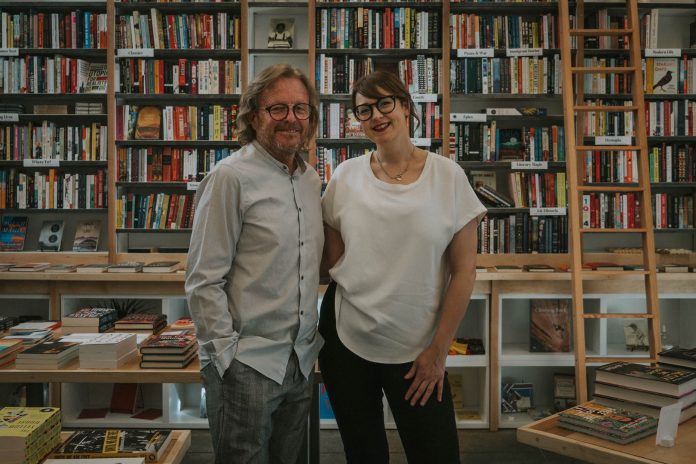
Owners Ian Gill and Zoe Gram have goals of fostering an open, literary community within Upstart & Crow. Photo courtesy of Olivia Leigh Nowak

By: Kelly Chia, Peak Associate

Found within the thriving arts scene of Granville Island, Upstart & Crow was built with community and a love of literacy in mind. The first word that comes to mind upon entering the bookstore is comfort. Books line one wall, and a few tables had been set up with recommended selections. Above me, the staircase leads up to a lofty mezzanine that was currently closed off. 

I spoke with Ian Gill, one of the owners, about the store. According to Gill, the name “Upstart & Crow” references an old nickname that William Shakespeare received when he first started writing plays because people thought he was an amateur. The idea for the name came up between Gill and his mother for a bookstore in Australia. While the bookstore in Australia never came to fruition, when the idea came to open up a bookstore here, the name stuck.

Photo courtesy of Olivia Leigh Nowak

Gill and his partner, Zoe Gram, had been eyeing the space on Granville Island for a while. When they finally got the keys on March 2, the pandemic really hit and they had to close for a while. At the time I spoke with Gill, he said that Upstart & Crow had only been open for almost a month — just about a day shy. Despite this, Gill said that business was well because people seemed eager to support the local economy. “Ironically, through the pandemic, people are thinking about the global economy and all these big box stores, and [concluding], ‘You know what? Most of the [everyday solutions] are local, including to the economy.’” 

Despite Upstart & Crow’s classic namesake, you’re more inclined to find works by new authors here. “We tend to favor more independent presses [ . . . ] to [try and] help the voices of the margins be better heard, because we have a very diverse and complex society, and you go into a lot of conventional bookstores, and you don’t get a diverse choice of books to read about. We’re trying to elevate the conversation and diversify the conversation,” Gill explained. 

Another key concept that Upstart & Crow had in mind was to act as a literary hub and a community resource. Gill gestured to the currently closed off mezzanine area, which had been intended to host a more communal space in the bookstore, but is currently not in use due to the pandemic. He hopes that in the future, they can invite writers in residence, and generally create a communal space for discussion. 

To reflect this, Upstart & Crow lists various offerings on their website, from information on upcoming plans for communal activities (if COVID-19 doesn’t interfere) to products from small-batch producers meant to enhance the reading experience. Upstart & Crow also has a collaboration with Thistalalh Library which provides new books to a community of about 1,300 people in Bella Bella in the Haíɫzaqv (Heiltsuk) territory. Customers of Upstart & Crow can choose an amount to contribute for books of their choice, and Upstart & Crow will source and provide it. 

A carefully curated section at Upstart & Crow. Photo courtesy of Olivia Leigh Nowak

The books in this store have clearly been curated to provoke discussion. Instead of the genres I was used to seeing like fiction and non-fiction, books were categorized based on the ways that they can challenge and present new ideas to potential readers. “Boys & Men,” for example, isn’t necessarily a section intended for men, but is described as collections of books that reflect on masculinity. 

In particular, one section that is titled “Urgent Voices” with the caption reading “books that will surprise, enrage, galvanize and inspire you,” lingers on my mind. It was clear to me then that these books were curated lovingly with the intention to be shared and spoken about — these captions were indeed engaging, and I wanted to know more about the curation process.

“We’re hoping that people will come in and think about the experience they want from reading a book rather than just think about being entertained,” Gill said. Rather than being split into fiction or non-fiction, these books were curated for people who had questions about things like history, current affairs, how we got here, and where we’re headed — books meant to thoroughly immerse you in a sea of ideas. 

Gill is also trying to immerse readers in international literature by bringing more translated works to the store. “Disappointingly, Canadians don’t read much international [ . . . ] literature, so we’re trying to sell more of that because there are a lot of good stories out there and a lot of them aren’t written in English,” Gill explained. In bringing more translated works, he’s hoping that these books will inspire people to expand their perspective. 

Overall, the atmosphere of Upstart & Crow was exactly as Gill described: approachable, but slightly challenging. “We think of this as our living room. You know, like our literary living room.,” Gill claimed, smiling. “We like to entertain, and we get to entertain lots of people, including all the people we don’t know!” 
SFU student writes letter on tuition increases

2
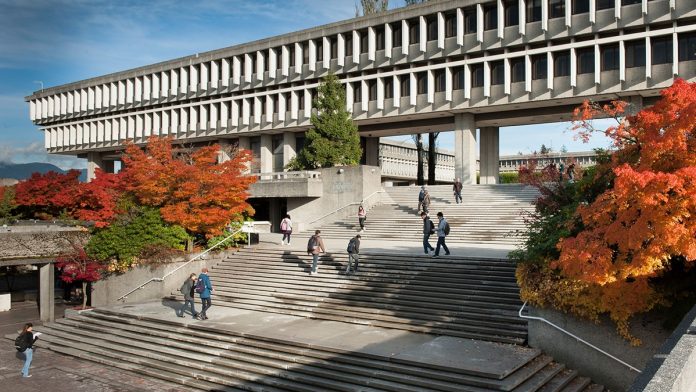
Image Courtesy of Simon Fraser University via Facebook

Written by: Dev Petrovic, Staff Writer

On September 8, SFU student Aliya Boulanger wrote a letter to decision-makers regarding SFU’s tuition increase. At the March 19 meeting, the Board of Governors approved the tuition hike in regards to the 2020–21 Budget and Financial Plan. The increase entails a 2% increase for domestic undergraduate students and 4% increase for undergraduate for international students.

Boulanger asks that “student activity fees for this semester are deferred until the student body can use the facilities that they’re paying for, and the student activity fees [students have] paid for this semester to be refunded.” 

She also calls on SFU “to go to bat for its students against TransLink to get us an opt-in system” as well as the “freez[ing of] tuition increases until our education can be delivered in the way in which it was intended, and refund us the tuition increase they charged us for this semester.”

The student fee breakdown has indicated that remote students are not being charged for Athletics & Recreation fees and supplementary fees for laboratory equipment. Student services fees continue to operate remotely and are still included in tuition fees, as well as the student activity fee, which is set by the Simon Fraser Student Society (SFSS). Students eligible in pre-existing categories for exemption of the U-Pass and students residing outside of Metro Vancouver are able to opt-out of the U-Pass fee, which is also set by the SFSS. 

Boulanger sent her letter to Dr. Jonathan Driver and the Minister for Advanced Education, Melanie Mark, twice. In her second attempt, she included other ministers of education. Boulanger stated that she had not received a response from any of the recipients.

The Peak spoke to Boulanger in regards to her letter and what prompted her to take action against the tuition increase. She explained that she was disappointed with “the way the end of the Spring 2020 semester was handled” and hoped there would be improvements made to the quality of education for the Fall 2020 semester. 

“It reaffirms what many of my SFU peers and I have felt; that SFU as an institution is not a supportive community where students are seen as human beings, but rather as units to be churned through the system to maximize efficiency and financial gain,” Boulanger said.

Boulanger’s next steps will be to “try to ask these questions in person [ . . . ] [and] to send the letter, or a shorter version, to local papers and other media.

“We are consumers, and the SFU administration is accountable to us! If we’re not satisfied we have to let them know, otherwise they’ll continue to take advantage of us. We are powerful if we ask for these things together, so I encourage those reading this to take the time to speak up and take action,” Boulanger concluded.

In a statement to The Peak, Vice-President and Academic Provost pro tem, Jonathan Driver, explained that “SFU is funded through [ . . . ] operating revenues [that] come from a grant from the province (based on enrollment targets) and from tuition fees from students. 

“This covers all the costs of running a big institution – salaries, financial aid, equipment and supplies, library, cleaning, utilities, etc.”

Driver noted that “tuition fees are adjusted annually by the Board of Governors, based on budget projections,” and “the rate of increase for domestic students is often capped by the province below the level of inflation.

“SFU is maintaining a full range of academic programs and supports for students, including increased financial assistance. Most of the costs associated with those activities will increase due to inflation, with salaries being the single largest expense. While some costs have gone down (e.g. electricity costs), others have increased, including financial aid to students, and IT services for remote delivery of programs,” concluded Driver. 

Top ten people natural selection is coming for

0
Very calm, very cool. Nothing wrong here. Illustration: Siloam Yeung / The Peak

By: Juztin Bello, Copy Editor

  1. Social media influencers

It should come as no surprise that social media influencers are on this list, given the fact that anyone who spends their life trying to flex their empty personalities and unfulfilling brand endorsements would quite literally do anything for validation. Whether they’re posing for the perfect picture in precarious places, trying to generate enough clicks on a video of them doing dramatized but super mundane things, or participating in some sort of unnecessary scandal, influencers have a life expectancy as long as their relevance — so as you can imagine, not long. As Lady Gaga said once in a song I think, “I live for the [validation from an audience of people I don’t care about and only want money from]!” 

2. Gender revealers

I could say a lot about how these people reinforce the gender binary, are mindless in their willingness to put others at risk with their unnecessarily grand gestures, or are most definitely attention-seeking nobodies who want to push their heteronormative practices in the faces of their friends and loved ones. But instead, I’ll just say this: the only thing revealed by your gender reveal party is that you’re an idiot.

3. Android users

Now I’m not one to insert my biases, but I can’t help but feel compelled to say Android users are inferior as I write this on my MackBook Air with my Apple Airpods in my ears and my iPhone X right next to me. According to an analytic on Macworld, in 2019 Apple dominated the North American market with 52.28% of sales, with Samsung following far behind at 25.54%. And according to me, anyone who takes a photo with an Android camera has a 100% of generating an image that’s literally five pixels and has a 0.1% chance of matching with me on Tinder with their five-pixel mirror selfies. These statistics are equally and indisputably significant, proving how much better Apple is and why Android users will not last. 

4. Boys of Frat

Legend says that long ago, a war broke out between the Boys of Frat and the Folding Table Nation when the Boys of Frat attacked. For centuries these champions of the competitive drinking game world raged war on one another, bringing misfortune to the innocent. Due to their misdeeds against society, the bloodlines of the Boys of Frat were cursed. Now, descendants of the Frat dynasty are subject to an infinite war on the successors of the Folding Table dynasty, enforcing their violence by jumping and smashing into them as their ancestors did. When will this war be over and who will win? Who knows. We can only predict which of these two fated foes will thrive and who will eventually perish: one side of this war consists of sensitive, cheap, skinny-legged, deconstructable objects with less than one brain cell, while the other side consists of tables, so who can really be sure. 

5. Karens

In today’s society, Karens are constantly testing their limits, thinking the solution to their problems is yelling and causing a scene. But what they need to realize is that these are the tactics for fending off a bear, not trying to get a return when they have used the product and don’t have a receipt on them. It’s only a matter of time before a Karen slips up and finds herself face to face with the devil — but trust, even after she’s six feet under, she will still ask to speak to the manager regarding why she’s in Hell not Hell+. 

6. People who still say “dank”

It’s said that language is constantly evolving, and it can be argued that in m̶o̶s̶t̶ ̶s̶o̶m̶e̶ a few ways, society is doing the same. So tell me why there are people out there who genuinely still use the word “dank”? How have we let these people slip through and remain integrated in our society? I would say that this notion and the people who still use this word still “dank,” but I have more common sense and knowledge to know that this word is about as weak and irrelevant as anyone who still says it.

7. “Ohhh, that’s too spicy for me”

I initially was going to open this section with a sassy little quip about people who can’t handle spice, but I think it may have been too spicy, so I had to cut it. If someone looks at the spice scale at Nando’s and thinks Lemon & Herb is too spicy for their chicken, their food palettes have left them at an unfortunate disadvantage that will ultimately lead to their downfall. What should happen to them if someone puts too much salt on their fries — or worse, their water is sparkling? I can’t help but wonder what will happen when these people eventually perish and find themselves in Hell — good luck finding anything less than Lemon & Herb when you literally live in fire.

8. Non-maskers

These people took Future a little too seriously when he said “Mask on, fuck it mask off” and are truly not built to last, no matter what their privileged immune systems have to say about it. While this could just apply to people who are truly risking it all and not wearing a mask, this is also a callout to anyone who wears their mask only on their mouth while completely exposing their nose. I don’t know if these people have an understanding of how breathing works, but bacteria can also enter your body by breathing through your nose. If only there was some way to also block that passageway and protect it. Oh wait. There is.

9. Anyone who posts stories on Facebook

I’ll keep this one short and sweet: it’s bold of you to think you’re safe by posting stories on Facebook, given the fact actual robot and sunscreen enthusiast Mark Zuckerberg is constantly watching. You’re just making it easier for him to find you and eliminate you. And if you think anyone is going to try to save you, just remember: you’re posting stories on Facebook, do you really think people will care that you’re gone? 

10. Me 

I can’t drive, I have anxiety, and I’m so gay and weak I consider pushing clothes down the rusty racks at Value Village a strenuous arm workout. My time is nigh.

SFUnexplained: SFU works with other institutions to keep its student body here — and not in the ways you may think

1
Illustration: Tiffany Chan / The Peak

By: Serena Bains, Staff Writer

Have you ever thought about why those at the top of SFU make hundreds of thousands of dollars to ignore students? People have to wake up and realize that these top-dog figures could never be this rich and be this bad at their jobs — they are playing 4D chess, and they are 20 steps ahead. 

All of their perceived incompetence must be constructed. They’re ignoring all students because none of us are here through our own free will. They know we have no choice but to stay at SFU. Wake up, sheeple: We’re all the victims of an underground cabal of shadowy figures in charge of trapping students in a university that no one really wanted to go to in the first place.

Everyone knows that SFU isn’t really anyone’s first choice, so how did we all get here? The double-crossing conspirators made up of underpaid high school teachers doubling as “counsellors,” academic advisors, and our parents will say it’s because they “get it, you like CSI and wanted to be a criminology major” or “you really struggled with physics 11, how do you expect to do calculus?” How do they know all this information about our personal lives? Since when are these people allowed to infringe on our rights and freedoms? They obviously have some kind of insider access.

But how? 

I’ll tell you how: SFU is paying off other universities, our supposed emotional support high school English teachers, and even our parents — all to purposely deny students and leave them with one option: Simon Fraser. 

When you really think about it, it all starts to make sense. SFU did take it upon themselves to raise tuition during a pandemic. Is that because they’re inherently evil or because they need to increase their profits to continue harvesting students?  It’s definitely not because “remote learning and teaching continues to provide a high-quality educational experience,” so the latter is the only plausible option left.

This also explains why SFU is located on a mountain. Running an operation that keeps students in a location against their will requires a large amount of land that is isolated from the rest of society. If any of us threaten to leave they’ll just stop bus services or manufacture a snowstorm. We’ll be stuck with no escape in sight and SFU will have exactly what they want: control over their precious little students. 

You may be thinking, “What if we organize and just carpool down the mountain?” That’s when the TMX pipeline comes into play. 

Have you ever thought about why SFU is in favour of TMX while in the same breath assuring everyone that they’re working towards reconciliation and sustainability? You might think it’s because they are “stupid” or “out of touch with reality” or “purposely keeping up socially progressive appearances to avoid any uprising of student organizations that would result in meaningful change that would hurt the university’s social and liquid capital.” 

But it’s not. 

It’s their solution for when the worst happens. If the students organize there will be an oil spill conveniently affecting the mountain. It’s a good contingency plan either way, as the pipeline will inevitably leak sooner or later.

The only way to escape the university is to replace each one of us with students from other universities without SFU noticing. Luckily, SFU doesn’t know anything about its students and likely wouldn’t notice if 25,000 students were suddenly exchanged for another group. All we need is to convince students of another university that SFU is full of opportunities. But what university is in such a dire situation that SFU looks like a safe haven? Is there a group of students that willingly spend their time at SFU without even being enrolled? 

Oh my god. The answer to our freedom has been right in front of us this whole time: Kwantlen Polytechnic University.

In-person dating horror stories

1
PHOTO: Debby Hudson / Unsplash

By: Serena Bains, Shangrila Plaza, and Paige Riding

Horror movie binge (by Serena)

When you live in Surrey, in-person dating means that going anywhere else is a date. It also means that overrated events like Fright Night at the PNE are the best date ideas within 20km. 

They’re so overrated that your date may drink half a bottle of vodka on the hour-long drive to the PNE, just to down the other half while their date looks for parking on a Saturday. 

The rest of the date plays out in the background like a Netflix movie you’re not necessarily interested in. The plot doesn’t really make sense at all. Once you start paying attention at the climax of the movie, everything is happening at once. Your date can’t walk straight, jumps a fence, and gets a concussion. Before you know it, you’re cleaning blood off of their clothes and the car. They don’t remember what happened. Then finally, you’re back in Surrey hoping you never see your date again. 

It’s me. I’m the date.

Kind of OK, Cupid (By Shangrila)

I met someone on OKCupid, figuring I’d give online dating a shot. And honestly? I think this person might be the one. 

I know we’ve only been texting for nine days, seven hours and 22 minutes, but I’m already in love. I’m thinking of surprising them with a video call for the first time. I’m in the best relationship in my life. 

This one actually respects my personal space unlike my ex-boyfriend, Josh. 

Josh always did things that annoyed the hell out of me like standing so close to me that I could feel his breath moistening the back of my neck. Now, there’s no more mandatory hand holding with sweaty palms, or having to deal with bad breath that makes Shrek’s ass smell like Dolce & Gabbana’s new Mediterranian fall fragrance collection. No more desperate face sucking in a Wendy’s washroom with nasty chapped lips, and no more unsolicited burps or terribly concealed transit farts. 

Going on online dates makes things less complicated. I don’t get stood up or left outside the theatre for two hours during a torrential downpour. Watching movies together with Netflix Party and starting music sessions on Spotify changes the game; we can listen to Lana Del Ray in sync as we both contemplate our existences to “Video Games” on our bedroom floors.

Our conversations are never dry thanks to emojis, stickers, and GIFs. You can’t really send GIFs that correlate with your mood when you’re talking face to face, can you? I mean, what better way to show your emotions, right?  

Love game (by Paige)

I miss the excitement of that one time I saved up money to fly down to see my long-distance boyfriend (remember flying and the little pretzels? Damn) only to have him ignore me the entire time for his League of Legends tournament. Fleeting moments of excitement would rush through my low self-esteem-filled body when he would finally break the nauseatingly awkward silence bouncing off the Plants vs. Zombies posters in his room. 

Turns out it was just him responding to the boys on Discord.

Nothing hit quite like putting my suitcase down, getting a .2 second hug with a cold-as-ice eboy reject, and spending the rest of my night alternating between the edge of his bed and the anxiety attacks in his tiny bathroom without him checking on me once. 

You just don’t get those intimate, heartwarming moments while socially distancing, you know?

What do I do now? Know my self-worth? Maybe. I haven’t swiped right on a “come over if you’re thicc, stay home if you’re sick” bio on Tinder yet. And I know to avoid light-up keyboards and double monitors like they’re the plague (too soon?) 

That’s called growth. Also I hate League of Legends.

Student grateful to finally be able to use hoarded Bath & Body Works hand sanitizers from sixth grade

1
Photo: Gudrun Wai-Gunnarsson / The Peak

By: Emma Jean, Staff Writer

With half the world being on fire and countless (often preventable) deaths being reported daily, it feels like everything is out of my control. My stupid little actions aren’t even helping with this deep sense of loneliness I have. How can I help with the new bubonic plague? What do I do when everything feels out of control? 

If almost buying hair dye online and then talking myself out of it doesn’t work, I clean. One day, I put on my combination Lizzo/Nickelback motivational playlist and some rubber gloves and got to work deep-cleaning my closet.

After digging through layers of high school binders and stress-tear-stained band sheet music like some kind of sad paleontologist, the Silly Bandz and Tiger Beat magazines told me I had reached the middle school era. I was bracing myself for deeply embarrassing drawings of David Tennant, but nothing could have prepared me for what I found instead. Shimmering, covered in turquoise and magenta cases and grime, there were dozens and dozens of Bath & Body Works hand sanitizer bottles from the early 2010s. I had found it: the pandemic holy grail. 

Like a ravenous beast, I ripped open bottles and poured the sweet nectar onto my hands, my arms, my head — anything to soak up the precious juices. Drunk on power and rubbing alcohol, my pulse pounded as I contemplated my newly held responsibility. People search their whole quarantine lives for just a drop of hand sanitizer. Here I was, boasting 10 litres of it — sparkles and the sweet, nauseating stench of Chocolate Creme Donut included. A sense of self-righteous purpose came over me.

I knew what I needed to do. 

I tied a bandana over my nose and mouth, smeared fallen forest fire ash under my eyes like war paint, and sprinted out of my driveway. 

Chucking hand sanitizer bottles at houses and passerbys like a punch-drunk Newsie, I ran through neighbourhood streets sharing my good news with anyone six feet away that would listen. The gift of cleanliness was too important to be hoarded; it was my responsibility to share this with the world. Did I hit the windshields of oncoming traffic, hindering their vision with the pink, sparkling contents of a Cherry Apple bottle reminiscent of a bludgeoned fairy? Maybe. But I also gave the driver peace of mind.

Skipping through the streets, tossing bottles over my shoulders with abandon, I felt like I had found my true Sweet Pea-scented purpose amongst the chaos. 

I threw almost every bottle I had at my neighbours that day . . . except for one. I placed it right in front of my door on a table to use. Now, every time I walk home, all worries about the pandemic and online classes and smoke and elections and deadlines and isolation and bullshit just melt away. I had a pandemic’s worth of hand sanitizer. Now others do, too. For one shining, Toasted Coconut-smelling moment, all was well.

SFU student Lucy Lei’s unique business stretches her wings and cookies

0
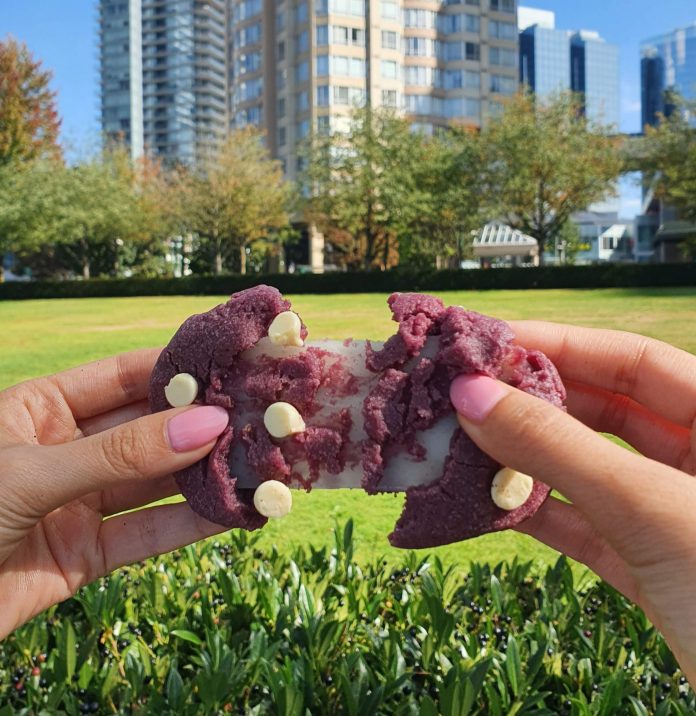
Mochi filling in an ube-flavoured Moki cookie. PHOTO: Sara Wong / The Peak

By: Sara Wong, Peak Associate

From sourdough to banana bread to pancake cereal (yes, this is a real thing), home baking trends have taken over everyone’s social media feeds. While amateurs like myself were busy kneading, mixing, and flipping for the ‘gram, fifth year SFU student Lucy Lei was hard at work building a business that would make some serious dough.

Moki Cookies is an online business specializing in Asian-flavoured, mochi-filled cookies. Currently, they have three flavours available — matcha, milk tea, and ube. Each is studded with white chocolate chips, adding a little sweetness to the cookies. “I thought they’d be perfect for the Vancouver food scene, especially with the growing demand for Asian cuisines nowadays. I was confident that these Western Asian fusion cookies would be a huge hit!” Lei said. 

As a student in both the Charles Chang Certificate in Innovation and Entrepreneurship program and the Technology Entrepreneurship program, Lei has gained a wealth of knowledge on starting and running a small company. Having also studied other “food entrepreneurs,” Lei was able to put together a team to perfect Moki recipes and launch the business. She explained, “As the founder, I had to know how to do a bit of everything, which required a lot of research and learning. However, as we familiarize our operations, I now lean towards marketing and business development because I know our team of bakers and other members can handle the rest of production.”

Lucy Lei, founder of Moki Cookies. Photo courtesy of Lucy Lei

Not everything was a piece of cake for Lei and her team. According to the Moki Cookies founder, “There were few recipes available online for mochi cookies, since it was such a new concept. Most of the recipes online didn’t meet our expectations.” The Moki bakers then began a month-long process of experimenting with different ingredient ratios, a task which became especially challenging when it came to the milk tea flavour. “[We were] the first to attempt infusing milk tea flavours into a traditional chocolate chip cookie,” Lei said. Despite the large time setback, Lei affirmed, “It was worth it because we want our cookies to be extraordinary.”

Having tried the cookies myself, I can say with certainty that they are extraordinary. Distinct flavours of matcha, ube, and milk tea are distinguishable in every bite. The hefty amount of mochi filling makes the cookies incredibly soft and chewy, and it’s fun pulling the cookies apart to see the mochi stretch out in front of you. If you like desserts that aren’t too sweet, I recommend the matcha and milk tea cookies because the tea flavours are strong enough to balance out the sweetness — though my personal favourite is the ube.

With their online shop up and running, I asked Lei what was to come next. “Some short-term objectives include hiring more bakers, expanding our menu, and beginning corporate partnerships,” she replied. “We then plan to expand the business to Toronto next year, in which I’d be leaving our Vancouver team to my right-hand man and flying to Toronto to build a second team. Depending on how [COVID-19] progresses, we’re determined to open our first franchise in Vancouver within the next 2–4 years.”

Finally, I asked Lei if she has any advice for fellow SFU students looking to start or grow their own business. She shared, “My biggest advice is [to not] overthink it and just do it. Start anywhere whether it’s writing your idea on paper, drafting it out, talking to friends about it, prototyping, etc.” 

Lei added, “Take action and get the ball rolling. Everything else will fall into place, but not without a lot of stumbling. That’s simply the nature of entrepreneurship. I truly believe that there is no such thing as failure, you are always either learning or succeeding. Trust the process and don’t give up!”

To celebrate their grand opening, Moki Cookies is offering free delivery to Vancouver, Burnaby, and Richmond from now until October 7. Normally, free delivery is only valid for those who live in Vancouver and order a dozen or more cookies. There is also a pickup option, available Fridays at the A&W outside of the Joyce-Collingwood SkyTrain station between 1 and 5 p.m. Additionally, in celebrating their grand opening, Moki Cookies is donating $1 with every half dozen order and $2 for every one dozen order to the Canadian non-profit Feed It Forward.

Louis Tomlinson carves out a space for himself with emotionally wrought pop album, Walls

0
While no longer with One Direction, Tomlinson’s album shows he’s doing fine on his own. Courtesy of 78 Productions Limited

By: Tiffany Chang, Peak Associate

Four years after One Direction announced their hiatus, former band member Louis Tomlinson finally released his first solo studio album, Walls, in January of 2020. As a huge fan of Tomlinson since his days in the world-renowned boyband, I was thrilled to hear the new songs.

Having stayed within the pop genre for over a decade, I wondered if Walls would be a departure from this. Tomlinson’s previous projects have included a handful of fast-paced stand-alone singles, including “Back To You” featuring Bebe Rexha and Digital Farm Animals, and “Miss You” in 2017 prior to Walls.

Though this album, too, falls within the genre of pop, it shows a more emotional side of Tomlinson. Listening to the tracks, I could definitely tell how much heart and soul he put into them.

In “Two of Us,” Tomlinson discusses losing a loved one, vowing to them that he will live his best life for the both of them. A tear-jerker from start to finish, this number showcases Tomlinson’s incredible song-writing prowess. With heartfelt lyrics and a beautiful melody, “Two of Us” is absolute perfection and remains my favourite song off the album.

“Don’t Let It Break Your Heart” is about going through challenging times but having hope and not allowing these times to dim your light. Evocative lyrics such as, “It comes, it goes, we’re driving down a one-way road to something better” coupled with a prominent drumbeat make “Don’t Let It Break Your Heart” a great sing-along tune. It also incorporated pop-rock elements reminiscent of One Direction — a nostalgic component existing fans will appreciate.

While “Two of Us” highlights Tomlinson’s song-writing, “Too Young” exhibits his singing talent more than any other song on Walls. He consistently goes back and forth between his head (falsetto) and chest (vibrato) voice throughout, which allows people to hear the various dimensions of his unique tone. The power, restraint, and control he demonstrates truly validates him as a strong vocalist. 

Another strong display of his vulnerability is in “Defenceless” which examines the emotional trials and tribulations that occur in a relationship. He touches on the day-to-day anxieties when considering the feelings of his significant other and comparing them to his own. This is an insightful song that encompasses various poignant nuances concerning love that I don’t hear quite often.

Overall, Tomlinson asserts his individuality and simultaneously stays true to his roots. Honestly, he couldn’t have done a better job re-introducing himself to the world. If he keeps coming up with soulful records like Walls, he’s going to have an amazing career as a solo artist ahead of him. Walls is definitely a recommendation for those looking for a great pop album.


SFYou: Get the buzz on Professor Mark L. Winston

0
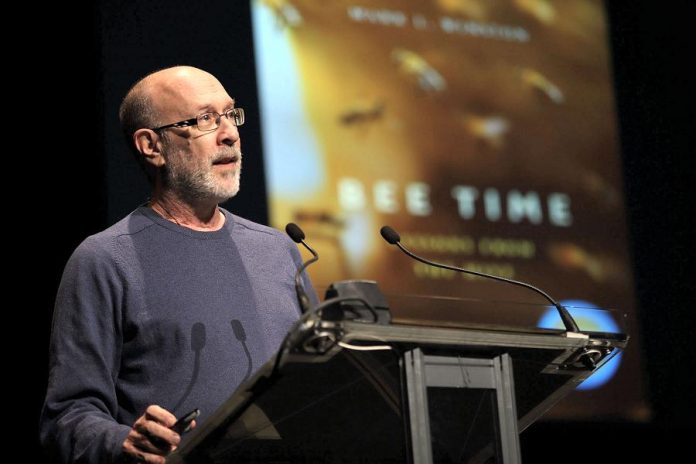
Image courtesy of Sarah Murray.

By Kelly Chia, Peak Associate

Name: Mark L. Winston

Pronouns: He/him/his

Departmental Affiliation: Biological Sciences and the Morris J. Wosk Centre for Dialogue

Hometown: South Euclid, Ohio

Current Occupation: Professor and Senior Fellow

Fun Fact: Mark was once the president of the Douglas County, Kansas Western Swing Association

Professor Mark L. Winston has had a lengthy education and career in the work of bee pollination. It has led to being the director of SFU’s Centre for Dialogue for the past 12 years, and now as the new non-fiction Writer-in-Residence for the SFU Library. I sat down with Winston for an interview to talk about his career, effective environmental communication, and the role of mentorship in his new position.

We first talked about how the issues that Winston studied at the beginning of his career compared to the issues that were being studied in the field today. For Winston, who had taken two very distinct career paths, this was a complex question. 

“As an entomologist, I’ve always studied bees. The questions today are considerably more complex because bees are dying. There’s urgency in figuring out why bees are dying, there’s been a lot more work investigating the impact of the environment on bees. When I first started out, they were much more interested in bees themselves and their social behaviour [ . . . ] looking at things like how bees communicate to looking at [their] environmental impact,” Winston explained. 

I asked Winston what made him start studying bees and work in bee pollination. He chuckled.  “I’m always interested in how younger people today look at work! In my experience, a lot of what we end up doing in our lives is coincidence. A lot of it is inspired by things that may have nothing to do with what we end up doing.” To answer the question, he first started studying bees because he wanted to be a tropical biologist.

“Y’know, I wanted to wear khaki clothes and start exploring the jungle [ . . . ] the trees, and the birds, and the snakes, and all that’s living in the wild in South America,” he said, eliciting a chuckle. The thought sent me straight to Indiana Jones, which did sound pretty fun. “I applied for PhD research at the University of Kansas where they have a good entomology department that often sends students down to the tropics. I had determined that insects were of interest to me because I had taken some courses in entomology as an undergraduate. When I got to Kansas, my supervisor said, ‘Oh, guess what? I just got a grant to study killer bees in South America!’ I heard South America and thought, ‘Great, I’m writing about bees, but hey, I’m in the tropics!’” 

His first time studying bees was a little harrowing. “Knowing nothing about bees, I was mostly terrified. I heard they stung,” I chuckled again. “The first time I entered a hive, time just slowed down for me. I took off my helm, and I took off my gloves, and I was just fascinated by these complex social organisms and how they operate with each other, and run society, and collaborate. That was a moment that I can still reach back and experience,” he says fondly. 

There was something really comforting listening to Winston talk about something that has driven such a large part of his career as a coincidence. Evidently, he ended up falling in love with them, but he had not always known that he was going to study them.

We then talked more about how to effectively communicate urgent environmental issues like the declining bee population without coming off as too alarmist. In essence, Winston explained that it’s best to focus on multiple factors rather than one key impact so as to not oversimplify the issue. 

“In my writing, I really try to focus on interactive synergy: not just one thing, but a complex set of factors. You have to bring in multiple elements. It’s really easy to write about one thing, I could write about pesticides and how they’re killing bees. It would probably be fairly simple, but it’s not the story —  the story is one of a thousand little cuts, and moving points where the whole ecosystem surrounding bees is causing it.”

These days, Winston focuses more on editing and helping other writers find their voice. Winston has published quite a few books himself, receiving the Governor General award in 2015 for his book, Bee Time: Lessons From the Hive. For him, book writing is an engaging process.

“I can see a book in all of its dimensions when I’m writing. It’ll take a year, or two, or three when I’m really immersed in it, but when you’re writing a book, no matter what else you’re doing, the book is always in the back of your mind.” 

I asked if it’s difficult to balance the ideas of other writers as they develop their ideas. Winston presented me with four principles that he uses to judge writing, emphasizing that it needs to make an impact most of all. 

“All writing benefits from four things: brevity, getting to the point, clarity — which is really knowing what you want to say, from knowing your own voice and not trying to sound like someone else — and the ultimate arbitrator of writing, which is impact.

Everybody has a different voice, it is quite easy to tell one writer from another. But the key issue is: is your writing doing what you’d hope it would do? Does it have an impact, make you feel something, change your mind?” 

After more than a decade of work in the Centre for Dialogue, Winston comes into his position as the Non-Fiction Writer-in-Residence, and as a mentor, with eloquence and empathy. 

In mentioning his role as a mentor, Winston was very much impacted by the mentors in his life. In particular, he spoke about one memory when he was an undergraduate student, where he mused that he probably had the lowest grade point average of any faculty member he had ever known. 

“I knocked on the door of a faculty member I had never met, and it turned out that she was one of the most famous biologists of the 20th century! At the time, I had a lot of hair, a big beard, overalls, and a transcript that looked like I was barely making it in school. For whatever reason, she took me seriously. She sat me down for two to three hours, and she told me about her research and old books from her shelf about what she was studying, and she offered me a job! That changed my life. I’ve never forgotten the impact that a person can have on other people.” 

Thinking about the way Winston was changing people’s lives now by helping them make their impact through their writing was very warming. I expressed that I had some difficulty picturing the impact of my own work, and it was relieving to hear him express similar sentiments. 

“The impact of what any of us do is so hard to measure. I would think it’s fair to say that there’s more awareness of issues due to the writing I’ve done. I’ve seen some examples of things getting better, but it’s not just due to my voice — it has taken a cacophony of many voices to move the needle. As I get older, I’ve become more comfortable with the idea that it’s very unusual for any one of us to change the world.

To answer that another way, if I’ve had much impact, it’s through my students — research students, students that I’ve taught in Semester in Dialogue, and I see those students going out in the world and doing things in a different way.”

Winston had a message for students experiencing the impacts of remote learning and living in a pandemic:

 “In human history, there’s always been periods like this —  horrible wars, famines, pandemics, and volcanoes, and terrible natural disasters. In that sense, it’s not new to the world, but it’s new in our time. This is the worst I’ve seen the world . . . [but] we get through this by supporting each other. That’s never changed. Be kind is the take home response, that’s what we gotta do.”

For more information on upcoming workshops with Mark L. Winston, visit the events page of the SFU library website. 

The Bright-er Side: Catching a cold might not be so bad afterall

0
ILLUSTRATION: Siloam Yeung / The Peak

by Nathan Tok, Peak Associate

Did you know that in some sense of the word, every so often we experience another form of a pandemic? It’s the cold and the flu. So while the word “pandemic” might sound scary, did you also know that catching these viruses could be a potentially good thing?

According to some American scientists writing in the Lancet, the spread of the flu in Europe in 2009 was hindered by people who caught the cold. The rhinovirus’ (the cold virus) infection of human airway cells prompted cells to turn on their interferon genes to block against influenza A virus infections. This meant the cell had a 50,000 fold decrease in influenza viral load.

So what does this mean? Viruses can get in each others’ way and could change the course of disease outbreaks. A cold could stop you from catching the flu. The researchers then speculated (and this is the big one) that having the cold prevalent in a population could help us cope better with seasonal flu outbreaks and the COVID-19 pandemic. This is due to how SARS-CoV-2 (the COVID-19 virus strain), like other viruses, seems to be inhibited by interferon. Just like the cold disrupted the flu epidemic in Europe in 2009, so maybe the cold could help ease the COVID-19 pandemic.

Will this happen? Maybe. The researchers say more work is needed to see how the rhinovirus affects the body’s interferon responses towards SARS-CoV-2, but this viral interference should be considered when trying to create interventions against respiratory virus epidemics such as the COVID-19 pandemic or even the seasonal flu.

At this point, humanity needs all the help we can get. Perhaps the enemy of my enemy is my friend, which applies to viruses as well. At the very least, having a cold this fall might not be all bad.